From idea to market-ready product, our NPI solutions make every stage easier, faster. Discover How We Help
Help Center

Views: 265 Author: Capital Technology Publish Time: 2026-09-13 Origin: Site
Content Menu
● Main Components of an Industrial Tube Axial Fan
>> Motor
>> Bearings
● Key Advantages of Tube Axial Fans
>> High Airflow in Inline Systems
>> Compact Installation Footprint
>> Better Pressure Capability Than Open Panel Fans
>> Configurable for Industrial Environments
● Tube Axial Fan vs. Vane Axial Fan vs. Centrifugal Fan
● How to Select the Right Tube Axial Fan
>> Step 1: Define the Heat Load
>> Step 2: Identify Airflow and Static Pressure Requirements
>> Step 3: Choose DC Fan, AC Fan, or Industrial Tube Axial Fan
>> Step 4: Evaluate the Operating Environment
>> Step 5: Plan for Maintenance and Lifecycle Cost
● Practical Applications of Tube Axial Fans
>> Industrial Ventilation and Exhaust
>> Equipment and Electrical Enclosure Cooling
>> Marine, Transportation, and Infrastructure Systems
● Expert Insight: The Fan Is Only One Part of the Thermal System
● Why Work With CAPITAL for Industrial Cooling Solutions?
>> 1. What is the difference between a tube axial fan and a standard axial fan?
>> 2. When should I use a tube axial fan instead of a centrifugal fan?
>> 3. Are DC fans better than AC fans?
>> 4. How do I calculate the required airflow for equipment cooling?
>> 5. Why does my fan provide less airflow after installation?
>> 6. What should I consider for fans used in dusty or humid environments?
>> 7. Can tube axial fans be used for telecom and electronics cooling?
Industrial equipment does not fail only because of electrical faults or mechanical wear. In many real-world installations, excessive heat, restricted airflow, dust accumulation, and poor fan selection are the underlying causes of reduced reliability. A properly selected tube axial fan can help engineers move high volumes of air through ducts, equipment enclosures, ventilation systems, and process lines while supporting stable operating temperatures.
For OEMs, telecom equipment manufacturers, panel builders, and industrial system integrators, the challenge is not simply buying an axial fan. It is choosing an airflow solution that fits the actual heat load, static-pressure demand, environmental exposure, power architecture, noise target, and expected service life.
At Capital Technology Co., Limited, we work with customers that require dependable cooling for telecommunications, power electronics, industrial automation, and related applications. As the chief agent of SANYO DENKI and a manufacturer with its own CAPITAL product line, we support projects involving DC fans, AC fans, blowers, centrifugal fans, filters, reactors, and integrated thermal-management solutions.
This guide explains how tube axial fans work, where they perform best, how to select the right configuration, and why system-level airflow design matters more than nominal fan airflow alone.

A tube axial fan is an axial-flow fan installed inside a cylindrical housing or tube. Its impeller rotates around an axis parallel to the direction of airflow. Air enters from one side of the fan and exits in the same axial direction.
This construction makes tube axial fans a practical choice for moving relatively large airflow volumes through ductwork, tunnels, machinery, ventilation shafts, and industrial processes.
Unlike centrifugal fans, which redirect airflow by approximately 90 degrees, a tube axial fan moves air in a straight path. That simple flow path can make it highly effective where space is limited and the system requires inline airflow.
The main operating principle is straightforward:
1. The motor rotates the impeller.
2. The blades create a pressure difference between the inlet and outlet.
3. Air is accelerated through the cylindrical housing.
4. The fan delivers airflow to cool, ventilate, exhaust, dry, or supply air to the process.
However, the real performance of a tube axial fan depends on more than blade rotation. It is shaped by blade geometry, motor speed, housing design, inlet conditions, discharge restrictions, air density, and system resistance.
A fan that performs well in an open-air test may deliver much less airflow after it is installed behind a guard, filter, heat exchanger, dense electronics assembly, or long duct run.
Understanding the individual components helps buyers compare industrial tube axial fans more accurately. A fan is not only a motor and a set of blades. Every part influences airflow, durability, safety, and maintenance requirements.
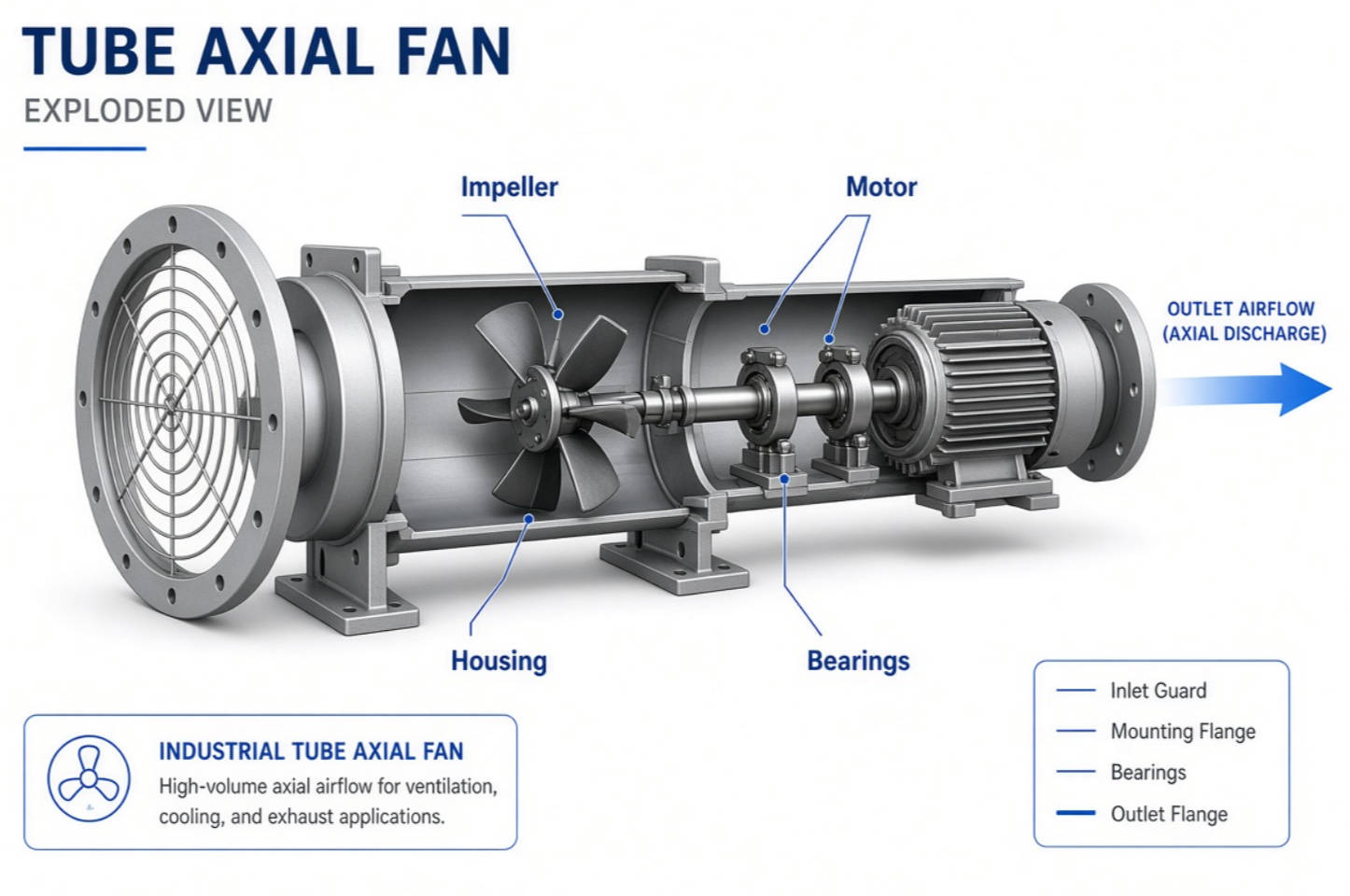
The impeller is the rotating assembly that moves air. It normally consists of a central hub and multiple blades.
Blade materials may include:
- Aluminum for low weight and corrosion resistance
- Carbon steel for robust industrial use
- Stainless steel for demanding corrosive or hygienic environments
- Engineering plastics for lighter-duty or compact applications
Blade angle, blade profile, and hub-to-tip ratio influence the relationship between airflow, pressure, noise, and power consumption. A poorly matched blade design can create turbulence, vibration, excess noise, or insufficient pressure.
For demanding applications, dynamic balancing is especially important. It helps reduce vibration, supports bearing life, and improves long-term fan stability.
The tube housing guides air through the fan and protects the rotating assembly. It can be manufactured from steel, aluminum, stainless steel, or coated materials depending on the environment.
A well-designed housing should support:
- Stable airflow with reduced recirculation
- Mechanical protection for the motor and impeller
- Easy integration with ducts or mounting flanges
- Service access for inspection and cleaning
- Appropriate corrosion resistance for the installation site
In practical industrial installations, the housing should never be treated as a minor detail. The clearance between the blade tips and the housing affects leakage and efficiency. Excessive clearance can reduce performance because air can recirculate around the blade tips rather than moving through the system.
The motor provides the rotational energy for the impeller. Tube axial fans may use single-phase or three-phase AC motors, depending on the application, supply voltage, control needs, and required output.
In electronics, telecommunications, and intelligent equipment, compact DC fans are often preferred because they can support variable-speed control, speed monitoring, alarm output, and PWM control. For conventional industrial equipment and control cabinets where AC mains power is readily available, AC fans remain a practical and robust solution.
Key motor factors include:
- Rated voltage and frequency
- Input power
- Speed
- Insulation class
- Thermal protection
- Efficiency
- Operating temperature range
- Bearing configuration
- IP rating or environmental protection level
Bearings affect service life, noise, operating temperature, and maintenance needs.
Common options include:
- Sleeve bearings for cost-sensitive and lower-load conditions
- Ball bearings for higher-speed, higher-temperature, or multi-position operation
- Enhanced bearing systems for extended-life industrial and telecom equipment
For equipment expected to run continuously, bearing choice should be evaluated together with temperature, mounting direction, vibration, and contamination exposure.
Tube axial fans can be configured as either direct-drive or belt-drive systems.
| Configuration | How It Works | Typical Strengths | Considerations |
|---|---|---|---|
| Direct-drive tube axial fan | Impeller mounts directly to the motor shaft | Compact structure, fewer mechanical parts, lower maintenance | Motor speed and impeller speed are directly linked |
| Belt-drive tube axial fan | Motor drives the fan shaft through belts and pulleys | More flexibility in speed adjustment and motor positioning | Requires belt inspection, alignment, and periodic maintenance |
For many modern compact cooling and ventilation systems, direct-drive designs are preferred because they reduce mechanical complexity. Belt-drive tube axial fans may still be useful in larger industrial ventilation systems where speed adjustment, motor separation, or service accessibility is important.
Tube axial fans are widely used because they offer a practical balance of airflow capacity, inline installation flexibility, and rugged industrial construction.
A tube axial fan is designed to move air along the same axis as the duct or tube. This makes it suitable for systems that need straight-through airflow rather than a directional change.
Common examples include:
- Factory ventilation ducts
- Equipment cooling channels
- Drying tunnels
- Engine-room ventilation
- Air-supply systems
- Exhaust ducts
- Process cooling lines
Because the fan is integrated into a cylindrical housing, it can be installed directly in ducts or mounted between flanges. This is useful when equipment layouts do not allow large fan assemblies or complex duct transitions.
Compared with basic open-frame panel fans, tube axial fans generally offer better pressure characteristics because the housing helps direct the airflow.
This does not mean they replace centrifugal fans in every high-pressure application. Instead, they occupy an important middle position: they can provide meaningful airflow and moderate pressure in compact, ducted, or semi-restricted systems.
Depending on the specification, industrial tube axial fans can be adapted for challenging conditions involving:
- Elevated temperatures
- Dust and particulate matter
- Humidity
- Corrosive atmospheres
- Outdoor exposure
- Continuous-duty operation
- Industrial vibration
- Smoke or heat exhaust requirements
The correct configuration may require protective coatings, specialized bearings, sealed motors, guards, filters, or higher environmental ratings.
Choosing the right fan type begins with understanding the system's airflow and pressure requirements.
| Fan Type | Airflow Direction | Pressure Capability | Best-Fit Applications |
|---|---|---|---|
| Tube axial fan | Straight through the tube | Moderate | Duct ventilation, equipment cooling, exhaust, drying |
| Vane axial fan | Straight through with guide vanes | Higher than many tube axial designs | Higher-pressure duct systems, tunnels, industrial ventilation |
| Centrifugal fan | Airflow turns through the impeller | High | Long ducts, dense filters, process exhaust, high-resistance systems |
| DC axial fan | Straight airflow in compact form | Low to moderate | Telecom cabinets, servers, power supplies, electronics |
| AC axial fan | Straight airflow in compact form | Low to moderate | Electrical cabinets, industrial panels, general equipment cooling |
A tube axial fan is usually the right choice when the application requires substantial airflow through a relatively straight duct path and the system pressure is moderate.
A vane axial fan may be more appropriate when higher static pressure is required in a ducted system. A centrifugal fan is often the better option for high-resistance systems with restrictive filters, long duct runs, heat exchangers, or complex airflow paths.
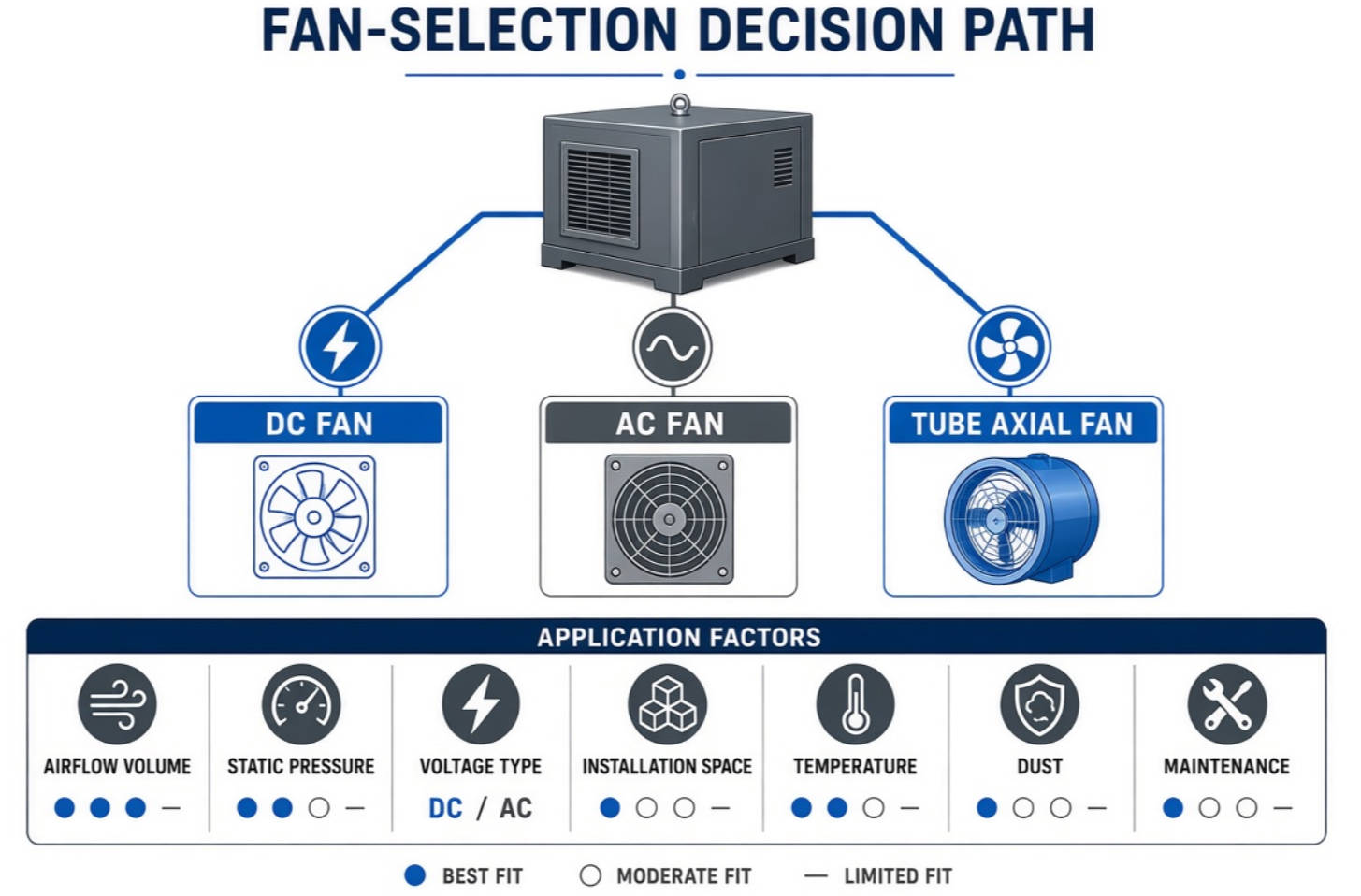
The most common fan-selection mistake is choosing a model based only on free-air airflow. Free-air airflow describes performance with almost no resistance. Industrial systems rarely operate under those conditions.
Instead, fan selection should begin with the full system requirement.
First, determine how much heat must be removed.
For electronic equipment, heat load may come from:
- Power supplies
- Inverters
- Servers
- Telecom modules
- Batteries
- Controllers
- LED systems
- Communication equipment
For industrial processes, heat load may come from:
- Motors
- Furnaces
- Drying systems
- Manufacturing equipment
- Compressors
- Switchgear
- Process machinery
The target is not simply "more airflow." The goal is to keep critical components within their allowable operating temperature range.
Airflow is commonly expressed in CFM, cubic meters per hour, or liters per second. Static pressure reflects the resistance the fan must overcome.
Resistance can be caused by:
- Air filters
- Fan guards
- Narrow ducts
- Louvers
- Heat sinks
- Radiators
- Grilles
- Cable congestion
- Dense equipment layouts
- Long duct runs
A fan curve should be reviewed against the actual system curve. The operating point is where the fan's available pressure and the system's pressure demand intersect.
This is why a high-CFM fan may still perform poorly in a restrictive enclosure. If it cannot overcome the system resistance, actual airflow will be far below the fan's nominal rating.
Use the application environment to guide the choice.
Choose a DC fan when you need:
- Variable-speed control
- Temperature-responsive cooling
- Compact dimensions
- Alarm or tachometer signals
- Lower-voltage electronics integration
- Efficient cooling for telecom, servers, and power modules
Choose an AC fan when you need:
- Simple AC mains integration
- Stable continuous operation
- Cooling for control panels or industrial cabinets
- A practical solution for legacy equipment
Choose an industrial tube axial fan when you need:
- High-volume inline airflow
- Ducted ventilation
- Exhaust or supply air
- Process cooling
- Drying airflow
- Larger equipment ventilation
A fan selected for a clean, air-conditioned server room may fail prematurely in a dusty factory, humid coastal area, or outdoor telecom cabinet.
Check the following factors:
- Ambient temperature
- Humidity
- Dust level
- Salt spray or corrosive gases
- Altitude
- Vibration and shock
- Water exposure
- Maintenance accessibility
- Required safety certifications
For sensitive equipment, the fan should be considered part of the reliability strategy, not an interchangeable commodity.
The purchase price of a fan matters, but the lifecycle cost often matters more.
A lower-cost fan that causes frequent replacement, unplanned downtime, or overheating can become more expensive than a higher-quality solution.
Evaluate:
- Expected bearing life
- Replacement accessibility
- Cleaning frequency
- Filter maintenance needs
- Spare-part availability
- Energy consumption
- Noise level
- Monitoring capability
- Failure alarm requirements
Tube axial fans are used across many industries because they can support cooling, ventilation, air exchange, and process airflow.
Factories, workshops, warehouses, and processing facilities use tube axial fans to remove hot air, fumes, moisture, and airborne contaminants.
Typical uses include:
- General ventilation
- Welding-fume extraction
- Paint booth exhaust
- Steam exhaust
- Engine-room ventilation
- Warehouse air exchange
- Make-up air systems
Modern electrical and electronic systems generate concentrated heat in small spaces. DC fans, AC fans, and compact axial fans help remove heat from:
- Telecom base stations
- Communication cabinets
- Power supplies
- UPS systems
- Inverters
- PLC cabinets
- Server racks
- Industrial control systems
- Charging systems
In these applications, a complete cooling strategy may include a fan, air filter, heatsink, radiator, airflow guide, and temperature-control logic.
Tube axial fans are often used where a process requires controlled airflow across a product or surface.
Examples include:
- Grain drying
- Glass drying
- Coating and paint drying
- Food-processing ventilation
- Textile processes
- Plastic-product cooling
- Material handling
Tube axial fans may be installed in engine rooms, utility tunnels, equipment compartments, and ventilation systems where reliable airflow is essential.
The exact selection must account for salt exposure, vibration, high temperature, duty cycle, and safety requirements.
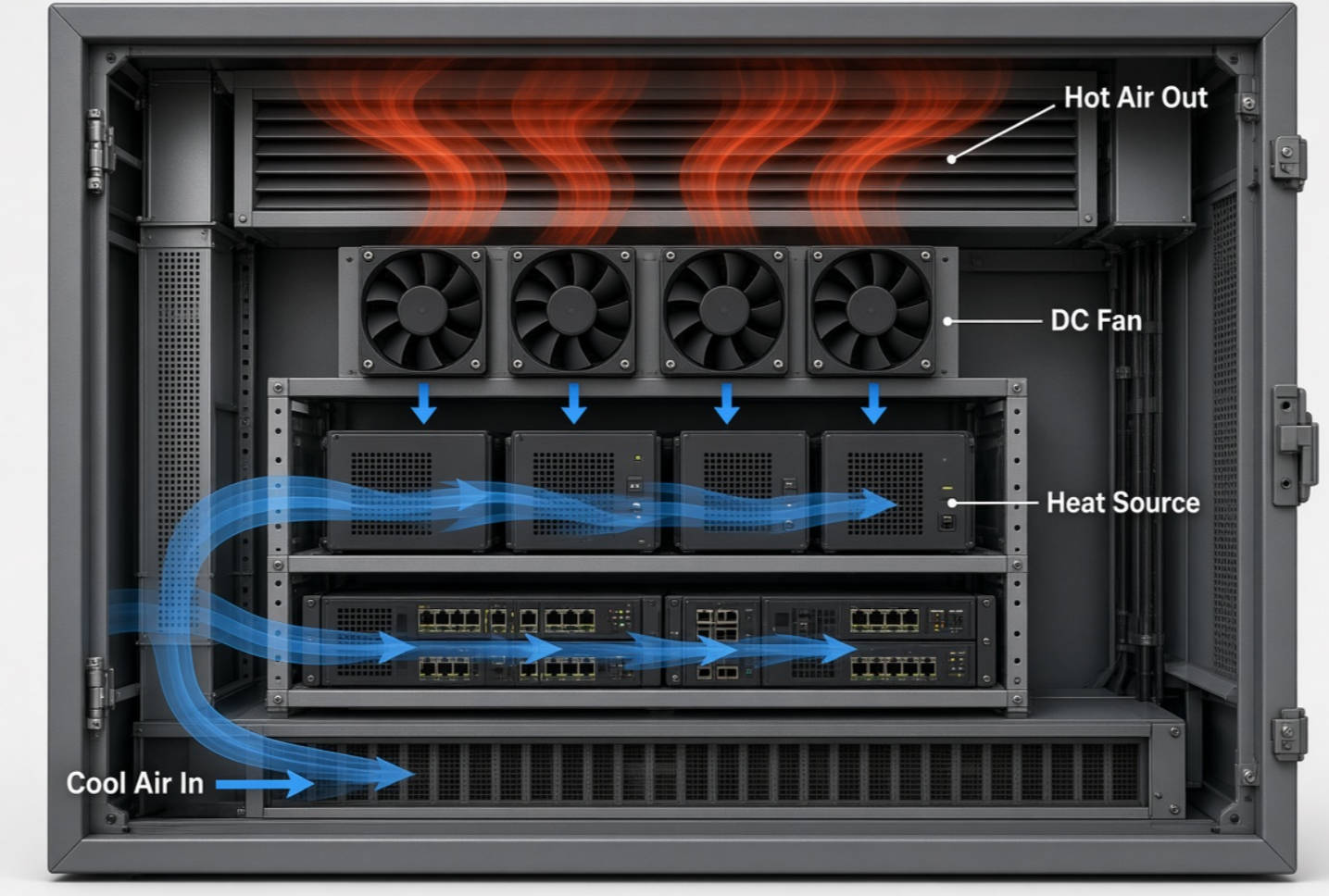
From an engineering perspective, the most important lesson is that a fan should not be selected in isolation.
A high-performance fan cannot solve an airflow problem caused by poor enclosure design, blocked intake paths, undersized vents, dirty filters, or recirculated hot air.
A reliable cooling system should consider:
- Heat-source location
- Intake and exhaust separation
- Airflow direction
- Hotspot mapping
- Pressure losses
- Filter loading
- Fan redundancy
- Temperature monitoring
- Maintenance access
For example, a telecom cabinet may contain a powerful DC fan, but the system can still overheat if hot exhaust air is pulled back into the intake. Separating the air paths and improving internal cable routing may deliver more benefit than simply installing a larger fan.
This is why professional thermal-management support is valuable. It helps customers move from component selection to a solution that performs in real operating conditions.
Capital Technology Co., Limited supports customers that need more than a standard fan quotation. Our product range includes CAPITAL-branded cooling products and SANYO DENKI cooling solutions, allowing customers to evaluate options for performance, availability, form factor, cost, and application fit.
Our solution capabilities include:
- DC fans for electronics, telecom, and intelligent equipment
- AC fans for industrial cabinets and equipment cooling
- Blowers and centrifugal fans for higher-pressure airflow needs
- Tube axial and related airflow solutions for ventilation systems
- Filters for dust protection and cleaner enclosure airflow
- Reactors and EMI filters for power-quality support
- Application-focused product selection and technical support
We understand that customers in telecommunications, industrial automation, power electronics, and high-reliability equipment need consistency. They need stable quality, technical responsiveness, and a supplier that understands the difference between a catalog specification and real application performance.
If you are designing a telecom cabinet, industrial control panel, power system, ventilation line, or custom equipment enclosure, contact CAPITAL to discuss your airflow requirement. Share your operating temperature, enclosure dimensions, airflow target, static-pressure condition, voltage, and environment. Our technical team can help identify a DC fan, AC fan, blower, or industrial cooling solution that fits your application.
A tube axial fan is an axial fan installed in a cylindrical housing. The housing directs airflow through the tube and supports inline duct installation. A standard axial fan may be open-frame or panel-mounted and is often used for enclosure cooling or general air circulation.
Use a tube axial fan when you need high airflow in a straight-through duct path and the static-pressure requirement is moderate. Use a centrifugal fan when the system has high resistance caused by long ducts, dense filters, heat exchangers, sharp turns, or restrictive process equipment.
Neither is universally better. DC fans are typically preferred for compact electronics, variable-speed control, and intelligent monitoring. AC fans are often suitable for industrial equipment with AC mains power and stable continuous-duty cooling requirements.
Start with the equipment heat load, the maximum allowable temperature rise, ambient temperature, and airflow path. Then account for pressure losses from filters, guards, heat sinks, ducts, and vents. A fan-performance curve should be reviewed at the expected operating pressure, not only at free-air conditions.
Installed airflow is usually lower than free-air airflow because the system adds resistance. Dirty filters, restrictive grilles, narrow openings, long ducts, heat exchangers, and poor internal layout can all reduce actual airflow.
Consider environmental protection, bearing type, corrosion resistance, operating-temperature range, filtration, coating options, and maintenance access. Dust accumulation and humidity can reduce cooling performance and shorten fan service life if they are not addressed in the design.
Large tube axial fans are more commonly used in ducted ventilation and larger equipment systems. For compact telecom and electronics enclosures, DC axial fans, AC axial fans, blowers, and centrifugal fans are often more suitable. The correct choice depends on enclosure size, heat load, static pressure, and control requirements.
1. Sofasco. “Tube Axial Fan: Components, Advantages & Industrial Applications.”
[https://sofasco.com/blogs/article/tube-axial-fan-components-advantages-industrial-applications]
2. Capital Technology Co., Limited. “About Us.”
[https://www.sanyodenki-cn.com/aboutus.html]
3. Capital Technology Co., Limited. “Enhanced Industrial Cooling Fans: Features, Benefits, and How CAPITAL Delivers Reliable Thermal Solutions.”
4. Capital Technology Co., Limited. “SANYO DENKI, San Ace, Cooling Fan Supplier.”
[https://www.sanyodenki-cn.com/]
5. SANYO DENKI. “Cooling Fans and Thermal Management Products.”
6. AMCA International. “Air Movement and Control Association International.”
7. U.S. Department of Energy. “Improving Fan System Performance: A Sourcebook for Industry.”


