From idea to market-ready product, our NPI solutions make every stage easier, faster. Discover How We Help
Help Center

Views: 287 Author: Capital Technology Publish Time: 2026-09-14 Origin: Site
Content Menu
● Why DC Fan and AC Fan Selection Matters for Equipment Reliability
● DC Fans vs. AC Fans: Which Cooling Fan Is Right for Your Application?
● Understanding Airflow, Static Pressure, and Fan Performance Curves
● Axial Fan, Blower, or Centrifugal Fan: How to Select the Correct Air-Moving Technology
>> DC Axial Fans for General Electronics Cooling
>> DC Blowers for Restricted Air Paths
>> Centrifugal Fans for High Static Pressure Applications
● A Practical 7-Step Cooling Fan Selection Process
>> 2. Confirm Ambient Conditions
>> 3. Measure Available Installation Space
>> 4. Determine Required Airflow and Static Pressure
>> 5. Select the Power and Control Method
>> 6. Evaluate Bearings and Reliability Requirements
>> 7. Validate the Final Design
● How to Reduce Fan Noise Without Sacrificing Cooling Performance
>> Effective Noise-Reduction Methods
● Why Total Cost of Ownership Is More Important Than Purchase Price
● CAPITAL Cooling Solutions for Telecom and Industrial Applications
● Request a Professional DC Fan or AC Fan Selection
● FAQ
>> 1. How do I choose between a DC fan and an AC fan?
>> 2. What is the difference between airflow and static pressure?
>> 3. When should I use a centrifugal fan instead of an axial fan?
>> 4. Why does a cooling fan become louder over time?
>> 5. What information should I provide when requesting a cooling fan quotation?
>> 6. How much safety margin should be included in fan selection?
>> 7. Can a DC fan be used in outdoor telecom equipment?
Selecting the right DC fan, AC fan, blower, or centrifugal fan is no longer a simple component decision. For telecom cabinets, power supplies, industrial control panels, servers, charging equipment, and automation systems, fan performance directly influences equipment temperature, reliability, maintenance frequency, noise, energy use, and total lifecycle cost.
From an engineering and procurement perspective, the best cooling fan is not necessarily the fan with the highest airflow rating. It is the fan that matches the system's real heat load, available installation space, static-pressure demand, power architecture, environmental conditions, and reliability target.
At Capital Technology Co., Limited, we support customers with both independently developed CAPITAL cooling fan products and SANYO DENKI cooling solutions. As a specialist supplier of DC fans, AC fans, blowers, radiators, filters, reactors, and related thermal-management components, we help OEMs and system integrators make cooling decisions based on application requirements rather than catalog specifications alone.

Heat is one of the most persistent risks in electronics and industrial equipment. As component density rises, a small cooling error can create a chain reaction: semiconductor temperatures increase, power conversion efficiency declines, capacitors age faster, protection systems trigger, and equipment downtime becomes more likely.
A cooling fan should therefore be evaluated as part of the complete thermal system. The system includes:
- Heat-generating components, such as CPUs, power modules, rectifiers, IGBTs, transformers, and batteries
- Enclosure size and internal airflow path
- Air inlets, vents, filters, louvers, and heat sinks
- Ambient temperature and humidity
- Dust, salt mist, oil vapor, corrosive gases, or vibration
- Required airflow and static pressure
- Fan control method, monitoring signals, and maintenance access
In practical projects, we often find that a fan fails to meet expectations not because the fan itself is poor, but because the system was designed around a free-air airflow figure. A fan may deliver a high airflow value in open space, yet provide insufficient cooling after filters, grills, narrow channels, and heat sinks create resistance.
The key principle is simple: select a fan based on its operating point inside the equipment, not only its maximum catalog airflow.
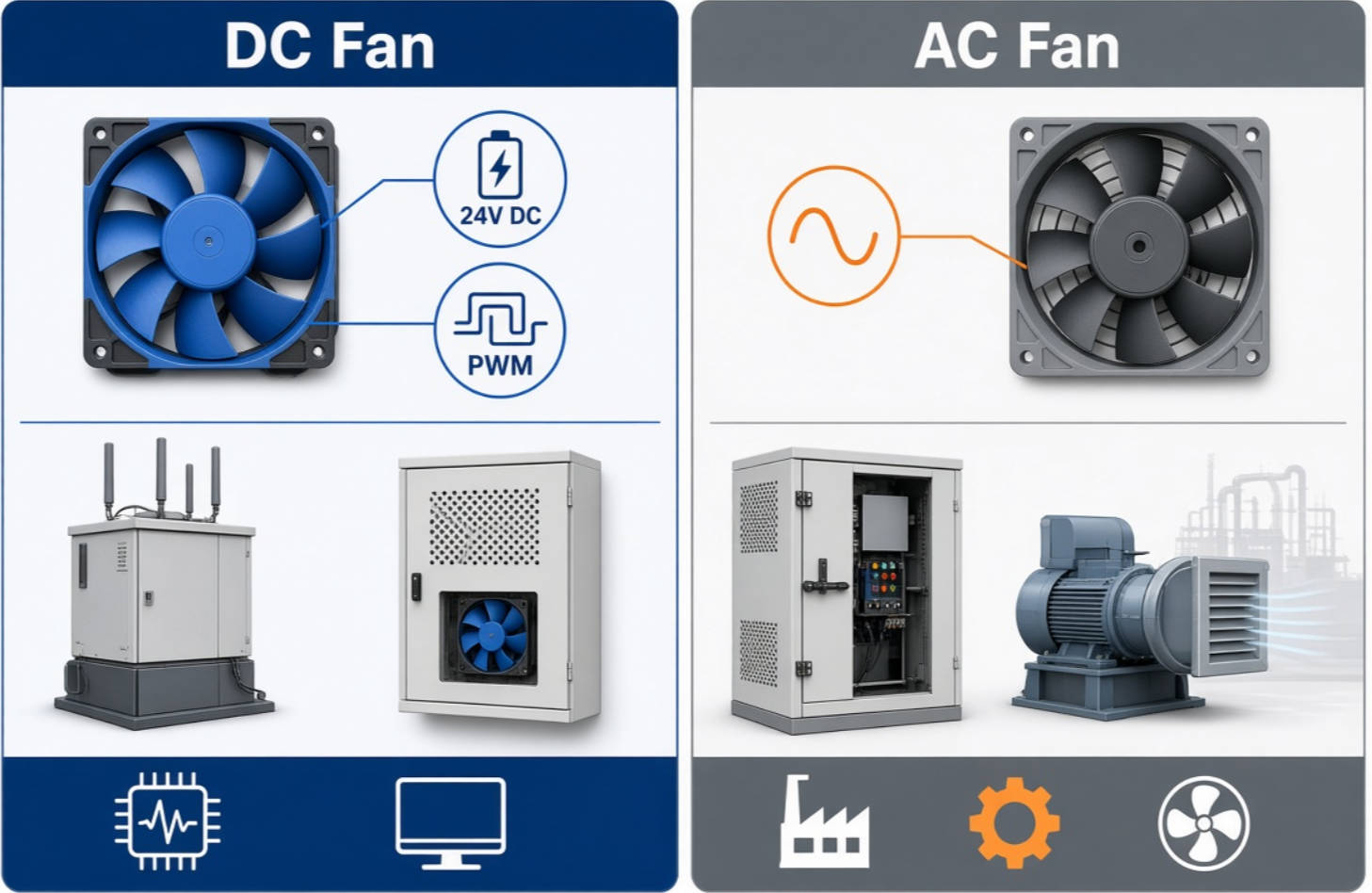
DC fans and AC fans serve different technical and commercial requirements. Neither type is universally better. The correct choice depends on the available power supply, control requirements, operating environment, and target cost of ownership.
| Selection Factor | DC Fan | AC Fan |
|---|---|---|
| Typical power source | 5V, 12V, 24V, 48V DC | 110V, 115V, 220V, 230V, 240V AC |
| Speed control | Excellent; PWM, voltage control, tachometer, alarm signals | Usually fixed speed; some systems use external control methods |
| Common applications | Telecom, servers, networking, medical devices, power supplies, EV charging, embedded electronics | Electrical cabinets, industrial machinery, HVAC equipment, power distribution, automation systems |
| Energy efficiency | Often strong, especially with brushless DC motor designs | Depends on motor technology and duty cycle |
| Monitoring capability | Can support FG, RD, PWM, and speed feedback functions | Typically simpler, though monitoring options are available for selected products |
| Installation approach | Well suited to intelligent and low-voltage electronic systems | Well suited to systems supplied directly by AC mains |
| Procurement priority | Control, compactness, intelligent protection, low-voltage compatibility | Simplicity, rugged operation, direct mains integration |
A DC cooling fan is typically the preferred solution when equipment uses a low-voltage DC power rail and requires intelligent thermal management. It is widely used in telecom infrastructure, base stations, routers, servers, industrial computers, battery systems, communication equipment, and compact electronic devices.
Choose a DC fan when your project requires:
- PWM speed control based on temperature or system load
- Tachometer feedback for monitoring fan speed
- Alarm output for fan-failure detection
- Lower power consumption at variable operating loads
- Compact dimensions for dense electronic assemblies
- Precise cooling performance in enclosed equipment
- Integration with a microcontroller, BMS, PLC, or intelligent control platform
For example, in a telecom cabinet, fan speed can be adjusted according to internal temperature. At moderate temperatures, the fan can run at reduced speed to lower noise and power consumption. When the cabinet temperature rises, the controller can increase the PWM duty cycle and raise airflow automatically.
This approach can improve the balance between thermal protection, acoustic performance, and energy efficiency.
An AC axial fan is often selected for industrial equipment where AC mains power is readily available and the cooling requirement is stable. It remains a practical, reliable option for electrical enclosures, switchgear, power-control cabinets, welding equipment, industrial machinery, charging stations, and ventilation assemblies.
Choose an AC fan when your application requires:
- Direct connection to AC mains power
- Continuous, straightforward operation
- A stable, fixed-speed cooling solution
- Robust performance in industrial installations
- Simplified system integration
- A practical solution for existing or legacy equipment designs
For many industrial cabinets, an AC fan combined with a properly sized filter fan assembly can provide dependable ventilation without adding a separate DC power supply or electronic fan-control circuit.
However, designers should still verify airflow performance under actual cabinet resistance. A filter that becomes loaded with dust can significantly increase pressure drop and reduce effective airflow over time.
The most common mistake in cooling fan selection is focusing only on airflow. Airflow is important, but it tells only part of the story.
A fan's true operating performance depends on the relationship between airflow and static pressure.
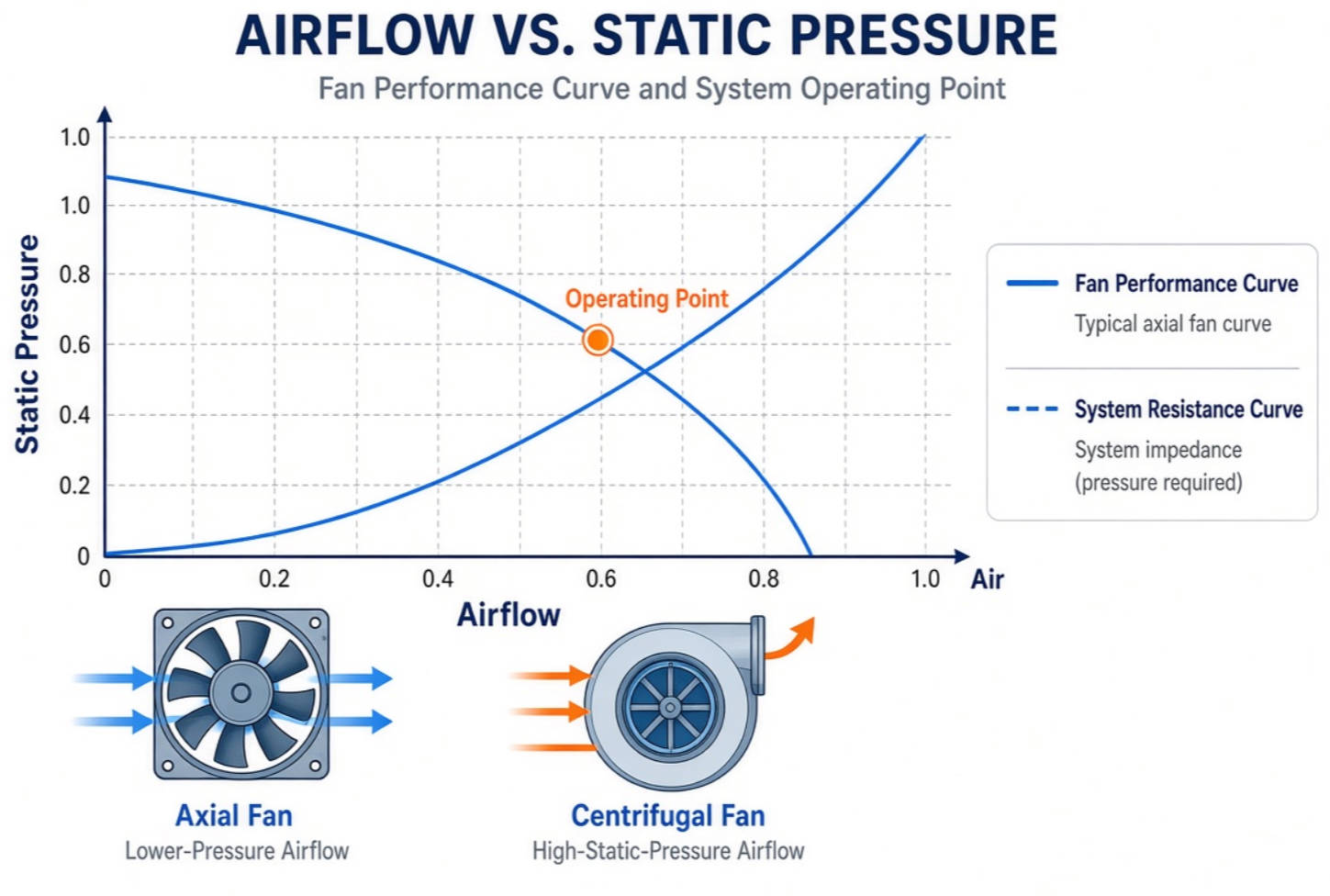
Airflow describes how much air a fan moves over time. It is usually measured in:
- CFM, or cubic feet per minute
- m³/h, or cubic meters per hour
Higher airflow can help remove heat, but only if the air can travel through the system efficiently.
Static pressure is the resistance a fan must overcome to move air through an enclosure or duct path. Restrictions can include:
- Dust filters
- Finger guards
- Louvers
- Heat sinks
- Narrow internal channels
- Cable bundles
- Dense PCB layouts
- Long ducts
- Radiators
- High-efficiency filtration systems
When static pressure rises, airflow falls. This is why a fan that looks suitable in a product catalog may underperform after installation.
A fan curve shows the relationship between airflow and static pressure.
- At zero static pressure, the fan produces its maximum free-air airflow.
- At zero airflow, the fan reaches its maximum static pressure.
- The actual operating point sits between these two limits.
The operating point is determined by where the fan curve intersects the system-resistance curve.
For high-resistance applications, such as compact server modules, filtered outdoor enclosures, or ducted cooling paths, a fan with higher static-pressure capability is often more important than one with a high free-air airflow rating.
The mechanical design of the fan matters as much as the motor type. DC and AC fans can be configured as axial fans, blowers, or centrifugal fans.
DC axial fans move air parallel to the fan shaft. They are common in electronics because they are compact, efficient, and easy to install.
Typical uses include:
- Telecom equipment
- Rack-mounted servers
- Network switches
- Power supplies
- LED lighting systems
- Industrial computers
- Medical electronics
- Battery energy-storage systems
DC axial fans work best when the air path is relatively open and the pressure requirement is moderate.
A DC blower is designed to generate higher pressure than a typical axial fan. It is especially useful when air must pass through narrow channels, ducts, heat sinks, filters, or compact assemblies.
Typical uses include:
- Laser equipment
- Portable analyzers
- Medical instruments
- Battery packs
- Automotive electronics
- Small air-handling modules
- Localized cooling for hot components
For a compact product with a restrictive airflow path, replacing an axial fan with a blower may improve cooling performance even if the blower's free-air airflow number appears lower.
Centrifugal fans are commonly selected for systems with significant airflow resistance or more complex ducting. Their impeller design and housing geometry help convert air velocity into usable pressure.
They are particularly suitable for:
- Industrial ventilation systems
- Air handling units
- Filtered enclosures
- Telecom shelters
- Equipment with long ducts
- High-density power electronics
- HVAC systems
- Cleanroom and filtration applications
Backward-curved centrifugal fans are generally associated with higher efficiency and more stable performance in high-pressure systems. Forward-curved designs can provide high airflow in compact packages and are often used where space and initial cost are important considerations.
A reliable cooling solution starts with a structured engineering review. Before requesting a quote, prepare the following information.
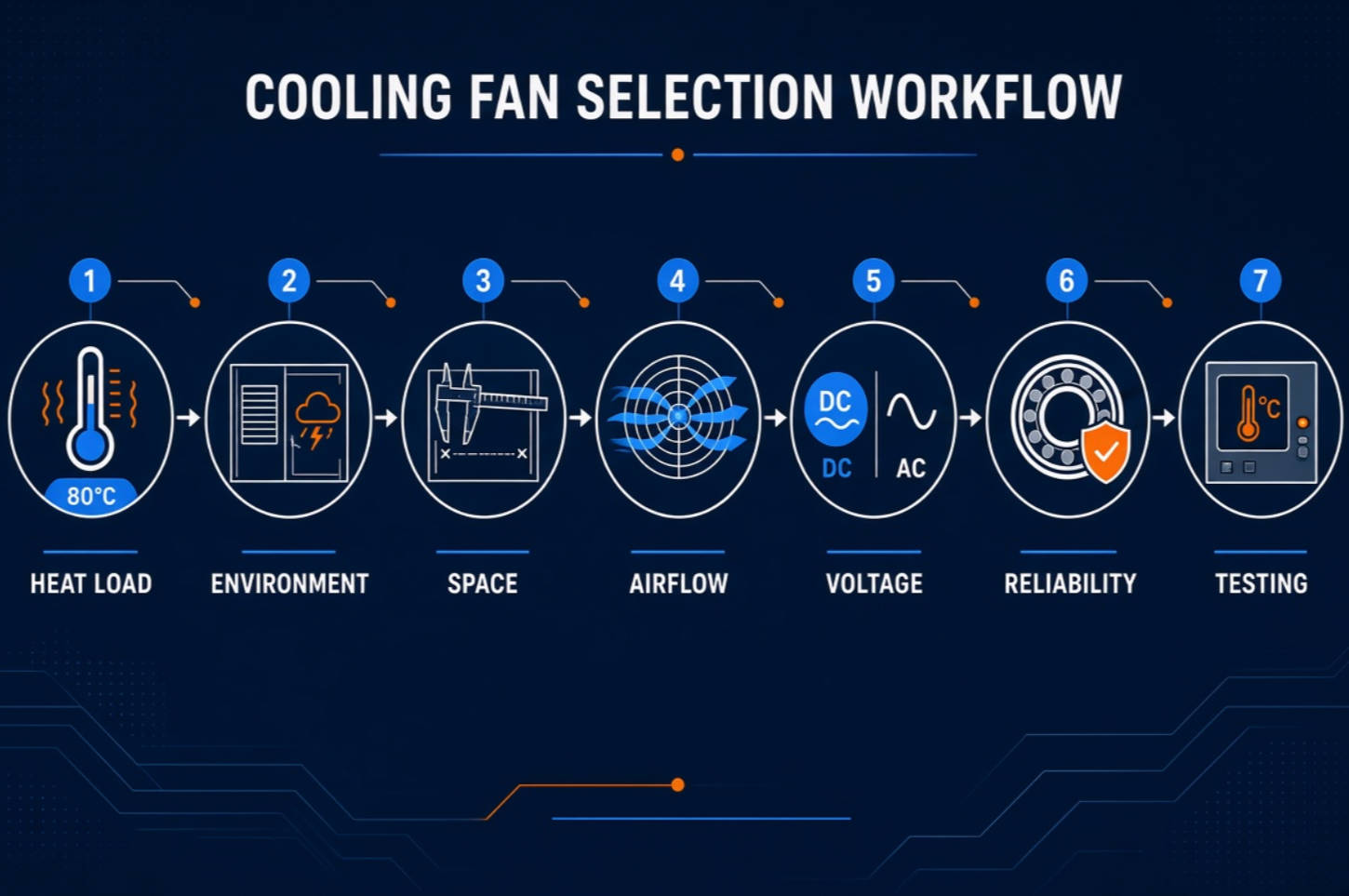
Identify the total heat generated inside the equipment. Include power modules, processors, transformers, batteries, converters, and other components that release heat.
The thermal goal is not simply to move air. It is to keep critical components below their maximum permitted operating temperatures.
Ask where and how the equipment will operate.
Consider:
- Maximum ambient temperature
- Minimum ambient temperature
- Altitude
- Humidity
- Dust concentration
- Salt mist
- Oil vapor
- Chemical exposure
- Vibration and shock
- Indoor or outdoor installation
A fan used in a clean office environment may require very different protection from a fan installed in an outdoor telecom cabinet or factory control panel.
Confirm the maximum dimensions for:
- Length and width
- Fan thickness
- Mounting-hole positions
- Cable exit direction
- Connector type
- Airflow direction
- Clearance for guards and filters
Small dimensional changes can affect available airflow and pressure performance. In compact designs, thickness is often a critical parameter.
Estimate the airflow requirement based on heat load and allowed temperature rise. Then evaluate the airflow path to identify resistance sources.
Do not forget to account for:
- Filter pressure drop when clean
- Filter pressure drop after dust accumulation
- Heat-sink resistance
- Airflow losses caused by protective grills
- Leakage around panel openings
- Resistance created by internal components
A reasonable design margin is essential. A cooling system designed exactly at the limit may become inadequate as filters age, ambient temperatures rise, or internal components change.
Choose the appropriate electrical configuration:
- DC voltage: 5V, 12V, 24V, 48V, or other specified options
- AC voltage: 110V, 115V, 220V, 230V, 240V, or other options
- PWM input
- Tachometer output
- Locked-rotor alarm
- Speed control
- Reverse-polarity protection
- Soft start or surge considerations
For intelligent equipment, DC fans with feedback and speed-control functions can support preventive maintenance and remote monitoring.
Bearing selection affects fan life, noise, mounting flexibility, and performance in high-temperature environments.
Common options include:
- Sleeve bearings
- Ball bearings
- Hydraulic bearings
- Advanced bearing systems designed for long-life applications
For 24/7 equipment, vertical mounting, elevated temperature, or difficult maintenance locations, long-life bearing configurations often provide a better lifecycle outcome.
The final step should include testing under realistic conditions.
Recommended validation activities include:
- Thermal testing at maximum load
- Fan speed and airflow verification
- Noise testing
- Startup testing at low and high temperatures
- Filter-loading evaluation
- Vibration testing when relevant
- Power-consumption measurement
- Failure-alarm function testing
Engineering validation is less expensive than field failure. A short test phase can prevent expensive redesigns, customer complaints, and warranty issues later.
Noise is a common concern in telecom rooms, medical devices, office equipment, and indoor industrial installations. The goal is not always to select the lowest-noise fan. A low-noise fan that cannot maintain component temperatures creates a reliability risk.
Instead, reduce noise through system-level design.
- Use PWM or temperature-based speed control where practical
- Select a larger fan operating at a lower speed when space allows
- Avoid unnecessary air restrictions near the inlet and outlet
- Use smooth airflow channels instead of sharp bends
- Reduce turbulence from poorly designed grills
- Keep fan blades away from obstructing surfaces
- Select an appropriate bearing system
- Use vibration-isolation mounts if mechanical vibration is transmitted to the chassis
- Keep filters clean and accessible for maintenance
A fan should ideally run at the lowest speed that still maintains the required thermal margin. This reduces noise, power consumption, and mechanical stress.
B2B buyers often compare fans by unit price. This is understandable, especially in high-volume projects. However, the lowest purchase price can create the highest long-term cost if the selected fan causes excessive maintenance, energy waste, field replacements, or equipment failures.
A more complete evaluation includes:
- Initial component cost
- Power consumption
- Expected operational life
- Replacement frequency
- Maintenance labor
- Product downtime risk
- Noise-related complaints
- Quality consistency
- Technical support availability
- Supply continuity
- Customization capability
For a continuously operating telecom cabinet or industrial control system, a reliable fan can protect far more valuable components. The value of stable thermal management is often much greater than the difference between two fan purchase prices.
Capital Technology Co., Limited provides cooling solutions for customers requiring reliable air-moving and thermal-management components. Our product range includes DC fans, AC fans, blowers, centrifugal fans, radiators, filters, reactors, and supporting cooling components.
Our approach combines product selection with application-level support. Rather than recommending a fan solely by size or voltage, we focus on the actual operating conditions of the equipment.
CAPITAL serves customers in demanding sectors such as:
- Telecommunications infrastructure
- Network and communications equipment
- Industrial automation
- Power electronics
- Control cabinets
- Energy systems
- Charging equipment
- Electronic manufacturing
- Equipment integration and OEM production
As the chief agent of SANYO DENKI and a manufacturer with the independent CAPITAL brand, we can support different project priorities, including proven performance, cost control, customized specifications, airflow optimization, and technical consultation.
Our company profile identifies CAPITAL as a supplier to organizations including ZTE, HUAWEI, HYTERA, and GOLD POWER, reflecting experience supporting demanding telecom and electronics applications. [en.szcpt]
The right cooling fan should be selected through engineering data, not guesswork. Whether you need a compact DC axial fan for telecom equipment, an AC fan for an industrial cabinet, a high-static-pressure blower for constrained airflow paths, or a centrifugal fan for larger ventilation systems, a well-matched solution can improve reliability and lower total cost of ownership.
To receive a practical fan-selection recommendation, provide the following details:
- Equipment type and application
- Required airflow or heat load
- Available installation dimensions
- Voltage and control requirements
- Maximum ambient temperature
- Static-pressure or airflow-path information
- Target noise level
- Operating hours per day
- Required certifications or environmental requirements
- Annual demand and project schedule
Contact CAPITAL Technology Co., Limited to discuss your DC fan, AC fan, blower, or centrifugal fan requirements and receive application-focused thermal-management support.
Choose a DC fan when your equipment uses DC power and needs variable speed, PWM control, tachometer feedback, or fan-failure monitoring. Choose an AC fan when your system uses AC mains power and requires a rugged, straightforward ventilation solution for industrial cabinets or equipment.
Airflow measures the volume of air moved by a fan, usually in CFM or m³/h. Static pressure measures the resistance the fan can overcome when air moves through filters, ducts, heat sinks, grills, or restricted enclosure paths. Both values are important for correct fan selection.
Use a centrifugal fan when your system has high airflow resistance, long ducting, dense filtration, narrow channels, or a need for stronger static pressure. Axial fans are generally better for open or low-resistance cooling paths.
Noise can increase because of dust accumulation, clogged filters, bearing wear, blade imbalance, increased fan speed, airflow turbulence, or mechanical vibration. Regular filter maintenance and proper fan installation can help reduce these issues.
Provide fan dimensions, voltage, airflow, static pressure, speed-control requirements, expected ambient temperature, application type, bearing preference, cable or connector requirements, certifications, and expected order quantity. Photos or drawings of the installation area can also improve selection accuracy.
The required margin depends on the application, but the design should account for filter loading, increased ambient temperature, component aging, and airflow restrictions. A system that operates too close to its thermal limit can become unreliable as real-world conditions change.
Yes, provided the fan and enclosure are selected for the relevant environmental conditions. Consider temperature range, humidity, dust, water exposure, salt mist, corrosion resistance, ingress-protection needs, bearing life, and service accessibility.
1. Capital Technology Co., Limited. "Company Profile – Capital Cooling Fan Manufacturer." Available at: [https://www.en.szcpt.com/intro/1.html]
2. Capital Technology Co., Limited. "Enhanced Industrial Cooling Fans: Features, Benefits, and How CAPITAL Delivers Reliable Thermal Solutions." Available at: [https://www.sanyodenki-cn.com/enhanced-industrial-cooling-fans-features-benefits-and-how-capital-delivers-reliable-thermal-solutions.html]
3. LONGWELL. "B2B Fan Selection Guide: Choosing High-Performance Centrifugal Fans." Available at: [https://www.longwellfans.com/b2b-fan-selection-guide-choosing-high-performance-centrifugal-fans/]
4. SANYO DENKI. "SANYO DENKI Cooling Fan Supplier." Available at: [https://www.sanyodenki-cn.com/]
5. Mouser Electronics. "SANYO DENKI Manufacturer Overview." Available at: [https://www.mouser.com/manufacturer/sanyo-denki/]
6. Pelonis Technologies. "Enhanced Industrial Fan Features and Benefits for Your Facility." Available at: [https://www.pelonistechnologies.com/blog/enhanced-industrial-fans-features-benefits-market]


