From idea to market-ready product, our NPI solutions make every stage easier, faster. Discover How We Help
Help Center

Views: 279 Author: Capital Technology Publish Time: 2026-08-15 Origin: Site
Content Menu
● Why Compact Electronics Need Micro Fans
>> Prevent Thermal Throttling and Instability
>> Extend Component and System Reliability
>> Enable Smaller Product Designs
>> Improve Performance Under Variable Loads
● Key Benefits of a Micro Cooling Fan
● How to Choose the Right Micro Fan
>> 1. Define the Heat Load and Temperature Target
>> 2. Evaluate Airflow and Static Pressure Together
>> 3. Choose Axial Fan or Blower Based on Air Path
>> 4. Check Electrical and Control Requirements
>> 5. Consider Noise, Vibration, and Mounting
>> 6. Verify Life Expectancy in Real Conditions
● Typical Micro Fan Applications
>> Telecom and Network Equipment
>> Industrial Automation and Control
>> Medical and Laboratory Devices
>> Security, Robotics, and Smart Devices
>> Consumer and Portable Electronics
● Expert Design Tips for Better Cooling Results
● Why Work With Capital Technology?
● Request a Micro Fan Selection Review
>> 1. What is the difference between a micro fan and a normal cooling fan?
>> 2. Is a micro fan always a DC fan?
>> 3. How do I know whether I need an axial fan or a centrifugal blower?
>> 4. What does static pressure mean in micro fan selection?
>> 5. Can PWM control reduce micro fan noise?
>> 6. How long does a micro fan last?
>> 7. What information should I provide when requesting a fan recommendation?
A micro fan is a compact active-cooling component designed to move air through limited spaces and remove heat from sensitive electronic parts. Its main purpose is to prevent localized overheating in compact devices where passive cooling alone cannot maintain a safe operating temperature.
As power density rises in electronics, a small enclosure can contain processors, power modules, memory, batteries, communication boards, sensors, and LEDs that all produce heat. A properly selected micro cooling fan helps direct airflow toward these hot spots, supports stable performance, reduces thermal stress, and protects long-term product reliability.
At Capital Technology Co., Limited, we work with OEMs and equipment manufacturers that need dependable cooling for demanding applications. As the manufacturer behind the CAPITAL brand and a leading SANYO DENKI distributor, we help customers evaluate DC fans, AC fans, blowers, and compact thermal-management solutions based on real operating conditions—not catalogue specifications alone.

A micro fan, also called a miniature cooling fan or mini fan, is a small electrically powered fan used for active air cooling inside compact electronic equipment. Most models use a brushless DC motor and are designed to deliver airflow in a small footprint.
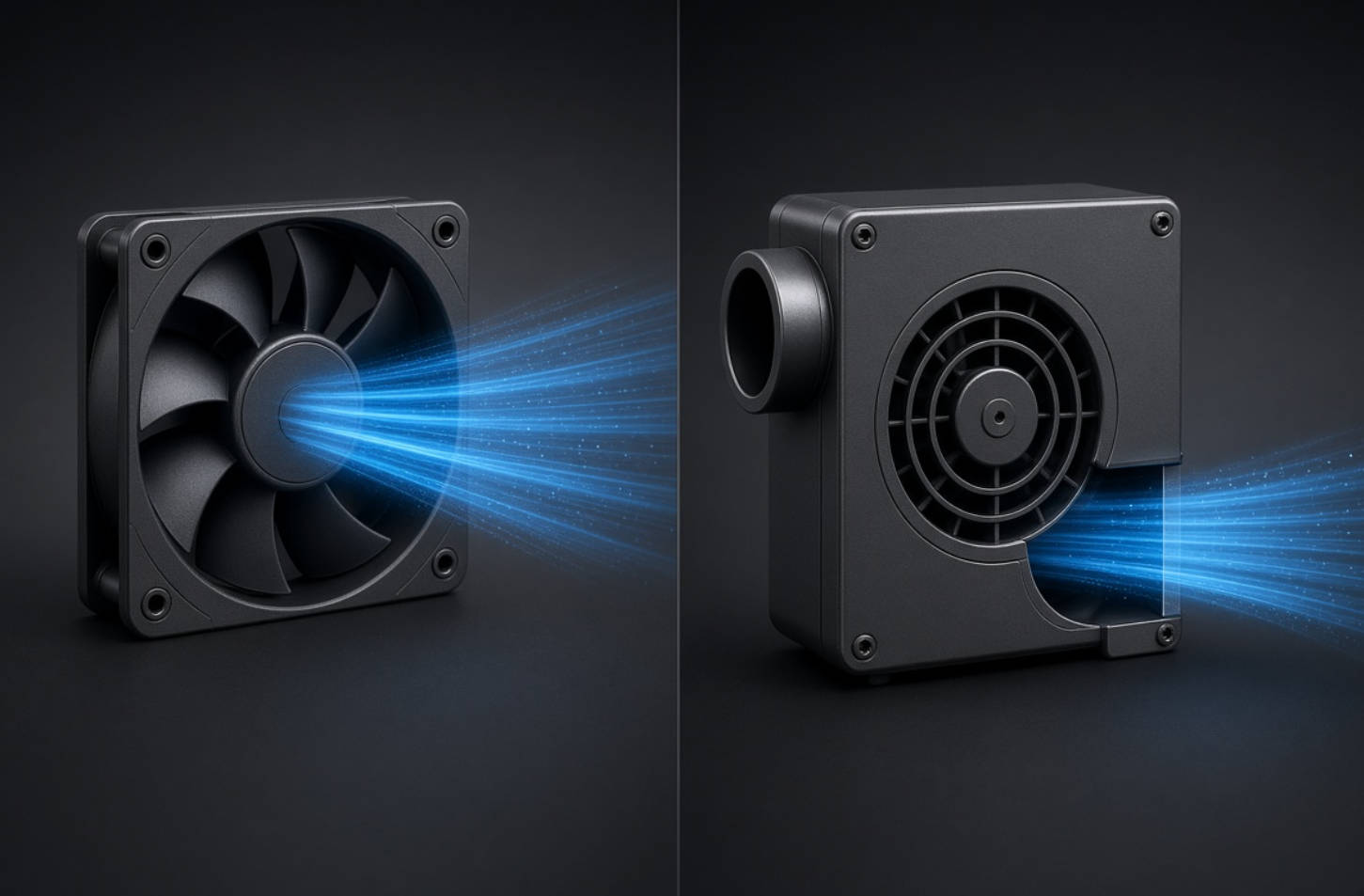
Depending on the application, a micro fan may use an axial-flow design or a centrifugal blower design:
| Fan Type | Airflow Direction | Best Use Cases | Main Advantage |
|---|---|---|---|
| Axial micro fan | Air moves parallel to the shaft | Open enclosures, ventilated boards, compact equipment | Efficient airflow in a thin profile |
| Centrifugal micro blower | Air exits at 90 degrees from the inlet | Ducted systems, dense assemblies, restricted air paths | Higher pressure capability in tight airflow channels |
A fan's physical size alone does not define whether it is the right choice. A 25 mm fan may be appropriate for one device but ineffective in another if the enclosure has a dense heatsink, narrow vents, dust filters, cables, or a complex internal air path.
The correct micro fan is the one that delivers sufficient airflow at the actual system resistance, while meeting the device's limits for space, noise, voltage, power consumption, and service life.
The purpose of a micro fan is not simply to make a product "cooler." Its practical role is to control the temperature of critical components so the complete system can operate more consistently.
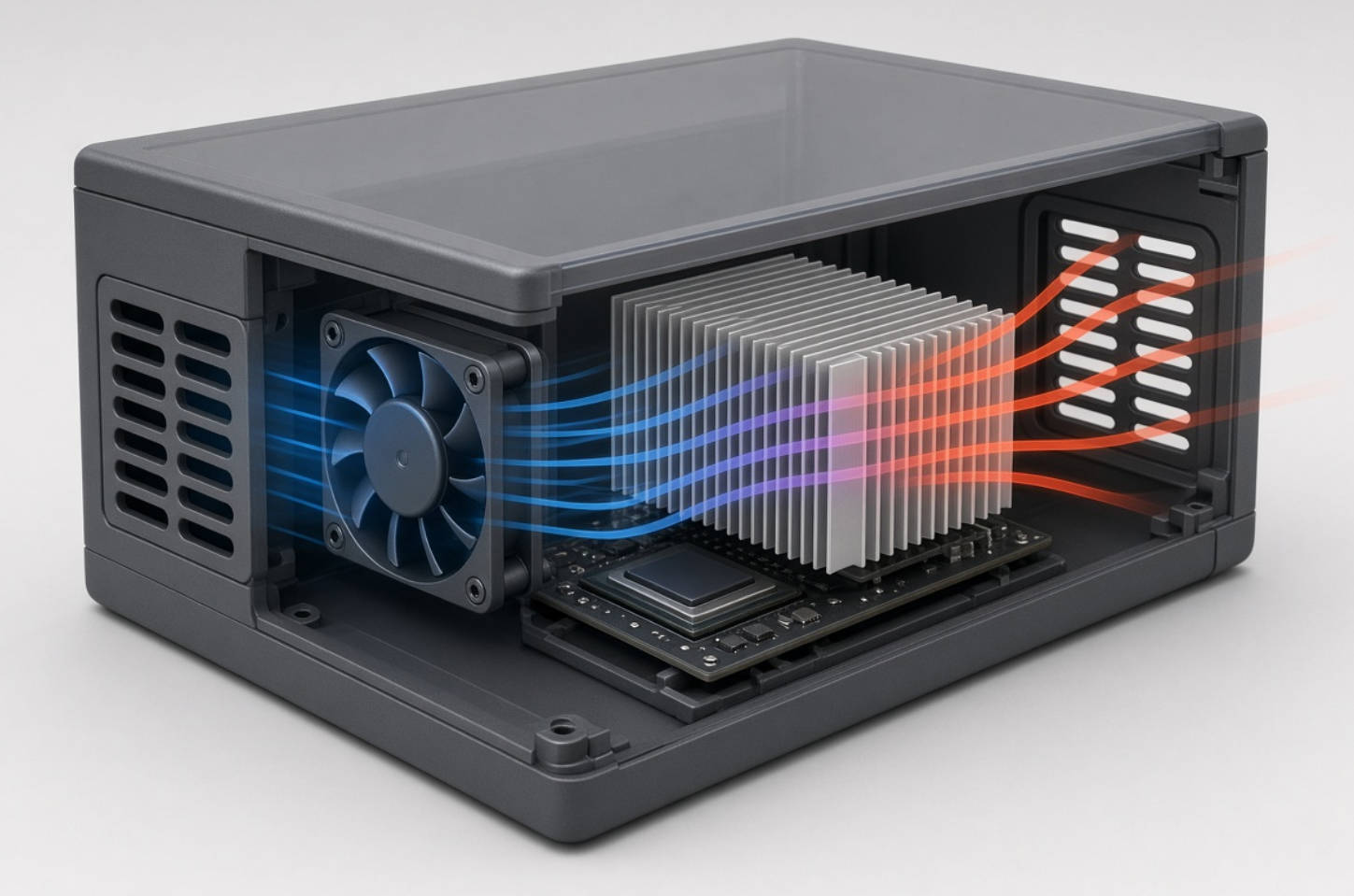
Processors, power ICs, LED drivers, wireless modules, and storage devices can reduce performance or shut down when temperatures rise above their operating limits. In compact products, heat can become trapped around a single component rather than spreading evenly throughout the enclosure.
A micro fan provides targeted forced convection. It moves cooler air across a heatsink or component surface and carries heat toward an outlet. This can help reduce hot spots, lower thermal gradients, and stabilize operation under peak loads.
High temperatures can accelerate the aging of electronic assemblies, insulation materials, capacitors, connectors, adhesives, and solder joints. Thermal cycling also creates repeated expansion and contraction in materials, which can increase mechanical stress over time.
Cooling does not eliminate every reliability risk, but better temperature control gives engineers more margin. This is especially valuable for equipment that operates continuously, such as telecom systems, industrial controllers, network devices, security equipment, and battery-management systems.
Modern OEMs are under pressure to make products thinner, lighter, more powerful, and easier to install. Passive cooling may be sufficient for low-power devices, but larger heatsinks take up valuable space.
A compact DC fan or blower can allow designers to manage heat without making the enclosure substantially larger. In many cases, it enables a more practical balance between performance, enclosure dimensions, weight, and component placement.
Not every device produces the same amount of heat all day. A system may remain lightly loaded for hours and then experience short bursts of high power demand.
A PWM-controlled DC micro fan can adjust speed according to temperature or control signals. This approach helps reduce unnecessary noise and power consumption during low-load periods while increasing cooling capacity when needed.
A well-engineered micro fan can provide several benefits beyond basic airflow:
- Localized cooling for processors, power electronics, sensors, memory, LEDs, and battery modules.
- Compact integration in equipment with tight PCB layouts or low-profile housings.
- Dynamic speed control through PWM, tachometer feedback, or temperature-based control.
- Improved thermal consistency across critical components.
- Reduced risk of performance throttling during heavy workloads.
- Lower acoustic impact when the fan design, speed range, and mounting method are properly matched.
- Scalable product options for different voltages, airflow requirements, bearing systems, and environmental conditions.
However, these benefits depend on selection and installation. A fan with high free-air CFM may still underperform if it cannot overcome the resistance created by a filter, heatsink, grille, duct, or narrow exhaust opening.
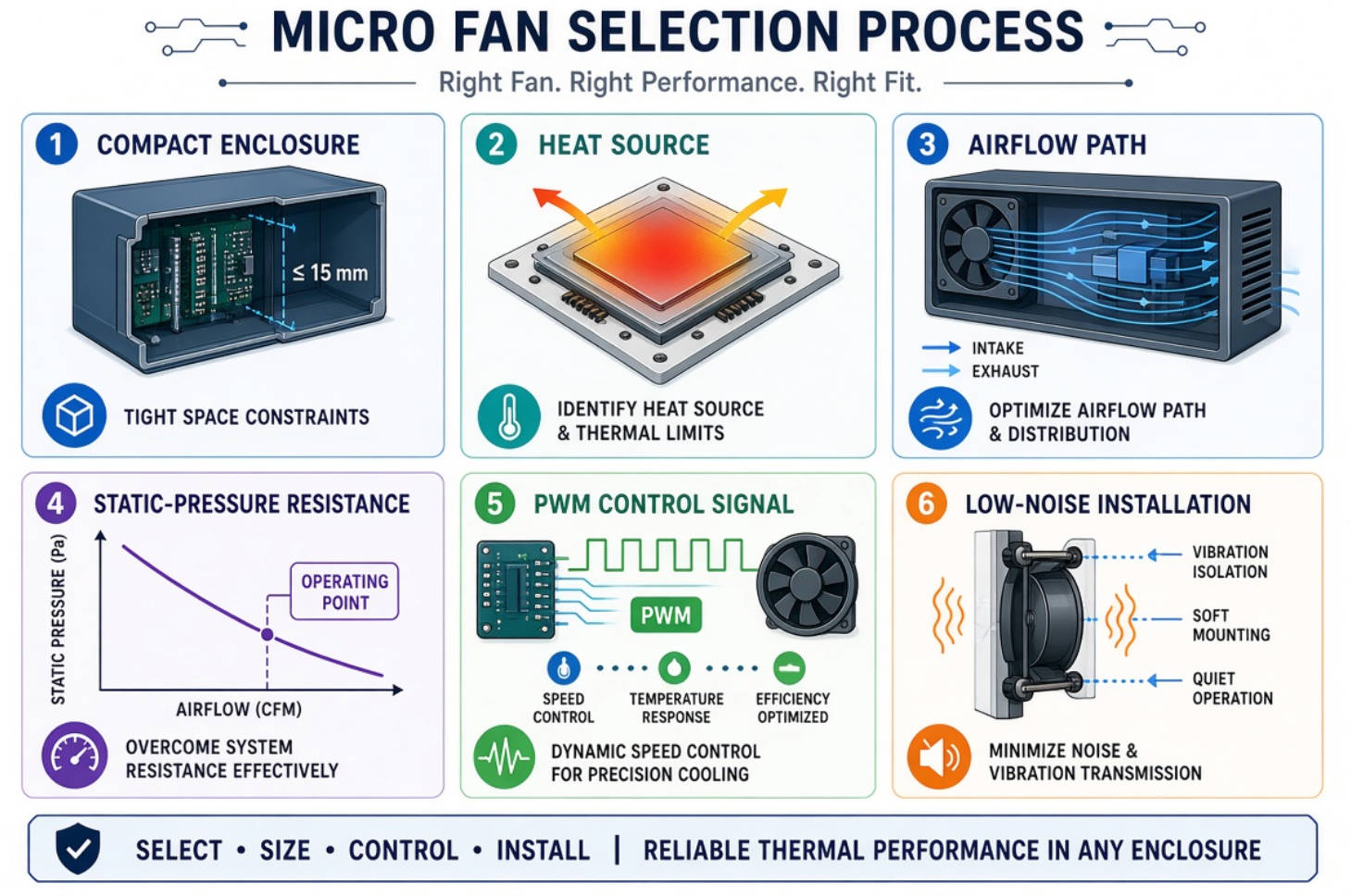
The most common mistake in fan selection is choosing only by fan size or maximum airflow. Engineers should evaluate the complete thermal system.
Start with the heat generated inside the product. Identify which components produce the most heat and determine their maximum allowable temperature.
Important questions include:
- What is the total heat load in watts?
- Which component creates the main hot spot?
- What is the highest expected ambient temperature?
- What temperature margin is required at maximum load?
- Is the device used continuously or intermittently?
A compact fan should be selected around the real thermal objective, not simply because it fits the available mounting area.
Airflow describes the volume of air moved by the fan, commonly measured in CFM or cubic metres per hour. Static pressure describes the fan's ability to push air through resistance.
For example, an open test bench may require only airflow. A compact telecom enclosure with a dense heatsink, cable bundles, perforated metal, and a dust filter requires both airflow and pressure capability.
The true operating point is created where the fan performance curve meets the system resistance curve. This is why fan selection should use the manufacturer's P–Q curve rather than only a single maximum-airflow figure.
Use an axial micro fan when air can travel relatively straight through the product. It is commonly suitable for open or ventilated compact assemblies.
Use a centrifugal blower when airflow must turn sharply, travel through a narrow channel, pass through a heatsink, or overcome higher resistance. A blower may consume more power or create more acoustic output, but it can maintain useful airflow where a small axial fan cannot.
Confirm that the fan matches the system's electrical design:
- Rated voltage and allowable voltage range.
- Starting current and normal operating current.
- PWM speed-control compatibility.
- Tachometer or alarm output requirements.
- Reverse-polarity and locked-rotor protection needs.
- Connector, lead-wire length, and pin assignment.
- EMC and electrical-noise considerations.
For battery-powered products, power consumption matters as much as cooling performance. For industrial products, fault detection and speed monitoring may be more important.
Noise is influenced by fan speed, blade geometry, airflow turbulence, grille design, mounting method, and enclosure resonance. A quiet fan on a laboratory fixture can become noticeably louder after installation in a thin metal housing.
Use vibration-damping mounts where appropriate, avoid restrictive grilles, and maintain clear inlet and outlet paths. During prototype testing, measure noise and temperature with the final enclosure configuration—not only with the fan operating in free air.
Fan life specifications should be interpreted carefully. Expected life may be stated under defined conditions, such as continuous operation at rated voltage, a specified ambient temperature, normal humidity, and free-air installation.
In actual equipment, elevated temperature, dust, vibration, corrosive gases, frequent starts and stops, or blocked airflow can shorten service life. For mission-critical equipment, request clear data on bearing construction, life-test conditions, failure criteria, and quality-control processes.
Micro fans are used wherever electronics must deliver high performance in a small volume.
Communication devices often operate continuously and contain power supplies, processors, modules, and high-speed data components. Controlled airflow helps manage heat accumulation and supports reliable uptime.
PLC systems, industrial gateways, motion-control equipment, machine-vision units, and compact control cabinets may operate in warm, dusty, or vibration-prone environments. A suitable DC fan can help maintain stable internal temperatures while supporting a compact enclosure design.
Portable diagnostic tools, patient-monitoring devices, imaging modules, and laboratory instruments often require compact, low-vibration cooling. Selection must consider not only thermal performance but also acoustic comfort, cleanliness, and long-term reliability.
Cameras, edge-computing devices, autonomous equipment, battery systems, and robotic controllers increasingly combine high processing demand with limited installation space. Micro fans help cool processors, power stages, communication modules, and sensors.
Portable projectors, gaming devices, charging equipment, small computers, and smart-home products often need low-profile cooling. Here, designers typically prioritize low noise, compact size, and energy efficiency.
From a thermal-management perspective, the fan is only one part of the solution. The enclosure and internal airflow path determine whether the fan can perform as intended.
1. Place the fan near the heat source or airflow inlet. Avoid designs where the fan circulates already-heated air without a defined exhaust route.
2. Create a complete airflow path. Air needs an inlet, a route across the hot component, and an outlet. Adding a fan without adequate venting can produce limited cooling improvement.
3. Avoid leakage paths. Gaps around the fan or heatsink can allow air to bypass the components that need cooling.
4. Do not block the inlet. Keep adequate clearance between the fan inlet and nearby surfaces, cables, labels, foam, or enclosure walls.
5. Test at the worst-case condition. Validate performance at maximum ambient temperature, maximum electrical load, and realistic installation orientation.
6. Build margin into the design. Dust accumulation, aging, component variation, and higher-than-expected ambient temperatures can reduce cooling performance over time.
Capital Technology Co., Limited supports customers that need a practical, reliable cooling solution rather than a one-size-fits-all product recommendation.
Our product and supply capabilities include:
- CAPITAL-branded DC fans, AC fans, blowers, and thermal-management components.
- SANYO DENKI cooling-fan solutions for applications requiring high airflow, high static pressure, low vibration, and long-life performance.
- Support for OEM and industrial applications with requirements for voltage, airflow, speed control, noise, bearing selection, and custom integration.
- Experience serving demanding electronics and communication supply chains, including customers such as ZTE, HUAWEI, and HYTERA.
The best cooling solution is not necessarily the smallest fan, the highest-RPM fan, or the fan with the highest published CFM. It is the component that delivers verified thermal performance in your final product environment.
If your device has overheating, thermal-throttling, noise, or space limitations, send us your basic application details: enclosure dimensions, heat load, operating temperature, available fan space, airflow direction, voltage, noise target, and expected service environment.
Contact Capital Technology Co., Limited to discuss a DC fan, AC fan, micro fan, or SANYO DENKI cooling solution tailored to your product. Our engineering-oriented team can help you compare options and move from early selection to prototype validation.
A micro fan is generally designed for compact equipment with limited mounting space. It often uses a smaller frame, thinner profile, lower voltage, and more focused airflow than a larger cooling fan used in cabinets, servers, or HVAC equipment.
No. Many micro fans use brushless DC motors because they are compact and easy to control. However, fan type should be selected according to the electrical architecture, application environment, and required performance. AC fans are more common in certain larger industrial or mains-powered systems.
Choose an axial fan when air can move relatively straight through the equipment with low resistance. Choose a centrifugal blower when the airflow must pass through a narrow channel, dense heatsink, filter, or duct, or when the design requires airflow to turn 90 degrees.
Static pressure is the fan's ability to overcome airflow resistance. It becomes important when the air path includes restrictions such as grilles, filters, heatsinks, ducts, or dense internal components. Higher free-air airflow does not automatically mean better installed cooling.
Yes. PWM control can reduce fan speed during lower thermal loads, which can lower power consumption and acoustic output. The fan, controller, PWM frequency, and application requirements should be checked for compatibility.
Fan life depends on bearing design, operating temperature, voltage, dust exposure, vibration, duty cycle, and airflow conditions. Always review the manufacturer's stated life-test conditions because a published life value may not represent the same conditions as your final product.
Provide the fan installation space, voltage, heat load, operating ambient temperature, airflow direction, target noise level, expected operating hours, enclosure design, airflow restrictions, and any requirements for PWM, tachometer output, IP rating, connectors, or certifications.
1. [Same Sky, "Thermal Management Techniques and Choosing a Fan"]
2. [SANYO DENKI, "Long Life Fan | San Ace"]
3. [SANYO DENKI, "Fan Lifespan | Basic Knowledge of Fans"]
4. [JEDEC, "Arrhenius Equation (for Reliability)"]
5. [SANYO DENKI, "60 × 76 mm Cooling Fan That Features 100,000-Hour Expected Life"]
6. [Electronics Cooling, "SANYO DENKI Develops Long-Life Counter-Rotating Fan"]


