From idea to market-ready product, our NPI solutions make every stage easier, faster. Discover How We Help
Help Center

As an engineer who has helped telecom and industrial customers solve overheating issues for more than a decade, I see DC fans as one of the most overlooked levers for reliability, energy savings, and system lifetime. In this guide, I will walk you through what a DC fan is, how it works, how it compares to AC fans, and how brands like CAPITAL and SANYO DENKI are deployed in real projects for ZTE, Huawei, HYTERA and other OEMs. [orionfans]
A DC fan is an electric fan driven by direct current (DC) power, commonly 5 V, 12 V, 24 V, or 48 V, instead of alternating current (AC). In modern electronics and industrial systems, DC fans are usually brushless motors with integrated control electronics, optimized for efficiency, low noise, and precise speed control. [orionfans]
In practical terms, when my team designs cooling for a base station or power module, a DC fan gives us:
- Direct compatibility with DC buses (telecom 48 V, server 12 V, battery systems). [alibaba]
- Fine-grained speed control, usually by PWM (pulse-width modulation) or voltage control. [acdcecfan]
- Better efficiency at partial load than most comparable AC fans. [orionfans]
At the heart of a typical DC cooling fan is a brushless DC motor that converts electrical energy into rotational motion using electromagnetism. The motor has two key parts: a fixed stator with coils and a rotating rotor with permanent magnets attached to the fan hub. [acdcecfan]
When DC voltage is applied, the driver electronics sequentially energize the stator coils, creating a rotating magnetic field that pulls the rotor around, spinning the blades and moving air from the high-pressure side to the low-pressure side. The motor speed is roughly proportional to the applied voltage and the control signal (often a PWM duty cycle), which is why DC fans are easy to control dynamically. [orionfans]
Typical DC fan voltages in real projects include:
- 5 V: small axial DC fans for chip or module-level cooling.
- 12 V: PC, networking, and embedded systems.
- 24 V: industrial control, automation, and LED drivers.
- 48 V: telecom power systems, base stations, and rectifiers. [alibaba]
From an application standpoint, most DC fans you'll specify fall into three families. Choosing the right type is often more important than choosing a slightly higher CFM rating. [acdcecfan]
Axial DC fans move air parallel to the axis of the fan, like a propeller. They are the workhorse choice for electronics cooling and cabinet ventilation because they provide high airflow at relatively low static pressure. [acdcecfan]
Common use cases:
- Switches, routers, base stations.
- Power supplies and rectifiers.
- Industrial cabinets and 19-inch racks. [orionfans]
Cross-flow DC fans use a long cylindrical impeller, creating a wide uniform airflow curtain across their length. This makes them ideal where you need to cool a broad surface or board array rather than a single hotspot. [acdcecfan]
Typical applications:
- Display equipment and kiosks.
- Instrumentation panels.
- Narrow, elongated enclosures where airflow needs to be evenly distributed. [acdcecfan]
DC blowers draw air in axially and expel it radially, generating significantly higher static pressure than axial fans of similar size. When I design for tightly packed servers or telecom modules with restrictive airflow paths, a DC blower very often outperforms a standard axial fan. [acdcecfan]
Typical applications:
- Server racks and hot-swap power supplies.
- Telecom rectifiers and DC power modules.
- Industrial equipment with long ducts or filters. [orionfans]
From the field, here are the advantages that make DC cooling fans the default choice in most modern equipment.
High-efficiency brushless DC motors, combined with speed control, allow DC fans to use substantially less energy than comparable AC fans, especially at partial load. Industry assessments and field measurements show correctly controlled DC fan systems can reduce fan energy consumption by up to around 50–70% versus fixed-speed AC solutions in similar conditions. [orionfans]
This matters when:
- You deploy thousands of units (telecom, data centers, OEM equipment).
- Your system is battery-backed or runs on renewable sources.
- You need to meet energy or ESG targets at the equipment level. [orionfans]
Unlike most AC fans that typically offer only a few discrete speeds, DC fans support continuous speed control via PWM or analog voltage control. That allows your controller to increase fan speed only when temperature or load demands, rather than running at full speed all the time. [orionfans]
Typical control strategies I see in practice:
- Temperature-based fan curves: quietly ramp up only when components exceed thresholds.
- System load-based control: fan speed linked to CPU, power, or RF output power.
- Redundancy and failover: multi-fan arrays where one compensates for a failed unit.
The result is lower average noise, lower power, and longer fan life compared with always-on, fixed-speed cooling. [orionfans]
For medical devices, office equipment, and indoor telecom gear, low noise is not a nice-to-have; it's a requirement. Well-designed DC fan systems benefit from:
- Lower vibration brushless motors.
- Optimized blade geometry and housing design.
- Ability to run at reduced speeds most of the time. [acdcecfan]
In real deployments, this can reduce perceived noise by several decibels compared with legacy AC units, materially improving acoustic comfort for operators and end users. [orionfans]
Industrial-grade DC fans are built to survive temperature extremes, dust, moisture, and vibration typical of field installations. With the right enclosure and sealing, fans can operate reliably across wide temperature ranges suitable for outdoor telecom cabinets, traffic systems, and factory equipment. [acdcecfan]
For OEMs, this directly translates into:
- Fewer field failures and site visits.
- Longer maintenance intervals.
- More stable performance in high-ambient or polluted environments.
Both DC and AC fans have their place, but for most modern electronics and telecom equipment, DC has become the mainstream choice. [acdcecfan]

| Criterion | DC Fans | AC Fans |
|---|---|---|
| Power source | Run on DC voltages (5–48 V), ideal for electronics and telecom buses acdcecfan | Run directly on AC mains, e.g., 110–240 V AC |
| Energy efficiency | Higher efficiency, especially with variable speed control orionfans | Typically lower efficiency at partial load |
| Speed control | Fine, continuous control via PWM or voltage orionfans | Limited, often multi-tap or simple triac controls |
| Noise level | Lower noise when correctly sized and speed-controlled orionfans | Often noisier under comparable airflow |
| Integration | Easy to integrate with PCBs, controllers, smart systems orionfans | Simple for basic ventilation tied to mains |
| Typical use cases | Electronics, telecom, data centers, medical, automotive orionfans | Building HVAC blowers, simple AC-powered ventilation |
As a rule of thumb:
- Choose DC fans when you care about efficiency, noise, control, and system integration.
- Choose AC fans for simple, mains-powered ventilation where control and noise are less critical.
In the field, DC fans are now standard in almost every performance-critical electronic system. [orionfans]
In servers, switches, routers, and storage, axial DC fans and blowers keep CPUs, GPUs, ASICs, and power modules operating within safe temperature limits. Designers often deploy multiple smaller fans in parallel or series to achieve redundancy and higher static pressure in compact enclosures. [acdcecfan]
Telecom base stations, small cells, rectifiers, and DC power systems rely heavily on 48 V DC cooling fans. For example, DC fans specifically designed for Huawei power modules operate from 36–60 V and deliver high airflow (hundreds of CFM) in a compact form factor suitable for hot-swappable power shelves. [alibaba]
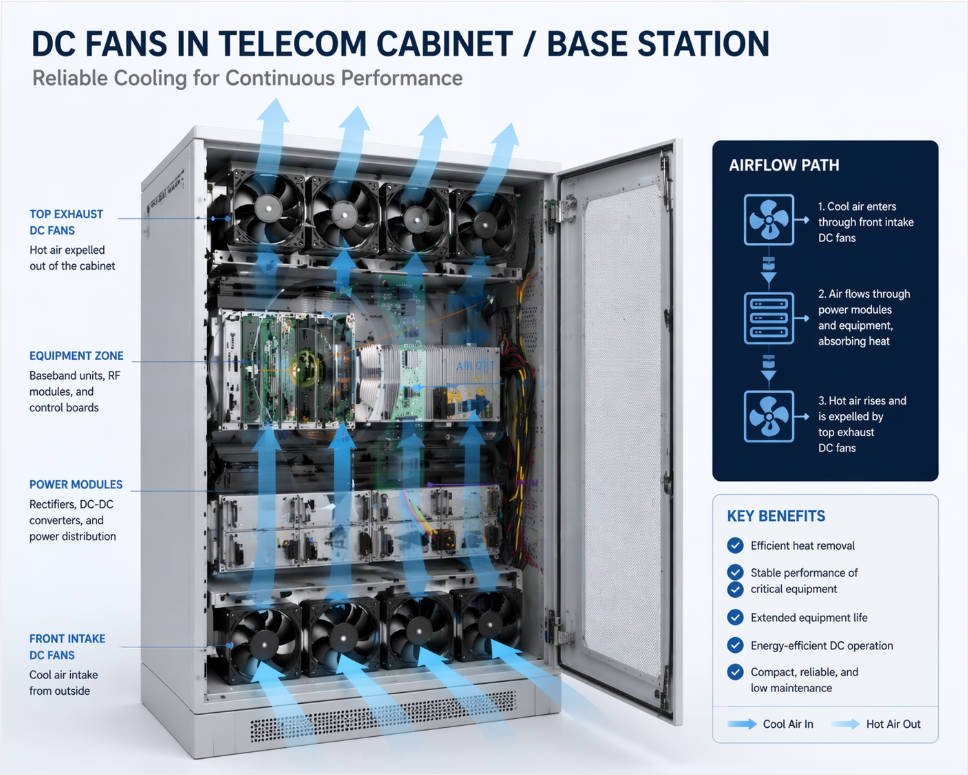
In HVAC terminals, control cabinets, and industrial automation panels, DC fans support:
- Cabinet ventilation and component lifetime extension.
- Localized cooling for inverters, drives, and power electronics.
- Cooling of LED lighting and power supplies in compact housings. [orionfans]
Medical devices such as ventilators, diagnostic systems, and patient monitoring equipment require quiet, reliable cooling. DC fans are used here because they can deliver adequate airflow at carefully controlled, low noise levels and support intelligent speed curves for different operating modes. [orionfans]
In automotive and transportation, DC fans handle:
- Battery and power electronics cooling in EV/HEV platforms.
- In-cabin ventilation and seat cooling.
- Cooling for infotainment and ADAS electronics. [orionfans]
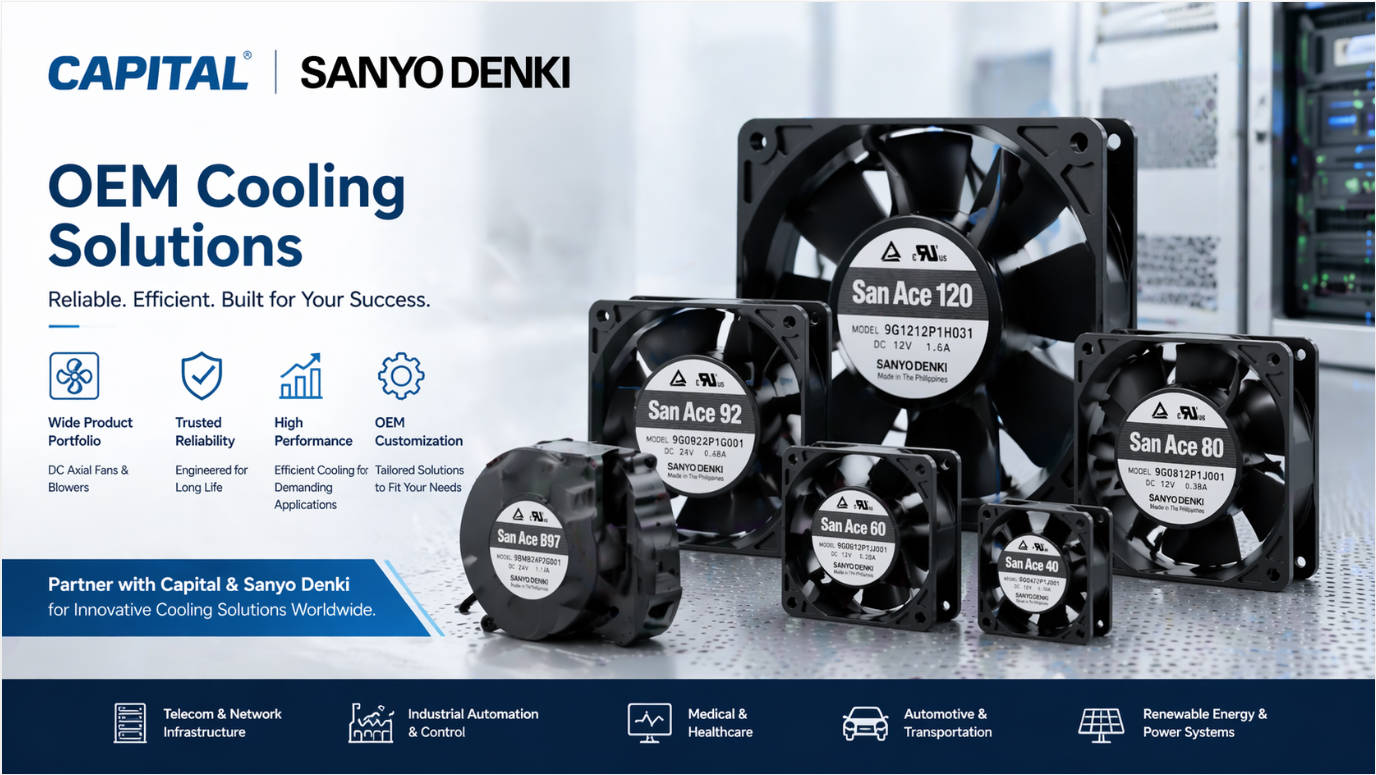
Capital Technology Co., Limited is a cooling fan manufacturer with its own CAPITAL brand product series, producing DC/AC fans, radiators, and related cooling components. Beyond in-house development, CAPITAL also serves as a chief agent of SANYO DENKI, one of the leading names in the global cooling fan industry. [en.szcpt]
Today, CAPITAL and its ecosystem supply DC fans and cooling solutions to well-known OEMs, including ZTE, Huawei, and HYTERA, where reliability, availability, and long-term support are non-negotiable. In practice, that means: [sanyodenki-cn]
- Application-specific DC fan selection for telecom, industrial, and power electronics.
- Matching SANYO DENKI and CAPITAL models to customer airflow, noise, and lifetime targets. [en.szcpt]
- Coordinating long-term supply, certification support, and technical integration for global deployments.
For engineers and buyers, working with a source manufacturer plus a top-tier Japanese brand gives a balance of cost, performance, and reliability across different product tiers. [en.szcpt]
Based on real selection workflows with OEM customers, here is a simple, practical process for selecting a DC fan for cooling your system.
Start with:
1. Maximum allowable component and ambient temperatures.
2. Heat dissipation (power loss) in watts.
3. Operating environment: indoor, outdoor, dust, humidity, altitude. [acdcecfan]
This lets you estimate required airflow (CFM) and static pressure. Many fan vendors provide charts or software tools to size the fan correctly based on your system curve.
- Choose axial DC fans for high airflow, low static pressure applications (open enclosures, general ventilation). [acdcecfan]
- Choose DC blowers for high restriction or ducted systems (dense racks, filters, heatsinks with narrow fins). [acdcecfan]
- Consider cross-flow DC fans when you need even cooling over long boards or displays.
Mechanical constraints (height, width, depth) will quickly narrow the available sizes (for example, 40×40×10 mm, 80×80×25 mm, or 120×120×38 mm).
Align the fan's operating voltage with your system bus:
- 12 V for IT equipment and general electronics.
- 24 V for industrial controls.
- 48 V for telecom power systems. [alibaba]
Decide how you will control and monitor the fan:
- 2-wire: simple on/off.
- 3-wire: tachometer feedback for RPM monitoring.
- 4-wire: PWM input for precise speed control plus tach feedback. [orionfans]
From a user-experience and reliability perspective, you should check:
- Noise level in dB(A) at typical operating points.
- Expected lifetime (often given as L10 or MTTF) at your operating temperature.
- Relevant certifications (CE, UL, RoHS, REACH, telecom or medical standards where needed). [orionfans]
In many projects, we prototype with 2–3 candidate DC fans and log temperature, noise, and RPM over time to validate the design under realistic load profiles.

If you are designing or upgrading a system and need a DC cooling fan that balances airflow, noise, cost, and availability, you should not rely on datasheets alone. CAPITAL's engineering and sales teams work directly with OEMs in telecom, industrial, and medical sectors to match CAPITAL and SANYO DENKI DC fans to real-world requirements. [sanyodenki-cn]
You can:
- Share your thermal budget, space constraints, and target markets.
- Request recommendations, samples, or cross-references for existing fan models.
- Discuss lifecycle, certification, and long-term supply planning for your project.
Get in touch with CAPITAL today to discuss your DC cooling fan requirements and start designing a quieter, more efficient, and more reliable system. [en.szcpt]
A DC fan is used for cooling and ventilating electronic and electrical equipment, including telecom base stations, servers, industrial control cabinets, medical devices, and automotive systems. By moving air across hot components, DC fans help maintain safe operating temperatures, extend component life, and improve system reliability. [alibaba]
A DC fan runs on direct current, usually at low voltages (5–48 V), and offers high efficiency and precise speed control, often via PWM. An AC fan runs on mains AC voltage, is simpler to wire for basic ventilation, but usually offers less efficient and less flexible control, and can generate more noise at comparable airflow levels. [acdcecfan]
Telecom systems, such as base stations and rectifiers, typically use 48 V DC power buses, making DC fans a natural fit from a power integration perspective. DC fans also support intelligent speed control, which helps minimize noise and energy usage in densely packed telecom racks that operate continuously in varied environmental conditions. [alibaba]
Most modern DC cooling fans are controlled either by adjusting the supply voltage or, more commonly, by using a PWM control signal on a dedicated input. The system's controller (MCU, FPGA, or dedicated thermal controller) adjusts the duty cycle of the PWM signal based on temperature sensors or system load to achieve the desired fan speed. [orionfans]
You should consider required airflow and static pressure, operating voltage, available space, acceptable noise levels, expected lifetime at your ambient temperatures, and necessary certifications. It is also important to decide on the control and monitoring interface (2-, 3-, or 4-wire) to integrate the fan with your system's thermal management strategy. [acdcecfan]
1. Orion Fans – "Benefits of DC Fans" (overview of DC fan efficiency, control, and applications).
<https://orionfans.com/benefits-of-dc-fans/> [orionfans]
2. ACDC FAN – "What is DC Fan for Cooling Technology" (basic explanation of DC fan operation, types, and comparison to AC fans).
<https://www.acdcecfan.com/what-is-dc-fan/> [acdcecfan]
3. CAPITAL Technology Co., Limited – Company profile and product overview (CAPITAL brand DC/AC fans, radiators, and role as SANYO DENKI chief agent).
<https://www.en.szcpt.com/intro/1.html> [en.szcpt]
4. CAPITAL Technology / SANYO DENKI (China) – Additional background on supplying ZTE, Huawei, HYTERA and other OEMs.
<https://www.sanyodenki-cn.com/aboutus.html> [sanyodenki-cn]
5. Example telecom DC fan product for Huawei power module (voltage range and airflow characteristics in telecom context).
<https://www.alibaba.com/product-detail/32030092-DC-Fan-36V-60V-D175_62110507396.html> [alibaba]


