From idea to market-ready product, our NPI solutions make every stage easier, faster. Discover How We Help
Help Center

Views: 286 Author: Capital Technology Publish Time: 2026-08-12 Origin: Site
Content Menu
● How Does a Centrifugal Fan Work?
● What Is a Centrifugal Fan Used For?
>> Electronics and Telecom Cabinet Cooling
>> HVAC and Building Ventilation Systems
>> Industrial Ventilation and Process Equipment
>> Medical and Laboratory Equipment
>> Automotive, EV, and Energy Storage Systems
● Centrifugal Fan vs. Axial Fan: Which One Should You Choose?
● Understanding Static Pressure Before Buying
● How to Select the Right Centrifugal Fan
>> 1. Define the Real Duty Point
>> 2. Choose the Impeller Type
>> 3. Check Motor, Control, and Protection Features
>> 4. Evaluate Noise as a System Issue
>> 5. Validate Performance in the Finished Equipment
● Expert Insight: Why Fan Speed Changes Matter
● Work With a Centrifugal Fan Supplier That Understands the System
>> 1. What is the main use of a centrifugal fan?
>> 2. Is a centrifugal fan better than an axial fan?
>> 3. Can a centrifugal fan be used for electronics cooling?
>> 4. How do I calculate the centrifugal fan size I need?
>> 5. What causes a centrifugal fan to be noisy?
>> 6. What information should I send to a centrifugal fan manufacturer?
A centrifugal fan is used to move air or gas through systems that create resistance, such as ducts, filters, heat exchangers, cabinets, dust collectors, and ventilation equipment. Unlike an axial fan that pushes air straight along the motor shaft, a centrifugal fan draws air into the impeller inlet and discharges it outward at roughly 90 degrees.
This pressure-building capability makes centrifugal fans a practical choice whenever airflow must overcome static pressure. From telecom cabinets and medical equipment to HVAC systems, industrial ventilation, and electronic cooling, the right centrifugal fan helps maintain temperature, air quality, equipment reliability, and stable process performance.
At Capital Technology Co., Limited, we work with customers who need more than a fan with a high airflow number. They need a cooling and air-movement solution that fits the real operating environment: restricted spaces, dust exposure, long duct runs, power limitations, noise targets, and continuous-duty requirements.
A centrifugal fan converts electrical energy into airflow and pressure through a rotating impeller. Air enters near the center of the impeller, where the pressure is lower. As the impeller rotates, it accelerates the air outward toward the edge of the wheel.
The fan housing, often called a scroll or volute, then collects and guides that moving air toward the outlet. This design turns air velocity into useful static pressure.
In simple terms, the airflow path is:
1. Air enters through the fan inlet.
2. The impeller accelerates the air radially outward.
3. The housing directs the air to the discharge outlet.
4. The system receives the airflow needed to overcome resistance.
This is why centrifugal fans are commonly selected for equipment with narrow channels, filters, heatsinks, bends, grilles, or enclosed cabinets. These components all create resistance that can reduce actual airflow.

Centrifugal fans are used for cooling, ventilation, exhaust, pressurization, air handling, dust collection, and process-air movement. They are especially valuable where the system needs pressure as well as airflow.
Electronic equipment produces heat in a compact space. Servers, communication base stations, power supplies, inverters, routers, and control panels often contain dense components and restricted air passages.
A centrifugal blower can force air through heatsinks, filters, and narrow internal channels more effectively than many open-frame axial fan designs. This helps designers manage hot spots and maintain more consistent operating temperatures.
For telecom and network equipment, fan selection should consider:
- Required airflow at the actual system resistance
- DC voltage, such as 12 VDC, 24 VDC, or 48 VDC
- PWM speed control and tachometer output
- Operating temperature range
- Acoustic performance
- Bearing life and maintenance access
- Alarm or redundancy requirements
For critical communications equipment, the goal is not simply maximum CFM. The goal is dependable airflow at the required pressure and operating point.
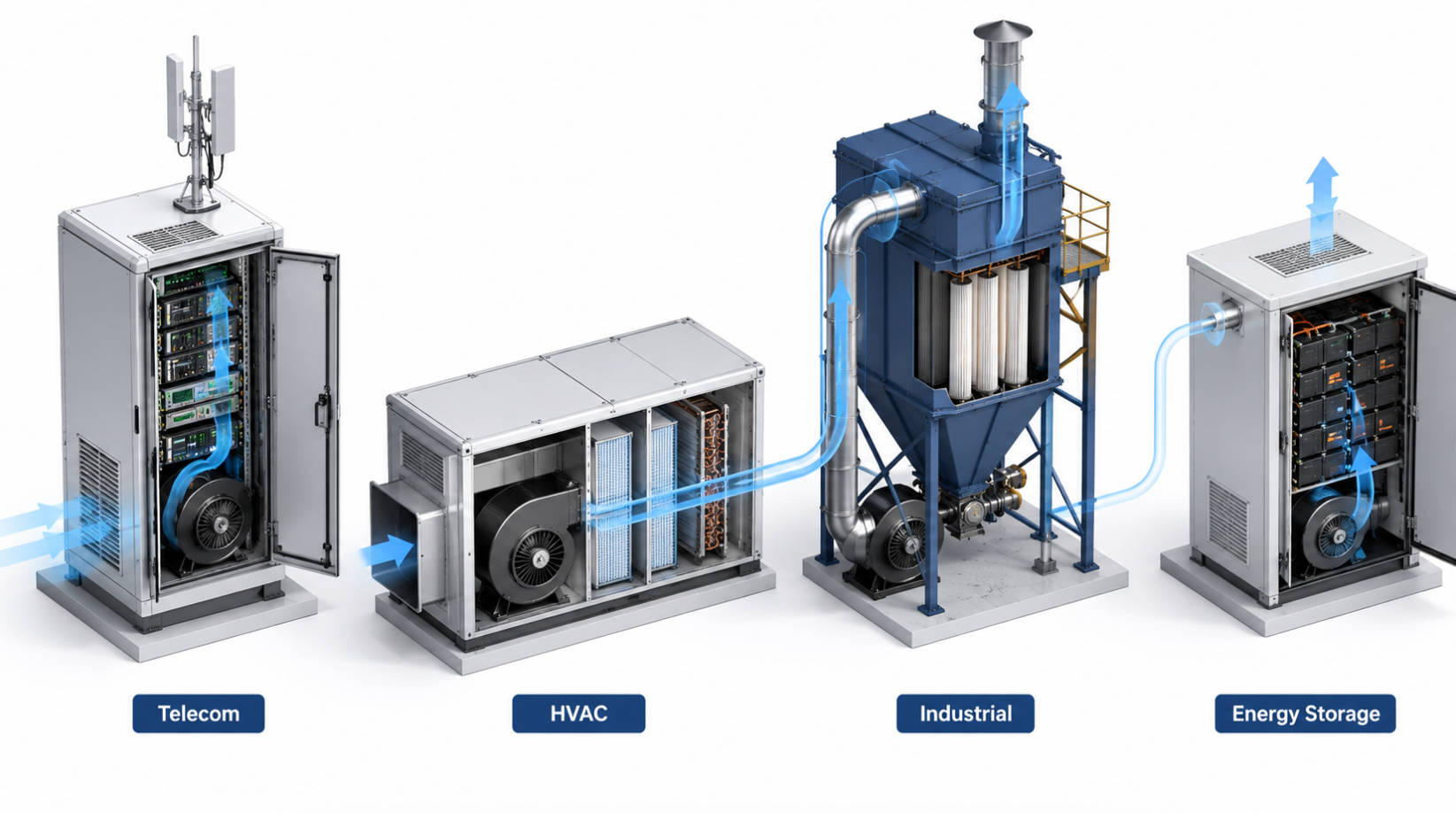
Centrifugal fans are widely used in air handling units, fan coil units, exhaust systems, inline duct fans, and commercial ventilation equipment. In these applications, air must travel through ductwork, dampers, coils, louvers, and filters.
The longer or more complex the duct path becomes, the more static pressure the fan must overcome. A correctly selected centrifugal fan provides the airflow needed at the system's true pressure requirement rather than only in free-air conditions.
Common HVAC uses include:
- Supply-air and return-air systems
- Bathroom and kitchen exhaust
- Fresh-air ventilation
- Heat-recovery ventilation units
- Air purification equipment
- Fan coil units and air handlers
- Commercial building pressurization
In factories and process environments, centrifugal fans can remove heat, fumes, vapors, dust, and airborne contaminants. They may also supply combustion air, circulate process air, or support drying and material-handling operations.
The appropriate impeller and housing material depend on the air stream. Clean air, humid air, corrosive gases, elevated temperatures, and particulate-laden air create very different design requirements.
Typical industrial applications include:
| Application | Why a Centrifugal Fan Is Used | Key Selection Concern |
|---|---|---|
| Dust collection | Moves air through hoods, ductwork, and filters | Abrasion resistance and static pressure |
| Welding fume extraction | Pulls contaminated air through capture systems | Airflow at hood and duct resistance |
| Drying equipment | Delivers controlled air through heaters or chambers | Temperature capability and uniformity |
| Battery equipment | Removes heat or gases from enclosures | Safety requirements and corrosion resistance |
| Machine tools | Extracts mist, chips, or process heat | Filtration loss and maintenance |
| Cleanroom systems | Supports filtered, controlled airflow | Stability, vibration, and low noise |
Medical devices, analyzers, laboratory instruments, oxygen systems, and diagnostic equipment often require compact and controllable airflow. Depending on the design, the fan may cool electronics, move air through filters, support pneumatic functions, or create controlled internal pressure.
In this category, manufacturers should examine airflow repeatability, noise, vibration, EMC compatibility, electrical safety, and long-term reliability. A fan is a small component, but a failure can affect the availability of an entire device.
Electric vehicles, charging systems, battery packs, energy-storage cabinets, and power electronics depend on effective thermal management. Centrifugal blowers are often used where air must pass through tightly arranged cells, ducts, cooling modules, or electronic assemblies.
The operating environment can be demanding. Engineers may need to consider vibration, wide temperature variation, moisture, dust, voltage fluctuation, speed control, and protection against reverse polarity or locked-rotor conditions.
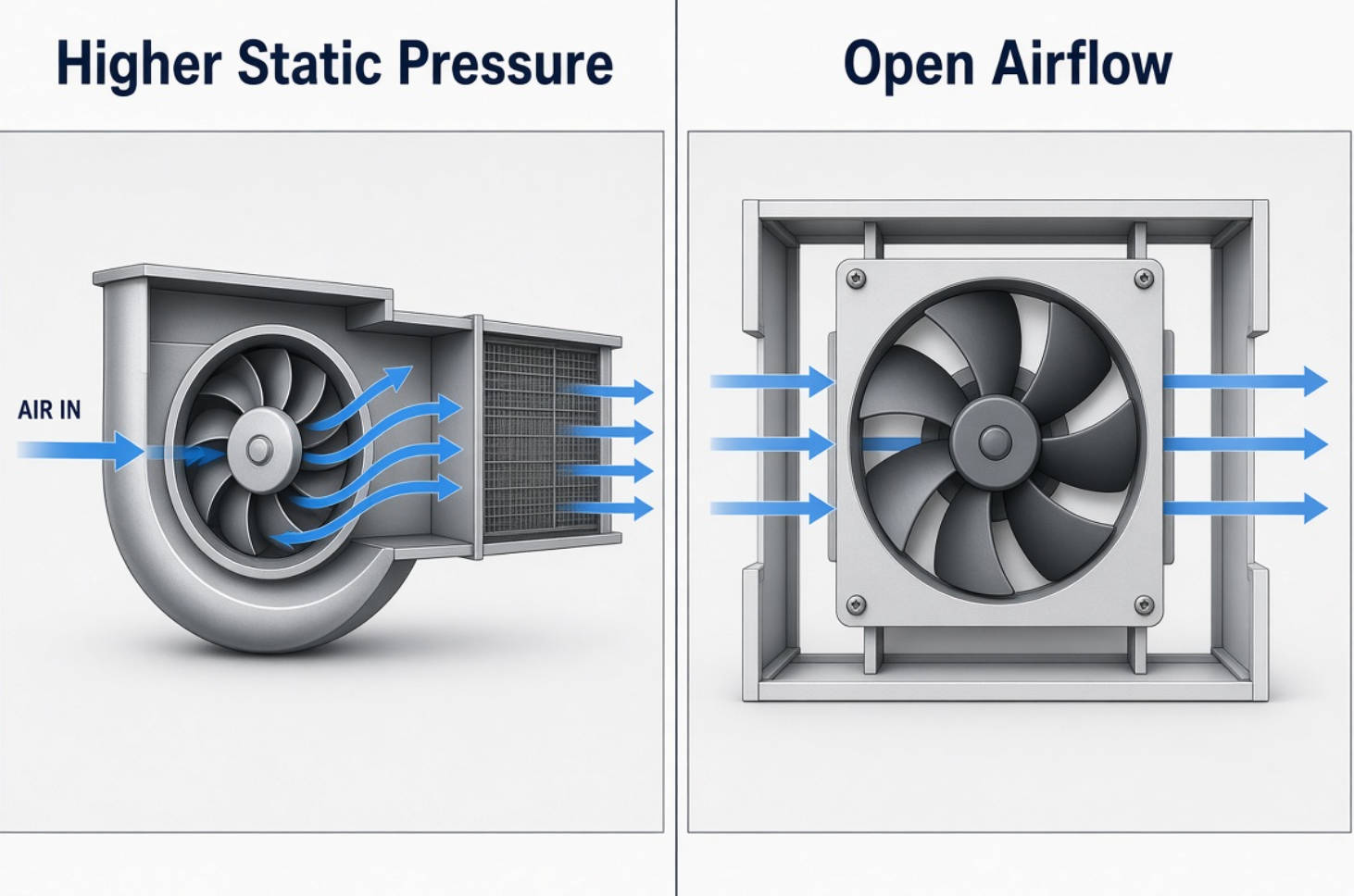
The choice depends on the balance between airflow, static pressure, installation space, noise, and system resistance.
| Feature | Centrifugal Fan | Axial Fan |
|---|---|---|
| Airflow direction | Air enters axially and exits radially | Air enters and exits parallel to the shaft |
| Static-pressure capability | Generally stronger for restrictive systems | Usually better for low-resistance airflow |
| Best for | Ducts, filters, heatsinks, cabinets, blowers | Open ventilation, panel cooling, free-air use |
| Installation shape | Often requires a housing or blower structure | Often compact and straightforward to mount |
| Typical electronic use | High-pressure cabinet and channel cooling | General enclosure ventilation |
| Main selection risk | Oversizing can increase noise and energy use | Performance may collapse under resistance |
A common mistake is to select an axial fan based only on its maximum airflow rating, then install it behind a dense filter or restrictive grille. The fan may deliver far less air than expected because the resistance moves the operating point away from the advertised free-air condition.
A centrifugal fan is usually the better option when the cooling path is restrictive. An axial fan can be the better option when the system needs high airflow with minimal pressure loss.
Static pressure is the resistance that a fan must overcome to move air through a system. It comes from every part of the airflow path, including filters, ducts, bends, coils, grilles, dampers, heatsinks, and equipment openings.
The actual operating point is where the fan curve intersects the system-resistance curve. This point determines the real airflow, pressure, speed, and power draw in the installed system.
For this reason, do not select a centrifugal fan from a single "maximum airflow" figure. Ask for a performance curve and confirm performance at the required duty point.
A useful selection request should include:
- Required airflow in CFM or m³/h
- Required static pressure in Pa or in. w.g.
- Available installation space
- Supply voltage and current limit
- Ambient and air-stream temperature
- Noise limit
- Air quality, including dust, moisture, oil mist, or corrosion risk
- Expected operating hours and target service life
- Control method, such as fixed speed, PWM, voltage control, or closed-loop control
Start with the required airflow and static pressure, not the fan size. If the equipment includes a filter, heatsink, duct, or grille, estimate or measure its pressure loss at the required airflow.
For a cooling enclosure, also calculate the heat load. The fan must provide enough airflow to carry heat away while maintaining acceptable component temperatures.
Different wheel designs suit different airflow and pressure conditions.
- Forward-curved impellers are often compact and can provide high airflow at relatively low speeds.
- Backward-curved impellers are commonly chosen for good efficiency and stable performance in many air-handling applications.
- Radial-blade impellers can suit more demanding or particulate-laden air streams, depending on the fan construction.
Do not treat these categories as universal performance guarantees. The final choice should be based on tested curves, material compatibility, operating speed, and the application environment.
For DC centrifugal fans, verify voltage compatibility, speed-control capability, tachometer output, locked-rotor protection, reverse-polarity protection, and alarm functions where required.
For AC fans, evaluate frequency, voltage tolerance, insulation class, bearing system, and expected duty cycle. In export projects, confirm that the electrical specification matches the destination market and end equipment.
Noise does not come only from the fan. Restrictive inlets, sharp bends, poor mounting, vibration, turbulent discharge paths, and dirty filters can all increase acoustic problems.
A lower-speed fan operating near an efficient point is often preferable to a smaller fan forced to operate at high speed. However, the best solution must still meet pressure, space, and cost requirements.
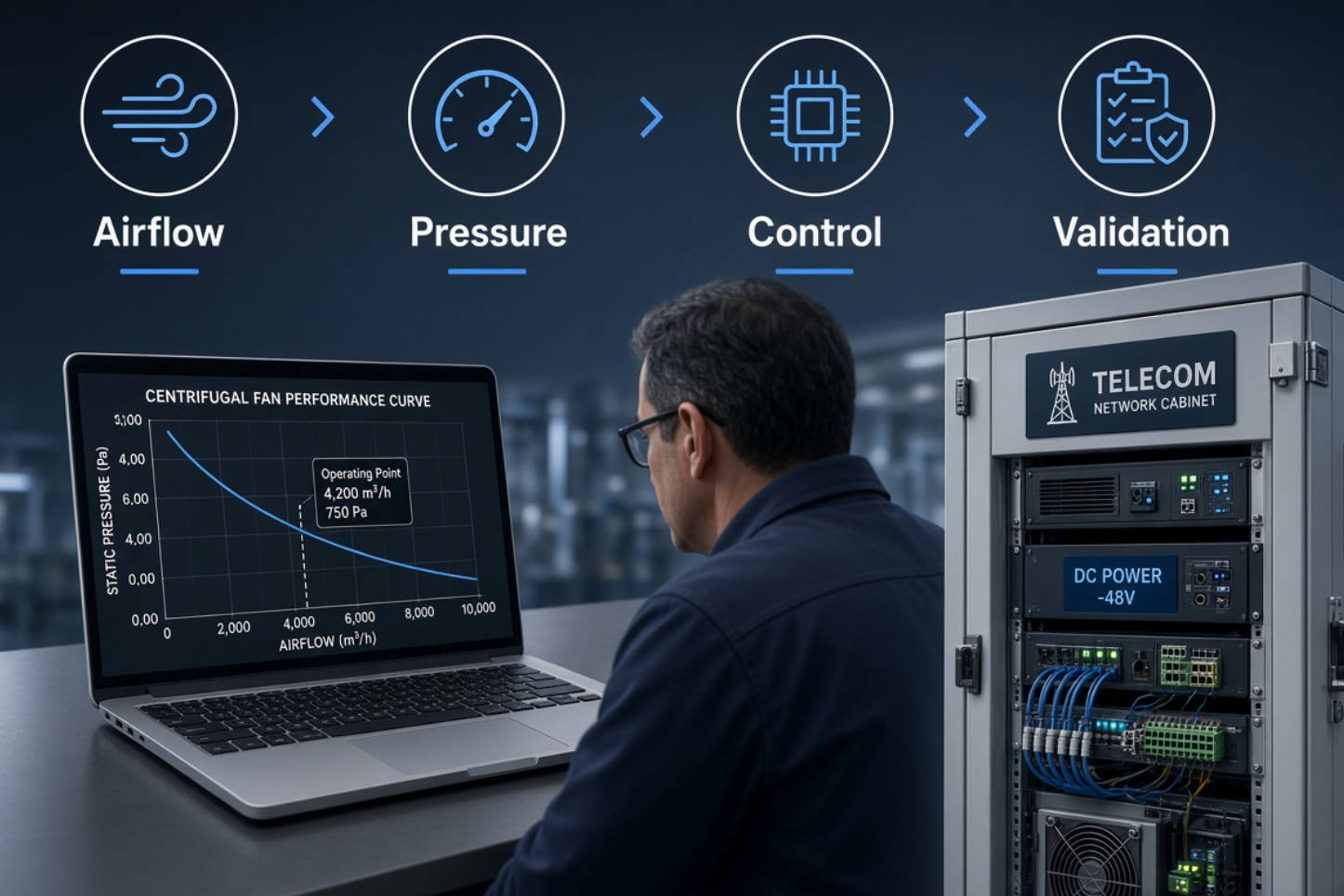
A catalog curve is essential, but it is not the same as final system performance. Test the fan in the real enclosure or duct arrangement whenever the application is critical.
This is particularly important for telecom, medical, power-electronics, and industrial equipment. A reliable cooling design should verify temperature rise, airflow distribution, acoustic performance, fan speed, current draw, and fault response.
Fan speed has a strong effect on performance. For geometrically similar conditions, airflow changes approximately in proportion to speed, pressure changes with the square of speed, and power demand changes with the cube of speed.
This means a modest speed increase can create a much larger increase in power consumption and noise. Conversely, speed control can be an effective way to reduce energy use during partial-load operation.
For example, increasing fan speed by 20% can increase airflow by roughly 20%, but the pressure requirement rises much more quickly and power demand can rise by about 73%. This is why engineers should avoid using speed as a quick fix without checking motor capacity, fan limits, noise, and the operating curve.
A centrifugal fan should be selected as part of a complete airflow system, not as an isolated component. Capital Technology Co., Limited supports customers with DC fans, AC fans, centrifugal blowers, and thermal-management solutions for demanding equipment applications.
With the CAPITAL brand and distribution support for SANYO DENKI products, our team can help evaluate airflow requirements, static pressure, control needs, reliability expectations, and installation constraints. We also understand the importance of stable supply and consistent specifications for OEM and industrial projects.
If you are designing a telecom cabinet, power system, industrial machine, electronic enclosure, or ventilation product, send us your airflow target, pressure requirement, voltage, dimensions, and operating environment. Our technical team can help you identify a centrifugal fan solution that matches the real application.
A centrifugal fan moves air or gas through systems with resistance. Common uses include cabinet cooling, HVAC ducting, industrial exhaust, filtration, dust collection, medical equipment, and power-electronics cooling.
Neither is always better. Centrifugal fans are generally more suitable for higher-static-pressure systems, while axial fans are often effective for high-volume airflow in low-resistance, open-air applications.
Yes. Centrifugal fans and blowers are widely used in electronics cooling because they can push air through restrictive paths such as heatsinks, filters, narrow vents, and densely populated enclosures.
First define the required airflow and static pressure. Then select a fan whose tested performance curve reaches that duty point within a stable operating range. Consider voltage, dimensions, noise, temperature, and control requirements as well.
Common causes include excessive speed, restrictive inlet conditions, turbulent discharge airflow, vibration, poor mounting, damaged bearings, dirty filters, and operation near an unstable region of the fan curve.
Provide airflow, static pressure, voltage, frequency or DC input, available dimensions, ambient temperature, air-stream condition, noise target, mounting arrangement, operating hours, and any required control or alarm functions.
1. Air Movement and Control Association International. ANSI/AMCA Standard 214-21: Test Procedure for Calculating Fan Energy Index for Commercial and Industrial Fans and Blowers. [Read the standard]. [amca]
2. U.S. Department of Energy / National Renewable Energy Laboratory. Improving Fan System Performance: A Sourcebook for Industry. [Read the sourcebook record]. [osti]
3. Greenheck Fan Corporation. The Basics of Fan Performance Tables, Fan Curves, System Resistance Curves, and Fan Laws. [Read the application guide]. [webcontent.greenheck]
4. International Organization for Standardization. ISO 5801: Fans — Performance Testing Using Standardized Airways. [Learn about ISO 5801].
5. Air Movement and Control Association International. AMCA Certified Ratings Program. [Learn about certified ratings].


