From idea to market-ready product, our NPI solutions make every stage easier, faster. Discover How We Help
Help Center

Views: 216 Author: Capital Technology Publish Time: 2026-11-08 Origin: Site
Content Menu
● What Does "Wired Backwards" Mean for a Centrifugal Fan?
>> Backward-Curved Blades Do Not Mean Backward Rotation
● What Happens When a Centrifugal Fan Runs Backwards?
>> Airflow and Static Pressure Fall
>> Motor Loading Can Become Abnormal
>> Noise and Vibration May Signal a Problem
● Can Reversing DC Fan Polarity Reverse Its Rotation?
● How to Check Centrifugal Fan Rotation Safely
>> 1. Identify the Exact Fan and Motor
>> 2. Isolate Power Before Inspection
>> 3. Locate the Rotation Arrow
>> 4. Use the Approved Momentary Rotation Check
>> 5. Correct the Cause, Then Verify Again
● How to Verify Cooling Performance After Correcting Rotation
● A Practical Diagnostic Framework for Equipment Teams
>> Is the Electrical Interface Correct?
>> Is the Mechanical Arrangement Correct?
>> Does the Installed Operating Point Meet the Requirement?
● How to Prevent Reverse-Wiring Problems in Production
● Choosing the Right Cooling Partner
>> 1. Will a centrifugal fan blow air backwards if its motor reverses?
>> 2. Can a backward-curved centrifugal fan run in either direction?
>> 3. Does reversing a DC fan's wires reverse airflow?
>> 4. Will reverse rotation always increase current?
>> 5. Can I swap two wires to correct any fan?
>> 6. What if airflow is still low after rotation is corrected?
When a centrifugal fan is wired backwards, it may still move air, but it will not necessarily deliver the airflow or static pressure your equipment needs. Depending on the motor, incorrect wiring can cause reverse rotation, prevent startup, or damage electronic components. Understanding the difference is essential before changing any connections.
For equipment engineers and maintenance teams, the important question is not simply whether the impeller spins. It is whether the fan rotates correctly and delivers sufficient cooling under actual operating conditions.
This guide explains centrifugal fan reverse rotation, distinguishes AC and DC wiring problems, and provides a practical framework for diagnosis and prevention.
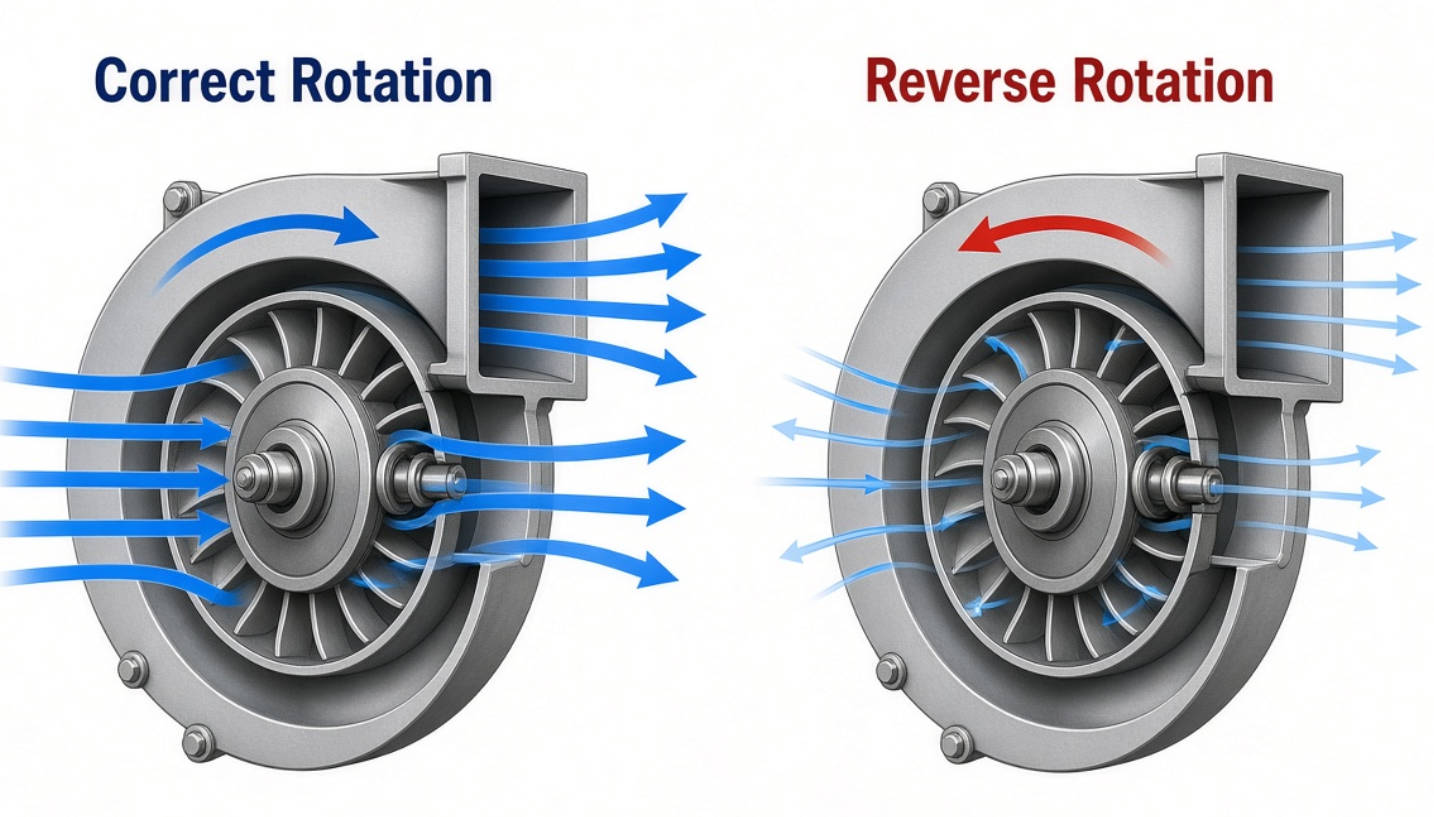
A centrifugal fan draws air into the impeller inlet and accelerates it outward. Its blades, inlet geometry, and housing are designed for a specified rotational direction.
However, "wired backwards" describes different electrical problems.
| Fan or motor type | What incorrect wiring may cause | Correct approach |
|---|---|---|
| Three-phase AC induction motor | Reversed rotation from incorrect phase sequence | Have qualified personnel verify phase connections |
| Single-phase AC motor | Incorrect operation or failure to start, depending on its construction | Follow the specific motor wiring diagram |
| Brushless DC fan | No operation or possible electronic damage from reversed supply polarity | Verify power polarity and connector pinout |
| Electronically commutated fan | Behavior determined by its controller and configuration | Follow the complete fan assembly instructions |
For a conventional three-phase motor, exchanging two phases can reverse rotation. That instruction must not be applied indiscriminately to electronically controlled equipment. Some integrated motor-drive assemblies require direction changes through programming instead.
A backward-curved centrifugal fan is designed with blade tips that curve away from its intended direction of rotation.
It is not a fan designed to operate incorrectly.
Forward-curved and backward-curved impellers must both rotate in their specified direction. Use the manufacturer's rotation arrow and stated viewing position rather than guessing from blade appearance.
A reverse-running centrifugal fan can still discharge air. Feeling air at the outlet therefore does not establish that rotation is correct.
The impeller no longer interacts with the air as intended, reducing useful performance. In an installed system, that can mean inadequate airflow through filters, heat exchangers, ducts, or densely packed electronics.
Manufacturer instructions explicitly warn that an incorrectly rotating fan may move some air while failing to perform as designed.
Do not assume every reversed fan retains the same percentage of rated airflow. The result depends on the impeller, housing, speed, and connected system.
Incorrect rotation can increase motor loading in some centrifugal fan assemblies, potentially causing overheating or motor burnout. However, a universal current increase cannot be assigned to every fan.
The practical rule is to measure voltage, current, speed, and delivered performance rather than infer the electrical condition from airflow alone. Greenheck's centrifugal fan instructions identify incorrect rotation as a possible cause of reduced performance and increased motor loading.
A fan drawing apparently acceptable current should not be treated as proof of adequate cooling.
Unexpected noise or vibration deserves investigation, but it is not a direction indicator by itself.
Poor inlet conditions, uneven airflow, installation geometry, and mechanical problems can also produce undesirable sound or loading. A nearby elbow or restricted inlet may reduce performance even when rotation is correct.
Compare observations with the equipment's normal operating condition and verify the rotation arrow directly.
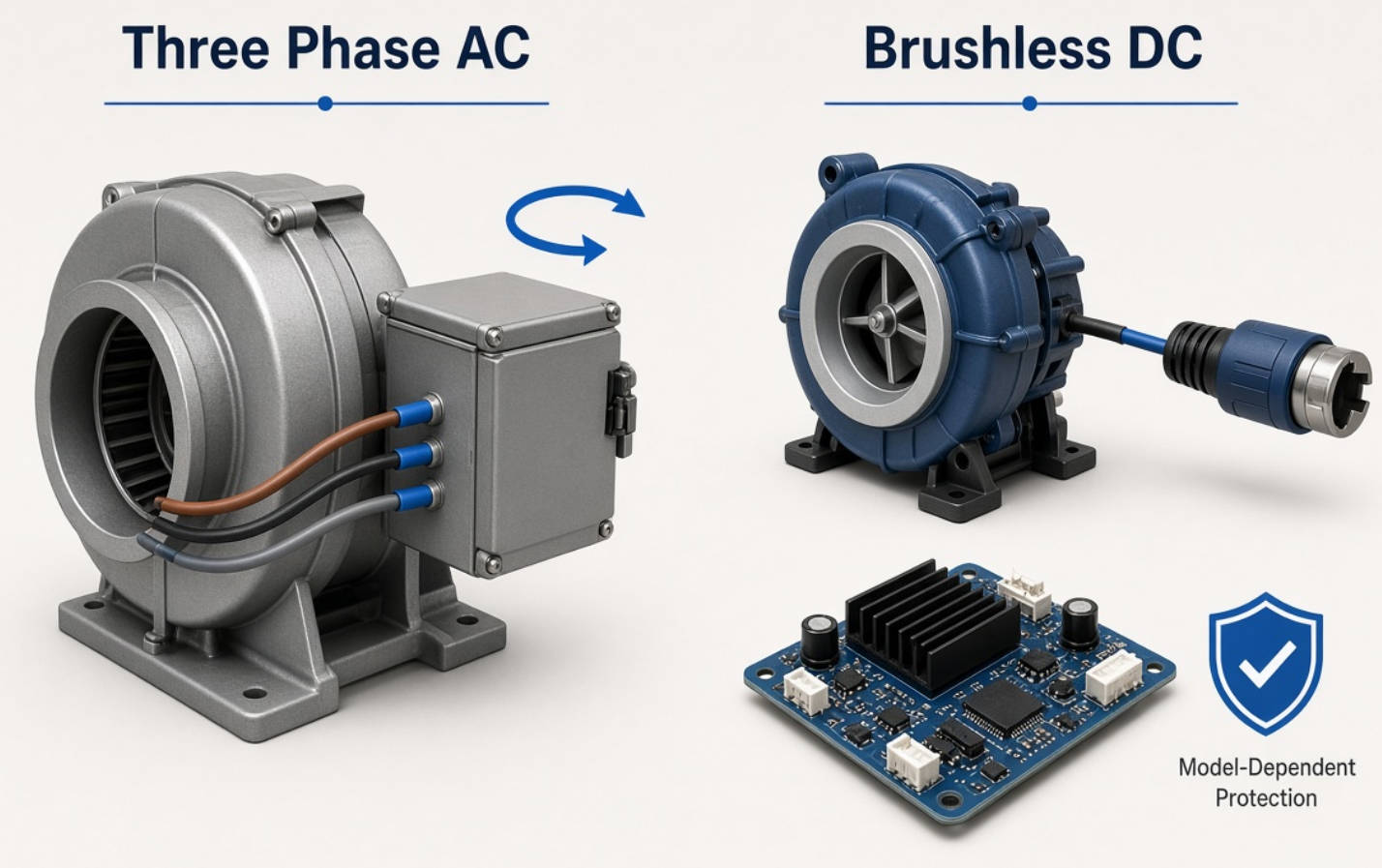
For a typical brushless DC cooling fan, reversing the positive and negative supply wires is not an approved way to reverse airflow.
SANYO DENKI explains that its reverse-polarity protection cuts off current when the power leads are reversed. Normal operation resumes after the leads are connected correctly. However, connected sensor or PWM control wires can create conditions in which reversed power connections cause damage.
This distinction matters in compact centrifugal blowers and equipment cooling assemblies. Their internal electronic circuits make them different from simple motors whose direction can be changed by reversing supply polarity.
Before applying power, confirm:
- Rated voltage and allowable operating range.
- Positive and negative supply terminals.
- Connector orientation and pin numbering.
- Tachometer or alarm output.
- PWM control input and signal requirements.
- Any documented direction-control function.
Wire color alone is not a substitute for a model-specific drawing.
Purpose-built reversible-flow fans are a separate category. SANYO DENKI offers models with controlled airflow reversal and nearly equivalent performance in both directions. Their existence does not make an ordinary centrifugal blower reversible.
The objective is to establish correct rotation without exposing personnel to electrical hazards or moving components.
Electrical inspection and rewiring should be performed by qualified personnel using the equipment manufacturer's procedures.
Record the fan model, motor nameplate, supply type, and controller details.
Determine whether the assembly uses a three-phase motor, a single-phase motor, a brushless DC motor, or an integrated electronic drive.
Obtain the correct wiring diagram before troubleshooting. Similar housings and connectors do not guarantee identical electrical arrangements.
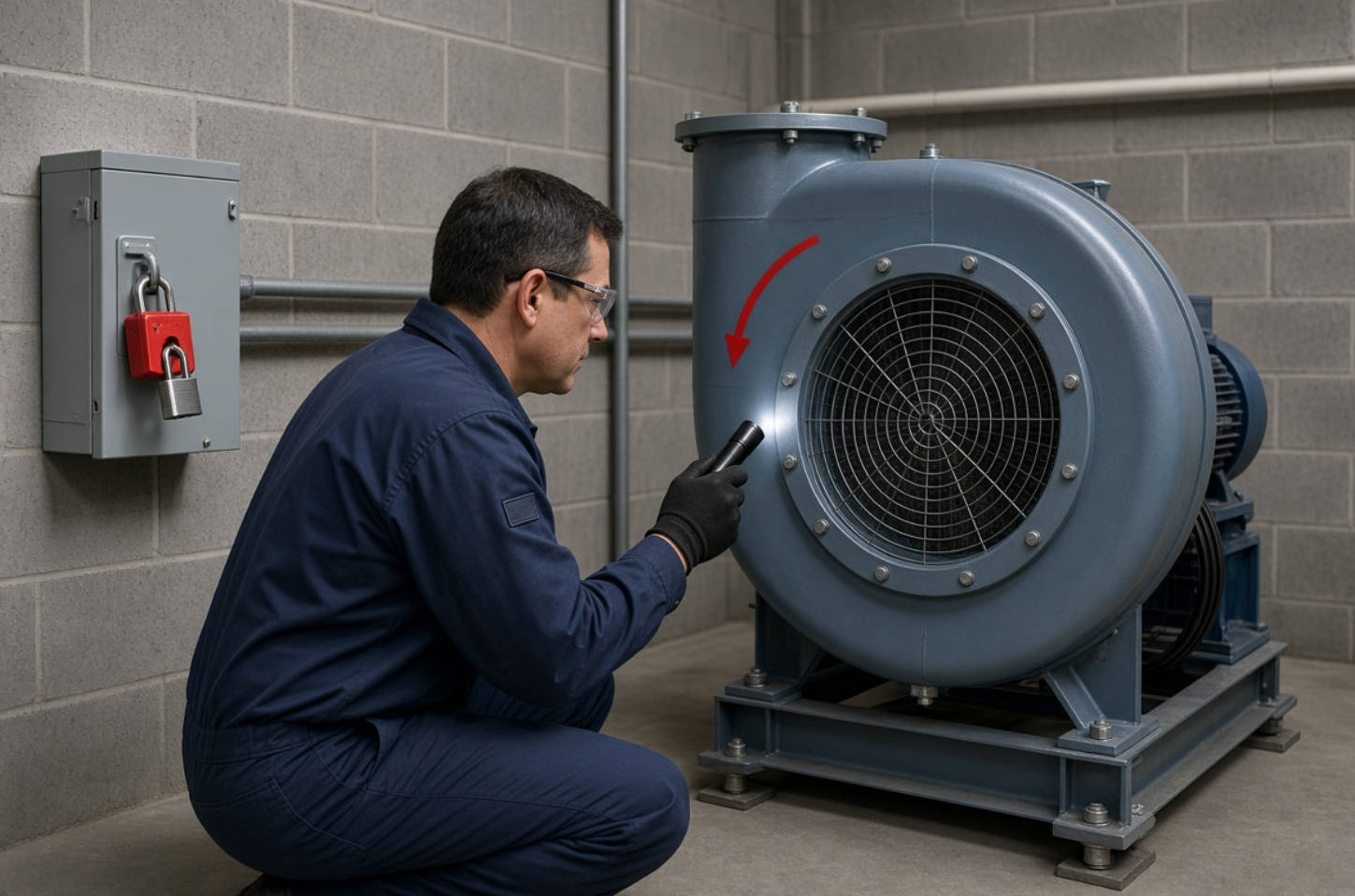
Disconnect and lock out power before touching wiring or accessing the impeller.
Follow the manufacturer's requirements for stored energy and controller discharge. Confirm the wheel has stopped before approaching it; airflow through an installation can cause some fan wheels to freewheel even after electrical power is disconnected.
Inspect for obstruction, rubbing, loose components, and installation damage.
Identify the marked direction and the viewing position used by the manufacturer.
Clockwise viewed from one side appears counterclockwise from the opposite side. A maintenance note that says only "clockwise" is therefore incomplete.
Where possible, record a photograph of the arrow and the associated viewing position for future service.
Where the manufacturer permits it, a brief start-and-stop check can establish rotation.
Keep guards and protective arrangements in place as required, maintain a safe observation position, and do not reach toward a moving wheel.
Manufacturer instructions commonly specify momentary energization to check rotation before normal operation.
For a conventional three-phase motor, qualified personnel can generally reverse direction by interchanging two motor supply phases after isolating power.
For a single-phase motor, use its specific wiring diagram. For an integrated electronic assembly, follow its controller instructions rather than assuming a phase swap is appropriate.
After correction, repeat the approved direction check before returning the equipment to service.
Correct rotation is necessary, but it is not the entire acceptance test.
A fan may rotate correctly and still deliver inadequate airflow because of restrictions, leakage, unsuitable duct geometry, or an inappropriate operating speed. Greenheck identifies reverse rotation alongside dirty filters, obstructed inlets, duct problems, and low speed as possible causes of reduced airflow.
A useful commissioning record includes:
| Verification item | What to record |
|---|---|
| Rotation | Direction, viewing position, and arrow confirmation |
| Electrical conditions | Supply voltage and current |
| Speed | Measured RPM or verified tachometer signal |
| Air performance | Airflow and pressure at defined measurement locations |
| Thermal performance | Inlet temperature and critical equipment temperatures |
| Mechanical condition | Rubbing, unusual vibration, and mounting security |
| Controls | Speed command, feedback, and alarm operation |
Compare measurements under equivalent conditions. A test with an open cabinet and clean filters cannot automatically represent operation with closed panels and loaded filters.
For equipment cooling, the decisive result is whether the installed system keeps critical components within their specified temperature limits.
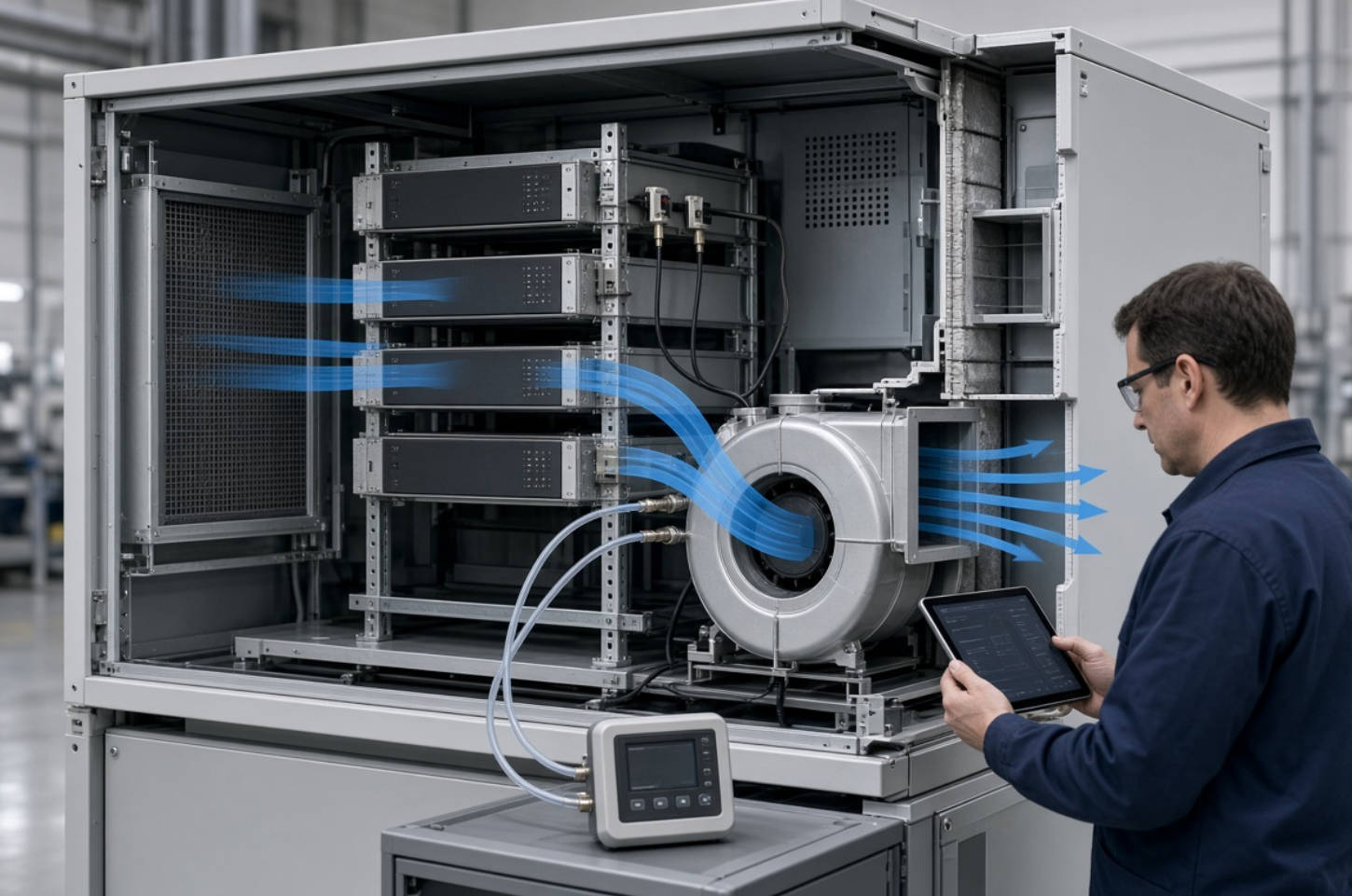
Consider an illustrative cabinet-cooling problem: a replacement blower starts normally, but internal temperatures rise.
Do not assume that a spinning fan proves the replacement is suitable. Equally, do not assume that every cooling shortfall comes from reverse rotation.
Work through three questions.
Check the replacement's voltage, connector pinout, polarity, and control requirements against the approved drawing.
For a DC fan, incorrect PWM or feedback wiring is a different problem from reverse motor rotation.
Verify the impeller direction, inlet clearance, housing orientation, and discharge connection.
Inspect nearby obstructions and abrupt duct transitions. Installation-related system effects can prevent a correctly rotating fan from achieving its expected performance.
A replacement should not be accepted solely because its dimensions and free-air airflow look similar.
Review its pressure–airflow characteristics against the actual restriction in the equipment, then confirm thermal performance in the assembled system.
This framework separates wiring errors from selection errors and installation problems. It also produces more useful evidence for the fan supplier than a report that simply says "airflow is weak."
For manufacturers and purchasing teams, prevention begins with a controlled specification.
Include these items in the approved fan documentation:
1. Exact model number and electrical rating.
2. Connector drawing and numbered pin assignments.
3. Rotation and airflow arrows.
4. Viewing position used to define rotation.
5. Required airflow at the specified pressure.
6. Control and monitoring requirements.
7. Installation orientation and clearance requirements.
8. Production acceptance criteria.
When changing suppliers or approving an alternative model, verify electrical and aerodynamic compatibility separately.
A matching connector does not prove a matching pinout. A matching frame size does not prove a matching operating point.
For repeat production, a documented first-article check helps turn an individual technician's knowledge into a repeatable quality process.
At Capital Technology Co., Limited, our focus is to help customers evaluate the complete cooling requirement rather than select a fan by appearance alone.
Our offering includes DC fans, AC fans, and thermal solutions under our independent CAPITAL brand. We also serve as a principal agent for SANYO DENKI. Our customer supply experience includes ZTE, HUAWEI, and HYTERA.
For replacement or new-design inquiries, provide the existing model number, supply voltage, connector drawing, available installation space, required airflow and pressure, and operating environment.
Contact Capital Technology Co., Limited with those details to discuss a suitable CAPITAL or SANYO DENKI option and the verification steps needed before production approval.
Not necessarily. A centrifugal fan may continue moving air through its outlet while delivering reduced performance. Outlet airflow alone cannot confirm correct rotation; check the marked direction using the manufacturer's procedure.
It should operate only in its specified direction unless the manufacturer explicitly approves otherwise. "Backward-curved" describes blade geometry relative to intended rotation, not permission to reverse the motor.
Not for a typical electronically commutated DC cooling fan. Reversed supply polarity may activate protection or damage the electronics, particularly where sensor or control connections are involved. Use the specified polarity and pinout.
No universal current change applies to every centrifugal fan. Some manufacturer instructions warn of increased loading and possible burnout. Measure the actual electrical conditions and compare them with the assembly's ratings and operating requirements.
No. Interchanging two phases applies to suitable conventional three-phase motors. Single-phase motors require their own diagrams, while some electronically controlled assemblies require direction changes through programming.
Inspect filters, dampers, inlet restrictions, duct geometry, leakage, speed, and impeller condition. Correct rotation eliminates one possible cause, but system resistance and installation effects can still prevent adequate airflow.
1. [Blauberg Motors — “What Happens When a Centrifugal Fan Is Wired Backwards”]. Original article used to establish the topic and identify areas requiring clarification.
2. [Greenheck — Installation, Operation and Maintenance Manual, Model IGX, Document 481153]. Guidance on rotation checks, reduced performance during reverse operation, and motor-specific correction procedures.
3. [Greenheck — Installation, Operation and Maintenance Manual, Model FPB, Document 471833]. Warnings concerning incorrect rotation, reduced air performance, increased motor loading, and possible motor burnout.
4. [Greenheck — Installation, Operation and Maintenance Manual, Model BCSW-FRP, Document 474051]. Rotation viewing convention, momentary direction checks, and three-phase motor reversal.
5. [Greenheck — “Understanding Fan System Effects”]. Explanation of inlet and outlet installation effects, duct geometry, and performance losses.
6. [Greenheck — “Centrifugal Blowers FAQs”]. Diagnostic causes of low airflow, including reverse rotation, restrictions, low speed, and mechanical conditions.
7. [SANYO DENKI — San Ace Technical Material: “Motor Protection”]. Reverse-polarity protection and the damage risks associated with connected sensor and PWM wires.
8. [SANYO DENKI — “Reversible Flow Fan”]. Purpose-built reversible airflow products and their distinction from ordinary unidirectional fans.
9. [Greenheck — CPF ABB ERH Motor Drive Quick Start, Document 488578]. Example of an integrated assembly requiring programmed direction changes rather than motor-phase swapping.
10. [Greenheck — Installation, Operation and Maintenance Manual, Models TCB, TCBRU and TCBRS, Document 456557]. Startup safety, freewheeling hazards, rotation checks, and wiring precautions.


