From idea to market-ready product, our NPI solutions make every stage easier, faster. Discover How We Help
Help Center

Views: 278 Author: Capital Publish Time: 2026-07-16 Origin: Site
Content Menu
● Where Propeller Fans Are Commonly Used
● Propeller vs Axial Fans: Key Technical Differences
● DC Axial Fans vs AC Axial Fans
● How to Decide Between Propeller and Axial Fans
>> Step 1: Define Airflow and Pressure Requirements
>> Step 2: Assess the Flow Path
>> Step 3: Match Fan Type to Environment
>> Step 4: Decide Between DC and AC Drive
>> Step 5: Evaluate Reliability and Support
● Cooling a Telecom Outdoor Cabinet
● Practical Design Considerations for Fan Integration
● Long‑Term Trends in Fan Selection
● FAQs
>> Q1: Are propeller fans suitable for use with ducts and filters?
>> Q2: Why do many equipment manufacturers prefer axial fans for enclosed systems?
>> Q3: When should DC axial fans be chosen over AC axial fans?
>> Q4: Can propeller fans and axial fans be mixed in the same facility?
>> Q5: What is the first step in evaluating which fan type to use?
Choosing between propeller fans and axial fans is a critical design decision in any system where airflow, reliability, and energy performance matter. From large industrial halls to compact telecom cabinets, the type of fan you select will directly influence equipment temperature, noise levels, and long‑term operating costs.
This article provides a practical, experience‑driven overview of both fan types, explains how DC and AC variants fit into real projects, and offers a simple framework to help engineers, purchasers, and project managers select the most suitable cooling solution for their application.

Propeller fans are open‑frame fans with blades attached to a central hub, designed primarily to move large volumes of air in environments with very low resistance. They are visually similar to the propeller of an aircraft: long, narrow blades rotating in free air, with no enclosing housing.
Because the construction is simple, propeller fans are generally lightweight and cost‑effective. They are often mounted directly to walls, frames, or support structures where the airflow can disperse freely without the constraints of ducts or filters.
From a performance perspective, propeller fans are characterized by high air volume and low static pressure. They excel where air can move freely and where there is no need to push air through restrictive elements such as deep heat‑sink fins or complex ductwork.
In practice, propeller fans are widely used in applications where wide‑area circulation is more important than precise airflow control. Typical use cases include:
- Ventilation in factories, workshops, and warehouses
- Air circulation in agricultural facilities and greenhouses
- Cooling of large radiators or condensers in open environments
- General mixing of air in large spaces with minimal obstructions
In these scenarios, designers prioritize coverage area and simplicity. As long as the space is relatively open and there are no dense filters or long ducts, propeller fans can deliver an impressive amount of airflow at a relatively low cost.
Axial fans belong to the same broad family of axial‑flow devices but are built with a distinct mechanical design. The blades are enclosed in a cylindrical or rectangular housing that shapes the airflow and improves pressure performance. The blades themselves are typically shorter and wider than those of propeller fans, tuned to deliver a balance of airflow and static pressure.
The housing is crucial for performance. It helps guide air into and out of the fan, reduces bypass and recirculation around the blade tips, and allows the fan to generate higher static pressure than a comparable open‑frame propeller fan. This makes axial fans far more suitable for systems where the airflow path includes restrictions.
Unlike open propeller fans, axial fans are designed to integrate directly into ducts, cabinets, and equipment enclosures. They are often supplied with mounting flanges, guards, and accessories that simplify installation and servicing in more complex systems.
Axial fans are used wherever there is a need to overcome resistance and direct air along a defined path. Common applications include:
- Ventilation systems that rely on ducts, filters, and grilles
- Heat exchangers and cooling coils in HVAC units
- Cooling towers and industrial process equipment
- Electronic cabinets and enclosures in telecom and industrial automation
- Automotive engine compartments and other confined spaces
In these environments, designers do not simply need airflow; they need controlled, reliable airflow that can move through filters, bends, and obstructions. Axial fans are preferred when static pressure requirements are moderate to high and the airflow must be directed to specific components or zones.
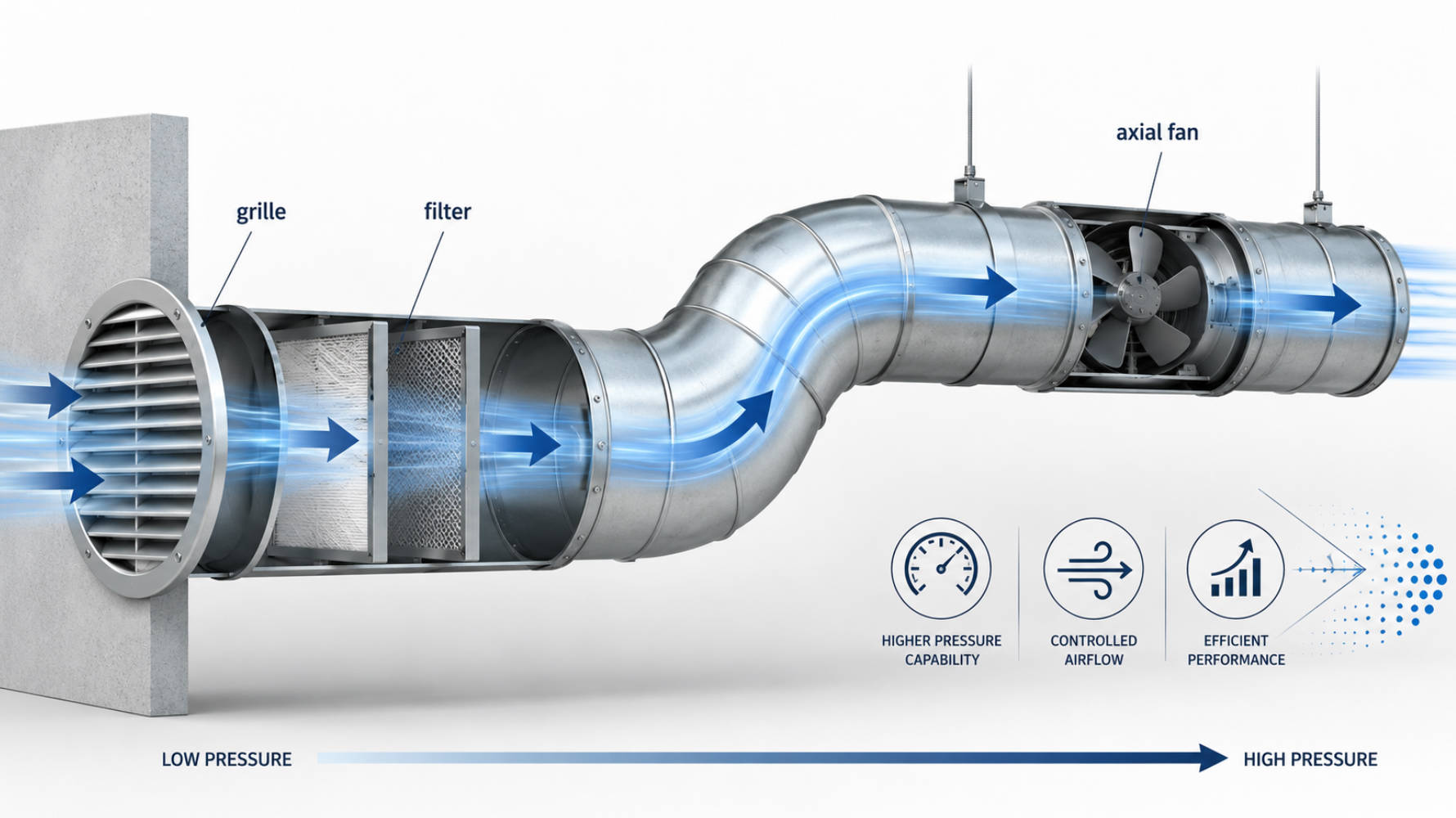
Although propeller and axial fans both move air along the axis of rotation, their design differences lead to distinct performance characteristics. Understanding these differences helps avoid misapplication and ensures that the selected fan type aligns with the project's real requirements.
Propeller fans generate broad, unconstrained airflow. Because there is no housing, air spreads out quickly and is less focused. This is ideal for wide‑area circulation but less effective when air needs to be channeled through a defined flow path.
Axial fans, on the other hand, guide air through their housing. The result is a more concentrated, predictable airflow stream that can be directed through ducts or toward specific components, with less loss from air spilling around the blades.
Static pressure describes the ability of a fan to push air against resistance. Propeller fans are optimized for low static pressure conditions and lose performance rapidly once significant resistance is added. Axial fans are designed to generate higher static pressure and maintain airflow through filters, coils, or complex duct arrangements.
In practical terms, propeller fans are appropriate when resistance is negligible, while axial fans are better suited to systems where air encounters multiple obstacles.
Propeller fans are usually mounted in open locations with basic supports. Axial fans are designed for more structured integration. They can be flange‑mounted to walls, duct sections, cabinet panels, or heat exchanger frames and often come with guards and accessories that simplify safe installation in confined, serviceable spaces.
Beyond mechanical design, fan selection today often involves choosing between DC and AC drive technologies. This choice has significant implications for control, efficiency, and compatibility with other system components.
DC axial fans are commonly used in applications where control and monitoring are important. They typically operate from low‑voltage DC power and can be controlled via pulse‑width modulation or variable voltage, allowing fine adjustment of fan speed.
This controllability enables dynamic thermal management: fan speed can increase during high load or high ambient conditions and decrease when demand is low. The result is reduced energy consumption, lower noise at partial load, and better alignment between cooling capacity and real operating conditions.
DC fans also often provide tachometer outputs and other signals that allow system monitoring. This makes them suitable for applications that require real‑time information on fan status and performance, such as telecom equipment and sophisticated industrial automation systems.
AC axial fans run directly from AC mains and are widely used in simpler or more traditional systems. Their main strengths are straightforward wiring, robust construction, and proven reliability in environments where fan speed and control requirements are stable.
In many ventilation and HVAC applications, a fixed‑speed AC axial fan provides sufficient airflow and pressure at a lower upfront cost. Where there is no requirement for fine control or integrated monitoring, AC fans remain a practical choice.
Selecting the optimal fan type begins with understanding the airflow requirements of the system and the physical constraints of the installation. A structured approach makes this process more transparent and reduces the risk of oversizing or misapplication.
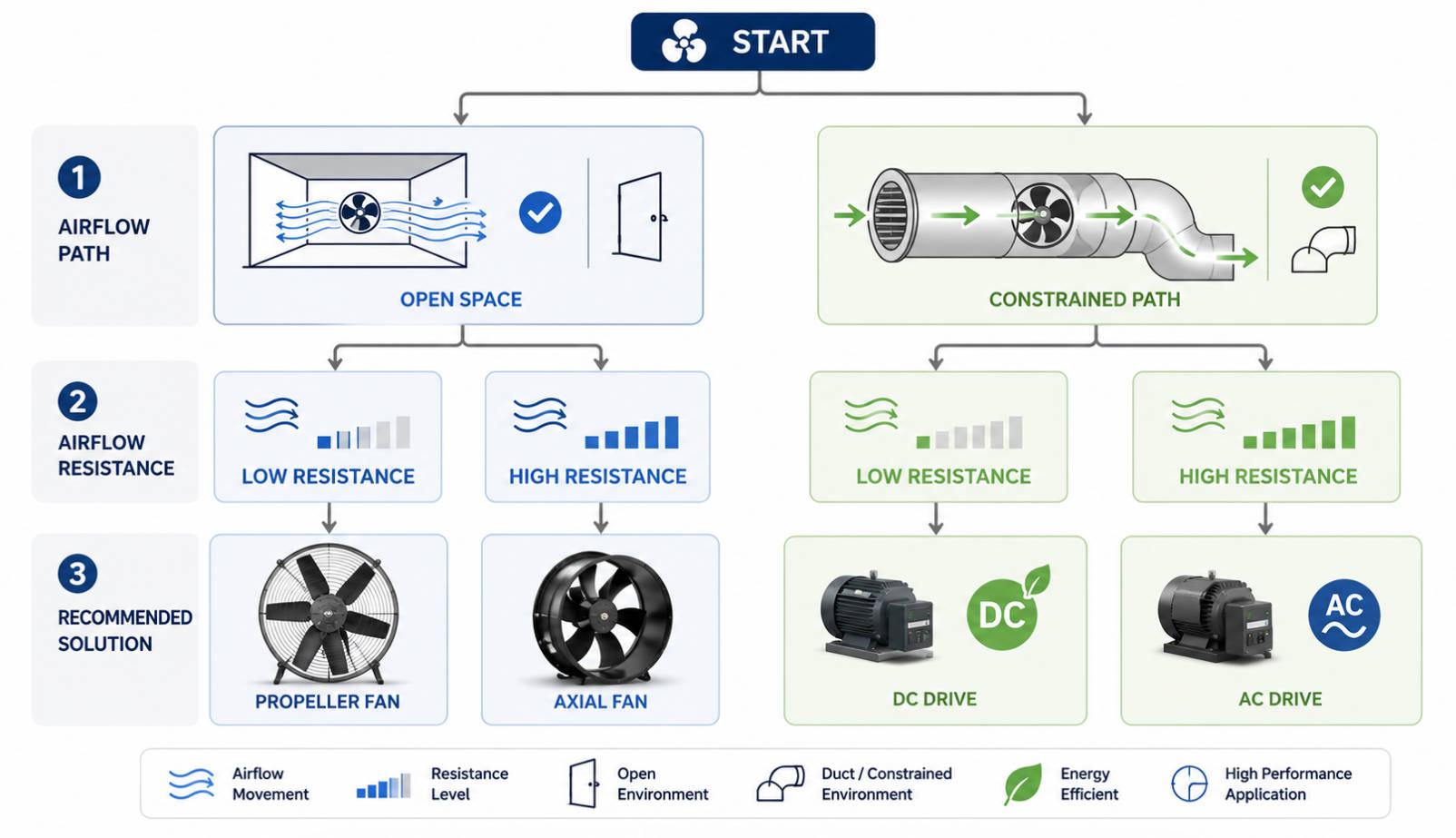
Start by estimating the airflow needed to remove the heat generated by the equipment or process. Then identify any elements that add resistance, such as filters, grilles, duct runs, or dense heat‑sink fins. The combination of airflow and static pressure requirements will guide the type of fan you need.
Determine whether the flow path is open or constrained. Wide, open spaces with minimal obstacles favor propeller fans. Constrained paths, such as ducts, cabinets, and enclosed radiators, favor axial fans with higher static pressure capability.
For large halls, workshops, and agricultural environments, propeller fans are usually sufficient and economical. For telecom cabinets, industrial enclosures, HVAC systems, and any equipment with filters or ductwork, axial fans are typically the more appropriate choice.
Consider the available power supply, desired control features, and monitoring needs. If you require variable speed, integrated monitoring, or compatibility with intelligent control systems, DC axial fans will generally be a better fit. If you need simple, fixed‑speed operation from an AC mains supply, AC fans can offer a robust and straightforward solution.
Beyond pure performance, reliability and long‑term support are critical. Look at the expected operating hours, ambient conditions, and maintenance practices. Favor fan solutions that offer documented reliability data, clear specifications, and accessible technical support from established manufacturers and solution providers.
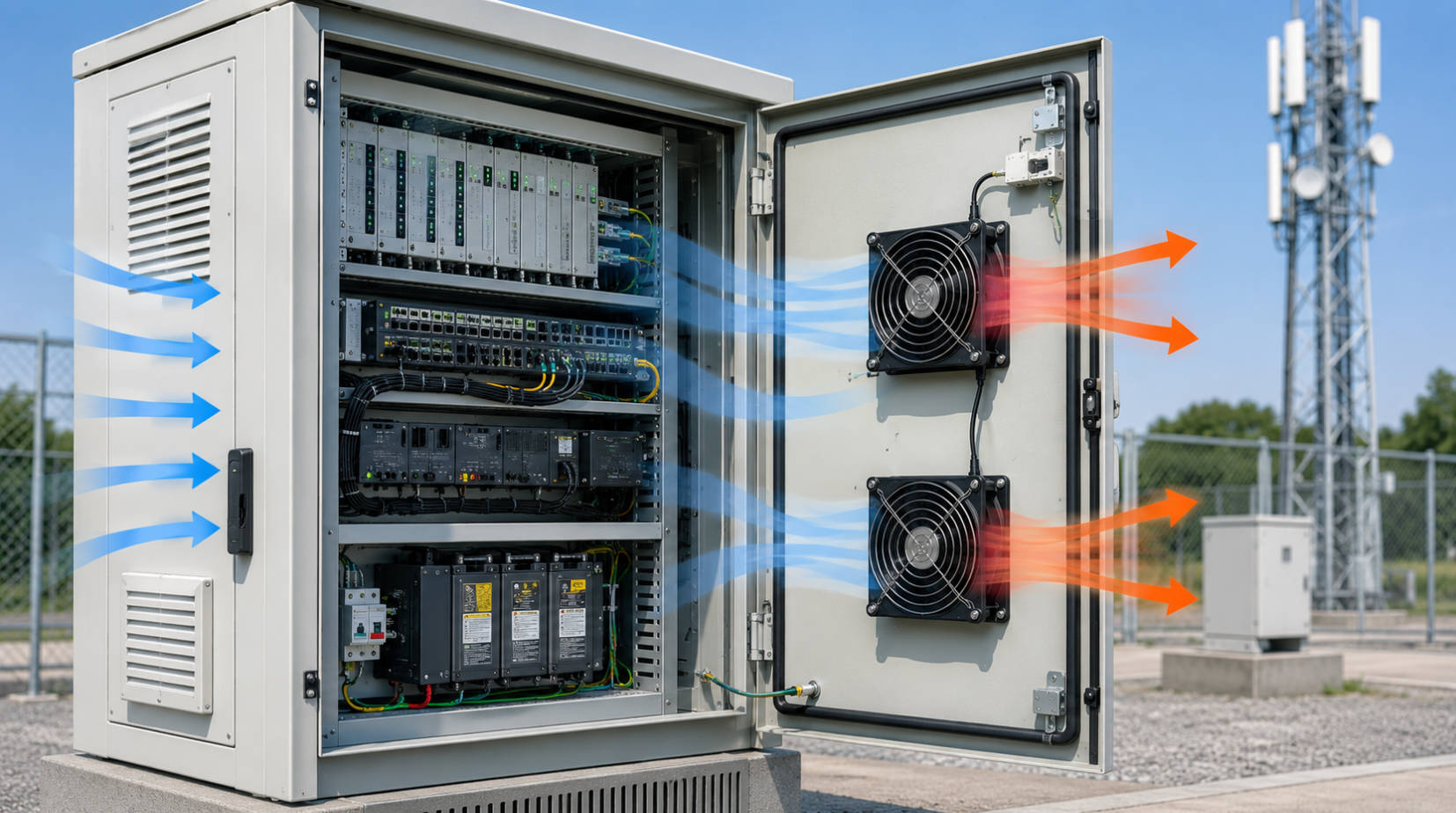
To illustrate these principles, consider a telecom outdoor cabinet hosting high‑density electronics and operating in variable environmental conditions. The cabinet may include dust filters, sound‑absorbing materials, cable routing constraints, and limited space for airflow.
In such a system, an open propeller fan would struggle to maintain adequate flow through filters and around internal obstructions. Instead, axial fans with higher static pressure are better suited to pushing air through the cabinet and across critical components.
If the cabinet is part of a modern network infrastructure, DC axial fans are often selected. They enable variable‑speed control based on temperature and load, and provide monitoring outputs that can be integrated into supervisory control systems. This approach supports stable equipment temperatures, energy‑conscious operation, and simple diagnostics when maintenance is required.
The performance of a fan is strongly influenced by how it is integrated into the overall system. Good mechanical and layout practices help maximize cooling efficiency and minimize operational issues.
Focus on factors such as:
- Adequate clearance for air at the fan inlet and outlet
- Smooth transitions from the fan housing into ducts or cabinet spaces
- Minimizing sharp bends or abrupt restrictions in the airflow path
- Using filters and grilles designed to limit unnecessary pressure drop
- Providing clear markings for airflow direction to aid maintenance and installation
Using these considerations during the design phase allows the chosen fan type to operate close to its intended performance and improves the reliability of the system over time.
Across many industrial and communication sectors, there is a noticeable shift toward more sophisticated cooling strategies. Systems are designed not only for initial thermal performance but for ongoing efficiency, ease of monitoring, and predictable maintenance.
This has led to greater adoption of advanced axial fan solutions, particularly DC variants with adjustable speed and integrated signals. Propeller fans continue to play a key role in large‑volume ventilation and open‑space cooling, but more complex equipment increasingly relies on axial fans that can deliver focused, controllable airflow in constrained environments.
Reliable partnerships between solution providers and established fan brands support this trend by combining high‑quality components, engineering expertise, and application‑specific design support.
Choosing between propeller fans and axial fans is about matching the characteristics of each type to the realities of your project. Propeller fans are simple, cost‑effective, and ideal for open environments with minimal resistance. Axial fans, especially in DC and AC variants, are designed for more demanding applications where airflow must be directed through ducts, filters, and dense assemblies.
A clear understanding of airflow and pressure requirements, combined with thoughtful integration and long‑term reliability planning, will help ensure that the selected fan solution delivers stable temperatures, reasonable energy consumption, and dependable operation throughout the life of the equipment.
Propeller fans are generally not recommended for systems with significant ducting or filtration because they are optimized for low static pressure conditions. Once resistance increases, their airflow drops rapidly and they struggle to maintain performance.
Axial fans provide higher static pressure and more controlled airflow, making them better suited to pushing air through the restrictive elements commonly found in enclosed systems such as cabinets, coils, and filters.
DC axial fans are typically chosen when variable speed, precise control, and monitoring are important. They are common in telecom and industrial equipment where temperature and load can fluctuate and where system monitoring is standard practice.
Yes. It is common to use propeller fans for large, open‑space ventilation and axial fans for localized cooling of equipment, cabinets, or specific process sections. Each fan type is applied where its strengths match the airflow requirements.
The first step is to quantify the required airflow and identify all sources of resistance in the system. Once airflow and static pressure requirements are known, it becomes much easier to select between propeller and axial fans and then choose suitable DC or AC variants.
1. Blauberg Motors. "The Difference Between Propeller Fans and Axial Fans." [Link]
2. Google for Developers. "Creating Helpful, Reliable, People‑First Content." [Link]
3. QuickCreator. "E‑E‑A‑T for Technical Content: 2025 Best Practice Guide." [Link]
4. Blue Noda. "HVLS Fan Manufacturer SEO Case Study." [Link]
5. Roberts Siegers. "SEO for Manufacturers: Strategies to Dominate Search in 2025." [Link]
6. Keywordseverywhere. "Google E‑E‑A‑T Guidelines: an Overview (2026 Playbook)." [Link]


