From idea to market-ready product, our NPI solutions make every stage easier, faster. Discover How We Help
Help Center

Views: 222 Author: Capital Technology Publish Time: 2026-05-20 Origin: Site
Fan airflow is the invisible backbone of every reliable electronic system, from compact communication base stations to large industrial control cabinets. As a manufacturer focused on DC fans, AC fans and complete thermal solutions, I have spent years helping OEMs balance airflow, noise, efficiency and reliability in real-world projects. In this guide, I will explain fan airflow in plain language, share field-tested lessons from projects with leading telecom and industrial customers, and show how to choose and apply fans for better cooling and longer system life. [made-in-china]Why Fan Airflow Matters
Effective airflow is the primary mechanism that carries heat away from sensitive components and out of the enclosure, preventing overheating, system instability and premature failures. In practical terms, good airflow means:
- Lower operating temperatures for CPUs, power supplies, RF modules and drives
- Higher mean time between failures (MTBF) for entire systems
- More stable performance under peak loads and harsh environments
In modern networks and industrial systems, cooling is not just about safety; it directly affects uptime, warranty risk and energy costs, which is why leading brands such as ZTE, HUAWEI and HYTERA pay close attention to airflow design when selecting fan suppliers. [made-in-china]
To design or troubleshoot any cooling system, you need to understand two fundamental fan metrics: airflow and static pressure.
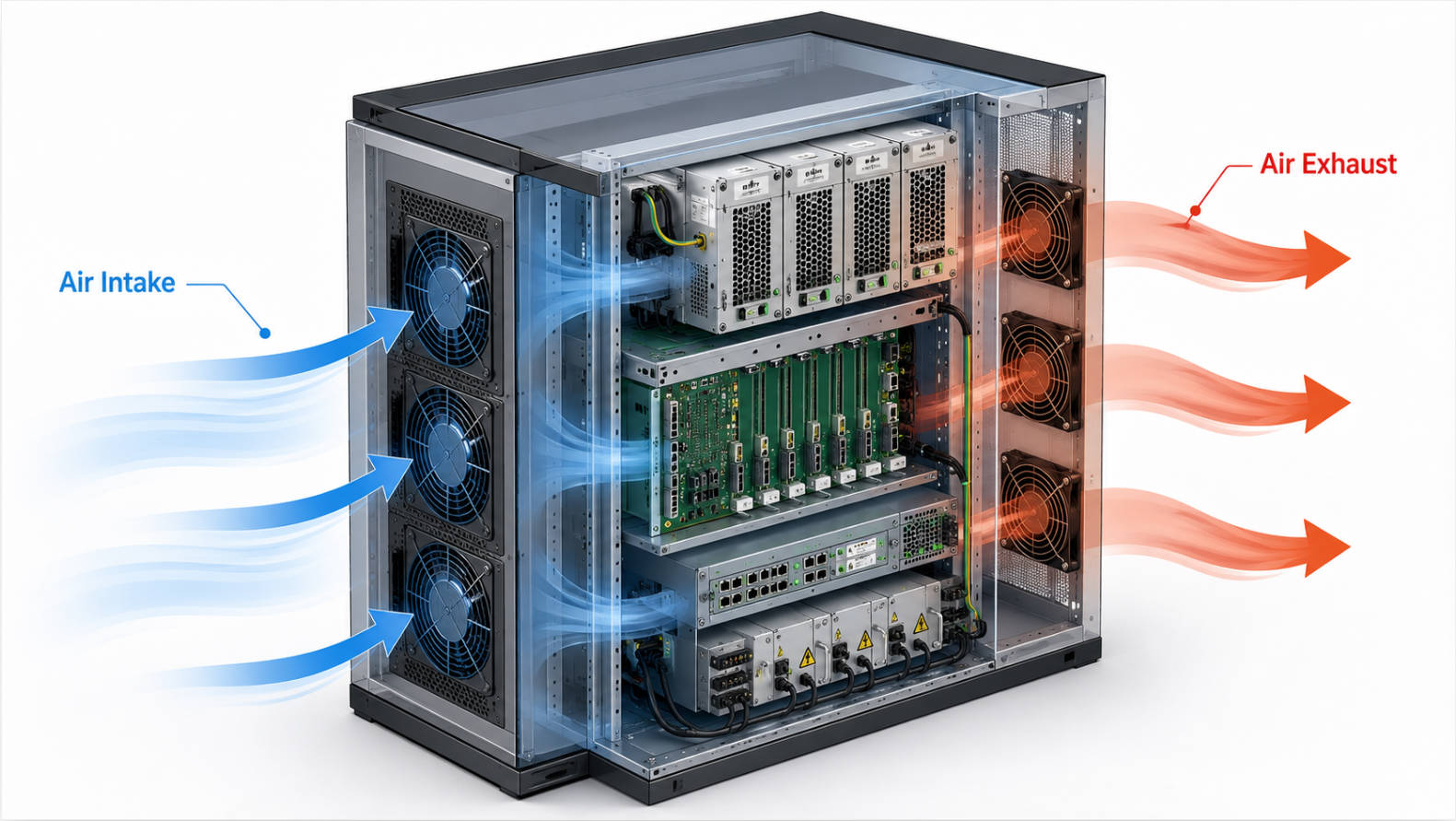
Airflow is the volume of air a fan can move in a given time, usually expressed as CFM (Cubic Feet per Minute). Imagine air moving freely through an open case or vent with almost no obstruction:
- Higher CFM = more air exchanged per minute
- Best suited for low-resistance paths, such as cabinet exhaust or open ventilation panels
If your application is mainly about exchanging warm air with cooler ambient air in a relatively open space, a high-airflow fan is usually the right starting point.
Static pressure measures how much force the fan can apply to push air through resistance, such as dense heatsinks, filters, radiators or narrow ducts. It is typically expressed in mmH2O or inH2O.
A simple analogy:
- Airflow (CFM) = volume of water coming out of a hose
- Static pressure (mmH2O) = strength of the water jet when you restrict the opening
High static-pressure fans are designed with steeper, more aggressive blade profiles and strong motors so they can maintain airflow even when the system impedance is high.
| Metric | Measures | Best For |
|---|---|---|
| Airflow (CFM) | Volume of air moved | Open environments, case ventilation, low-resistance paths |
| Static Pressure (mmH2O) | Force of air against load | Heatsinks, filters, radiators, dense boards, long ducts |
In real projects, the question is not "Which is better?" but "What balance of airflow and static pressure matches my system impedance and space constraints?"
Fan performance is not random; it is the result of deliberate engineering choices around mechanical design, motor design and system conditions.
The geometry of the blades largely determines whether a fan is optimized for airflow or static pressure.
- High-airflow blades: Fewer, wider blades with gentler curvature move a large volume of air with relatively low resistance.
- High static-pressure blades: More numerous blades with steeper, more aggressive curvature build up pressure behind the fan to push air through dense obstacles.
Blade pitch (the angle between the blade and the hub) also matters: higher pitch generally increases both static pressure and noise, while lower pitch favors quieter operation at the cost of pressure capability.

Fan speed, measured in RPM (Revolutions Per Minute), directly affects both airflow and static pressure: as RPM increases, both typically rise. However:
- Higher RPM = more airflow and pressure
- But also more power consumption and acoustic noise
This is why industrial-grade fans rely on robust motors with high-quality copper cores, which can maintain stable RPM under load while minimizing vibration and long-term drift. For OEMs, this stability is critical when fans run 24/7 in telecom base stations or industrial cabinets.
Most catalogue CFM values are measured in "free air" with almost no resistance—the famous number on the box. In the real world, airflow paths include:
- Intake: filters, grilles, finger guards
- Internal: heatsinks, PCBs, cables, power modules
- Exhaust: outlet grilles, ducting and louvers
Each element adds resistance, or system impedance, which reduces actual airflow. This explains why a fan that looks strong on paper can perform poorly when mounted behind a clogged filter or dense radiator. Matching fan selection to realistic impedance conditions is one of the most common issues we solve with customers during design reviews.
Two fans with similar CFM and static pressure on paper can behave very differently after months of operation. From an engineering and field-service perspective, several additional metrics matter.
Noise is more than a comfort issue; it is often a proxy for mechanical balance and efficiency. Poorly designed blades or low-cost bearings can create tonal noise, vibration and early bearing failures. High-quality fans use:
- Optimized blade shapes for smoother airflow
- Precision-balanced rotors
- Advanced bearings, such as dual ball bearings, for lower noise and longer lifespan
For large deployments—such as racks of telecom equipment or energy storage systems—small gains in CFM per watt translate into noticeable operating cost savings. Efficient fans deliver required airflow with minimal electrical input, which also reduces thermal stress on the fan motor itself.
In critical applications, downtime is more expensive than the fan itself. Manufacturers use MTBF (Mean Time Between Failures) and L10 life (time by which 10% of fans may fail) to communicate expected reliability under specific temperatures and loads. For outdoor, automotive or industrial environments, it is essential to select fans with:
- High MTBF ratings at elevated temperatures
- Bearings and materials suitable for wide temperature ranges and vibration
Over the years, we have supported many engineers and buyers across telecom, industrial automation and power electronics. Below are typical scenarios and how airflow decisions play out in practice. [made-in-china]
Telecom cabinets are high-density, high-impedance environments with limited space and strict uptime requirements. Air must flow through tightly packed boards, filters and RF shielding.
- Use high static-pressure DC fans in a push–pull configuration along defined cold and hot aisles.
- Prioritize fans with long MTBF, high-temperature capability and redundancy options.
- Consider intelligent speed control (PWM) to balance cooling needs and noise during lower loads.
Industrial control panels host PLCs, drives and power modules in sealed or semi-sealed enclosures, sometimes outdoors.
- Select AC or DC axial fans with adequate static pressure to move air across internal heat sources and through filters.
- Validate that fans can operate reliably in wide temperature ranges and under dust or vibration.
- Design airflow paths that avoid dead zones near critical components.
When cooling a CPU, IGBT module or liquid radiator, the airflow path is highly restricted.
- Prefer high static-pressure fans that can sustain airflow through narrow fin spacing.
- Check fan curves at likely operating pressures instead of relying only on free-air CFM.
- Use ducting or baffles to make sure air passes fully through the fin stack rather than leaking around it.
One of the most powerful tools in fan selection is the fan performance curve, which plots static pressure against airflow.
- The Y-axis shows static pressure.
- The X-axis shows airflow (CFM).
- At zero airflow (blocked outlet), the fan delivers its maximum static pressure.
- At zero static pressure (open air), it reaches its maximum airflow.

In practice:
1. Estimate or calculate your system's impedance curve (pressure vs airflow).
2. Overlay it on the fan curve.
3. The intersection is the actual operating point—the airflow you can realistically expect in your application.
This approach is especially important in high-value projects such as telecom or industrial systems, where underestimating impedance can lead to overheating, derating or expensive redesigns late in the development cycle.
As a source manufacturer of DC and AC fans and a thermal solutions provider, Capital Technology Co., Limited integrates these principles into the design and selection of every product. We operate our own brand CAPITAL and serve as a key distributor for SANYO DENKI, combining flexible customization with globally recognized quality. [made-in-china]
From an engineering standpoint, we focus on:
- Stable airflow under load: High-quality copper-core motors and robust frames help maintain consistent airflow and reduce vibration over long service periods. [made-in-china]
- Environmental resilience: Fans are selected and validated for wide working temperature ranges and challenging environments, supporting applications in telecom, transportation and industrial automation.
- Application-specific solutions: We provide AC, DC and EC fans in axial and radial formats with configurable RPM ranges so customers can match airflow, pressure, noise and efficiency to their exact needs. [made-in-china]
Working with demanding OEMs such as ZTE, HUAWEI and HYTERA has pushed us to continuously refine our quality control, performance testing and project support processes. This field experience directly feeds back into our fan selection advice and thermal design recommendations. [made-in-china]
In many projects, customers ask us to improve cooling without changing the basic mechanical design. Often, significant gains are possible through small, practical steps.
1. Clean filters and blades regularly
Dust is one of the most common performance killers. It increases system impedance and reduces blade efficiency, sometimes cutting effective CFM by a large margin.
2. Organize cables and harnesses
Poor cable routing can block airflow channels inside enclosures. Using cable ties and defined paths reduces turbulence and dead spots.
3. Ensure intake and exhaust clearance
Fans need space on both sides to "breathe". Placing cabinets too close to walls or stacking equipment tightly can trap hot air and reduce net airflow.
4. Verify fan orientation
Most fans include arrows showing the airflow and rotation direction. Ensuring consistent intake and exhaust orientation (push–pull or front–rear) is a simple but often overlooked step.
Through onsite inspections with customers, we have seen these basic measures lower component temperatures and extend fan lifetimes, often without changing the fan model.
To make this practical, here is a simple process we use when advising engineers and buyers on fan selection.
1. Define thermal targets
Identify critical components and their maximum temperature limits, then determine allowable temperature rise inside the enclosure.
2. Estimate heat load
Sum the power dissipation of all major components. This gives a baseline for required airflow to remove that heat under typical ambient conditions.
3. Assess mechanical constraints
Measure available space for fans, grille sizes, filter locations and duct lengths. These define physical limits and likely impedance.
4. Choose airflow path strategy
Decide on front-to-back, bottom-to-top or side-to-side airflow. Design clear intake and exhaust paths with minimal recirculation.
5. Select candidate fans
Shortlist AC, DC or EC fans based on voltage, size, expected static pressure and reliability requirements. Use fan curves to predict performance under load.
6. Validate and refine
Prototype the system, measure temperatures under worst-case conditions and adjust fan RPM, number of fans or filter design as needed.
Following this structured method not only reduces design risk but also provides documentation that buyers and QA teams can audit and approve.

In one telecom cabinet project similar to those used by major communication equipment providers, the initial design relied on high-airflow fans measured in free air. During field testing, temperatures near power modules remained above the specified limit, even though calculated CFM seemed sufficient.
The root cause was:
- Dense filter media at the intake
- Tight component spacing
- Exhaust grilles with limited open area
By switching to higher static-pressure DC fans, optimizing the filter material and slightly increasing grille open area, the operating point on the fan curve shifted to higher real airflow. Component temperatures dropped into the safe range while maintaining acceptable noise levels, and no major mechanical redesign was required.
This type of adjustment is typical in late-stage validation and demonstrates why combining theoretical airflow, real impedance and field feedback is essential for reliable cooling design.
To enhance user understanding and support both engineers and non-technical stakeholders, consider adding visuals at strategic points in the article:
- Diagram of airflow vs static pressure curves near the fan performance curve section, showing operating points.
- Exploded view of airflow path for a typical cabinet or control panel, highlighting intake, flow around components and exhaust.
- Comparison illustration of blade shapes for airflow-optimized vs static-pressure-optimized fans.
- Photo or 3D rendering of a real installation (telecom cabinet or industrial panel) with airflow arrows to bridge theory and practice.
Designing reliable airflow is both an engineering challenge and a strategic decision. If you are working on a new cabinet, base station, industrial panel or other heat-sensitive system and need application-specific fan selection, thermal validation or customized fan solutions, you can reach out to our engineering team.
As a source manufacturer of DC and AC fans, owner of the CAPITAL brand and key partner of SANYO DENKI, we can help you:
- Analyze your current airflow design
- Select suitable AC, DC or EC fans based on your requirements
- Customize parameters such as size, RPM, control interface and protection level
- Support long-term supply and quality consistency for your projects [made-in-china]
You can contact us to discuss your application, request technical documentation or arrange sample evaluation for your next project.
If your airflow path is mostly open, such as a lightly obstructed cabinet or simple exhaust vent, a high-airflow fan is usually sufficient and often quieter. If air must pass through dense heatsinks, filters or narrow ducts, you should prioritize high static-pressure fans, as they can maintain airflow against higher resistance.
Catalogue CFM values are often measured in free air and do not account for system impedance from filters, grilles, heatsinks and internal components. In real conditions, effective airflow can be much lower. Reviewing the airflow path, reducing obstructions and selecting fans based on performance curves at realistic pressures usually resolves this issue.
The ideal interval depends on dust levels and operating hours, but we often recommend inspection every few months for 24/7 systems. In dusty environments, more frequent cleaning is necessary. Visual inspection of filters and listening for unusual fan noise are good practical indicators.
DC fans typically offer finer speed control, better integration with control systems and higher energy efficiency, which makes them popular in telecom and industrial electronics. AC fans can be a good fit for simpler systems with stable mains supply. The best choice depends on your voltage, control and reliability requirements. [made-in-china]
To receive an accurate recommendation, share your heat load, enclosure dimensions, target component temperatures, ambient conditions, available fan size and voltage, as well as whether filters or special sealing are required. The more detail you provide, the easier it is for the supplier to suggest suitable AC, DC or EC fan models and airflow strategies. [made-in-china]
1. ACDCFAN – "The Science of Cooling: A Deep Dive into Fan Airflow" (original article content).
2. Capital Technology Co., Limited – company information and product positioning on DC/AC fans and thermal solutions. [made-in-china]
3. iO Digital – "Google E-E-A-T: creating content that puts people first" (E-E-A-T framework and best practices). [iodigital]
4. Copy.ai – "Make E-E-A-T Work for You: SEO Credibility, Simplified" (guidelines on demonstrating expertise and trust in content). [copy]
5. 85Sixty – "How AI Query Fan-Out Is Reshaping SEO in 2026" (recommendations on topic clustering, headings, tables and FAQ structures for modern SEO). [85sixty]


