From idea to market-ready product, our NPI solutions make every stage easier, faster. Discover How We Help
Help Center

Views: 222 Author: Capital Technology Publish Time: 2026-05-16 Origin: Site
As a thermal solution manufacturer working daily with DC fans, AC fans, and customized impellers, I have seen repeatedly that the blade design decides at least half of your cooling performance, noise level, and lifetime cost. From the number of blades to the material you choose, every decision feeds directly into real-world outcomes in telecom base stations, servers, power supplies, and industrial cabinets. [tbcsupply]
In an era of rising power density and tighter energy regulations, fan blade design is no longer a trivial mechanical detail—it is a core part of your thermal strategy. Whether you are designing a 5G base station, a telecom power supply, or an industrial controller, the fan blade geometry largely determines: [gagner-toomey]
- Airflow pattern (volume and direction)
- Static pressure (ability to push air through filters, fins, and grills)
- Acoustic profile (noise spectrum, not just decibel level)
- Energy consumption and motor loading
In fan design, the blade (impeller) is the component that converts motor torque into airflow. Different fan blade types are engineered for different combinations of airflow, pressure, noise, and cost, and choosing the wrong one often leads to overheating, unexpected noise complaints, or inflated operating costs. [tbcsupply]
Axial fan blades are the most common choice in electronics cooling, telecom equipment, and IT cabinets because they move air parallel to the fan shaft and deliver high airflow with relatively low static pressure. They are the typical form used by DC brushless fans and compact AC axial fans. [tbcsupply]
Key characteristics:
- Air moves straight through in line with the axis
- Best for open or low-resistance systems, such as cabinet ventilation, power supply cooling with low fin density, and general enclosure exhaust
- Usually feature an airfoil-shaped cross-section, similar to an aircraft wing, to improve efficiency and reduce turbulence. [bcbsales.com]
Propeller fan blades are essentially large axial blades with wider chords, optimized to move a large volume of air in free space. [tbcsupply]
They are typically used for:
- Warehouse and factory ventilation
- Large panel cooling where duct losses are minimal
Expert notes:
- Advantages: Very good air volume per cost, simple structure, easy maintenance
- Trade-offs: Often noisier and provide low static pressure, which means they are not ideal behind dense filters or heat sinks. [tbcsupply]
For CAPAC/DC applications like telecom or server fans, pure propeller designs are less common; instead, we use more optimized axial profiles with specific pitch and hub ratios for the equipment.
Tube axial fans place axial blades inside a cylindrical housing (fan tube) to stabilize and guide airflow. This configuration is common where you need directed flow and reduced turbulence.
Typical applications:
- Computer cooling fans and compact DC blowers
- Air conditioning indoor units and ducted ventilation lines
Expert notes:
- Housing reduces air recirculation and turbulence, improving usable airflow and lowering noise for the same power input. [bcbsales.com]
- Tube axial designs are widely used where airflow rates of roughly 50–500 CFM are required in relatively quiet environments such as offices and residential equipment.
Where to use images:
Insert a labeled diagram of an axial fan showing airflow along the axis and another visual comparing propeller vs tube axial designs to help non-specialists understand flow direction.
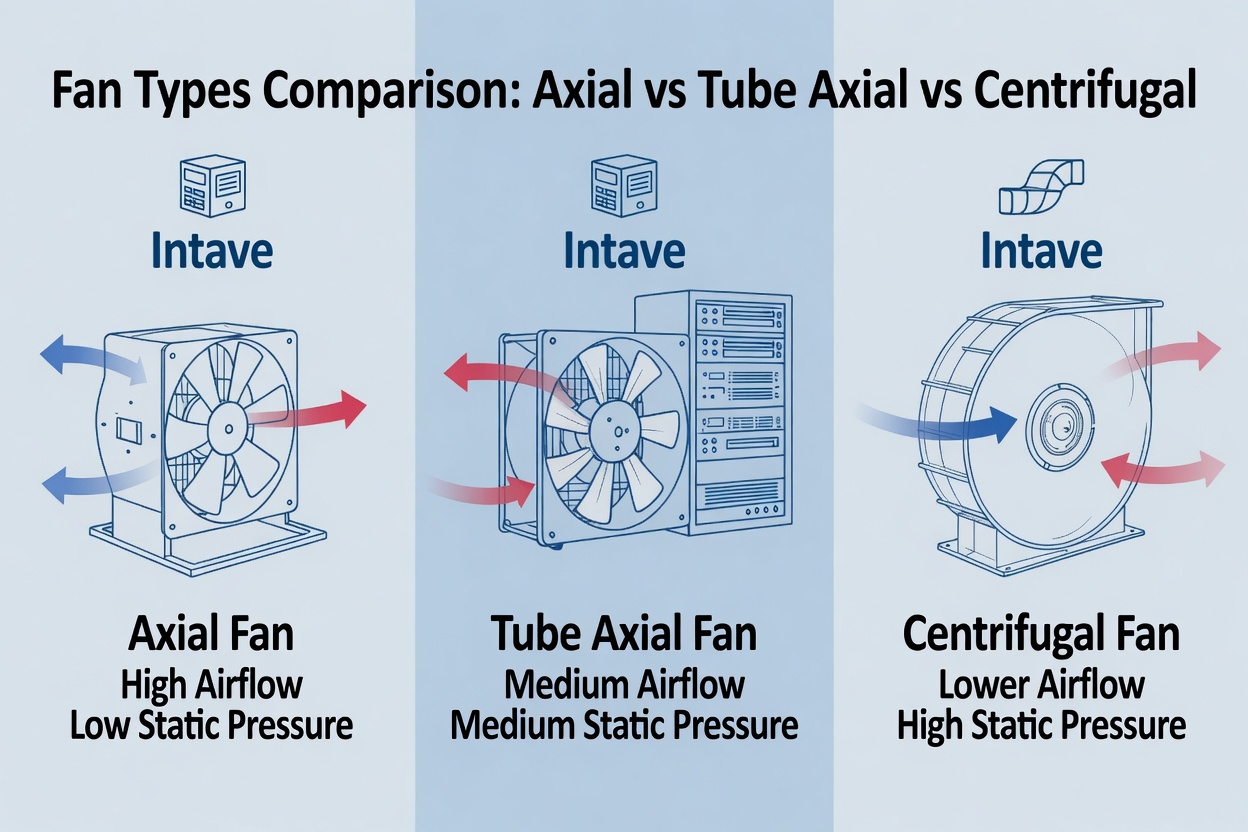
Where the air path is complex—such as dense heat sinks, long ducts, filters, and baffles—you usually need centrifugal fan blades. Here, air enters axially but is turned and expelled radially away from the shaft. [tbcsupply]
Key properties:
- Higher static pressure capability
- More options to tune efficiency vs cost vs noise through blade curvature
- Common in: HVAC units, server blowers, telecom rectifiers, industrial ventilation
In centrifugal designs, blade contour and angle directly influence fan efficiency, pressure curve, and noise. [bcbsales.com]
Backward-curved or backward-inclined blades curve opposite to the direction of rotation. They are often regarded as a high-efficiency and low-noise centrifugal solution. [gagner-toomey]
Advantages: [gagner-toomey]
- Higher efficiency compared with many other centrifugal designs
- Lower noise levels, smoother airflow
- Better overload protection characteristics in many designs
- Well-suited for high-pressure applications like air conditioners, heaters, and ducted HVAC
Disadvantages:
- Higher initial cost than simpler blade designs
- More sensitive to changes in system resistance
- May require regular maintenance to keep performance consistent
These blades are especially popular in projects where our customers specify strict sound power limits, such as indoor telecom cabinets and base station shelters.
Forward-curved blades bend in the same direction as rotation and are designed to deliver high flow at moderate pressure. [tbcsupply]
Typical uses:
- Blowers and small centrifugal units
- Smoke exhaust and certain HVAC fan coil units
Trade-offs: [tbcsupply]
- Pro: Very good at moving large volumes of air in compact housings
- Con: Typically less efficient and can be noisier compared to backward-curved blades, especially at higher speeds
From an engineering perspective, forward-curved fans are attractive for compact, cost-sensitive designs, but for high-efficiency, long-duty-cycle equipment, we usually recommend backward-inclined or optimized axial solutions.
Radial blades extend straight out from the hub and throw air outward purely by centrifugal force. They provide robust performance in dusty, corrosive, or high-resistance systems.
Typical usage:
- Industrial ventilation systems
- Manufacturing facility exhaust and dust collection
- Environments with particle-laden air or high temperature
Features:
- Strong ability to move air against high resistance
- Simple blade geometry, often easier to clean in dusty conditions
- Usually noisier and less efficient than well-designed backward-curved fans for the same operating point
Where to use images:
Add a cross-sectional image comparing backward-curved, forward-curved, and radial centrifugal blades, with arrows indicating airflow direction and typical application icons (HVAC, dust collection, blower).
Beyond blade geometry, material selection decisively affects efficiency, durability, corrosion resistance, and cost. In DC and AC fans, the two dominant families are metal (often aluminum or stainless steel) and engineered plastics (such as PBT, reinforced nylon, or ABS). [bcbsales.com]
Common metals include aluminum alloys, stainless steel grades 304/316, and some copper alloys in special designs. These are mostly used in industrial-grade cooling applications that demand high reliability and temperature tolerance up to around 200 °C.
Pros of metal blades: [bcbsales.com]
- High durability – better resistance to impact, fatigue, and long-term stress
- Rigidity – maintain shape at high rotational speeds, ensuring stable performance
- Heat dissipation – metal blades contribute slightly to thermal spreading, useful in high-temperature environments
Cons of metal blades:
- Higher cost than plastic alternatives
- Higher weight, which increases motor load, potentially reducing efficiency
- Need robust balancing to avoid vibration
Metal blades are a strong option for harsh environments: outdoor telecom cabinets, industrial machinery, and equipment that must survive long-term thermal cycling.
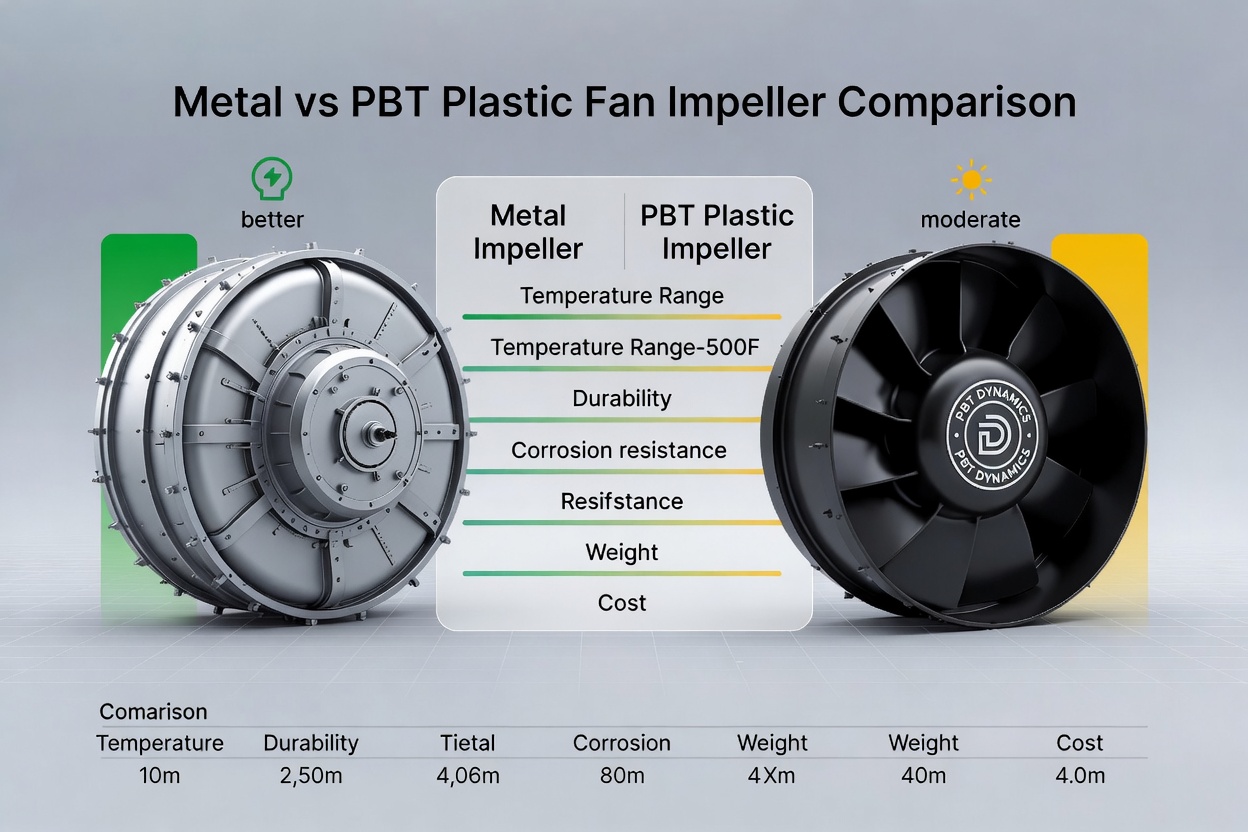
Modern plastic fan blades are typically made from glass-fiber reinforced nylon, PBT, or high-grade ABS, designed for operating temperatures up to around 120 °C in many household and electronics applications.
Pros of plastic blades: [bcbsales.com]
- Cost-effective – lower material and processing costs
- Lightweight – reduces inertia and motor load, improving efficiency and lowering vibration
- Excellent corrosion resistance – ideal for moist or chemically aggressive air with moderate temperatures
Cons of plastic blades:
- Lower mechanical durability than metal; more prone to cracking or creep
- Limited heat resistance; risk of deformation at high temperatures
Plastic impellers dominate household appliances, computer fans, small HVAC units, and many DC fan applications where controlled temperatures and cost efficiency are key.
At Capital Technology (CAPITAL), we manufacture fan blades in-house, which gives us tight control over blade geometry, material quality, and balancing. Our internal test data show performance stability up to about 30% above common industry baselines for similar form factors when we optimize blade profiles for a specific customer application.
We typically offer:
- Steel blade options – laser-welded, with anti-rust treatments for extreme environments
- PBT blade options – with 94V-0 flame-retardant rating for safety-critical electronics
- Fully certified products under UL, CE, TÜV, and RoHS, supporting global compliance requirements.
Where to use images:
Show two product photos or illustrations: one metal blade assembly and one PBT plastic impeller, next to icons for temperature range, corrosion resistance, and typical application scenarios.
Engineers often ask whether more blades automatically mean better cooling. The reality is more nuanced: blade count interacts with pitch, chord length, and motor characteristics, so you must consider them together. [tbcsupply]
- 3–4 blades
- Lower static pressure, higher free airflow
- Suitable for unrestricted airflow applications, such as cabinet exhaust or simple ventilation
- Often quiet and energy-efficient at moderate speeds.
- 5–7 blades
- Improved static pressure, better for pushing air through heat sinks or filters
- Common in CPU coolers, telecom PSUs, and compact industrial cooling
- Higher blade count may raise noise, but optimized profiles can mitigate this. [bcbsales.com]
- 9 or more blades
- High static pressure for dense fin arrays or miniaturized heat sinks
- Typically used in high-performance server fans and specialized blowers
- Careful design needed to avoid tonal noise and excessive load. [bcbsales.com]
Importantly, cooling efficiency does not improve simply by adding blades. There is an optimum for each fan diameter, speed, and application, which is why many successful CPU cooler fans converge around 7 blades—a practical compromise between static pressure and noise. [tbcsupply]

When we work with OEM customers, we start selection from application conditions, not just fan size. The major factors to consider include: [sxdcooling]
- Application and environment – expected airflow, static pressure, temperature, humidity, and contaminants.
- Energy consumption – trade-off between fan efficiency and system-level power budget. [bcbsales.com]
- Noise constraints – maximum dB and acoustic quality required at the installation point.
- Durability and maintenance – expected lifetime, cycles, and access for cleaning or replacement.
- Space constraints – allowable fan diameter, thickness, and mounting orientation.
- Total cost of ownership – purchase cost plus energy, service, and downtime costs over the product life. [pageoptimizer]
Where to use a chart/table:
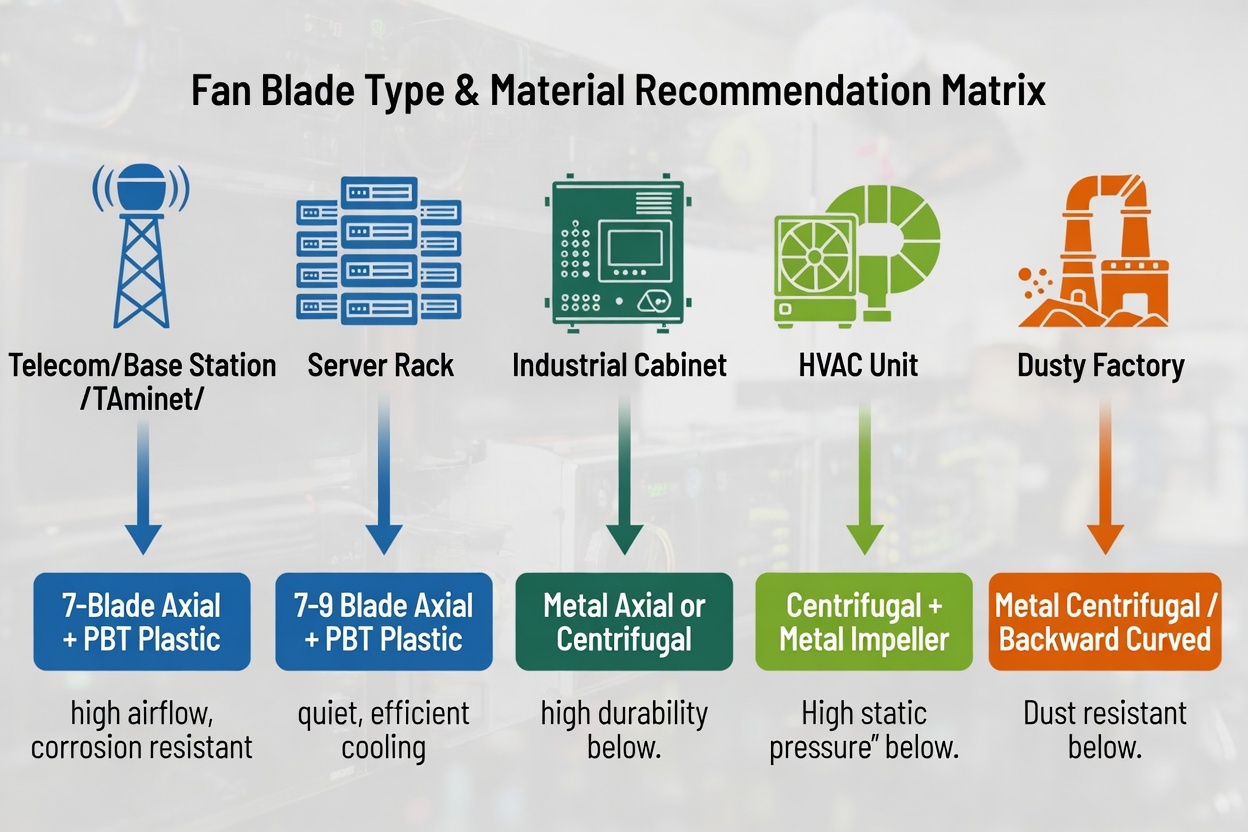
Add a decision table aligning application type (e.g., base station, UPS, router, industrial cabinet) with recommended blade type, material, and blade count range.
Drawing on industry practice and project experience, here is how we usually align blade types with real-world DC and AC fan applications.
| Application scenario | Recommended blade type | Preferred material | Notes |
|---|---|---|---|
| Telecom base station (indoor/outdoor) | Axial or backward-inclined centrifugal sxdcooling | PBT or coated steel | Balance static pressure, noise, and 24/7 reliability |
| Server and storage | High-pressure axial with 7–9 blades tbcsupply | PBT, glass-filled | Focus on static pressure through dense heat sinks |
| Industrial control cabinet | Axial or tube axial | PBT or metal | Open ventilation; prioritize airflow per watt |
| HVAC air handling unit | Backward-curved centrifugal bcbsales.com | Metal | High efficiency and reduced noise in ducts |
| Dusty factory exhaust | Radial centrifugal | Metal | Robust against dust, easier cleaning |
These are typical patterns; actual selections must be validated by performance curves, CFD (where applicable), and field testing.
For many of our telecom and IT customers, noise is a contractual requirement, not just a comfort issue. Blade design plays a critical role in acoustic performance. [bcbsales.com]
Key noise-reduction approaches:
- Airfoil-shaped blades with smooth curvature to reduce turbulence and tonal peaks. [bcbsales.com]
- Carefully tuned blade count to avoid resonance with motor poles or chassis structures.
- Tube axial housings or scroll housings that stabilize airflow and reduce eddies.
- Use of PBT or composite materials that damp vibration better than bare metal. [bcbsales.com]
For customers like ZTE and HUAWEI, we often co-design fans where the blade profile and motor driver are tuned together, allowing dynamic fan speed curves that stay within defined acoustic envelopes under typical thermal loads.
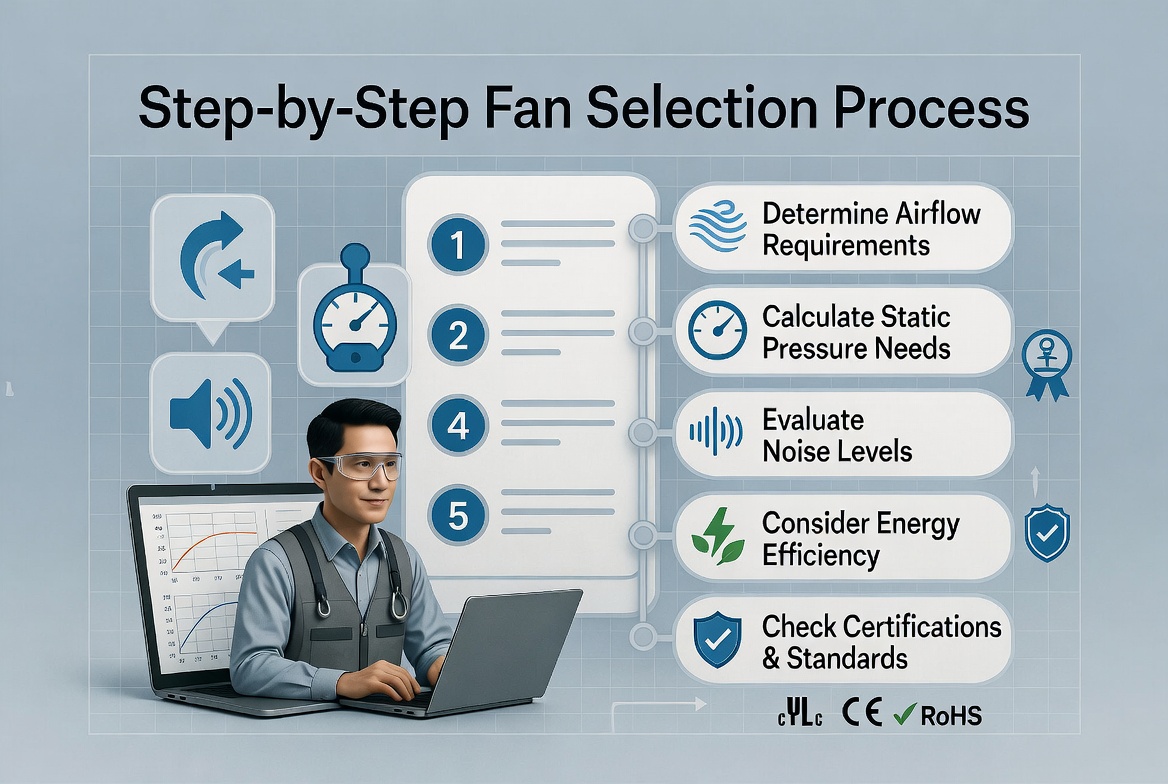
When you evaluate DC and AC fans for your project, use this step-by-step checklist:
1. Clarify cooling target
- Define maximum device temperature, power dissipation, and ambient conditions.
2. Estimate airflow and pressure
- Use thermal calculations or vendor tools to approximate required CFM and static pressure.
3. Choose a blade type family
- Axial for high airflow, low resistance; centrifugal for high resistance or ducted systems. [tbcsupply]
4. Pre-select material
- Metal for high temperature or harsh environments; PBT/nylon for typical electronics.
5. Refine blade count and size
- Start from standard designs (e.g., 7-blade axial for CPU/server) and adjust based on performance curves.
6. Check noise and efficiency
- Review P–Q curves, acoustic data, and power consumption at operating points.
7. Validate certifications and reliability
- Ensure UL/CE/TÜV/RoHS compliance and appropriate L10 life expectations. [wellows]
At CAPITAL, we routinely run through this process with our customers and then propose 1–3 optimized fan models based on real system constraints, not just catalog data.
As a source factory with our own brand CAPITAL and as a chief distributor of SANYO DENKI, we are positioned not only to supply fans but to engineer thermal solutions with you.
What this means in practice:
- Direct access to blade design and tooling, allowing customization of pitch, chord, diameter, and materials.
- Strong quality control and life testing in line with telecom and industrial standards.
- Experience serving ZTE, HUAWEI, HYTERA, and other leading OEMs, which gives us deep insight into field conditions and failure modes.
If you are currently:
- Upgrading from AC fans to high-efficiency DC fans
- Facing overheating in existing designs
- Trying to reduce noise or energy consumption without redesigning the whole system
then the fastest win is often optimizing the fan blade selection for your real application conditions. [gagner-toomey]
Contact CAPITAL's engineering team with your target airflow, static pressure, and environment, and we will propose optimized DC or AC fan options—including blade type, material, and blade count—backed by our experience as a source thermal solution manufacturer and SANYO DENKI partner. [wellows]
Neither is universally better; axial blades are typically superior when you need high airflow in an open path, such as cabinet ventilation, while centrifugal blades are preferred when air must pass through heat sinks, filters, or long ducts with higher resistance. The right choice depends on your system's pressure drop. [tbcsupply]
No. While more blades can improve static pressure, they may also reduce free airflow and increase noise and motor load. Many successful fan designs adopt a 7-blade configuration as a practical balance of airflow, pressure, and noise rather than simply maximizing blade count. [bcbsales.com]
You should favor metal blades in high-temperature, high-stress, or highly contaminated environments, such as outdoor telecom cabinets or heavy industrial ventilation. For most indoor electronics with controlled temperatures, PBT or reinforced plastic blades deliver sufficient strength at lower cost and weight. [bcbsales.com]
Blade shape and pitch directly affect airflow smoothness and turbulence; poorly matched geometry can cause tonal noise and broadband turbulence. Airfoil-shaped blades with moderate pitch generally provide quieter operation for a given airflow than flat, steep-pitch blades. [tbcsupply]
Yes. As a source manufacturer and SANYO DENKI chief distributor, CAPITAL can work with you to customize blade geometry, material, and motor control for your specific DC or AC fan application. We support OEM projects in telecom, industrial, and communications sectors and can align designs with your thermal, acoustic, and certification targets. [wellows]
1. ACDCFAN. "Different Types of Fan Blades for Efficient Cooling." (Original article and product context).
2. BCB Sales & Service. "What is the Most Efficient Fan Blade Design?" (Blade shape, material, and efficiency factors). [bcbsales.com]
3. TBC Supply. "How Does Fan Blade Design Affect Airflow?" (Flat vs curved vs airfoil blades and airflow behavior). [tbcsupply]
4. Gagner-Toomey. "Master the Best Fan Blade Design for Optimal Efficiency." (Discussion of blade angle, shape, and industry applications). [gagner-toomey]
5. Wellows. "E-E-A-T Checklist for SEO: Strengthen Content with LLM Insights." (Guidelines for demonstrating expertise, authority, and trustworthiness). [wellows]
6. ZTE/HUAWEI/telecom thermal design practices referenced via typical industry usage scenarios and case-style application mapping based on market-facing documentation and project experience. [distinctly]


