From idea to market-ready product, our NPI solutions make every stage easier, faster. Discover How We Help
Help Center

Views: 218 Author: Capital Technology Publish Time: 2026-11-19 Origin: Site
Content Menu
● What Makes a DC Filter Supplier Worth Qualifying?
>> What the 2025–2026 Industry Data Actually Shows
● Selection Criteria: How This Shortlist Was Built
● Five DC Filter Manufacturers and Suppliers to Evaluate
>> 1. Capital Technology Co., Limited — Shenzhen OEM Option for Custom DC Power Filters
>> 2. AEDON — Russian Manufacturer for Converter-Matched DC Filter Modules
>> 3. CHIP and DIP — Russian Catalog Source for Named AC/DC-Rated Parts
>> 4. Components.ru — Russian-Market Distributor for Part-Number Cross-Checks
>> 5. DOREXS — Overseas Benchmark for Low-Voltage DC Line Filters
● Supplier Comparison: Capacity, MOQ, and Certification
● Buyer's Guide: From RFQ to Production Approval
>> 1. Specify the Actual Electrical and Thermal Operating Conditions
>> 2. Lock Critical Materials Before Negotiating the Final Unit Price
>> 3. Qualify Samples from the Intended Production Process
>> 4. Insider Check: Test the Filter and Converter Together at Startup
>> 5. Separate Product Compliance From Permission to Ship
● Conclusion: Choose a Supplier You Can Requalify, Not Just a Part You Can Buy
● FAQ
>> 2. Can I substitute a 250 V AC/DC filter for a purpose-designed DC EMI filter?
>> 3. Why does a filter pass the supplier's bench test but fail in our enclosure?
>> 4. Which compliance documents should we require for a private-label or custom variant?
>> 5. How do we detect a lower-grade material substitution after sample approval?
For a long-term DC filter program, start with four checks: the factory's certification scope, its ability to adapt a design, the quality-control records it can trace to production lots, and its history of delivering on time. Then test the exact filter in your equipment. A supplier can have a strong catalog and still be the wrong choice if it cannot explain a component substitution, commit to a repeat-order lead time, or reproduce the performance of the approved sample.
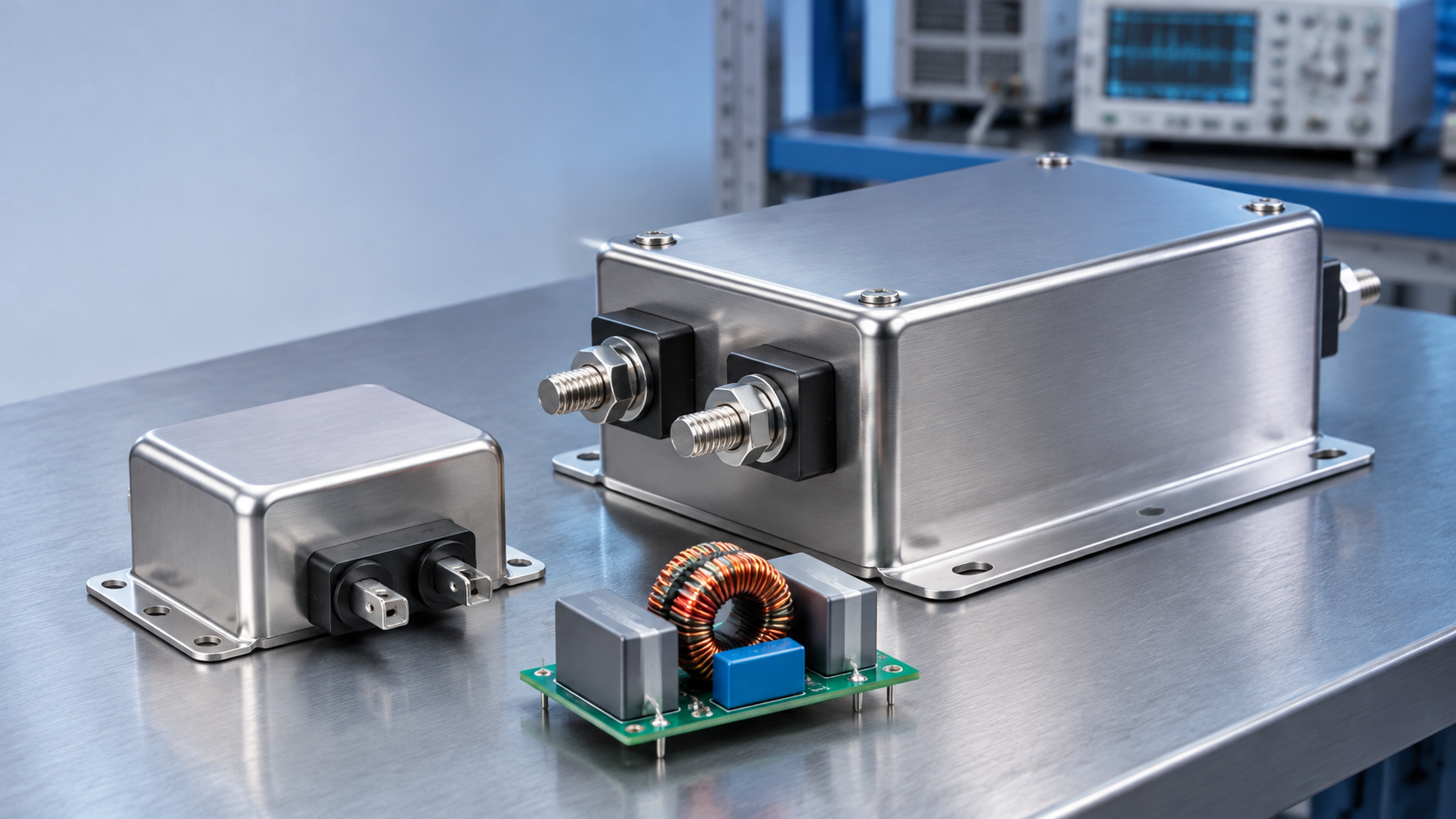
In this guide, DC filters are electrical components that suppress conducted electromagnetic interference (EMI) on direct-current power lines. They are not air filters for DC cooling fans, three-phase drive filters, or generic surge protectors. A filter can attenuate common-mode noise, which travels in the same direction on the supply conductors relative to a reference such as chassis, or differential-mode noise, which appears between the supply and return. The right choice depends on which noise dominates, where the filter is installed, and how it behaves under load.
Russia's sourcing advantage is concentrated in specific parts of the supply chain. The suppliers reviewed here illustrate two useful hubs: Voronezh for domestic modular power engineering and Moscow for catalog-based electronics sourcing. A local power-module specialist can be a practical starting point when a filter must match a Russian converter family; a domestic catalog seller can be useful for evaluating a named international part. Neither local stock nor a Russian invoice proves Russian manufacture.
A 2026 compilation of Rosstat figures reports that Russian output of computers, electronic and optical products rose 11.7% in 2025 and 9.1% year over year in the first nine months of 2026. Rosstat also publishes industrial production indices by activity and region. These figures cover a far broader category than DC EMI filters: they provide context for the electronics supply base, not a measure of DC filter output, civilian demand, or any supplier's capacity. The sources reviewed did not establish a reliable standalone market size for Russian DC power filters.
The shortlist compares five procurement options by role rather than ranking them by revenue or market share. It includes a Russian manufacturer, Russian-market catalog suppliers, and overseas manufacturers for comparison. CAPITAL is the publisher and appears first as an overseas OEM option, not as a Russian factory. Inclusion does not establish authorization, stock, an approved shipping route, or permission to sell to a particular end user.
| Evaluation criterion | Evidence to request | What should stop approval |
|---|---|---|
| Product fit | Exact part number, DC working voltage, current derating, mechanical drawing, and attenuation curves | An AC-only rating or a family datasheet that does not identify the quoted model |
| Factory and quality management | Manufacturing-site address, certificate scope, inspection plan, and a traceable production test record | A certificate covering a sales office when the actual manufacturing site is unknown |
| Engineering and OEM support | Named engineering contact, design review, drawing control, and written limits on customization | A supplier that accepts the drawing but cannot explain what it can test or change |
| Production repeatability | Lot records, approved materials, change-notification terms, and an agreed pilot build | A hand-built sample with no documented link to the intended production process |
| Capacity and delivery | Model-specific monthly output, current loading, bottleneck operations, and recent delivery performance | A corporate capacity figure that includes unrelated product lines |
| Commercial and regulatory fit | Quoted MOQ, importer responsibilities, applicable conformity documents, and transaction screening | Unclear product origin, mismatched documents, or unresolved end-user or export-control concerns |
CAPITAL is a Shenzhen-based manufacturer with its own brand and a catalog that lists 50 A and 300 A DC power filters. The company describes itself as a chief agent for SANYO DENKI and names ZTE, HUAWEI, and HYTERA among customers it has supplied. These are company-reported relationships; they do not establish that those customers purchased either listed DC filter, or that SANYO DENKI manufactures or endorses the CAPITAL filter range. The company reports more than 20 years of experience in cooling solutions but does not state an exact founding year on the cited profile. Its published export references to Europe, the United States, and Southeast Asia concern cooling fans, not verified DC filter sales by destination.
CAPITAL is most relevant to small and midsize equipment brands that want to compare a standard filter with a factory-designed variant without committing to full production at the prototype stage. Its website advertises no minimum order quantity and describes custom filtering support. Buyers should get separate terms for catalog samples, modified prototypes, and production orders: a no-MOQ policy does not tell you whether a custom design has tooling charges, minimum component purchases, or a separate production lot minimum.
A useful first RFQ is to ask for two quotes against the same application: a standard part and a drawing-controlled variant. Specify what needs to change, such as the mounting footprint, terminal orientation, or target attenuation band, and ask which changes the engineering team can validate. Assess communication efficiency by whether the first reply identifies missing specifications and sets a date for a reviewed drawing and test plan. Compare cost at the approved production configuration, not at the first sample price. Published cooling-fan output figures should not be used as evidence of DC filter capacity.

Based in Voronezh, AEDON has the clearest published domestic manufacturing fit in this shortlist for buyers integrating filters with DC/DC converters. Its catalog lists the МФ-Р family at 2–40 A depending on version, optimized for use with AEDON's МДМ-Р converters. It also lists МДМ-Ф DC filter modules for equipment sensitive to conducted interference and МРМ modules that combine filtering with protection functions. Industry coverage reported 25 years of experience in 2024; that is useful company history, but it is not a verified legal founding date. Its public catalog establishes a Russian industrial power-electronics presence, not a geographic sales breakdown.
Start with AEDON when the converter is already on the approved bill of materials and you want a documented filter pairing. Ask whether the recommended part can be used on the input, output, or both in your design and whether AEDON can provide test conditions for the pairing. For OEM work, request written confirmation of any nonstandard pinout, packaging, or electrical change; a broad converter catalog does not by itself establish unrestricted ODM service.
CHIP and DIP lists specific Schaffner FN2090 variants, including entries labeled 12 A and 20 A at 250 V AC/DC. Its Russian-language listings make it a candidate for local catalog procurement and part-number comparison, not a manufacturer of these filters. The cited product pages do not establish a founding year, an export-market footprint, or a custom filter manufacturing service.
This route suits a buyer who already has an exact part number and needs to evaluate or replace it. Before ordering, match the complete suffix to the original manufacturer's datasheet. Request traceable lot information and confirm whether the item is physically stocked or sourced against the order. A listing for a filter rated for both AC and DC is not evidence that it performs like a purpose-designed DC bus filter under your converter's load and grounding conditions.
Components.ru lists the Schaffner FN2090-16-06 and advertises delivery within Russia. Its value is as a second catalog quotation when engineering has already specified the exact component. It should not be treated as a second manufacturing source: buying the same Schaffner part through two sellers can reduce dependence on one distributor, but not on the original manufacturer. The cited listing does not verify the company's founding year, an OEM/ODM service, or markets outside Russia.
Ask the seller to distinguish physical stock from upstream availability and to quote the quantity and delivery commitment in writing. For repeat orders, specify whether mixed lots or date codes are acceptable. Also prohibit substitution without written approval: a different suffix can affect installation or electrical behavior even when the headline voltage and current match.
DOREXS publishes a Russian-language EMI filter catalog with DC line-filter offerings advertised at 12–100 VDC and 1–50 A. It is an overseas comparison candidate for lower-voltage designs, not a verified Russian manufacturing site or evidence of local stock. Its cited category page does not establish a founding year, sales by country, or how much of the listed range can be customized under an OEM agreement.
Use DOREXS to benchmark a compact filter when mounting space, pole configuration, and current rating matter more than a high-current busbar format. Ask for a drawing, exact working-voltage and temperature ratings, separate common-mode and differential-mode curves, and model-specific conformity evidence. Keep the comparison to standard parts unless the supplier confirms custom engineering and production terms in writing.
"Request by model" means the cited material did not establish a reliable figure or document for the exact SKU. For distributors, compare allocated stock and replenishment commitments rather than factory output.
| Supplier | Main procurement fit | DC filter capacity or supply | MOQ | Certification and conformity to verify |
|---|---|---|---|---|
| CAPITAL | Overseas factory-direct OEM; catalog 50 A and 300 A DC filters | Filter-specific capacity not verified; request qualified monthly output by model | Website states no MOQ; confirm custom build terms | Site advertises ISO 9001 and product conformity credentials; request the site certificate and exact-model evidence |
| AEDON | Russian-made converter-matched filtering modules | Request monthly output, stock allocation, and lead time for the chosen module | Request sample and production terms | Request site quality documents and product records for the quoted series |
| CHIP and DIP | Local catalog procurement by manufacturer part number | Distributor; confirm allocated stock and replenishment | Confirm order multiples for the exact SKU | Request original manufacturer documentation for the exact suffix and verify traceability |
| Components.ru | Second quotation for a named catalog part | Distributor; confirm physical stock versus upstream availability | Confirm order multiple and repeat-buy terms | Request origin and lot records plus manufacturer documents for the supplied SKU |
| DOREXS | Overseas low-voltage DC filter benchmark | Request model-specific output and production site | Request catalog and OEM terms separately | Request exact-model test reports and applicable declarations or approvals |
Give suppliers the nominal and maximum continuous DC bus voltage, expected transients, continuous and peak current, local ambient temperature, cooling conditions, and enclosure layout. Describe the converter, cable lengths, and chassis bonding. Ask for derating curves, DC resistance, terminal torque, and insertion loss—the reduction in signal level measured through the filter under stated conditions. Ask how the curves were measured, at what impedance, and whether the filter was carrying DC current. A high attenuation number without a frequency range and test setup is not enough to compare two filters.
For example, if the design draws 50 A continuously and the filter sits next to a heat sink in a 60°C enclosure, do not approve a "50 A" part on the nameplate alone. Ask the supplier to show that the exact variant can carry 50 A continuously at the filter's local ambient temperature, in the proposed mounting orientation, with acceptable terminal temperature rise and voltage drop. Then reproduce those conditions during qualification. Published filter ratings can be tied to a specified ambient temperature; the Schaffner FN2200 datasheet, for example, states its current range at 55°C.
Put the critical construction details into the approved drawing or a controlled material schedule. For a high-current chassis filter, specify conductor material and cross-section, terminal plating, insulation system, and insulating or potting material where applicable. For the electrical network, agree on the permitted capacitor series or approved equivalents and the magnetic components that affect saturation and loss. Where capacitance connects to chassis, require the supplier to document the construction, insulation, and leakage characteristics for the intended use. Product families can offer different configurations, including variants without capacitors to ground, so check the actual suffix.
The common purchasing mistake is to approve the enclosure drawing and current label but leave internal materials open to substitution. Ask the supplier to identify the critical components on the sample build record and require written notice before changes to the core, winding, capacitor, conductor, insulation system, or factory. Agree in advance which changes require document review and which require fresh thermal, electrical, or EMC tests.
1. Freeze the acceptance criteria before ordering. Define the target emissions limit and engineering margin, temperature-rise limits, and the acceptable voltage drop at load.
2. Buy engineering samples and record their revision. Evaluate mechanical fit, terminal access, bonding, and emissions performance on the actual equipment.
3. Run a production-intent pilot. Require traceable units made with the intended materials, tooling, and assembly process. Recheck emissions and thermal performance on units selected from the lot rather than on supplier-selected demonstration pieces alone.
4. Release volume orders against the approved revision. Record lot identification on incoming goods, retain a reference unit, and tie any deviation to a written approval.
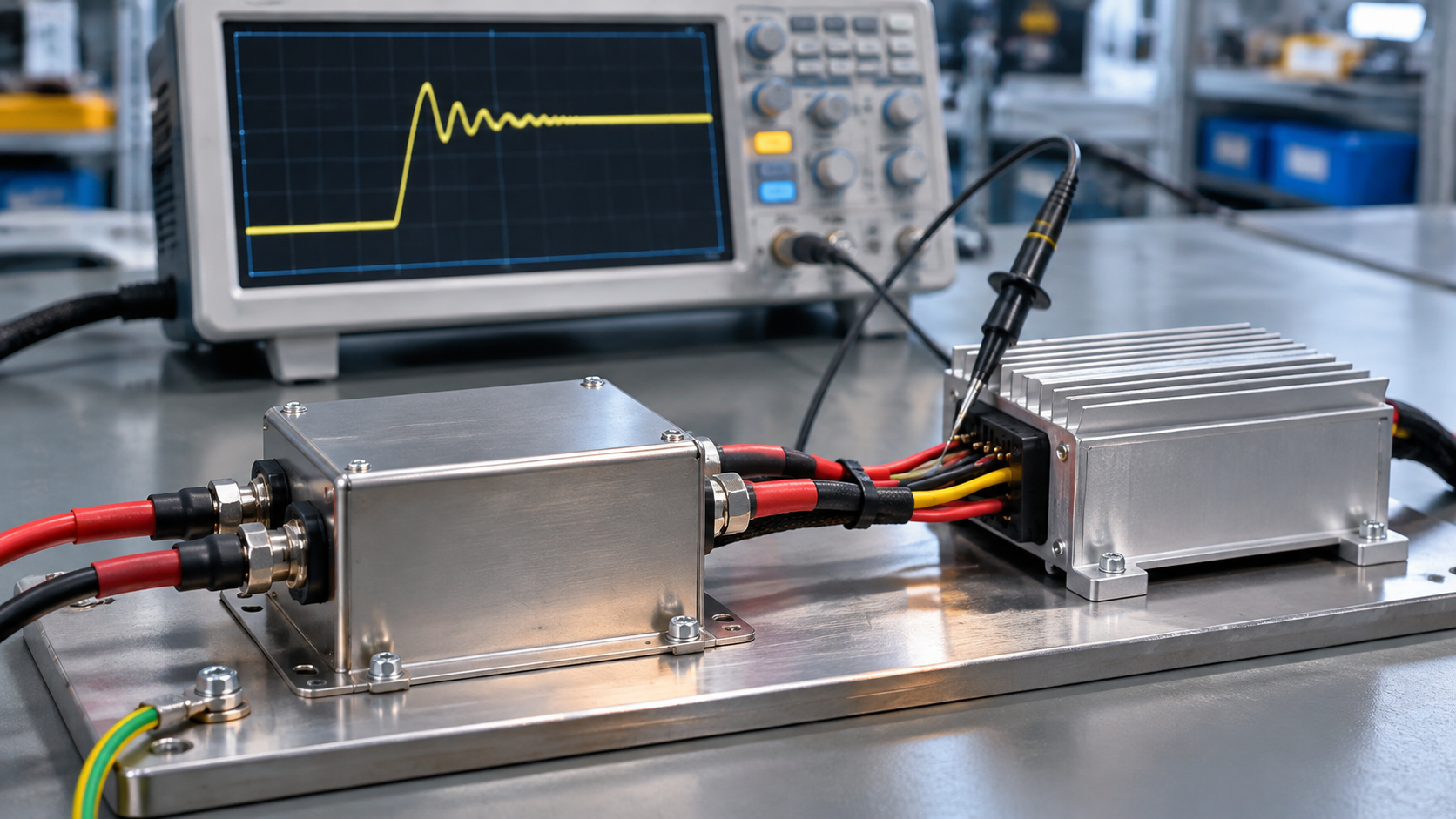
A filter that lowers bench noise can still cause trouble at startup. The input filter and a regulated DC/DC converter interact: the filter's output impedance can peak near resonance, while the converter's input behavior changes with load. A clean attenuation plot does not answer whether the combined system will ring, reset, or fail to start. This is one reason a documented filter-and-converter pairing is valuable, even when a catalog alternative looks equivalent.
For the pilot, test startup at minimum bus voltage, then repeat at maximum operating load and during load transitions. Capture voltage at the converter input rather than only at the bench supply. Repeat with the production cable harness and grounding arrangement. If you see sustained ringing, intermittent resets, or failed starts, ask both suppliers for application guidance before changing parts. The acceptance question is whether the equipment meets its EMC target and remains stable in its intended configuration.
For Russia and the Eurasian Economic Union, have the importer or qualified compliance adviser determine whether the exact product, as sold, falls under TR CU 020/2011 for EMC, TR CU 004/2011 for low-voltage safety, or TR EAEU 037/2016 for hazardous substances. Do not assume that every passive component needs a standalone declaration, or that the finished equipment automatically complies because a filter has its own paperwork. ISO 9001 concerns the quality management system; CE marking and RoHS documentation address different product requirements and do not substitute for applicable EAEU conformity documentation.
Before paying for samples or issuing a volume order, confirm the importer of record, product origin, customs classification, delivery terms, and responsibility for damaged or rejected goods. Screen the item, end use, end user, and transaction parties under applicable export-control and sanctions rules. Where U.S. rules apply, BIS identifies Russia-specific controls on exports, reexports, and transfers of items subject to the Export Administration Regulations. A quote or an online listing is not permission to ship. If classification or authorization is unresolved, pause the order.
For an existing AEDON converter design, start with the documented converter-matched filter. For an approved international part number, compare local distributors on traceability and replenishment, not just advertised stock. For a custom footprint or a small-brand production program, request a factory quote from CAPITAL and compare it with a standard catalog alternative using identical acceptance criteria.
To request a technical quotation from CAPITAL, send your DC bus range, continuous and peak current, enclosure drawing, problem frequencies or EMC test results, annual demand, and intended end use to `rainlee@sanyodenki-cn.com`. Ask for the proposed model, drawing revision, a sample and pilot schedule, and separate prices for the catalog and custom configurations.
Search IAF CertSearch using the certificate number and legal company name. Compare the status, scope, address, and issuing body with the site that will manufacture your filter. A valid certificate for a headquarters or sales operation does not establish coverage of a subcontractor. If the record is missing or inconsistent, ask the issuer to confirm the scope and status independently before counting the certificate toward supplier approval.
Only after engineering verifies the exact part. Check the manufacturer's DC rating, attenuation in the relevant modes and frequency bands, current derating, leakage or chassis-capacitance constraints, and mechanical fit. Then validate the replacement in the equipment under realistic load. The AC/DC rating tells you that the model has a stated DC working rating; it does not establish equivalent noise suppression or converter stability.
The test fixture may use different impedances, cables, loads, and grounding. The production installation can also couple noise around the filter if the noisy and filtered wiring run close together. Ask the supplier for the fixture and test conditions, then repeat measurements with the final harness and mounting arrangement. Compare changes one at a time so the team can tell whether the difference comes from the filter, the installation, or the converter.
First establish which rules apply to the product as sold and which apply to the finished equipment. Then connect the applicable declaration, test report, model code, factory, drawing revision, and private-label identifier. If this is a variant of a tested model, require a written explanation of what changed, why existing evidence still applies, and which changes trigger retesting. A supplier's general certificate or a report naming a visually similar model is not enough.
Keep a reference unit and a controlled record of its critical materials. For incoming lots, compare dimensions, mass, DC resistance, markings, and lot records against agreed tolerances. Use periodic construction checks where justified, and repeat loaded temperature-rise or attenuation tests after a significant change. A different mass or resistance is a reason to investigate, not proof on its own that the supplier substituted a material.
1. - Russian Federal State Statistics Service (Rosstat) — official industrial production indices by activity and region. [rosstat.gov]
2. - 2026 Rosstat-based industrial output compilation — full-year 2025 and first-nine-months 2026 electronics-sector figures, not standalone DC filter market data. [thinktank.4freerussia]
3. - Eurasian Economic Union Technical Regulation 037/2016 — text of the hazardous-substance regulation, including scope, exclusions, and conformity provisions. [mastcert]
4. - International Accreditation Forum CertSearch — accredited management-system certificate lookup and status verification. [iafcertsearch]
5. - U.S. Bureau of Industry and Security — official Russia and Belarus export-control guidance, licensing resources, and due-diligence notices. [bis]


