From idea to market-ready product, our NPI solutions make every stage easier, faster. Discover How We Help
Help Center

Views: 276 Author: Capital Technology Publish Time: 2026-08-21 Origin: Site
Content Menu
● Why Source DC Blower Fans From China?
● How We Selected These Manufacturers
● Top 10 DC Blower Fan Manufacturers in China
>> 1. Capital Technology Co., Limited
>> 2. Shenzhen YCCFAN Technology Co., Ltd.
>> 3. Nidec Motor (Dongguan) Corporation
>> 5. Dongguan Xingdong Electronics Co., Ltd.
>> 6. Shenzhen TOPFAN Technology Development Co., Ltd.
>> 7. Dongguan Tianxi Electronic Technology Co., Ltd.
>> 8. Dongguan Fengsheng Electronic Technology Co., Ltd.
>> 10. SANONDA
● DC Blower Fan Technical Checklist
● Common Sourcing Problems—and How to Avoid Them
>> 2. Free-Air Data Used as Application Data
>> 3. "Equivalent" Certification Claims
>> 4. Inconsistent Noise After Assembly
>> 5. Lead-Time Risk During Peak Demand
● An Internal Procurement Tip Few Buyers Discuss
● Buyer's Guide: RFQ, Samples, and Logistics
>> Step 1: Prepare a Complete RFQ
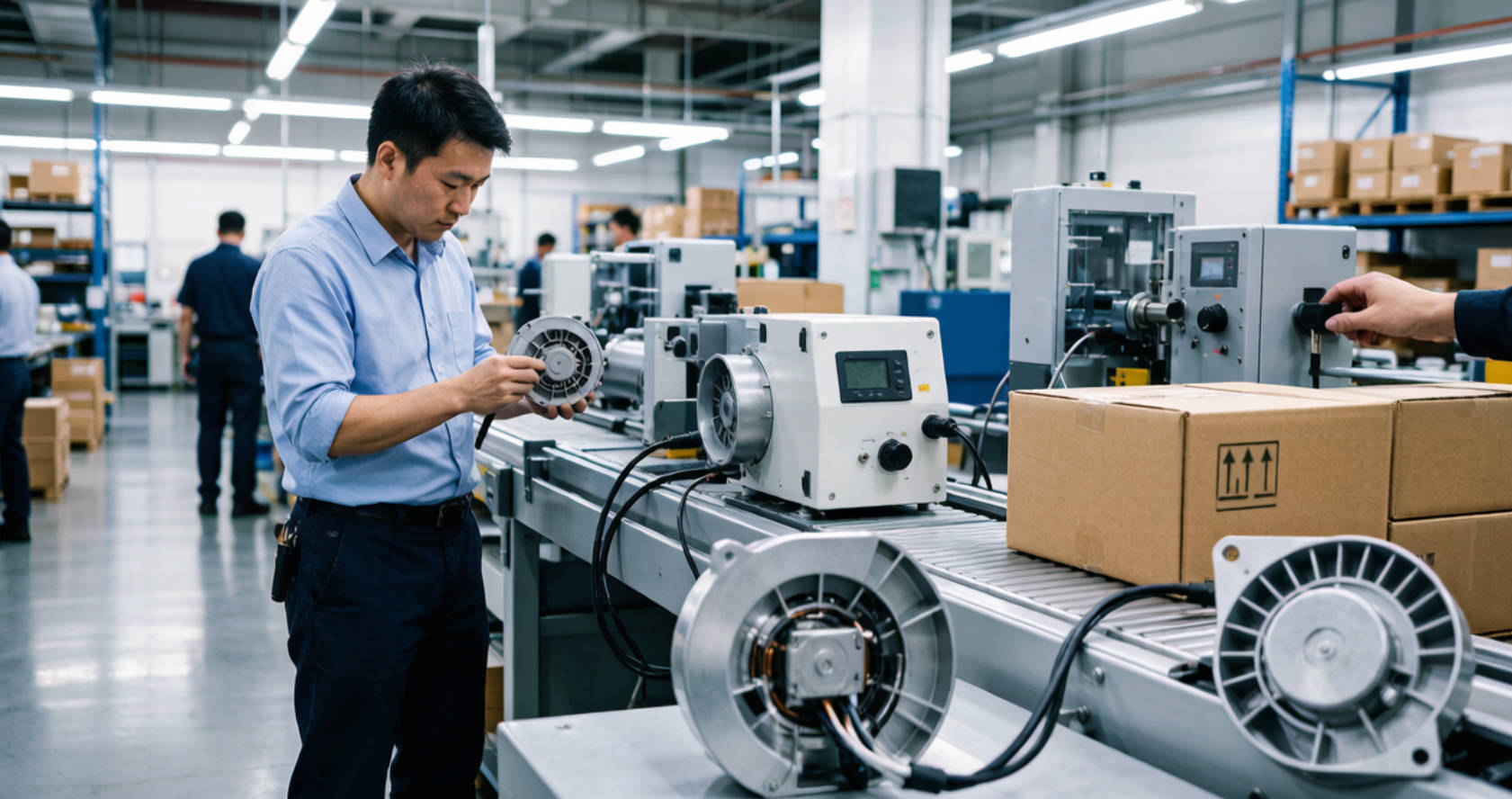
>> Step 2: Use a Three-Stage Sample Process
>> Step 3: Audit the Factory Beyond Certificates
>> Step 4: Plan Export Logistics
● FAQ
>> 1. How can I verify whether a supplier's ISO certificate is still valid?
>> 2. Is CE certification enough for a DC blower fan sold in Europe?
>> 3. What should I test before approving a DC blower fan sample?
>> 4. How do I know whether a blower uses genuine ball bearings?
>> 5. What MOQ should I expect for custom DC blower fans?
China remains one of the world's most important manufacturing bases for DC blower fans, thanks to its mature electronics supply chain, strong BLDC motor ecosystem, injection-molding capacity, and export-oriented production infrastructure. For procurement teams sourcing DC blower fans for telecom equipment, servers, energy storage systems, medical devices, EV electronics, air purifiers, and industrial controls, the real challenge is not finding suppliers—it is identifying a manufacturer that can maintain consistent airflow, static pressure, reliability, and delivery performance over the product lifecycle.
China exported an estimated 509 million non-household ventilation fans in 2024, valued at approximately US$3.8 billion. Guangdong and Zhejiang together represented more than half of related fan exports, demonstrating the importance of the Pearl River Delta and Yangtze River Delta industrial clusters for global cooling and ventilation supply.
This guide evaluates manufacturers from a buyer's perspective, with attention to technical capability, certifications, production consistency, application fit, and OEM/ODM cooperation—not simply brand visibility.
The Shenzhen–Dongguan–Huizhou manufacturing corridor is particularly important for compact cooling products. It brings together suppliers of brushless DC motors, Hall sensors, IC controllers, magnet materials, PBT housings, copper wire, bearings, cable assemblies, and electronics manufacturing services.
For buyers, this ecosystem can offer several practical advantages:
- Faster prototype-to-production cycles for customized DC blower fan projects
- Broad availability of 5V, 12V, 24V, and 48V blower platforms
- Flexible options for airflow, static pressure, speed, connector, cable length, and PWM/RD/FG functions
- Competitive tooling and molding costs for customized housings
- Easier integration with control boards, power systems, and complete thermal-management assemblies
- Access to suppliers serving telecom, power electronics, EV charging, medical equipment, and consumer appliances
However, China's fan supply base is highly fragmented. A quotation that appears technically comparable may conceal major differences in bearing type, copper content, plastic grade, motor winding quality, balancing process, and reliability validation.
This list is not a laboratory ranking or a claim that every supplier is suitable for every project. Instead, it identifies manufacturers with visible evidence of relevant product capability, manufacturing footprint, certifications, market coverage, or technical specialization.
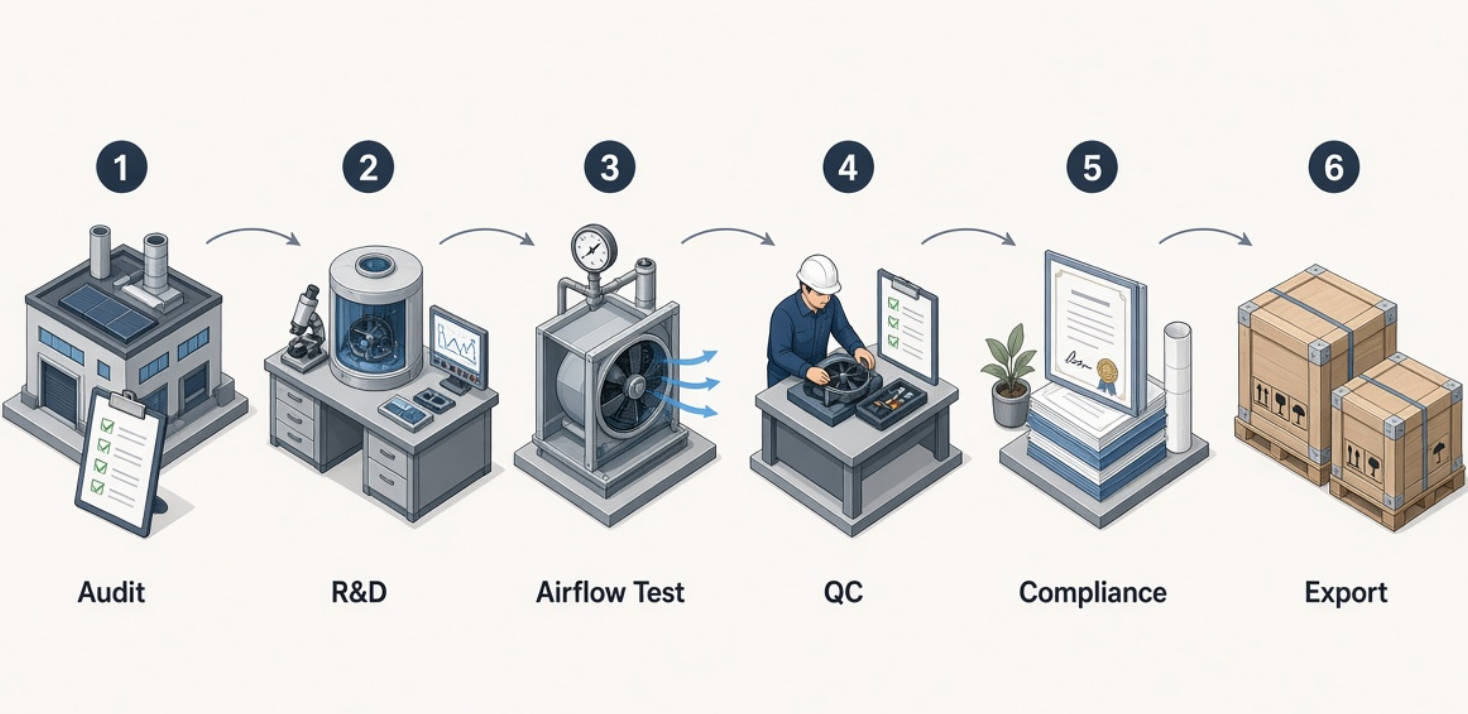
The assessment criteria include:
| Evaluation area | What professional buyers should verify |
|---|---|
| Product capability | DC centrifugal blowers, radial blowers, turbo blowers, high-static-pressure designs, waterproof options, PWM/FG/RD functions |
| Manufacturing control | In-house motor assembly, injection molding, automated testing, airflow/static-pressure testing, balancing, burn-in procedures |
| Quality systems | ISO 9001, ISO 14001, IATF 16949 where automotive relevance applies |
| Product compliance | CE, RoHS, REACH, UL/cUL or other safety documentation according to destination market |
| Engineering support | CFD support, fan-curve matching, custom voltage, connector, cable, housing, speed-control, and acoustic optimization |
| Delivery reliability | Material planning, line capacity, backup tooling, lead-time visibility, export documentation |
| Commercial fit | MOQ flexibility, sample support, NPI cooperation, responsiveness, and long-term OEM/ODM capability |
A supplier should be evaluated by the specific blower model and production line, rather than by a generic company certificate alone.
| Manufacturer | Location / footprint | Main focus | Reported scale or capability | Typical buyer fit |
|---|---|---|---|---|
| Capital Technology Co., Limited | Shenzhen, Guangdong | DC/AC fans, DC blowers, centrifugal fans, cooling solutions, filters | Reported monthly capacity of 3.9 million cooling fans | OEM buyers needing flexible communication and integrated cooling support |
| YCCFAN Technology | Shenzhen, Guangdong | Mini cooling fans, DC blowers, AC/DC/EC fans | Reported daily capacity above 210,000 units | High-volume industrial, automotive-adjacent, and electronics projects |
| Nidec Motor (Dongguan) | Dongguan, Guangdong | Fan/blower-related motors and precision motor components | Global precision motor manufacturer with China production and R&D | Enterprise, ICT, appliance, and high-reliability supply programs |
| ebm-papst China | Shanghai / Xi'an / Qingdao | Energy-efficient fan and motor solutions | Xi'an site reported at about 60,000 m² | Data center, cleanroom, renewable energy, and premium industrial applications |
| Dongguan Xingdong Electronics | Shenzhen / Dongguan footprint | DC/AC/EC axial fans, cross-flow fans, blowers, motors | Reported monthly capacity of 1.2 million units | Broad industrial and appliance cooling requirements |
| Shenzhen TOPFAN | Shenzhen, Guangdong | DC fans, centrifugal fans, blower fans, waterproof fans | Established in 2006; ISO 9000 cited | General OEM cooling-fan sourcing |
| Dongguan Tianxi Electronic Technology | Dongguan, Guangdong | DC fans and computer-related cooling products | ISO 9001:2015; products cited with TUV, UL, CE | PC, electronics, peripheral-device, and compact blower projects |
| Dongguan Fengsheng Electronic Technology | Dongguan, Guangdong | Brushless DC fans, centrifugal blowers, GPU and semiconductor cooling fans | Established in 2018 | Computer hardware and compact thermal-management applications |
| FanBlower / FB-M&F | Shenzhen / Dongguan | DC, EC, AC fans; centrifugal and duct blowers | OEM, private-label, design services; reported 60,000-hour target under stated conditions | Ventilation, HVAC auxiliaries, appliance, and custom fan applications |
| SANONDA | China | DC cooling fans, blowers, waterproof and industrial fans | Founded in 2006; also distributes multiple fan brands | Buyers requiring catalog breadth and distribution options |
Capacity, certification, and product claims above are based on publicly available manufacturer or exhibitor information. Buyers should request model-specific evidence before nominating a supplier.
Capital Technology Co., Limited is a Shenzhen-based cooling-solution supplier and manufacturer with its own CAPITAL product line, alongside its role as chief agent for SANYO DENKI. Its product range includes DC fans, AC fans, DC blowers, centrifugal fans, radiators, EMI filters, reactors, motors, and related cooling products.
The company is positioned for buyers who need more than a standard catalog fan. Its value is especially relevant for small and mid-sized brands, equipment makers, and export-oriented OEMs that need practical engineering communication, flexible coordination, and a supplier able to support customized cooling requirements.
Capital states that its cooling fan range covers sizes from 20 mm to 280 mm and that it operates automated industrial production lines with a reported monthly capacity of 3.9 million cooling fans. It also identifies ZTE, Huawei, Hytera, and Gold Power among its customers or supply relationships.
Core strengths
- Combination of CAPITAL-brand products and access to SANYO DENKI fan solutions
- Experience in DC fans, DC blowers, centrifugal fans, filters, motors, and integrated cooling applications
- Suitable for OEM projects requiring practical customization rather than purely standard distribution
- Faster communication model for buyers that need technical clarification, sample adjustments, or cable/connector changes
- Ability to support product development from initial specification through application matching
- Reported experience serving telecom, communications, power, and industrial customers
OEM/ODM scope to discuss
- 5V, 12V, 24V, and 48V DC blower fan configurations
- Airflow and static-pressure matching for an enclosure or heat source
- PWM speed control, tachometer output, alarm signal, and connector selection
- Cable length, wire gauge, terminal type, and labeling
- Ball-bearing or sleeve-bearing selection according to life and cost targets
- Branding, packaging, barcode labels, and export carton requirements
- Cooling fan plus filter, controller, or thermal-management component integration
For procurement teams that value commercial responsiveness and lower-volume development support, Capital Technology can be a practical candidate to include in an RFQ shortlist—particularly when the project requires custom coordination rather than only purchasing a fixed standard part number.
YCCFAN is a Shenzhen-based manufacturer specializing in miniature cooling fans and blowers. Public company information identifies DC fans, AC fans, EC fans, axial fans, and blower fans as core products.
The company reports ISO 9001, ISO 14001, and IATF 16949 management systems, which can be relevant for buyers serving automotive-related or high-process-control applications. Its public exhibitor profile reports a 230,000 m² facility, approximately 1,000 employees, and daily production capacity above 210,000 pieces.
Core strengths
- Broad cooling-fan portfolio, including DC blower fan products
- Reported scale suitable for established volume programs
- In-house capabilities cited for reliability testing, noise testing, airflow/static-pressure testing, mold manufacturing, injection molding, automated production, and automated inspection
- Certifications cited publicly include UL, cUL, TUV, CE, SGS, and CCC, although model-specific confirmation remains necessary
- Strong fit for electronics, industrial equipment, telecom, automotive-adjacent, and appliance applications
Buyer note: Public web listings show inconsistent historical establishment dates in some third-party product pages. Use the supplier's current business license, ISO certificate, and factory audit report as the authoritative sources.
Nidec has a significant China manufacturing and engineering presence. Nidec Motor (Dongguan) Corporation lists production of DC motors for PC peripherals and precision-motor components, including fan/blower-related products for ICT servers, office automation, audiovisual equipment, and appliances. Nidec also maintains a Dongguan R&D branch focused on small precision motors and fan motors.
Core strengths
- Major global motor and fan technology group
- Strong relevance for high-volume and high-reliability programs
- China-based production and R&D infrastructure
- Application coverage includes servers, network equipment, air conditioners, renewable energy, and office equipment
- Suitable for buyers with rigorous qualification requirements and long product lifecycles
OEM/ODM fit: Nidec is generally more appropriate for structured enterprise sourcing, forecast-based programs, and applications where performance consistency, qualification documentation, and global supply assurance are prioritized over low-MOQ flexibility.
ebm-papst is a German fan and motor manufacturer with a longstanding China presence. It has been active in China since 1996 and operates facilities and offices in Shanghai, Xi'an, Qingdao, Beijing, Shenzhen, and Hong Kong. Its Xi'an plant produces energy-efficient fan solutions for data centers and cleanrooms.
The company reports that its Xi'an facility covers around 60,000 m² and employs about 1,000 people. The site received recognition as a National Green Factory from China's Ministry of Industry and Information Technology in January 2025.
Core strengths
- Premium engineering and high-efficiency fan technology
- Strong relevance for cleanrooms, data centers, renewable energy, and mission-critical industrial equipment
- China-based manufacturing combined with global engineering standards
- Appropriate for projects where lifecycle performance and efficiency may outweigh unit-price pressure
OEM/ODM fit: Better suited to technically demanding projects with formal specifications, qualification milestones, and premium performance requirements.
Dongguan Xingdong Electronics manufactures DC, AC, and EC axial fans, cross-flow fans, blowers, and motors. Its public profile cites a monthly capacity of up to 1.2 million units and use across computers, power equipment, home appliances, automotive, security, communications, medical equipment, industrial control, and printing equipment.
The company also states compliance with ISO 9001 and ISO 14001 and references CE, TUV, and UL certifications.
Core strengths
- Diverse fan and motor product range
- Broad application experience across industrial and electronics segments
- Reported capacity suitable for recurring OEM demand
- Potential option for buyers consolidating multiple fan categories with one supplier
OEM/ODM fit: Appropriate for buyers needing a combination of axial fans, blower fans, cross-flow fans, and motors rather than only a single blower platform.
Shenzhen TOPFAN is a DC and AC fan manufacturer established in 2006. Its published product categories include DC fans, axial-flow fans, centrifugal fans, blower fans, and waterproof fans. The company states that it operates under ISO 9000 quality management certification.
Core strengths
- Long operating history in the Shenzhen cooling-fan cluster
- Coverage of standard DC fan, centrifugal fan, blower fan, and waterproof fan types
- Potential fit for standard industrial OEM sourcing and custom fan configuration
OEM/ODM fit: Buyers should clarify in advance whether requested changes involve only wire/connector/label variations or require new impeller, housing, motor, or tooling development.
Dongguan Tianxi Electronic Technology was founded in 2017 and manufactures DC fans and computer peripheral products. Its product scope includes DC cooling products and related components. The company reports ISO 9001:2015 certification, while its products are described as having TUV, UL, and CE certifications.
Core strengths
- Relevant for PC, electronics, and compact thermal applications
- Dongguan location supports access to electronics assembly and component suppliers
- Publicly stated quality-system and product-compliance credentials
- Potentially suitable for buyers needing compact DC fan or blower-related components
OEM/ODM fit: Particularly relevant for chassis cooling, graphics cards, CPU radiators, small appliances, and electronics housings where fit, acoustics, and cable routing must be controlled closely.
Founded in April 2018, Dongguan Fengsheng focuses on R&D and production of fans and computer radiators. Its listed products include brushless DC computer fans, DC axial fans, DC centrifugal blowers, chassis fans, graphics-card fans, semiconductor cooling fans, CPU radiators, and related products.
Core strengths
- Product focus aligned with compact electronics cooling
- Centrifugal blower relevance for graphics hardware, semiconductor cooling, and tight-space airflow systems
- Suitable for projects where blower geometry, static pressure, and acoustic performance need balancing
OEM/ODM fit: Buyers should request performance curves at the intended operating voltage and installation condition, rather than relying on free-air airflow figures.
FanBlower operates from Shenzhen and Dongguan and offers DC, EC, and AC brushless fans, including centrifugal fans and duct blowers. Its public profile states that it supports OEM service, design service, and buyer-label programs.
The company also describes applications in air purifiers, fresh-air systems, dryers, boilers, humidifiers, street sweepers, rail transit, automotive cooling, and ventilation systems. It cites a 60,000-hour continuous operating-life target at 40°C for certain products and conditions.
Core strengths
- Broad centrifugal, duct blower, and ventilation application coverage
- Private-label and customization orientation
- Potentially suitable for appliance, HVAC auxiliary, and air-treatment applications
- Flexible product portfolio spanning smaller electronics cooling and larger ventilation needs
OEM/ODM fit: Confirm that any life-expectancy claim applies to the exact bearing type, operating temperature, duty cycle, orientation, dust exposure, and voltage condition required by your application.
SANONDA positions itself as a Chinese manufacturer of cooling fans and blowers, including DC cooling fans, industrial fans, and IP-rated waterproof and dustproof products. It states that it was founded in 2006 and also distributes a number of established fan brands.
Core strengths
- Coverage of DC cooling fan, blower, industrial fan, and waterproof-fan categories
- Potential catalog breadth for maintenance, replacement, or mixed-brand purchasing
- Distribution capability may be valuable for buyers needing access to multiple fan brands alongside China-made alternatives
OEM/ODM fit: Clarify whether an offered product is SANONDA-manufactured, third-party branded, or sourced through distribution. This affects traceability, warranty terms, certificate ownership, and long-term supply control.
A DC blower fan is not interchangeable with a standard DC axial fan. A blower typically uses centrifugal airflow, which is better suited to systems with higher airflow resistance, such as narrow ducts, dense fin stacks, filters, sealed enclosures, server modules, telecom cabinets, and compact medical equipment.
When comparing models, buyers should evaluate the operating point rather than a headline airflow figure.
| Parameter | Why it matters |
|---|---|
| Rated voltage | Common choices include 5V, 12V, 24V, and 48V DC; voltage tolerance must match the power system |
| Airflow | Usually shown in CFM or m³/h; free-air airflow alone does not represent installed performance |
| Static pressure | Critical for filters, ducts, heatsinks, dense PCBs, and restricted internal air paths |
| Fan curve | Shows airflow versus static pressure and helps identify the real operating point |
| Bearing type | Sleeve bearings reduce cost; ball bearings usually provide better life at elevated temperature or non-horizontal mounting |
| Motor design | Brushless DC motor design affects efficiency, start-up behavior, speed consistency, and durability |
| PWM control | Enables dynamic speed control and can reduce system noise and energy use |
| FG/RD signals | Tachometer and alarm outputs help the host system monitor fan health |
| Noise level | Should be compared at a defined voltage, distance, test environment, and operating point |
| Ingress protection | IP ratings may be needed for dust, humidity, outdoor cabinets, and harsh industrial environments |
| Material grade | PBT with UL94 V-0 flame rating is commonly requested for electronics and power applications |
| Life expectancy | Must be tied to temperature, bearing type, orientation, duty cycle, and test method |
A useful engineering rule is:
Select the blower at the system operating point, not at free-air maximum airflow.
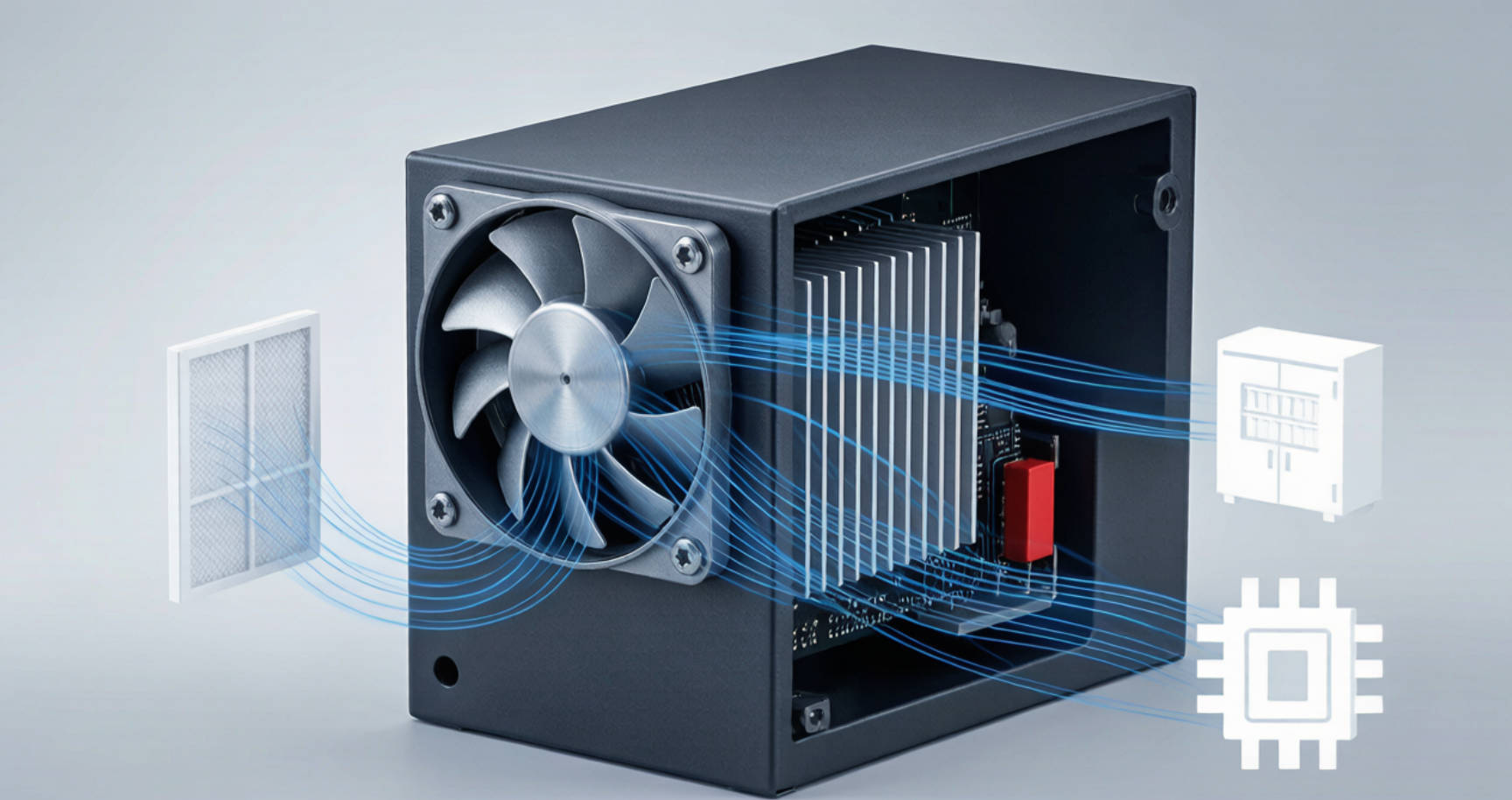
For example, a blower quoted at 30 CFM in free air may deliver much less airflow once installed behind a restrictive heat sink, air filter, grille, and narrow duct. Ask the manufacturer for the full P-Q curve—static pressure versus airflow—and then overlay your system resistance curve.
A frequent issue is that the approved sample uses a specified plastic, copper winding, bearing, or magnet grade, while later production batches use lower-cost alternatives.
How to reduce the risk
- State the housing and impeller material grade in the purchase specification.
- Request PBT UL94 V-0 documentation when flame-retardant material is required.
- Define bearing type by part number or approved supplier, not only as "ball bearing."
- Include copper-wire, bearing, and plastic-grade requirements in the signed technical agreement.
- Keep a golden sample with revision number, manufacturing date, and approved test results.
Some suppliers quote airflow and noise from a free-air test environment, while the actual equipment includes filters, ducts, heatsinks, and grilles.
How to reduce the risk
- Request the complete fan performance curve.
- Share a drawing or 3D model of the installed air path.
- Test the blower inside the final enclosure before mass-production approval.
- Define acceptance criteria at the installed operating point.
A supplier may state "CE," "RoHS," or "UL compliant," but the document may apply to a different model, expired product series, material, or legal entity.
How to reduce the risk
- Request the certificate number, issuing body, validity date, product model, and factory legal name.
- Verify UL files through UL Product iQ where applicable.
- Confirm that RoHS documentation covers the exact product materials and revision.
- Check whether CE documentation is a supplier declaration, test report, or third-party certification.
Noise may increase after the blower is mounted into an enclosure due to resonance, turbulence, screw stress, or grille design.
How to reduce the risk
- Test with the final mounting geometry.
- Specify screw torque and gasket requirements.
- Consider soft mounts where vibration transfer is a concern.
- Ask for acoustic data at actual RPM and static pressure.
- Evaluate tonal noise, not only overall dB(A).
Cooling-fan lead times can increase when demand rises in telecom, data-center, appliance, or energy-storage sectors. A supplier may have nominal production capacity but lack secured bearings, ICs, magnets, or approved resin.
How to reduce the risk
- Ask for a material lead-time breakdown.
- Confirm the supplier's backup source policy for critical components.
- Share a rolling forecast, even if non-binding.
- Use staggered production releases for critical programs.
- Establish agreed safety-stock or vendor-managed inventory terms where justified.
The most overlooked risk is not the fan itself—it is the relationship between the motor controller, bearing system, and your real duty cycle.
A blower can pass a short run test at room temperature but fail early in real equipment due to high internal temperature, PWM switching behavior, frequent start-stop cycles, vertical mounting, contaminated airflow, or unstable power input. This is especially common in telecom cabinets, battery systems, EV chargers, outdoor enclosures, and industrial power supplies.
Before releasing production, ask the supplier to conduct or support a duty-cycle validation that reflects:
- Maximum internal enclosure temperature
- Minimum and maximum input voltage
- PWM control range and start-up duty
- Airflow restriction from filters and heat sinks
- Mounting orientation
- Expected dust, moisture, and vibration exposure
- Required operating hours and failure criteria
A 12V blower operating continuously at 25°C in a clean lab may behave very differently from the same fan operating at 60°C inside a dusty enclosure with frequent speed changes.
A serious DC blower fan RFQ should include:
- Fan type: centrifugal blower, radial blower, turbo blower, or duct blower
- Dimensions and mounting drawing
- Rated voltage and allowable voltage range
- Required airflow and minimum static pressure
- Maximum noise requirement
- Bearing type and target life
- Operating temperature range
- IP rating requirement
- Signal requirements: PWM, FG, RD, lock rotor, speed control
- Cable length, connector, terminal, and pinout
- Compliance requirements: RoHS, REACH, CE, UL, IEC, or destination-market requirements
- Annual demand forecast and expected order quantity
- Packaging, labeling, and barcode requirements
- Required Incoterm: EXW, FOB Shenzhen, CIF, DDP, etc.
1. Engineering sample
Confirm physical dimensions, connector, voltage, initial airflow direction, and mounting compatibility.
2. Validation sample
Test the blower inside the actual product enclosure under high temperature, voltage variation, and realistic airflow resistance.
3. Golden sample approval
Lock the final fan model, BOM, bearing configuration, wire, connector, label, firmware or speed-control parameters, packaging, and inspection criteria.
Do not approve mass production based solely on a catalog datasheet.
During a remote or onsite audit, ask to see:
- Incoming inspection records for bearings, ICs, magnets, copper wire, and plastic resin
- Airflow and static-pressure testing equipment
- Noise-testing room or acoustic setup
- Dynamic balancing process
- Aging or burn-in procedures
- Final inspection records and sampling plans
- Traceability labels and lot-code process
- Calibration certificates for key testing equipment
- Non-conformance and corrective-action records
- Warehouse management and raw-material storage controls
For DC blower fan shipments, logistics planning should cover:
- Carton drop-test and stacking requirements
- Moisture protection for sea freight
- Pallet type and fumigation requirements for destination markets
- Lithium-battery restrictions if fans are shipped as part of a powered assembly
- HS code confirmation with a customs broker
- Country-of-origin and labeling requirements
- Spare-parts quantities for warranty support
- Incoterm and insurance allocation
For long-term programs, buyers should also negotiate a documented process for engineering changes, end-of-life notices, alternate-material approvals, and warranty claims.
China offers a deep and competitive supply base for DC blower fans, particularly across Shenzhen, Dongguan, and other Guangdong manufacturing centers. However, choosing a supplier should involve more than comparing unit price, maximum airflow, or a list of certificates.
The most reliable sourcing decision combines verified factory capability, model-level compliance records, realistic thermal testing, documented materials control, and a clear OEM change-management process. For buyers that need flexible communication, practical engineering coordination, and tailored cooling solutions for small-to-mid-volume programs, Capital Technology Co., Limited is a relevant supplier to include in the qualification process alongside larger-scale and premium global manufacturers.
To discuss a DC blower fan project, prepare your operating voltage, dimensions, required airflow/static pressure, operating temperature, annual volume, and compliance requirements. A structured RFQ will make it much easier to receive comparable technical proposals and avoid costly redesigns after production starts.
Ask for the complete ISO certificate, including the certificate number, legal company name, factory address, scope, certification body, issue date, and expiration date. Then verify it through the certification body's public directory where available. Also check whether the manufacturing address on the certificate matches the actual production site—not only a sales office.
Not always. CE is generally a conformity marking framework rather than a universal third-party product certificate. You should confirm which EU directives apply to the final product and whether the fan's documentation supports your equipment-level compliance obligations. RoHS, REACH, EMC implications, and safety standards may also be relevant depending on the end product.
At minimum, test dimensions, airflow direction, voltage tolerance, start-up voltage, current draw, speed, noise, vibration, airflow/static-pressure performance, connector compatibility, cable routing, and thermal performance inside your actual enclosure. For demanding applications, add high-temperature operation, power cycling, dust exposure, and long-duration endurance testing.
Do not rely only on a quotation line saying "dual ball bearing." Ask for the approved bearing supplier, bearing model, BOM specification, sample disassembly approval, and incoming inspection process. For critical programs, include bearing-brand approval and change-notification requirements in the supply agreement.
MOQ depends on the level of customization. Standard products with wire, connector, or label changes may have relatively low MOQs. A new housing, impeller, motor winding, or custom tooling project usually requires higher volumes or tooling investment. Request separate quotations for samples, pilot production, standard production MOQ, and annual-volume price breaks.
1. - Capital Technology Co., Limited, company overview, product scope, customer references, and stated manufacturing capacity. [sanyodenki-cn]
2. - IndexBox, China non-household ventilation fan market overview, 2024 production and export estimates. [indexbox]
3. - China fan export analysis under HS 841459, including 2024 export volume/value and Guangdong–Zhejiang export share. [sinobtd]
4. - YCCFAN company and Electronica exhibitor profiles, including product range, stated production capability, and certifications. [exhibitors.electronica]
5. - Nidec China factory and R&D profiles for fan/blower-related manufacturing and development. [nidec]
6. - ebm-papst China manufacturing and investment updates. [ebmpapst]
7. - Dongguan Xingdong, Tianxi, Fengsheng, TOPFAN, FanBlower, and SANONDA public company profiles. [d-fan]


