From idea to market-ready product, our NPI solutions make every stage easier, faster. Discover How We Help
Help Center

Views: 243 Author: Capital Technology Publish Time: 2026-09-03 Origin: Site
Content Menu
● Why Source Brushless Fans From China?
>> 1. Manufacturing and capacity
>> 2. Engineering and R&D ability
>> 5. Communication and program management
>> 1. Capital Technology Co., Limited
>>> Core strengths
>> 2. YCCFAN
>>> Core strengths
>> 3. Guangdong Shenghui Technology Co., Ltd.
>>> Core strengths
>> 4. Shenzhen Huaxia Hengtai Electronics Co., Ltd.
>>> Core strengths
>>> Core strengths
>>> Core strengths
>> 7. Shenzhen Xinyujie Technology Co., Ltd.
>>> Core strengths
>> 8. Shenzhen Topfan Technology Development Co., Ltd.
>>> Core strengths
>> 9. Snowfan / Shenzhen Yongyihao Electronics Co., Ltd.
>>> Core strengths
>> 10. Shenzhen Jiangshanlai Electronic Technology Co., Ltd.
>>> Core strengths
● Brushless Fan Technical Checklist
>> Risk 1: The sample and mass-production fan use different bearings
>> Risk 2: Airflow is quoted in free air only
>> Risk 3: Life expectancy is presented without test conditions
>> Risk 4: Certifications are expired, incomplete, or not model-specific
>> Risk 5: Low pricing hides unstable materials
● Buyer's Qualification Process
>> Step 1: Prepare a complete RFQ
>> Step 2: Ask suppliers for technical evidence
>> Step 3: Test samples in your actual device
>> Step 5: Establish change control
>> 1. How can I verify whether a supplier's ISO certificate is still valid?
>> 2. Is CE certification enough for a brushless DC fan sold in Europe?
>> 3. What is a reasonable MOQ for customized DC fans?
>> 4. Which bearing type should I choose: sleeve bearing or dual-ball bearing?
>> 5. How should I compare two fans with similar airflow ratings?
China is one of the world's most important production bases for Brushless Fan products, including DC axial fans, DC blowers, centrifugal fans, AC cooling fans, EC fans, and application-specific thermal-management assemblies. For procurement teams buying for telecom equipment, industrial automation, energy storage, EV charging, medical devices, power supplies, servers, and consumer electronics, China offers a combination of mature component supply chains, flexible manufacturing, competitive cost structures, and fast product-development cycles.
However, selecting a brushless fan manufacturer is not simply about comparing unit prices. A cooling fan is an electromechanical reliability component. A low-cost fan that fails early, creates abnormal noise, loses speed under load, or cannot meet electromagnetic and environmental requirements can create warranty claims, equipment downtime, and reputational damage for the finished-product brand.
This updated guide reviews ten notable China-based or China-manufacturing brushless fan suppliers. It is designed for professional sourcing managers seeking a long-term manufacturing partner, rather than buyers looking only for a one-time catalog purchase.
China's broader brushless DC motor market was estimated at USD 3.2194 billion in 2025 and is forecast by MarketsandMarkets to reach USD 5.2494 billion by 2030, reflecting continued demand from electronics, industrial automation, EV-related systems, and energy-efficient equipment.
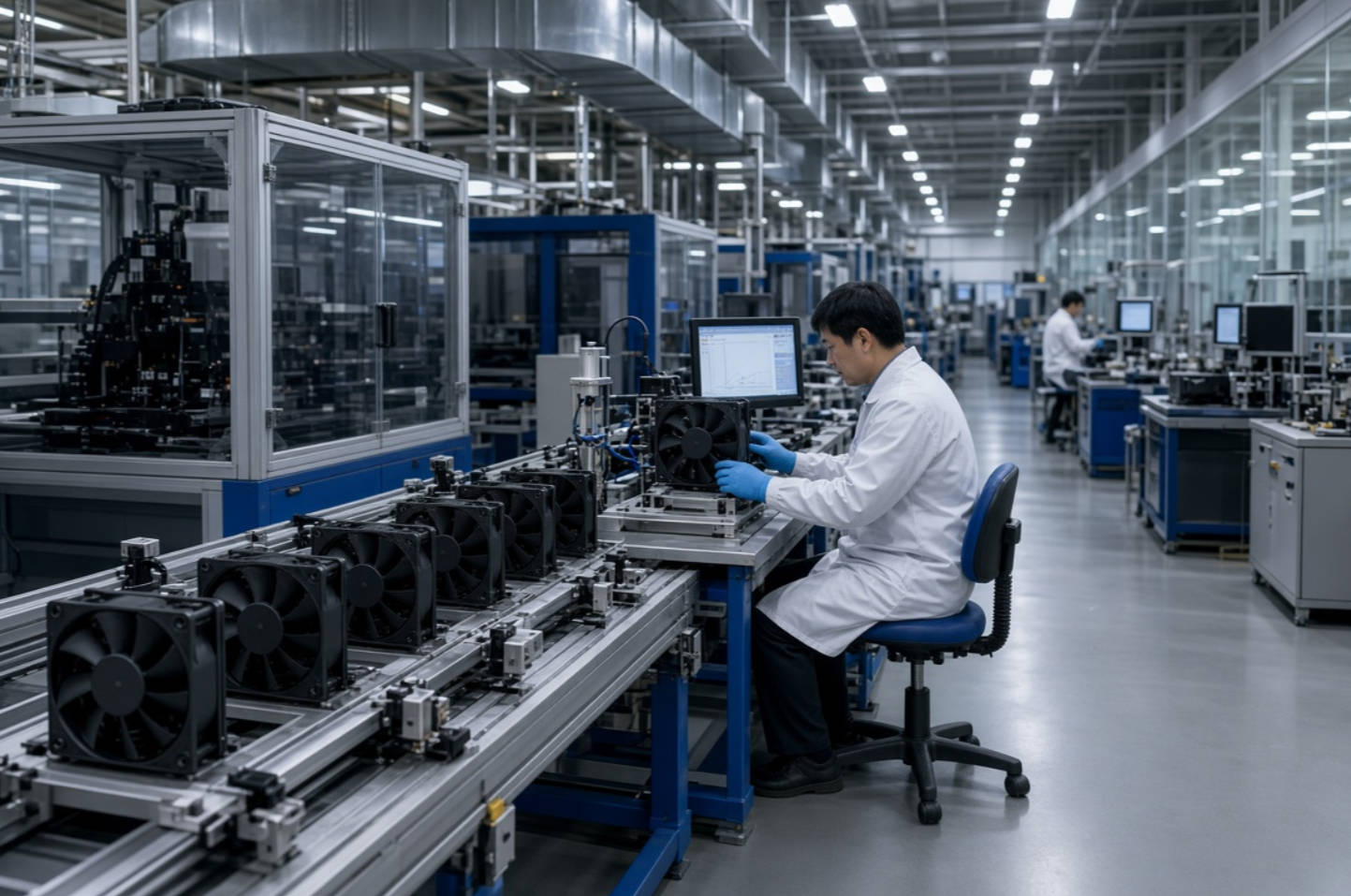
China's brushless fan industry has developed around major electronics and manufacturing clusters, especially in Shenzhen, Dongguan, Huizhou, Zhongshan, Foshan, Suzhou, Zhejiang, and the Pearl River Delta.
For international buyers, the main advantage is not only labor cost. The larger advantage is the concentration of upstream resources:
- Plastic injection-molding suppliers for UL-rated housings and impellers
- Magnet, winding-wire, bearing, PCB, and IC suppliers
- Motor-control and PWM-control engineering resources
- Tooling and rapid-prototyping factories
- Reliability-testing laboratories
- Export logistics infrastructure around Shenzhen, Guangzhou, Ningbo, and Shanghai
- OEM/ODM experience serving telecom, industrial, automotive, consumer-electronics, and power-equipment sectors
Shenzhen is particularly important because it combines electronics design, PCB manufacturing, motor-control development, contract manufacturing, and global export infrastructure in one region. This makes it easier for brushless fan suppliers to support product iteration, customized control functions, cable assemblies, connector changes, private labeling, and small-to-medium OEM projects.
China's electric-fan export data also illustrates the scale of the country's fan supply chain. CEIC, citing China General Administration of Customs data, reported electric-fan exports of USD 1.012 billion in March 2025.
That said, China should not be treated as one uniform supplier market. There are meaningful differences between:
- High-volume manufacturers with automated lines
- Engineering-oriented OEM/ODM suppliers
- Trading companies with limited production control
- Factories focused on consumer fans rather than industrial cooling
- Suppliers that can provide product compliance documents versus those that only claim compliance in quotations
The correct supplier depends on your application risk, annual volume, certification needs, and customization requirements.
This list is not a "lowest-price ranking." It is a practical sourcing shortlist built around the factors that matter when a buyer needs stable brushless fan supply over multiple product cycles.
A credible supplier should show evidence of production capability beyond product photos. This may include automated assembly lines, winding processes, balancing equipment, aging rooms, airflow testers, noise-test stations, incoming-material inspection, and documented production capacity.
Capacity alone is not enough. Buyers should ask whether the quoted capacity is:
- Total factory capacity or capacity for the specific fan series
- Available capacity after existing customer commitments
- Monthly output under normal conditions or theoretical maximum output
- Supported by second-source material planning
- Available for both standard and customized models
For brushless DC fans, product performance comes from much more than the housing shape. A capable supplier should be able to discuss:
- Motor topology and pole configuration
- Hall-sensor or sensorless control design
- Bearing selection
- PWM input, tachometer output, and alarm functions
- Locked-rotor protection
- Reverse-polarity protection
- Soft-start and auto-restart behavior
- IP protection options
- Operating-temperature range
- Static-pressure requirements
- Life-expectancy testing
The supplier should also be able to review your actual thermal requirement, not merely recommend the closest catalog model.
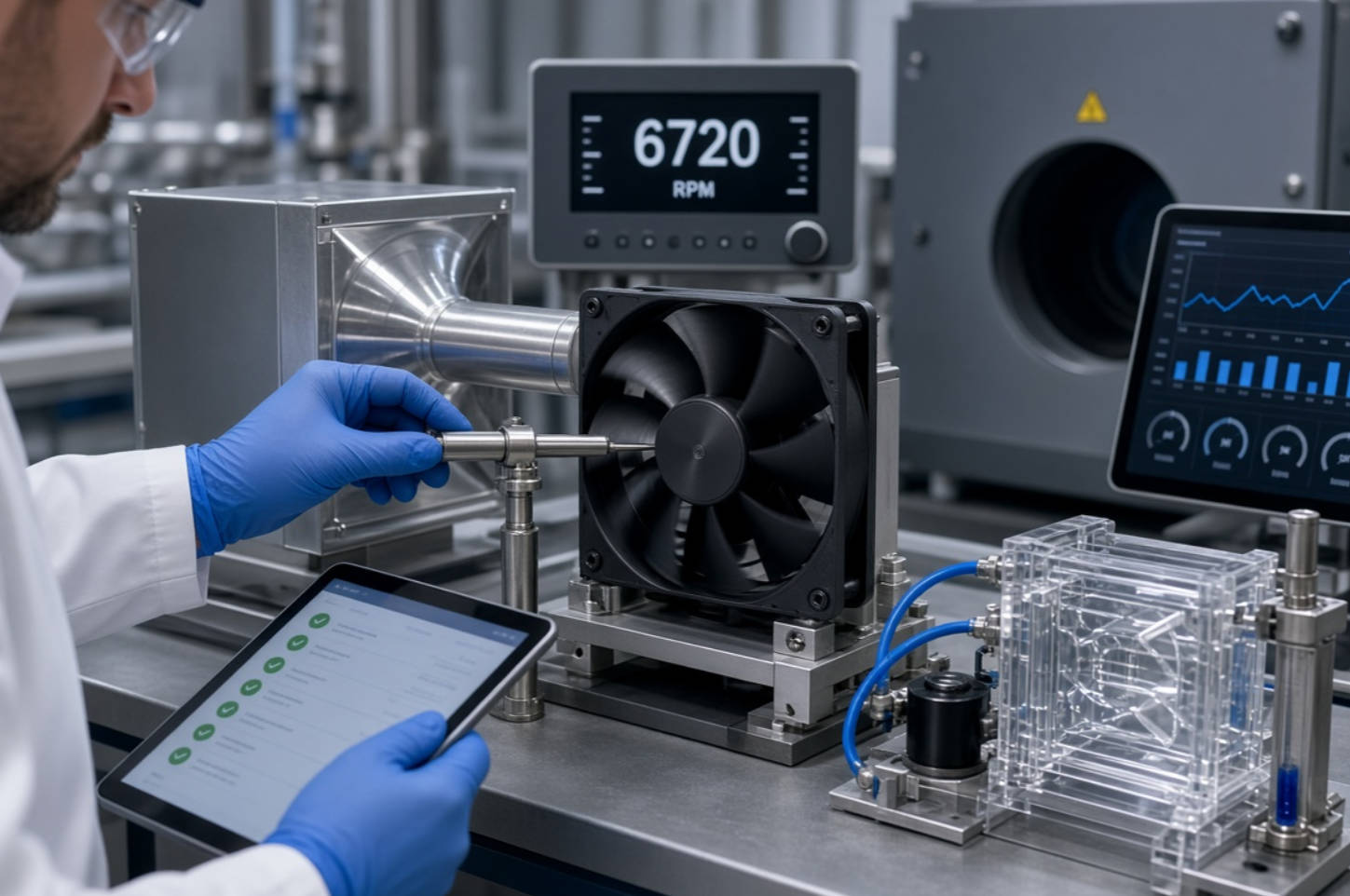
A reliable cooling-fan supplier should be willing to explain how it controls key failure points, including:
- Incoming inspection for bearings, magnets, wires, ICs, and plastic resin
- Rotor balancing
- Coil winding consistency
- Fan-speed verification
- Airflow and static-pressure testing
- Noise testing
- Locked-rotor and polarity protection testing
- High-temperature operation
- Aging or burn-in testing
- Packaging inspection and shipment traceability
For many export applications, CE marking, RoHS compliance, REACH declarations, UL recognition, TÜV reports, and ISO management-system certifications may be relevant. The exact requirement depends on the final product, target market, and customer specification.
A critical distinction: a factory ISO certificate does not automatically mean every fan model has CE, UL, or RoHS documentation. Buyers should request documents for the exact product family, voltage, wire configuration, and intended market.
For OEM programs, engineering communication often determines whether a project succeeds. A supplier should be able to provide drawings, tolerance information, test conditions, sample records, change-control procedures, and clear lead-time commitments.
This is especially important for small and mid-sized brands that may need customized cable lengths, connector types, labels, RPM ranges, bearing options, or packaging without the purchasing volume of a multinational OEM.
The companies below serve different buyer profiles. Some are suitable for high-volume and high-specification programs; others are more appropriate for flexible OEM/ODM development or cost-conscious industrial applications.
| Manufacturer | Primary Focus | Reported/Indicative Capacity | Typical MOQ Approach | Compliance and Quality Focus |
|---|---|---|---|---|
| Capital Technology Co., Limited | DC/AC fans, blowers, thermal solutions, SANYO DENKI distribution | 3.9 million cooling fans/month stated on company page | Flexible; project-dependent | Product compliance to be confirmed by model; engineering-led support |
| YCCFAN | DC/AC fans, blowers, mini fans, automotive and industrial cooling | More than 250,000 units/day stated by company | Usually project and model dependent | ISO 9001, ISO 14001, IATF 16949; UL/CUL/TÜV/CE/SGS/CCC claims |
| Guangdong Shenghui Technology | Industrial cooling fans and brushless fan products | 120 million pieces/year cited in industry source | Better suited to volume programs | CE, UL, TÜV, RoHS, ISO 9001/14001, IATF 16949 cited |
| Shenzhen Huaxia Hengtai Electronics | DC fans, AC fans, blowers, cross-flow fans | Not publicly confirmed in this review | Quote-based | CE, UL, TÜV, CCC, RoHS, IATF 16949 cited |
| Delta Electronics | High-performance thermal management and server-grade fans | Global multi-site manufacturing | Often program-volume oriented | Enterprise-level engineering and global quality systems |
| SANYO DENKI | Premium cooling fans, blowers, controllers, motors | Global industrial manufacturing network | Usually distributor/project based | High-reliability industrial and mission-critical product focus |
| Shenzhen Xinyujie Technology | DC fans, DC blowers, AC fans | Not publicly confirmed in this review | Small-to-medium quantities often available | Buyers should validate model-specific documentation |
| Shenzhen Topfan Technology | Cooling fans and thermal products | Not publicly confirmed in this review | Quote-based | Buyers should verify current certificates and test reports |
| Snowfan / Shenzhen Yongyihao Electronics | DC cooling fans and related products | Not publicly confirmed in this review | Quote-based | Buyers should validate product-level approvals |
| Jiangshanlai Electronic Technology | DC fans, AC fans, blowers and cooling components | Not publicly confirmed in this review | Quote-based | Buyers should request current audit and compliance files |
Important note: Capacity, MOQ, and certification requirements vary by model, voltage, bearing system, custom tooling, cable assembly, and destination market. Treat this table as an initial sourcing map—not as a substitute for supplier qualification and document verification.
Capital Technology Co., Limited is a Shenzhen-based cooling-solution supplier and manufacturer serving customers that need a practical balance between product performance, customization flexibility, and cost control.
The company offers its own independent CAPITAL product range and also acts as chief agent for SANYO DENKI, a long-established Japanese cooling-fan brand. Its product offering includes DC fans, AC fans, blowers, centrifugal fans, counter-rotating fans, reversible-flow fans, long-life fans, splash-proof fans, oil-resistant fans, wide-temperature fans, filters, reactors, motors, and related thermal-management components. The stated fan-size range is 20 mm to 280 mm.
Capital Technology states a monthly production capacity of 3.9 million cooling fans. Its company profile also identifies ZTE, Huawei, Hytera, and Gold Power among its customers or supplied brands.
- Combination of proprietary CAPITAL products and SANYO DENKI channel resources
- Broad DC fan, AC fan, blower, and thermal-component coverage
- Suitable for telecom, industrial power, communications, automation, and equipment-cooling applications
- Engineering support for customer-specific cooling requirements
- Better fit for buyers needing deeper OEM coordination than a catalog-only supplier may provide
- Ability to support buyers who need a value-oriented alternative while retaining access to premium SANYO DENKI fan solutions where the application requires it
Capital Technology is particularly relevant for small-to-medium brands, equipment manufacturers, and engineering-led procurement teams that need responsive communication and practical customization support.
Potential OEM/ODM customization areas can include:
- Fan voltage, speed, airflow, and static-pressure targets
- Wire length, wire gauge, connector, and pinout
- Tachometer, PWM, FG, RD, and alarm signals
- Sleeve-bearing, ball-bearing, or long-life bearing configurations
- Waterproof, dust-resistant, oil-resistant, or wide-temperature options
- Branding, labels, packaging, and model-number management
- Supporting products such as EMI filters, controllers, and thermal accessories
A buyer should still request application-specific samples and confirm the test conditions behind every performance figure. Airflow values can differ materially depending on whether a supplier reports free-air airflow or airflow under actual system resistance.

YCCFAN is a Shenzhen-based supplier of miniature cooling fans, DC blowers, axial fans, AC fans, EC fans, and customized thermal products. It states that it was established in 2011 and serves sectors including automotive, communications, medical equipment, power electronics, solar energy, energy storage, and home appliances.
The company reports daily output exceeding 250,000 units and claims certifications including ISO 9001, ISO 14001, and IATF 16949, with product certifications or approvals described as UL, CUL, TÜV, CE, SGS, and CCC.
- Broad miniature-fan and blower portfolio
- Strong positioning in industrial and automotive-adjacent thermal management
- OEM/ODM support for cooling requirements
- Reported automated manufacturing and large-scale capacity
- Experience across electronics, automotive, telecom, medical, and energy applications
YCCFAN may be appropriate for buyers with medium-to-high-volume programs that need a manufacturer able to support fan selection, airflow requirements, custom dimensions, control functions, and compliance discussions.
Before nomination, buyers should clarify which certifications apply to the exact SKU rather than relying on general corporate certification statements.
Guangdong Shenghui Technology is frequently cited in industry supplier roundups as a large-scale cooling-fan producer. An industry source lists its establishment year as 2004, workforce at more than 1,000 people, factory area at approximately 40,000 square meters, and capacity at 120 million pieces annually. The same source cites CE, UL, TÜV, RoHS, ISO 9001, ISO 14001, and IATF 16949 among its certifications.
- Large-volume manufacturing orientation
- Broad international compliance profile reported by industry sources
- Potential fit for OEMs requiring scalable production
- Suitable for established industrial, appliance, electronics, and automotive supply-chain programs
This type of supplier is generally best suited to buyers with clear specifications, stable demand forecasts, and recurring annual volumes. Buyers with low annual volume or frequent design changes should confirm whether the supplier can provide sufficient engineering attention and flexible MOQ terms.
Shenzhen Huaxia Hengtai Electronics is listed as a manufacturer of DC brushless fans, AC fans, blowers, cross-flow fans, vortex fans, centrifugal fans, and brushless motors. An industry-source profile describes the company as founded in 2004 and cites product and management credentials including CE, UL, TÜV, CCC, RoHS, ISO 9001, ISO 14001, and IATF 16949.
The company's product focus makes it relevant for buyers needing more than a basic axial fan, especially where airflow direction, pressure requirements, fan geometry, or industrial application conditions need to be considered.
- Diverse cooling-product categories
- Experience with axial, blower, centrifugal, and cross-flow formats
- Reported international safety and environmental compliance coverage
- Potentially suitable for industrial equipment, information technology, communications, medical equipment, and appliance programs
Ask for evidence of the supplier's ability to control performance variation across production lots. For blower and centrifugal applications, request actual P-Q curves, noise data, current draw, locked-rotor behavior, and test conditions rather than selecting from free-air CFM alone.
Delta Electronics is a global power-electronics and thermal-management supplier rather than a China-only fan manufacturer, but it has manufacturing operations in China and publishes brushless DC fan specifications connected to facilities in Dongguan, Guangdong.
Delta is known for high-performance cooling solutions for server, storage, data-center, power-electronics, and harsh-environment applications. Its product range includes three-phase brushless DC fans designed for demanding equipment environments.
- High-performance fan and thermal-management engineering
- Strong fit for data centers, servers, power modules, storage, and critical electronics
- Global manufacturing, R&D, and quality infrastructure
- Advanced motor-control and energy-efficiency capabilities
Delta is generally more suitable for technically demanding, high-volume, or mission-critical applications where product qualification, thermal reliability, acoustic performance, and lifecycle support are more important than the lowest initial purchase price.
For startups or low-volume buyers, purchasing may be more practical through authorized channels or distributors rather than pursuing a direct customization program.
SANYO DENKI is a Japanese industrial manufacturer recognized for its San Ace cooling-fan range, motors, servo systems, and related industrial products. Capital Technology Co., Limited identifies itself as the chief agent of SANYO DENKI and supplies SANYO fan, controller, airflow-tester, and motor products alongside its own CAPITAL range.
- Premium positioning for industrial and high-reliability fan applications
- Extensive product coverage, including DC fans, AC fans, blowers, counter-rotating fans, reversible-flow products, splash-proof designs, oil-resistant products, and wide-temperature models
- Strong relevance for telecom, servers, industrial systems, transportation, medical systems, and demanding electronic equipment
- Good option where lifecycle performance and technical documentation outweigh initial unit-cost pressure
SANYO DENKI is generally appropriate for applications with a high cost of fan failure, such as network infrastructure, critical power equipment, industrial control systems, and continuously operating systems.
Buyers should clearly define whether their project requires a premium branded fan, a cost-effective custom fan, or a dual-source strategy. A combination of CAPITAL and SANYO DENKI options can be useful when different equipment tiers have different reliability and price requirements.
Shenzhen Xinyujie Technology is listed on Alibaba as a manufacturer of DC fans, DC blowers, and AC fans. Its published catalog includes miniature brushless DC blower and axial fan offerings, including 5 V, 12 V, and 24 V configurations, plus common performance features such as PWM and auto restart.
- Focus on compact DC cooling fans and blowers
- Potentially accessible for prototype, replacement, and smaller industrial projects
- Broad standard-voltage options
- Suitable for buyers seeking catalog products with moderate customization
This type of supplier can be useful for smaller devices, consumer electronics, compact enclosures, and early-stage product development. Buyers should confirm expected annual capacity, bearing-system options, actual operating life, and whether engineering changes are controlled through revision documentation.
Shenzhen Topfan is mentioned in market and industry listings related to DC brushless cooling fans. It is generally positioned within Shenzhen's electronics-manufacturing ecosystem, where component suppliers can support standard fan products and potentially customized cooling solutions.
- Located in Shenzhen's thermal-management and electronics supply chain
- Potential fit for buyers needing standard DC fan and blower products
- May be relevant for comparison quotations during supplier qualification
Procurement teams should carry out a full audit before approval. Request factory photographs with production dates, bill-of-materials control information, current quality certificates, customer references where appropriate, and samples from the actual planned production line.
Shenzhen Yongyihao Electronics, often associated with the Snowfan name in industry supplier listings, is included in China cooling-fan market roundups as a supplier of cooling-fan products.
- Relevant option for buyers sourcing standard DC cooling-fan products
- Can be considered in a multi-supplier RFQ strategy
- May offer cost-competitive alternatives for standard models
The key issue for buyers is verification. Ask whether customized impellers, motor-control boards, wires, and bearings are produced under controlled specifications, and verify whether a change in component supplier requires written customer approval.
Shenzhen Jiangshanlai Electronic Technology is also identified in industry lists of China DC fan suppliers.
- Part of Shenzhen's established electronics-component sourcing base
- Potential source for standard fans, blowers, and project quotations
- May be suitable for buyers developing a qualified backup-supplier list
Use a staged qualification process:
1. Compare technical proposal quality, not only price.
2. Obtain samples and test them in your real enclosure.
3. Review the supplier's inspection records.
4. Audit the production process if the product is business-critical.
5. Approve a pilot order before annual-volume allocation.
A Brushless Fan uses an electronically commutated DC motor rather than a brushed motor. The absence of physical brushes can reduce wear associated with brush contact, but the total life of the fan still depends heavily on bearing type, motor design, electronics, balance quality, operating temperature, dust exposure, and actual duty cycle.
When sourcing a DC brushless cooling fan, buyers should define the following items in writing.
| Parameter | Why It Matters | What to Request |
|---|---|---|
| Voltage range | Prevents startup or speed instability | Nominal voltage, operating range, undervoltage behavior |
| Airflow | Determines heat-removal capability | CFM or m³/h at specified test condition |
| Static pressure | Essential for dense equipment or restricted airflow paths | Full P-Q curve, not only maximum airflow |
| Noise | Affects user experience and equipment acceptance | dB(A) at stated distance and test environment |
| Bearing type | Strongly affects life, noise, orientation, and cost | Sleeve, hydraulic, rifle, dual-ball, or ceramic-bearing specification |
| Speed | Influences airflow, acoustics, and power draw | Rated RPM with tolerance |
| Current and power | Affects PSU and connector design | Rated current, startup current, locked-rotor current |
| PWM/FG/RD functions | Supports smart thermal control and failure monitoring | Pinout, logic levels, signal timing, pull-up requirements |
| Operating temperature | Determines reliability in real equipment environments | Ambient and storage-temperature range |
| Protection | Helps reduce field failures | Locked rotor, reverse polarity, overcurrent, thermal protection |
| Ingress protection | Relevant for dust, moisture, oil, and outdoor use | IP rating and test report if required |
| Materials | Influences flame resistance and durability | Plastic resin grade, UL 94 flammability class, wire and insulation data |
For industrial cooling fans, buyers commonly need to verify:
- Frame and impeller resin: Often PBT, PA66, or other engineering plastics. Ask whether the quoted resin grade is consistent across production.
- Flammability rating: UL 94 V-0 may be required in many electrical applications, but buyers should verify the exact material grade and documentation.
- Bearing system: Sleeve bearings can be cost-effective but may be less suitable for high temperature, long operating hours, or certain mounting orientations. Dual-ball-bearing designs are commonly specified for higher duty cycles and longer service life.
- Copper winding: Confirm wire grade, insulation class, and process control.
- Magnet material: Variation in magnet quality can affect torque, efficiency, and stability at high temperature.
- PCB and driver IC: These determine protection features, speed control, startup reliability, and failure behavior.
Depending on the product and destination, buyers may require:
- CE documentation for applicable EU product requirements
- RoHS declaration and material compliance evidence
- REACH SVHC declaration
- UL recognition or safety documentation
- TÜV reports where customer specifications require them
- ISO 9001 quality-management-system certificate
- ISO 14001 environmental-management-system certificate
- IATF 16949 for automotive supply-chain expectations
- Conflict-minerals or PFAS declarations where requested by large OEM customers
Do not assume that a CE logo on a fan label is sufficient. Ask for the Declaration of Conformity, supporting test information where relevant, manufacturer information, model coverage, issue date, and authorized signature.
This is one of the most important and under-discussed risks in the cooling-fan industry.
A supplier may provide a good sample using a dual-ball-bearing system, while mass production later uses a lower-cost sleeve-bearing or alternative bearing configuration unless the exact bearing requirement is locked into the approved specification and bill of materials.
How to avoid it:
- State the bearing type in the purchase order and technical drawing.
- Ask for an approved bill of materials for critical components.
- Require written approval for material or component changes.
- Perform incoming inspection or third-party pre-shipment inspection.
- Retain a golden sample and compare production samples against it.
A fan may produce an attractive airflow figure in an open test setup but deliver poor performance once installed behind filters, grilles, heat sinks, cables, narrow ducts, or dense PCB assemblies.
How to avoid it:
Ask for the P-Q curve, which shows the relationship between airflow and static pressure. Then test the fan in your actual enclosure or a representative airflow-resistance fixture.
A claim such as "50,000 hours" is incomplete unless the supplier states the temperature, orientation, voltage, load condition, and life-test method.
How to avoid it:
Request the rated service-life definition, for example:
- Bearing type
- Ambient temperature
- Mounting orientation
- Continuous or intermittent operation
- Acceptable speed/noise degradation
- Test duration and sample size
A supplier may show an ISO certificate that has expired or a CE/RoHS document covering a different product family.
How to avoid it:
- Verify the certificate number with the issuing certification body.
- Check the valid-from and valid-to dates.
- Confirm the legal company name and factory address.
- Confirm that the exact factory—not an affiliated trading company—is certified.
- Match the product model number on test reports with the model you intend to purchase.
A quotation that is significantly below market may reflect changes in plastic resin, magnet grade, bearing supplier, driver IC, copper content, balancing process, or testing level.
How to avoid it:
Do not compare quotations only by unit price. Compare:
- Bearing type
- Plastic material and flammability rating
- Winding wire specification
- Motor protection functions
- Testing method
- Warranty terms
- Packaging standard
- Change-notification policy
- Incoterms and payment conditions
Here is a practical point that experienced cooling-fan engineers understand but many online sourcing guides overlook:
> A fan's rated CFM is often less important than its performance at your operating static pressure.
For example, a 120 mm axial fan might show high free-air airflow in a catalog. But when installed behind a dense filter, narrow vent slots, a heat sink, or a telecom cabinet door, its airflow may collapse if the fan has insufficient static-pressure capability.
For enclosures with resistance, compare suppliers using:
- Full P-Q curve
- Operating point in the actual system
- Noise at the operating point
- Power consumption at the operating point
- Speed tolerance
- Temperature rise during continuous operation
A lower-CFM fan with stronger static pressure can outperform a higher-CFM fan inside a restrictive enclosure.
This is why an application-based supplier discussion is more useful than selecting a fan solely by size, voltage, and catalog airflow.
A high-quality RFQ reduces misquotation and helps suppliers recommend the correct fan.
Include:
- Fan type: axial, blower, centrifugal, AC, DC, or EC
- Dimensions: length × width × thickness
- Voltage and allowable operating range
- Target airflow and static-pressure requirement
- Noise target
- Rated speed and control method
- Wire length, connector, pinout, and polarity
- Bearing preference
- Operating-temperature range
- Required ingress protection
- Required certifications
- Annual demand forecast
- Target sample date and mass-production date
- Destination country and Incoterms
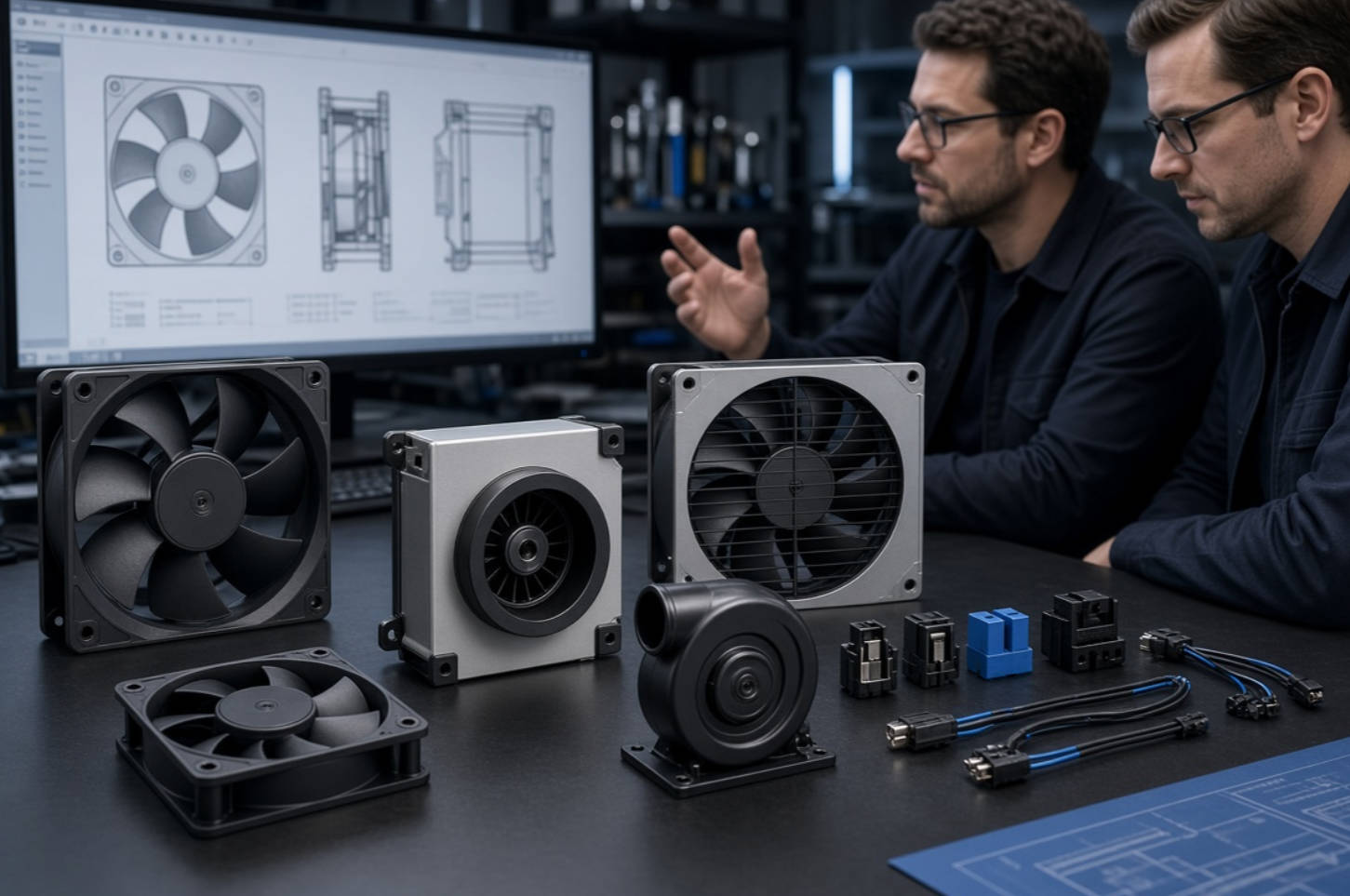
Before comparing prices, request:
- Product drawing with tolerances
- Datasheet
- P-Q curve
- Noise-test conditions
- Life-test conditions
- Environmental-test summary
- Compliance documentation
- Factory ISO certificate
- Quality-control flowchart
- Production-line photographs or video
- Sample lead time and mass-production lead time
- Warranty terms
- Change-control policy
Bench testing is useful, but final validation should happen in the real application.
Measure:
- Internal enclosure temperature
- Component hot spots
- Fan noise in installed condition
- Startup behavior at minimum input voltage
- PWM control behavior
- Tachometer signal reliability
- Current draw
- Vibration
- Failure behavior during blocked-rotor testing
- Performance after high-temperature operation
Before allocating annual volume, place a controlled pilot order. Inspect the shipment against the golden sample, approved drawings, packaging requirements, labels, and test records.
For mission-critical products, include pre-shipment inspection, AQL sampling, or independent laboratory testing in the purchasing plan.
The purchase order or supplier-quality agreement should state that the supplier cannot change critical materials, bearings, magnets, PCBs, driver ICs, resin grade, production site, or manufacturing process without written approval.
This clause protects the buyer from "silent substitutions" after initial sample approval.
China remains a strong sourcing destination for Brushless Fan manufacturers, particularly for buyers who need access to mature electronics supply chains, flexible OEM/ODM development, and a broad choice of DC fans, AC fans, blowers, centrifugal fans, and thermal-management components.
For high-volume industrial programs, supplier selection should be based on more than price. The right manufacturing partner should demonstrate stable material control, verifiable compliance, documented test methods, transparent quality processes, and the ability to support your actual thermal design.
For buyers seeking responsive engineering support, flexible communication, customized OEM solutions, and access to both cost-effective CAPITAL fan products and premium SANYO DENKI cooling products, Capital Technology Co., Limited is a practical supplier to include in the initial RFQ and sample-validation process. The company states that it provides cooling-fan solutions across DC/AC fan sizes from 20 mm to 280 mm, has monthly capacity of 3.9 million cooling fans, and supports applications in communications, industrial equipment, and related thermal-management fields.
Before committing to mass production, request a complete technical package, validate samples under real operating conditions, inspect the factory or conduct a third-party audit, and define change-control requirements in writing.
Looking for a customized DC fan, AC fan, blower, or industrial cooling solution? Contact Capital Technology Co., Limited with your application drawing, voltage, airflow target, static-pressure requirement, noise target, operating environment, and forecast volume to begin a technical evaluation.
Ask for the full ISO certificate, including certificate number, issuing body, company legal name, factory address, scope, issue date, and expiry date. Then verify the certificate number through the certification body's public database or by contacting the issuing organization directly. Confirm that the certificate covers the actual manufacturing site, not only a sales company or related entity.
Not always. CE marking is a conformity declaration related to applicable EU requirements; it is not a universal "quality certificate." Your product may also require RoHS, REACH, EMC-related assessment at the finished-system level, or industry-specific documentation. Confirm the obligations based on the complete end product and the market where it will be sold.
MOQ depends on the degree of customization. A standard fan with custom labels or cable lengths may have a relatively low MOQ. A fan requiring a new mold, unique impeller, special PCB, customized performance curve, or nonstandard certification may require a much higher commitment. Always ask separately for sample MOQ, pilot-order MOQ, regular-production MOQ, and MOQ after tooling amortization.
Sleeve bearings can offer lower cost and lower initial noise in controlled environments. Dual-ball bearings are generally preferred for higher temperature, continuous operation, demanding mounting orientations, and longer design-life requirements. The correct choice depends on duty cycle, ambient temperature, required reliability, and budget. Do not select based on price alone.
Compare the complete operating profile: P-Q curve, static pressure, noise, current draw, bearing type, operating-temperature range, control functions, life-test conditions, material grade, warranty, and installed performance in your actual enclosure. Similar free-air CFM figures do not necessarily mean the fans will perform similarly in a restrictive system.
1. Capital Technology Co., Limited, "About Us" — company overview, product range, stated monthly capacity, SANYO DENKI agency status, and referenced customer relationships. [sanyodenki-cn]
2. MarketsandMarkets, "China Brushless DC Motor Market (2025–2030)" — market estimate of USD 3.2194 billion in 2025 and projected USD 5.2494 billion by 2030. [marketsandmarkets]
3. CEIC Data, "China Export: Electric Fan" — export data sourced from China’s General Administration of Customs. [ceicdata]
4. YCCFAN, company and product information — establishment year, product range, stated production scale, and claimed quality and product certifications. [yccfan]
5. Delta Electronics, thermal-management and fan product information — global manufacturing footprint, China operations, and brushless DC fan specifications. [delta-fan]
6. Industry supplier overview for Guangdong Shenghui, Shenzhen Huaxia Hengtai, Snowfan, and Jiangshanlai — indicative founding year, capacity, and claimed certifications; buyers should independently validate all current claims. [eaglecooleer]


