From idea to market-ready product, our NPI solutions make every stage easier, faster. Discover How We Help
Help Center

Views: 222 Author: Capital Technology Publish Time: 2026-05-21 Origin: Site
As an engineer who has spent years specifying DC fans, AC fans, radiators, and filters for telecom and industrial systems, I've seen tangential fans (also called cross‑flow fans) quietly become a go‑to solution wherever designers need a wide, uniform curtain of air instead of a narrow jet. This guide brings together the fundamentals of tangential fan design, the latest market trends, and practical selection tips from real projects in communications, power electronics, and industrial equipment. [sofasco]
A tangential fan, or cross‑flow fan, uses a long cylindrical impeller with many forward‑curved blades to move air uniformly across the entire length of the fan. Air enters along the impeller length and exits as a consistent sheet of airflow, which is ideal for cooling elongated or narrow spaces. [rs-online]
Unlike typical axial fans that push air along the shaft, tangential fans direct airflow perpendicular to the shaft, creating a wide air curtain rather than a focused column. This geometry is why they are commonly used in HVAC units, electronics cooling, and air curtains in commercial environments. [pbmmf]
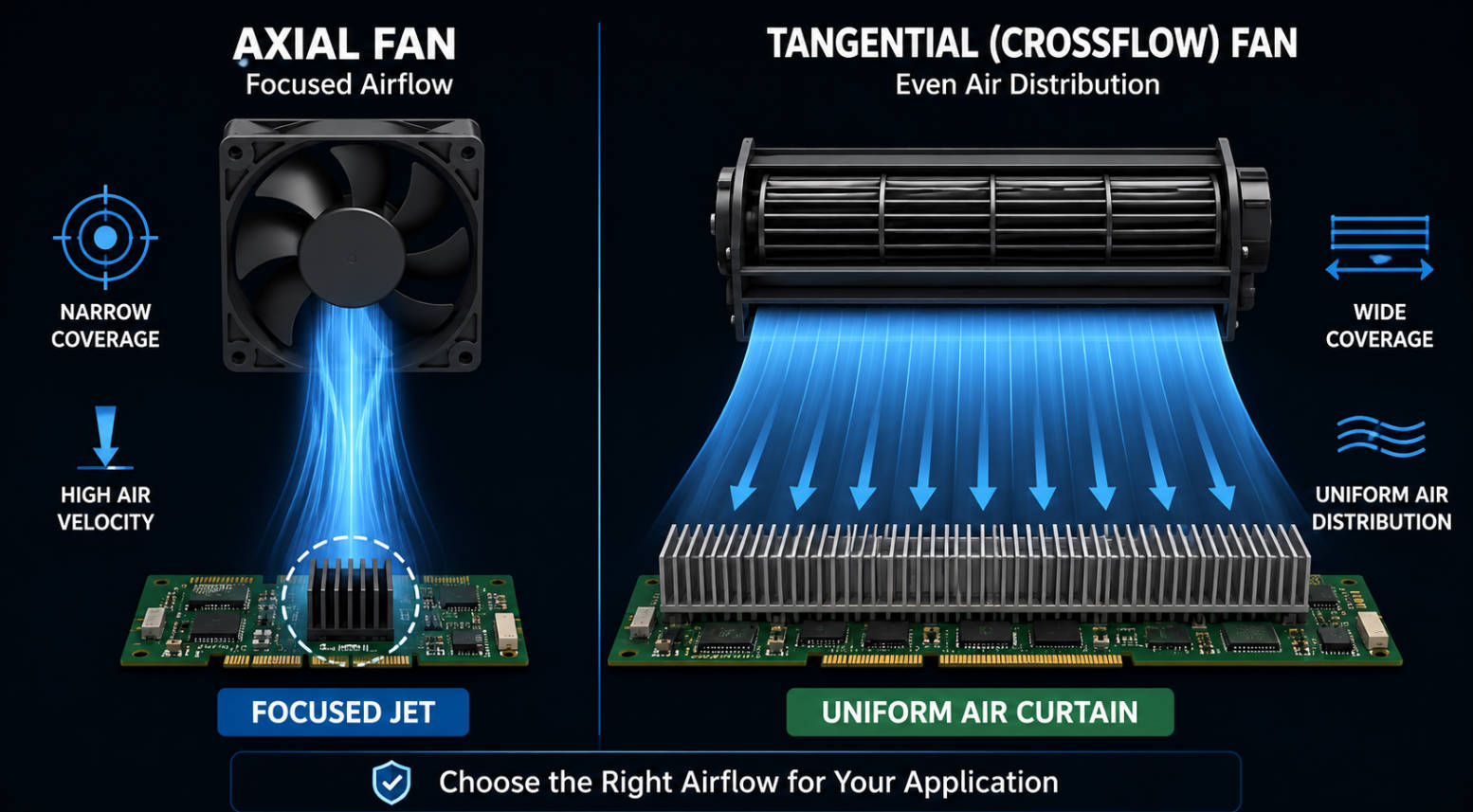
Below is a concise engineering comparison to position tangential fans against axial and centrifugal fans. [sofasco]
| Fan type | Airflow pattern | Typical pressure | Noise level | Best use cases |
|---|---|---|---|---|
| Tangential / Cross-flow | Wide, uniform air curtain across length sofasco | Low–medium | Low to medium sofasco | Air curtains, electronics, HVAC, displays sofasco |
| Axial | Focused jet along shaft | Low | Medium to high | General ventilation, server fans |
| Centrifugal | Radial, higher pressure | Medium–high | Medium | Ducted systems, filtration, combustion air |
When your design brief mentions "long narrow cabinet," "wide outlet," or "even airflow across the entire front panel," a tangential fan is almost always on the shortlist. [rs-online]
Historically, the cross‑flow concept dating back to Paul Mortier in 1893 has evolved into today's compact, efficient industrial designs used in telecom and industrial equipment. In practice, the working principle can be summarized in four steps that matter to designers. [pbmmf]
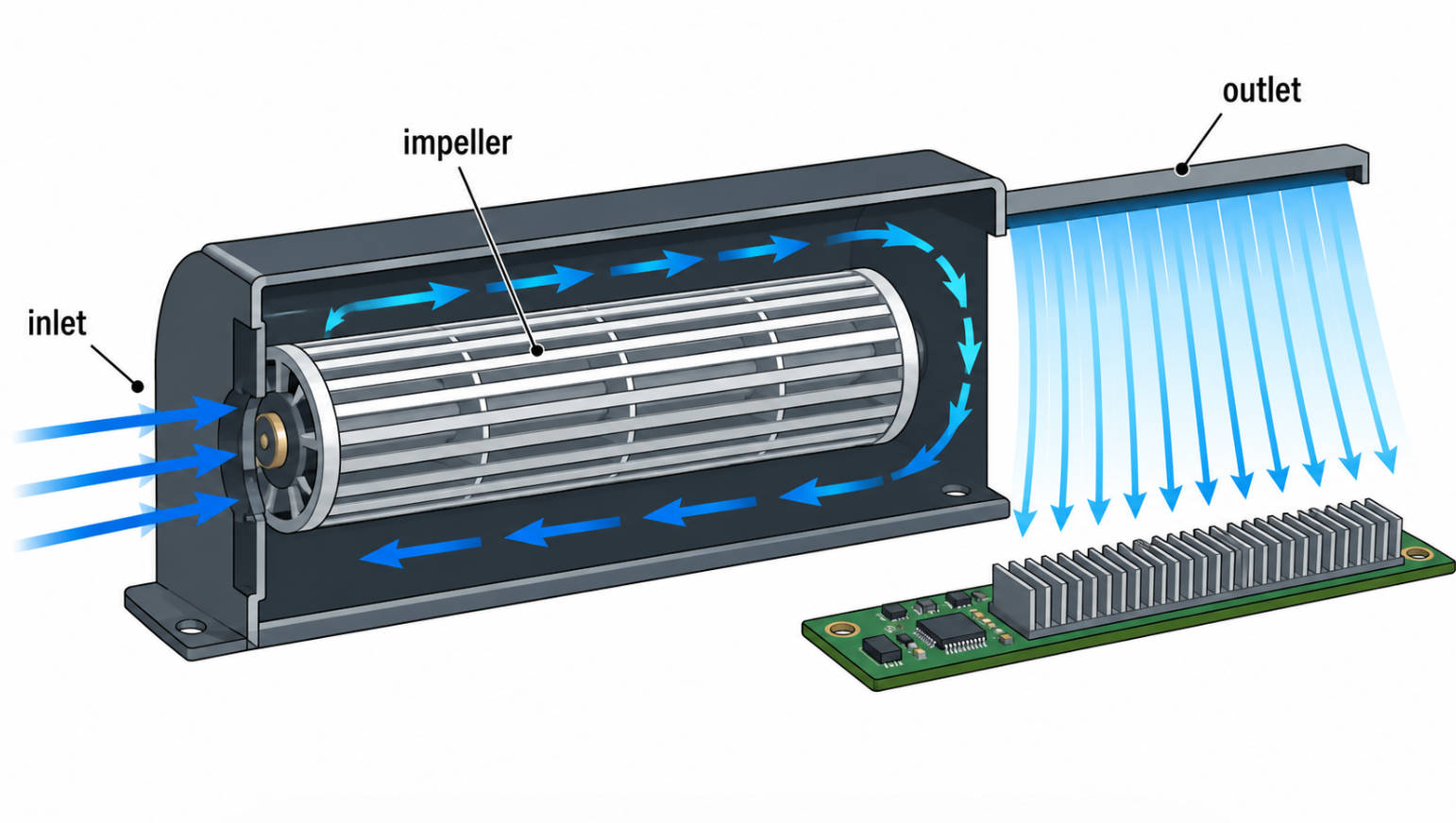
1. Motor starts and drives the hub
The electric motor turns the central hub, which drives a long impeller fitted with multiple forward‑curved blades. [sofasco]
2. Air enters along the impeller length
Because the fan housing is designed with an inlet along one side, air is pulled in tangentially across the length of the cylindrical impeller. [pbmmf]
3. Vortex formation and compression
As the blades rotate, air circulates inside the housing, forming a vortex that maintains relatively uniform static pressure along the fan length. This circulation compresses the air and stabilizes the flow before discharge. [sofasco]
4. Uniform discharge as an air curtain
The compressed air exits through the outlet slot, creating a laminar, evenly distributed sheet of airflow across the entire width of the fan. [rs-online]
In design terms, this means you can cool a long PCB, radiator, or heat sink profile with fewer flow dead zones than with a single point‑source axial fan.
From a systems engineer's perspective, understanding the basic structure of a tangential fan helps when you're evaluating datasheets or integrating custom thermal modules. [rs-online]
- Impeller (cylindrical rotor)
A long cylinder with multiple forward‑curved blades that defines the fan's length and effective coverage area. [sofasco]
- Hub and shaft
The hub transmits torque from the motor shaft to the impeller, ensuring stable rotation and consistent airflow. [sofasco]
- Housing and vortex casing
A shaped metal or plastic casing forms the inlet and outlet, controls the vortex, and governs both pressure and noise characteristics. [pbmmf]
- Drive motor (AC or DC / EC)
Depending on the application, tangential fans may use AC motors for simple mains‑driven systems or DC/EC motors where efficiency, speed control, and low noise are critical. [ystechusa]
When integrating tangential fans with radiators or filters, we typically simulate how the housing, filter frame, and heat sink fins interact to avoid unexpected turbulence and pressure drops.
In my work with telecom enclosures and industrial cabinets, tangential fans stand out for several engineering and user‑level benefits. [ystechusa]
- Wide, uniform airflow
Tangential fans deliver a consistent velocity profile across the outlet width, which is ideal for long PCBs, racks, or human‑scale air curtains. [rs-online]
- Compact, low‑profile form factor
Their elongated geometry fits neatly into slim equipment, under‑display spaces, or the top of cabinets where axial fans would be too deep. [rs-online]
- Quiet and user‑friendly operation
With optimized impeller and housing design, tangential fans can achieve relatively low noise levels while maintaining smooth airflow, which is essential in control rooms and office‑facing equipment. [sofasco]
- Predictable airflow for sensitive electronics
The laminar curtain minimizes hot spots and sudden turbulence, a key advantage when cooling densely packed telecom boards or RF modules. [pbmmf]
- Easy integration with filters and radiators
Because the outlet is long and uniform, it mates well with radiators, finned heat sinks, and filter assemblies designed for distributed airflow.
From a procurement standpoint, these characteristics often translate into fewer fans per assembly and simpler noise‑control measures.
While early cross‑flow designs were mostly used in HVAC, current applications are far broader, reflecting rising power density and stricter energy rules. [reitzindia]

- Telecom and networking equipment
Base stations, small cells, and microwave backhaul units often need quiet, uniform cooling across a long RF or baseband board, where tangential fans combined with radiators are a strong option. [ystechusa]
- Industrial and power electronics
Inverters, servo drives, UPS systems, and power supplies demand stable airflow over heat sinks and IGBT modules, which aligns well with cross‑flow fan geometry. [reitzindia]
- HVAC units and air curtains
Ceiling cassettes, fan‑coil units, and doorway air curtains rely on a wide, even air stream for comfort and thermal separation. [pbmmf]
- Display, kiosk, and retail equipment
Digital signage, vending machines, and POS terminals often combine limited depth with wide frontal surfaces, making compact tangential fans ideal. [rs-online]
In Asia‑Pacific and global telecom markets, these use cases increasingly overlap as operators demand quieter, more efficient cooling for 5G and edge equipment. [reitzindia]
Industrial fan technology is evolving rapidly, and tangential fans are part of this shift toward smarter, more efficient cooling systems. [paclights]
- Move to high‑efficiency EC motors
The 2026 thermal cooling market heavily favors EC motors for fans and blowers, driven by rising power density and tighter energy regulations. Integrating EC tangential fans enables precise speed control, lower energy use, and better system‑level efficiency. [reitzindia]
- IoT‑ready and smart monitoring
Industrial fan systems increasingly incorporate IoT connectivity for real‑time performance monitoring, predictive maintenance, and closed‑loop control. In practice, this means tangential fans paired with sensors and controllers that adjust speed based on temperature or load. [paclights]
- Advanced materials and CFD‑optimized designs
Use of composite materials and computational fluid dynamics (CFD) in fan design improves durability, reduces noise, and optimizes airflow paths. For cross‑flow fans, CFD helps refine housing shape and impeller blade geometry to maintain uniform velocity and minimize recirculation losses. [reitzindia]
For engineers and buyers, incorporating these trends early in a new product introduction (NPI) process—especially specifying PQ curves and environmental qualifications—reduces redesign risk later. [ystechusa]
From experience working with telecom and industrial customers, successful tangential fan selection always starts with a clear definition of application constraints rather than just airflow numbers. [ystechusa]
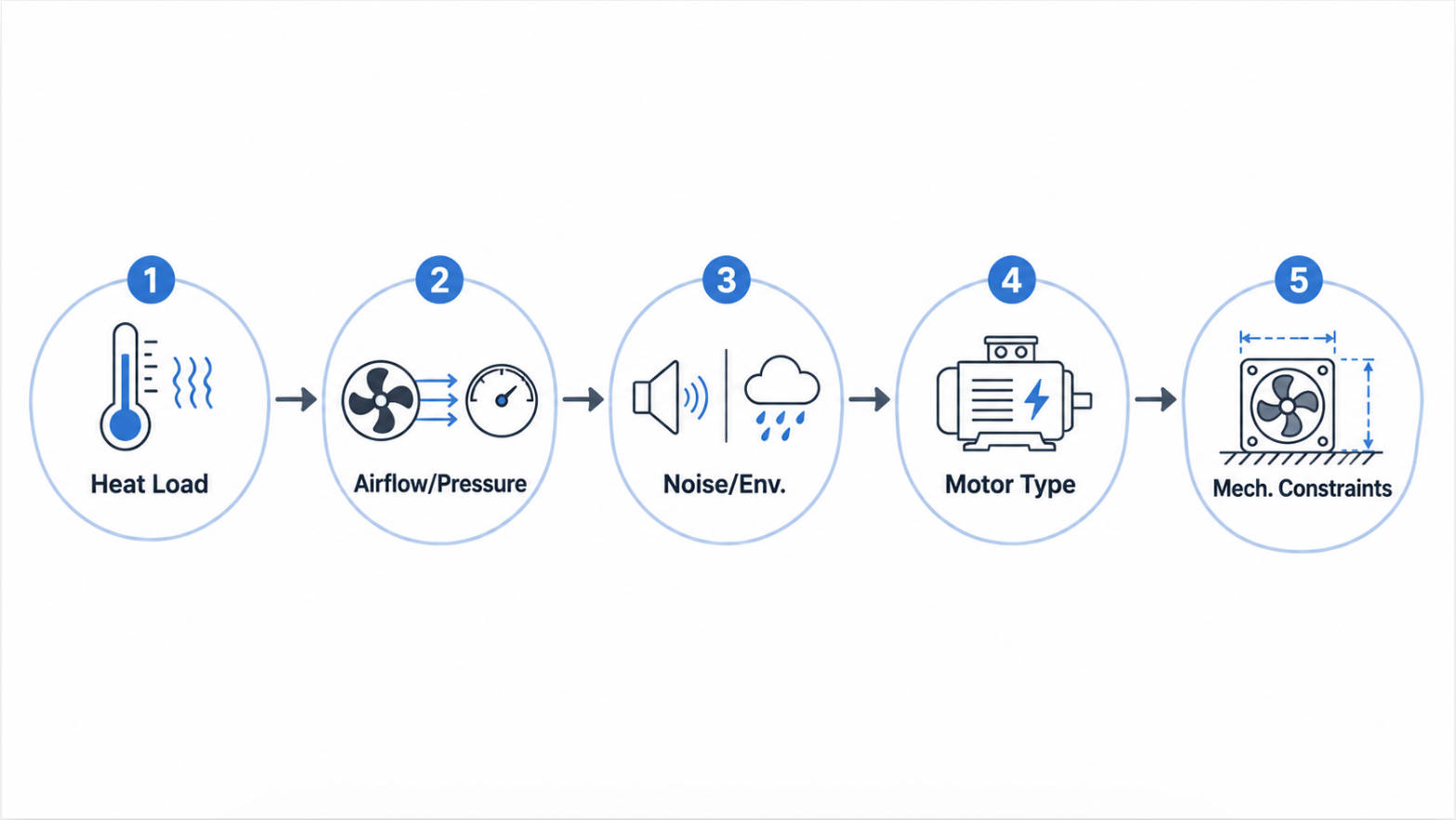
1. Define the application purpose and airflow coverage
Clarify whether the fan is for cooling, heating, or air curtain / separation, and determine the exact length and area that must receive uniform airflow. [ystechusa]
2. Calculate airflow and heat load
Use your system's power dissipation and allowable temperature rise to estimate required airflow (CFM or m³/h), factoring in pressure losses from radiators, filters, and grilles. [pbmmf]
3. Assess static pressure and system impedance
Tangential fans are best suited to low–medium static pressure systems, so measure or model pressure drops across radiators and filters to ensure the fan's PQ curve will intersect your duty point. [ystechusa]
4. Evaluate noise and environmental constraints
For equipment placed in offices, hospitals, or control rooms, set maximum allowable noise levels and review IP ratings, humidity, and temperature ranges. [reitzindia]
5. Choose motor type: AC vs DC/EC
- AC tangential fans are straightforward where mains power and simple on/off control are enough.
- DC/EC tangential fans suit systems requiring PWM or voltage control, telemetry, and higher efficiency. [reitzindia]
6. Check mechanical and integration constraints
Confirm mounting orientation, available depth, and compatibility with radiators, filters, and grille designs, including space for wiring, connectors, and vibration damping.
7. Bring fan selection earlier into NPI
Market analysis suggests moving fan selection earlier in the design cycle and requiring PQ curves plus environmental data to avoid late‑stage thermal surprises. [ystechusa]
In practice, many engineers and suppliers use "tangential blower," "cross‑flow fan," and "tangential fan" interchangeably, but the context sometimes matters. [rs-online]
- Tangential blower
Often used when the emphasis is on delivering an elongated sheet of air at slightly higher pressure, for example in heating equipment or HVAC modules. [pbmmf]
- Cross‑flow fan
Highlights the flow orientation: air moving across the impeller, perpendicular to the shaft, with uniform velocity across the outlet. [rs-online]
- Tangential fan
Common term in product catalogs, especially where the focus is on compact geometry and application in electronics or air curtains. [sofasco]
Most datasheets will specify airflow, static pressure, and noise in comparable ways, so your selection criteria remain the same regardless of naming. [pbmmf]
As a cooling solutions manufacturer with DC fans, AC fans, radiators, and filters, and as a chief agent of SANYO DENKI, CAPITAL Technology sits in a strong position to deliver end‑to‑end thermal solutions, not just standalone fans. [made-in-china]
SANYO DENKI is recognized globally for high‑reliability cooling fans used in telecom, IT, and industrial applications, and this reliability culture extends to cross‑flow and specialty fan lines. In my experience, that matters when you are supplying demanding customers such as ZTE, Huawei, and Hytera, who expect stable performance in harsh environments. [sanyodenki-cn]
By combining tangential fans with matched radiators and filtration modules, CAPITAL can offer integrated, validated assemblies tailored to specific cabinet geometries and environmental requirements, reducing your integration and testing burden. [made-in-china]
To make this more concrete, consider a realistic scenario that mirrors many telecom and industrial projects.
- A 3U outdoor telecom enclosure houses a long RF board and a high‑density power module.
- The thermal analysis shows several hot spots across the board edge, and noise must be strictly controlled due to rooftop residential deployment.
Using tangential fans in combination with custom radiators and an appropriate filter assembly allows you to:
- Create a uniform airflow curtain along the board and heat sink surfaces, reducing temperature gradients.
- Maintain lower noise by running a long fan at moderate speed rather than several small high‑RPM axial fans. [sofasco]
- Integrate EC motors and an intelligent controller so the fan speed increases only during peak traffic or high ambient conditions, improving energy efficiency and fan lifetime. [reitzindia]
This kind of configuration is exactly where CAPITAL's portfolio of DC/AC fans, radiators, and filters can be combined into a validated solution for OEM customers.
If you are in the concept or redesign phase of a telecom, industrial, or HVAC product and you need uniform, low‑noise airflow across a long, narrow space, now is the time to bring tangential fan selection into your design process. [ystechusa]
By engaging an integrated supplier capable of providing DC/AC fans, tangential fans, radiators, and filters—and by leveraging SANYO DENKI's high‑reliability technology through CAPITAL Technology—you can:
- Shorten your thermal design cycle.
- Reduce noise and energy consumption.
- Improve long‑term reliability and maintenance intervals.
Reach out to your cooling solutions partner's engineering team with your thermal specs, PCB layouts, and environmental requirements to start a targeted tangential fan evaluation.
In most industrial and electronics contexts, tangential fans and cross‑flow fans refer to the same technology: a cylindrical impeller that draws air across its length and discharges a wide, uniform air curtain. Terminology may differ by region or supplier, but the operating principle is effectively identical. [sofasco]
Choose a tangential fan when you need even airflow across a wide outlet, such as air curtains, long PCBs, or wide radiators, and when noise and low profile are important. Axial fans remain a good fit for compact spaces where you need a focused jet of air and the outlet is small. [rs-online]
Tangential fans are typically best for low to medium static pressure systems, such as HVAC modules, electronics cooling, and air curtains. For high static pressure applications—long duct runs, dense filters, or combustion air—centrifugal fans are generally more appropriate. [pbmmf]
Yes, when you select DC or EC motor versions, tangential fans can be controlled by PWM, voltage, or digital interfaces and integrated into IoT‑enabled systems. This allows dynamic speed control based on temperature or load and supports predictive maintenance strategies. [paclights]
Industry guidance suggests bringing fan and blower selection early into the NPI process, ideally at the initial thermal architecture stage. This gives you time to validate PQ curves, noise levels, and environmental performance before committing to enclosure, PCB, and radiator geometries. [ystechusa]
1. Sofasco, "Tangential Fans: Introduction and Working Principle Discussed." [Link] [sofasco]
2. DesignSpark, "Fan types – Why choose a tangential fan?" [Link] [rs-online]
3. PBM, "Tangential Blowers vs Cross Flow Fans: Which Is Right for Your Equipment?" [Link] [pbmmf]
4. Reitz India, "Advancements In Industrial Draught Fan Technology." [Link] [reitzindia]
5. PACLights, "Breaking Down the Technical Aspects of Industrial Ceiling Fan." [Link] [paclights]
6. Y.S. Tech, "2026 market trends reveal future of fans, blowers, and EC motors in thermal cooling." [Link] [ystechusa]
7. Capital Technology Co., Limited profile, Made‑in‑China. [Link] [made-in-china]
8. SANYO DENKI China, "San Ace cooling fan supplier." [Link] [sanyodenki-cn]


