From idea to market-ready product, our NPI solutions make every stage easier, faster. Discover How We Help
Help Center

Views: 288 Author: Capital Technology Publish Time: 2026-07-07 Origin: Site
Content Menu
● Core Performance Advantages Engineers Actually Care About
● Main Application Scenarios for Small Blowers
>> 1. Electronic Equipment and Telecom Systems
>> 2. Industrial Small Equipment and Production Lines
>> 3. Residential, Commercial, and Office Environments
>> 4. New Energy, Medical, and Emerging Applications
● Application Scenarios at a Glance
● How to Select the Right Small Blower for Your Scenario
>> Step 1 – Match Blower Type to Scenario
>> Step 2 – Define Key Operating Parameters
>> Step 3 – Consider Industry Standards and Compliance
● Practical Usage and Maintenance Tips from the Field
● Why Supplier Capability Matters: From Parts to Complete Cooling Solutions
● Where to Use DC vs AC Fans in Small Blower Systems
● How to Plan a Cooling Project with Small Blowers (Step-by-Step)
● Call to Action: Talk to a Cooling Specialist
● FAQs on Small Blowers and Cooling Design
>> 1. How do I calculate the airflow I need for my enclosure?
>> 2. When should I choose a DC blower instead of an AC fan?
>> 3. How often should small blowers be maintained or replaced?
>> 4. What certifications should I look for in medical or new energy applications?
>> 5. Can one blower model be reused across multiple products?
Small blowers have quietly become one of the most critical components in modern thermal management, especially as equipment gets smaller, smarter, and more power-dense. From my experience working with OEMs in telecom, industrial control, and new energy, a well-matched small blower often makes the difference between a reliable product and a support nightmare.
In this guide, I will walk through what "small blowers" really are, where they deliver the most value, and how engineers and buyers can select the right models for DC/AC cooling projects—drawing on both industry standards and hands-on project lessons. [community.element14]

When we talk about small blowers in real projects, we mean compact airflow devices (typically body size ≤ 30 cm) that provide moderate air volume (around 1–50 m³/min) at low to medium pressure (roughly 5–10 kPa). They are commonly built on centrifugal or axial principles and are widely used in electronics cooling and localized ventilation. [community.element14]
Key working categories you will see in BOMs and RFQs: [community.element14]
- AC small blowers – For AC mains environments, stable industrial or commercial use.
- DC blowers (12 V / 24 V / 48 V) – Dominant in telecom, new energy, vehicle, and mobile devices.
- Mini blower fans – Ultra-compact units for medical devices, instruments, and embedded electronics.
From a design standpoint, small blowers are defined more by application constraints than by marketing labels: tight space, strict noise limits, and precise airflow requirements instead of the very high flow/pressure of large industrial blowers. [community.element14]
When we support R&D teams at telecom and industrial clients, they rarely ask "what's your newest fan," but instead: "Can this blower meet my thermal target, noise budget, and reliability spec in this limited space?" [community.element14]
The strengths of small blowers align very well with those questions: [community.element14]
- Compact integration
Small footprint and thickness allow them to be embedded in cabinets, edge devices, and sealed enclosures without redesigning the whole structure.
- Low energy consumption
Power is typically ≤ 500 W, and many DC models are designed for energy-optimized duty cycles, which matters in data centers, base stations, and battery-powered systems. [community.element14]
- Low noise and vibration
Properly selected and balanced small blowers can operate around or below 75 dB, with precision instruments often kept below 60 dB. Compliance with GB/T 13928‑2018 (noise limits for industrial fans) and ISO 1940‑1 (balance accuracy) provides an objective basis for this.
- High adaptability and customization
- 12 V / 24 V / 48 V DC compatibility
- Optional speed control (PWM / voltage)
- Filtration modules, grills, and housings for specific industries (medical, food, telecom) [community.element14]
In practice, these benefits translate into longer component life, more stable system performance, and lower total cost of ownership for end users. [community.element14]
This is the most mature and demanding field for small blowers. Every new generation of hardware runs hotter in a smaller form factor, and that makes precision cooling design non-negotiable. [community.element14]
Typical use cases: [community.element14]
- Industrial control and PLC cabinets
Small centrifugal or DC blowers embedded in sealed cabinets to exhaust hot air and stabilize internal temperature for PLCs, I/O modules, and power supplies.
- Telecom and networking equipment
- Router and switch cabinets
- Outdoor base station boxes
- Small server racks
Here, DC blowers (often 24 V or 48 V) ensure stable thermal performance under harsh ambient temperatures, with strict MTBF requirements. [community.element14]
- Precision instruments and lab equipment
Medical analyzers, test instruments, and industrial sensors use mini blowers to remove localized heat without adding vibration or noise that could affect measurement accuracy.
- Consumer and prosumer electronics
Desktop PCs, gaming consoles, and projectors frequently rely on axial blowers or compact centrifugal blowers to move air through constrained duct paths, improving user experience and product life. [community.element14]
In OEM projects with brands like ZTE, Huawei, and HYTERA, this kind of scenario-specific blower matching is a core part of the design phase rather than a late-stage patch. [thesmallbusinessexpo]
Many production lines don't need a huge high-pressure blower; they need precise, localized airflow. [iastx]
Representative scenarios: [sofasco]
- Local ventilation on small assembly lines
Small food-processing or electronics assembly lines use industrial blower fans to keep work zones clean, remove fumes, or protect sensitive components.
- Short-distance material conveying
Compact centrifugal blowers can transport powder or granular materials (e.g., flour, plastic pellets, electronic components) over short distances, helping prevent buildup and blockages.
- Assisted dust collection
Pairing small blowers with filters or cyclones can provide effective local dust control around grinders, small CNC machines, and cutting equipment, protecting both operators and equipment. [iastx]
Here, engineers typically balance airflow, pressure, robustness, and easy maintenance, rather than just picking the largest fan that fits. [sofasco]
When moving from factory floors to homes and offices, noise, size, and aesthetics move to the top of the priority list.
Common scenarios:
- Home and small-space ventilation
- Bathroom and kitchen auxiliary exhaust
- Small fresh-air systems for apartments
Axial blowers are popular because they deliver adequate flow with low energy usage in compact spaces.
- Office equipment and small commercial appliances
POS terminals, ticket machines, vending machines, and under-counter refrigerators all rely on compact blowers to stabilize temperatures in small, often poorly ventilated enclosures.
- Portable and outdoor devices
Camping tent ventilators, portable dehumidifiers, and compact air purifiers frequently adopt 12 V DC blowers, often powered via adapters, power banks, or small batteries.
End users in these scenarios care a lot about comfort: low noise, no hot spots, and unobtrusive installation.
Two fast-growing segments where we see strong demand for small DC blowers are new energy systems and medical/healthcare devices. [iastx]
Key examples: [iastx]
- New energy equipment
- Portable energy storage power stations
- Vehicle-mounted DC-DC or inverter modules
- Compact charging equipment
These rely on highly efficient DC blowers that can run continuously at low power while meeting strict reliability standards and often IP-rated enclosures.
- Medical devices
- Compact ventilator assist systems
- Nebulizers and respiratory support devices
- Portable emergency or diagnostic equipment
Here, the requirements go beyond airflow: oil-free design, ultra-low noise, and extremely stable performance are essential, along with compliance to medical standards.
In such regulated industries, partnering with a professional DC blower factory that understands certification and validation workflows is usually more important than chasing the lowest unit price.
Below is a quick reference table summarizing where different blower types typically fit, and what matters most in each scenario. [community.element14]
| Application area | Typical scenarios | Common blower types | Core requirements | Key standards / notes |
|---|---|---|---|---|
| Electronic equipment | PLC cabinets, server racks, routers, instruments | DC blower, 12 V / 24 V blower, mini blower fan | Precise heat dissipation, low noise, long life | ISO 1940‑1, GB/T 13928‑2018 |
| Industrial small equipment | Assembly line ventilation, short material conveying, dust removal | Small centrifugal blower, AC small blower, industrial blower fan | Low pressure, stable flow, robust structure | GB/T 13928‑2018, plant safety rules iastx |
| Residential & office | Home ventilation, office equipment, small fridges | Axial blower, 12 V DC blower | Low noise, low power, easy installation | Household electrical safety standards |
| New energy & medical | Energy storage, EV subsystems, ventilators, nebulizers | DC blower fan, oil-free mini blower | High stability, oil-free, low noise | Medical device standards, energy-saving norms iastx |
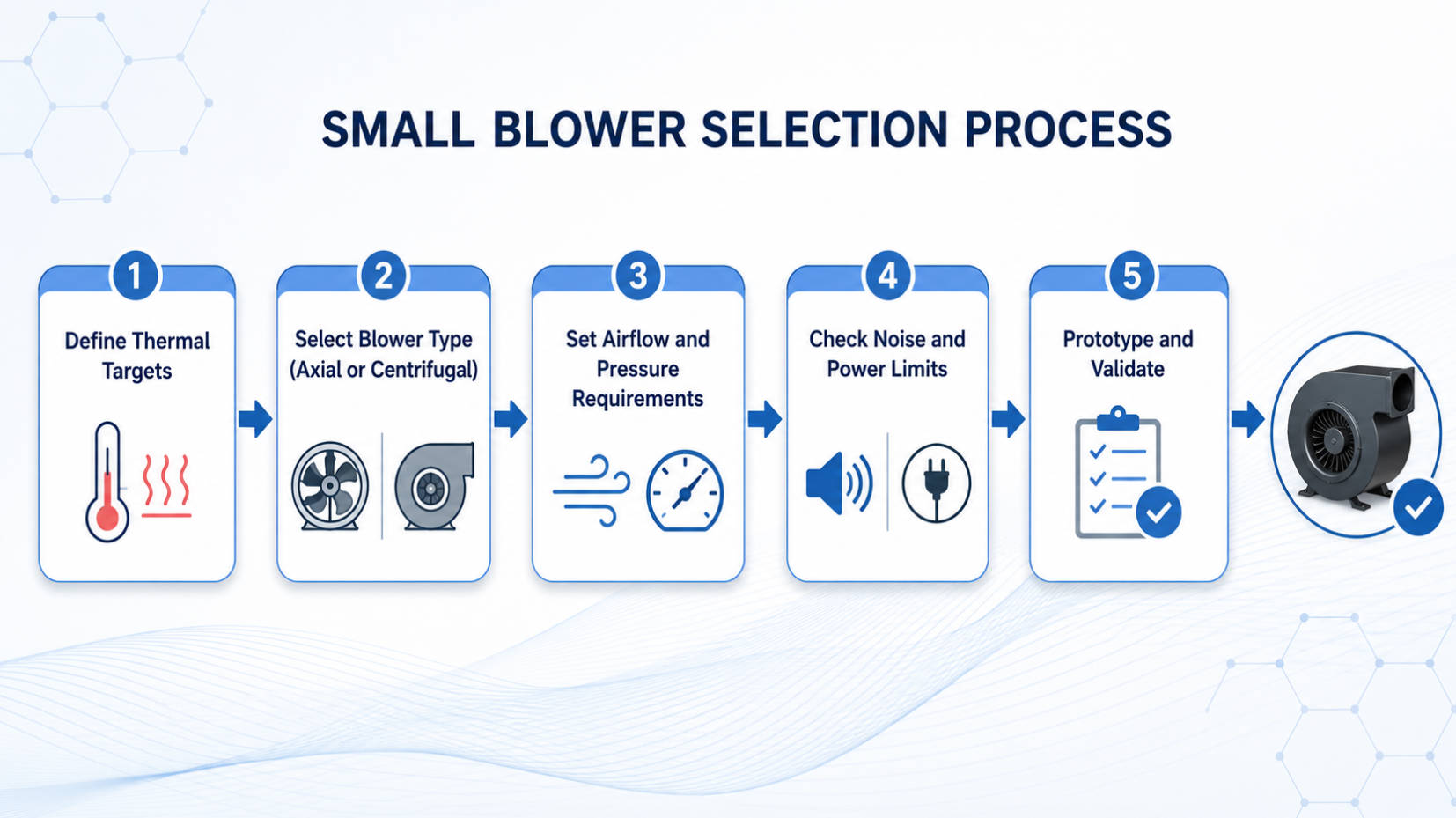
From a buyer or design engineer's perspective, a practical selection process usually follows three steps: [sofasco]
- Heat dissipation in constrained spaces
Choose axial blowers when you primarily need to move air straight through a device, such as across heatsinks or along a casing. [community.element14]
- Ventilation and air transport
Use centrifugal small blowers for ducted airflow, local ventilation, and powder conveying where you need higher pressure to overcome resistance. [iastx]
- Portable and low-voltage systems
Opt for 12 V or 24 V DC blowers in battery-powered or vehicle-mounted applications, and when you need precise speed control via PWM or voltage. [community.element14]
Before requesting quotes or samples, clarify: [sofasco]
- Required air volume (m³/min) and static pressure (Pa / kPa)
- Noise budget (dB) at a specific distance and environment
- Allowable power draw and supply voltage
- Installation constraints (dimensions, mounting holes, connector type)
For example, for a precision instrument:
- Air volume: 1–5 m³/min
- Noise: ≤ 60 dB
- Voltage: 12 V DC
- Space: height ≤ 40 mm
Having this defined upfront dramatically reduces trial-and-error and speeds up design validation.
- Industrial: Ensure compliance with GB/T 13928‑2018 for noise and ISO 1940‑1 for balance to reduce vibration.
- Medical and food: Prioritize oil-free, easily cleanable designs aligned with sector regulations.
- Telecom and IT: Look for documented MTBF, surge protection, and EMC test records from the manufacturer or distributor. [community.element14]
In my work with engineering teams, the most successful projects usually involve early thermal simulation plus blower selection instead of treating the fan as a last-minute add-on.
Even the best blower will underperform if it's installed or maintained poorly. In OEM after-sales data, common failures often trace back to dust, blockage, or unstable power rather than product defects. [iastx]
Key best practices:
- Installation
- Keep the air inlet and outlet unobstructed; avoid placing them directly against flat panels.
- Minimize sharp turns and sudden cross-section changes in ducts.
- Avoid highly humid, corrosive, or dusty environments where possible.
- Maintenance
- Create a schedule to clean filters and casings, especially in dusty workshops.
- Check for unusual noise or vibration; they often indicate bearing wear or imbalance.
- For DC blowers, keep supply voltage stable and avoid frequent power cycling.
- Safety
- In industrial environments, follow relevant electrical safety and lockout-tagout procedures.
- In medical and food scenarios, implement regular disinfection and leak testing to prevent contamination.
A simple example: regularly vacuuming dust from cabinet filters in a telecom rack can extend blower life and keep operating temperatures 3–5 °C lower, which in turn significantly increases electronic component reliability. [sofasco]
Capital Technology Co., Limited is both an independent brand manufacturer (CAPITAL) and the chief agent of SANYO DENKI, a globally recognized leader in the cooling fan industry. This dual role offers two important advantages for OEM and system customers: [sunon]
- Complete DC/AC cooling portfolio
Access to a full range of DC and AC cooling fans, radiators, filters, and related components enables complete thermal solutions, not just single components. [thesmallbusinessexpo]
- Proven track record with leading brands
Being a supplier to companies such as ZTE, Huawei, and HYTERA indicates that the product and quality systems can meet telecom-grade requirements and long lifecycle deployments. [thesmallbusinessexpo]
For engineers and procurement teams, this means you are not only buying a blower—you are getting technical support on model selection, thermal design consulting, and long-term supply assurance. [semrush]
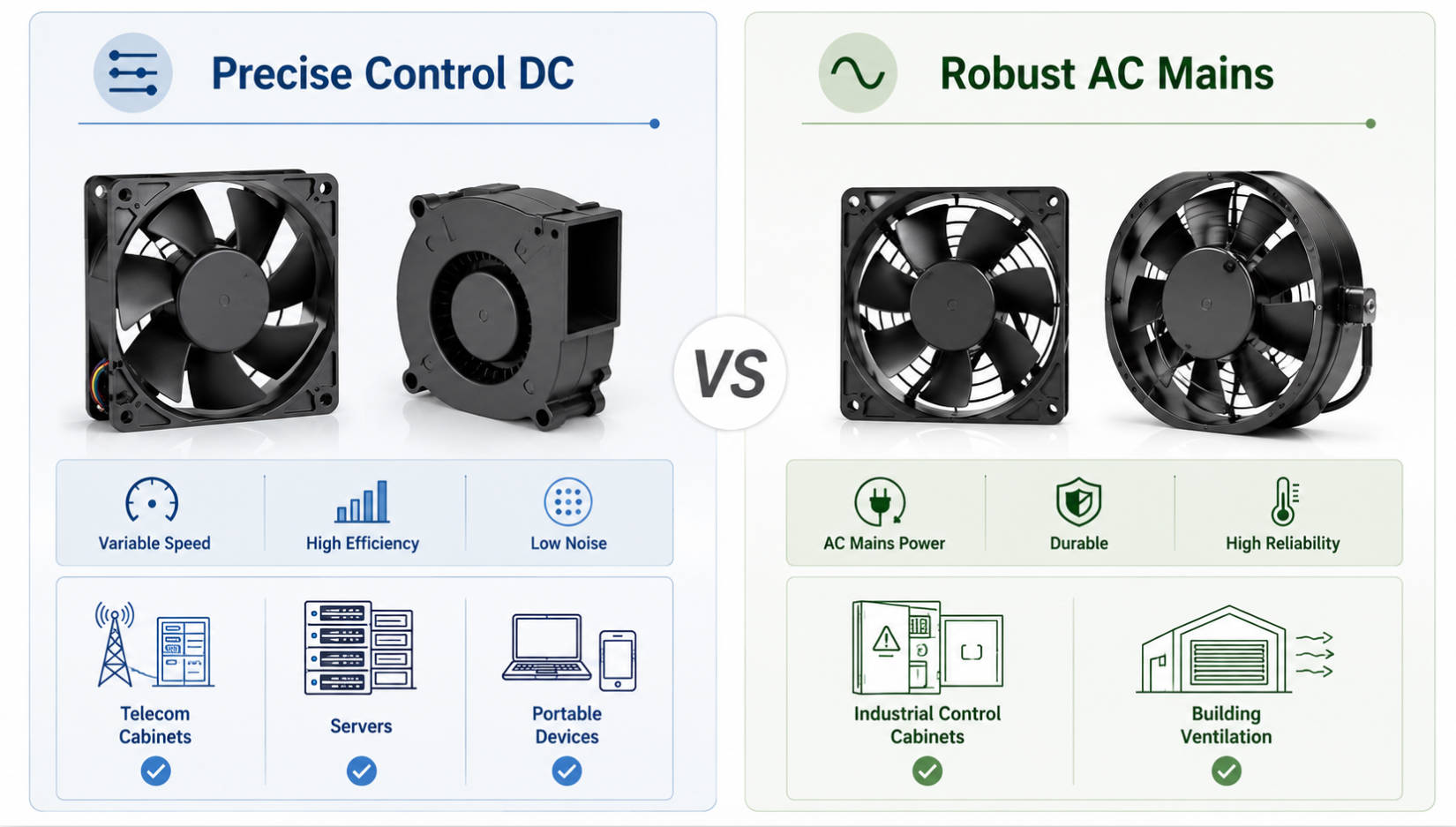
Many cooling designs combine DC fans, DC blowers, and AC fans in the same overall system. Understanding when each is appropriate can avoid overengineering or costly redesigns. [thesmallbusinessexpo]
| Scenario | Recommended type | Why it works best |
|---|---|---|
| Inside telecom or network cabinets | DC blower / DC fan | Uses existing DC bus (typically 24 V / 48 V), easy speed control and monitoring. community.element14 |
| Industrial control cabinets on AC mains | AC fan or AC blower | Direct connection to AC supply, robust, simple wiring and long life. thesmallbusinessexpo |
| Portable or vehicle-mounted equipment | 12 V / 24 V DC blower | Compatible with batteries and vehicle electrical systems, supports smart control. community.element14 |
| Small home/office ventilators | AC axial fan or DC fan with adapter | Quiet, energy-efficient, easy for end users to install. |
Capital's product line covers DC/AC fans, radiators, and related accessories, which makes it easier to design consistent thermal architectures across different product lines. [thesmallbusinessexpo]
For product managers and hardware leads, a clear process makes blower selection systematic rather than ad hoc. [siteimprove]
1. Define thermal and environmental targets
- Max device temperature under worst-case load
- Ambient temperature range and installation environment
- Noise and energy constraints
2. Perform initial thermal simulation and layout
- Identify hot zones and airflow paths
- Decide how many blowers, where to mount, and in which orientation
3. Shortlist blower candidates
- Work with a supplier like Capital to get 2–3 candidate models per scenario, with curves for airflow vs pressure and noise data. [thesmallbusinessexpo]
4. Prototype and test
- Validate temperature, noise, and vibration under sustained load
- Check dust, humidity, and vibration resistance where relevant
5. Optimize and finalize
- Adjust speed profiles, firmware control, and duct designs
- Confirm lifetime expectations and service plan
This structured approach aligns with modern SEO-friendly, E‑E‑A‑T content principles as well: you are demonstrating real, repeatable processes rather than abstract marketing claims. [toprankmarketing]
If you are designing or upgrading a system that relies on compact cooling—whether it is a telecom cabinet, a medical device, or a new energy storage product—the choice of small blower will directly affect reliability, user experience, and long-term maintenance costs. [iastx]
Capital Technology Co., Limited can support you from early thermal concept through to mass production, leveraging both its independent brand CAPITAL and its position as chief agent of SANYO DENKI. For engineering support, model selection, or project-based consultation, you can reach the team via the contact details on the Capital official site. [thesmallbusinessexpo]
Start by estimating your system's total heat dissipation (in watts) and acceptable temperature rise, then use basic heat transfer formulas or thermal simulation tools to convert this into a target airflow (m³/min). A blower supplier's engineering team can often help you validate and refine these numbers using their performance curves and test data. [sofasco]
Use a DC blower when you need precise speed control, integration with a DC bus (12 V / 24 V / 48 V), or intelligent monitoring (tachometer output, alarms). AC fans are a better fit when you have stable AC mains, simple on/off operation, and minimal control requirements. [thesmallbusinessexpo]
In clean environments with proper filtration, small blowers can run for many years, but it is good practice to inspect and clean filters and inlets every 3–6 months. In dusty industrial or outdoor conditions, shorten the interval and plan for periodic replacement aligned with your system's maintenance schedule. [sofasco]
For medical devices, look for blowers and fans that can be integrated into systems compliant with relevant medical standards and that use oil-free, low-noise designs. For new energy systems, focus on energy efficiency, long lifetime, and compliance with applicable safety and EMC standards in your target markets. [iastx]
Often yes, and it is a smart strategy. Many OEMs standardize on a small family of DC and AC blowers to simplify inventory and maintenance. The key is to ensure that each target product still meets its specific airflow, noise, and lifetime requirements with that shared model. [growandconvert]
1. Capital Technology Co., Limited – AC/DC Fan Product Information and Company Profile. [https://www.en.szcpt.com/product/44/] [thesmallbusinessexpo]
2. "Are the Application Scenarios for Small Blowers?" – Capital / YCCFAN technical article on small blower definitions and applications. [https://www.yccfan.com/articledetail/are-the-application-scenarios-for-small-blowers.html]
3. A Comprehensive Guide to Compact Fans – element14 Community. [https://community.element14.com/technologies/experts/b/comprehensive-guides/posts/a-comprehensive-guide-to-compact-fans] [community.element14]
4. How to Choose the Right Blower System for Your Manufacturing Plant – IASTX. [https://www.iastx.com/how-to-choose-the-right-blower-system-for-your-manufacturing-plant] [iastx]
5. Industrial Blower Fans: Applications, Types and Selection Guide – Sofasco. [https://sofasco.com/blogs/article/industrial-blower-fan-overview-and-applications] [sofasco]
6. Google E‑E‑A‑T: What It Is & How It Affects SEO – Semrush. [https://www.semrush.com/blog/eeat/] [semrush]
7. E‑E‑A‑T and SEO: Optimizing for Google's Guidelines – TopRank Marketing. [https://www.toprankmarketing.com/blog/eeat-seo-google-guidelines-experience-expertise-authority-trust/] [toprankmarketing]
8. A Creator's Guide to SEO Content Strategy – Siteimprove. [https://www.siteimprove.com/blog/seo-content-strategies/] [siteimprove]
9. SEO Tips for Small Businesses – BDC. [https://www.bdc.ca/en/articles-tools/marketing-sales-export/marketing/seo-small-businesses-10-ways-rank-higher] [bdc]
10. 6 Step SEO Content Strategy – Grow & Convert. [https://www.growandconvert.com/content-marketing/seo-content-strategy/] [growandconvert]


