From idea to market-ready product, our NPI solutions make every stage easier, faster. Discover How We Help
Help Center

Views: 210 Author: Capital Technology Publish Time: 2026-11-23 Origin: Site
Content Menu
● Quick Answer: Key Differences
● What Is a San Ace Reversible Flow Fan?
>> How Direction Control Works
● Performance Comparison: Where the Differences Show
>> Airflow and Static Pressure
● Expert Insight: Where Reversible Fans Pay Off
>> Cost Check
● How to Choose: A 5-Step Process
● Which One Should You Choose?
● Get a Cooling Recommendation
● FAQ
>> 1. Can a standard DC fan run in reverse?
>> 2. Does a reversible fan lose airflow in reverse?
>> 3. How is the direction controlled?
>> 4. What voltages are available?
>> 5. Where are reversible fans typically used?
>> 6. How long do these fans last?
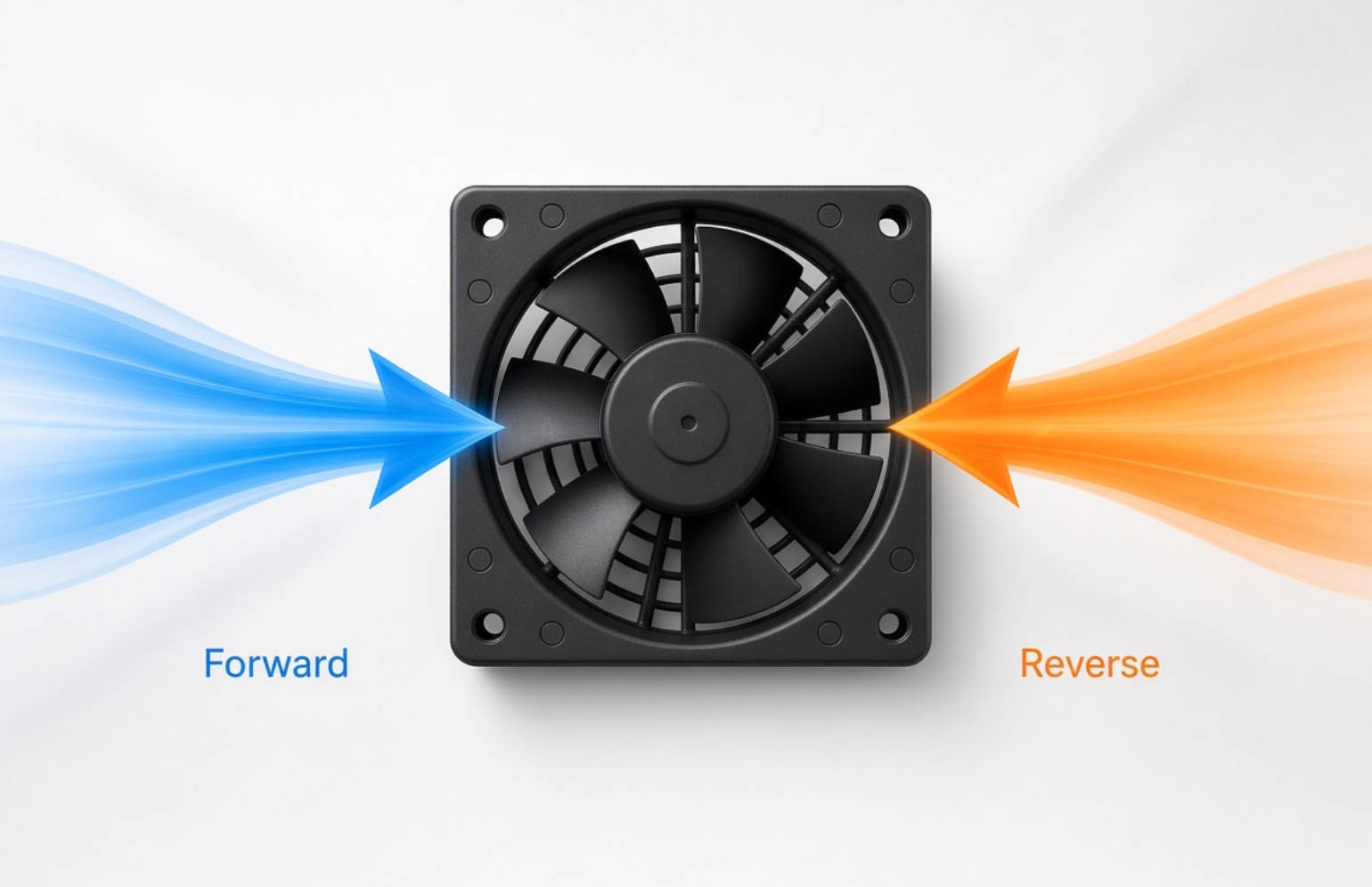
A San Ace Reversible Flow Fan moves air in two directions with one fan. A standard DC fan moves air in one fixed direction. The right choice depends on whether your equipment needs to switch between intake and exhaust.
At Capital Technology Co., Limited, we make DC fans under our own CAPITAL brand. We are also the lead distributor of SANYO DENKI. We supply thermal solutions to telecom and network companies, including ZTE, HUAWEI and HYTERA. The comparison below comes from that work.
| Feature | San Ace Reversible Flow Fan | Standard DC Fan |
|---|---|---|
| Airflow direction | Forward and reverse | One direction only |
| Direction control | Set by a PWM signal | Not applicable |
| Reverse performance | Nearly equal to forward | Not applicable |
| Fans needed for two-way airflow | One | Two, plus extra mounting |
| Best fit | Vending machines, display cases, LED lights, ventilation | Servers, telecom racks, power supplies, general cooling |
| Cost per unit | Higher | Lower |
A standard DC fan runs on 5, 12, 24 or 48 V. It spins in one direction and blows air from one side of the frame to the other.
Most electronics cooling uses this design. It is simple, low cost and available in many sizes. Engineers pick one by matching its airflow, static pressure, noise, and bearing type to the equipment.
A standard fan is still the best choice when the airflow path never changes. Most servers, base stations and power supplies fall into this group.
A San Ace Reversible Flow Fan is a DC fan that can blow air in two opposite directions. SANYO DENKI says a single fan can replace several fans. This can reduce equipment cost and save space.
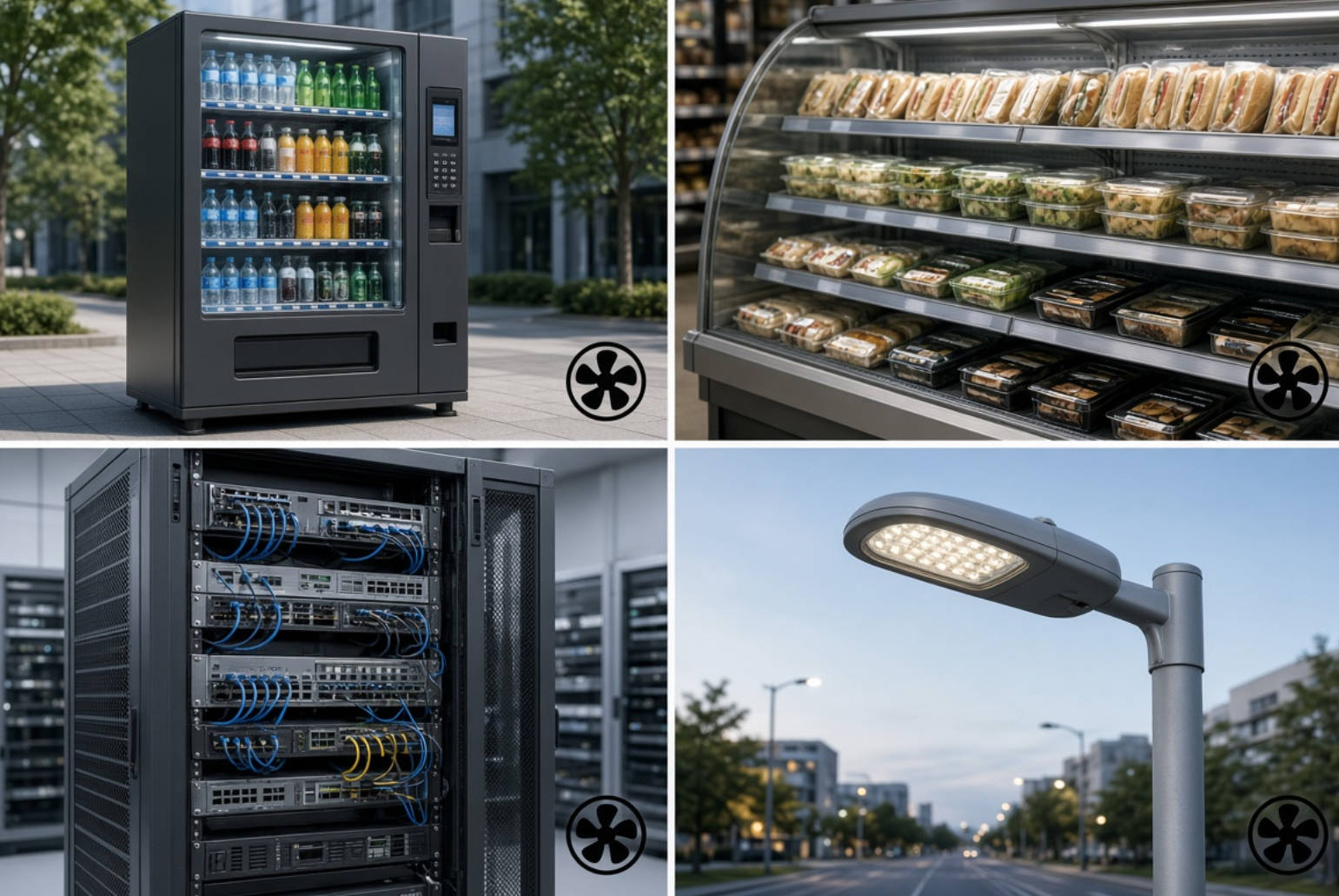
The fan is aimed at several applications:
- Beverage vending machines
- Food display cases
- LED lights
- Household ventilation
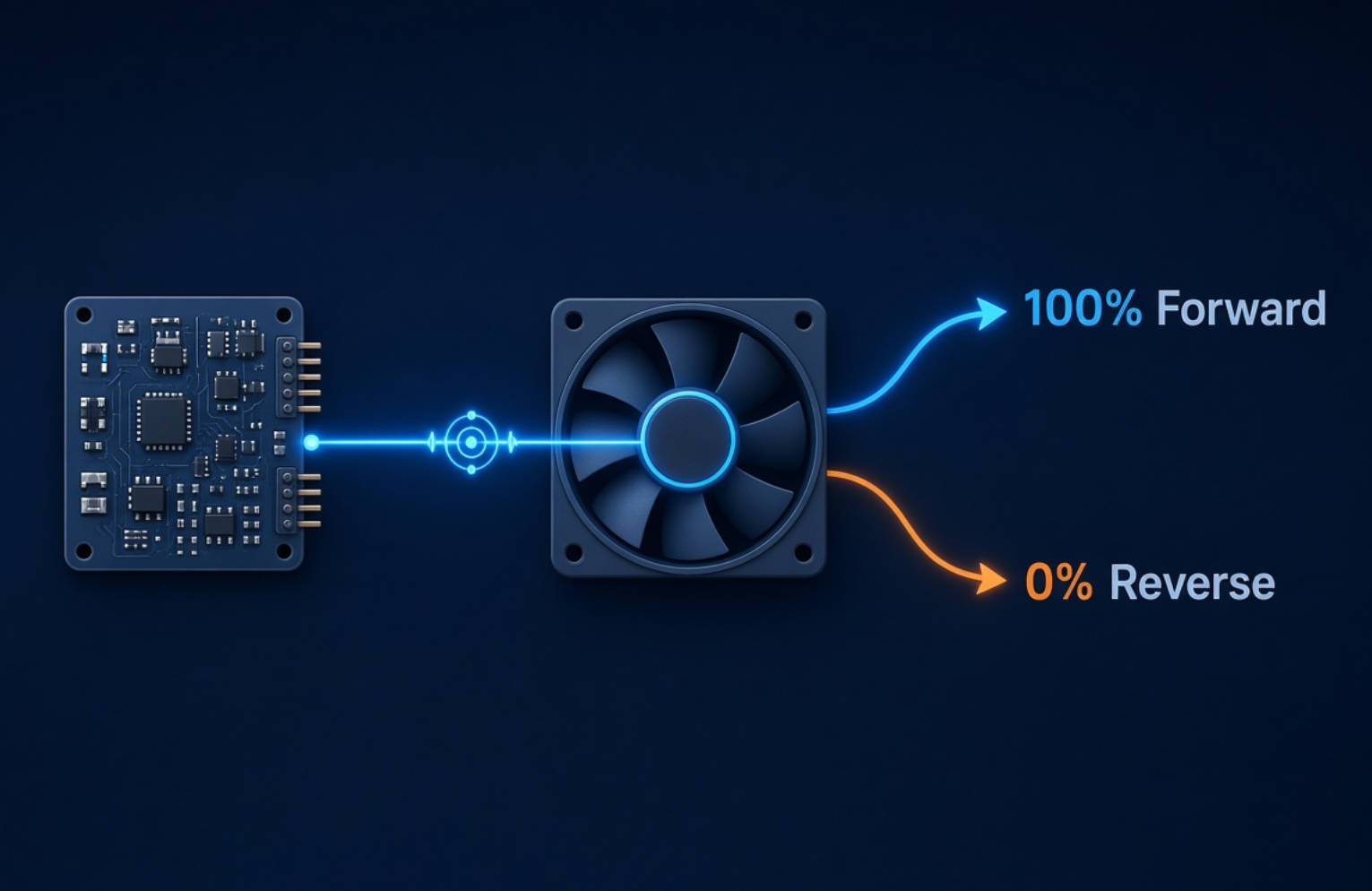
The direction is set through the PWM input. In the 136 mm 9RFA model, a 100% duty cycle runs the fan forward, blowing air from the label side. A 0% duty cycle runs it in reverse, blowing from the impeller side.
The same PWM signal also sets the fan speed. The result is lower noise and lower power use.
The main design goal of the reversible fan is equal performance both ways. Many bidirectional designs lose most of their output in reverse, and this one does not. SANYO DENKI states that both directions deliver nearly the same airflow and static pressure.
The 9RFA1312P3G001 (ø136 × 28 mm) shows this in its published figures:
| Direction | Max airflow | Max static pressure | Noise |
|---|---|---|---|
| Forward | 74.2 CFM | 285 Pa | 49 dB(A) |
| Reverse | 72.4 CFM | 280 Pa | 52 dB(A) |
Reverse airflow is about 2.4% lower than forward. Static pressure is about 1.8% lower. Reverse noise is 3 dB(A) higher. These are small differences for a fan that changes direction.
The 9RF series is rated for 40,000 hours at 60°C. The 9RFA is rated for 70,000 hours at 40°C. Protection features include locked rotor burnout protection, reverse polarity protection and a UL 94V-0 frame.
Standard fans vary widely. Premium models have similar protection, and budget models often lack it. Always check the datasheet rather than the headline life figure.
Life ratings also have limits. Dust, moisture, vibration and frequent start-stop cycles can shorten fan life beyond what a catalog number suggests.
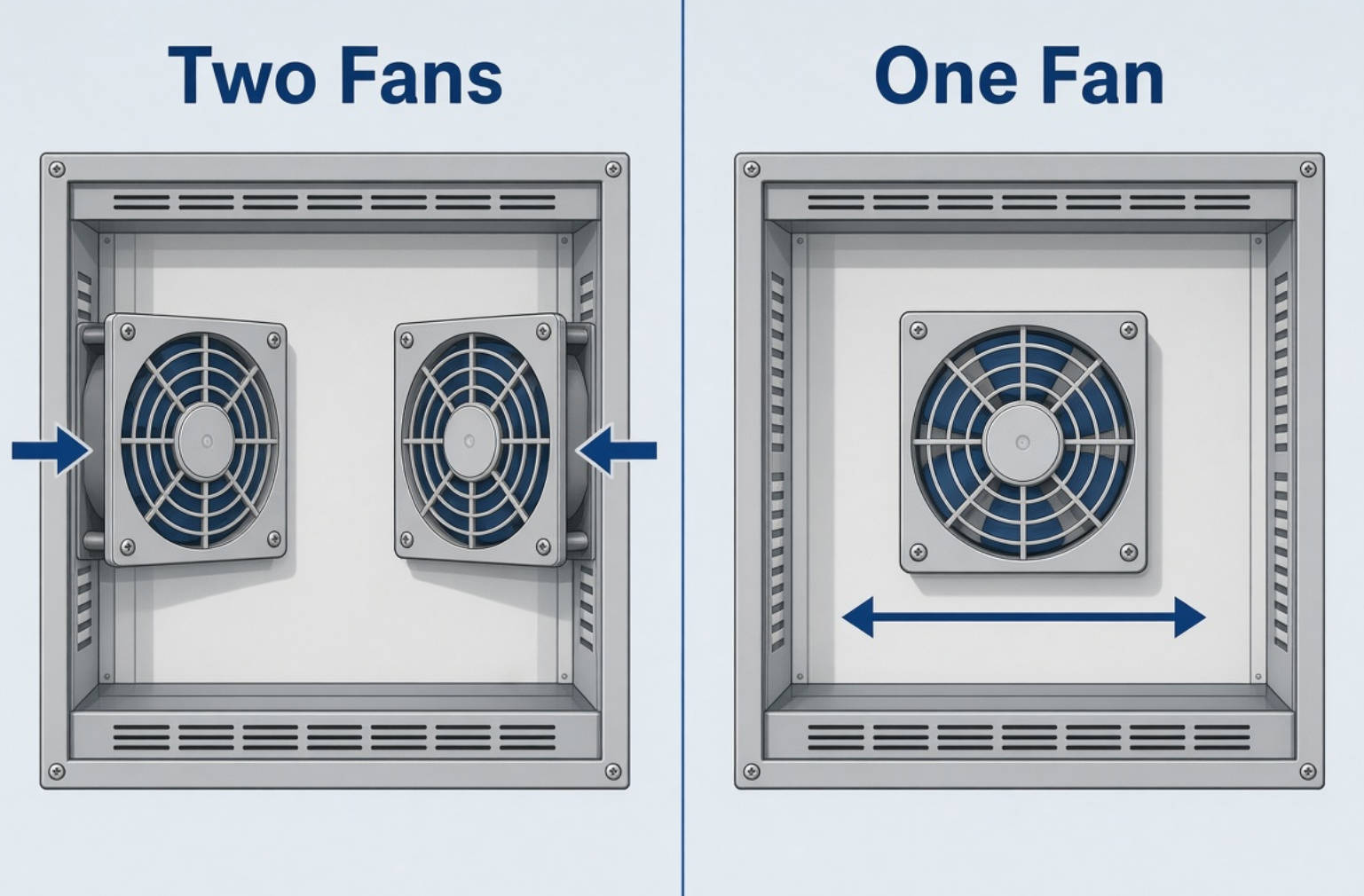
Take a cabinet that needs fresh air drawn in during normal operation. It also needs to blow dust out of its filter on a schedule. With standard fans, that takes two fans, two sets of wiring and a damper.
A reversible fan does both jobs. One unit handles intake and purge, and the controller switches direction with PWM. This is a design choice based on the published features. It is not a result from a specific customer test.
Dust matters here. Contamination on blades, grilles and filters raises system resistance and cuts airflow. Reverse-flow cleaning cycles can help slow that build-up.
A reversible fan costs more per unit. The saving comes from fewer fans, fewer connectors and less space. If your design needs only one direction, you pay for a feature you will never use.
1. Define the airflow need. Decide if you need one direction or two.
2. Calculate the heat load. Work out the required CFM and the system resistance.
3. Read the fan curve. Do not rely on free-air CFM alone. Check the operating point on the curve.
4. Match voltage and control. Confirm 12 V or 24 V, and PWM at 25 kHz if you need direction control.
5. Check the environment. Review temperature, dust, humidity and vibration, then leave a margin. One guide suggests running 10–20°C below the maximum rated temperature.
A tach or pulse signal is also worth specifying. It lets your firmware detect a failing fan early.
Choose a San Ace Reversible Flow Fan if:
- Your equipment needs intake and exhaust from one fan.
- Space is tight and you want fewer parts.
- You want speed and direction under one PWM control.
Choose a standard DC fan if:
- Airflow runs one way only.
- Cost per unit is the top priority.
- You need a size, voltage or bearing type the reversible range does not cover.
Not sure which fan fits your design? Send us your dimensions, voltage, airflow target and operating environment. The Capital Technology team will recommend a genuine SANYO DENKI San Ace model or a CAPITAL-brand alternative, and will quote with datasheets.
Not as a designed function. Reversing the polarity usually triggers reverse polarity protection or damages the fan. Even if a motor spun backward, the blade shape would give poor airflow. A reversible fan is designed for it.
Only slightly. In the 9RFA1312P3G001, reverse airflow is 72.4 CFM against 74.2 CFM forward.
By PWM signal. A 100% duty cycle gives forward flow, and 0% gives reverse flow.
The San Ace 9RF and 9RFA series come in 12 V and 24 V versions.
They are used in vending machines, food display cases, LED lighting and home ventilation.
The 9RF series is rated for 40,000 hours at 60°C. Real life depends on temperature, dust and duty cycle.
1. [SANYO DENKI – Reversible Flow Fan, San Ace Product Site]
2. [SANYO DENKI – Development of the ø136 × 28 mm 9RFA Reversible Flow Fan (PDF)]
3. [SANYO DENKI – ø136 × 28 mm Reversible Flow Fan product news]
4. [Mouser – Sanyo Denki San Ace 9RF Reversible Flow Fans]
5. [Fanacdc – Fan L10 Life vs MTBF]
6. [Senhar Fans – Why Do Cooling Fans Fail Earlier Than Expected?]
7. [Pendec Electronics – Fan Failure Causes and Prevention Methods]


