From idea to market-ready product, our NPI solutions make every stage easier, faster. Discover How We Help
Help Center

Views: 253 Author: Capital Technology Publish Time: 2026-10-10 Origin: Site
Content Menu
● San Ace Fan Size vs Airflow: What Are You Comparing?
● How San Ace Frame Size Affects Fan Selection
>> Frame Width, Height, and Thickness Must Be Checked Together
>> Fan Size Is Not a Reliable Airflow Ranking
● Why Static Pressure Determines Usable Airflow
>> Maximum CFM Is Only the Starting Point
>> Read the P–Q Curve Against System Resistance
● Calculate Required Airflow Before Choosing Frame Size
>> Worked Example: A 300 W Electronics Enclosure
● Choose Fan Size According to the Application
>> Compact Servers and Communications Equipment
>> Noise-Sensitive Electronics
>> Larger Equipment and Ventilation Paths
● A Six-Step Process for Selecting the Right San Ace Fan
>> 1. Define Thermal Requirements
>> 2. Establish the Installation Envelope
>> 3. Characterize System Resistance
>> 4. Compare Exact Model Curves
>> 5. Verify Electrical and Control Compatibility
>> 6. Validate the Complete Assembly
● Compare Cooling at Equal Delivered Performance
● Request a Model-Specific Fan Comparison from Capital Technology
>> 1. Does a Larger San Ace Fan Always Deliver More Airflow?
>> 2. What Is the Difference Between Maximum and Operating Airflow?
>> 3. Can I Choose a Fan Using Only Its CFM Rating?
>> 4. Do Two Fans Double Cooling Performance?
>> 5. Do All San Ace Fans Support PWM Control?
>> 6. Should I Replace an AC Fan with a Same-Size DC Fan?
Choosing between San Ace fan size and airflow is not simply a matter of selecting the largest fan that fits. Frame dimensions determine installation compatibility, while airflow describes how much air a fan moves under specified conditions. The right choice connects both to enclosure resistance, heat generation, noise limits, and electrical requirements.
My recommendation is to start with the operating point: the airflow a fan actually delivers against your equipment's resistance. A larger frame does not automatically provide better cooling, and maximum airflow alone cannot predict installed performance. SANYO DENKI identifies the intersection of the fan's performance curve and the system-resistance curve as the basis for determining operating airflow.
This guide compares the specifications that matter, demonstrates why size-based assumptions fail, and provides a practical selection process for industrial and communications equipment.
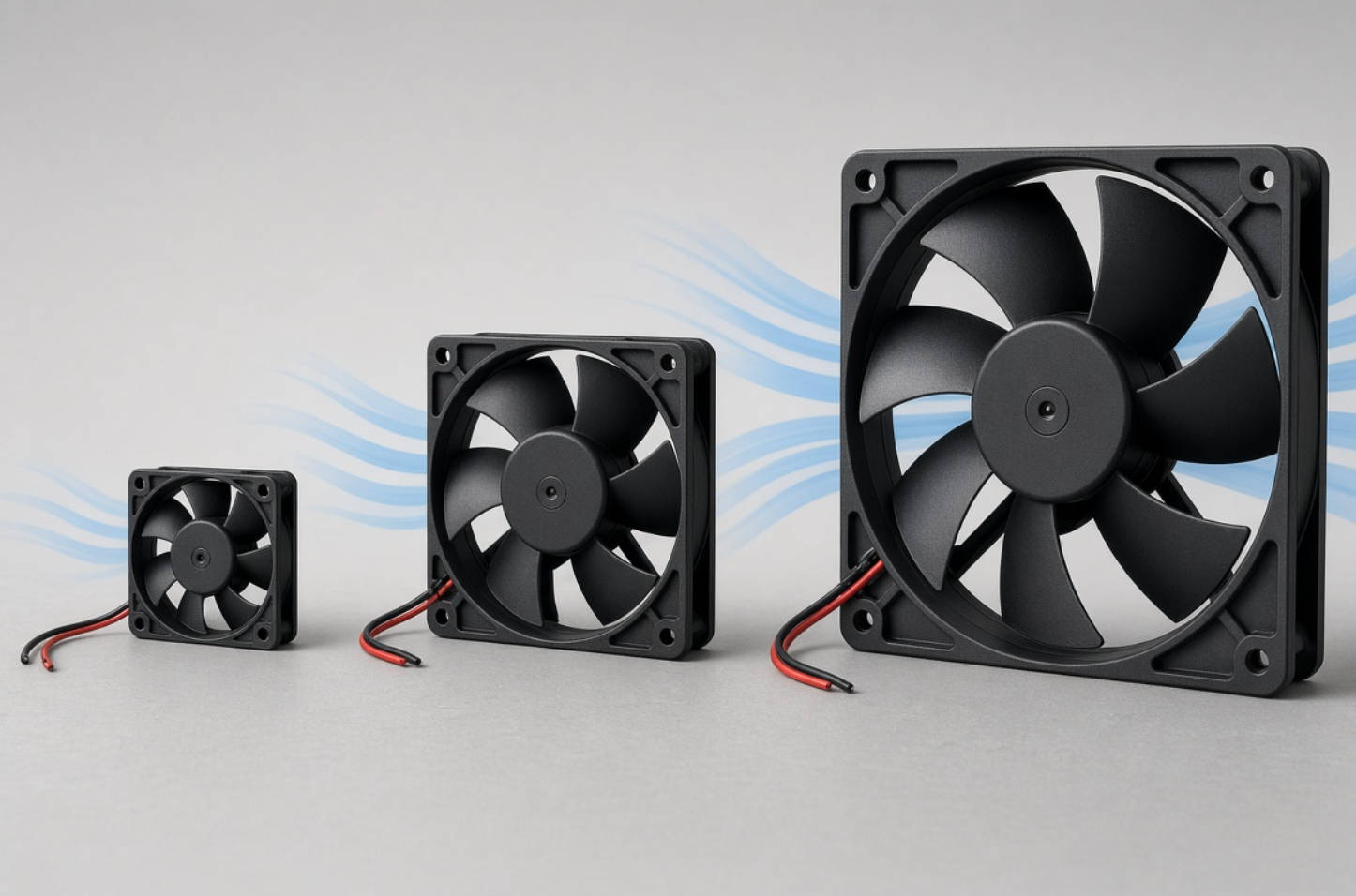
Fan size and airflow answer different questions. One describes the available installation envelope; the other describes aerodynamic performance.
| Selection factor | What it tells you | What it does not tell you |
|---|---|---|
| Frame width and height | Whether the fan fits the mounting space | Delivered cooling airflow |
| Frame thickness | Required installation depth | Pressure capability by itself |
| Maximum airflow | Air delivery with essentially no external resistance | Airflow through your enclosure |
| Maximum static pressure | Pressure at zero airflow | Pressure available at the required airflow |
| Airflow–pressure curve | Performance across different resistance levels | Final component temperatures |
SANYO DENKI defines maximum airflow at zero static pressure and maximum static pressure at zero airflow. These are opposite endpoints of the performance curve, not simultaneous operating conditions.
For procurement, this distinction is essential. A specification requiring "120 mm and 100 CFM" remains incomplete unless it also addresses system resistance or installed cooling performance.
A 40 × 40 × 28 mm fan and an 80 × 80 × 25 mm fan require different mounting openings and installation depths. Even when two products share the same nominal frame size, their thickness, mounting details, wiring, and control functions may differ.
Published San Ace specifications list frame size and thickness separately. For example, the 9HVA0412P3J001 measures 40 × 40 × 28 mm, while the 9S0812L4011 has an 80 mm frame and 25 mm thickness.
Before shortlisting, record:
- Available width, height, and depth.
- Mounting-hole requirements.
- Inlet and outlet clearances.
- Connector and cable space.
- Required airflow direction.
- Access for replacement and maintenance.
Treat mechanical fit as an initial filter, not proof of cooling suitability.
Frame dimensions cannot establish a universal performance hierarchy. Blade design, rotational speed, motor characteristics, and product purpose also influence airflow and pressure.
The following manufacturer-published examples demonstrate the limitation:
| Specification | Compact high-pressure model | Larger silent model |
|---|---|---|
| Model | 9HVA0412P3J001 | 9S0812L4011 |
| Dimensions | 40 × 40 × 28 mm | 80 × 80 × 25 mm |
| Rated voltage | 12 VDC | 12 VDC |
| Maximum airflow | 37.1 CFM | 23.3 CFM |
| Maximum static pressure | 2,300 Pa | 18.1 Pa |
| Rated speed | 38,000 rpm | 2,000 rpm |
| Rated input | 31.2 W | 0.6 W |
| Published sound pressure | 71 dB(A) | 16 dB(A) |
Values are specific to these models and their published conditions; they are not representative averages for either frame size. The 40 mm data come from a dated product announcement, so current specifications should be confirmed before ordering.
The smaller fan has higher maximum airflow and dramatically higher pressure capability. However, its published power consumption and sound pressure are also much higher. This is not a "better versus worse" comparison: the products serve different design priorities.
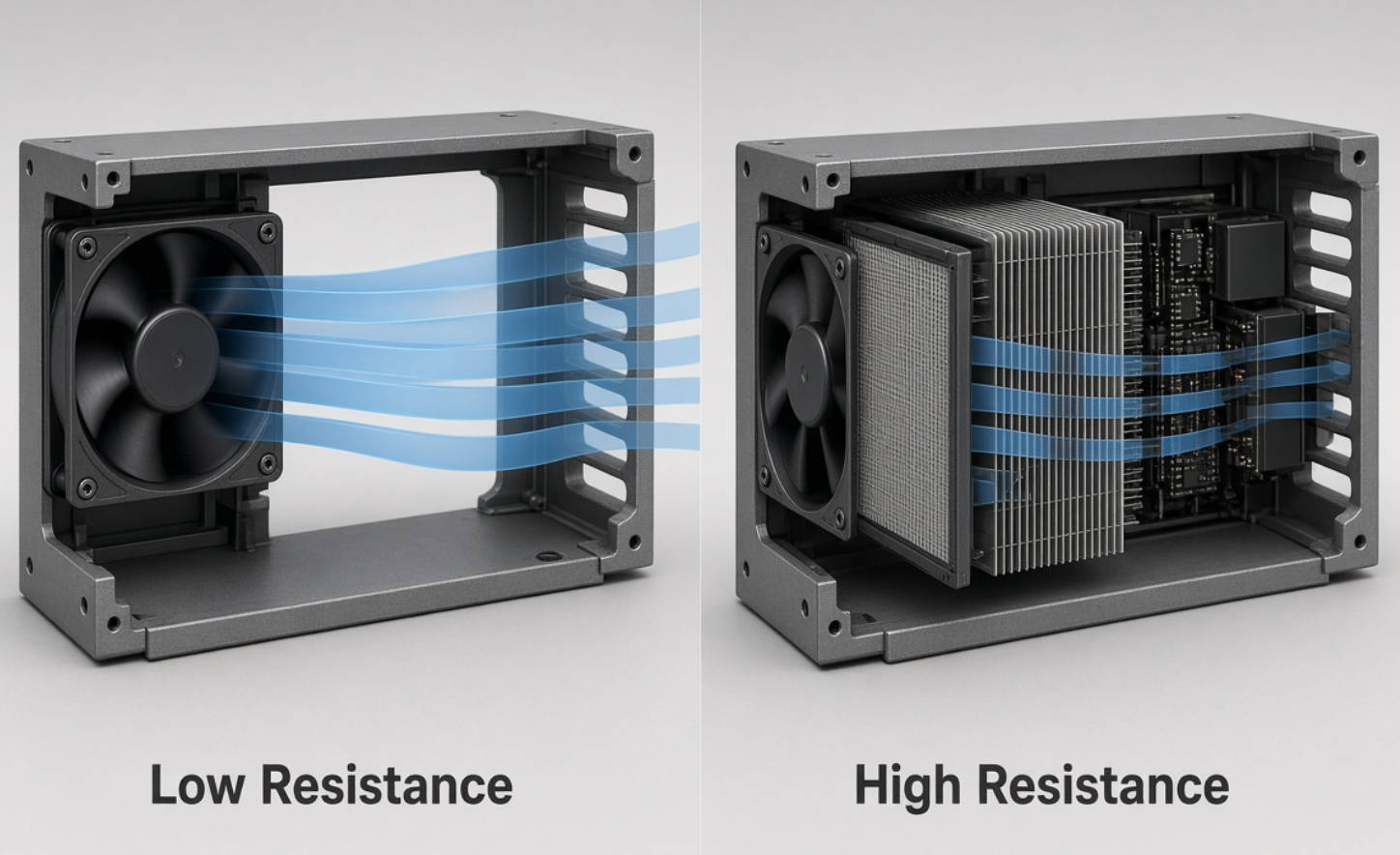
Maximum airflow describes an unobstructed condition. Real equipment introduces resistance through filters, heatsinks, grilles, internal components, and restricted passages.
Consequently, a fan advertised with a high CFM rating may deliver substantially less air after installation. SANYO DENKI describes system impedance as the difficulty of moving air through equipment and generally models it as increasing with the square of airflow.
The practical question is therefore:
How much airflow will this fan deliver through my equipment—not how much can it move in free air?
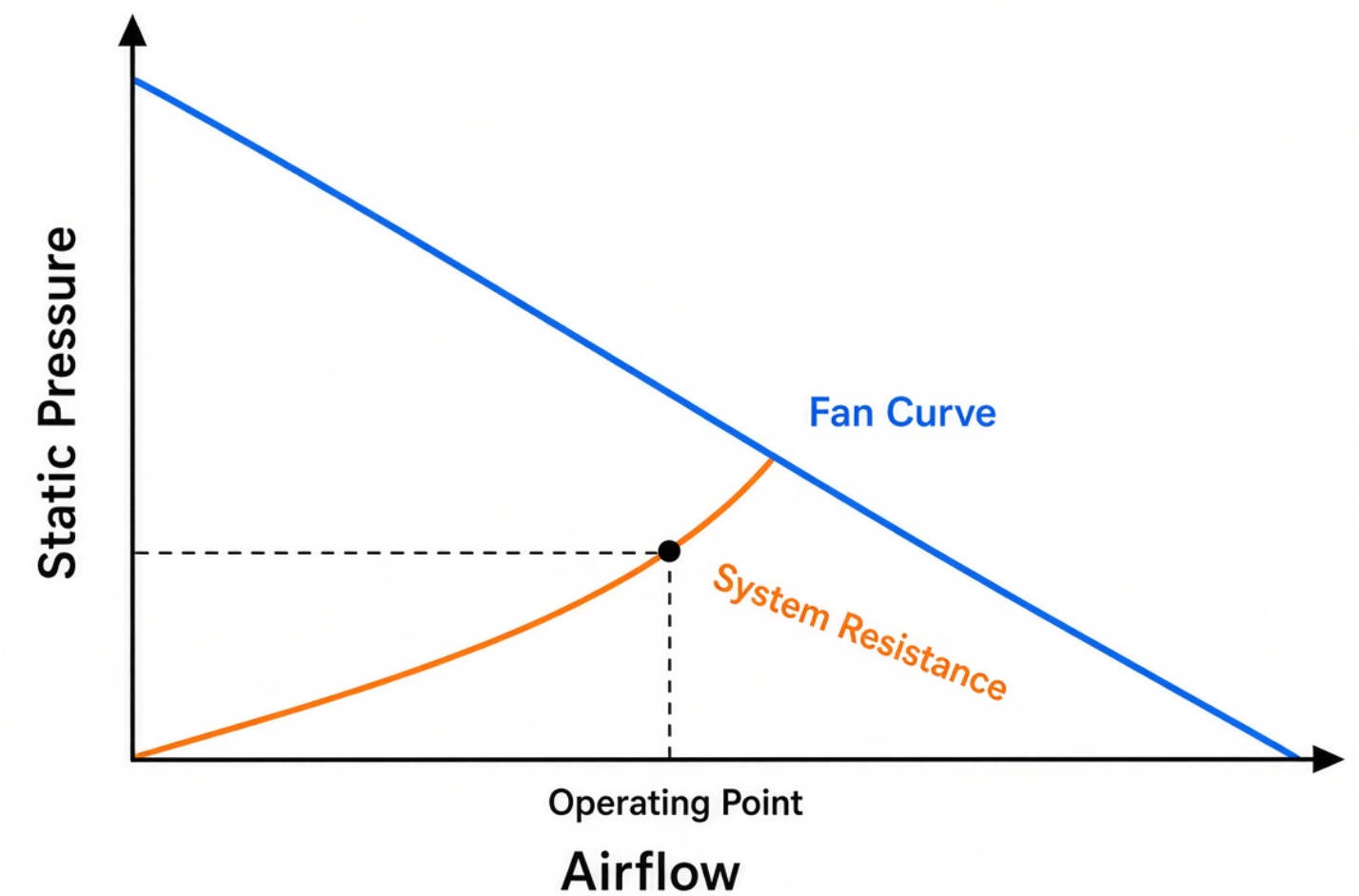
A P–Q curve plots static pressure against airflow. The system-resistance curve represents the pressure required to move different airflow volumes through the enclosure.
Their intersection establishes the operating point. A candidate meets the aerodynamic requirement only when that intersection provides sufficient airflow.
For meaningful San Ace fan airflow comparisons:
1. Use curves for the exact model numbers.
2. Match voltage and operating conditions.
3. Identify the required airflow.
4. Check pressure capability at that airflow.
5. Confirm the result through installed testing.
Comparing maximum pressure alone repeats the same mistake as comparing maximum CFM alone: it substitutes an endpoint for actual operating performance.
SANYO DENKI's selection guideline provides a useful preliminary relationship for systems where cooling air carries away the heat:
Q≈P/20ΔT
Here:
- Q is required airflow in m³/min.
- P is heat dissipation in watts.
- ΔT is the permitted air-temperature rise in kelvins.
The manufacturer treats this calculation as a rough target and requires final selection to be confirmed through actual installation testing.
Consider an illustrative enclosure dissipating 300 W, with a permitted bulk-air temperature rise of 10 K:
Q≈300/(20×10)=1.5 m3/min
That is approximately 53 CFM of required operating airflow.
This is not automatically a requirement for a fan rated at 53 CFM maximum. The selected model must supply approximately that airflow against the enclosure's resistance.
SANYO DENKI discusses using additional maximum-airflow capacity during preliminary selection when impedance is unknown, but also emphasizes installed confirmation. Such allowances are screening tools, not substitutes for a measured system curve.
Additionally, an acceptable average air-temperature rise does not prove that every component stays below its temperature limit. Component temperatures remain a separate validation requirement.
For space-constrained equipment, frame dimensions may already be fixed. The selection problem then becomes finding sufficient pressure and airflow within that envelope.
SANYO DENKI identifies its 40 × 40 × 28 mm San Ace 40 9HVA model as suitable for 1U servers, switching power supplies, and communications equipment. Its published pressure capability illustrates why compact frames should not be dismissed automatically.
For these applications, examine the complete curve, available power, noise budget, and control options before recommending a larger frame.
A quiet product cannot be selected from frame size alone. Compare actual acoustic specifications and confirm that the model still delivers enough airflow through the enclosure.
The San Ace 80 9S0812L4011 illustrates a low-speed, low-power approach, with published sound pressure of 16 dB(A). However, its maximum static pressure is only 18.1 Pa. Its low-noise specification does not establish suitability for a restrictive airflow path.
Where installation space permits, larger frames can be shortlisted alongside smaller high-pressure alternatives. The decision should still be made at the required operating point.
For example, SANYO DENKI's 140 × 140 × 38 mm 9LG1412P1A001 has published maximum airflow of 282 CFM and maximum static pressure of 516 Pa. These figures expand the available options, but do not eliminate the need to evaluate resistance and installed performance.
Document heat dissipation, maximum inlet temperature, permitted air-temperature rise, and critical component limits.
Use representative worst-case operating conditions rather than an average workload.
Record frame dimensions, thickness, mounting details, airflow direction, and service access.
Eliminate mechanically incompatible candidates before comparing performance.
Measure impedance when possible. SANYO DENKI's San Ace Airflow Tester supports system-impedance and operating-airflow measurements, allowing selection to be based on equipment behavior rather than assumptions.
Shortlist models that provide sufficient airflow at the relevant pressure.
Review the full curve rather than ranking candidates by frame size or maximum CFM.
Check rated voltage, operating range, input power, sensor output, and speed-control requirements.
Do not assume every San Ace model supports PWM: the 9HVA0412P3J001 includes PWM control, while the 9S0812L4011 does not.
Test with production-intent covers, filters, guards, cables, and component placement.
Record component temperatures, operating airflow, fan speed, input power, and noise. Final selection should follow actual installation testing, consistent with SANYO DENKI's guidance.
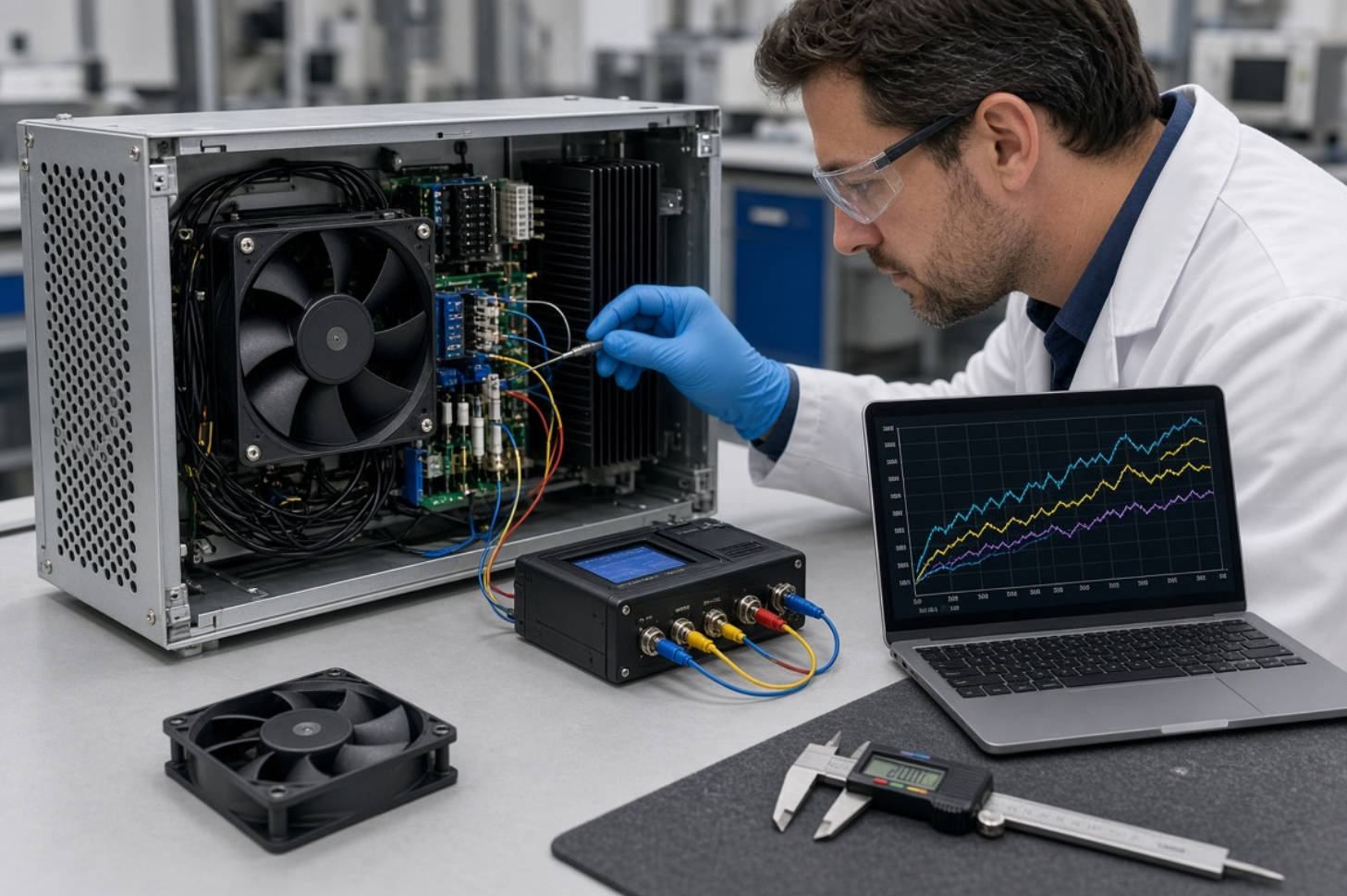
My preferred comparison is not "small fan versus large fan at full speed." It is "which candidate meets the same installed cooling requirement with acceptable noise, power, and mechanical constraints?"
This changes the shortlist substantially.
A high-pressure compact fan may be necessary where space and resistance dominate. A different model may suit a quieter, less restrictive enclosure. Neither conclusion can be reached reliably from frame dimensions alone.
Speed control also changes the comparison. SANYO DENKI explains that airflow is approximately proportional to rotational speed, while static pressure is approximately proportional to speed squared. Reducing speed therefore affects pressure capability more sharply than airflow capability.
The implication is important: confirm cooling at the intended control setting, not only at maximum speed.
Capital Technology Co., Limited manufactures DC and AC cooling products under the CAPITAL brand and supplies SANYO DENKI products. Its stated company background includes chief-agent status and supply relationships with ZTE, HUAWEI, and HYTERA; those commercial credentials should be supported by current documentation when published.
For your next project, send Capital Technology:
- Available frame dimensions and mounting drawing.
- Heat dissipation and inlet-temperature range.
- Required airflow and measured pressure, if available.
- Supply voltage and control requirements.
- Noise, environment, and service-life targets.
Request a comparison of exact San Ace model numbers, performance curves, electrical specifications, and sample-testing requirements. Keep CAPITAL-branded and SANYO DENKI-branded options clearly identified so your engineering and purchasing teams can evaluate each product on its own specifications.
No. The published 40 mm 9HVA0412P3J001 delivers 37.1 CFM maximum airflow, compared with 23.3 CFM for the 80 mm 9S0812L4011. Frame size alone cannot rank performance.
Maximum airflow is measured at zero static pressure. Operating airflow is the amount delivered against actual system resistance, determined by the intersection of the fan and system curves.
No. You also need pressure capability at the required airflow, mechanical fit, electrical compatibility, and installed validation. SANYO DENKI's selection guidance specifically considers system impedance and actual installation testing.
Not automatically. SANYO DENKI explains that identical fans theoretically double pressure in series or airflow in parallel. Actual delivered airflow still depends on system resistance and the resulting operating point.
No. Control functions are model-specific. The 9HVA0412P3J001 supports PWM, while the 9S0812L4011 does not. Always check the exact product specification.
Matching dimensions alone is insufficient. Verify the power supply, control requirements, mounting details, and airflow–pressure performance. A replacement must satisfy the installed operating requirement, not merely occupy the same space.
1. SANYO DENKI. "Guideline in Selecting a Fan." San Ace technical material. Updated September 2024. Basis for preliminary thermal calculations and installed validation. [products.sanyodenki]
2. SANYO DENKI. "Fan Airflow and Static Pressure." Tech Compass. Definitions of maximum airflow, maximum pressure, performance curves, and fan arrangements. [techcompass.sanyodenki]
3. SANYO DENKI. "Equipment Ventilation Resistance." Tech Compass. Explanation of system impedance and operating airflow. [techcompass.sanyodenki]
4. SANYO DENKI. "Basic Knowledge for Selecting a Cooling Fan." Tech Compass. Selection considerations and rotational-speed relationships. [techcompass.sanyodenki]
5. SANYO DENKI. "SANYO DENKI Develops 40 × 40 × 28 mm High Static Pressure Fan." May 28, 2020. Specifications for 9HVA0412P3J001. [sanyodenki]
6. SANYO DENKI. "Silent Fan San Ace 80 9S0812L4011." Official product specification page. [products.sanyodenki]
7. SANYO DENKI. "Airflow Tester." Official product page. Measurement capabilities for impedance and operating airflow. [products.sanyodenki]
8. SANYO DENKI AMERICA. "SANYO DENKI Develops 140 × 140 × 38 mm Long Life Fan." January 10, 2018. Specifications for the San Ace 140L 9LG series. [sanyodenki]
9. Capital Technology Co., Limited. Company background supplied for this article; commercial credentials were not independently verified.


