From idea to market-ready product, our NPI solutions make every stage easier, faster. Discover How We Help
Help Center

Views: 215 Author: Capital Technology Publish Time: 2026-10-18 Origin: Site
Content Menu
● San Ace Counter Rotating Fan vs Standard Axial Fan: The Essential Difference
● Why Static Pressure Matters More Than Free-Air CFM
>> Maximum Airflow Does Not Represent Installed Airflow
>> The Operating Point Determines Cooling Capability
● Published San Ace Counter Rotating Fan Performance
● Comparing Efficiency, Noise, Installation, and Reliability
>> Cooling Efficiency: Compare Equal Thermal Results
>> Noise: Evaluate the Complete Operating Range
>> Installation: Frontal Area Is Only One Dimension
>> Reliability: Distinguish Lifetime from Redundancy
● Practical Insight: Two Ordinary Fans Are Not an Equivalent Substitute
● A Six-Step Server Cooling Fan Validation Process
>> 1. Define the Thermal Acceptance Criteria
>> 2. Establish the Available Fan Envelope
>> 3. Measure Airflow Resistance
>> 4. Compare Candidate Operating Points
>> 5. Test Thermal and Failure Conditions
>> 6. Tune Control and Document Approval
● When Is Each Fan Design the Better Choice?
>> Choose a San Ace Counter Rotating Fan When Pressure Is the Bottleneck
>> Choose a Standard Axial Fan When It Already Meets the Requirement
● Find the Right Server Cooling Fan with Capital Technology
>> 1. Is a San Ace Counter Rotating Fan an Axial Fan?
>> 2. Does a Counter Rotating Fan Always Provide Better Server Cooling?
>> 3. Can Two Standard Axial Fans Replace One Counter Rotating Fan?
>> 4. Should I Choose a Server Fan by CFM or Static Pressure?
>> 5. Can PWM Control Reduce Counter Rotating Fan Power and Noise?
>> 6. Does a Two-Stage Fan Eliminate the Need for Redundant Fan Trays?
A San Ace counter rotating fan can outperform a standard axial fan when a server's tightly packed components create substantial airflow resistance. However, a standard axial fan may be the better choice when cooling requirements are moderate, installation depth is limited, and simplicity matters. The deciding factor is system impedance, not the largest airflow number on a datasheet.
At Capital Technology Co., Limited, our approach to server cooling fan selection starts with the enclosure, heat load, and operating conditions. This comparison explains how the two designs work, where their advantages matter, and how to evaluate them without confusing maximum specifications with actual cooling performance.
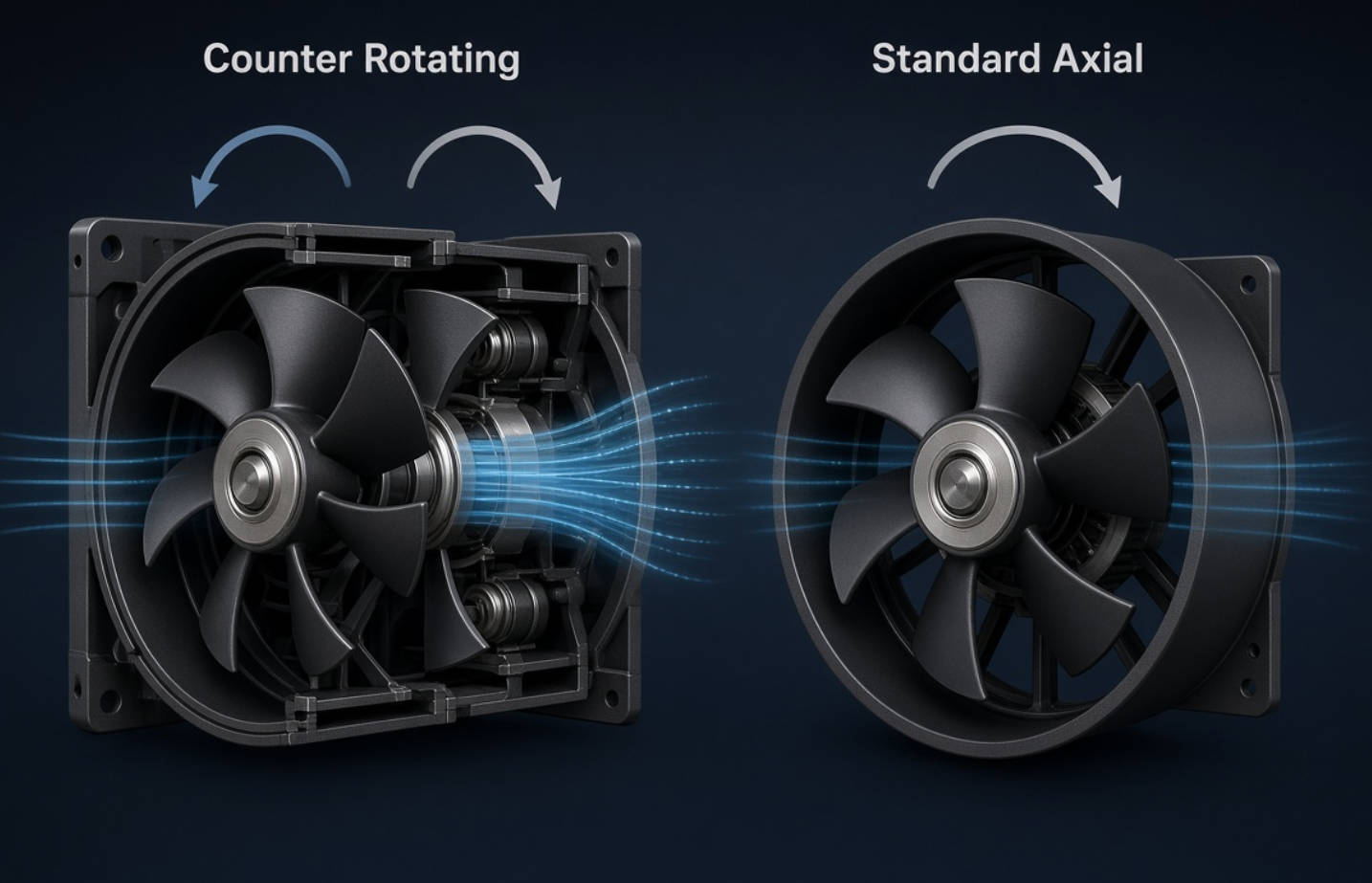
A counter rotating fan is itself an axial-flow device. In this comparison, "standard axial fan" means a conventional single-stage axial fan, rather than every product within the broader axial category.
A standard axial fan uses one rotating impeller to move air along its axis. Its installed performance depends on blade geometry, rotational speed, motor design, and the surrounding airflow path.
A San Ace counter rotating fan combines two coordinated impellers on the same axis, rotating in opposite directions. The stages are designed to work together rather than function as two unrelated fans.
This arrangement supports high airflow and static pressure within a compact frontal area. It is particularly relevant when air must pass through restrictive heatsinks, densely populated boards, or narrow internal channels.
| Selection Factor | San Ace Counter Rotating Fan | Standard Single-Stage Axial Fan |
|---|---|---|
| Impeller arrangement | Two coordinated, oppositely rotating stages | One rotating stage |
| Main strength | Pressure capability in restrictive equipment | Simpler cooling where resistance permits |
| Installation considerations | Check assembly depth and weight | More flexibility across available frame depths |
| Electrical requirements | Check total input and startup behavior | Depends on the selected motor and speed |
| Acoustic performance | Must be evaluated at the required operating point | Also strongly dependent on speed and loading |
| Typical decision trigger | Required airflow cannot be maintained against resistance | Required airflow is achieved within other limits |
These are selection tendencies, not guarantees. Compare specific models under equivalent conditions.
Maximum airflow is normally measured near zero external static pressure. Maximum static pressure is measured at approximately zero airflow.
These values describe different endpoints of a fan's performance curve. They do not occur simultaneously.
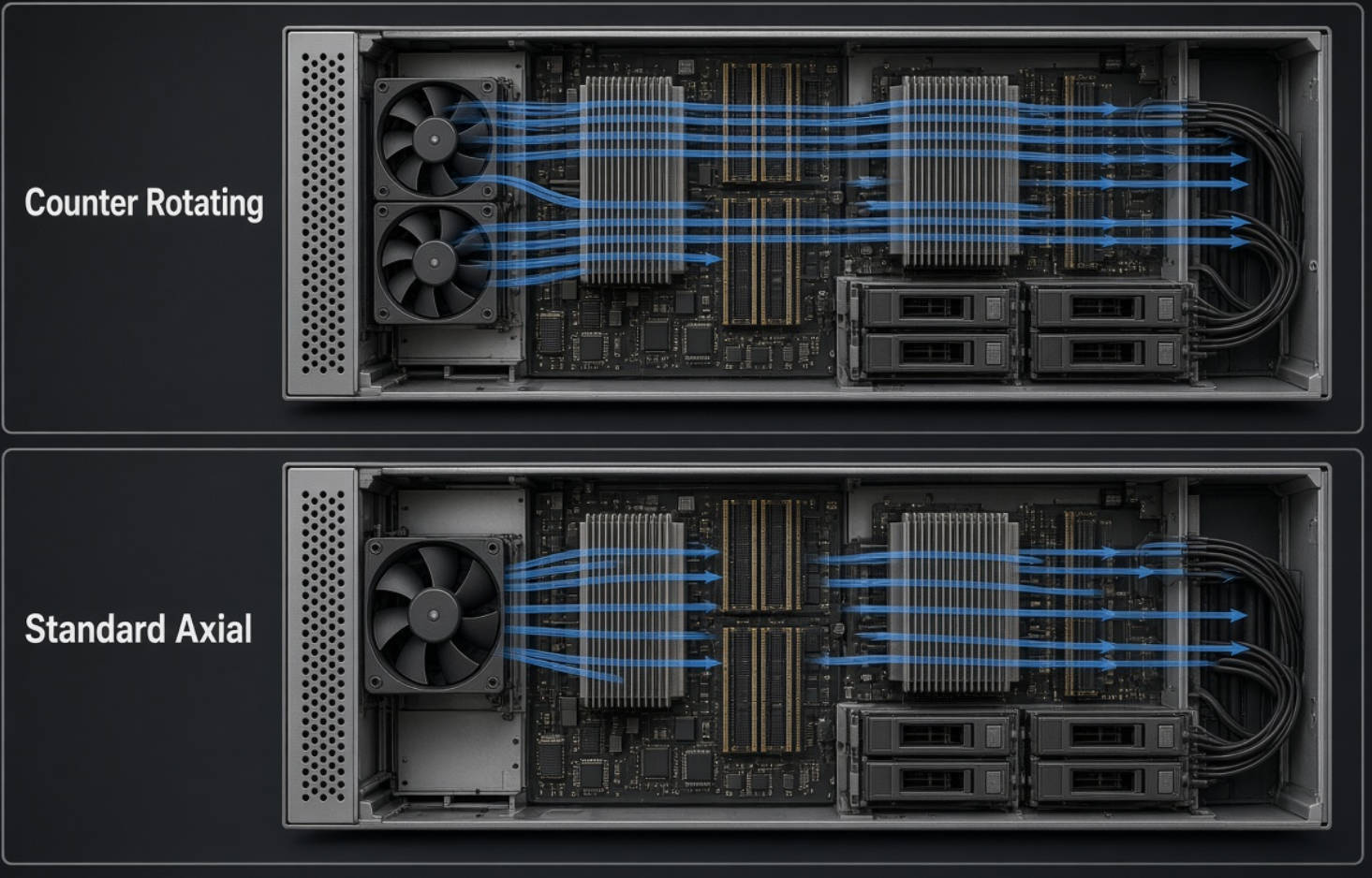
A server operates between those endpoints. Heatsinks, drive bays, grilles, cables, and internal partitions resist airflow. As resistance changes, the fan delivers a different combination of airflow and pressure.
For example, a fan advertised with impressive free-air CFM may deliver insufficient airflow through a restrictive server chassis.
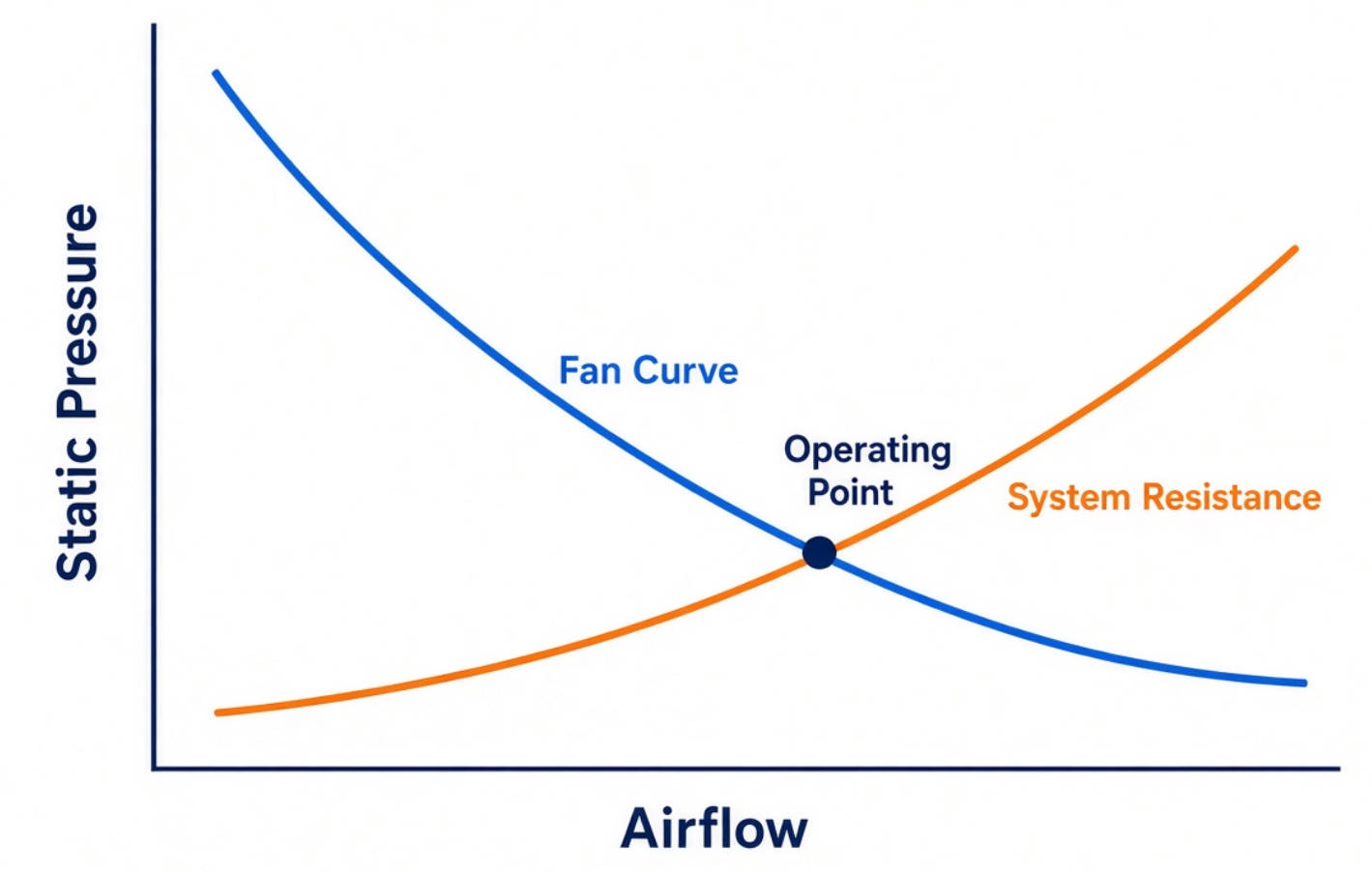
The operating point is the intersection between:
- The fan's pressure–airflow curve.
- The enclosure's system-resistance curve.
For an unchanged configuration, system resistance is often approximated by:
ΔP=KQ2
Here, ΔP represents pressure loss, Q represents airflow, and K describes the resistance of that particular airflow path.
The practical question is therefore: which fan supplies the required airflow against the measured resistance?
A counter rotating design becomes valuable when it provides the necessary operating point without exceeding the server's electrical, mechanical, or acoustic limits.
Recent product releases illustrate the pressure capability available in compact counter rotating designs.
| Published Specification | San Ace 60 9CRH | San Ace 80 9CRHA |
|---|---|---|
| Example model | 9CRH0612P6G001 | 9CRHA0812P8J001 |
| Dimensions | 60 × 60 × 56 mm | 80 × 80 × 80 mm |
| Rated voltage | 12 VDC | 12 VDC |
| Rated input | 67.2 W | 144 W |
| Maximum airflow | 90.8 CFM | 199 CFM |
| Maximum static pressure | 3,350 Pa | 2,700 Pa |
| Published sound pressure level | 78 dB(A) | 85 dB(A) |
The 60 mm product was released in June 2024. The 80 mm 9CRHA product was released in May 2025.
These figures reveal two important points.
First, a smaller fan can provide higher maximum static pressure while delivering less maximum airflow. Frame size alone does not identify the best solution.
Second, strong cooling capability can carry substantial electrical and acoustic requirements. These models should not be treated as universal replacements for lower-power fans.
This is not a controlled comparison against a specific single-stage model. A defensible purchasing comparison requires matched dimensions where possible, equivalent test conditions, and complete performance curves.
A higher-pressure fan is not automatically more energy efficient.
A counter rotating assembly may consume more power at full speed than a conventional fan. However, it may also meet a demanding cooling requirement at a reduced speed.
The meaningful comparison is input power at equivalent thermal performance.
For example, compare both candidates while maintaining the same critical component temperatures under the same workload and inlet-air conditions. Record fan power, actual airflow, and control settings.
Comparing one fan at maximum speed against another at partial speed does not establish a fair efficiency ranking.
Counter rotating fans are not automatically quieter than standard axial fans.
Noise depends on rotational speed, aerodynamic loading, blade interaction, installation geometry, and control behavior. Published sound-pressure values also need comparable measurement conditions.
For server-room equipment, high noise may be acceptable within an established acoustic budget. For edge servers installed near occupied workspaces, it can become a primary constraint.
Evaluate steady operation and load transitions. A fan-control strategy that repeatedly accelerates and decelerates may create an undesirable user experience even when average sound levels appear acceptable.
Two fans can share the same mounting width and height but require very different installation depths.
Before substitution, check:
- Clearance behind the fan outlet.
- Connector position and cable routing.
- Mounting-hole compatibility.
- Fan-tray retention and service access.
- Assembly weight and vibration behavior.
Avoid selecting a model solely because its square frame fits the opening.
The two example San Ace releases specify an expected L10 life of 40,000 hours under stated conditions: continuous free-air operation at 60°C and rated voltage.
L10 means a 90% survival rate under those specified conditions. It is not a guarantee that every fan will operate for exactly 40,000 hours in every server.
Likewise, two impellers do not automatically provide redundant cooling. A stopped stage can change airflow resistance and remaining performance.
Verify failure detection, controller response, and safe temperatures during the actual failure scenarios required by the system specification.
Placing two conventional axial fans in series may increase available pressure, but the improvement depends on their combined aerodynamic behavior.
The downstream fan receives flow influenced by the upstream fan. Unfavorable interactions can prevent the combination from achieving the expected performance.
A purpose-designed counter rotating assembly coordinates the stages to work together.
In a published 1U server development case, an equipment manufacturer initially tested conventional axial fans in series but did not obtain the expected pressure improvement. A counter rotating solution subsequently met the prototype's cooling requirements.
The case reports increases of 51% in maximum airflow and 44% in maximum static pressure, alongside reduced power consumption.
These are application-specific, supplier-reported results. They are not universal performance gains and should not be presented as Capital Technology customer test data.
The useful lesson is to test the complete airflow architecture rather than assume that adding another fan produces a predictable improvement.
Specify maximum allowable temperatures for critical components, expected workloads, and inlet-air conditions.
Do not rely only on average enclosure temperature. A localized hotspot may remain unacceptable even when overall exhaust temperature looks reasonable.
Document mounting dimensions, installation depth, voltage, connector requirements, and the fan-power budget.
Identify hard constraints before comparing performance curves.
Measure system impedance with representative heatsinks, cables, grilles, and other restrictions installed.
Where direct measurement is unavailable, use preliminary estimates for screening, but validate the final selection in hardware.
Overlay each candidate's pressure–airflow curve with the enclosure resistance curve.
Check performance at relevant control settings, not just maximum speed. Exclude candidates that cannot achieve the required airflow within the operating limits.
Run realistic workloads at the required environmental conditions. Include specified fan failures and relevant restriction changes, such as filter loading where filters are used.
Record component temperatures, fan speed, power, and control response.
Adjust PWM control to maintain thermal limits without unnecessary speed.
Confirm the model's permitted control behavior, including minimum speed and stop behavior where applicable. Preserve the approved part number, test configuration, and acceptance results for production purchasing.
A counter rotating fan deserves evaluation when:
- A compact server has high airflow resistance.
- Existing fans cannot maintain acceptable component temperatures.
- Available frontal mounting area cannot increase.
- Dense heatsinks require greater pressure capability.
- Electrical power, installation depth, and noise allowances support the candidate.
Its value lies in meeting a difficult installed operating point, not simply providing a more impressive specification.
A conventional single-stage axial fan remains a strong option when:
- Airflow paths are relatively open.
- Required cooling is achieved with adequate margin.
- Available installation depth is restricted.
- Lower-complexity integration is a priority.
- The chosen model meets power and acoustic targets.
There is little engineering value in purchasing pressure capability the application does not need.
Before upgrading, also investigate bypass gaps, recirculation, cable obstruction, and poorly directed airflow. Changing the airflow path may address the underlying problem more effectively than increasing fan speed.
Capital Technology Co., Limited manufactures DC fans and AC fans under the CAPITAL brand and serves as a principal agent for SANYO DENKI. Our company background includes supplying ZTE, HUAWEI, and HYTERA.
For server projects, the strongest proposal starts with measurable requirements rather than a brand-only recommendation.
Send Capital Technology your existing fan model, installation dimensions, supply voltage, thermal targets, and available airflow or pressure measurements. Request a comparison between suitable San Ace counter rotating fans and standard axial alternatives, supported by candidate curves and a clear validation plan.
Yes. It uses axial airflow with two coordinated impellers rotating in opposite directions. The comparison here distinguishes that two-stage arrangement from a conventional single-stage axial fan.
No. It can be advantageous in restrictive enclosures, but cooling depends on the operating point, airflow distribution, and heat-transfer conditions. A correctly selected standard axial fan may already satisfy the requirement.
Possibly, but they are not automatically equivalent. Their combined pressure–airflow behavior, installation space, power consumption, and failure response must be evaluated in the actual system.
Use both through the complete pressure–airflow curve. Free-air CFM alone does not show how much air the fan will move through your server's resistance.
Yes, when reduced speed still provides sufficient cooling. Savings depend on the selected fan, operating point, and control strategy. Confirm compatibility and validate temperatures throughout the required operating range.
No. Two stages do not establish system-level redundancy. Fan-tray architecture, monitoring, failure behavior, and remaining cooling capacity require separate validation.
1. SANYO DENKI. "[SANYO DENKI Develops 60 × 60 × 56 mm Counter Rotating Fan with the Highest Static Pressure and Airflow in the Industry]." June 12, 2024. Source for the 60 mm model's dimensions, electrical ratings, performance, and stated lifetime conditions. [sanyodenki]
2. SANYO DENKI. "[SANYO DENKI Develops 80 × 80 × 80 mm Counter Rotating Fan with the Highest Static Pressure in the Industry]." Released May 26, 2025; regional announcement dated May 28, 2025. Source for the 80 mm model's specifications and stated lifetime conditions. [sanyodenki]
3. SANYO DENKI, Tech Compass. "[Basic Knowledge for Selecting a Cooling Fan]." October 9, 2024. Technical background on airflow, static pressure, system impedance, and speed-related performance. [techcompass.sanyodenki]
4. SANYO DENKI, Technical Report. "[Development of the 'San Ace Airflow Tester'—A Measuring Device]." 2016. Source for system-impedance measurement, operating-point selection, and comparison of power and noise at the required operating point. [sanyodenki]
5. SANYO DENKI, Tech Compass. "[Counter Rotating Fan Examples: Improving Cooling in a Compact Server]." Supplier-published application case describing series-fan limitations, counter rotating fan adoption, and prototype performance improvements. [techcompass.sanyodenki]
6. SANYO DENKI. "[PWM Controller—San Ace Product Information]." Technical background on external PWM speed control and its potential contribution to reduced fan power and noise. [products.sanyodenki]
7. Company information supplied for this article by Capital Technology Co., Limited. Source for the CAPITAL brand, SANYO DENKI agency relationship, and named customer relationships. These company statements were not independently verified. The selection workflow and purchasing recommendations are editorial engineering synthesis, not claimed original laboratory results.


