From idea to market-ready product, our NPI solutions make every stage easier, faster. Discover How We Help
Help Center

Views: 216 Author: Capital Technology Publish Time: 2026-10-30 Origin: Site
Content Menu
● San Ace Blower vs Centrifugal Fan: Understanding the Terms
● San Ace Blower vs Centrifugal Fan: Key Differences
● Airflow and Static Pressure: Why Maximum Ratings Can Mislead
● A Real Specification Comparison: Two San Ace Models
● Three Engineering Checks That Improve Fan Selection
>> 1. Evaluate the Complete Air Path
>> 2. Compare Noise at the Required Cooling Output
>> 3. Read Lifetime Ratings With Their Temperature Conditions
● A Practical Five-Step Selection Workflow
● Which Option Should You Choose?
>> 1. Is a San Ace blower a centrifugal fan?
>> 2. Does a blower always provide higher static pressure?
>> 3. Can a centrifugal fan replace a San Ace blower?
>> 4. Which option is quieter?
>> 5. Should I choose by maximum CFM?
>> 6. Do all San Ace blowers support PWM control?
A San Ace blower and a centrifugal fan are not fundamentally opposite technologies. San Ace is SANYO DENKI's cooling-product brand, while "centrifugal fan" describes an airflow mechanism. In a San Ace blower vs centrifugal fan comparison, the practical differences concern product construction, outlet configuration, installation space, and performance at the required operating point.
For equipment designers and purchasing teams, the most important distinction is integration: how effectively the air mover fits the enclosure and delivers cooling where needed.
At Capital Technology Co., Limited, our selection approach starts with the equipment's thermal requirements—not simply the highest airflow figure in a catalog.
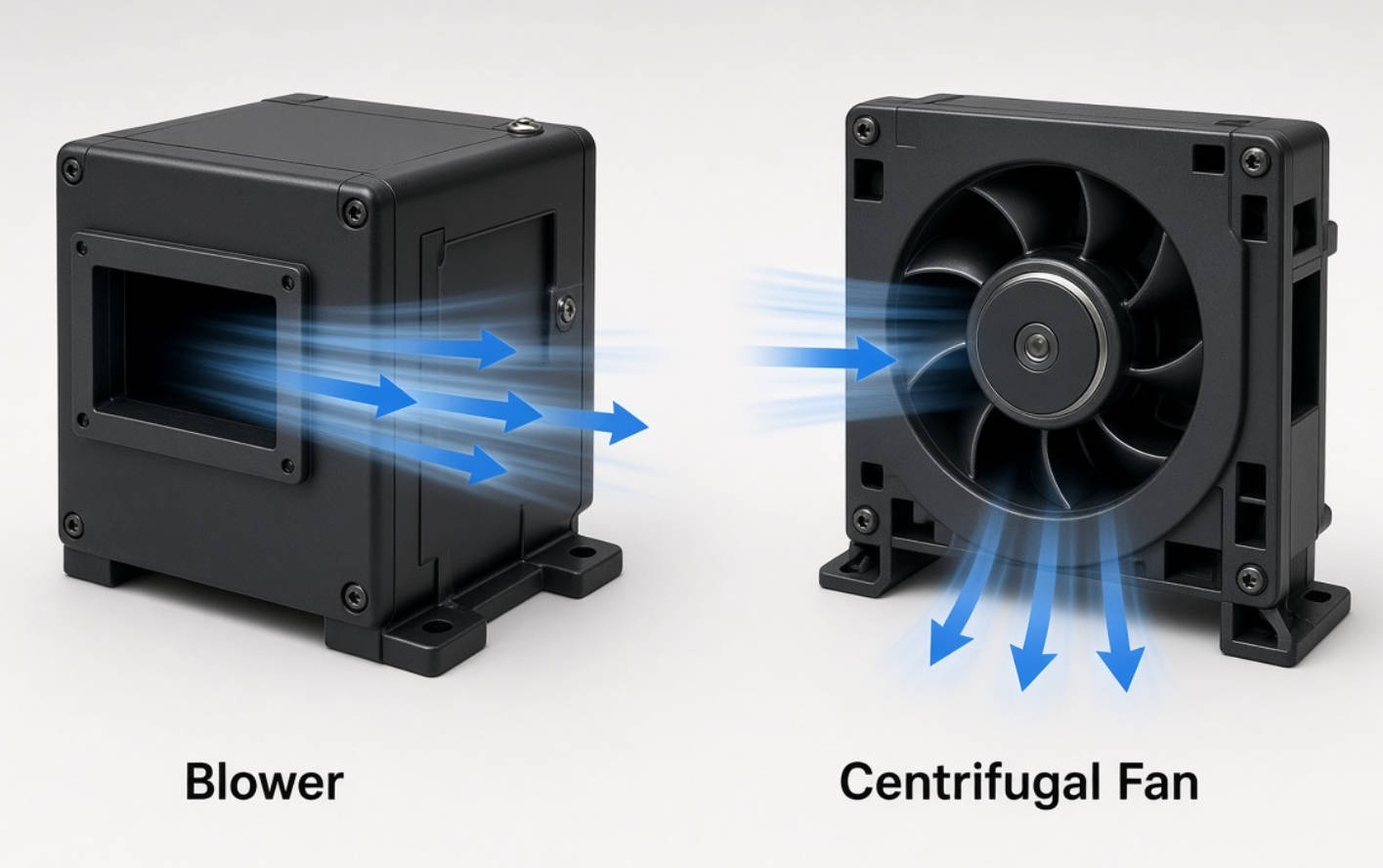
SANYO DENKI lists San Ace blowers as a dedicated product category. These units discharge air at approximately 90 degrees to the intake direction and incorporate an outlet that directs the airflow.
This configuration helps equipment designers redirect air without adding a separate external duct solely to make that turn. SANYO DENKI identifies servers, storage equipment, and base stations as suitable applications, particularly where airflow resistance is high.
A centrifugal fan moves air outward from its rotating impeller, with discharge perpendicular to the inlet direction.
SANYO DENKI also maintains a separate San Ace centrifugal fan category. Its listed applications include densely populated equipment, servers, storage systems, and heat exchangers.
The terminology therefore overlaps. A blower can use centrifugal airflow principles, while a manufacturer may distinguish "blower" and "centrifugal fan" as separate product families.
The useful comparison is between specific assemblies—not between two supposedly incompatible technologies.
| Selection factor | San Ace blower | Centrifugal fan |
|---|---|---|
| Meaning | A specific San Ace product category | An airflow technology and a separate San Ace category |
| Airflow direction | Approximately 90 degrees from intake | Perpendicular to intake |
| Outlet arrangement | Integrated directional outlet | Depends on the selected assembly |
| Integration priority | Directing air through a defined path | Matching the fan to the surrounding airflow architecture |
| Pressure capability | Suitable for restrictive equipment | Also suitable for pressure-demanding applications |
| Typical applications | Servers, storage systems, base stations | Servers, storage systems, heat exchangers |
| Selection basis | Installed airflow, pressure, dimensions, controls | The same engineering requirements |
Neither label guarantees better cooling, lower noise, or greater efficiency. Those outcomes depend on the model and installation.
Airflow indicates how much air a fan moves. Static pressure indicates its ability to overcome resistance from components such as filters, heatsinks, grilles, and internal passages.
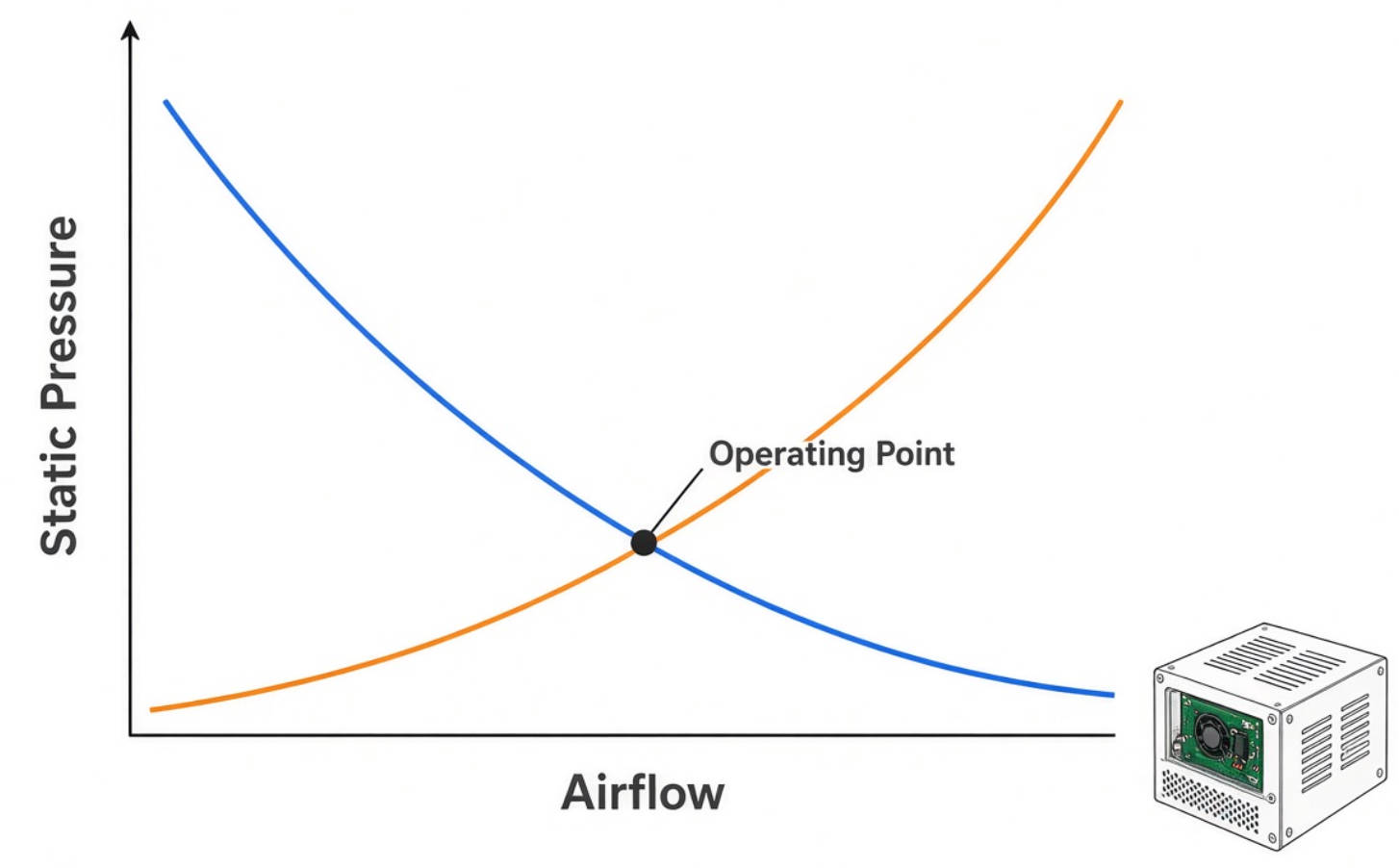
However, maximum airflow and maximum static pressure represent different endpoints of a fan's performance curve. They are not available simultaneously.
The actual operating point occurs where the fan's airflow–static pressure curve intersects the equipment's system-impedance curve.
From an engineering perspective, this changes the buying question:
- Do not ask only, "Which fan has more CFM?"
- Ask, "Which fan delivers the required airflow against our equipment's resistance?"
A high free-air rating alone cannot establish suitability for a tightly packed enclosure.
The following manufacturer-listed specifications illustrate why buyers should compare individual models.
| Specification | San Ace blower 9BMB12P2K01 | San Ace centrifugal fan 9TD12P6G001 |
|---|---|---|
| Listed frame size | 97 mm | Ø70 mm |
| Frame thickness | 33 mm | 20 mm |
| Rated voltage | 12 V | 12 V |
| Maximum airflow | 56.8 CFM | 39.9 CFM |
| Maximum static pressure | 1,280 Pa | 560 Pa |
| Listed sound pressure level | 66 dB(A) | 61 dB(A) |
| PWM control | Yes | Yes |
| Expected life at 60°C | 40,000 hours | 40,000 hours |
This is not an equal-size comparison or evidence that all blowers outperform all centrifugal fans.
The blower has higher maximum airflow and pressure ratings, but it also occupies a different envelope. The centrifugal model is smaller and thinner.
For a purchasing decision, compare the full performance curves, dimensional drawings, electrical requirements, and acoustic measurement conditions. Catalog endpoints help establish a shortlist; they do not replace installed testing.
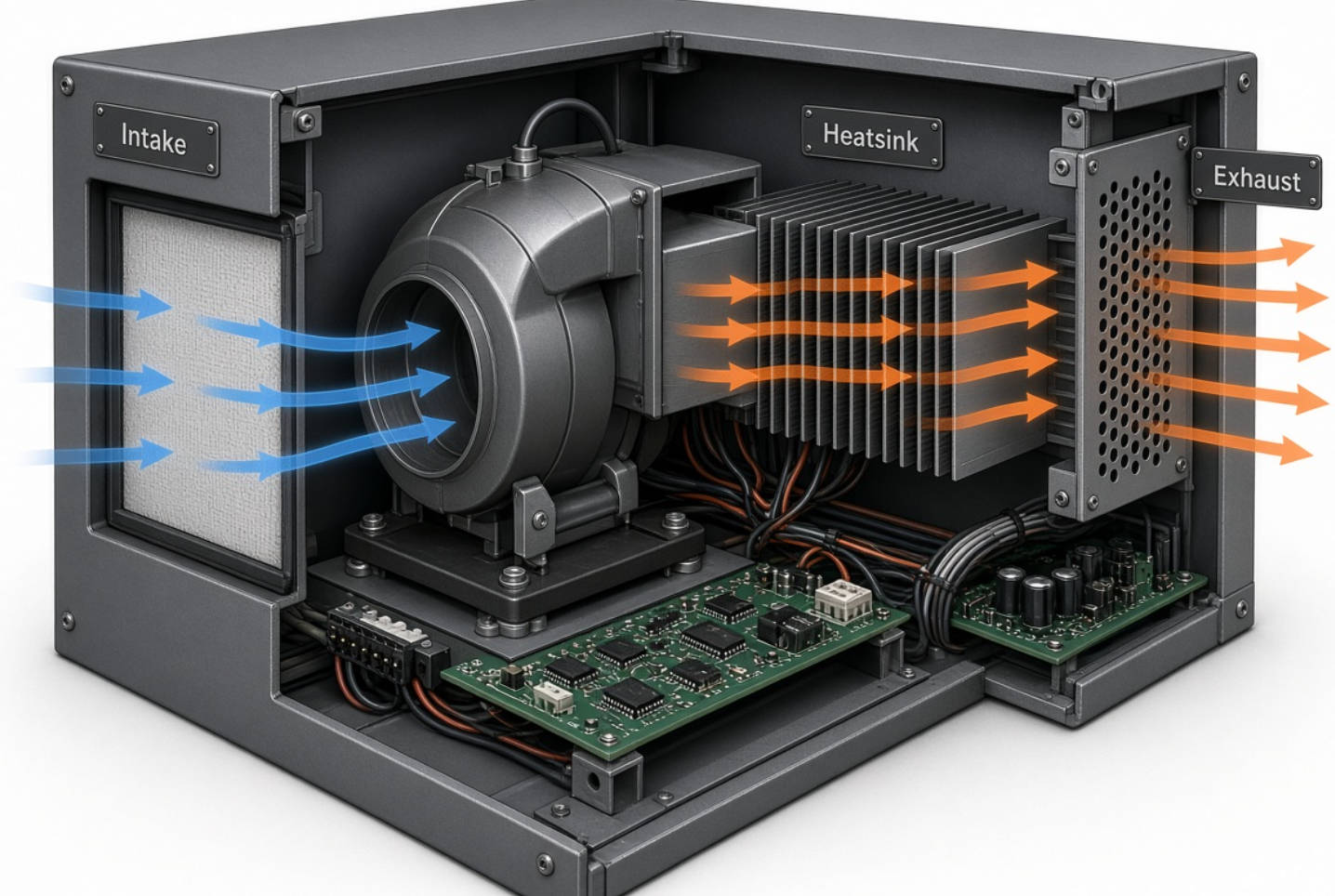
A compact blower may simplify a design requiring a right-angle discharge. However, the surrounding enclosure still determines whether that airflow reaches the intended components.
Check for:
- Obstructions near the inlet.
- Leakage around the discharge connection.
- Warm exhaust returning to the intake.
- Restrictions introduced by filters and protective grilles.
Our recommendation is to review the complete intake-to-exhaust path before freezing the mechanical layout. Selecting the air mover and designing the enclosure should be connected tasks.
A lower catalog sound-pressure figure does not automatically mean a quieter finished product.
One candidate may need to run near full speed, while another may meet the thermal requirement at reduced speed. Installation conditions also affect the final acoustic result.
Compare noise after both candidates achieve the same required thermal performance. Where supported, PWM speed control allows the fan's speed to follow cooling demand rather than remaining permanently at maximum.
An expected-life figure needs its associated temperature.
For example, SANYO DENKI lists 40,000 hours at 60°C and 70,000 hours at 40°C for the 9BMB12P2K01. Quoting only the larger number removes important operating context.
Check the exact model's temperature range, lifetime conditions, environmental protection, and electrical specifications. Do not assume that every product within a family shares identical ratings.
1. Define the thermal requirement. Document heat generation, maximum ambient temperature, and acceptable component temperatures.
2. Establish the airflow path. Identify the available envelope, discharge direction, filters, heatsinks, and likely restrictions.
3. Determine the operating point. Measure system impedance where possible and compare it with candidate performance curves.
4. Check integration requirements. Confirm voltage, current, connector, PWM input, speed-feedback output, mounting, and environmental suitability.
5. Validate a production-representative assembly. Test temperatures, airflow, noise, and electrical demand under the intended operating conditions.
This workflow turns a broad "blower versus centrifugal fan" discussion into a defensible component-selection decision.

Shortlist a San Ace blower when a defined directional outlet and a compact right-angle airflow path fit your equipment architecture.
Evaluate centrifugal fan assemblies when their dimensions, mounting arrangement, and performance curves better match the enclosure or heat-exchanger layout.
In either case, choose by verified operating performance rather than terminology.
Capital Technology Co., Limited manufactures DC fans and AC fans under its CAPITAL brand and supplies SANYO DENKI products. Our role is to help connect mechanical constraints, thermal requirements, and procurement needs.
Send our team your enclosure drawing, supply voltage, heat load, target airflow and pressure, noise limit, and expected order quantity. Request a model-specific comparison covering dimensions, performance curves, control options, and sample-validation requirements.
Its airflow behavior overlaps with centrifugal fan principles. However, SANYO DENKI lists blowers and centrifugal fans separately, so confirm the exact product category and model.
No. Pressure capability depends on the individual design, size, speed, and operating point. A product-category name cannot establish a universal ranking.
Possibly, but not automatically. Compare mounting, airflow direction, electrical interfaces, and installed performance before approving a replacement.
There is no universal winner. Compare both candidates at the cooling output your equipment actually requires and verify noise in the finished assembly.
No. Maximum CFM is only one reference value. Required airflow must be delivered against the actual system resistance.
Do not assume so. The example blower supports PWM, but control functions and signal requirements must be checked against the selected model's documentation.
1. SANYO DENKI, "Blower — San Ace Product Features." Source for discharge direction, integrated outlet benefits, and recommended applications. [products.sanyodenki]
2. SANYO DENKI, "Centrifugal Fan — San Ace Product Lineup." Source for centrifugal fan applications and the specifications of model 9TD12P6G001. [products.sanyodenki]
3. SANYO DENKI, "Blower San Ace B97 — 9BMB12P2K01." Source for model dimensions, voltage, airflow, pressure, sound level, PWM support, and temperature-dependent expected life. [products.sanyodenki]
4. SANYO DENKI, "Equipment Ventilation Resistance — Basic Knowledge of Fans." Source for system impedance and the relationship between performance curves and operating airflow. [techcompass.sanyodenki]
5. SANYO DENKI, "Basic Knowledge for Selecting a Cooling Fan." Source for electrical compatibility, environmental considerations, and PWM-based speed control. [techcompass.sanyodenki]
6. SANYO DENKI, "Guideline in Selecting a Fan." Source for thermal requirement assessment and the importance of final installation testing. [products.sanyodenki]


