From idea to market-ready product, our NPI solutions make every stage easier, faster. Discover How We Help
Help Center

Views: 215 Author: Capital Technology Publish Time: 2026-10-29 Origin: Site
Content Menu
● San Ace 12V DC Fan vs 24V DC Fan: Quick Comparison
● Real San Ace Specifications: Different Voltage, Similar Cooling
● Electrical Integration: Where 12V and 24V Differ Most
>> Supply Voltage and Operating Range
>> Current Draw and Cable Losses
>> Conversion Changes the System-Level Result
● Cooling Performance: Compare Pressure–Airflow Curves
● Noise, PWM Control, and Expected Life
>> Higher Voltage Does Not Guarantee Lower Noise
>> PWM Compatibility Requires More Than Matching Wire Count
>> Lifetime Ratings Need Their Test Conditions
● A Practical Selection Workflow for Equipment Manufacturers
● Specify the Right San Ace Fan With Capital Technology
>> 1. Is a 24V DC fan more powerful than a 12V DC fan?
>> 2. Can I connect a 12V San Ace fan directly to 24V?
>> 3. Will a 24V San Ace fan work correctly on 12V?
>> 4. Does a 24V fan always use less electricity?
>> 5. Can I replace a 12V fan with a same-size 24V model?
Choosing a San Ace 12V DC fan vs 24V DC fan changes electrical integration more than cooling capability. A 24V model does not automatically deliver more airflow, lower noise, or longer life. The better choice depends on your power supply, enclosure resistance, wiring, and control requirements.
At Capital Technology Co., Limited, our selection philosophy is straightforward: compatibility comes before voltage preference. As a cooling-solutions manufacturer with our CAPITAL brand and a principal agency role for SANYO DENKI, we approach selection from both the component and system perspectives.
The practical question is not "Which voltage is better?" It is "Which exact fan meets the thermal target with the fewest integration compromises?"
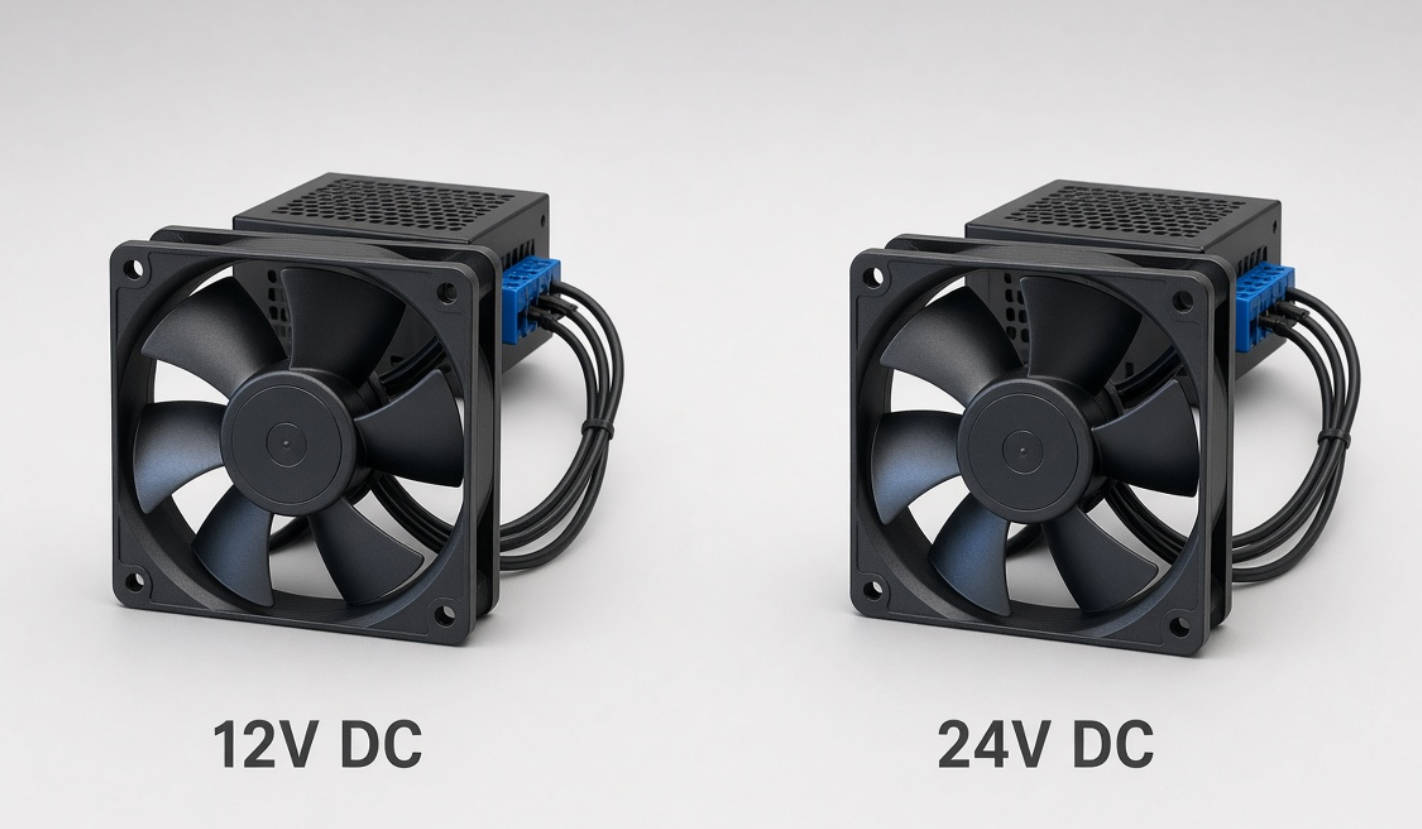
| Selection factor | San Ace 12V DC fan | San Ace 24V DC fan |
|---|---|---|
| Power integration | Direct fit for a compatible 12V supply | Direct fit for a compatible 24V supply |
| Current at equal input power | Approximately twice the current | Approximately half the current |
| Cable losses at equal power and resistance | Higher | Lower |
| Airflow and static pressure | Depend on the model and operating point | Depend on the model and operating point |
| Noise | Not inherently quieter or louder | Not inherently quieter or louder |
| Speed control | Verify the exact control interface | Verify the exact control interface |
| Replacement suitability | Requires electrical and mechanical checks | Requires electrical and mechanical checks |
Voltage is therefore an integration parameter—not a cooling-performance ranking.
A useful comparison uses equivalent models from the same family, rather than unrelated fans with different dimensions or speeds.
SANYO DENKI's published San Ace 120 9RA specifications provide this example:
| Specification | 9RA1212P4G001 | 9RA1224P4G001 |
|---|---|---|
| Dimensions | 120 × 120 × 25 mm | 120 × 120 × 25 mm |
| Rated voltage | 12V DC | 24V DC |
| Operating voltage range | 10.8–13.2V | 21.6–26.4V |
| Rated input power | 6.6W | 6.72W |
| Rated speed | 4,500 rpm | 4,500 rpm |
| Maximum airflow | 130 CFM | 130 CFM |
| Maximum static pressure | 120 Pa | 120 Pa |
| Published noise level | 47 dB(A) | 47 dB(A) |
| Control and feedback | PWM and pulse sensor | PWM and pulse sensor |
Both models have identical published maximum airflow, maximum static pressure, speed, and noise figures. Their input power differs slightly.
However, matching endpoints do not prove identical performance throughout the complete pressure–airflow curve. Maximum airflow and maximum static pressure also occur at different operating conditions—not simultaneously.
These are published specifications, not results from a Capital laboratory comparison.
Start with the voltage available at the fan connector, including supply tolerance and cable drop.
The 12V PWM model above specifies 10.8–13.2V operation. Its 24V counterpart specifies 21.6–26.4V. Do not assume every San Ace fan accepts the same percentage variation.
Even within the 9RA family, the pulse-sensor models 9RA1212G4001 and 9RA1224G4001 list different ranges: 7–13.8V and 14–27.6V respectively.
The complete part number matters more than a general family description.
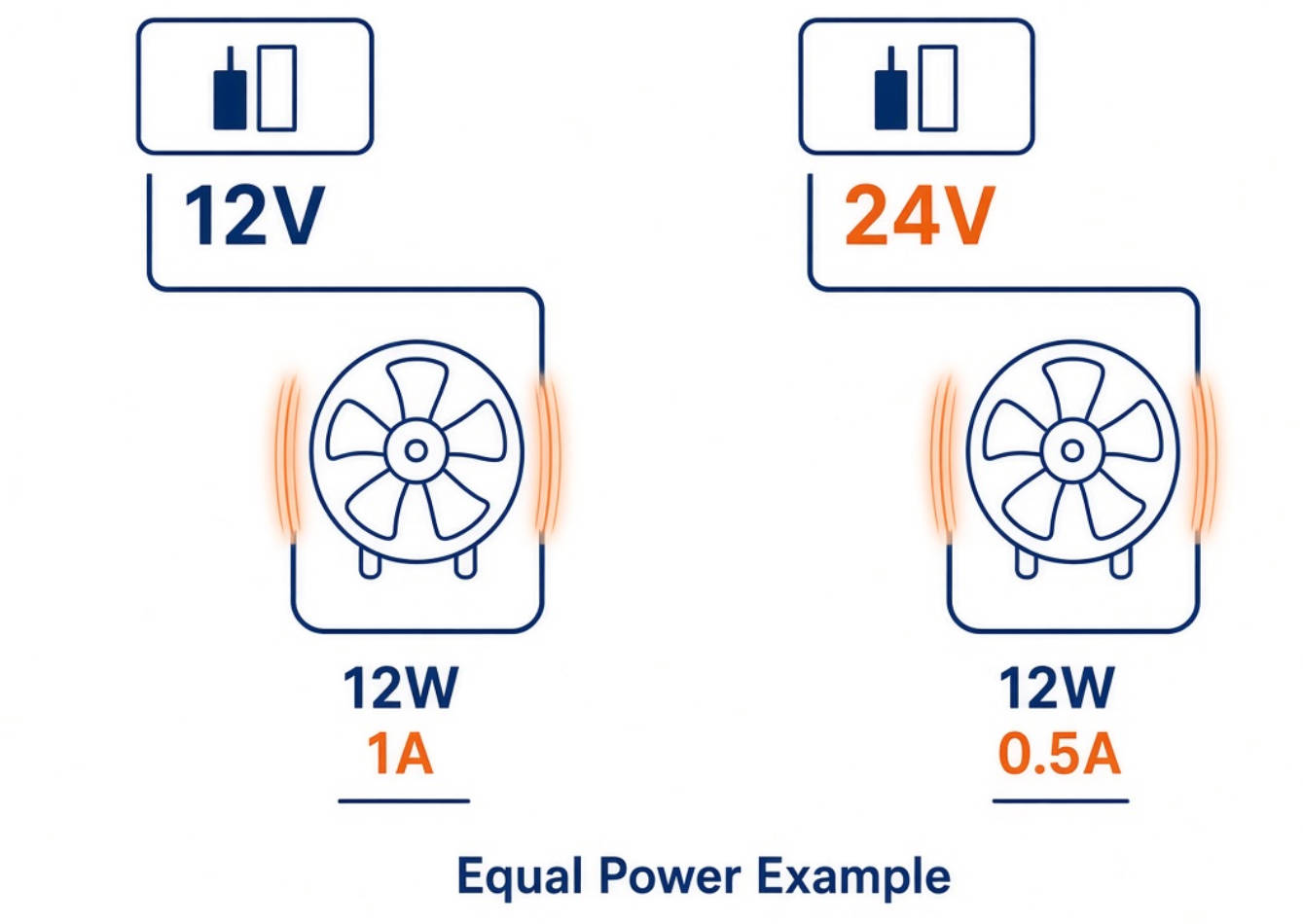
For an illustrative equal-power comparison, a 12W load draws:
- 1A at 12V.
- 0.5A at 24V.
With identical cable resistance, resistive heating follows Ploss=I2R. Halving current reduces cable heating to one-quarter.
For a hypothetical 0.4Ω round-trip wiring resistance, losses would be 0.4W at 1A and 0.1W at 0.5A.
This can favor 24V in distributed installations. However, it does not prove that a particular 24V fan consumes less power. Actual fan input, startup behavior, connectors, and protective devices still require checking.
A 12V fan on a 24V system may require a suitable DC–DC converter. That adds conversion losses, components, and qualification work.
Conversely, selecting 24V solely to reduce current may offer little benefit when the equipment already has a suitable 12V rail.
Evaluate the complete power path, not just the fan label.
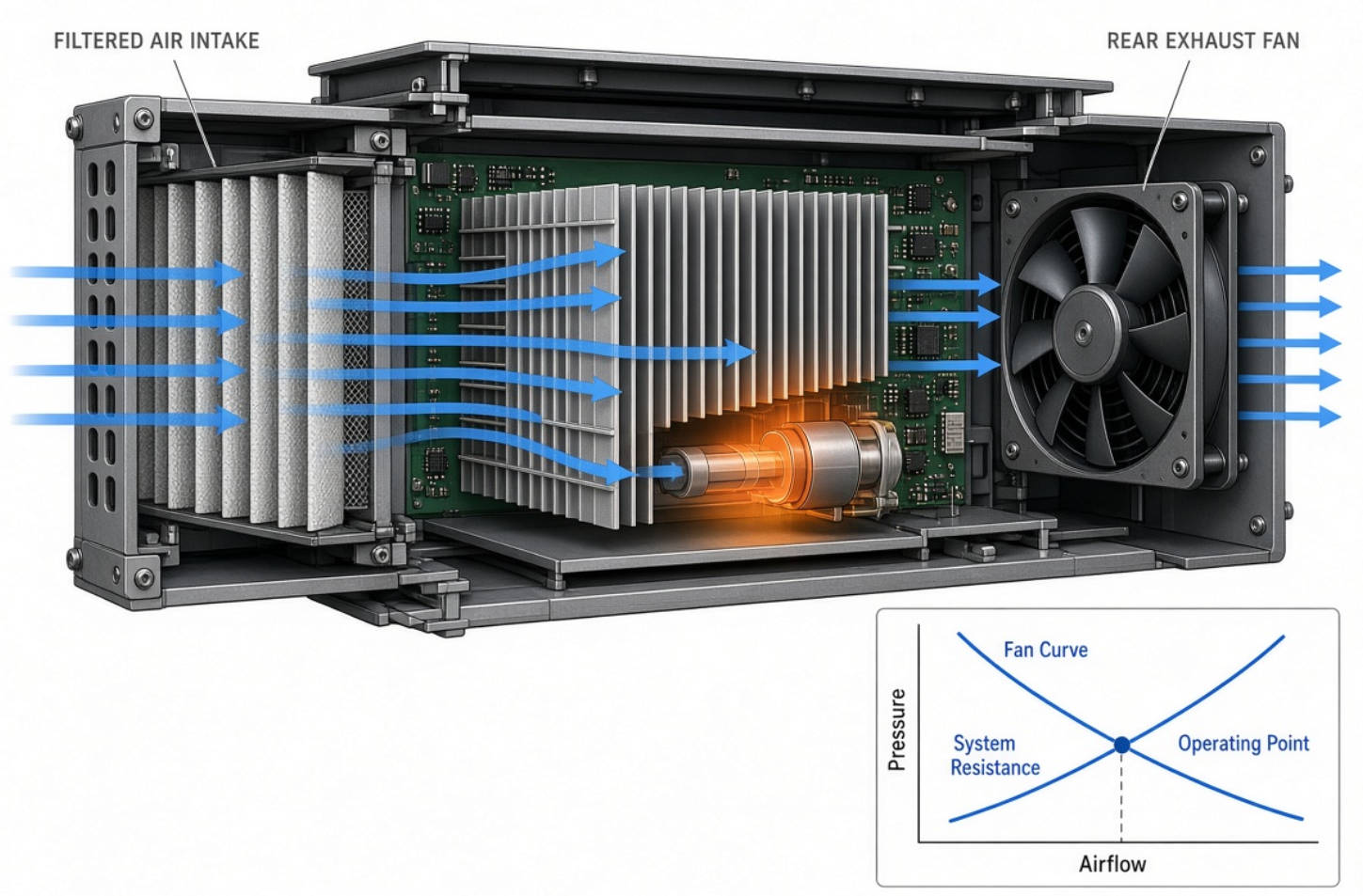
A fan operates where its pressure–airflow curve intersects the enclosure's resistance curve.
Filters, heatsinks, grilles, and narrow passages influence that operating point. Consequently, a higher free-air CFM rating does not guarantee better cooling inside restrictive equipment.
When comparing a San Ace 12V DC fan with a 24V alternative:
1. Establish the required airflow through the heat-generating components.
2. Estimate or measure enclosure resistance.
3. Compare candidate pressure–airflow curves.
4. Validate component temperatures in the assembled equipment.
I would prioritize this operating-point comparison over voltage whenever the main concern is overheating.
The paired 9RA models both specify 47 dB(A). Their different supply voltages do not create an inherent acoustic advantage.
Installed noise also depends on inlet restrictions, turbulence, mounting, and operating speed. Compare acoustic results under equivalent conditions, ideally inside the intended enclosure.
PWM allows speed adjustment, but the exact interface still needs verification.
Check:
- Pin assignments and connector orientation.
- Permitted control-signal voltage and frequency.
- Minimum speed and zero-duty behavior.
- Pulse-sensor output characteristics.
- Controller grounding and interface compatibility.
The fan's 12V or 24V supply rating does not establish the permitted PWM signal voltage. A physically compatible connector is not proof of electrical compatibility.
The compared 9RA models specify 60,000 hours of L10 life under continuous free-air operation at 60°C and rated voltage.
L10 means a 90% survival rate under the stated conditions. It is not a guarantee that every fan will run for that duration in every enclosure.
Temperature, environmental exposure, and the required protection rating deserve separate evaluation.
For a hypothetical filtered control cabinet with an existing 24V supply, begin with compatible 24V candidates. For equipment with a suitable 12V rail and short wiring, begin with 12V candidates.
Neither starting point replaces thermal validation.
Before approving either option:
1. Confirm heat load, ambient limits, and available installation space.
2. Check supply minimum and maximum voltage at the fan.
3. Compare airflow at the required pressure.
4. Verify control, feedback, connector, and mounting details.
5. Check startup demand against power-system capability.
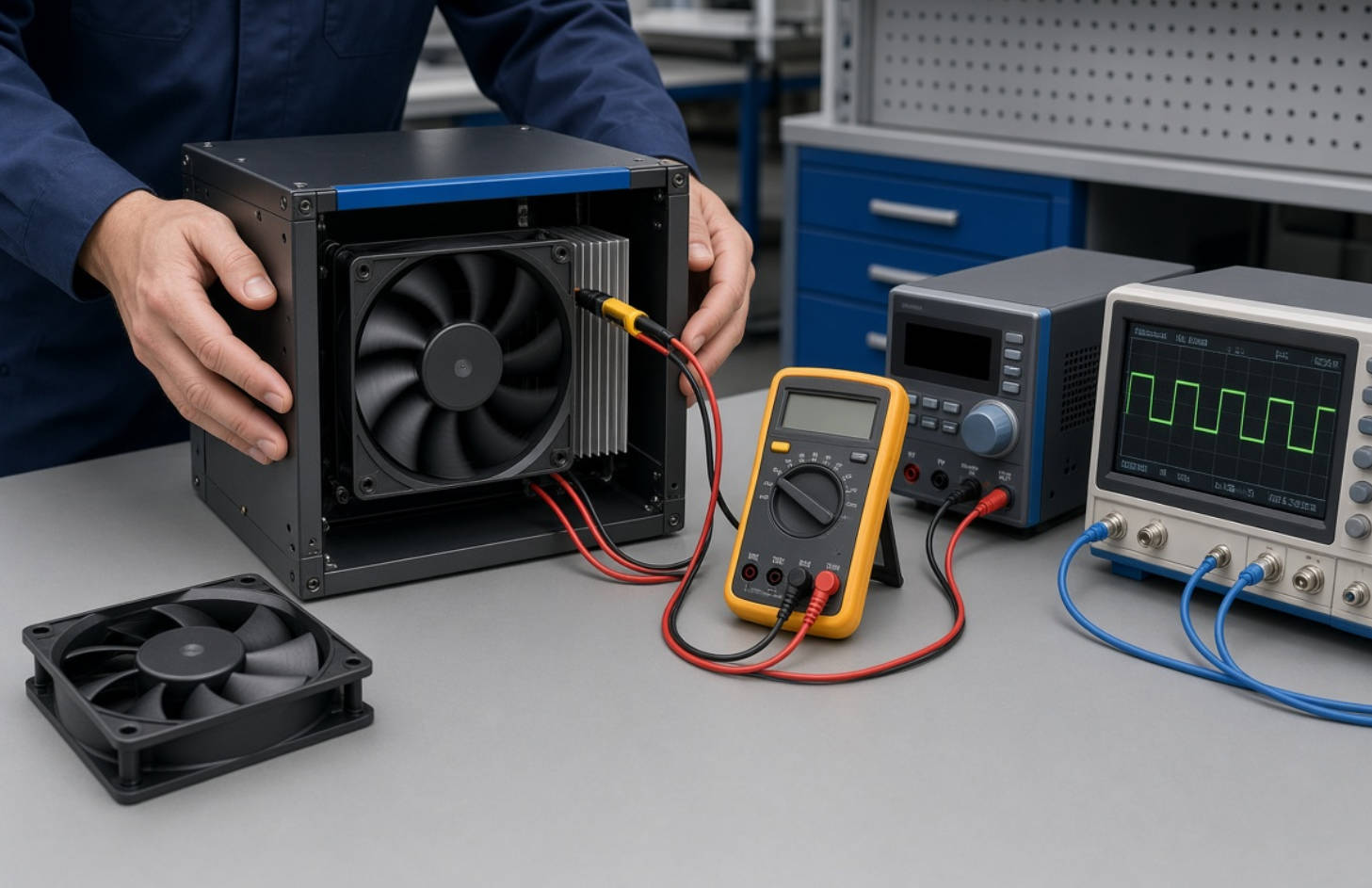
6. Test temperatures, noise, and fault detection in the enclosure.
Our recommendation is to document acceptance criteria before testing. This makes supplier comparisons more objective and reduces redesign risk.
Capital Technology Co., Limited combines its CAPITAL-brand manufacturing background with SANYO DENKI product support. Our supplied company profile also identifies ZTE, HUAWEI, and HYTERA among our customers; these relationships do not establish approval of every model for every application.
For a focused selection review, send Capital your existing fan number, supply range, enclosure dimensions, thermal target, control requirements, and annual quantity. Request a model-specific comparison covering electrical fit, pressure–airflow performance, and sample validation.
Not necessarily. Comparable models can deliver the same published airflow and pressure. Compare their actual specifications and curves.
Do not do so unless the exact model explicitly permits it. The 12V models discussed here do not support 24V operation.
Do not assume so. Below its specified operating range, startup and cooling performance are not assured.
No. It generally draws less current at equal power, but lower current is not the same as lower power consumption.
Only after checking supply compatibility, mounting, airflow direction, pressure performance, control signals, and feedback. Matching dimensions alone are insufficient.
1. [SANYO DENKI — San Ace 120 9RA Product Announcement and Specifications]. Source for the compared model specifications, operating ranges, PWM availability, noise figures, and conditional L10 life rating. The page states that its product information is current as of July 20, 2021. [sanyodenki]
2. [SANYO DENKI America — Fan Selection Tutorial]. Source for pressure–airflow curves, enclosure operating points, power and acoustic considerations, environmental selection, and physical system testing. [sanyodenki]


