From idea to market-ready product, our NPI solutions make every stage easier, faster. Discover How We Help
Help Center

Views: 276 Author: Capital Technology Publish Time: 2026-09-07 Origin: Site
Content Menu
● What Is a Radial Fan and How Does It Work?
● Radial Fan vs. Axial Fan: Which One Fits Your Application?
● The Core Components of a Radial Fan
>> Impeller
>> Motor
>> Bearings and Protection Features
>> Forward-Curved Centrifugal Fans
>> Backward-Curved Centrifugal Fans
● Why Radial Fans Deliver Value in High-Resistance Systems
>> Better Pressure Performance
>> Durability for Industrial Duty
>> Lower Total Cost of Ownership
● How to Select the Right Radial Fan
>> Step 1: Define Required Airflow
>> Step 2: Calculate Total Static Pressure
>> Step 3: Review the Fan Curve
>> Step 4: Match Voltage, Control, and Signal Requirements
>> Step 5: Assess Environment and Reliability
● Installation Mistakes That Reduce Radial Fan Performance
● Energy Efficiency and Intelligent Fan Control
● Radial Fan Applications Across Key Industries
>> Telecommunications and Network Equipment
>> Industrial Control and Automation
>> HVAC and Building Ventilation
>> Energy Storage and Power Electronics
>> Manufacturing and Process Ventilation
● Work With a Cooling Fan Partner That Understands the System
>> 1. What is the difference between a radial fan and a centrifugal fan?
>> 2. When should I choose a radial fan instead of an axial fan?
>> 3. How do I calculate the static pressure for a radial fan?
>> 4. Can DC radial blowers be controlled by PWM?
>> 5. Why is my installed airflow lower than the fan catalog rating?
>> 6. How often should a radial fan be maintained?
>> 7. Are radial fans suitable for high-temperature environments?
A radial fan, also called a centrifugal fan, is designed to move air outward at roughly 90 degrees from its inlet. It is often the better choice when an application needs dependable airflow against resistance from ducts, filters, heat sinks, grilles, bends, or particulate-control equipment.
For cooling-system designers, equipment manufacturers, and industrial buyers, the key is not simply choosing the highest-airflow fan. The right radial fan must balance required airflow, static pressure, sound level, power consumption, installation space, operating environment, and long-term reliability.
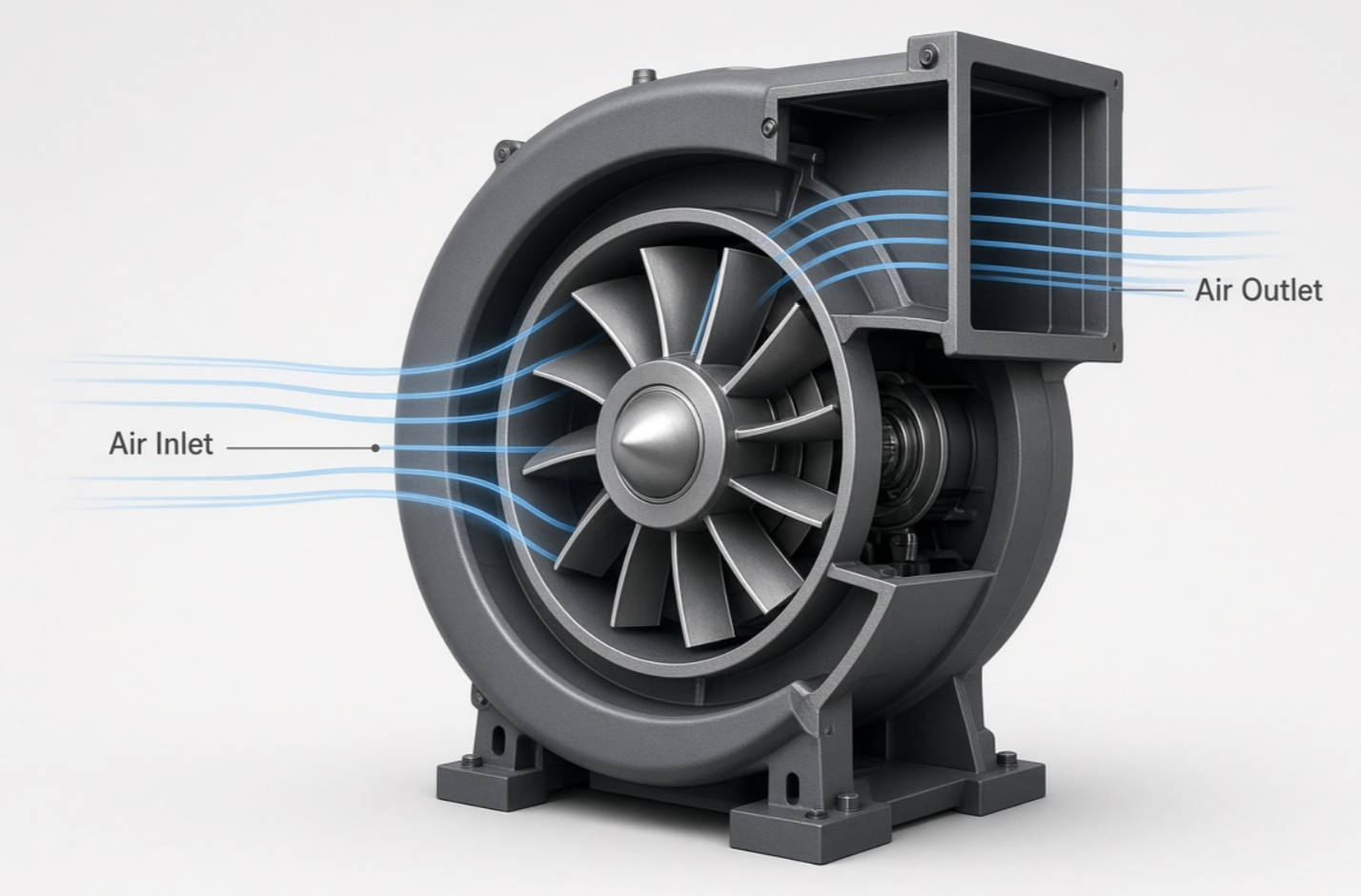
A radial fan uses a rotating impeller to draw air into the center of the fan and accelerate it outward toward the fan housing. The housing captures and redirects that moving air into an outlet, converting part of its velocity into usable pressure.
This operating principle makes radial fans fundamentally different from axial fans.
An axial fan pushes air in the same direction as the motor shaft. It is typically effective when a system needs large airflow with relatively low resistance. A radial fan changes the airflow direction and is generally better suited to systems where air must pass through restrictive components or ductwork.
In practical engineering terms, a radial fan is often selected when the air path includes:
- Dense heat sinks or narrow electronic enclosures
- Long or complex ducts
- Air filters, dampers, louvers, and grilles
- Dust-collection equipment
- HVAC coils and air-handling units
- Industrial process equipment
- Telecom cabinets, power systems, servers, and battery enclosures
The fan does not "create" airflow in isolation. It operates as one part of a complete air system. Its real duty point is determined by the interaction between the fan performance curve and the resistance created by the enclosure, ductwork, filters, fittings, and downstream components.
The most common selection error is comparing fans by free-air airflow alone. A fan may show a high airflow value in an open test environment but deliver much less airflow after it is installed behind a filter, inside an enclosure, or connected to ductwork.
The decision should start with system resistance.
| Selection Factor | Radial Fan / Centrifugal Fan | Axial Fan |
|---|---|---|
| Airflow direction | Air enters axially and exits radially | Air moves parallel to the shaft |
| Static-pressure capability | Typically stronger in restrictive systems | Usually better for low-resistance systems |
| Ducted applications | Well suited to ducts, filters, and bends | Can be suitable but is more sensitive to resistance |
| Enclosure cooling | Effective for dense or restricted airflow paths | Effective for open, straight-through airflow paths |
| Typical form factors | Blowers, squirrel-cage fans, centrifugal fans | Tube axial fans, panel fans, propeller fans |
| Common applications | HVAC, industrial ventilation, electronics cooling, dust control | Cabinets, condensers, radiators, open ventilation |
| Design priority | Pressure, controlled airflow, system performance | Air volume, compact straight-through airflow |
A radial fan should be considered when the target airflow must overcome significant static pressure. For example, a telecom cabinet with fine filters, cable congestion, high-density power electronics, and limited vent area may require a high-static-pressure cooling fan rather than a conventional axial fan.
Conversely, an axial fan may be more appropriate when the air path is short, open, and relatively unrestricted.
A radial fan may appear simple, but its performance depends on how several components work together.
The impeller is the rotating wheel that transfers energy to the air. Blade geometry strongly affects airflow, pressure, efficiency, noise, and tolerance of dust or particulates.
Common impeller designs include:
- Forward-curved impellers: Often selected for high airflow in compact HVAC and air-handling applications
- Backward-curved impellers: Often chosen for efficient operation and higher-pressure duty points
- Radial-blade impellers: Frequently used in rugged industrial applications and airstreams containing particles
- Mixed-flow impellers: Used where a balance of pressure capability, compactness, and airflow direction is required
The motor drives the impeller at the speed required to achieve the target performance. Motor selection affects energy use, controllability, service life, and acoustic performance.
Depending on the application, the fan may use:
- AC motors
- DC motors
- Electronically commutated, or EC, motors
- Variable-speed control
- PWM speed control for DC cooling fans
- Tachometer, alarm, or locked-rotor signal outputs
For electronics cooling and intelligent equipment, DC and EC fan technologies can support more precise speed control. This allows systems to increase airflow when temperatures rise and reduce fan speed when cooling demand falls.
The housing, sometimes called a volute or scroll casing, collects air leaving the impeller and guides it toward the outlet. Its geometry affects pressure recovery, turbulence, noise, and overall efficiency.
A poorly matched housing can undermine the potential of an otherwise well-designed impeller. In high-performance applications, the housing, inlet condition, outlet condition, and mounting method must be treated as part of the fan system.
Bearing quality influences operating life, vibration stability, and maintenance requirements. Depending on the environment, buyers may also need:
- Ball bearings for long-life or high-temperature operation
- Sleeve bearings for selected lower-cost applications
- IP-rated protection against dust and moisture
- Corrosion-resistant coatings
- Salt-spray resistance for outdoor or coastal installations
- Thermal protection
- Speed-monitoring and alarm functions
- Redundant fan configurations for critical equipment
For mission-critical infrastructure, fan reliability is not merely a maintenance concern. It directly affects equipment uptime, product life, service continuity, and thermal safety.
The phrase "radial fan" covers multiple designs. Each performs differently, so the right choice depends on the air system rather than product appearance alone.
Forward-curved fans use blades that curve in the direction of rotation. They are widely used in fan-coil units, air handlers, compact HVAC equipment, and commercial ventilation systems.
Typical advantages include compact packaging and relatively high airflow capability. However, they must be selected carefully because their power demand can rise sharply under certain operating conditions.
They are most appropriate when:
- Installation space is limited
- The system requires relatively high airflow
- The operating point is clearly defined
- The equipment manufacturer can manage speed and overload risk
Backward-curved impellers have blades that curve away from the direction of rotation. They are often valued for efficient operation and stable performance in systems with moderate to high resistance.
They are widely used in:
- Air-handling units
- HVAC equipment
- Cleanroom systems
- Industrial ventilation
- Filtration systems
- Equipment requiring energy-conscious airflow design
For many modern systems, an EC backward-curved fan is an attractive option because it combines aerodynamic performance with controllable speed and potentially lower operating energy.
Radial-blade fans use straight blades that extend outward from the hub. They are robust and can be better suited to airstreams containing dust, fibers, chips, or other particulates.
Typical uses include:
- Dust collection
- Pneumatic conveying
- Material handling
- Woodworking exhaust
- Metalworking operations
- Industrial process ventilation
These fans are selected for durability and material-handling tolerance rather than for the lowest possible sound level.
Compact DC radial blowers are commonly used in electronic devices and enclosed thermal-management systems. Their high static-pressure capability can be particularly valuable where air must move through narrow channels or dense components.
Common applications include:
- Telecom equipment
- Network switches and routers
- Power supplies
- Energy storage systems
- EV charging equipment
- Medical devices
- Laser systems
- Industrial control cabinets
- Server and data-center hardware
As an authorized channel partner for SANYO DENKI products and as a manufacturer of CAPITAL-branded cooling solutions, Capital Technology Co., Limited can support projects that require application-based fan selection rather than one-size-fits-all product matching. SANYO DENKI's San Ace portfolio emphasizes high airflow, high reliability, low noise, and low power consumption for broad thermal-management applications.

The main benefit of a radial fan is its ability to maintain useful airflow as system resistance increases.
Static pressure is the resistance the fan must overcome to move air through the system. Filters, duct friction, bends, heat sinks, protective grilles, louvers, coils, and narrow openings all add resistance.
If the fan does not provide sufficient static pressure, the actual installed airflow can fall below the cooling or ventilation requirement. The result may include overheating, uneven temperature distribution, high component failure risk, poor indoor air quality, or insufficient process ventilation.
Radial fans are commonly specified for applications with restrictive air paths because they can develop higher static pressure than many comparable axial solutions.
This is especially important in equipment where airflow must pass through multiple barriers. A high-airflow fan on paper may still fail in a real installation if it cannot overcome the total pressure drop of the system.
A radial fan can help direct airflow into a duct, plenum, or targeted cooling channel. This supports more intentional thermal design.
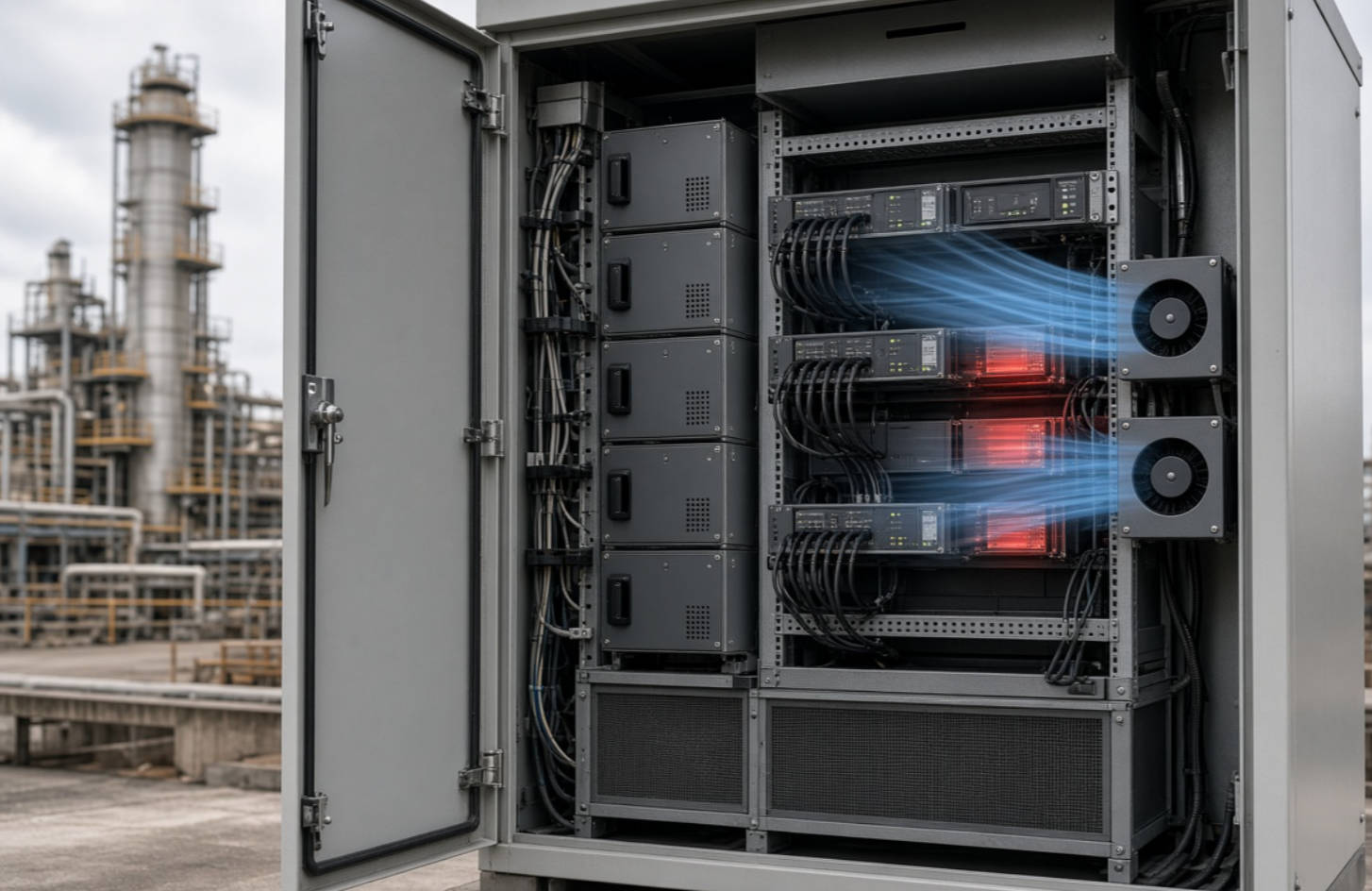
For example, in an outdoor communications cabinet, a properly selected radial blower can direct air through filtered intake paths and across high-heat power modules. This is more effective than allowing airflow to disperse randomly through an enclosure.
Industrial radial fans can be designed for demanding operating environments, including elevated temperatures, airborne contaminants, continuous duty cycles, and vibration-prone installations.
The best configuration depends on the actual application. A clean electronics enclosure may prioritize low noise, compact size, PWM control, and long bearing life. A dusty manufacturing process may prioritize a rugged impeller, protective coating, service access, and resistance to particulate buildup.
The initial fan price is only one part of the decision. Buyers should consider the total cost of ownership, including energy consumption, maintenance, replacement frequency, downtime, and the risk of equipment overheating.
Variable-speed control is particularly valuable because fan power changes sharply with speed. Energy Star notes that fan power follows a cube relationship with speed: reducing speed can substantially reduce energy use when full airflow is not required.
A professional fan-selection process starts with operating conditions, not catalog dimensions.
Determine the required airflow at the actual duty point. Depending on the market and specification, airflow may be expressed in:
- CFM
- m³/h
- L/s
- m³/min
For electronics cooling, airflow should be connected to a heat-load calculation, allowable temperature rise, equipment layout, and expected ambient temperature.
Do not rely only on the maximum "free-air" value in a catalog. Free-air performance does not represent real performance in a restrictive system.
Estimate the pressure loss across the complete air path, including:
- Filters
- Heat sinks
- Ducts
- Elbows
- Grilles
- Louvers
- Dampers
- Coils
- Outlet restrictions
- Protective guards
This calculation should include a reasonable allowance for filter loading, contamination, and future system changes.
Select a fan that provides the required airflow at the calculated static pressure. The operating point should sit in a stable and efficient region of the fan curve rather than at an extreme edge.
A selection based solely on maximum airflow can lead to underperformance, excess noise, unnecessary power use, or unstable operation.
Specify the electrical and control interface early in the design process.
For DC cooling fans, critical requirements may include:
- Rated voltage, such as 12 VDC, 24 VDC, or 48 VDC
- PWM speed control
- Tachometer output
- Locked-rotor alarm
- Reverse-polarity protection
- Redundant power options
- Connector type and cable length
For AC or larger industrial centrifugal fans, consider motor efficiency class, variable-frequency drive compatibility, starting method, and control-panel integration.
Ask the following questions before final approval:
1. What are the minimum and maximum ambient temperatures?
2. Is the air clean, dusty, oily, humid, corrosive, or salty?
3. Is the fan expected to run continuously?
4. What is the permitted sound level?
5. Is field replacement easy or difficult?
6. Is failure of a single fan acceptable?
7. Does the system need life-cycle documentation, qualification testing, or traceability?
For critical equipment, a dual-fan or N+1 redundancy strategy may be justified. The cost of an additional fan can be far lower than the cost of unplanned equipment downtime.
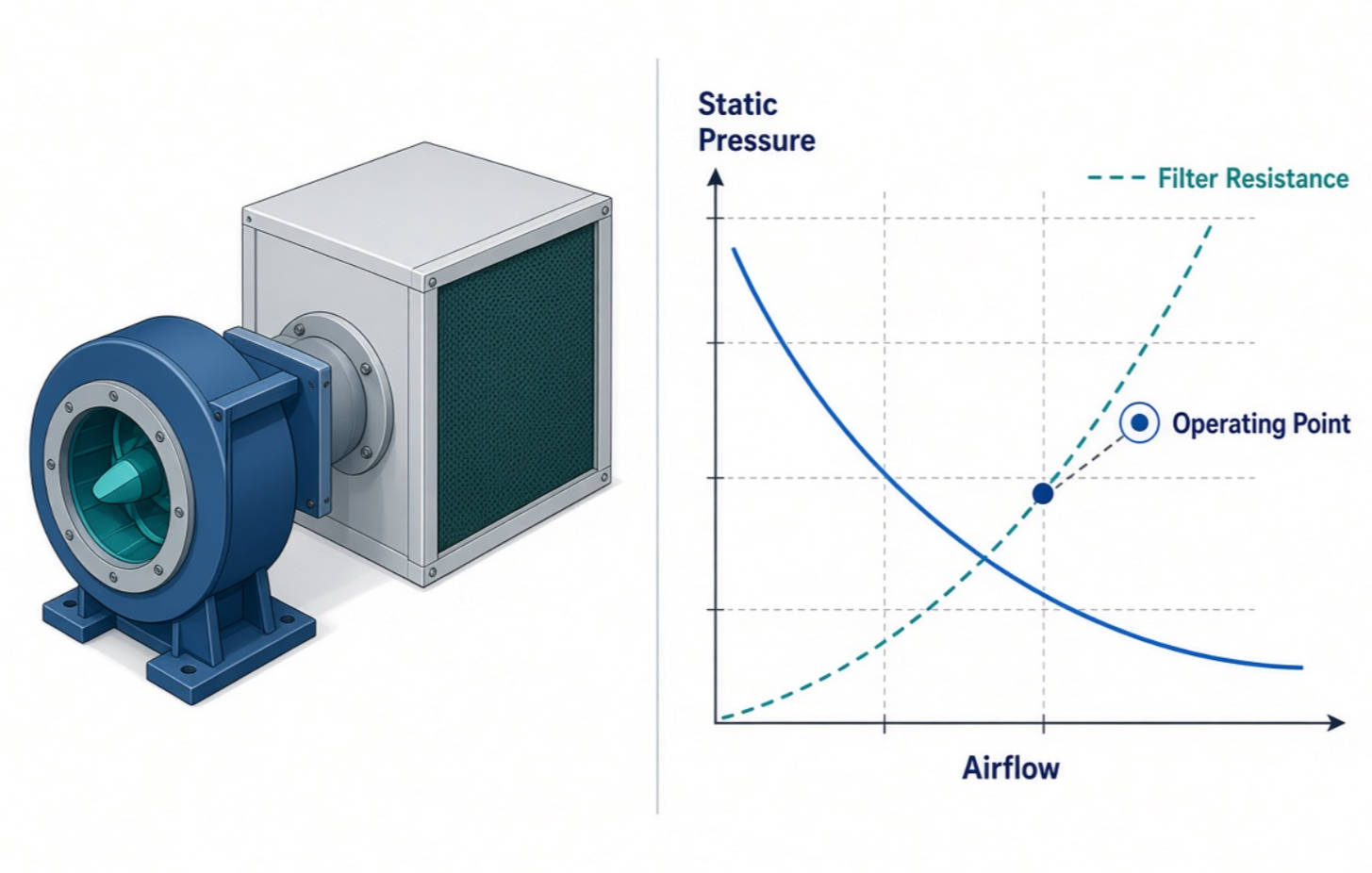
Even a correctly specified fan can disappoint if it is installed poorly. This is often called a system effect problem: the fan itself may be operating normally, but turbulence, swirl, obstructions, or poor duct transitions reduce the airflow delivered by the installed system.
The Air Movement and Control Association highlights that adverse inlet and outlet conditions can reduce air-system performance. Uniform, symmetrical airflow at the inlet and sufficient downstream duct development are important for achieving expected results.
Avoid these common mistakes:
- Placing a sharp elbow directly at the fan inlet
- Using abrupt transitions near the inlet or outlet
- Restricting the inlet with an undersized grille
- Installing a guard that creates high turbulence
- Neglecting filter pressure rise as filters load with dust
- Selecting the fan at the edge of its performance curve
- Ignoring acoustic isolation and vibration control
- Operating a fan continuously at maximum speed when variable control is available
A useful rule is to protect the inlet airflow. Air should enter the fan as evenly as possible, without excessive swirl or sudden directional changes.
In many installations, a short straight duct section before and after the fan can improve performance. AMCA guidance notes that adequate outlet duct length helps airflow diffuse and develop, while inlet obstructions and poorly configured ductwork can create measurable losses.
Energy efficiency should be evaluated at the real operating point, not only by motor label or nameplate power.
A fan that is oversized and then operated at full speed against an overly restrictive system may consume more energy than necessary while also generating excess noise. A correctly selected variable-speed fan can better match airflow to actual thermal or process demand.
Practical energy-saving strategies include:
- Use speed control instead of throttling airflow with dampers where appropriate
- Select a fan near its efficient operating region
- Reduce unnecessary duct resistance
- Monitor filter condition and replace filters before pressure loss becomes excessive
- Use temperature-based control for equipment cooling
- Consider EC motor technology for applications requiring frequent speed adjustment
- Avoid continuous full-speed operation when partial-load airflow is sufficient
The U.S. Department of Energy identifies variable-speed control and turning fans off when process demand does not require them among key fan-system energy-performance measures. In data-center cooling applications, Energy Star also notes that reducing fan speed by half can reduce fan energy use to approximately one-eighth because of the cube relationship between speed and power.
This does not mean every system should reduce fan speed aggressively. The cooling requirement, safety margin, equipment temperature, and redundancy strategy must always come first.
Radial fans are used wherever air must move reliably through resistance.
Telecom base stations, network switches, radio equipment, power modules, and outdoor cabinets often combine high heat density with limited installation space. Fan selection must account for filters, enclosure restrictions, solar loading, dust exposure, and 24/7 operating requirements.
Capital Technology's experience serving recognized communications and electronics organizations, including ZTE, HUAWEI, and HYTERA, supports a practical understanding of the reliability, airflow, and qualification priorities common in these applications.
Variable-frequency drives, PLC cabinets, servo systems, inverters, welding equipment, and control panels generate concentrated heat. Compact DC blowers and high-static-pressure fans can move air through constrained internal paths and help protect temperature-sensitive components.
Centrifugal fans are widely used in air-handling units, fan-coil units, exhaust systems, filtration systems, and commercial ventilation equipment. The selection must reflect duct layout, filter type, required air changes, occupancy patterns, and acoustic requirements.
Battery-energy-storage systems, UPS units, chargers, inverters, and power conversion equipment require stable thermal management. Fan failure can increase component temperatures and accelerate degradation, making monitoring signals, bearing life, environmental protection, and redundant airflow paths particularly important.
Industrial radial fans support dust extraction, fume removal, pneumatic conveying, drying, combustion air, and process ventilation. In these applications, the fan material, coating, impeller geometry, and maintenance plan should be matched to the contaminants and temperature of the airstream.
The best radial fan is not simply the model with the largest airflow rating or the lowest unit price. It is the model that delivers stable airflow at the required pressure, operates reliably in the actual environment, fits the available space, meets noise and control requirements, and supports the expected product life cycle.
Capital Technology Co., Limited provides DC fans, AC fans, radial fans, and thermal-management solutions under the independent CAPITAL brand. As a lead distributor for SANYO DENKI, the company can also support customers seeking high-reliability San Ace cooling-fan solutions for demanding electronic and industrial applications.
If you are developing telecom equipment, industrial electronics, power systems, HVAC equipment, energy-storage products, or specialized machinery, start with a technical airflow review rather than a part-number comparison.
Contact Capital Technology with your required airflow, static pressure, voltage, installation dimensions, temperature range, and application details to receive a more accurate radial fan recommendation.
In most industrial and HVAC discussions, the terms are used interchangeably. Both describe fans that draw air into the impeller inlet and discharge it outward in a radial direction. However, "centrifugal fan" is sometimes used as the broader category, while "radial fan" may refer more specifically to a radial-blade configuration.
Choose a radial fan when your system has moderate or high static pressure caused by filters, ducts, dense heat sinks, bends, grilles, or narrow air passages. Choose an axial fan when you need relatively high airflow through a short and low-resistance air path.
Add the pressure losses of all airflow-path components, including ducts, filters, heat sinks, elbows, grilles, dampers, coils, and outlet restrictions. You should also allow for filter loading and manufacturing variation. Use the total value to find the appropriate operating point on the fan performance curve.
Yes. Many DC radial blowers support PWM speed control, although the exact control method and signal specifications depend on the model. PWM control can help equipment adjust airflow according to temperature or system demand while reducing unnecessary noise and energy consumption.
Catalog airflow may be measured under free-air or standardized test conditions. In a real installation, filters, ducts, bends, restrictive grilles, poorly designed inlet conditions, and outlet turbulence add pressure loss. These effects can shift the actual operating point and reduce delivered airflow.
Maintenance frequency depends on the environment, duty cycle, and fan type. In clean electronics environments, periodic visual checks, alarm monitoring, and dust removal may be sufficient. In industrial or dusty environments, maintenance should include inspection of impellers, bearings, vibration, mounting hardware, guards, filters, and airflow performance.
They can be, provided the fan, motor, bearings, insulation system, electronics, wiring, and materials are specifically rated for the expected ambient and airstream temperature. Do not select a fan based only on airflow; confirm its temperature rating and derating requirements with the supplier.
1. Longwell Fans. “Radial Fan Applications and Benefits.”
[https://www.longwellfans.com/radial-fan-applications-and-benefits/]
2. Air Movement and Control Association International. “Mitigating System Effect to Optimize Fan Performance and Efficiency.”
3. U.S. Department of Energy, Better Buildings Better Plants Initiative. “Fans: Top Five Energy Performance Measures for Fan Systems.”
[https://betterbuildingssolutioncenter.energy.gov/better-plants/fans]
4. ENERGY STAR. “Replace Standard Fans with Variable Speed Fans.”
5. SANYO DENKI America. “San Ace Cooling Fan Systems.”
[https://www.sanyodenki.com/america/products/sanace/index.html]
6. SANYO DENKI Product Site. “DC Cooling Fan: San Ace.”
[https://products.sanyodenki.com/en/sanace/dc/dc-fan/]
7. SANYO DENKI Product Site. “Long Life Fan: San Ace.”
[https://products.sanyodenki.com/en/sanace/dc/long-life-fan/]
8. U.S. Department of Energy. *Improving Fan System Performance: A Sourcebook for Industry.*


