From idea to market-ready product, our NPI solutions make every stage easier, faster. Discover How We Help
Help Center

Views: 276 Author: Capital Technology Publish Time: 2026-09-19 Origin: Site
Content Menu
● What Are Plug Fans in HVAC Systems?
>> Why Plug Fans Have Gained Attention
● What Are Traditional HVAC Fans?
● Plug Fans vs. Traditional Fans: Performance Comparison
>> Energy Efficiency and Part-Load Performance
>> Airflow Control and System Responsiveness
>> Noise and Vibration Performance
>> Installation Flexibility and Footprint
>> Maintenance Requirements and Reliability
● Decision Table: Which Fan Performs Better?
● How to Select the Right HVAC Fan
>> Step 1: Define the Duty Point
>> Step 2: Evaluate the Full Lifecycle Cost
>> Step 3: Check Installation Conditions
>> Step 4: Choose the Motor and Control Strategy
● Practical Application Examples
>> Data Centers and Telecom Facilities
>> Commercial Buildings and Hospitals
>> Warehouses and Simple Ventilation
● Final Verdict: Plug Fans or Traditional Fans?
● FAQ
>> 1. Are plug fans more energy efficient than traditional fans?
>> 2. What is the difference between a plug fan and a centrifugal fan?
>> 3. Can plug fans replace belt-driven HVAC fans?
>> 4. Are EC plug fans better than AC plug fans?
>> 5. Do plug fans require maintenance?
>> 6. Are plug fans suitable for data centers?
>> 7. When should I choose a traditional HVAC fan instead?
When facility managers compare plug fans for HVAC systems vs. traditional fans, the right answer is not simply "newer is better." Plug fans often deliver superior energy control, compact installation, redundancy options, and lower maintenance exposure—especially in variable-air-volume HVAC systems, data centers, telecom shelters, hospitals, cleanrooms, and commercial air-handling units.
However, traditional axial and housed centrifugal fans still have practical advantages in certain high-volume, low-pressure, budget-sensitive, or legacy-system applications. The best HVAC fan is the one selected around the real operating point, static-pressure requirement, control strategy, sound target, installation geometry, and lifecycle cost—not just its initial purchase price.
For Capital Technology Co., Limited, a manufacturer of DC fans and AC fans, owner of the CAPITAL brand, and a leading SANYO DENKI distributor serving recognized organizations such as ZTE, HUAWEI, and HYTERA, this comparison is particularly relevant. Modern HVAC and equipment-cooling projects increasingly require reliable, controllable, high-efficiency airflow solutions rather than a one-size-fits-all fan selection.
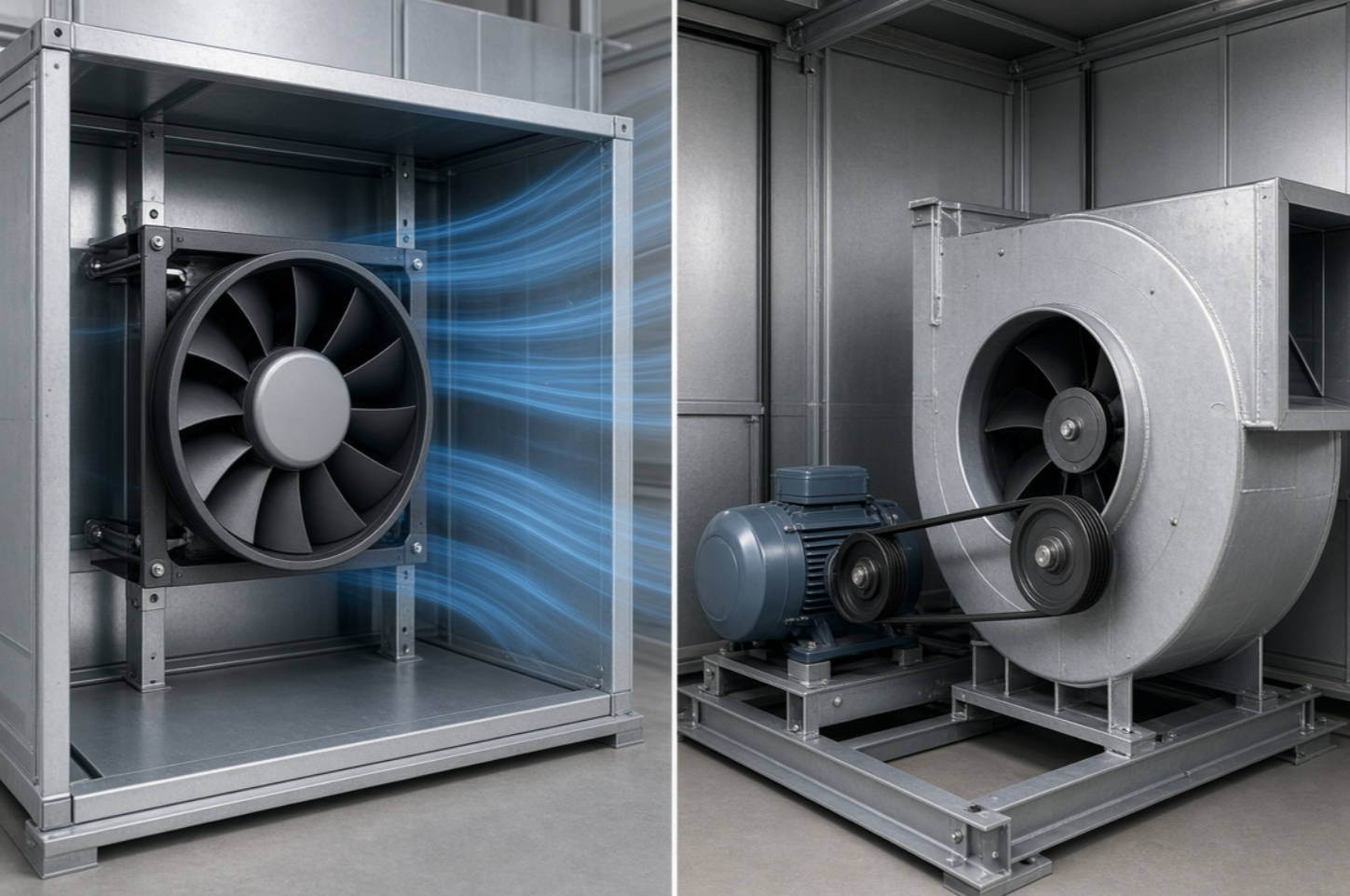
A plug fan is typically a direct-driven centrifugal fan with a backward-curved impeller, motor, and mounting plate. Unlike a conventional housed centrifugal fan, it is often installed directly into an air handling unit (AHU), fan wall, plenum chamber, rooftop unit, precision cooling unit, or custom ventilation enclosure.
The term "plug" refers to the fan assembly being "plugged" into a larger air chamber rather than depending on a full scroll housing to create and direct airflow.
Modern plug fan systems are commonly supplied with:
- Backward-curved centrifugal impellers
- EC motors, permanent-magnet motors, or variable-speed motor options
- Integrated electronics and speed control
- Direct-drive construction
- Compact mounting frames
- Single-fan or multi-fan array configurations
- Communication options for building management systems
- Monitoring functions for speed, alarms, operating status, and energy use
For HVAC applications requiring variable airflow, plug fans can provide a highly responsive platform. They are especially effective where airflow demand changes by occupancy, heat load, outdoor-air requirement, server load, process conditions, or time of day.
The HVAC industry is moving toward more flexible and intelligent ventilation systems. Buildings are expected to reduce energy use while maintaining thermal comfort, indoor air quality, equipment reliability, and acoustic performance.
A plug fan supports this transition because it can operate at different speeds instead of running at full output continuously. This matters because fan power does not change in a simple one-to-one relationship with fan speed.
Under the fan affinity laws:
In practical terms, reducing fan speed can produce a disproportionately large reduction in power demand. For example, operating near 80% of full speed theoretically reduces power demand to approximately 51.2% of full-speed power, assuming similar system conditions and acceptable fan efficiency at that operating point.
This is why variable-speed plug fans can be attractive in VAV air handlers, smart buildings, telecom cooling systems, and facilities with fluctuating cooling demand.
The term traditional fans covers several well-established fan types used in commercial, industrial, and residential HVAC systems. These fans remain widely used because they are familiar, available in many sizes, and can be cost-effective for stable-duty applications.
The most common traditional HVAC fan categories include:
| Traditional Fan Type | Typical Airflow Direction | Common HVAC Use | Main Strength |
|---|---|---|---|
| Axial fan | Parallel to the shaft | Condensers, exhaust, ventilation | High airflow at low pressure |
| Tube axial fan | Parallel to the shaft | Ducted ventilation | Compact duct integration |
| Vane axial fan | Parallel to the shaft | Higher-pressure duct systems | Better directional airflow |
| Forward-curved centrifugal fan | Radial | Small AHUs, fan coils, furnaces | High airflow in compact housings |
| Backward-curved housed centrifugal fan | Radial | Commercial AHUs and industrial ventilation | Good efficiency and pressure capability |
| Belt-driven centrifugal fan | Radial | Older AHUs and large ventilation systems | Flexible speed adjustment through pulleys |
A traditional fan may be direct-driven or belt-driven. A belt-driven system uses belts and pulleys to transfer motor power to the fan wheel. This arrangement can be practical for adjusting speed during commissioning, but it introduces maintenance requirements and mechanical losses.
The U.S. Department of Energy notes that even properly adjusted new belts can experience 5% to 10% losses, while wear, slipping, poor alignment, and incorrect tension can further reduce performance and raise maintenance needs.
The strongest comparison is not plug fan versus every traditional fan in every condition. Instead, engineers should compare the full air-moving system: fan, motor, controls, ductwork, air handling unit, installation environment, maintenance plan, and operating profile.
Plug fans usually have the advantage in variable-load HVAC systems.
A direct-drive plug fan removes the belt-and-pulley transmission stage found in many conventional fan systems. This can reduce mechanical losses and eliminate common belt-related service tasks.
When a plug fan uses an EC motor or a high-efficiency electronically controlled motor, it can also offer accurate speed modulation. Rather than throttling airflow with dampers or operating continuously at full speed, the system can match fan output to actual demand.
This is valuable in applications such as:
- Variable-air-volume commercial buildings
- Data centers with changing IT loads
- Telecom cabinets and communication shelters
- Hospitals with different ventilation schedules
- Cleanrooms with occupancy-based airflow control
- Industrial facilities with intermittent process heat
- Air purification and filtration systems
Traditional fans can also achieve strong efficiency when paired with a properly selected motor and variable-frequency drive. However, the total system must be evaluated carefully. A high-efficiency fan wheel cannot compensate for poor duct geometry, excessive pressure drop, blocked filters, undersized ducts, or unstable operating conditions.
Expert insight: Do not compare only motor efficiency. Compare wire-to-air performance—how effectively electrical input becomes useful airflow at the actual duty point.
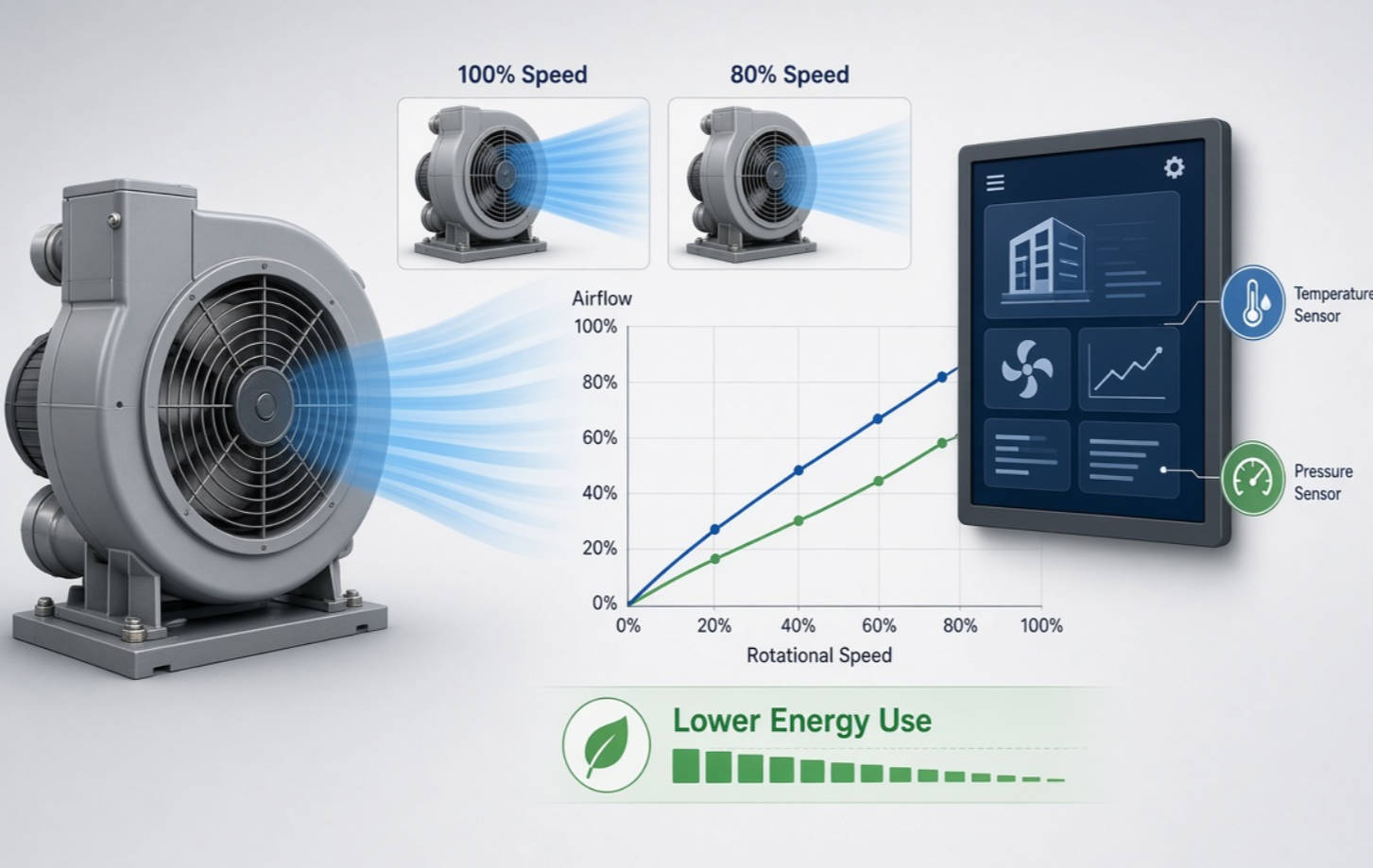
Plug fans are particularly strong where the airflow requirement changes frequently.
A modern EC plug fan can respond to demand signals from:
- Temperature sensors
- Differential-pressure sensors
- CO₂ sensors
- Building management systems
- Server-rack thermal sensors
- Air-quality sensors
- External control signals
This creates a more responsive HVAC system. For example, a data center cooling unit may increase fan speed when rack inlet temperatures rise, then reduce airflow once thermal conditions stabilize. A traditional constant-speed fan may require additional components to achieve the same level of control.
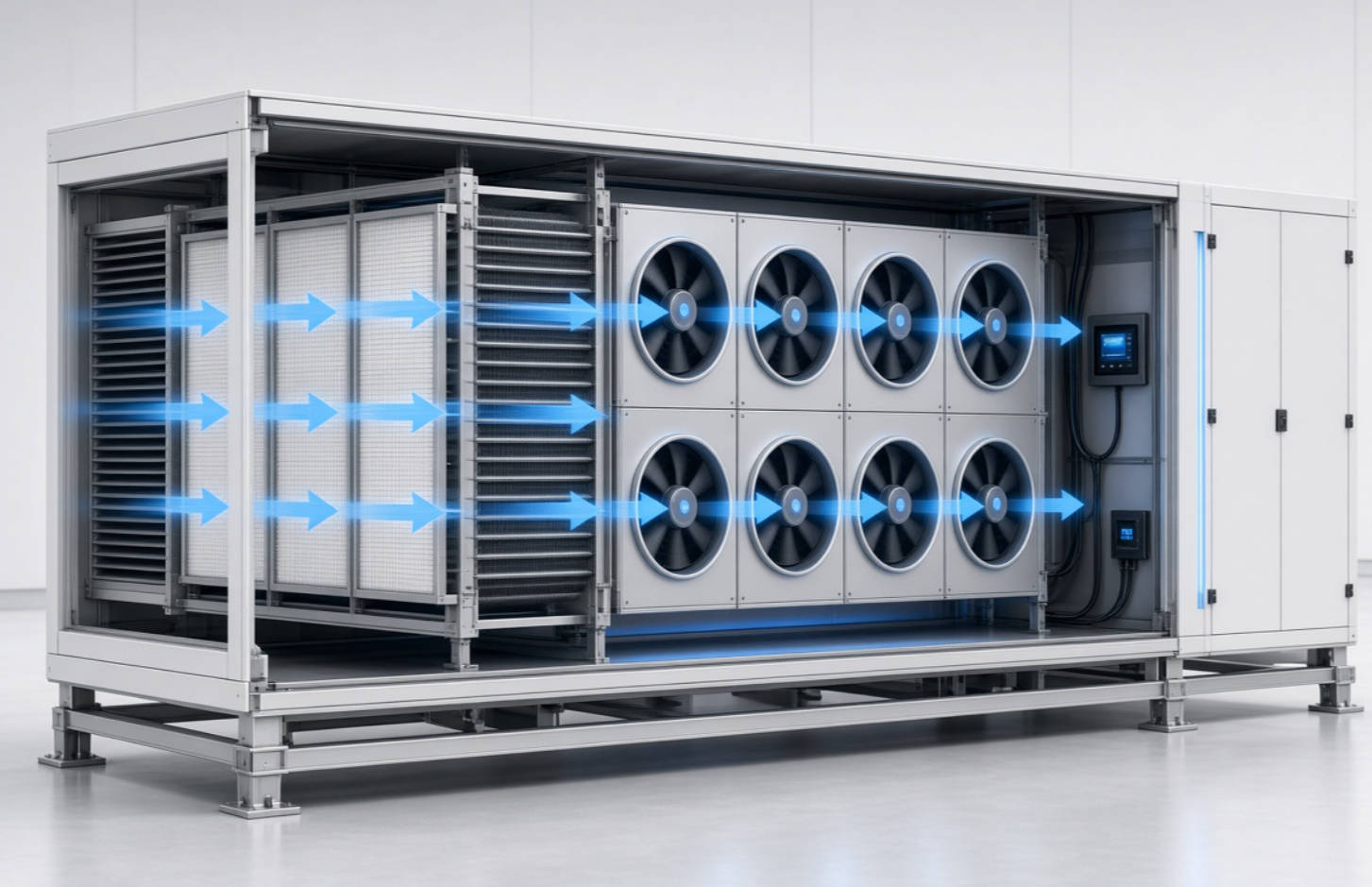
Multi-fan plug arrays can provide even more flexibility. Instead of one large fan operating at a low and inefficient point, an AHU can stage several smaller plug fans according to demand. This may improve part-load behavior and provide better turndown capability.
Traditional housed centrifugal fans remain competitive in systems requiring substantial static pressure. In long duct runs, industrial exhaust systems, filtration-heavy air handlers, or specialized process ventilation, a housed centrifugal fan can still be an appropriate solution.
Plug fans can also provide significant pressure capability, particularly backward-curved plug fan designs. But the selection must be based on the specific fan curve and system resistance curve.
A fan should not be selected solely according to maximum airflow. Engineers should verify:
- Required airflow at the design point
- Total static pressure
- External static pressure
- Filter loading condition
- Coil pressure drop
- Damper losses
- Duct fittings and transitions
- Air density at the installation site
- Required safety margin
- Operation at minimum and maximum airflow
An incorrectly selected plug fan may operate too far from its best efficiency region. The same risk exists with a traditional fan.
Noise is a system issue, not only a fan issue.
Plug fans often offer acoustic advantages because they are direct-driven and may avoid belt vibration, pulley noise, and mechanical misalignment. Backward-curved impellers can also support lower-noise fan designs when properly selected and installed.
However, low fan noise depends on more than the fan model. It also depends on:
- Fan speed
- Tip speed
- Air velocity
- Fan operating point
- Inlet conditions
- Outlet conditions
- Structural isolation
- Plenum design
- Duct transitions
- Sound attenuators
- Nearby obstructions
AMCA identifies "system effect" as performance loss caused by unfavorable airflow conditions near the fan inlet or outlet. Turbulence, swirl, obstructions, poor transitions, and inadequate discharge duct length can reduce delivered performance and force the fan to run at higher speed to achieve the specified airflow. Higher speed can also raise noise and energy consumption.
For this reason, a quiet plug fan installed poorly may become noisy. Likewise, a traditional fan installed with adequate ductwork, isolation, and acoustic treatment may perform acceptably.
Plug fans offer a major advantage in compact or irregular equipment spaces.
Their housing-free or minimal-housing architecture can make them easier to integrate into:
- Custom AHUs
- Fan walls
- Rooftop units
- Computer-room air conditioning systems
- Telecom cooling cabinets
- Precision cooling systems
- Equipment enclosures
- Compact ventilation modules
A plug fan array can also help designers distribute airflow across a large air-handler cross-section. This may improve airflow uniformity through coils, filters, and heat exchangers when engineered correctly.
Traditional housed centrifugal fans may require more dedicated space because of the scroll housing, belt drive, motor placement, access clearance, and associated framework. Yet they may still be easier to retrofit in existing systems that were originally designed around that configuration.
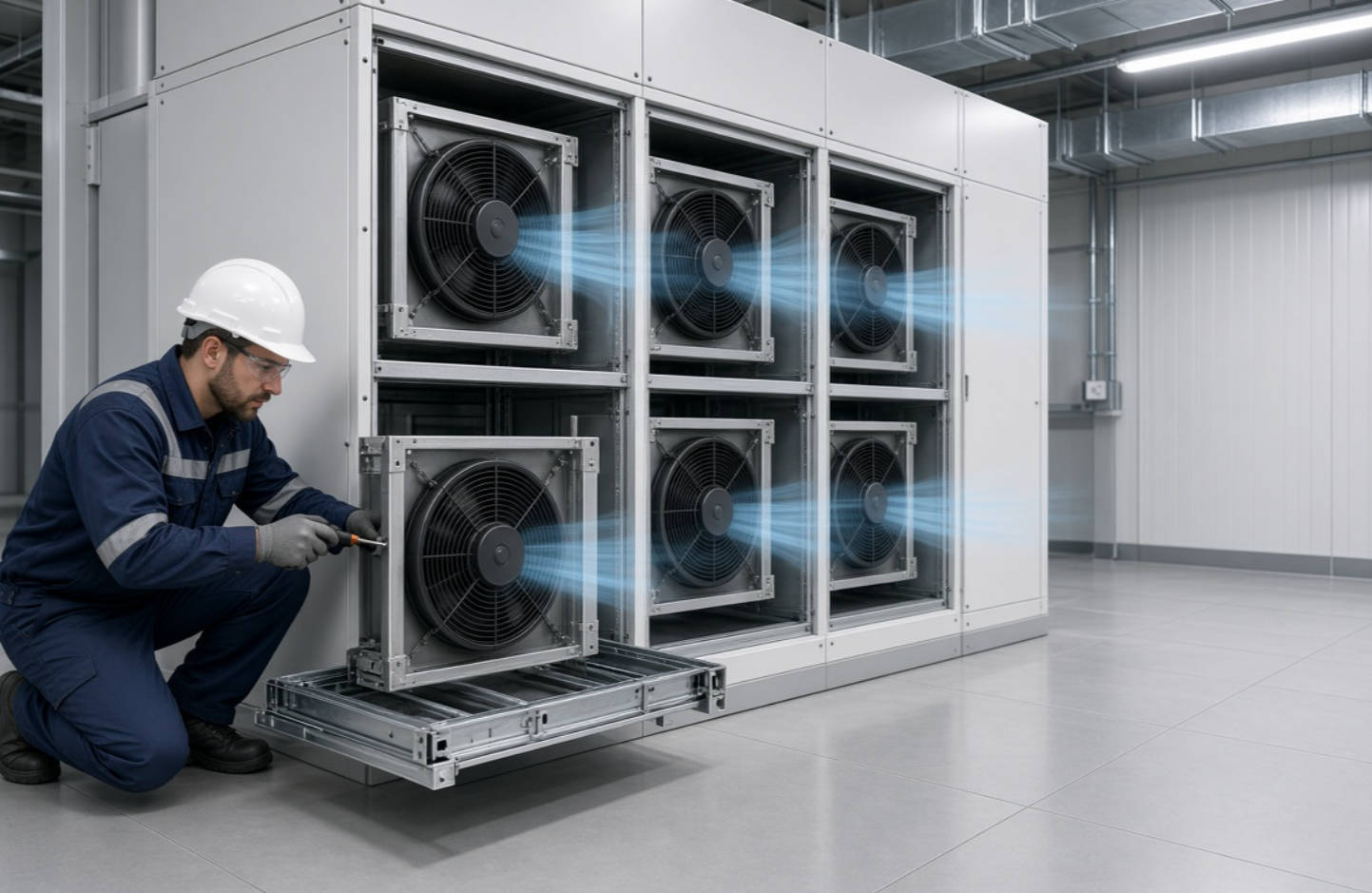
Direct-drive plug fans generally have fewer mechanical wear items than belt-driven fan assemblies.
Typical advantages include:
- No belt tensioning
- No belt alignment
- No pulley wear
- Fewer drive components
- Reduced risk of belt slip
- Faster replacement of modular fan units
- Easier condition monitoring in intelligent EC systems
Traditional belt-driven systems require a preventive-maintenance plan that includes belt inspection, alignment checks, tension adjustment, pulley inspection, bearing assessment, vibration checks, and cleaning.
That does not mean plug fans are maintenance-free. Their impellers still require cleaning, bearings still have a service life, electrical connections should be inspected, and control systems must be verified. Dust accumulation can affect aerodynamic efficiency, airflow balance, vibration, and noise.
For projects where uptime is critical, multi-fan arrays offer an additional benefit: redundancy. If one fan module requires service, other modules may continue operating at increased speed, allowing partial airflow to be maintained while the failed unit is replaced.
| Evaluation Factor | Plug Fans for HVAC Systems | Traditional Fans | Better Choice |
|---|---|---|---|
| Variable airflow control | Excellent with EC motors and speed control | Good when combined with VFDs | Plug fans |
| Part-load energy performance | Often very strong | Depends heavily on motor, drive, and controls | Plug fans |
| Initial purchase cost | Can be higher | Often lower for basic systems | Traditional fans |
| Belt-related maintenance | None in direct-drive designs | Required in belt-driven systems | Plug fans |
| High-pressure applications | Strong when properly selected | Strong, especially housed centrifugal designs | Application-dependent |
| Compact AHU integration | Excellent | May require more space | Plug fans |
| Retrofit into old equipment | Depends on available plenum space | Often easier in like-for-like replacement | Traditional fans |
| Redundancy | Excellent in fan arrays | Usually limited with one large fan | Plug fan arrays |
| Basic warehouse ventilation | May be unnecessary | Often cost-effective | Traditional fans |
| Smart-building integration | Excellent | Possible but may need extra controls | Plug fans |
| Noise control potential | Strong with good selection and installation | Can be good with acoustic design | Application-dependent |
The best fan selection starts with measured or calculated system requirements—not a catalogue preference.
Specify the exact design requirement:
- Airflow in CFM or m³/h
- Total and external static pressure
- Air temperature
- Altitude and air density
- Required operating hours
- Minimum and maximum airflow range
- Filtration and coil pressure drop
- Future expansion allowance
A fan that looks efficient at one operating point may perform poorly if the actual system curve changes after installation.
Initial fan price is important, but it is not the full financial picture. Consider:
- Electricity consumption
- Motor and drive losses
- Belt replacement and labor
- Downtime risk
- Spare-part availability
- Installation labor
- Controls integration
- Cleaning frequency
- Expected operating life
- Potential energy savings at part load
For continuously operated HVAC equipment, energy cost can become much larger than the initial equipment cost over the system lifetime.
Before choosing a plug fan or traditional fan, inspect the installation environment.
Ask these questions:
1. Is there a straight and uniform airflow path into the fan inlet?
2. Are elbows, dampers, filters, coils, or obstructions too close to the fan?
3. Is there enough discharge space for airflow to stabilize?
4. Can the fan be accessed safely for cleaning and replacement?
5. Will the unit operate in dust, humidity, corrosive gas, or elevated temperature?
6. Is vibration isolation required?
7. Is redundancy necessary for business continuity?
Poor installation can erase the expected benefits of an efficient fan design. AMCA recommends considering inlet and outlet conditions carefully because system effects may significantly affect delivered airflow and efficiency.
For projects that need variable speed, precise airflow control, and lower maintenance, a DC fan or EC fan solution may be appropriate.
For stable-duty applications with simple operation, an AC fan or conventional centrifugal fan may provide a practical and economical result.
Capital Technology can support this decision with its product expertise across DC fans, AC fans, branded CAPITAL cooling solutions, and SANYO DENKI fan products. For customers in telecommunications, network equipment, industrial electronics, and critical cooling environments, the decision should consider both HVAC airflow requirements and equipment-level thermal reliability.
Plug fan arrays are often well suited to data centers and telecom cooling because these environments require:
- Continuous operation
- Fast response to heat changes
- High airflow controllability
- Energy-conscious operation
- Redundancy
- Remote monitoring
- Compact equipment integration
In a fan-wall configuration, several EC plug fans can be controlled together. If one module fails, remaining fans may compensate, depending on system design and capacity margin.
For communication equipment, high-reliability DC fans and AC fans are also essential at cabinet, power supply, base station, and network-equipment level. A complete thermal strategy may include both room-level HVAC fans and equipment-level cooling fans.
Office buildings, schools, hotels, and hospitals often have varying occupancy and ventilation needs. A variable-speed plug fan system can adjust airflow based on schedules, pressure control, outdoor-air demand, and indoor air quality targets.
Hospitals require additional consideration for pressure relationships, filtration, infection-control requirements, sound levels, and uninterrupted operation. Fan selection should therefore be part of a broader HVAC engineering review rather than an isolated product decision.
Traditional axial or centrifugal fans may remain the better choice for basic warehouse ventilation, general exhaust, or low-complexity industrial environments.
If airflow demand is relatively steady, pressure requirements are modest, and the project budget is tight, a traditional fan can deliver a reliable result with a lower upfront investment.
The key is not to over-specify advanced controls where they add little operational value.
For most modern variable-airflow HVAC systems, plug fans perform better when energy efficiency, controllability, compact integration, maintenance reduction, and redundancy are important.
They are particularly attractive for AHUs, data centers, telecom cooling, hospitals, cleanrooms, smart buildings, and custom ventilation equipment. Direct-drive EC plug fans can reduce mechanical complexity and support intelligent airflow control.
Traditional fans remain relevant where the operating duty is steady, initial cost is the dominant concern, the system is already configured for a housed or belt-driven fan, or the application requires a specific traditional fan geometry.
The most reliable selection process is simple:
1. Define airflow and static-pressure requirements.
2. Review the real system curve, not just catalogue airflow.
3. Compare wire-to-air efficiency at expected operating conditions.
4. Evaluate part-load performance.
5. Check ductwork, inlet, outlet, and installation limitations.
6. Calculate lifecycle cost, not only purchase cost.
7. Choose a supplier that can provide performance data, application support, and dependable after-sales service.
Need a reliable DC fan, AC fan, EC plug fan, or industrial cooling solution for your HVAC, telecom, or electronic-equipment project? Contact Capital Technology Co., Limited to share your airflow, static pressure, voltage, installation space, and operating environment. Our technical team can help you identify a suitable CAPITAL or SANYO DENKI fan solution based on real application requirements.
Plug fans can be more energy efficient, particularly in variable-airflow HVAC systems. Their direct-drive design and compatibility with EC motors or speed control can reduce mechanical losses and allow airflow to match real demand. However, actual efficiency depends on fan selection, motor efficiency, system pressure, duct design, and operating point.
A plug fan is usually a type of backward-curved centrifugal fan. The main difference is installation architecture. A plug fan is commonly installed directly in an AHU plenum or fan wall and may not use a traditional scroll housing. A conventional centrifugal fan often uses a dedicated housing to guide airflow.
In many cases, yes. Plug fans can replace belt-driven systems when there is adequate installation space, suitable controls, and a properly engineered airflow path. A detailed retrofit assessment is required because duct connections, plenum design, electrical supply, controls, and static-pressure requirements may need modification.
EC plug fans often provide stronger speed control, monitoring capability, and part-load energy performance. AC plug fans may still be appropriate when the application needs a simpler electrical design, fixed-speed operation, or a lower initial cost. The correct choice depends on the project's control and efficiency goals.
Yes. Plug fans generally require less mechanical maintenance than belt-driven fan systems, but they still need periodic inspection. Maintenance should include cleaning impellers, checking vibration, inspecting bearings, verifying electrical connections, reviewing alarm signals, and confirming that airflow remains within the intended operating range.
Yes. Plug fans are commonly suitable for data centers because they can provide variable-speed airflow control, compact installation, redundancy in fan-array systems, and rapid response to changing thermal loads. Selection should include a review of airflow distribution, cooling-unit design, static pressure, filtration, and reliability requirements.
Choose a traditional HVAC fan when the system has stable airflow demand, limited budget, low control complexity, or an existing configuration designed around a housed or belt-driven fan. Traditional axial fans may also be highly effective for high-airflow, low-pressure ventilation applications.
1. [Longwell Fans — Plug Fans for HVAC Systems vs Traditional Fans: Which Performs Better?] — Competitor-page topic coverage and comparison scope used for content-gap analysis. [longwellfans]
2. [U.S. Department of Energy — Fan Systems] — Official DOE fan-system resources, including the Fan System Assessment Tool and industrial fan-performance guidance. [energy]
3. [U.S. Department of Energy / OSTI — Improving Fan System Performance: A Sourcebook for Industry] — Fan-system performance principles, maintenance practices, belt-drive losses, and industrial efficiency guidance. [docs.nlr]
4. [Air Movement and Control Association — Mitigating System Effect to Optimize Fan Performance and Efficiency] — Guidance on inlet/outlet conditions, turbulence, swirl, duct transitions, and system-effect losses. [amca]
5. [AMCA — New Fan Efficiency Requirements in ANSI/ASHRAE/IES 90.1-2019] — Fan Efficiency Index context and fan electrical input power concepts. [amca]
6. [ASHRAE Journal — Fan Laws and Variable-Speed Fan Performance] — Discussion of fan laws and the cubic relationship between fan speed reduction and input-power reduction. [nxtbook]
7. [Nordfab — Understanding the Fan Affinity Laws] — Practical explanation of the relationships among fan speed, airflow, pressure, and power. [nordfab]


