From idea to market-ready product, our NPI solutions make every stage easier, faster. Discover How We Help
Help Center

Views: 276 Author: Capital Technology Publish Time: 2026-09-17 Origin: Site
Content Menu
● What Does a Fan Blade Do in an Industrial Cooling System?
● Metal Fan Blades: Strength for Demanding Industrial Environments
>> Key Advantages of Metal Fan Blades
>> Limitations of Metal Fan Blades
● Plastic Fan Blades: Lightweight, Quiet, and Corrosion Resistant
>> Key Advantages of Plastic Fan Blades
>> Limitations of Plastic Fan Blades
● Metal vs. Plastic Fan Blades: Side-by-Side Comparison
● The Most Important Selection Factors
>> 1. Evaluate the Actual Temperature Near the Fan
>> 2. Identify Moisture, Salt, Chemicals, and Contaminants
>> 3. Match the Blade to Airflow and Static Pressure
>> 4. Consider Noise as an Engineering Requirement
● A Practical Decision Matrix for OEM Buyers
● New Insight: The Blade Material Is Only One Part of Fan Reliability
● How to Select the Right Fan Blade Material
● Why Work With CAPITAL Technology?
● FAQ
>> 1. Are metal fan blades better than plastic fan blades?
>> 2. Are plastic fan blades reliable for DC cooling fans?
>> 3. Can metal fan blades be used in humid or coastal environments?
>> 4. Do plastic fan blades create less noise than metal fan blades?
>> 5. What information should I provide when requesting a cooling-fan recommendation?
>> 6. Can plastic fan blades operate at high temperatures?
>> 7. Should I choose a DC fan or AC fan for industrial cooling?
Choosing between metal fan blades and plastic fan blades for industrial cooling is not a simple material decision. It is an engineering decision that affects airflow stability, noise, corrosion resistance, energy use, maintenance frequency, equipment safety, and total lifecycle cost.
At Capital Technology Co., Limited, we work with cooling requirements across telecom infrastructure, industrial electronics, communication equipment, cabinets, power systems, and OEM applications. As the manufacturer behind the CAPITAL brand and a lead agent for SANYO DENKI, we have seen one important truth repeatedly: the correct fan blade material must be selected around the actual operating environment, not simply the initial unit price.
For example, an industrial enclosure operating in a humid coastal region may benefit from a corrosion-resistant plastic impeller. A high-temperature manufacturing system, however, may require the rigidity and mechanical strength of a metal impeller or blade assembly. The "best" material is always the material that maintains safe, stable airflow throughout the product's real service life.
This guide compares metal fan blades vs. plastic fan blades from the viewpoint of an industrial cooling supplier and application engineer. It is designed to help OEMs, equipment manufacturers, system integrators, and procurement teams make a more confident selection.
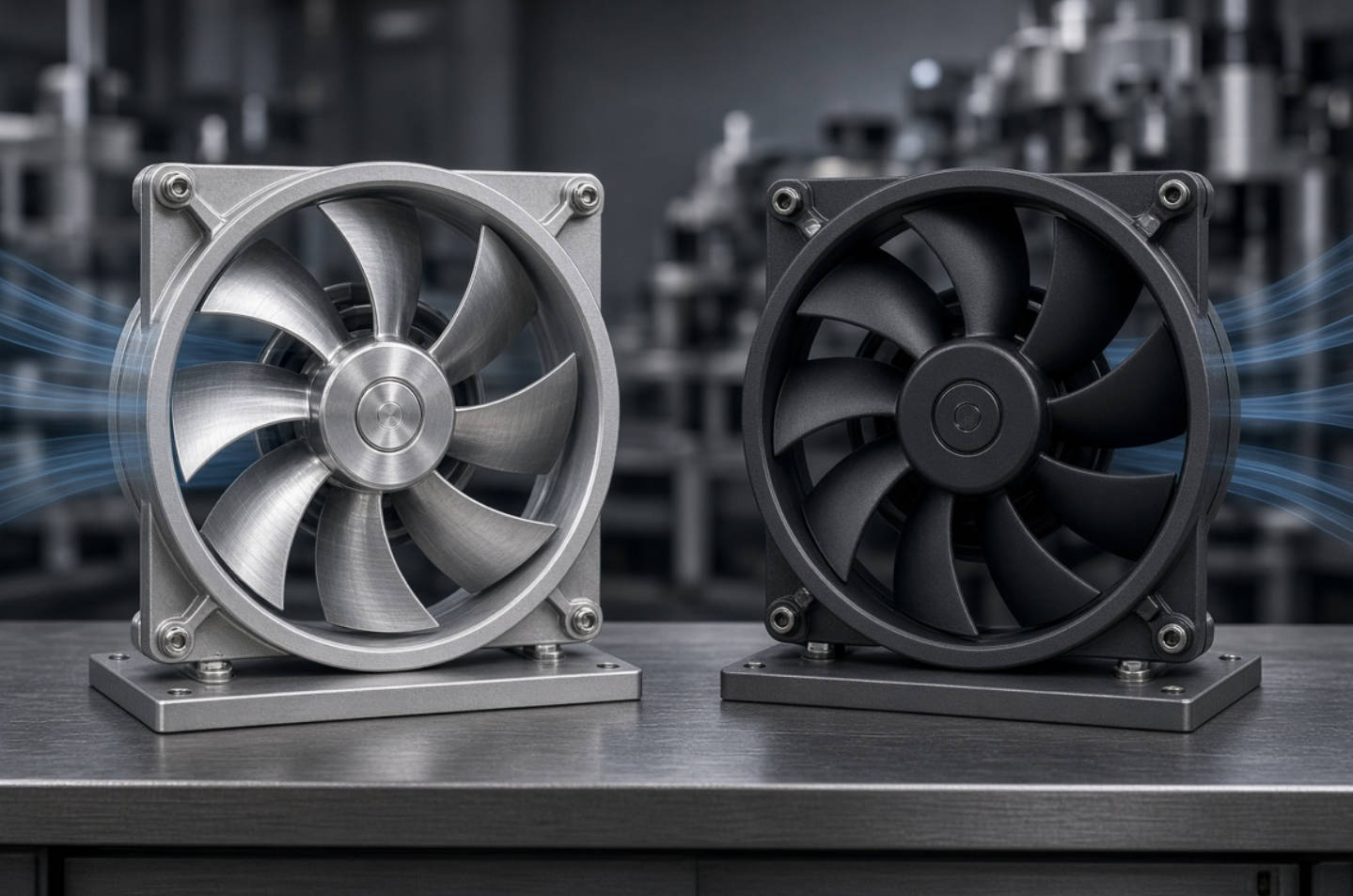
A fan blade, also called an impeller in many DC fan and centrifugal blower designs, converts motor rotation into controlled airflow. Its geometry, pitch, surface finish, balance, material stiffness, and weight all influence fan performance.
In practical terms, the fan blade helps determine:
- Airflow volume, usually measured in CFM or m³/h
- Static pressure capability, especially in dense equipment cabinets and restrictive air channels
- Acoustic noise
- Vibration level
- Motor load and power consumption
- Resistance to temperature, humidity, dust, chemicals, and impact
- Long-term balance and rotational stability
- Cooling reliability of the final equipment
A blade material cannot be evaluated separately from the complete fan design. Motor type, bearing system, frame construction, blade profile, speed control, environmental exposure, installation orientation, and airflow resistance must all be considered.
For high-reliability electronics cooling, this is particularly important. A DC fan may be physically small, but fan failure can cause overheating, reduced component life, unexpected shutdowns, or system-level failure.
Metal fan blades are commonly manufactured from aluminum, steel, stainless steel, galvanized steel, or coated metal alloys. They are widely used in larger axial fans, industrial ventilation systems, HVAC equipment, exhaust systems, high-temperature machinery, and heavy-duty cooling applications.
High mechanical strength is the most obvious advantage. Metal blades can tolerate physical impact, high rotational forces, and demanding airflow conditions better than many standard plastic alternatives.
Metal fan blades are often suitable when the cooling system requires:
- Large blade diameters
- Higher airflow volumes
- Higher static pressure
- High rotational stress
- Long operating hours
- Elevated ambient temperatures
- Exposure to abrasive dust or debris
- Strong structural stability under load
Metal also provides good dimensional rigidity. Under challenging operating conditions, a properly designed metal blade is less likely to flex excessively. This helps preserve the intended blade pitch and airflow profile.
For industrial facilities, this matters because even small geometry changes can affect airflow efficiency, vibration, and noise.
Metal is not automatically the best material for every industrial cooling fan. The main limitation is corrosion risk.
In humid environments, coastal areas, chemical plants, wastewater facilities, battery rooms, food-processing environments, or locations with corrosive gases, unprotected metal can oxidize or corrode. Corrosion can damage surface quality, change blade balance, increase vibration, and shorten service life.
Metal fan blades can also be heavier. Higher blade mass may increase the load on the motor and bearing system, especially during repeated start-stop cycles or high-speed operation.
Other considerations include:
- Potentially higher noise, depending on the blade profile and system design
- Higher initial cost for stainless steel, coated aluminum, or specialized alloys
- More complex corrosion-protection requirements
- Higher inertia, which may affect acceleration and deceleration behavior
- Greater safety requirements for large exposed industrial fans
The correct conclusion is not that metal is noisy or inefficient. A well-engineered metal blade can perform extremely well. However, metal requires careful aerodynamic design, balancing, coating selection, and application matching.
Plastic fan blades are typically produced using engineering plastics such as ABS, polycarbonate, nylon, PBT, PPE, glass-fiber-reinforced polymers, or flame-retardant resin compounds.
For compact cooling fans, including many DC fans and AC axial fans used in telecom, server equipment, power supplies, automation cabinets, medical devices, and communication systems, plastic impellers are extremely common.
This is not a compromise by default. It is an engineered choice.
The major benefit of plastic fan blades is their low weight. A lighter impeller can reduce rotational inertia and help optimize motor efficiency, bearing load, response time, and acoustic performance.
Plastic also offers strong corrosion resistance. Unlike unprotected metal, plastic does not rust in humid or saline conditions. This can be a major advantage for electronic enclosures, telecom cabinets, coastal installations, and applications exposed to condensation.
Plastic fan blades are often selected for these reasons:
- Low weight
- Lower vibration potential
- Quieter operation
- Natural resistance to rust and moisture
- Good resistance to many chemicals
- Flexible blade geometry options
- Efficient injection-molding production
- Lower cost in high-volume OEM programs
Modern engineering plastics can also be flame-retardant. Many cooling-fan products use materials designed to meet relevant flammability requirements, including UL 94 classifications. For example, SANYO DENKI's cooling-fan catalog specifies plastic frame and impeller constructions with UL 94 flame-retardancy ratings across various product designs.
Plastic blades must be selected carefully for temperature and mechanical load. Not all plastics are suitable for the same environment.
Standard ABS may be appropriate for moderate-temperature electronics cooling, while a high-performance nylon, glass-fiber-reinforced polymer, or specialized flame-retardant compound may be necessary for a more demanding application.
The main risks of using an unsuitable plastic blade include:
- Thermal softening
- Blade warping
- Loss of balance
- Reduced stiffness
- Cracking under impact
- Chemical degradation
- UV aging in outdoor applications
- Moisture absorption in certain nylon grades
Temperature capability also varies significantly by resin formulation. Published engineering-plastic comparisons show that typical service-temperature ranges differ substantially among ABS, polycarbonate, nylon, reinforced plastics, and high-heat compounds. This is why specifying only "plastic" is not enough for an industrial project.
| Selection Factor | Metal Fan Blades | Plastic Fan Blades |
|---|---|---|
| Typical materials | Aluminum, steel, stainless steel, coated alloys | ABS, nylon, PBT, polycarbonate, PPE, reinforced engineering plastics |
| Weight | Higher | Lower |
| Mechanical strength | Excellent for high-load applications | Good to excellent depending on polymer grade and reinforcement |
| Corrosion resistance | Requires coating, stainless steel, or special treatment | Naturally resistant to rust; chemical resistance depends on resin |
| High-temperature resistance | Generally stronger in high-temperature environments | Varies by material grade; must be verified carefully |
| Noise and vibration | Can be higher if design or balance is poor | Often favorable for low-noise compact fan applications |
| Blade-size suitability | Excellent for large industrial fan blades | Common in compact and medium-size fans; reinforcement may be needed for larger blades |
| Manufacturing flexibility | Fabrication and forming may be more complex | Injection molding supports complex blade shapes and repeatability |
| Initial cost | Often higher | Often lower for high-volume production |
| Best-fit applications | Heavy-duty ventilation, large HVAC systems, high-temperature equipment | Telecom, power electronics, server cooling, cabinets, automation equipment, moderate-duty industrial cooling |
The comparison above should be used as a starting point, not a final purchasing rule. A high-grade reinforced plastic fan blade can outperform a poorly protected metal blade in a humid environment. Likewise, a metal blade may be the safer choice when operating temperature, physical stress, or required diameter exceeds the reliable range of the selected polymer.

Do not select the blade material based only on room temperature.
The temperature near a fan can be much higher because of:
- Heat generated by power modules
- Limited exhaust paths
- Recirculated hot air
- Solar loading in outdoor cabinets
- High-density electronics
- Poor air-channel design
- Nearby motors, transformers, or heat sources
A compact DC cooling fan inside a telecom cabinet may experience a substantially different temperature than the external ambient air. Engineers should evaluate the temperature at the fan inlet, outlet, motor area, and blade path.
Expert recommendation: define both normal operating temperature and worst-case temperature before selecting a fan material.
Corrosion resistance is not only about rain or humidity. Industrial environments can expose fans to salt mist, sulfur compounds, cleaning agents, oils, airborne particles, chemical vapors, and conductive dust.
Plastic fan blades may be advantageous in humid and corrosion-prone locations. However, the specific plastic must still be compatible with the chemical environment.
Metal blades may require:
- Powder coating
- Anodizing
- Galvanization
- Stainless-steel construction
- Protective surface treatments
For outdoor telecom cabinets or industrial equipment deployed near coastal regions, corrosion management should be treated as a system-level design requirement.
Airflow alone does not determine cooling effectiveness.
A fan may advertise high free-air airflow but perform poorly when installed behind filters, grilles, heat sinks, cable bundles, louvers, narrow ducts, or dense PCB assemblies. These restrictions create static pressure.
For this reason, procurement teams should request:
- Fan performance curves
- Airflow data
- Static-pressure data
- Noise data
- Power-consumption data
- Operating-temperature range
- Bearing type
- Life-expectancy information
- Material specification
- Environmental protection rating, if applicable
SANYO DENKI's San Ace product range highlights high-airflow, reduced-power-consumption, low-noise, and long-life cooling fan designs for industrial applications.
Noise affects more than user comfort. In telecom rooms, laboratories, medical systems, office equipment, server environments, and commercial installations, sound levels can influence product acceptance and compliance goals.
Plastic impellers may help reduce noise through lower mass and optimized blade geometry. However, blade material is only one part of the acoustic equation.
Fan noise is also influenced by:
- Rotational speed
- Blade tip speed
- Blade shape
- Motor commutation
- Bearing condition
- Air turbulence
- Restrictive grilles
- Poor installation alignment
- Resonance from the enclosure
A quieter material cannot compensate for an incorrect fan selection. The best solution is to select the correct fan curve and operating point, then verify system noise in the final installation.
Use this checklist before choosing metal or plastic fan blades for industrial cooling.
| Application Condition | Recommended Direction |
|---|---|
| High-temperature machinery or heat-intensive process equipment | Consider metal blades or high-temperature engineering plastic after validation |
| Telecom cabinets, network equipment, power supplies, and server systems | High-performance plastic impellers are often suitable |
| Humid, coastal, or corrosion-prone installation | Consider corrosion-resistant plastic or protected metal construction |
| Large industrial ventilation fan | Metal blades are often preferred for rigidity and scale |
| Compact DC cooling fan | Plastic impellers are widely used and can provide excellent performance |
| Low-noise electronic equipment | Optimize for plastic impeller geometry, low-vibration motor design, and speed control |
| Chemical exposure | Verify compatibility of both metal coating and polymer resin |
| Outdoor equipment | Evaluate UV resistance, moisture exposure, salt mist, temperature cycling, and IP protection |
| High-impact or abrasive environment | Metal or reinforced engineering plastic may be required |
| Cost-sensitive high-volume OEM project | Plastic may provide a strong balance of cost, repeatability, and performance |
One of the most common purchasing mistakes is to compare fan blade materials without evaluating the complete cooling system.
A fan with an excellent blade material can still fail prematurely if it has:
- An unsuitable bearing system
- Inadequate motor protection
- Poorly designed airflow paths
- Incorrect voltage control
- Insufficient protection against dust or water
- Incompatible mounting orientation
- Excessive inlet or outlet restriction
For example, a plastic impeller with a high-quality ball-bearing motor and properly designed airflow channel may deliver more reliable cooling than a larger metal-blade fan installed in a restrictive enclosure.
This is especially important for OEMs serving telecommunications, industrial automation, power electronics, and communication equipment markets. The final design should be validated at system level, not only from the fan datasheet.
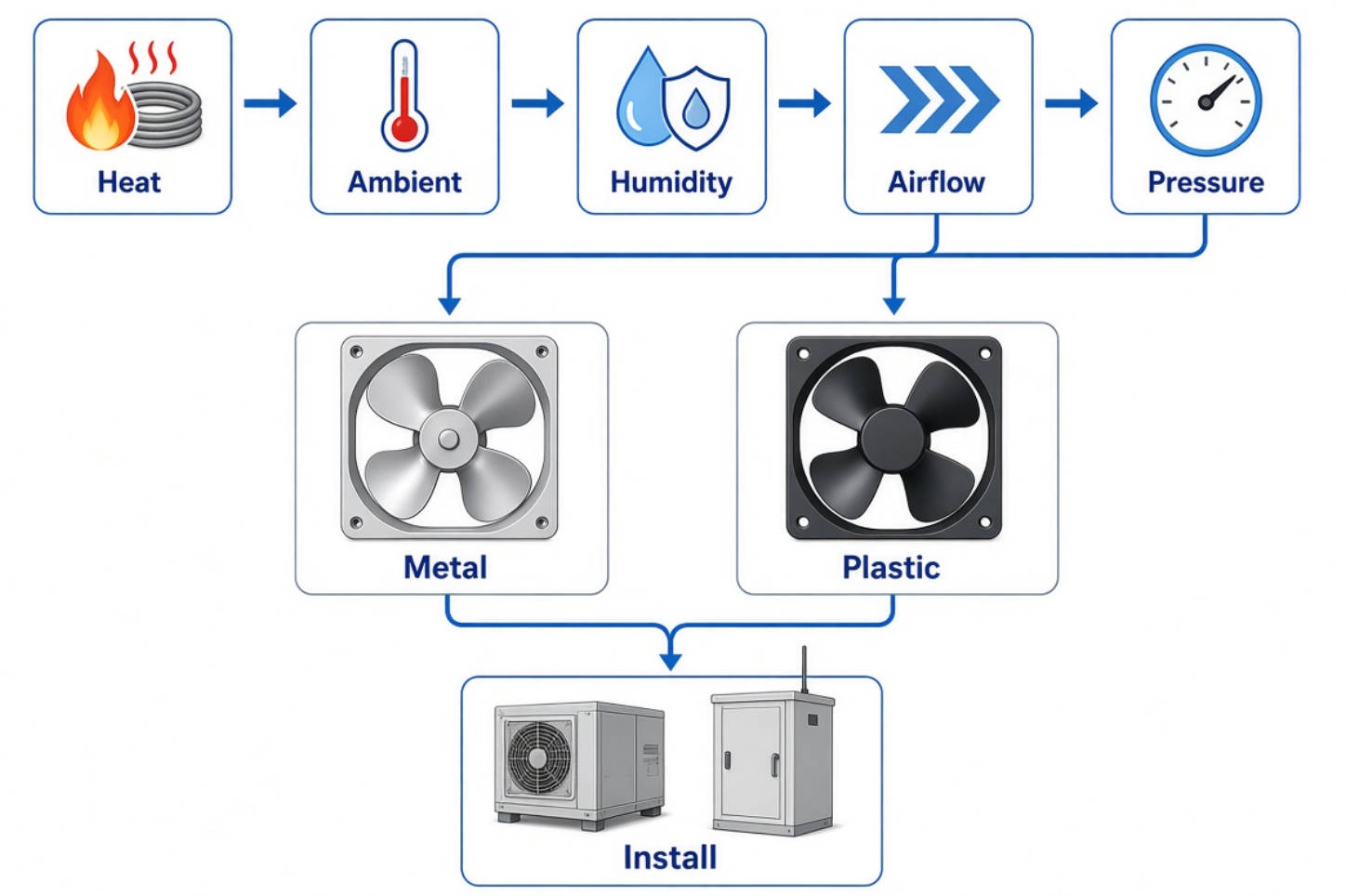
Follow this five-step method for a more reliable purchasing decision.
1. Define the cooling target.
Confirm the allowable equipment temperature, heat load, required airflow, expected static pressure, and available installation space.
2. Map the environment.
Record temperature range, humidity, salt exposure, chemicals, dust, vibration, shock, UV exposure, and indoor or outdoor conditions.
3. Choose the material family.
Consider metal for high-load and high-temperature environments. Consider engineering plastic for corrosion resistance, lightweight construction, and lower-noise designs.
4. Review complete fan specifications.
Compare performance curves, noise, power, bearing type, expected life, material grade, protection features, and compliance requirements.
5. Validate the final assembly.
Test the fan in the real enclosure, at the real voltage, with actual airflow restrictions and expected ambient conditions.
Capital Technology Co., Limited provides cooling solutions centered on DC fans, AC fans, and application-specific thermal management products.
Our value is not limited to supplying a fan. We help customers select cooling products based on the real operating condition of their equipment.
Our team supports applications that require:
- DC axial fans
- AC axial fans
- Industrial cooling fans
- Equipment-cabinet ventilation
- Telecom and communication cooling
- Power-electronics thermal management
- OEM and customized cooling solutions
- Fan performance and model-selection support
With our independent CAPITAL brand and our role as a lead agent for SANYO DENKI, we can support customers who need dependable cooling options across different performance, budget, and application requirements.
Our experience serving recognized companies including ZTE, HUAWEI, and HYTERA reinforces a practical engineering mindset: cooling components must support product reliability, service continuity, and lifecycle value.

For metal fan blades vs. plastic fan blades, there is no universal winner.
Choose metal fan blades when your equipment needs high structural strength, large-diameter airflow, high-temperature tolerance, or heavy-duty durability. Choose plastic fan blades when corrosion resistance, reduced weight, quieter performance, complex aerodynamic geometry, and high-volume cost efficiency are priorities.
The correct choice depends on the complete system: airflow requirement, static pressure, ambient temperature, corrosion risk, operating hours, noise target, installation space, and reliability expectations.
Need help choosing the right DC fan, AC fan, metal impeller, or plastic impeller for your equipment? Contact Capital Technology with your required airflow, static pressure, voltage, installation space, and operating environment. Our technical team can recommend a suitable cooling solution for your application.
Neither material is universally better. Metal fan blades are generally preferred for high-temperature, high-load, large-scale, or heavy-duty industrial applications. Plastic fan blades are often ideal for compact cooling fans, corrosion-prone environments, lower-noise requirements, and high-volume electronic equipment.
Yes. High-quality DC cooling fans commonly use flame-retardant engineering-plastic impellers. Reliability depends on the resin grade, operating temperature, motor design, bearings, blade balance, and airflow system—not simply whether the impeller is plastic.
Yes, but the metal should be properly protected. Depending on the environment, consider anodized aluminum, galvanized steel, powder-coated metal, stainless steel, or another corrosion-resistant treatment. In some applications, plastic blades may offer a simpler corrosion-resistance solution.
Plastic blades can support quieter operation because they are lightweight and can be molded into optimized aerodynamic shapes. However, noise also depends heavily on fan speed, blade design, airflow restrictions, bearing condition, motor control, and enclosure resonance.
Provide the required airflow, static pressure, voltage, fan size, installation space, operating temperature, humidity, dust level, expected operating hours, noise target, mounting orientation, and any special requirements such as PWM control, alarm output, IP protection, or flame-retardant materials.
It depends on the specific resin grade. Standard plastics have more limited heat resistance than metal, but high-performance and reinforced engineering plastics can support more demanding environments. Always verify continuous operating temperature, not only short-term exposure temperature.
DC fans are commonly selected for compact electronics, variable-speed control, energy-efficient designs, telecom equipment, and intelligent thermal management. AC fans are often used where direct AC power, simple control, robust ventilation, and standard industrial integration are priorities.
1. Longwell Fans. "Metal vs Plastic Fan Blades for Industrial Cooling."
[https://www.longwellfans.com/metal-fan-blades-vs-plastic-fan-blades-for-industrial-cooling/]
2. SANYO DENKI America. "San Ace Cooling Fans."
[https://www.sanyodenki.com/america/products/sanace/]
3. SANYO DENKI. "San Ace Cooling Systems Technical Material."
[https://products.sanyodenki.com/info/sanace/en/technical_material/index.html]
4. SANYO DENKI. "ACDC Fan / AC Fan Catalog."
[https://www.sanyodenki.com/america/document/ACDC_Fan_AC_Fan.pdf]
5. Piedmont Plastics. "Comparing Key Engineering Plastics."
[https://www.piedmontplastics.com/blog/engineering-plastics-comparison]
6. SpecialChem. "Maximum Continuous Service Temperature: Plastic Materials."
[https://www.specialchem.com/plastics/guide/max-continuous-service-temperature]
7. NIST. "Materials Testing Standards for Additive Manufacturing of Polymer Materials."
[https://nvlpubs.nist.gov/nistpubs/ir/2015/NIST.IR.8059.pdf]


