From idea to market-ready product, our NPI solutions make every stage easier, faster. Discover How We Help
Help Center

Views: 267 Author: Capital Technology Publish Time: 2026-08-16 Origin: Site
Content Menu
● What Are Inline and Centrifugal Duct Fans?
>> Inline Duct Fan: Core Characteristics
>> Centrifugal Duct Fan: Core Characteristics
● Inline Fan vs. Centrifugal Fan Comparison
● Airflow and Static Pressure: The Decision Point That Matters Most
>> When Inline Fans Perform Best
>> When Centrifugal Fans Perform Best
● Noise, Energy Use, and Fan Speed Control
>> Practical Noise-Reduction Measures
>> Why EC, DC, and Variable-Speed Control Matter
● Installation and Reliability Considerations
>> Inline Fan Installation Checklist
>> Centrifugal Fan Installation Checklist
● Expert Selection Framework for Buyers and Engineers
● How Capital Technology Supports Fan Selection
● Request a Fan Selection Recommendation
● FAQ
>> 1. Is an inline fan the same as an axial fan?
>> 2. Which fan is better for a long duct run?
>> 3. Can I use an inline fan with a filter?
>> 4. Why does my duct fan deliver less airflow after installation?
>> 5. Are centrifugal fans always quieter than inline fans?
>> 6. How do I calculate the static pressure needed for my fan?
>> 7. Should I choose AC, DC, or EC fan technology?
Choosing between an inline duct fan and a centrifugal duct fan is not simply a question of airflow volume. The correct decision depends on the operating point: required airflow, total system resistance, installation space, acoustics, control method, reliability targets, and lifecycle cost.
At Capital Technology Co., Limited, we support cooling and ventilation projects involving DC fans, AC fans, and high-performance thermal-management solutions. Based on the same selection logic used for demanding electronics and industrial applications, the most reliable approach is to select a fan from its airflow–pressure curve, rather than choosing only by "maximum CFM" or physical size.
Quick answer: Inline fans are generally a strong fit for compact, relatively straight duct runs with low-to-medium resistance. Centrifugal fans are usually the better choice when the system has long ducts, filters, bends, grilles, dampers, or other restrictions that create higher static pressure.

An inline duct fan is installed directly inside a round or mixed-flow duct. Air enters and exits along the same axis. Its compact cylindrical housing makes it a practical option where installation space is limited.
A centrifugal duct fan uses a rotating impeller to draw air into the center of the fan and discharge it at a right angle through a scroll or cabinet housing. This airflow path helps the fan generate stronger pressure for systems with greater resistance.
The distinction matters because every ventilation system has a system curve. Duct friction, elbows, filters, louvers, diffusers, dampers, and equipment all add resistance. A fan must supply the required airflow while overcoming the system's total pressure loss.
Inline fans are commonly selected for:
- Bathroom and restroom exhaust
- Small commercial ventilation
- Grow rooms and controlled-environment spaces
- Telecom cabinets or equipment-room exhaust paths
- Short-to-medium duct runs
- Retrofit projects with limited ceiling or wall space
Their main advantage is a space-saving, in-duct design. In many projects, installers can place the unit between two duct sections without constructing a separate fan room or large equipment platform.
However, an inline fan is not automatically the best choice merely because it is compact. If the duct system contains multiple bends, dense filters, long pipe runs, or high-resistance outlets, its real airflow can be substantially lower than its free-air rating.
Centrifugal fans are often used in:
- Commercial HVAC systems
- Industrial ventilation lines
- Commercial kitchens and grease-related exhaust systems
- Cleanroom or filtration systems
- Equipment enclosures requiring focused pressure performance
- Long, complex, or high-resistance duct networks
The key benefit is higher static-pressure capability. Static pressure is the pressure available to overcome resistance in ductwork and system components. It is commonly expressed in Pascals (Pa) or inches of water gauge.
For applications where airflow must pass through filters, heat exchangers, closely spaced grilles, or multiple duct turns, a centrifugal configuration can maintain design airflow more effectively than a low-pressure fan design.
| Selection Factor | Inline Duct Fan | Centrifugal Duct Fan |
|---|---|---|
| Airflow direction | Generally axial or mixed-flow through the duct | Air enters axially and exits radially |
| Typical strength | Compact airflow delivery | High-pressure airflow delivery |
| Static-pressure capability | Low to medium, depending on design | Medium to high, depending on impeller and housing |
| Space requirement | Small; mounts inside ductwork | Larger; often needs a cabinet, base, or external mounting position |
| Duct configuration | Best for simpler, lower-resistance layouts | Best for long, complex, or restricted duct systems |
| Installation | Often simpler for round duct systems | May require more planning for inlet, discharge, access, and vibration isolation |
| Noise control | Can be quiet when correctly sized and isolated | Can offer strong acoustic performance, but depends on fan type, speed, casing, and system design |
| Maintenance access | May be difficult if installed above ceilings | Usually easier if designed with service panels |
| Typical applications | Residential, light commercial, localized exhaust | HVAC, industrial, filtration, commercial process ventilation |
Many buyers compare fans by airflow alone, such as CFM or \(m^3/h\). That is incomplete.
A fan may deliver a high airflow figure under free-air conditions, but actual performance changes once it is installed in a real system. Every filter, duct elbow, silencer, grille, and transition adds pressure loss. As resistance rises, delivered airflow falls according to the relationship between the fan curve and the system curve.
For this reason, engineers should specify:
1. Required airflow at the point of use
2. Total duct length and duct diameter
3. Number and type of elbows, transitions, and branches
4. Filter type and anticipated dirty-filter resistance
5. Required static pressure or total pressure
6. Ambient temperature, altitude, and air density
7. Noise target and operating schedule
8. Required service life and control interface
CIBSE notes that fan selection should be based on the system's design airflow and total pressure requirement—not on airflow alone.
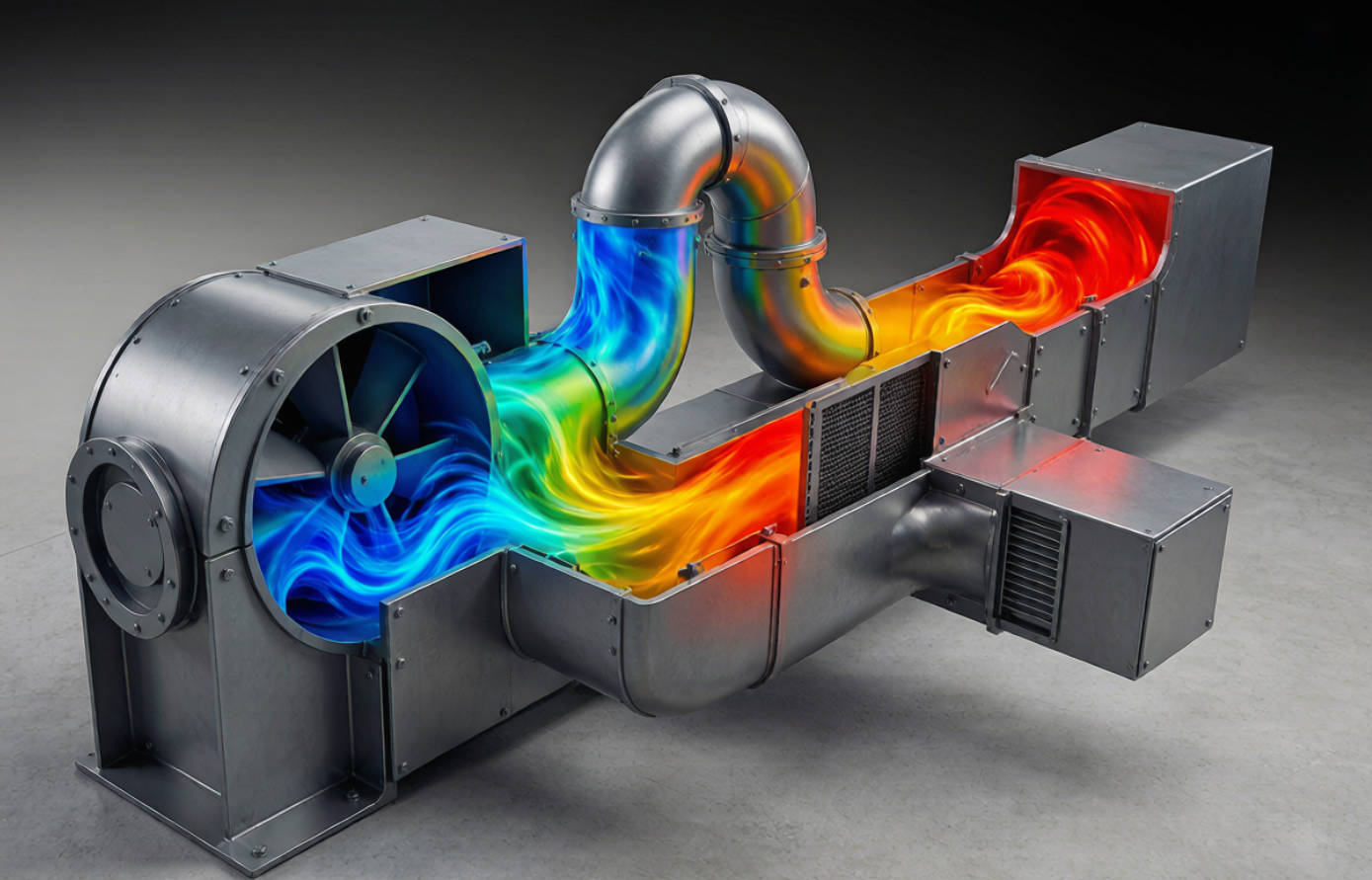
Select an inline fan when the system has:
- A short or moderate duct run
- Few sharp bends or restrictive components
- Round ductwork with straightforward connections
- A limited installation envelope
- Moderate pressure requirements
- A need for practical, cost-conscious installation
For example, an inline fan can be an efficient solution for a warehouse office restroom exhaust system with a short vertical duct, one grille, and a roof termination. In this scenario, a compact fan may deliver the target airflow without unnecessary equipment size or energy consumption.
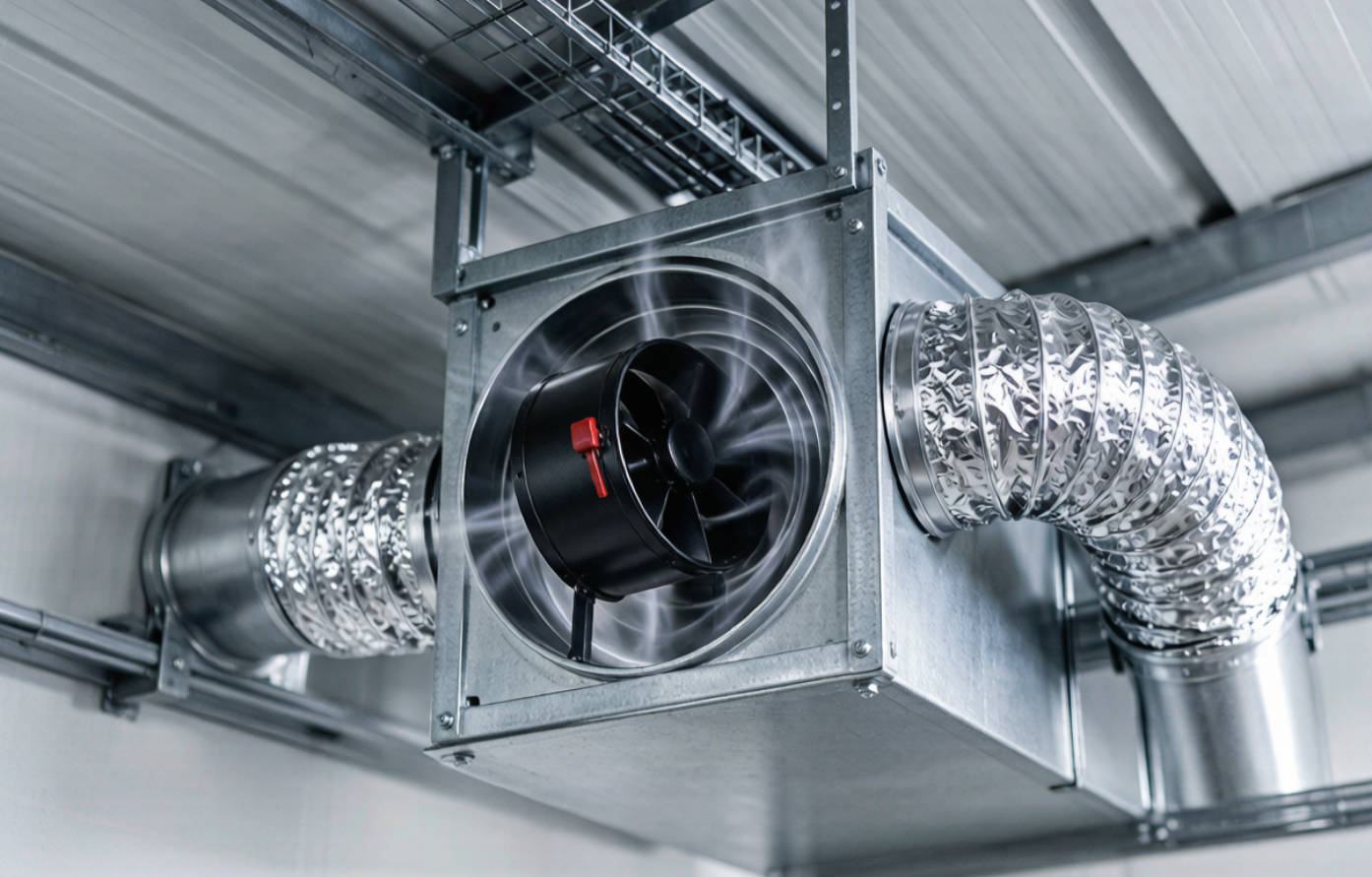
Choose a centrifugal fan when the system has:
- Long duct runs
- High-efficiency particulate filters
- Multiple duct branches
- Numerous elbows, dampers, or transitions
- High-pressure exhaust requirements
- A need for stable airflow under changing resistance
Consider a telecom equipment room with dust filtration, tightly packed cable pathways, protective grilles, and heat-generating network devices. The airflow path has resistance. A fan chosen only for high free-air CFM may underperform after installation. A centrifugal fan—or a high-static-pressure DC fan in a compact electronics cooling system—can be a more dependable choice.
SANYO DENKI's San Ace high-static-pressure DC fan range illustrates how pressure capability becomes decisive in constrained cooling paths. One 60 × 60 × 38 mm model is specified with maximum airflow of 84.3 CFM and maximum static pressure of 8.0 inH₂O, demonstrating why compact cooling systems often require more than free-air airflow.
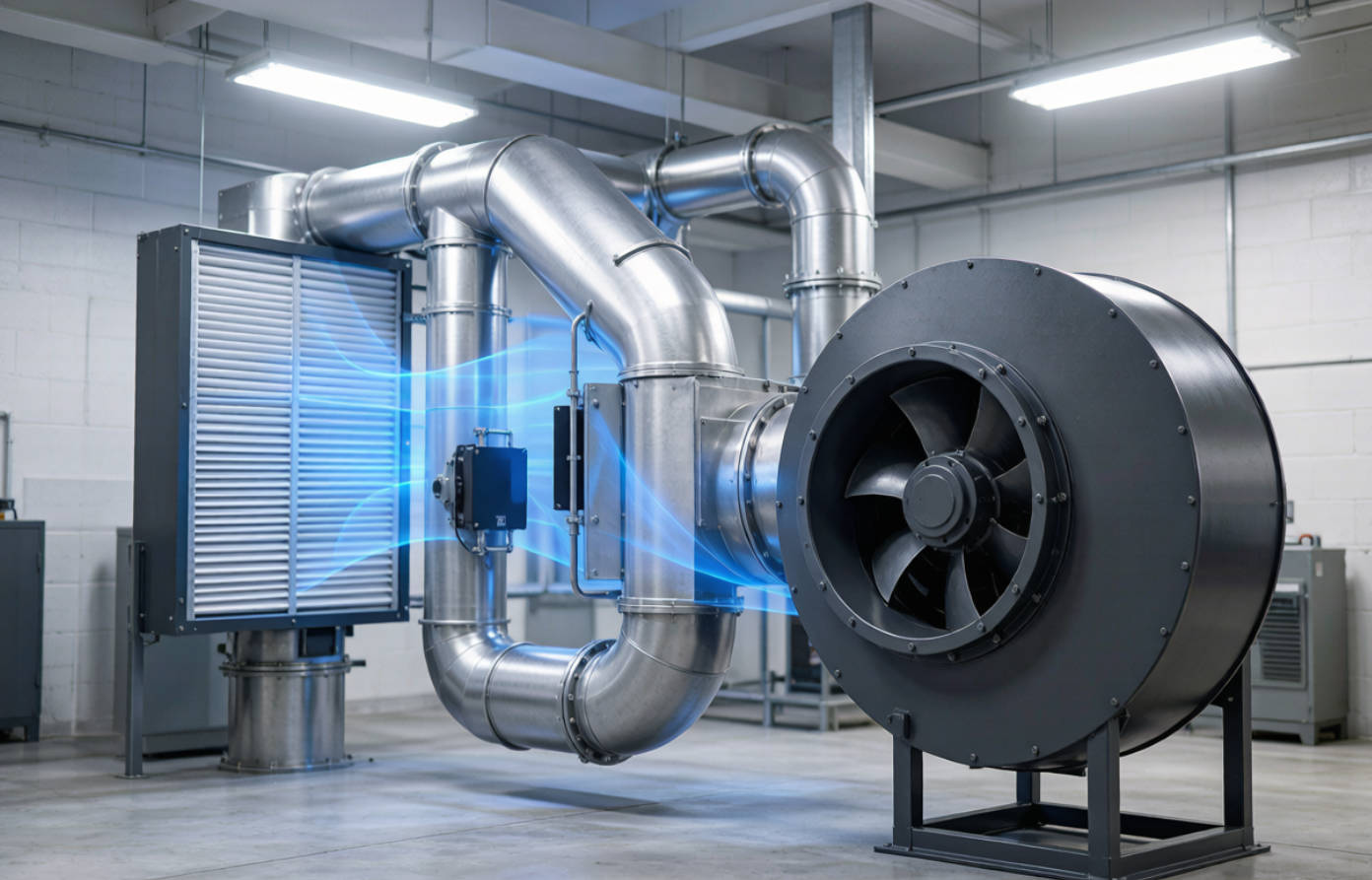
Noise is influenced by more than fan type. It can result from blade turbulence, motor vibration, duct resonance, restrictive inlet conditions, high air velocity, and poor mounting practices.
A poorly installed "quiet" fan can be louder than a correctly selected higher-performance fan.
- Avoid undersized ductwork that forces high air velocity.
- Use smooth transitions instead of abrupt duct changes.
- Keep adequate straight duct length near the fan inlet where possible.
- Add flexible connectors or vibration isolators.
- Avoid placing the fan directly above noise-sensitive rooms.
- Use acoustic insulation or silencers where the application permits.
- Select a fan that reaches the duty point without running continuously at maximum speed.
For speed-controlled fans, fan laws are especially important. With constant fan diameter and air density, airflow is approximately proportional to rotational speed, pressure is proportional to speed squared, and power is proportional to speed cubed.
That means reducing speed can produce substantial energy savings. But it also means pressure capability falls quickly. If speed is reduced to 80% of the original value, the theoretical pressure capability falls to approximately 64%, while power falls to about 51%.
For modern ventilation and thermal-management projects, variable-speed control can improve efficiency and operating stability. EC and DC fan solutions can support:
- PWM speed control
- Tachometer feedback
- Alarm signals
- Temperature-responsive operation
- Reduced energy use during partial load
- Lower acoustic output when full speed is not required
This is particularly relevant for communication equipment, industrial electronics, battery systems, automation cabinets, and other applications where thermal loads vary throughout the day.
The best fan on paper can fail in the field if installation details are ignored.
- Confirm duct diameter matches the fan connection size.
- Support the fan body independently; do not rely on flexible duct alone.
- Check airflow direction before installation.
- Provide an accessible service location.
- Seal duct joints to prevent leakage.
- Confirm that the mounting location will not transmit vibration into ceilings or walls.
- Verify electrical protection, grounding, voltage, and control wiring.
- Provide sufficient inlet clearance and discharge space.
- Check rotation direction before commissioning.
- Ensure the base or housing is level and rigid.
- Install flexible connectors where required.
- Plan maintenance access for the motor, belt system, impeller, and filters.
- Confirm that the discharge arrangement does not create excessive system effect.
- Measure actual airflow and pressure during commissioning.
In professional projects, it is good practice to maintain a commissioning record containing airflow, pressure, voltage, current, sound level, and operating speed. This creates a baseline for future maintenance and troubleshooting.
Use the following framework before asking a supplier for a quote.
| Question | Why It Matters |
|---|---|
| What airflow is required at the end use point? | Defines the ventilation or cooling target |
| What is the total pressure loss? | Determines whether the fan can operate at the required duty point |
| Is the air clean, hot, humid, corrosive, or greasy? | Influences material, motor, bearing, coating, and enclosure choices |
| Is noise a priority? | Affects speed, impeller design, mounting, and acoustic treatment |
| Will the system run continuously? | Impacts bearing life, motor design, redundancy, and maintenance planning |
| Is variable-speed control needed? | Determines AC, DC, EC, PWM, or other control requirements |
| What certifications are required? | Supports market access and project compliance |
| What is the lifecycle cost? | Includes energy, maintenance, downtime, and replacement—not only purchase price |
For OEM and industrial buyers, request the performance curve, operating voltage, current, power, noise data, bearing specification, expected life, IP rating, operating temperature range, and control options. Do not rely on a single "maximum airflow" value.
Capital Technology Co., Limited provides DC fan and AC fan cooling solutions under the CAPITAL brand and serves as a leading SANYO DENKI agent. Our experience supporting customers in communications, industrial equipment, and demanding thermal-management applications helps us translate application requirements into practical fan-selection recommendations.
For projects involving high heat density, restricted airflow paths, or strict reliability expectations, our approach focuses on the real operating condition:
- Required airflow and pressure at the duty point
- Available installation space
- Voltage and control requirements
- Noise limit
- Operating temperature and environmental exposure
- Product reliability and service-life expectations
- Certification and market requirements
Whether you need a compact DC cooling fan for an electronics enclosure or an AC fan solution for industrial ventilation, the objective is the same: stable airflow at the required pressure, with controlled noise and reliable long-term operation.
Do not choose between an inline fan and a centrifugal fan based on appearance or maximum airflow alone. Share your airflow target, duct layout, static-pressure estimate, installation dimensions, voltage, and noise requirements with Capital Technology.
Our team can help you evaluate the operating point and identify a suitable DC fan, AC fan, inline duct fan, centrifugal fan, or high-static-pressure cooling solution for your application.
Not always. Some inline duct fans use axial impellers, while others use mixed-flow or other aerodynamic designs. The key feature is that the fan is installed in-line with the duct path.
A centrifugal fan is often the safer option for a long duct run because it typically provides stronger static-pressure performance. The final choice should still be based on the system's required airflow and pressure curve.
Yes, but the filter adds resistance. Check the fan's performance curve at the expected clean- and dirty-filter pressure losses to ensure it can maintain the required airflow.
Common reasons include undersized ducts, restrictive grilles, dirty filters, excessive bends, duct leakage, incorrect rotation direction, or selecting the fan using free-air airflow rather than the actual system pressure.
No. Noise depends on the fan design, operating speed, airflow velocity, mounting method, duct system, and installation quality. A properly selected and isolated fan is generally quieter than an incorrectly selected fan of either type.
Add the pressure losses from ducts, fittings, filters, coils, dampers, grilles, and terminals at the required airflow. For complex systems, use duct-design software or consult an experienced ventilation engineer.
Choose based on the application. DC and EC solutions are often preferred when precise speed control, monitoring, efficiency, and compact integration are important. AC fans can remain practical for many fixed-speed industrial and ventilation applications.
1. Longwell Fans. "Comparing Duct Fans: Inline vs. Centrifugal Options." [https://www.longwellfans.com/duct-fans-inline-vs-centrifugal-options-explained/]
2. CIBSE Journal. "Matching the Fan to the Ventilation System." [https://www.cibsejournal.com/cpd/modules/2011-11/]
3. CaptiveAire. "Air Flow, Air Systems, Pressure, and Fan Performance." [https://www.captiveaire.com/manuals/airsystemdesign/designairsystems.htm]
4. SANYO DENKI America. "60 × 38 mm 9HVA Type High Static Pressure Fan Released." [https://www.sanyodenki.com/america/products/product_news/2022/sanace_60hva_dc-fan.html]
5. SANYO DENKI America. "40 × 40 × 28 mm Long Life Fan with High Static Pressure." [https://sanyodenki.com/america/products/product_news/2023/20230525_sanace_40lg_long-life-fan.html]
6. Engineering ToolBox. "Fan Affinity Laws." [https://www.engineeringtoolbox.com/fan-affinity-laws-d_196.html]


