From idea to market-ready product, our NPI solutions make every stage easier, faster. Discover How We Help
Help Center

Views: 289 Author: Capital Technology Publish Time: 2026-07-19 Origin: Site
Content Menu
● Industrial Panel Cooling Fan Manufacturer – DC & AC Thermal Solutions for Control Panels
● Capital Technology – Specialist in DC and AC Panel Cooling Fans
● Trusted by Telecom and Industrial Brands
● Core Product Lines – DC, AC, and EC Panel Cooling Fans
>> DC Panel Cooling Fans for Precision Control
>> AC Panel Cooling Fans for Robust and Simple Cooling
>> EC Fans for Efficiency and Smart Operation
● Engineering Perspective – Selecting the Right Panel Cooling Fan
>> AC, DC, or EC – Practical Selection Framework
>> Calculating Airflow – CFM and CMM
>> Static Pressure – Overcoming System Resistance
● Bearing Systems and Longevity
● IP Ratings and Environmental Protection
● Total Cost of Ownership – Why Quality Fans Cost Less Over Time
>> The Hidden Cost of Downtime
● Practical Buying Guidance for Engineers and Procurement
● Expert Support and Customization
● Summary – Reliable Thermal Solutions for Industrial Control Panels
● FAQs
>> Q1: What is the main factor when choosing a panel cooling fan?
>> Q2: How do DC and EC fans improve energy efficiency in control panels?
>> Q3: When should ball‑bearing fans be chosen over sleeve‑bearing fans?
>> Q4: Why are IP ratings important for panel cooling fans?
>> Q5: How can a manufacturer support complex industrial projects?
Industrial panel cooling fan manufacturer and thermal solutions partner for DC, AC, and EC fans in control panels and demanding electronic systems.
In modern industrial plants, the control panel is the nerve center of the production line, housing PLCs, drives, power supplies, radios, and networking devices that keep operations running around the clock. When heat accumulates inside these enclosures, it quietly accelerates component aging, causes intermittent faults, and can trigger costly unplanned downtime.
Choosing the right panel cooling fan manufacturer is therefore not just about moving air; it is a strategic engineering and business decision that protects assets, safeguards uptime, and reduces long‑term operating costs. As an engineer working with manufacturers, the difference between basic ventilation and a carefully designed thermal solution is visible in lower failure rates, quieter panels, and fewer urgent maintenance calls.
Capital Technology Co., Limited is a dedicated thermal solutions provider focusing on DC fans, AC fans, and EC fans for industrial control panels, telecom equipment, and high‑reliability electronics. Under its own brand, CAPITAL, and as an agent for SANYO DENKI, the company serves OEMs and system integrators who require stable, certified cooling components rather than commodity parts.
The company's positioning emphasizes engineering depth: high‑performance fans built with branded ball bearings, long service life ratings, and compliance with CE, UL, RoHS, and EMC standards. This helps customers simplify certification for export projects and maintain consistent quality across global installations.
When selecting a panel cooling fan manufacturer, industrial buyers often use collaboration with well‑known OEMs as a practical signal of reliability. Capital Technology has grown into a supplier to brands such as ZTE, HUAWEI, and HYTERA, which shows that its DC and AC fans consistently meet demanding telecom and mission‑critical requirements.
In high‑density base stations, rail signaling systems, or secure communication networks, cooling failures can cause cascading service outages. Customers in these sectors typically audit fan suppliers for thermal performance, lifespan expectations, and field failure records before awarding long‑term contracts. Widespread deployments under such conditions are a strong endorsement of stability and lifecycle value.
DC panel cooling fans operate on low‑voltage supplies such as 12 V, 24 V, or 48 V and excel in systems that demand precise speed control and energy efficiency. They are commonly used in telecom racks, base station cabinets, radio panels, and smart factory controls where equipment already uses DC rails and where variable cooling is needed to match changing loads.
From an engineering perspective, DC fans simplify the implementation of features like pulse‑width modulation (PWM) speed control, tachometer feedback, and alarm signals. This makes it possible to slow fans when ambient temperatures are low and increase speed during peak loads, balancing noise, power consumption, and thermal safety. Capital's DC fans are built around long‑life ball bearings and robust frames to ensure stable performance under frequent speed changes and continuous duty cycles.
AC fans remain the workhorses in many industrial control cabinets. They run directly from mains power and provide continuous airflow without additional control electronics. These fans are ideal for general‑purpose panels where the priority is straightforward, reliable cooling rather than complex control.
Because AC fans are often installed in harsh environments—dusty workshops, outdoor enclosures, or plant rooms—Capital focuses on high‑temperature tolerance, impact‑resistant frames, and competitive airflow‑to‑price performance. This makes them attractive for large facilities that deploy many panels and need predictable operation with minimal system complexity.
Electronically commutated (EC) fans combine AC input with DC‑motor efficiency and advanced control. They deliver similar cooling capacity to conventional AC fans but with significantly lower power consumption. This turns thermal management into a measurable energy‑saving lever instead of only a safety measure.
Although EC fans typically carry a higher upfront price, they can noticeably reduce operating costs compared with low‑efficiency AC units, especially in plants with hundreds of panels running non‑stop. EC technology is particularly attractive for projects focused on energy optimization, noise reduction, and long‑term lifecycle cost.
In real projects, the choice between AC, DC, and EC fans comes down to three main questions: available power, control requirements, and lifecycle cost. A practical selection framework is:
- Use AC fans when only mains power is available, airflow needs are constant, and system simplicity is critical.
- Use DC fans when the equipment runs on DC rails and you need features like speed control, monitoring, and integration with controllers or PLCs.
- Use EC fans when you aim for strong energy savings, quieter operation, and smart speed control but prefer to supply the fan from AC power.
Aligning fan type with the cabinet's electrical architecture and control logic simplifies commissioning and future maintenance, while reducing integration issues.

Airflow capacity is specified in CFM (cubic feet per minute) or CMM (cubic meters per minute), and correctly sizing this value is essential to prevent hotspots. A commonly used engineering rule is:
CFM ≈ 3.17 × P ÷ ΔT (in Fahrenheit) and CMM ≈ 0.088 × P ÷ ΔT (in Celsius), where P is total heat load in watts and ΔT is the allowed temperature rise.
For example, if a cabinet dissipates 500 W and the target is to keep internal temperature within 18 °F (10 °C) above ambient, the required airflow is approximately 88 CFM. Adding a 25–50% safety margin compensates for filter clogging, aging, and future component additions. Capital's technical team can assist engineers with these calculations and match them to specific fan models.
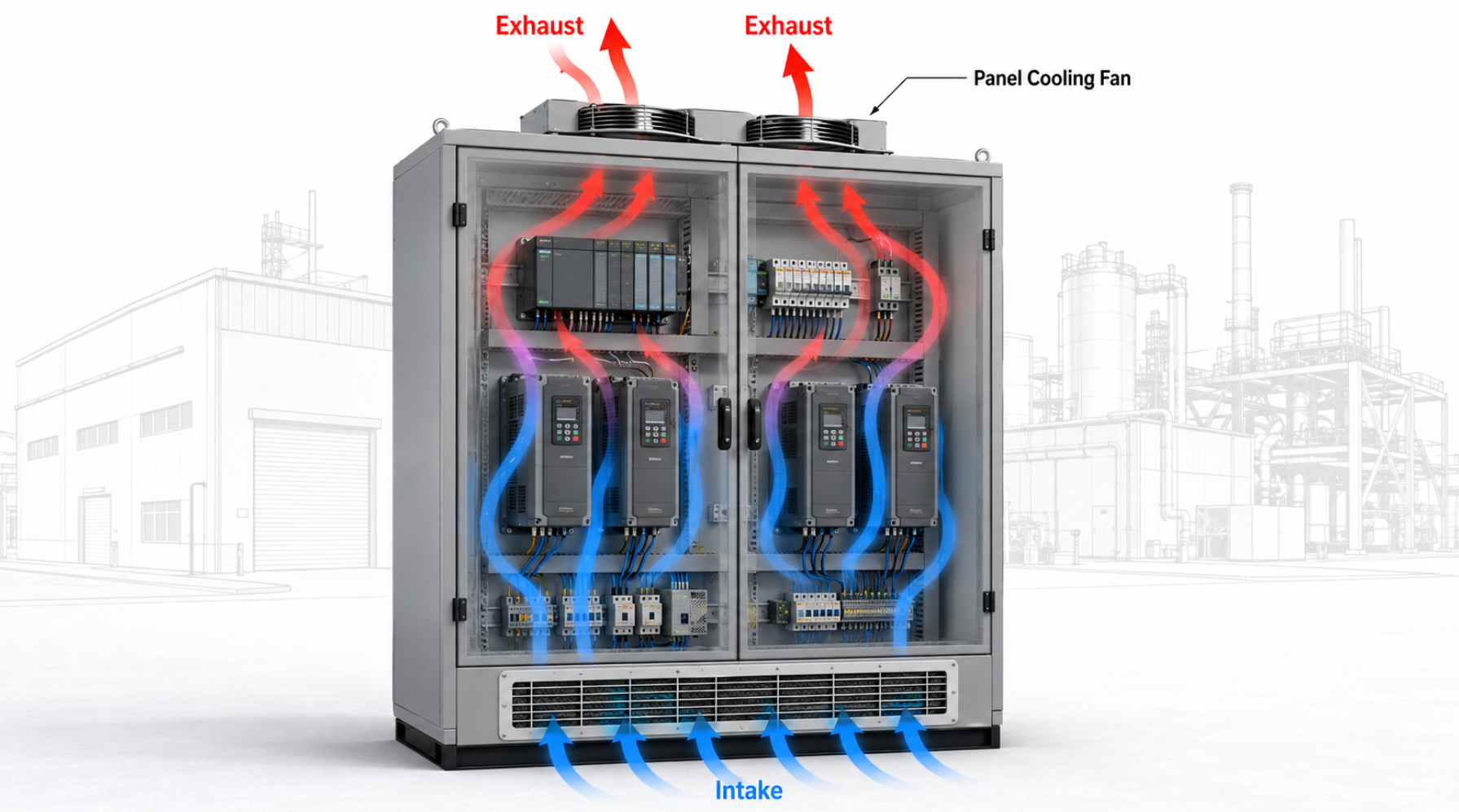
While CFM describes airflow under free‑air conditions, static pressure shows how effectively a fan can push air through filters, grilles, wiring, and densely packed electronics. If a cabinet uses fine‑mesh dust filters or has tight airflow channels, choosing a fan based only on CFM can result in insufficient real‑world cooling.
Static pressure is usually measured in Pascals or inches of water. Engineers should review fan performance curves to identify the operating point where the fan's airflow intersects the enclosure's resistance. For high‑density panels or telecom racks, high static‑pressure fans maintain target airflow under real operating conditions, rather than only in ideal lab setups.
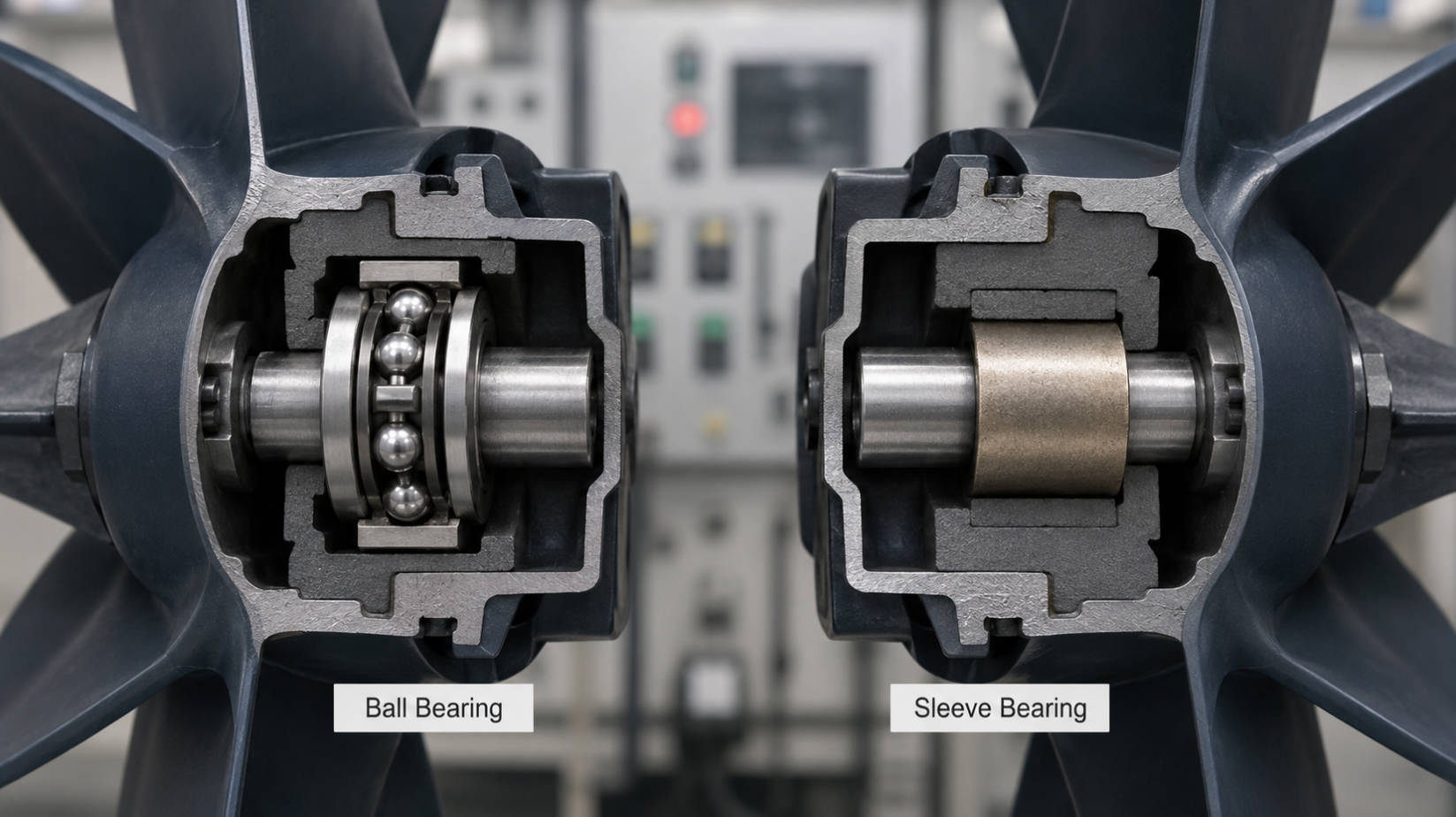
The bearing system inside a panel cooling fan is one of the most important determinants of lifespan, noise, and reliability. Sleeve bearings are more economical and relatively quiet at room temperature, but their lubricants tend to degrade faster in elevated temperatures, leading to noise increases, wobble, and early failure.
Dual ball bearings, used in many Capital fans, can deliver significantly longer lifespans under high thermal and mechanical stress. In continuous‑duty or mission‑critical applications, this directly translates into fewer panel openings, fewer emergency replacements, and a lower chance that a low‑cost cooling component will cause major downtime.
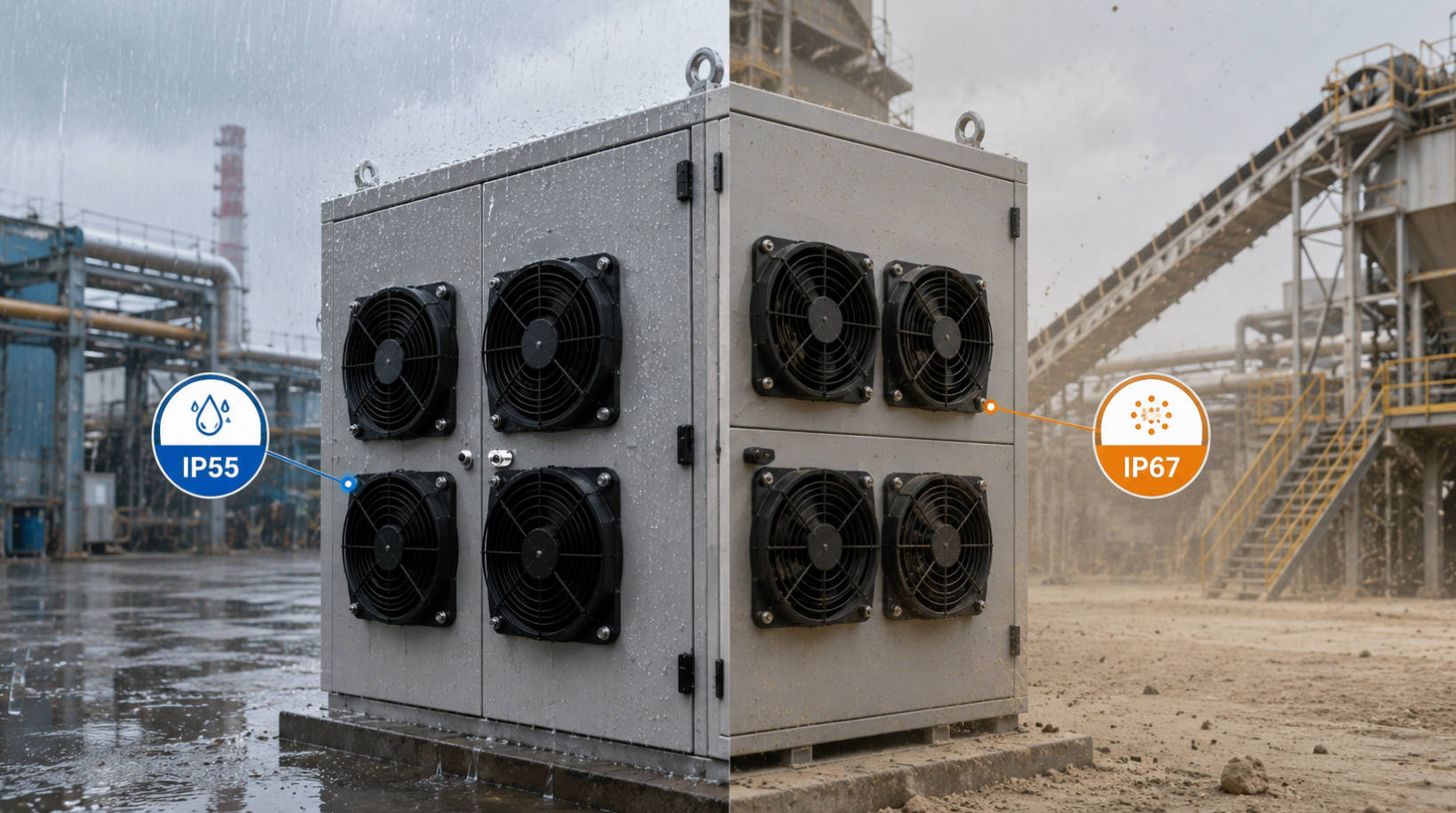
Panel cooling fans operate in environments ranging from clean control rooms to dusty workshops and outdoor cabinets. Ingress Protection (IP) ratings provide a standardized way to match fans to these conditions. IP codes use two digits—such as IP55—where the first digit indicates protection against solids and the second digit indicates protection against liquids.
For dry, clean environments, modest IP ratings may be sufficient. In dusty manufacturing areas, washdown zones, or exposed locations, higher ratings such as IP55 or above offer improved dust protection and resistance to water. In outdoor or harsh environments where fans may face temporary immersion or heavy spray, higher IP ratings provide sealing that helps keep mechanical life close to its rated expectation.
The purchase price of a fan is only a small portion of its true cost. The concept of total cost of ownership includes energy consumption, maintenance labor, replacement parts, and the financial impact of unplanned downtime. A lower‑cost fan that fails early or runs inefficiently can quickly become more expensive than a higher‑quality alternative.
Capital's engineering approach focuses on efficient motors, long‑life bearings, and robust construction. These design choices may increase unit prices slightly, but they lower overall lifecycle expenses. When energy use, replacement frequency, and downtime risks are factored in, well‑engineered DC, AC, and EC fans often become the most economical option over a period of several years.
Consider a typical scenario: a low‑efficiency AC fan drawing 25 W and an efficient EC fan providing comparable airflow at 10 W. Over a year of continuous operation, the EC fan saves 15 W. For a large facility with many panels, this difference translates into tangible reductions in electricity bills.
Because EC fans can adjust speed according to demand, they also avoid unnecessary full‑speed operation during cooler periods or low‑load conditions. This further reduces energy use and wear, supporting internal cost‑reduction efforts and sustainability objectives.
In many factories, a single control panel failure can stop an entire production line. Downtime costs quickly accumulate once idle labor, wasted material, delayed shipments, and rescheduling are taken into account. In this context, the fan inside that panel is not just a minor part; it is a device that helps prevent heat‑triggered failures.
Investing in high‑quality, certified fans from a reputable manufacturer reduces the likelihood of such incidents. Stable performance and predictable lifespan simplify spare‑part planning and maintenance schedules, making the whole system more resilient.
To make selection easier for engineers and buyers, the following checklist summarizes the key considerations:
1. Confirm electrical type – Decide whether AC, DC, or EC fans fit the available power and required control.
2. Calculate required airflow – Estimate CFM or CMM based on heat load and desired temperature rise, then add a safety margin.
3. Evaluate static pressure – Account for filters, grilles, and component density; check fan curves rather than only nominal CFM.
4. Select bearing type – Choose ball bearings for higher temperatures and critical duty; reserve sleeve bearings for low‑risk environments.
5. Check IP rating – Match dust and moisture exposure levels to suitable IP codes.
6. Review certifications – Ensure consistency with regulatory and market requirements.
7. Assess lifecycle costs – Consider energy use, expected lifespan, replacement intervals, and potential downtime.
Organizing information in this way improves readability for busy teams and helps them move from research to clear specifications.
Many industrial projects require more than catalog parts. Custom airflow profiles, specific connectors, alarm outputs, or application‑specific mounting can be essential to meet mechanical, electrical, or regulatory constraints. Capital's engineering team supports OEMs and integrators with tailored DC and AC fan solutions, including speed control options, monitoring outputs, and frame adaptations.
Working with a manufacturer that can co‑design cooling around the system architecture ensures that thermal management is part of the original design rather than a late add‑on. This approach is particularly valuable in telecom, transportation, and automation projects that must adhere to strict standards and footprint limitations.
A well‑designed panel cooling strategy protects control electronics, improves uptime, and lowers total operating costs. By offering DC, AC, and EC fans with robust bearings, suitable IP ratings, and support for precise airflow calculations, Capital Technology provides a comprehensive toolkit for engineers and buyers who want dependable thermal performance.
Building cooling decisions on clear technical criteria and long‑term cost considerations helps industrial plants avoid preventable failures and unlock consistent, stable operation over the lifespan of their equipment.
The main factor is matching airflow and static pressure to the enclosure's heat load and resistance, while ensuring that the fan type aligns with the power and control architecture of the system.
DC and EC fans use efficient motor technology and support variable speed operation. This allows them to deliver required cooling while using less energy than fixed‑speed, low‑efficiency AC fans.
Ball‑bearing fans are preferred for high‑temperature, continuous‑duty, or mission‑critical applications where long service life and low downtime risk are essential. Sleeve bearings are more suitable for non‑critical, room‑temperature environments.
IP ratings indicate the level of protection against dust and water. Choosing appropriate ratings helps fans withstand environmental conditions and maintain performance throughout their expected lifespan.
A manufacturer with strong engineering capabilities can provide consultation, airflow calculations, and customized fan configurations. This ensures that thermal solutions fit mechanical constraints, electrical systems, and regulatory requirements.


