From idea to market-ready product, our NPI solutions make every stage easier, faster. Discover How We Help
Help Center

Views: 275 Author: Capital Technology Publish Time: 2026-09-09 Origin: Site
Content Menu
● Industrial Fan vs. Blower: The Core Difference
>> How Industrial Fans Move Air
>> Best Applications for Industrial Fans
>> Advantages of Industrial Fans
● What Is an Industrial Blower?
>> How Industrial Blowers Generate Pressure
>> Best Applications for Industrial Blowers
● Fan vs. Blower: When Should You Use Each?
>> Choose an Industrial Fan When
>> Choose an Industrial Blower When
● Why Static Pressure Matters More Than Free-Air CFM
>> Understanding the Fan Curve
>> A Practical Selection Formula
● How to Select the Right Industrial Fan or Blower
>> 1. Define the Airflow Objective
>> 2. Calculate Heat Load or Ventilation Demand
>> 3. Identify Every Restriction
>> 4. Compare Curves, Not Just Catalog Ratings
>> 5. Validate the Installed System
● Application Insights from Thermal-Management Projects
>> Telecom and Network Equipment
>> Welding and Fume Extraction
>> Battery and Power-Electronics Cooling
● Choose the Right Air-Moving Solution
● FAQ
>> 1. What is the main difference between an industrial fan and an industrial blower?
>> 2. Can an axial fan replace a centrifugal blower?
>> 3. Why does my fan show high CFM in the catalog but poor airflow after installation?
>> 4. How do I calculate the static pressure requirement of my system?
>> 5. Is a high-pressure blower always better for electronics cooling?
>> 6. What information should I provide when requesting a DC fan or AC fan recommendation?
>> 7. Why is local exhaust ventilation important for welding fumes?
Industrial blowers and industrial fans both move air, but they are designed to solve very different airflow problems. The right choice depends less on the product name and more on the required airflow volume, static pressure, duct resistance, operating environment, safety requirements, and long-term energy cost.
For more than a decade, we have worked with OEMs, system integrators, and industrial buyers who need dependable cooling and ventilation components for demanding equipment. At Capital Technology Co., Limited, we manufacture DC fans and AC fans under the CAPITAL brand and supply SANYO DENKI fan solutions as a leading authorized agent. Our experience supporting customers such as ZTE, HUAWEI, and HYTERA has reinforced one important lesson: selecting air-moving equipment by CFM alone is one of the most expensive mistakes an engineering or procurement team can make.
A large fan can deliver impressive airflow in open space. However, once air must travel through filters, heatsinks, ducts, bends, grilles, cabinets, or narrow passages, pressure becomes just as important as volume. This guide explains the practical difference between industrial fans and blowers, when to use each, and how to avoid an underperforming ventilation or thermal-management system.
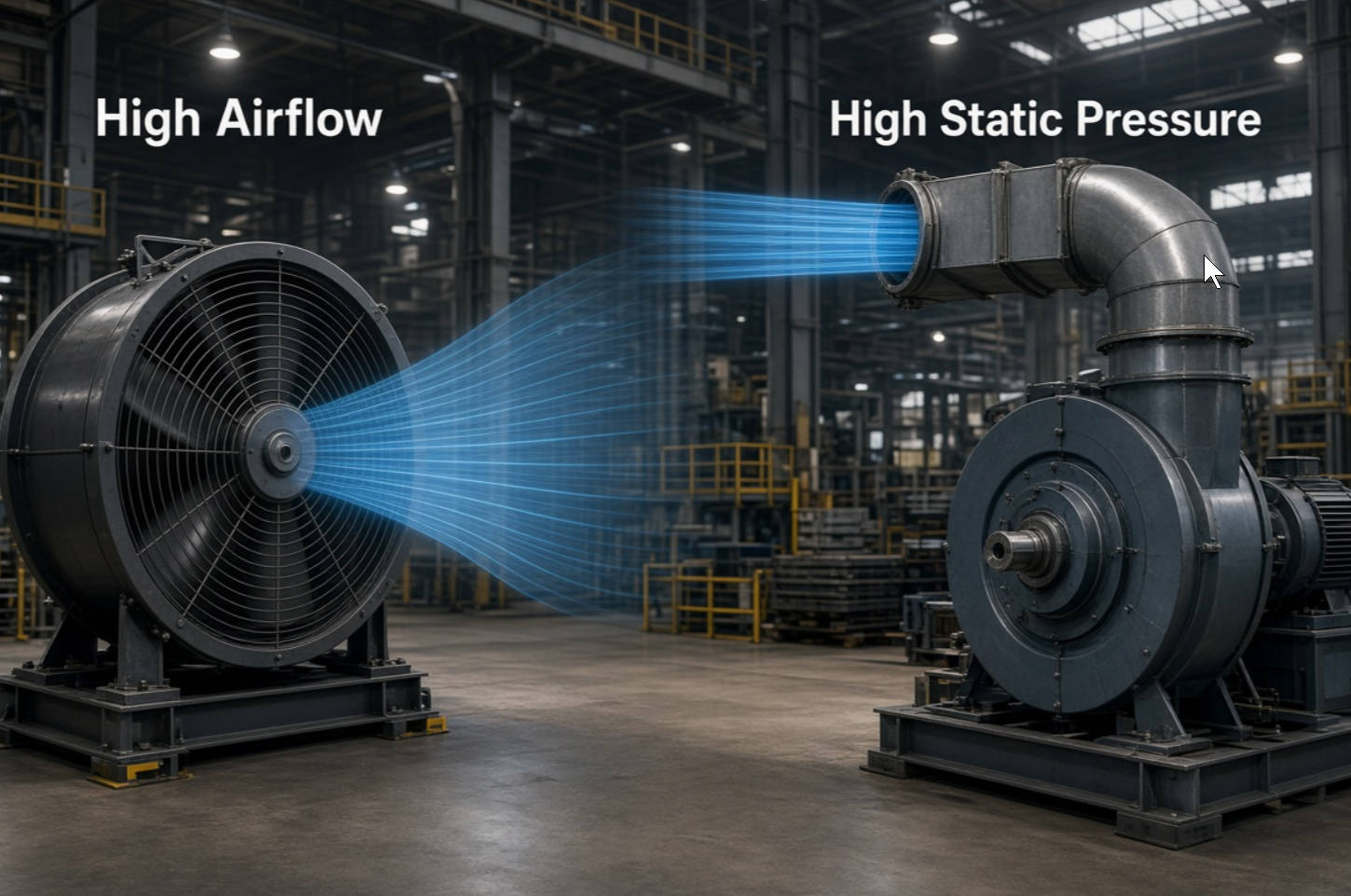
The simplest way to distinguish an industrial fan from an industrial blower is to ask one question:
Does the system need to move air freely, or force air through resistance?
Industrial fans are generally used for high-airflow, low-pressure applications. Industrial blowers are generally selected for directed airflow, higher static pressure, and resistance-heavy systems.
In practice, the distinction is not always absolute. Product names vary between manufacturers and markets. A centrifugal fan may be described as a blower in one application and as a fan in another. Therefore, buyers should focus on verified performance data, including airflow, static pressure, efficiency, noise, power consumption, and operating point.
| Selection Factor | Industrial Fan | Industrial Blower |
|---|---|---|
| Primary function | Move a large volume of air | Push or pull air through resistance |
| Typical pressure capability | Low to moderate | Moderate to high |
| Typical airflow pattern | Broad and distributed | Focused and directed |
| Best environment | Open spaces or low-resistance paths | Ducts, filters, equipment enclosures, process lines |
| Common designs | Axial, propeller, tube axial | Centrifugal, radial, regenerative, high-pressure |
| Typical applications | Room ventilation, cabinet cooling, warehouse circulation | Exhaust extraction, pneumatic conveying, burner air, filter systems |
| Main selection risk | Insufficient pressure after installation | Oversizing, unnecessary power use, excess noise |
The critical engineering concept is static pressure. Static pressure represents the resistance that the air-moving device must overcome as air passes through a system. Duct length, elbows, narrow openings, filters, heat exchangers, dampers, louvers, and contamination buildup all increase this resistance.
A system does not operate at the airflow printed in a catalog unless the installed resistance matches the manufacturer's test conditions. In real applications, the operating point is determined where the equipment's fan curve intersects the system curve. In many systems, resistance rises approximately with the square of airflow, which means a small increase in airflow demand may require a much larger increase in pressure capability.
An industrial fan is an air-moving device designed to circulate, ventilate, cool, or exchange air across a relatively open or low-resistance area. It is often the most economical choice when the main objective is to move a high volume of air without forcing it through long duct runs or restrictive components.
Most industrial fans use rotating blades to accelerate air in an axial or semi-axial direction. Axial fans move air parallel to the shaft axis, similar to a propeller. This design allows them to deliver high airflow in a compact format.
For electronics cooling, DC axial fans and AC axial fans are common because they fit easily into cabinets, telecom equipment, power supplies, battery systems, network devices, and industrial control panels.
At Capital Technology, a typical DC fan selection process does not begin with voltage or frame size alone. Our engineers first review the enclosure size, heat load, airflow path, allowable noise level, dust exposure, operating temperature, and expected life requirement. A 120 mm DC fan may fit mechanically, but it may still fail to cool the equipment effectively if a dense grille, filter, or heatsink creates more static pressure than the fan can overcome.
Industrial fans are usually the right solution when the airflow path is open, short, or lightly restricted.
Common applications include:
- General ventilation in workshops, warehouses, and agricultural facilities
- Air circulation in open production areas
- Cooling of low-resistance electrical cabinets
- Server racks and telecom enclosures with optimized airflow paths
- Heat dissipation for power electronics and chargers
- HVAC air movement where the system pressure requirement is moderate
- Employee comfort cooling in large indoor spaces
- Fresh-air intake and basic exhaust in non-hazardous environments
Industrial fans can provide excellent value when selected correctly.
- High airflow capacity for open or low-resistance spaces
- Compact installation for electronic cooling applications
- Lower initial cost than many high-pressure blower solutions
- Efficient operation when near the intended duty point
- Wide product availability across DC, AC, EC, axial, and centrifugal designs
- Flexible speed control on many DC and EC fan platforms
- Easy integration into cabinets, equipment housings, and ventilation panels
However, fan performance can decline sharply when installation conditions differ from the test environment. A poorly placed guard, sharp inlet bend, blocked intake, dirty filter, or undersized outlet can create turbulence and pressure losses that reduce delivered airflow.
An industrial blower is designed to generate a more concentrated and pressurized air stream than a typical open-air fan. Blowers are commonly used when air must travel through ducts, overcome restrictive filters, enter combustion chambers, move materials, or create controlled suction at a capture point.
Many industrial blowers use a centrifugal impeller. Air enters near the center of the impeller and is accelerated outward by centrifugal force. The housing then converts part of this velocity into pressure before discharging the air through an outlet.
This construction makes centrifugal blowers especially useful in applications with bends, ductwork, filtration stages, or concentrated air-delivery requirements.
There are several blower configurations, including:
- Forward-curved centrifugal blowers for compact HVAC and low-to-medium pressure applications
- Backward-curved centrifugal blowers for efficient, higher-performance industrial systems
- Radial blowers for particulate-laden air and demanding process applications
- Regenerative blowers for relatively high-pressure, lower-flow needs
- High-pressure DC blowers for compact electronics, medical equipment, battery systems, and precision cooling
For equipment manufacturers, compact DC blowers can be particularly valuable when airflow must pass through a dense heatsink, narrow electronics enclosure, air filter, or complex internal airflow channel. In these situations, an axial fan with a high free-air CFM rating may still deliver inadequate airflow after installation.
Industrial blowers are typically preferred when system resistance is meaningful or airflow must be targeted.
- Local exhaust ventilation and fume extraction
- Welding smoke and dust collection systems
- Industrial ovens, dryers, and combustion systems
- Pneumatic conveying of powders, grains, pellets, or lightweight materials
- Filtered air systems and dust-collection equipment
- Medical, laboratory, and analytical equipment
- Telecom cabinets with restricted airflow paths
- Battery energy storage systems requiring focused cooling
- Precision cooling for power modules, inverters, and high-density electronics
- Floor-drying and restoration equipment
- Commercial kitchen exhaust and make-up air systems
The correct answer is based on system resistance rather than habit or terminology.
Choose an industrial fan when you need wide-area airflow, low-pressure ventilation, or economical circulation in an open environment. Choose a blower when air must be pushed through a restricted path or when the system requires controlled suction or concentrated discharge.
An industrial fan is often the best option if your application has the following characteristics:
- The air is moving through an open room or a short, straight airflow path
- The system has minimal ductwork
- There are no dense filters, heat exchangers, or highly restrictive grilles
- You need broad air circulation instead of a focused air stream
- The main requirement is worker comfort or general heat removal
- The equipment enclosure has a well-designed intake and exhaust path
- Noise and energy efficiency are important, but pressure demand is low
Example: A large factory floor with high ceilings may need ceiling-mounted or wall-mounted axial fans to improve worker comfort and distribute air. Installing high-pressure blowers in this situation may create unnecessary noise and energy consumption without improving results.
A blower is generally the better choice when the application includes:
- Long ductwork or multiple elbows
- Dust collectors, filters, silencers, dampers, or heat exchangers
- Small air passages inside electronic equipment
- Localized extraction of smoke, fumes, vapors, or dust
- A need for high static pressure
- Combustion-air delivery or burner support
- Pneumatic transport of materials
- Precision cooling of high-heat components
- A requirement to create negative pressure at a source-capture hood
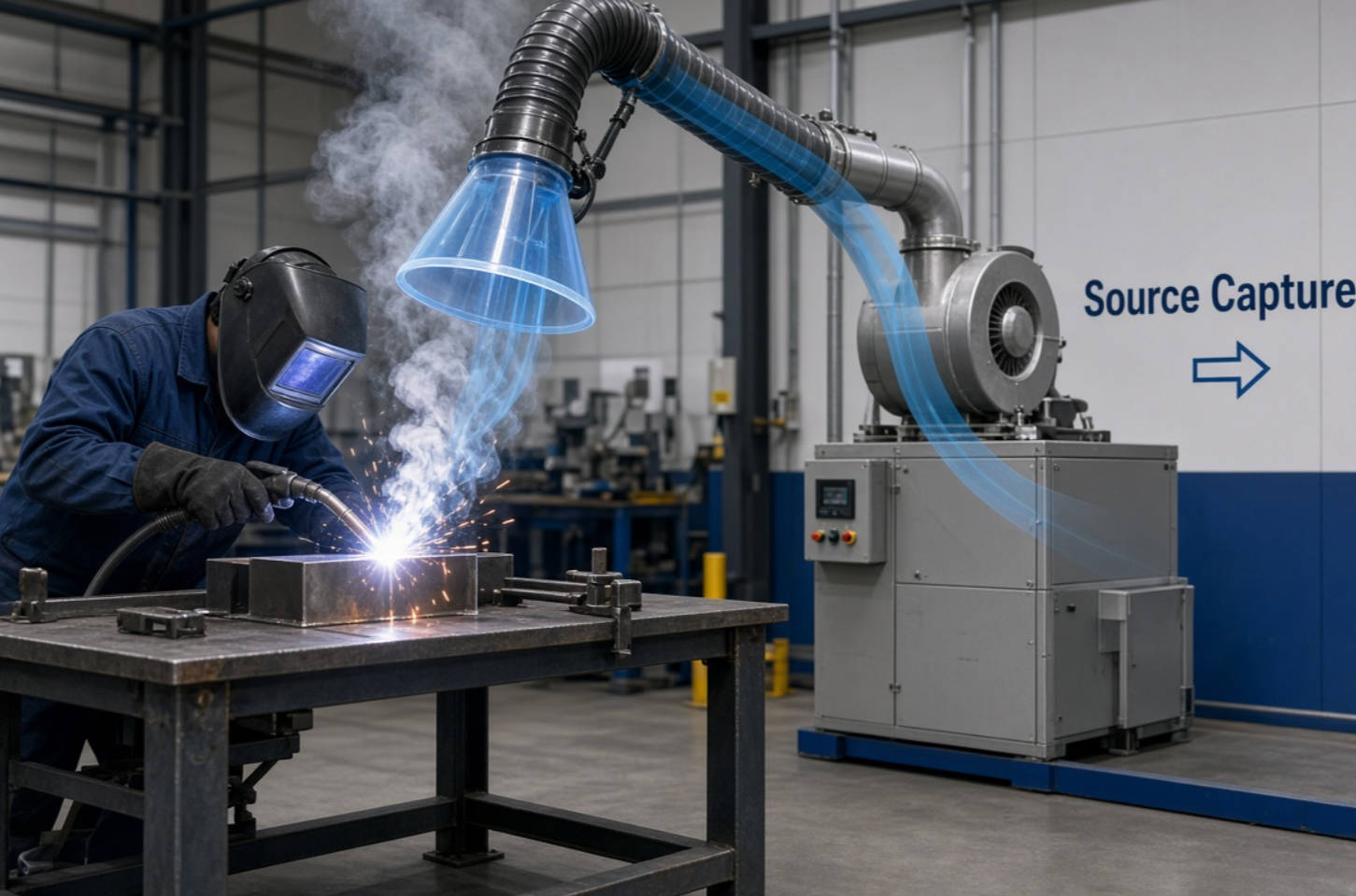
Example: A welding station with a movable extraction arm needs more than general room ventilation. The system must capture contaminants close to the welding arc and pull them through ducting and filtration equipment. That requires a properly sized exhaust blower and a well-designed local exhaust ventilation system.
For welding operations, local exhaust ventilation is generally considered the most effective method because it removes fumes and gases before they disperse into the room. Guidance from the Canadian Centre for Occupational Health and Safety recommends positioning a movable hood as close as practical to the weld and providing at least 100 ft/min, or 0.5 m/s, airflow across the welding arc.
One of the most common procurement mistakes is comparing products only by CFM or m³/h. Free-air airflow is useful, but it does not show how the unit will perform once installed.
A fan may be rated at 200 CFM in open air. If it is mounted behind a restrictive guard, connected to a filter, or placed inside a sealed cabinet, the actual delivered airflow may be far lower.
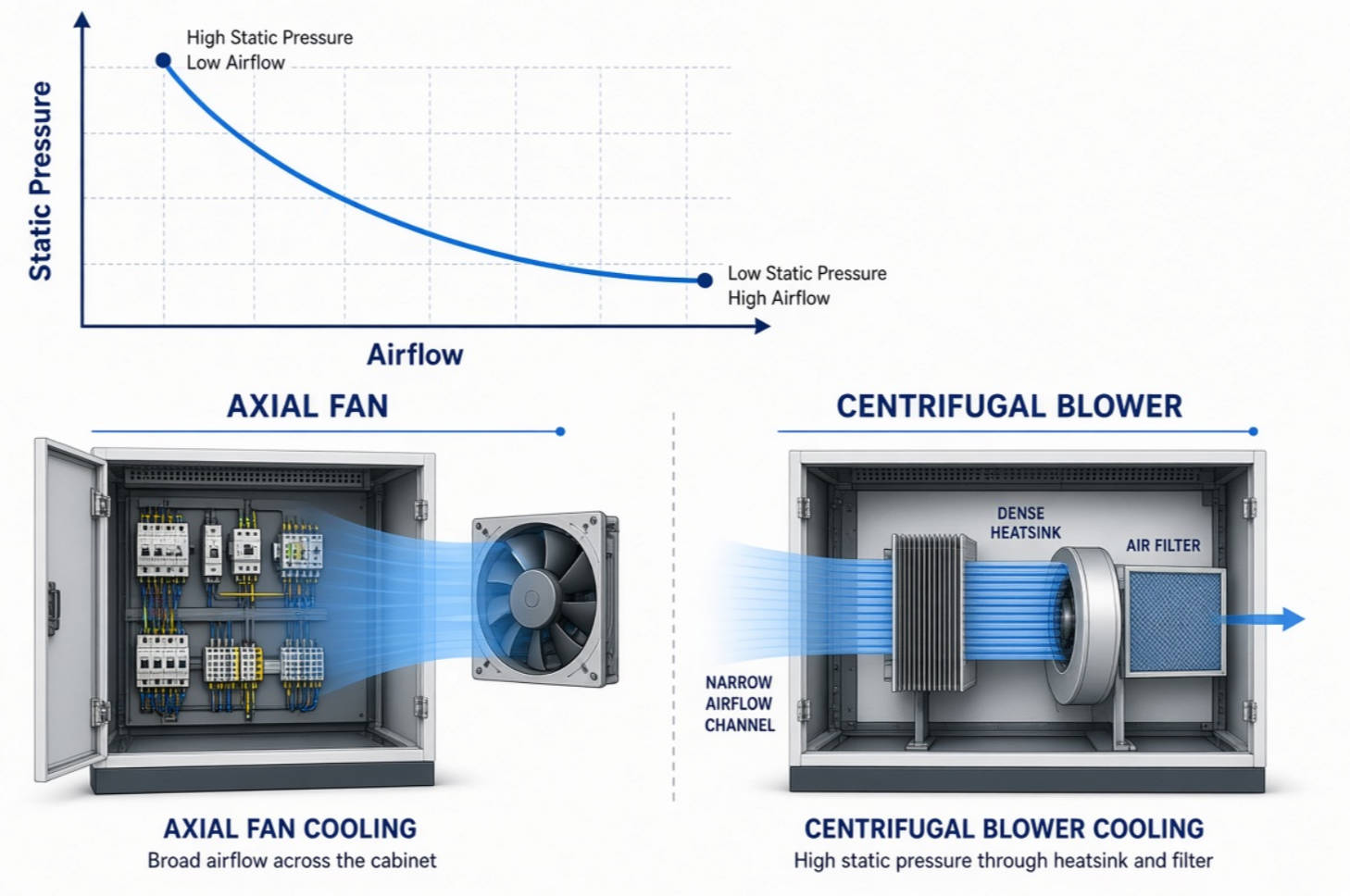
A fan curve shows the relationship between airflow and pressure.
At one extreme, the fan may produce maximum airflow at nearly zero static pressure. At the other extreme, it may produce maximum pressure at nearly zero airflow. The real operating point lies between these conditions.
When reviewing a fan curve, buyers should check:
1. Required airflow: What airflow does the application need in actual operating conditions?
2. Required static pressure: What pressure loss is created by ducts, filters, grilles, heatsinks, bends, and other components?
3. Operating point: Does the selected fan or blower meet both airflow and pressure requirements at the same point?
4. Efficiency: Is the unit operating near an efficient region of the curve?
5. Power requirement: Is the motor sized properly for the expected duty point?
6. Noise level: Will the selected speed and pressure create an unacceptable acoustic result?
7. Future fouling margin: Can the system maintain performance as filters become dirty?
AMCA explains that the system operating point occurs at the intersection of the equipment's fan curve and the system resistance curve. It also notes that a fan should generally operate to the right of peak pressure to avoid unstable airflow and pressure behavior.
For a simplified early-stage assessment:
Required Air-Moving Solution = Airflow Requirement + System Pressure Requirement + Reliability Margin
This is not a final engineering calculation. However, it is an effective procurement mindset. A solution that only meets the airflow requirement but ignores resistance is not properly specified.
A strong selection process combines thermal data, mechanical conditions, environmental risk, and lifecycle cost. The following steps can help equipment manufacturers, engineers, and purchasing teams avoid costly redesigns.
Start with the job that the air-moving device must perform.
Ask:
- Is the goal cooling, ventilation, exhaust, drying, combustion, or material conveying?
- Must air circulate throughout an open space?
- Must contaminants be captured at a specific source?
- Is the goal to cool a single electronic component, a cabinet, or an entire room?
- Does the system require positive pressure, negative pressure, or balanced airflow?
A clear airflow objective prevents the common mistake of choosing a product based only on physical size or price.
For electronics cooling, quantify the heat generated by processors, power modules, batteries, transformers, power supplies, and other components. For industrial ventilation, evaluate pollutant generation, room volume, process heat, and applicable safety requirements.
Do not assume that a larger fan automatically provides better cooling. Poor airflow direction can create recirculation zones where hot exhaust air returns to the intake side.
Create a simple airflow-path map and include:
- Intake grille
- Filter
- Fan guard
- Duct length
- Bends and transitions
- Heat sink fins
- Cabinet openings
- Dampers
- Exhaust louver
- Silencer
- Dust accumulation risk
Every restriction adds pressure loss. In compact telecom, communication, and power-electronics equipment, even a small airflow passage can be a major design constraint.
Request the performance curve for every candidate model. Compare airflow, static pressure, speed, power, efficiency, noise, and expected operating point.
For high-reliability equipment, also review:
- Bearing system and expected service life
- IP rating or dust/water protection
- Operating temperature range
- Alarm output, tachometer signal, PWM control, and speed control
- Redundancy requirements
- Salt-spray, vibration, shock, and EMC conditions where applicable
- Compliance requirements for the target market
Bench testing is valuable, but installed testing is essential. Measure actual airflow, temperature rise, current draw, noise, and pressure after the unit is installed in its final enclosure or duct system.
This is especially important for network equipment, base stations, energy storage systems, EV charging equipment, data communication products, and outdoor cabinets. The airflow path inside the final product may differ significantly from a laboratory setup.
From an electronics cooling perspective, the fan-versus-blower decision often becomes a question of airflow path quality.
An axial DC fan is usually effective when the enclosure allows air to enter freely, pass across components, and exit without major restriction. It can deliver substantial airflow with relatively low energy use.
A DC blower becomes more suitable when the equipment includes dense PCB layouts, narrow air channels, high-fin-density heatsinks, EMI shielding structures, dust filters, or high-power components concentrated in a limited space. In these designs, pressure retention matters more than free-air airflow.

Telecom cabinets and network devices often combine high heat density with strict reliability expectations. The cooling system must operate continuously, sometimes in outdoor or dusty environments.
A suitable solution may require:
- Long-life DC fans or DC blowers
- PWM speed control based on temperature
- Tachometer feedback for fan-failure monitoring
- Redundant fan modules
- High-static-pressure performance for dense airflow paths
- Low-noise operation for indoor network equipment
For these applications, working with an experienced cooling-solution manufacturer helps reduce design iterations. Capital Technology can support customers with CAPITAL-brand DC and AC fan options as well as SANYO DENKI solutions for projects that require demanding performance, reliability, or application-specific selection.
General dilution ventilation can improve room air, but it should not be treated as a substitute for source capture where hazardous welding fumes are generated. Local exhaust ventilation is designed to remove contaminants before they spread into the worker's breathing zone.
A successful extraction system requires more than a high-pressure blower. It also requires appropriate hood placement, duct sizing, filtration, make-up air, maintenance, and airflow verification.
Battery energy storage, UPS systems, inverters, chargers, and power conversion equipment can create concentrated heat loads. Cooling failure can reduce component life, trigger derating, or cause protective shutdowns.
A blower may be preferable when the cooling air must pass through narrow channels or tightly packed components. An axial fan may be preferable when the enclosure supports a direct front-to-back airflow path with low resistance.
The best design often uses multiple fans, intelligent speed control, temperature sensing, and fault monitoring instead of relying on one oversized unit.
The following errors frequently cause poor airflow performance, excessive noise, and premature maintenance costs.
- Selecting by free-air CFM only
- Ignoring static pressure from filters, grilles, ducts, and heatsinks
- Using a general ventilation fan for localized fume extraction
- Installing a high-pressure blower where broad low-pressure circulation is needed
- Underestimating filter loading and maintenance requirements
- Allowing hot exhaust air to recirculate into the intake
- Choosing the lowest-cost motor without reviewing lifetime and environmental conditions
- Oversizing the fan and then restricting it with poor duct design
- Neglecting speed control, monitoring, and redundancy in critical equipment
- Failing to validate actual performance after installation
For workplace contaminant control, ventilation systems should also be designed and maintained as part of a broader safety program. OSHA's ventilation standard is contained in 29 CFR 1910.94, while welding-specific requirements can also vary by process, workplace, and jurisdiction.
Industrial fans and industrial blowers should not be treated as interchangeable products. Fans are typically the smarter choice for high-volume, low-resistance air circulation. Blowers are usually the better choice when air must move through ducts, filters, compact equipment, or other restrictive paths.
The right selection protects more than airflow performance. It can improve equipment reliability, lower energy use, reduce noise, extend service life, support worker safety, and prevent expensive redesigns.
If you are developing telecom equipment, industrial control cabinets, power systems, battery products, communication devices, or other high-reliability equipment, do not select a DC fan, AC fan, or blower based on dimensions and CFM alone. Share your heat load, enclosure drawing, airflow path, voltage, noise target, and environmental requirements with the Capital Technology engineering team.
We can help you evaluate CAPITAL DC fans, AC fans, blowers, and SANYO DENKI cooling solutions to identify a configuration that matches your real operating conditions—not just a catalog number.
An industrial fan is usually designed to move a large volume of air at lower pressure, while an industrial blower is designed to produce more focused airflow and overcome greater system resistance. The correct choice depends on the required airflow and static pressure at the actual installation point.
Sometimes, but not always. An axial fan can work well in low-resistance applications such as open ventilation or direct cabinet airflow. If the system has dense filters, long ducts, narrow channels, sharp bends, or high-fin-density heatsinks, a centrifugal blower may be more effective because it can generate higher static pressure.
Catalog airflow is often measured under low-resistance or free-air conditions. Once the fan is installed behind guards, filters, grilles, heatsinks, or ductwork, static pressure increases and actual airflow decreases. Always review the fan curve and system resistance before final selection.
Add the pressure losses created by every component in the airflow path, including ducts, elbows, filters, grilles, dampers, heatsinks, louvers, and transitions. For accurate results, use engineering calculations, manufacturer data, and installed-system testing.
No. A high-pressure blower may consume more power and create more noise than necessary. If the enclosure has a direct, low-resistance airflow path, an axial DC fan may provide better efficiency. A blower is most valuable when compact geometry or internal restrictions demand higher static pressure.
Provide the required voltage, available installation space, heat load, target airflow, estimated system resistance, operating temperature, duty cycle, noise limit, expected product life, environmental conditions, and any control or alarm requirements. A cabinet drawing or airflow-path diagram can greatly improve selection accuracy.
Local exhaust ventilation captures fumes near the source before they disperse into the work area or reach the worker's breathing zone. It is generally more effective than relying only on natural or general room ventilation for welding fume control.
1. Longwell Fans. "Industrial Blowers vs Fans: Key Differences and When to Use Each." Available at: [https://www.longwellfans.com/industrial-blowers-vs-fans-key-differences-and-when-to-use-each/]
2. Air Movement and Control Association International. "Straightening Out Fan Curves." Discusses airflow, static pressure, fan performance curves, system curves, operating points, efficiency, and selection considerations. Available at: [https://www.amca.org/educate/articles-and-technical-papers/amca-inmotion-articles/straightening-out-fan-curves.html]
3. Canadian Centre for Occupational Health and Safety. "Welding – Ventilation." Covers natural dilution ventilation, mechanical dilution ventilation, local exhaust ventilation, movable hood placement, and recommended air velocity across a welding arc. Available at: [https://www.ccohs.ca/oshanswers/safety_haz/welding/ventilation.html]
4. Occupational Safety and Health Administration. "29 CFR 1910.94 – Ventilation." U.S. occupational ventilation requirements under Subpart G. Available at: [https://www.osha.gov/laws-regs/regulations/standardnumber/1910/1910.94]
5. The Fabricator. "How Clean Is the Air in Your Manufacturing Facility?" Discusses industrial air quality, welding fume control, source capture, filter considerations, and ventilation-system practices. Available at: [https://www.thefabricator.com/thefabricator/article/safety/how-clean-is-the-air-in-your-manufacturing-facility-]
6. Government of Canada. "Welding and Allied Processes: A Guide to Health Hazards and Hazard Control." Covers welding hazards, local exhaust ventilation, source capture, and recommended airflow practices. Available at: [https://www.canada.ca/en/employment-social-development/services/health-safety/reports/guide-welding.html]


