From idea to market-ready product, our NPI solutions make every stage easier, faster. Discover How We Help
Help Center

Views: 222 Author: Astin Publish Time: 2026-04-24 Origin: Site
As an engineer working with DC and AC cooling solutions for more than a decade, I've seen industrial blower fans quietly decide whether a production line runs smoothly—or fails at the worst possible moment. This guide walks you through how industrial blower fans really work in the field, how to choose the right one, and what I've learned from hands‑on projects with telecom, power, and electronics manufacturers. [sofasco]
An industrial blower fan is a high‑capacity air-moving device designed to deliver controlled airflow and static pressure for ventilation, cooling, drying, dust removal, and fume extraction in demanding environments. Unlike small household fans, industrial blowers are built for continuous duty, harsh conditions, and precise performance within complex systems such as telecom cabinets, power equipment, and process lines. [iqsdirectory]
Industrial blowers typically consist of an electric motor, an impeller (fan wheel), housing (scroll), and inlet/outlet interfaces that integrate with ducts, enclosures, or equipment. Engineers select these components to meet specific airflow (CFM), static pressure, noise, and reliability targets over thousands of operating hours. [baghouseamerica]
From a user's perspective, the first confusion is often: "Is this a blower or just a fan?"
- Airflow direction
- Ordinary axial fans move air in a straight line, from front to back, with relatively low pressure but high volume. [sofasco]
- Blowers (often centrifugal) pull air in axially and discharge it radially or tangentially, creating higher static pressure suitable for ducting, filters, and complex paths. [iqsdirectory]
- Pressure capability
- Standard fans: Best for open spaces, simple ventilation of rooms or cabinets with low resistance. [sofasco]
- Blowers: Designed to overcome system resistance from ductwork, bends, filters, heat exchangers, and confined enclosures. [blowerfab]
- Typical use cases
- Fans: Comfort cooling, general room ventilation, basic electronics cooling.
- Blowers: Industrial process ventilation, dust and fume extraction, drying tunnels, combustion air, telecom and power cooling where airflow paths are restricted. [blowerfab]
When we design cooling solutions for telecom, power, or industrial control systems, we mainly consider the following categories. [baghouseamerica]

Centrifugal blowers use a rotating impeller that throws air outward into a scroll-shaped housing, converting velocity into pressure. [iqsdirectory]
- Key characteristics
- Higher static pressure than axial fans for the same size. [baghouseamerica]
- Stable performance even when ducting or filters add resistance. [blowerfab]
- Robust construction suited for dusty, humid, or high‑temperature environments. [sofasco]
- Common applications
- Dust collection and particulate control
- Furnace and boiler draft
- Industrial drying and cooling tunnels
- Chemical and petrochemical ventilation systems [blowerfab]
In some projects, high‑performance axial fans are configured to act as blowers in constrained ducts or equipment housings. [iqsdirectory]
- Best for:
- High airflow, moderate pressure systems like telecom cabinets, base stations, IT racks, and HVAC units. [sofasco]
- Cooling electronic enclosures where space and airflow direction are constrained but pressure requirements are still moderate. [thermalspray]
- Typical industries:
- Telecom (ZTE, HUAWEI-style base stations and network gear)
- Data centers and communication equipment
- Industrial automation cabinets and power supplies [sanyodenki]
- Explosion-proof blowers: Prevent ignition of flammable dusts or vapors in hazardous areas by using special housings, motors, and grounding. [industrialfansdirect]
- High-temperature blowers: For ovens, kilns, and process exhaust where materials and bearings withstand elevated temperatures. [iqsdirectory]
- Corrosion-resistant blowers: Use coated steel or plastics for chemical and wastewater applications. [baghouseamerica]
Industrial blower fans appear in almost every modern facility, but the context determines how we specify and integrate them. [airprofan]
- Removal of fumes, vapors, and contaminated air from process lines, painting booths, welding areas, and chemical handling zones. [airprofan]
- Supports compliance with safety and environmental regulations by maintaining air quality and managing emissions. [blowerfab]
- Cooling of industrial machines, drives, transformers, telecom base stations, and power electronics by forcing air across heat sinks, coils, and enclosures. [thermalspray]
- In my own projects, correctly sized DC axial fans and blowers inside compact enclosures have often reduced component temperatures by more than 10–15°C compared to passive solutions, significantly extending equipment life. [sanyodenki]
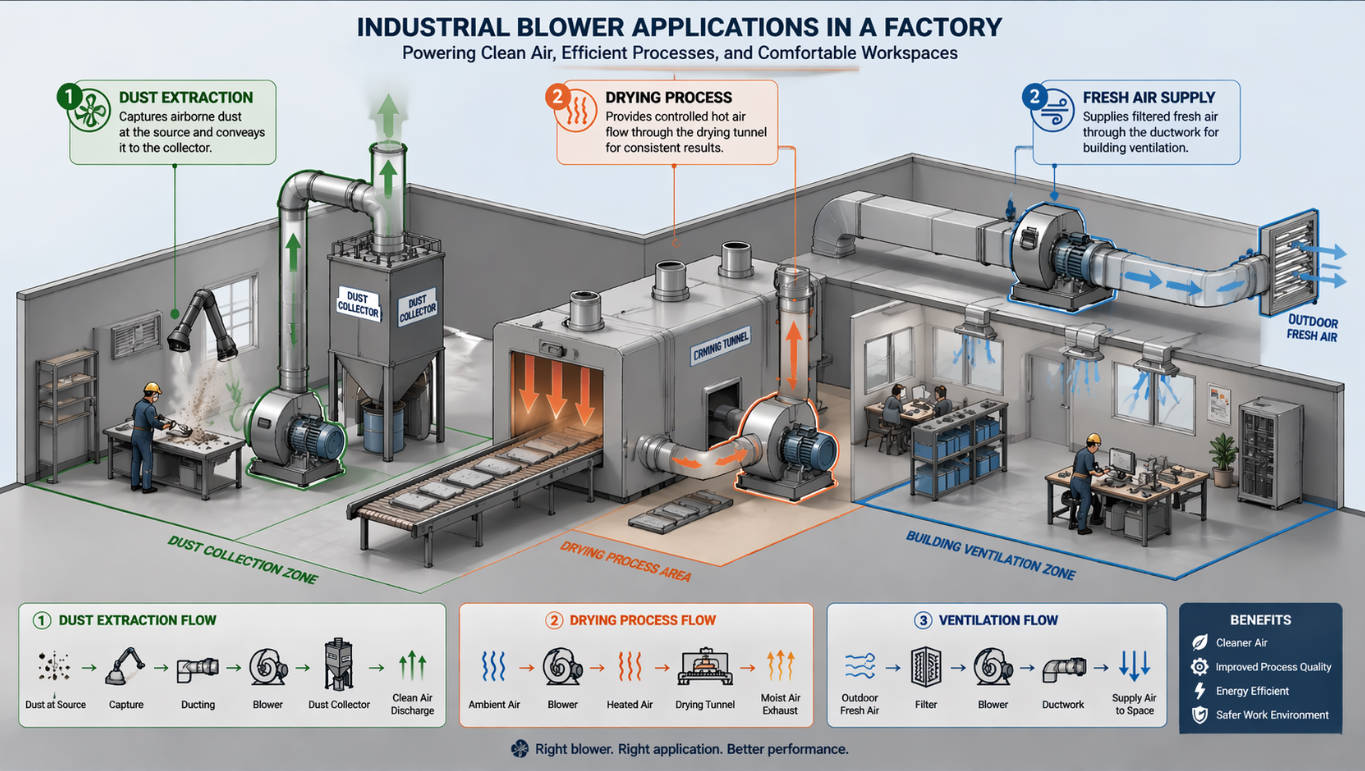
- Used in drying ovens, conveyor dryers, and food processing lines to accelerate moisture removal by moving heated air at controlled speeds. [baghouseamerica]
- Critical for consistent product quality in coatings, textiles, and packaged food production. [sofasco]
- Blowers provide the suction and transport force required for baghouses, cyclones, and central vacuum systems. [iqsdirectory]
- Properly sized and controlled blowers help maintain negative pressure in dust‑generating zones, improving worker safety and equipment reliability. [baghouseamerica]
- Supply and exhaust air in industrial buildings, tunnels, underground facilities, and parking structures. [airprofan]
- Provide fresh air, smoke control, and pressurization to meet building codes and comfort requirements. [airprofan]
A helpful image here is a simple process layout showing where blowers sit in a dust collection system, a drying line, and an HVAC loop.
As a manufacturer focusing on DC fans (DC blowers) and AC fans, I've seen clear patterns in how engineers choose between the two in real projects. [sanyodenki]
- DC blowers and fans
- Precise speed control via PWM or voltage adjustment, enabling smart thermal management and noise optimization. [sanyodenki]
- Better efficiency at partial load in many electronic cooling applications.
- Ideal for telecom, IT, and embedded equipment where the controller can modulate airflow based on temperature or load. [thermalspray]
- AC blowers and fans
- Simple wiring and direct connection to mains power, widely used in industrial HVAC and large machines. [sofasco]
- Robust and proven in continuous-duty industrial installations with stable supply voltages. [iqsdirectory]
- DC fans with advanced bearing systems and optimized blade profiles from major brands (e.g., SANYO DENKI San Ace series) deliver high MTBF in demanding electronic systems. [sanyodenki]
- AC fans excel where space is less constrained and the primary requirement is rugged, continuous operation in plant environments. [sofasco]
From an engineering perspective, most blower failures in the field trace back to poor sizing or specification, not manufacturing defects. A structured selection process significantly reduces that risk. [sanyodenki]
- Airflow (CFM or m³/h): Calculate how much air is needed based on heat load, air changes, or process requirements. [sanyodenki]
- Static pressure (Pa or inches H₂O): Estimate total system resistance, including ducts, filters, bends, and dampers. [baghouseamerica]
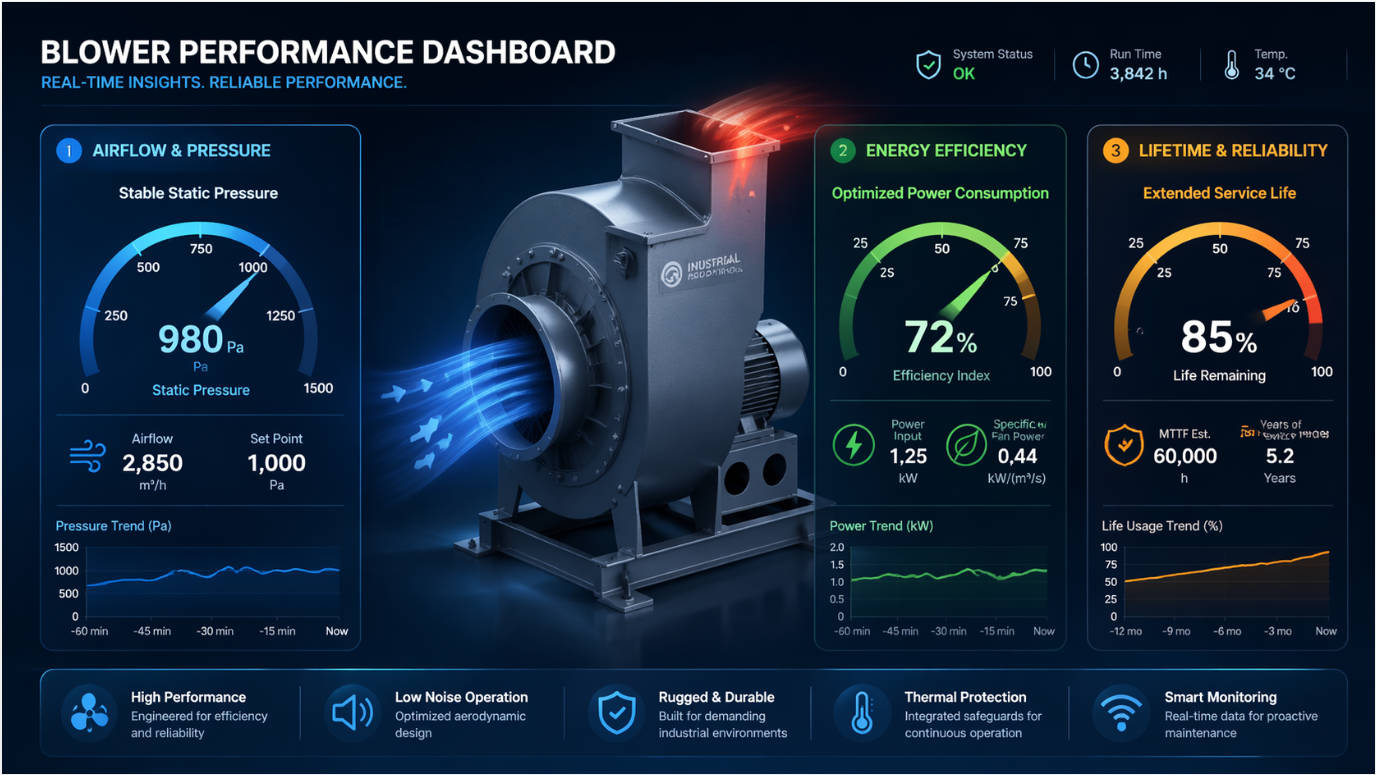
- Use blower performance curves to ensure the operating point lies in the stable, efficient region of the fan's chart. [iqsdirectory]
- Temperature range: Maximum inlet air temperature and any hot spots around motors or electronics. [sofasco]
- Contaminants: Dust, moisture, corrosive gases, or oil mist influence material and sealing choices. [baghouseamerica]
- Ingress protection: For outdoor or harsh environments, consider fans meeting up to IP68-level water and dust protection where appropriate. [sundafan.com]
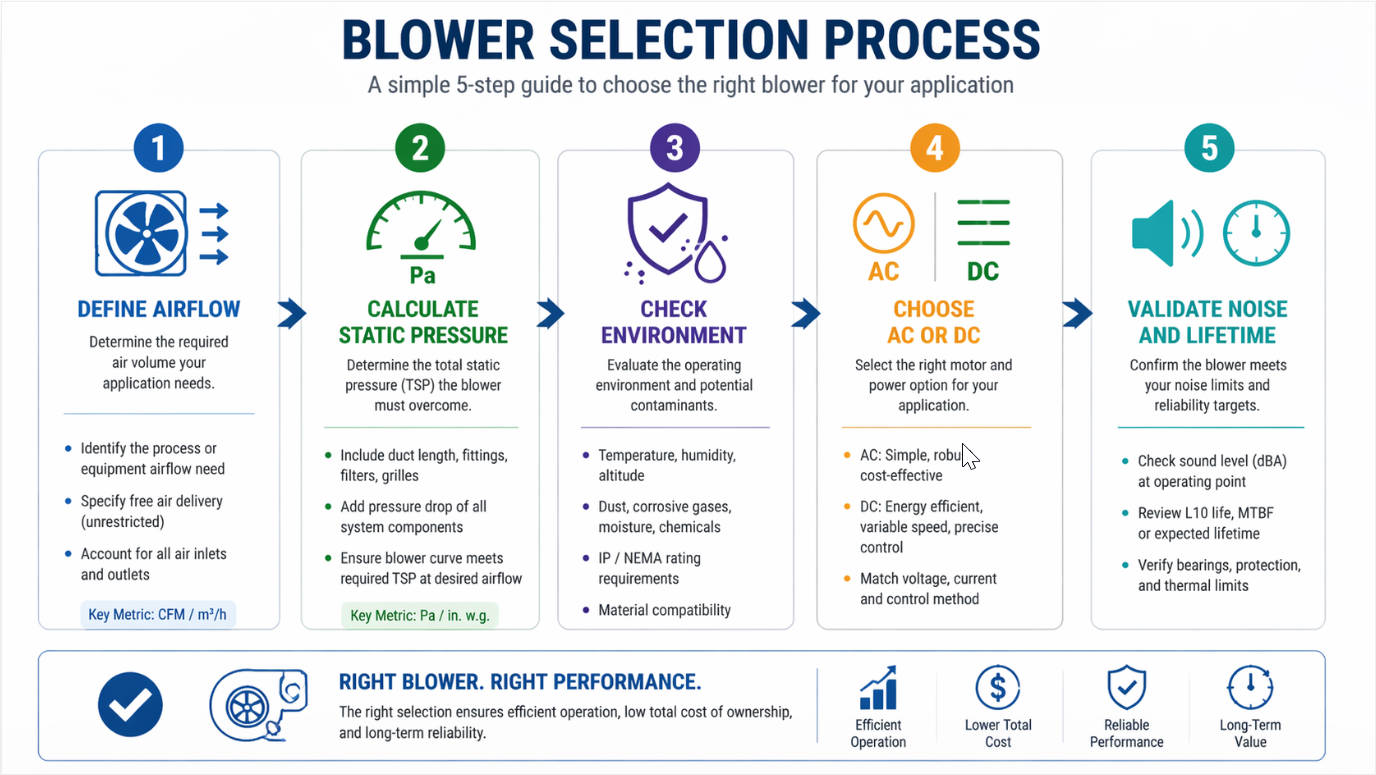
- Choose AC vs. DC based on available supply, control requirements, and integration with your existing system. [sanyodenki]
- For smart equipment, DC fans with PWM control enable dynamic adjustment to load, reducing noise and power consumption. [sanyodenki]
- Noise: Important for telecom, IT, and indoor environments; blade design, speed, and mounting strongly affect sound levels. [thermalspray]
- Efficiency: High-efficiency impellers and motors reduce energy cost over the blower's life. [iqsdirectory]
- Bearing technology: Ball vs. sleeve bearings, lubrication, and orientation impact lifetime in continuous duty applications. [sanyodenki]
In telecom and industrial electronics, such as base stations, radios, and industrial controllers, blower selection is rarely just about "moving air." It is about system reliability and long‑term maintainability. [thermalspray]
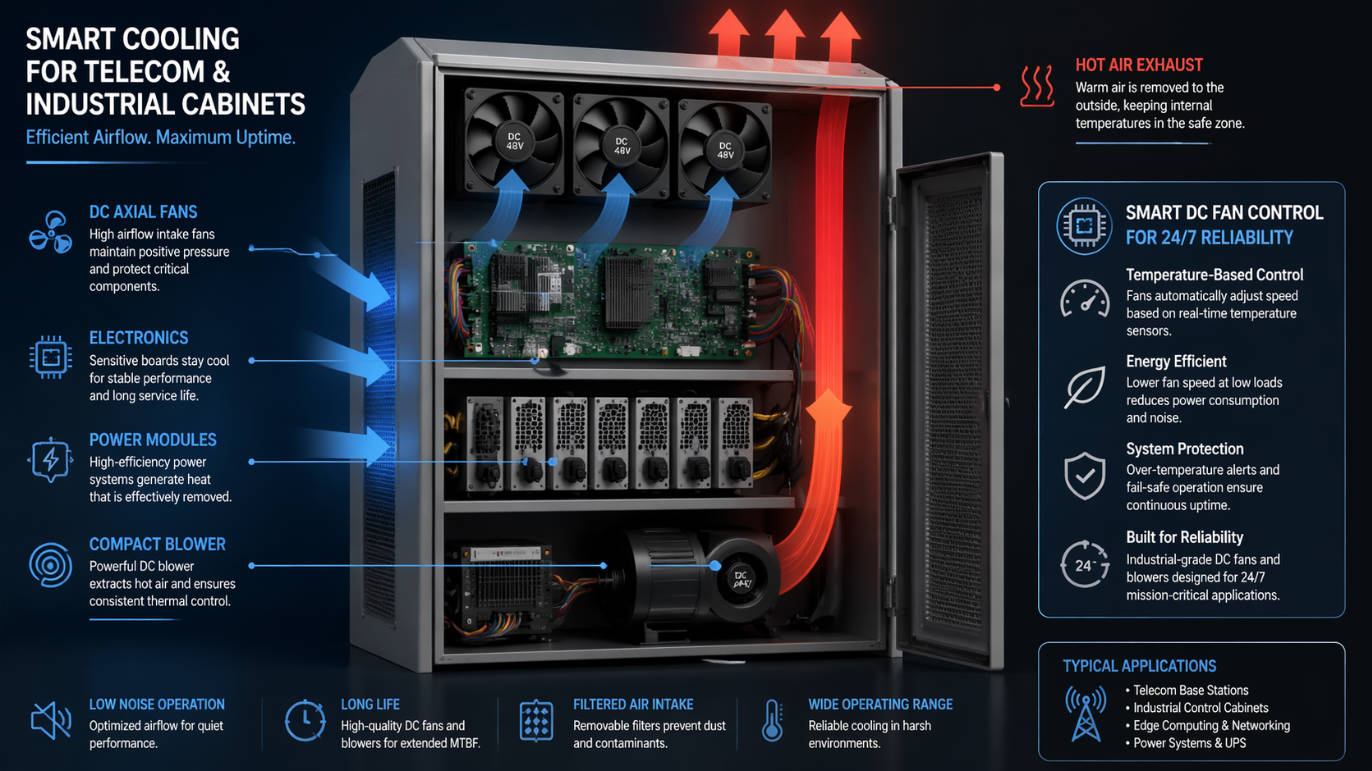
- Equipment like that used by leading telecom OEMs typically runs 24/7 in outdoor, dusty, and thermally challenging environments. [thermalspray]
- Designers often combine DC axial fans for high airflow and centrifugal blowers for focused, high‑pressure cooling of dense power modules or RF sections. [thermalspray]
- Using fans and blowers from proven brands with strong technical documentation and support simplifies certification, field replacement, and global deployment. [sanyodenki]
In my experience, involving a fan and blower specialist early—during enclosure and thermal design—prevents expensive mechanical redesigns later when testing reveals hot spots or airflow bottlenecks.
| Industry / Scenario | Typical Blower Role |
|---|---|
| Power & Energy | Cooling transformers, inverters, and switchgear enclosures |
| Telecom & Data Communication | Base station, server, and network hardware cooling in confined cabinets |
| Metals & Mining | Dust extraction, fume removal, and ventilation in harsh, particulate‑laden environments |
| Food Processing | Drying and cooling of products on conveyor lines, hygienic ventilation |
| Cement & Construction | Material conveying air, kiln and process ventilation, dust collection |
| Petrochemical & Chemical | Corrosive gas handling, process exhaust, explosion‑risk area ventilation |
| General HVAC / Building Infrastructure | Fresh air supply, exhaust, parking garage ventilation, tunnel air control |
Data and industry examples draw on typical blower application patterns across industrial sectors. [airprofan]
Based on both field experience and industry best practices, you should involve a specialist when: [thermalspray]
- Your system operates in harsh environments (outdoor, corrosive, high‑dust, high‑humidity, or wide temperature swings). [baghouseamerica]
- You face strict reliability and uptime requirements, such as telecom, power, or mission‑critical industrial control. [thermalspray]
- You're integrating multiple blowers into a confined space where airflow paths interact, creating unexpected hot spots. [thermalspray]
A knowledgeable partner can simulate airflow, propose suitable DC or AC fans, recommend IP ratings, and help calculate airflow and pressure, reducing design risk and speeding up certification. [iqsdirectory]
Selecting the right industrial blower fan is not just a catalog exercise—it is a design decision that directly affects system reliability, safety, and total cost of ownership. If you are working on a new telecom, power, or industrial electronics project and need to specify DC fans, AC fans, or custom blower solutions, it makes sense to involve a specialist early. [baghouseamerica]
If you want help reviewing your current design, comparing DC and AC options, or selecting blower models for harsh or high‑reliability applications, reach out to our engineering team with your airflow, temperature, and environmental requirements. We can collaborate with your mechanical and electrical engineers to propose a tailored, field‑tested thermal solution that fits your project's constraints. [thermalspray]
You likely need a blower when your system includes ducts, filters, heat exchangers, or any other components that create significant airflow resistance. If you must move air through a complex path or maintain specific pressure levels, a blower is usually more appropriate than a simple axial fan. [blowerfab]
You must match both required airflow (CFM or m³/h) and static pressure at the operating point defined by your system. Many problems occur when designers only consider airflow and ignore how ducts, filters, and bends increase resistance. [iqsdirectory]
In electronics and telecom applications where variable speed control is used, DC blowers often provide better partial‑load efficiency and more precise thermal management. In large, constant‑speed industrial installations with stable mains power, AC blowers can be equally effective and simpler to integrate. [sofasco]
Maintenance intervals depend on environment and duty cycle, but regular inspection of bearings, dust accumulation, and electrical connections is recommended for continuous‑duty systems. Operating blowers within rated temperature, voltage, and cleanliness conditions significantly extends their service life, reducing unplanned downtime. [sofasco]
A single blower can support multiple branches via ducting and dampers, but each branch adds resistance and complexity to control. In critical applications, using separate blowers for key processes improves redundancy and simplifies troubleshooting and balancing. [blowerfab]
1. Sofasco Fans – "Industrial Blower Fan Overview and Applications"
<https://sofasco.com/blogs/article/industrial-blower-fan-overview-and-applications> [sofasco]
2. IQS Directory – "Types, Uses, and Creation of Industrial Blowers"
<https://www.iqsdirectory.com/articles/blower/industrial-blower.html> [iqsdirectory]
3. Baghouse America – "Industrial Blower: What Is It? How Are They Used?"
<https://www.baghouseamerica.com/blog/industrial-blower-what-is-it-how-are-they-used/> [baghouseamerica]
4. Industrial Fans Direct – "What Is The Use Of A Blower?"
<https://industrialfansdirect.com/what-does-a-blower-do> [industrialfansdirect]
5. A&A Coatings – "Understanding Industrial Fans And Blowers"
<https://www.thermalspray.com/understanding-industrial-fans-blowers/> [thermalspray]
6. BlowerFab – "Industrial Blower Fan – Important Things to Know"
<https://www.blowerfab.com/know-before-buying-industrial-blower-fan/> [blowerfab]
7. AirPro Fan & Blower Company – "Industrial Fan & Blower Applications"
<https://airprofan.com/applications/> [airprofan]
8. SANYO DENKI – "San Ace Technical Information (Fan Overview and Selection)"
<https://www.sanyodenki.com/global/archive/document/product/servo/San_Ace_technicalinfo_2021.pdf> [sanyodenki]
9. SUNDA – Industrial Cooling Fans (Waterproof and Dustproof IP68)
<https://sundafan.com.tw> [sundafan.com]
10. WG Content – "E-E-A-T for Content Quality and SEO"
<https://wgcontent.com/blog/eeat-content-quality-seo-geo/> [wgcontent]
11. StellarContent – "The Complete Guide to Google E-E-A-T"
<https://www.stellarcontent.com/blog/seo/the-complete-guide-to-google-e-a-t-what-is-it-why-is-it-and-how-do-you-create-it/> [stellarcontent]
12. TinyMCE – "Blog UX Best Practices and Mistakes to Avoid"
<https://www.tiny.cloud/blog/blogging-best-practice-ux-mistakes/> [tiny]
13. eesel AI – "How to Write Blog CTAs That Actually Convert Readers"
<https://www.eesel.ai/blog/how-to-write-blog-ctas> [eesel]


