From idea to market-ready product, our NPI solutions make every stage easier, faster. Discover How We Help
Help Center

Views: 273 Author: Capital Technology Publish Time: 2026-09-20 Origin: Site
Content Menu
● Why HVAC Fan Selection Has a Major Impact on System Performance
● Main Types of Fans Used in HVAC Systems
>> Axial Fans for High Airflow and Compact Installations
>>> Best applications for axial fans
>> Centrifugal Fans for Higher Static Pressure
>>> Forward-Curved Centrifugal Fans
>>> Backward-Curved Centrifugal Fans
>>> Radial Fans for Dirty or Abrasive Air
● Axial Fan vs. Centrifugal Fan: Which Is Better for HVAC?
● The Overlooked Factor: System Effect and Installation Quality
>> Practical installation recommendations
● How EC Fans and DC Fans Improve HVAC Efficiency
>> Benefits of EC and DC fan solutions
● A Practical HVAC Fan Selection Process
>> Step 1: Define the required airflow
>> Step 2: Calculate total static pressure
>> Step 3: Identify the real operating environment
>> Step 4: Establish noise and vibration limits
>> Step 5: Select the fan curve, not only the product size
>> Step 6: Validate the final assembly
● Common HVAC Fan Selection Mistakes
● Choosing a Reliable HVAC Fan Supplier
● Get the Right Fan for Your HVAC Application
● FAQ
>> 1. What is the main difference between an axial fan and a centrifugal fan?
>> 2. Which fan type is best for an HVAC air-handling unit?
>> 3. Can a DC fan be used in HVAC equipment?
>> 4. Why does a fan deliver less airflow after installation than in the catalogue?
>> 5. How can I reduce HVAC fan noise?
>> 6. Why should I consider an EC fan instead of a standard AC fan?
>> 7. What information should I provide when requesting a fan recommendation?
Selecting the right HVAC fan type is not simply a question of airflow volume. It requires matching airflow, static pressure, installation space, noise limits, energy targets, control requirements, and the real resistance of the duct or equipment system. A fan that looks adequate on a catalogue curve can still underperform after installation if the system effect, inlet conditions, or control strategy is ignored.
For HVAC OEMs, equipment designers, and maintenance teams, the most common decision is whether to use an axial fan, a centrifugal fan, or an electronically controlled solution such as an EC fan, DC fan, or variable-speed AC fan. This guide explains where each HVAC fan design performs best, how to avoid costly selection errors, and what engineers should evaluate before approving a cooling-fan solution.
At Capital Technology Co., Limited, we work with thermal-management requirements across telecommunications, industrial equipment, power electronics, HVAC-related enclosures, and critical cooling applications. As the manufacturer of the CAPITAL brand and a leading distributor of SANYO DENKI products, we support customers that require dependable airflow solutions, including established companies such as ZTE, HUAWEI, and HYTERA.
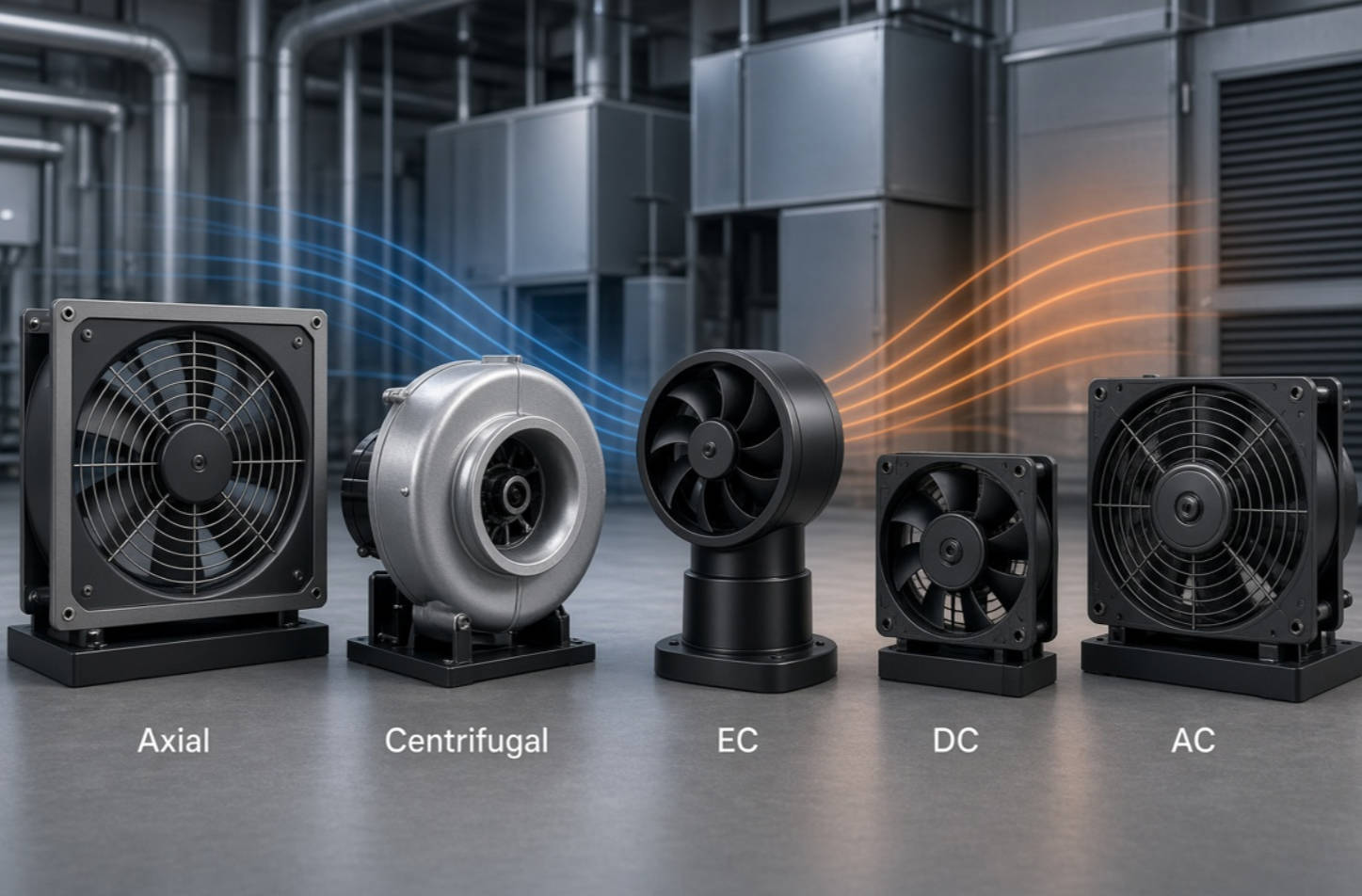
A fan is the component that creates the pressure difference needed to move air through coils, filters, ducts, heat exchangers, louvers, grilles, electronic cabinets, and other restrictions. In practice, the required airflow is only one part of the selection process.
A fan must deliver the required operating point after accounting for the total resistance of the system.
That resistance may come from:
- Air filters
- Cooling or heating coils
- Duct length and duct geometry
- Bends, elbows, dampers, and transitions
- Louvers and weather hoods
- Acoustic attenuators
- Dust buildup during operation
- Cabinet openings and protective fan guards
- Altitude, temperature, humidity, and air-density changes
A common mistake is choosing a fan based only on free-air airflow. Free-air performance does not reflect the real operating condition inside an HVAC unit, air-handling cabinet, telecommunications enclosure, or cooling module.
The actual operating point occurs where the fan curve and the system-resistance curve meet. If the fan cannot overcome the required static pressure, delivered airflow drops. This can increase equipment temperature, reduce coil performance, cause overheating alarms, raise energy consumption, and shorten component life.
AMCA notes that "system effect" can reduce real installed fan performance when airflow near the fan inlet or outlet is turbulent, swirling, or uneven. In other words, a correctly sized fan may still perform poorly if it is installed in a poor duct arrangement.
The most widely used HVAC fan designs include axial fans, centrifugal fans, mixed-flow fans, and electronically controlled fan systems. Each design has a different balance of airflow capacity, static-pressure capability, acoustic behavior, physical size, and cost.
| HVAC fan type | Airflow direction | Typical pressure capability | Typical strengths | Common applications |
|---|---|---|---|---|
| Axial fan | Parallel to shaft | Low to medium | Compact, high airflow, simple structure | Condensers, cooling towers, cabinet ventilation, outdoor units |
| Tube axial fan | Parallel to shaft inside a tube | Medium | Improved airflow direction and duct compatibility | Ducted ventilation, process exhaust, air movement systems |
| Vane axial fan | Parallel to shaft with guide vanes | Medium to high | Higher pressure and improved airflow efficiency | Industrial HVAC, tunnels, process systems, large ductwork |
| Forward-curved centrifugal fan | Perpendicular to shaft | Low to medium | High airflow in compact blower housings | Fan-coil units, furnaces, air handlers, packaged equipment |
| Backward-curved centrifugal fan | Perpendicular to shaft | Medium to high | Efficient operation and better pressure handling | AHUs, filtration systems, industrial air handling |
| Radial centrifugal fan | Perpendicular to shaft | High | Durable in contaminated or particulate air streams | Dust collection, material handling, industrial exhaust |
| EC/DC fan system | Depends on impeller type | Depends on impeller type | Variable speed, intelligent control, high part-load efficiency | Smart HVAC equipment, telecom cooling, precision cooling |
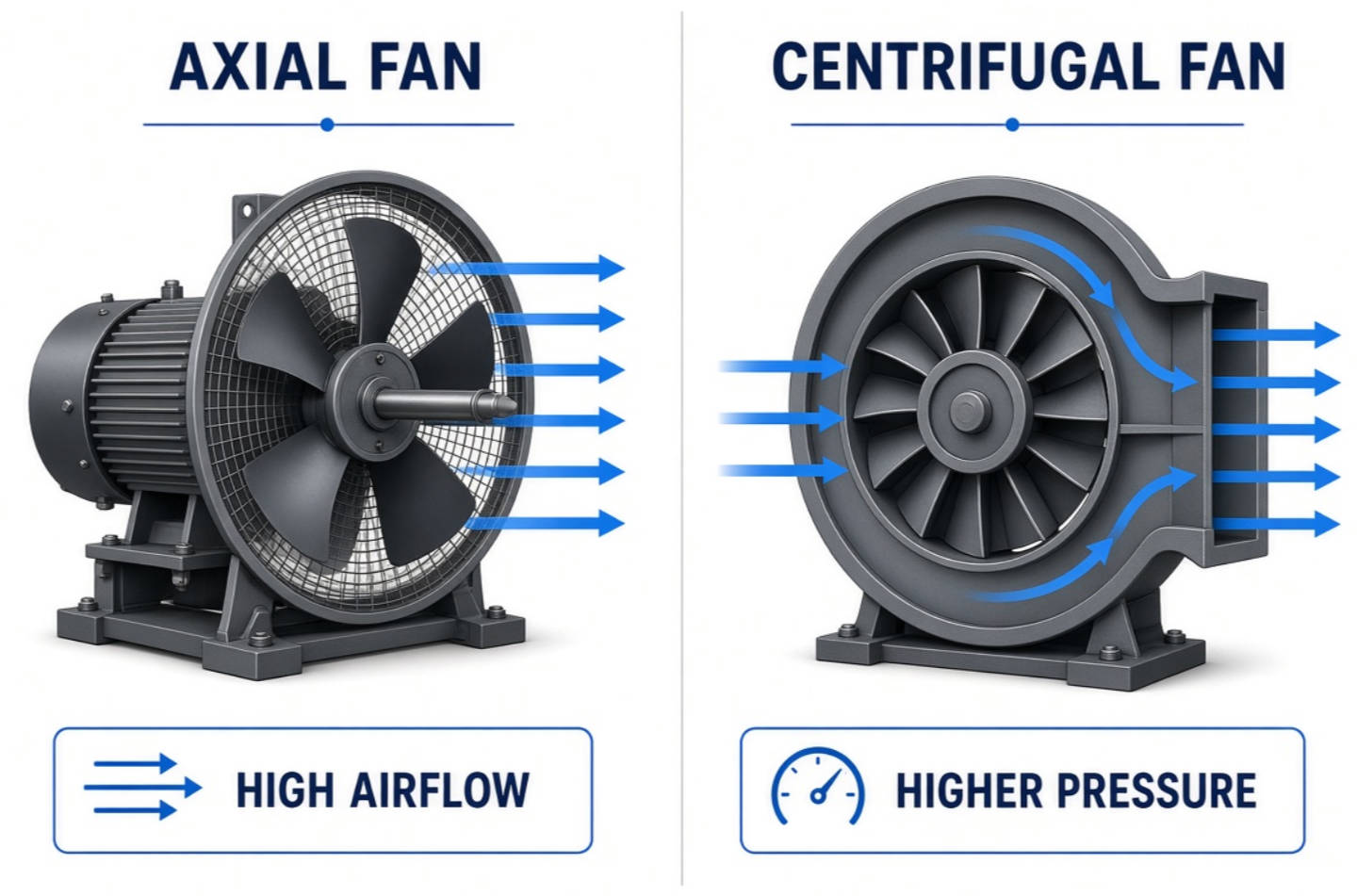
An axial fan moves air parallel to the motor shaft. It operates in a similar direction to an aircraft propeller: the rotating blades create aerodynamic lift, accelerating air along the fan axis.
Axial fans are widely used when the system needs substantial airflow but only modest resistance capability. Their compact depth and straightforward construction make them especially useful where space is limited.
Typical axial-fan variants include:
- Propeller fans, which provide basic high-volume airflow in low-resistance applications
- Tube axial fans, which use a cylindrical housing to guide air and reduce recirculation
- Vane axial fans, which use guide vanes to reduce swirl and improve pressure performance
Axial fans are commonly selected for:
- Outdoor air-conditioning condensers
- Cooling towers
- Heat-pump outdoor units
- Equipment cabinets and electrical enclosures
- Telecom base stations
- Power supplies and inverters
- Automotive cooling systems
- Refrigeration equipment
- General ventilation systems
- Electronics and server-rack cooling
For DC-powered equipment, a DC axial fan can be an especially practical choice. It provides compact cooling performance while allowing speed control through PWM, voltage control, or intelligent fan-control electronics.
However, axial fans are not always ideal for systems with high static pressure. A dense filter, restrictive heat exchanger, narrow duct path, or heavily guarded intake can sharply reduce axial-fan airflow.
A centrifugal fan draws air into the impeller inlet and discharges it at approximately 90 degrees to the inlet direction. The rotating impeller increases air velocity, while the fan housing converts a portion of that velocity into static pressure.
This design makes centrifugal fans highly suitable for HVAC applications with filters, coils, ductwork, long air paths, or variable resistance.
Centrifugal fans are generally divided into three major groups:
- Forward-curved centrifugal fans
- Backward-curved centrifugal fans
- Radial-blade centrifugal fans
Forward-curved centrifugal fans have many small blades curved in the direction of wheel rotation. They are frequently used in compact blower assemblies, furnaces, fan-coil units, and residential or light-commercial air-handling equipment.
Their advantages include:
- High airflow from a relatively compact wheel
- Good suitability for packaged equipment
- Relatively low initial cost
- Familiarity in blower applications
However, forward-curved blowers must be selected carefully. Their power demand can rise rapidly as airflow increases, so poor system design or incorrect motor selection may create overload risk.
Backward-curved centrifugal fans use blades that curve away from the direction of rotation. They are commonly chosen for air-handling units, filtration equipment, industrial ventilation, and systems that need a more efficient pressure-and-airflow balance.
Their main benefits include:
- Stronger efficiency potential
- Good operation at medium-to-high static pressure
- Better suitability for variable-speed control
- More stable performance in demanding HVAC systems
- Lower overload tendency than many forward-curved designs
Backward-curved fans are often a strong option for modern HVAC equipment where energy efficiency, controllability, and lifecycle cost matter more than the lowest initial purchase price.
Radial-blade centrifugal fans are typically used when air contains dust, fibers, chips, moisture, particles, or contaminants. Their rugged impeller designs can be more tolerant of harsh process conditions than some high-efficiency airfoil designs.
Common applications include:
- Dust-collection systems
- Industrial exhaust
- Material-handling systems
- Drying equipment
- Metalworking facilities
- Process ventilation
- Pollution-control equipment
Neither axial nor centrifugal fans are universally better. The correct choice depends on the duty point and installation environment.
| Selection factor | Axial fan | Centrifugal fan |
|---|---|---|
| Best airflow condition | High airflow with low resistance | Controlled airflow with moderate or high resistance |
| Static-pressure capability | Usually low to medium | Usually medium to high |
| Installation depth | Compact | Often requires a scroll housing or larger assembly |
| Ducted-system suitability | Limited unless designed for duct use | Excellent for ducts, filters, coils, and long air paths |
| Noise behavior | Can generate blade-pass and aerodynamic noise | Can be quieter in some ducted applications, depending on design |
| Typical HVAC uses | Condensers, cooling towers, cabinet ventilation | Air handlers, furnaces, filtration, industrial ventilation |
| Control potential | Strong with DC or EC axial fans | Strong with EC centrifugal blowers and VFD systems |
A practical rule is simple:
- Choose an axial fan when high airflow is needed with relatively low system resistance.
- Choose a centrifugal fan when the system has filters, coils, ducts, pressure loss, or changing resistance.
- Choose an EC fan or DC fan solution when energy efficiency, variable speed, monitoring, and precise thermal control are important.
Many fan-selection problems are actually installation problems.
A fan tested in a laboratory may deliver a different result when mounted near an elbow, abrupt transition, obstruction, damper, grille, or poorly designed intake. These conditions can create turbulence or swirl before the air reaches the fan, reducing usable airflow and increasing noise.
AMCA identifies this loss as system effect. It occurs when the airflow entering or leaving the fan is not uniform or fully developed.
To reduce system-effect losses:
1. Provide straight duct length before the fan inlet whenever possible.
2. Avoid placing a sharp elbow directly at the fan inlet.
3. Use smooth, gradual transitions instead of abrupt expansions or contractions.
4. Keep guards, screens, and louvers clean and appropriately sized.
5. Ensure that the fan outlet has enough space for airflow to stabilize.
6. Check whether filters, coils, and accessories create higher resistance over time.
7. Validate airflow and static pressure after final installation, not only during design.
AMCA guidance indicates that outlet duct length should generally allow air to diffuse and develop after leaving the fan. As a rule of thumb, it recommends at least 2.5 duct diameters at outlet velocities up to 2,500 feet per minute, with additional length needed at higher velocities.
This point is especially important for OEM equipment. A small layout change inside a cabinet can affect airflow, noise, motor load, and thermal performance more than expected.
Modern HVAC systems increasingly use electronically controlled motors and fan assemblies. These include EC fans, brushless DC fans, and variable-speed fan systems.
An EC motor combines motor and electronic control technology, allowing the fan speed to adjust more precisely to demand. Rather than repeatedly operating at full speed, an EC or DC fan can reduce speed during lower-load conditions.
This matters because fan power changes rapidly with speed. In simplified fan-law terms:
P∝N3
Where P is power and N is rotational speed.
This means a modest reduction in fan speed can produce a much larger reduction in power consumption. It also means increasing fan speed to compensate for poor duct design can become expensive.
Research summarized by the U.S. Department of Energy's Building America Solution Center reports that ECM air-handler fans can achieve substantially lower energy use than conventional PSC motor systems when duct systems are properly designed and excessive airflow resistance is minimized. The same source notes that ECM systems can operate at very low power during continuous low-speed fan operation.
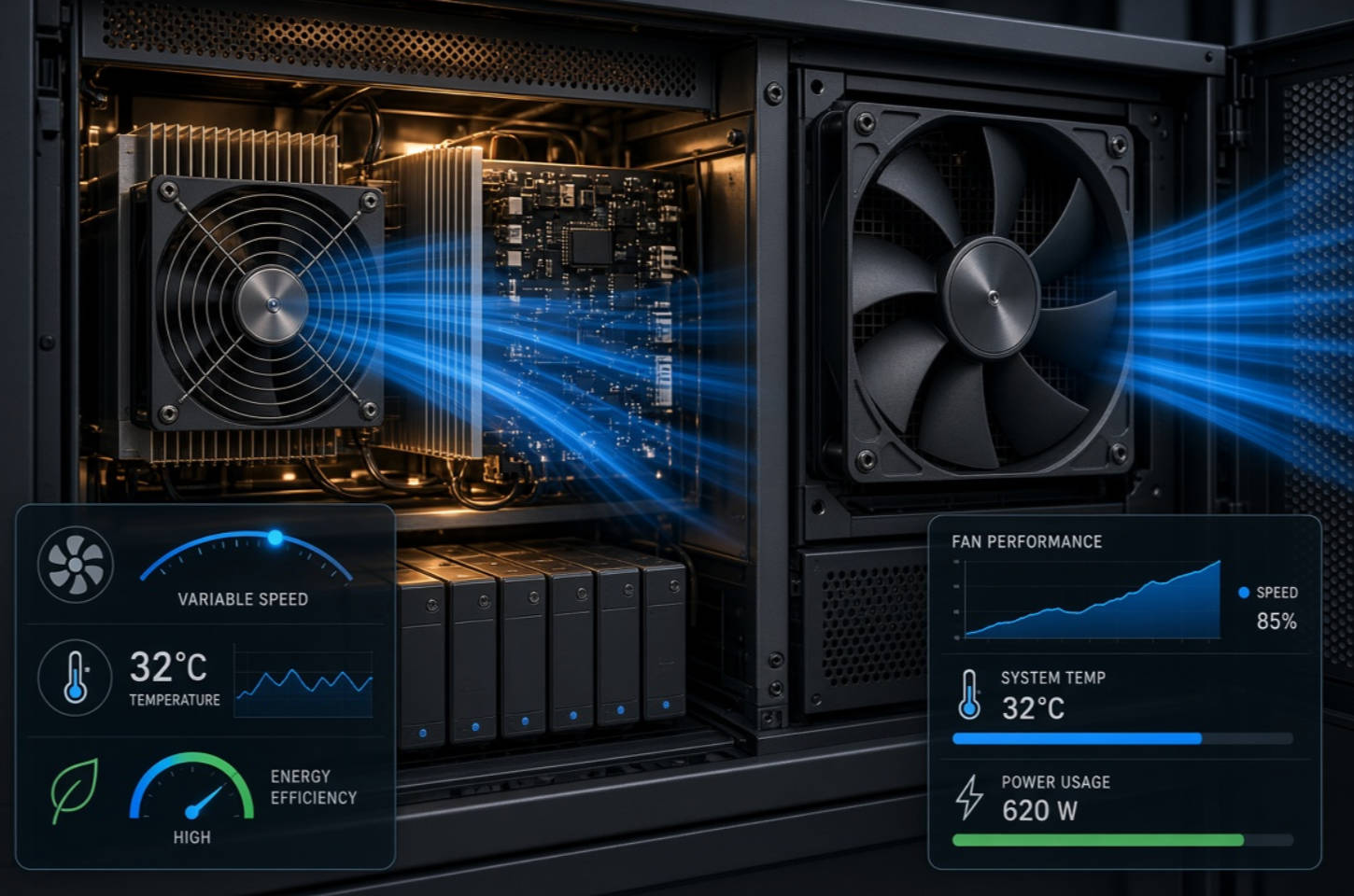
- Variable-speed airflow control
- Better part-load efficiency
- Lower energy use in many duty cycles
- Reduced start-stop stress
- Easier integration with sensors and controllers
- Potential for lower noise at reduced speed
- Alarm, tachometer, PWM, and communication options
- More precise temperature management for sensitive equipment
For telecommunications, data infrastructure, power systems, and compact HVAC equipment, smart DC fan control can help maintain a stable temperature while avoiding unnecessary full-speed operation.
A reliable selection process begins with the application, not the fan model.
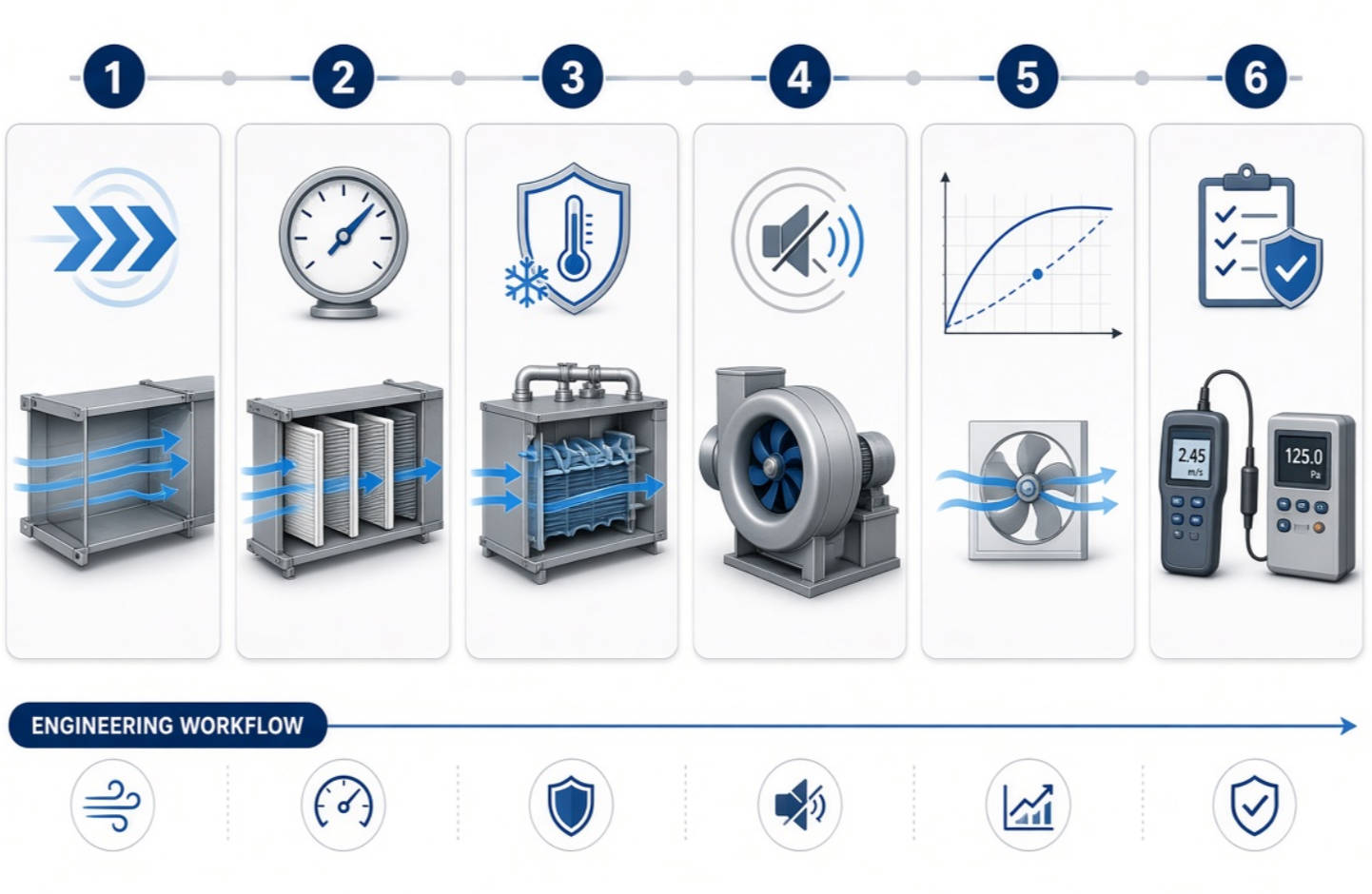
Establish the target airflow in CFM, m³/h, or L/s. Do not use free-air airflow as the final requirement if the fan will operate behind filters, coils, guards, or ducts.
Estimate resistance from every system component, including:
- Filter pressure drop at clean and dirty conditions
- Coil resistance
- Duct friction
- Fittings and elbows
- Dampers
- Louvers
- Silencers
- Safety guards
- Cabinet restrictions
Confirm:
- Ambient temperature range
- Maximum operating temperature
- Humidity and condensation risk
- Dust, oil, chemicals, or corrosive gases
- Altitude and air density
- Indoor or outdoor installation
- Required IP rating or environmental protection
- Expected operating hours
Noise should be evaluated as a system issue, not only as a fan specification. Consider blade noise, motor noise, vibration transmission, airflow turbulence, resonance, duct breakout noise, and nearby occupants.
Possible noise-reduction measures include:
- Lower fan speed through larger fan diameter
- Speed control during part-load operation
- Vibration isolators
- Flexible connectors
- Acoustic insulation
- Better inlet and outlet geometry
- Proper duct sizing
- Sound attenuators where necessary
Review the fan performance curve at the actual required airflow and static pressure. Verify:
- Airflow at the operating point
- Static pressure margin
- Motor power and current
- Fan efficiency
- Noise level
- Speed-control range
- Safe operating region
- Expected performance as filters load with dust
Prototype testing should measure airflow, pressure, temperature rise, power consumption, vibration, and sound level in the real equipment enclosure or duct system.
A fan selected from a catalogue is a starting point. A fan verified in the final system is an engineering solution.
Avoid these frequent errors:
- Selecting only by maximum CFM or m³/h
- Ignoring filter loading and future pressure increase
- Using an axial fan in a high-resistance ducted system
- Selecting a fan without reviewing the full fan curve
- Installing elbows, dampers, or obstructions too close to the inlet
- Increasing fan speed without checking motor load and acoustic impact
- Using a small high-speed fan where a larger low-speed fan may reduce noise
- Overlooking environmental conditions such as dust, humidity, salt spray, or high temperature
- Treating electronic cooling fans as interchangeable parts without checking voltage, bearing type, signal requirements, and reliability targets
For HVAC manufacturers and industrial-equipment builders, the supplier should do more than provide a model number. A capable cooling-fan partner should help evaluate the thermal system and reduce risk before volume production.
Look for a supplier that can provide:
- DC fan, AC fan, EC fan, blower, and customized cooling solutions
- Fan performance curves and operating-point support
- Voltage, speed, airflow, static-pressure, and noise options
- Custom cable, connector, sensor, PWM, FG, RD, and alarm configurations
- Ball-bearing or sleeve-bearing recommendations
- Environmental and reliability guidance
- Prototype samples and validation support
- Stable supply capacity for OEM production
- Brand options for demanding applications, including SANYO DENKI solutions where appropriate
Capital Technology Co., Limited supports customers seeking practical and dependable cooling solutions across demanding electronic, industrial, and HVAC-related applications. Whether your project needs a compact DC axial fan, an AC cooling fan, a high-performance centrifugal blower, or a branded SANYO DENKI solution, the correct answer begins with the actual system duty point.
The best HVAC fan is the one that delivers the required airflow at the true static pressure of the installed system, while meeting your targets for energy use, noise, reliability, control, and total lifecycle cost.
Do not select a fan only because it has the highest airflow figure or the lowest unit price. Share your airflow requirement, static-pressure estimate, voltage, installation space, temperature range, noise target, and expected operating environment with an experienced cooling-fan supplier.
Contact Capital Technology Co., Limited today to discuss a DC fan, AC fan, centrifugal blower, EC fan, or SANYO DENKI fan solution tailored to your HVAC or thermal-management project.
An axial fan moves air parallel to the motor shaft and is best suited to high-airflow, low-resistance conditions. A centrifugal fan changes the airflow direction and is usually better for ducted systems, filters, coils, and other applications with higher static pressure.
A backward-curved centrifugal fan or EC centrifugal fan is often a strong choice for an air-handling unit because it can handle the static pressure created by filters, coils, ducts, and dampers. The final choice should be based on the required operating point and fan curve.
Yes. DC fans are commonly used in compact HVAC equipment, electronic control cabinets, telecom cooling, power electronics, precision cooling, and other systems where variable speed, compact size, and intelligent control are important.
The fan may be experiencing higher system resistance or system effect. Tight duct bends, blocked inlets, restrictive guards, dirty filters, poorly designed transitions, and insufficient outlet duct length can all reduce installed airflow.
Use the lowest practical fan speed, select a properly sized fan, improve duct and inlet geometry, isolate vibration, use smooth transitions, avoid restrictive guards, and consider variable-speed control. In many cases, reducing turbulence is as important as changing the fan itself.
EC fans provide variable-speed capability and can reduce energy use during part-load operation. They can also support more precise temperature control, monitoring, and integration with intelligent HVAC controls. Actual savings depend on the system design and operating profile.
Provide the required airflow, static pressure, supply voltage, available installation space, ambient temperature, target noise level, operating hours, environmental conditions, control requirements, and any connector, cable, sensor, or certification requirements.
1. Pelonis Technologies. "Types of Fans Used in the HVAC Industry."
[https://www.pelonistechnologies.com/blog/different-types-fans-used-hvac-industry]
2. Air Movement and Control Association International, Inc. "Mitigating System Effect to Optimize Fan Performance and Efficiency."
3. Air Movement and Control Association International, Inc. "AMCA Publication 201-23: Fans and Systems."
[https://www.amca.org/publish/publications-and-standards/amca-publications/publication-201-02-(r2011)-fans-and-systems.html]-fans-and-systems.html)
4. U.S. Department of Energy Building America Solution Center. "ECM Air Handler Fans."
[https://basc.pnnl.gov/resource-guides/ecm-air-handler-fans]
5. Building Science Corporation. "PA-1001: ECM Efficiency—Better (and Worse) Than You Think."
[https://buildingscience.com/documents/published-articles/pa-ecm-eficiency/view]
6. Air Movement and Control Association International, Inc. "System Effects: AMCA Publication 201—Changing the Curve."


