From idea to market-ready product, our NPI solutions make every stage easier, faster. Discover How We Help
Help Center

Views: 287 Author: Capital Technology Publish Time: 2026-09-08 Origin: Site
Content Menu
● What Does a Radiator Cooling Fan Do?
● The Most Common Symptoms of a Bad Radiator Fan
>> Engine Temperature Rises at Idle or in Traffic
>> Air Conditioning Is Weak When the Vehicle Stops
>> The Fan Makes Grinding, Rattling, or Roaring Noises
>> The Cooling Fan Never Turns On
>> The Cooling Fan Runs Constantly
● Why a Bad Radiator Fan Causes Overheating
>> Low-Speed Airflow Is the Critical Test
● How to Check Whether Your Radiator Fan Is Bad
>> Step 1: Park Safely and Let the Engine Cool
>> Step 2: Inspect the Fan Blades, Shroud, and Surrounding Area
>> Step 3: Observe Fan Operation at Normal Temperature
>> Step 4: Use the A/C as a Functional Clue
>> Step 5: Check Fuses, Relays, Connectors, and Wiring
>> Step 6: Test the Fan Motor Only When Qualified
● Common Radiator Fan Faults and What They Mean
● When to Stop Driving Immediately
● Expert Advice: Replace the Root Cause, Not Just the Fan
● Choosing a Reliable DC Cooling Fan Supplier
● Need a Reliable DC Fan or Thermal Solution?
>> 1. Can I drive with a bad radiator fan?
>> 2. Why does my car overheat only when idling?
>> 3. Will a bad radiator fan affect my air conditioning?
>> 4. Can a bad relay cause the radiator fan not to work?
>> 5. Why is my radiator fan loud?
>> 6. Why does my cooling fan keep running after I turn off the car?
>> 7. Is a radiator fan motor the same as the entire fan assembly?
>> 8. Can I replace only the blown cooling-fan fuse?
A bad radiator fan can turn a minor cooling-system issue into an overheating event—especially during idling, stop-and-go traffic, hot weather, or A/C use. The most reliable warning signs are a rising temperature gauge at low speed, weak air conditioning at idle, unusual fan noise, and a cooling fan that does not switch on when vehicle conditions require airflow.
For vehicle owners, technicians, and fleet maintenance teams, the key is to diagnose the entire cooling-fan circuit, not simply replace the fan motor. A radiator fan problem may originate in the motor, blades, shroud, fuse, relay, wiring, coolant-temperature sensor, fan control module, or ECU command.
Important safety note: Never place hands, tools, clothing, or test leads near a cooling fan that may start automatically. Electric radiator fans can engage even when the engine is off, depending on vehicle design and temperature conditions.
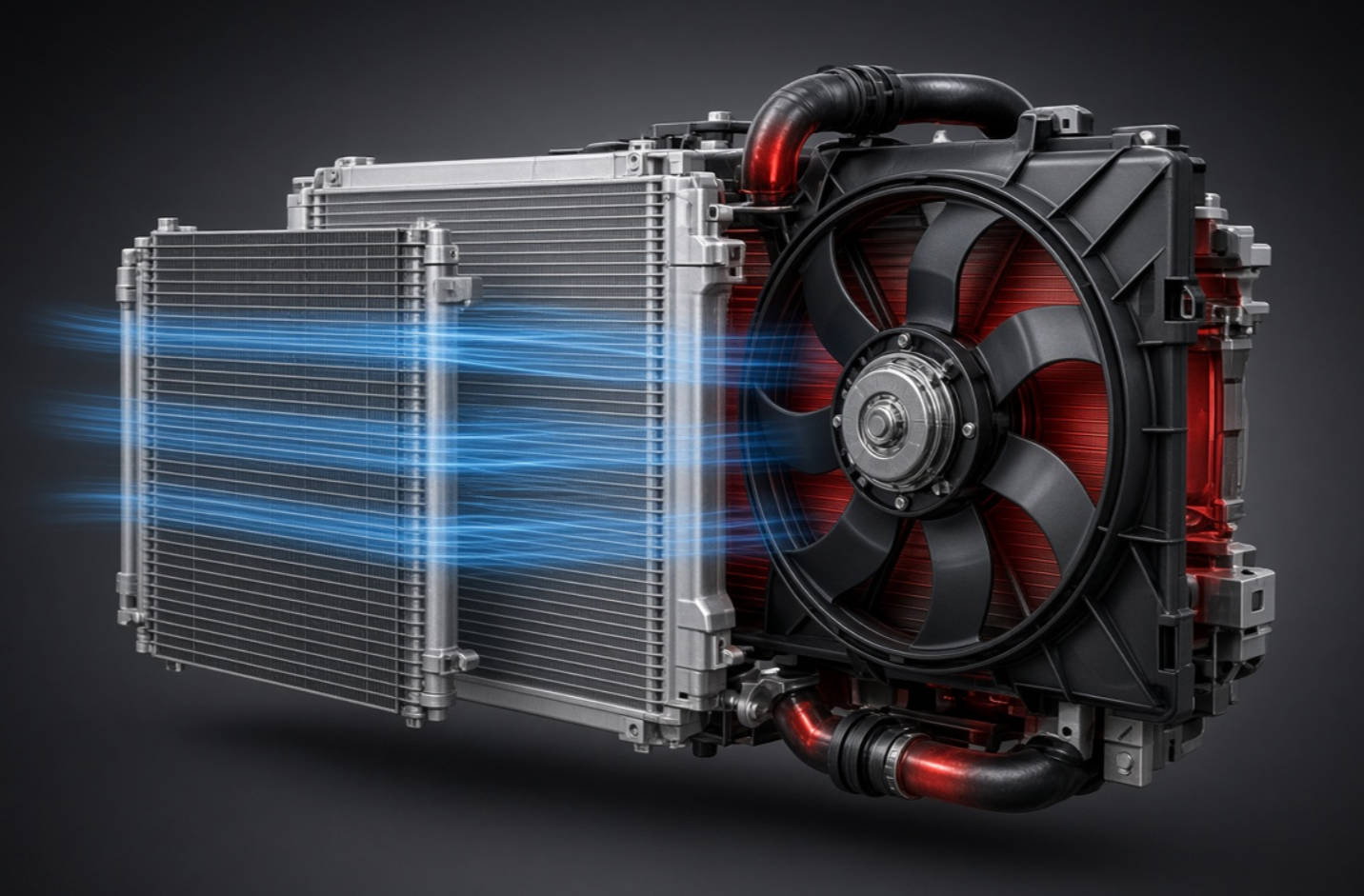
A radiator cooling fan is an airflow device that helps remove heat from the engine cooling system. It pulls or pushes air through the A/C condenser and radiator, allowing heat to transfer from hot coolant to the surrounding air.
At highway speed, natural ram air entering through the grille can provide substantial airflow. At idle, in heavy traffic, during low-speed driving, or when the A/C load is high, the vehicle relies much more heavily on the electric radiator fan.
This is why a weak or failed cooling fan often creates a very recognizable pattern:
- The engine temperature appears normal while driving quickly.
- The temperature rises while idling or crawling in traffic.
- The A/C becomes warmer when the vehicle is stopped.
- The issue may temporarily improve once the vehicle begins moving again.
Modern vehicles may use one fan, dual fans, variable-speed fans, brushless fan motors, PWM-controlled fans, or electronically managed fan modules. As cooling-system designs become more integrated, accurate diagnosis becomes more important than ever.
A radiator fan rarely fails without warning. In many cases, drivers first notice a change in vehicle behavior before the fan stops completely.
The clearest sign of a bad radiator fan is overheating at low vehicle speed.
If your temperature gauge rises while parked, waiting at a traffic light, driving uphill slowly, or sitting in congested traffic—but returns toward normal once the vehicle reaches road speed—the fan system should be one of the first areas to inspect.
This happens because the radiator needs airflow to release heat. Without sufficient fan airflow, hot coolant cannot cool effectively when the vehicle is not moving fast enough.
Watch for:
- A temperature gauge moving above its usual position
- A coolant-temperature warning light
- Steam or vapor from under the hood
- A sweet coolant smell
- Reduced engine performance or a power-protection mode
- Coolant overflowing from the reservoir
Do not continue driving when the temperature warning light is on or the gauge is in the hot zone. An overheating engine can suffer cylinder-head damage, head-gasket failure, warped components, coolant loss, and loss of power. AAA advises drivers to pull over safely and switch off the engine when overheating occurs.
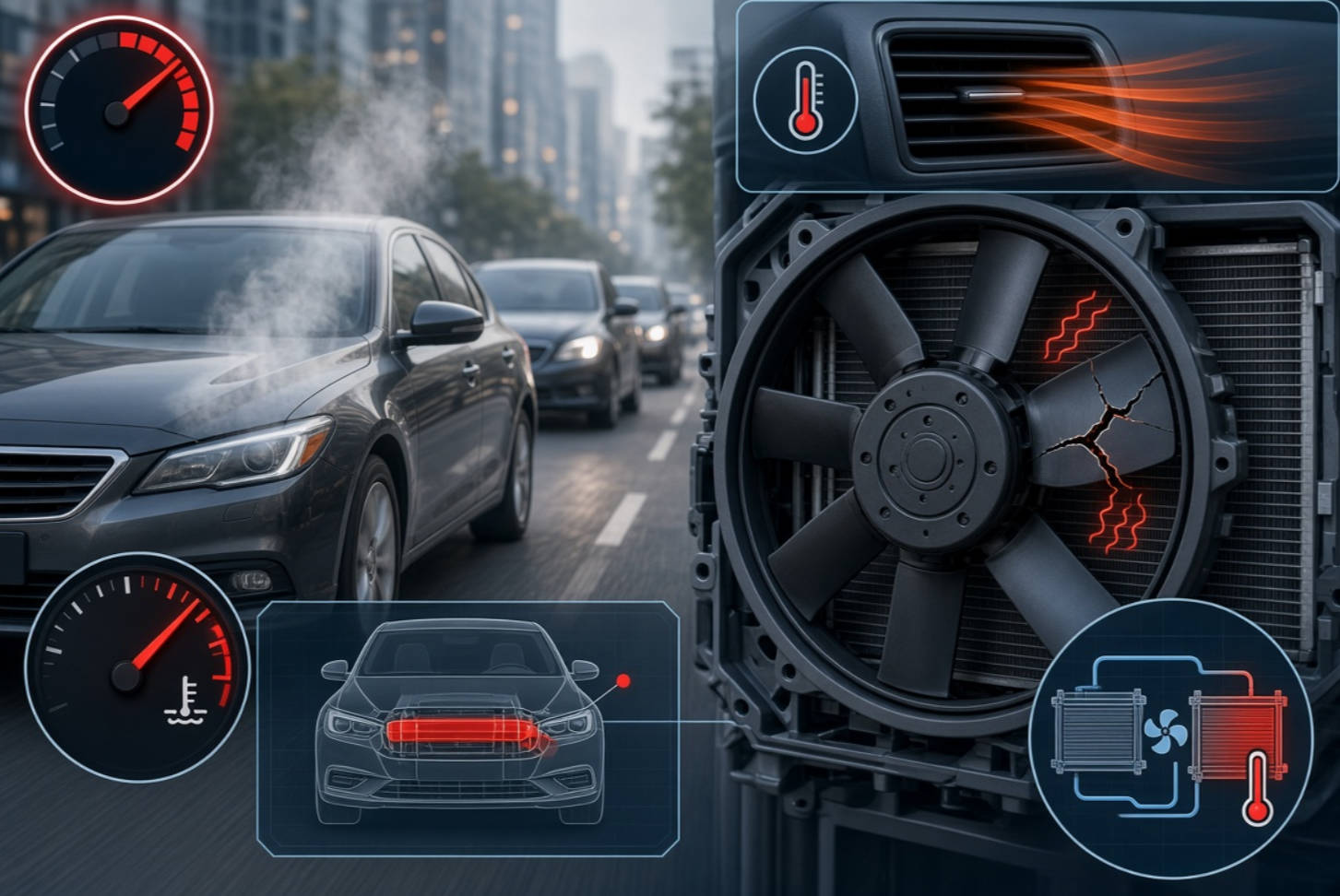
The radiator fan also affects air-conditioning performance because the A/C condenser is usually positioned in front of the radiator. The condenser must release heat for the A/C system to cool the cabin effectively.
A failing fan can cause these A/C symptoms:
- Cold air while driving but warm air at idle
- Cooling that improves only after the vehicle gains speed
- A/C that takes a long time to cool the cabin
- Compressor cycling or A/C protection shutdown
- Higher-than-normal engine temperature whenever the A/C is operating
This symptom is especially useful because it helps distinguish a possible fan airflow issue from some other cooling-system faults. If the engine runs warm and the A/C turns weak at the same time during idle, inspect the cooling fan system early in the diagnostic process.
A healthy electric radiator fan should operate with steady airflow and minimal mechanical noise. New sounds from the fan area often indicate mechanical wear or physical interference.
| Noise | Possible cause | Recommended action |
|---|---|---|
| Grinding | Worn motor bearings, internal motor damage | Stop using the fan if severe; inspect or replace the fan assembly |
| Rattling | Loose shroud, cracked blade, loose hardware, debris | Inspect blades, mounting points, and nearby wiring |
| Clicking | Relay cycling, failing relay, intermittent control signal | Check relay, fuse, wiring, and control module |
| Loud roaring | Fan stuck at high speed, excessive load, control issue | Scan for fault codes and inspect fan command behavior |
| Scraping | Blade contact with shroud, hose, wiring, or debris | Stop the vehicle and inspect after the engine has cooled |
A fan blade with a crack, warped shape, missing section, or imbalance may still spin, but it may not deliver the intended airflow. It can also create vibration that damages the motor, shroud, wiring, or mounting structure over time.
If the engine is warm and the fan remains silent, the fan system may have an electrical, mechanical, or control issue.
Possible causes include:
- Failed fan motor
- Blown fuse
- Faulty cooling-fan relay
- Corroded or loose connector
- Damaged wiring harness
- Faulty coolant-temperature sensor
- Failed fan control module
- ECU command or communication issue
- Faulty A/C pressure sensor on some vehicles
Do not assume the motor is bad simply because the fan does not run. The fan motor is only one component in a larger circuit.
A non-functioning cooling-fan relay can keep the fan off and contribute to overheating at idle, as documented in manufacturer service actions and technical bulletins.
A fan that never stops can also indicate a problem.
In some vehicles, the fan may continue running for a short period after the engine is turned off. This can be normal heat-management behavior. However, a fan that remains on for an unusually long time, runs at maximum speed from a cold start, or drains the battery may indicate a fault.
Common causes include:
- Stuck cooling-fan relay
- Shorted relay-control circuit
- Failed coolant-temperature sensor
- Fan control module fault
- Wiring short to power or ground
- ECU failsafe mode caused by a stored sensor fault
A fan running constantly does not always mean the fan motor itself is defective. It may mean the vehicle is commanding maximum fan operation because it cannot trust a sensor reading.
The radiator fan is part of a larger heat-management system. The engine produces heat during combustion, coolant absorbs that heat, and the radiator transfers it to the surrounding air.
The cooling fan becomes essential when airflow through the radiator is limited.
Many drivers assume that a vehicle with normal coolant level cannot have a fan problem. That is not always true. A vehicle may have good coolant, a functional water pump, and a clear radiator, yet still overheat because it lacks airflow at idle.
The fan is particularly important during:
- Stop-and-go city driving
- Extended idling
- Hot weather
- Towing or carrying heavy loads
- Steep, low-speed climbing
- A/C operation
- Fleet and delivery routes with frequent stops
- Construction, agricultural, and industrial equipment operation
The A/C condenser and radiator often share a cooling-air path. Automotive engineering research describes cooling modules in which airflow is directed through the condenser and radiator fan system, demonstrating why fan performance influences both engine cooling and A/C heat rejection.
Start with simple visual checks and controlled observations. If the issue involves electrical testing, scan-tool diagnosis, direct battery power, or component bypassing, use proper service information and safety procedures—or have a qualified technician perform the work.
Before inspecting the cooling system:
1. Park on level ground.
2. Apply the parking brake.
3. Turn off the engine.
4. Allow the engine compartment to cool fully.
5. Keep hands away from the fan blades and belt-driven components.
6. Do not remove the radiator cap when the engine is hot.
Hot coolant can remain pressurized after shutdown. Opening a hot cooling system can release scalding fluid or steam. If the vehicle has overheated, the safest first response is to pull over, stop the engine, and wait for the system to cool before checking anything under the hood.
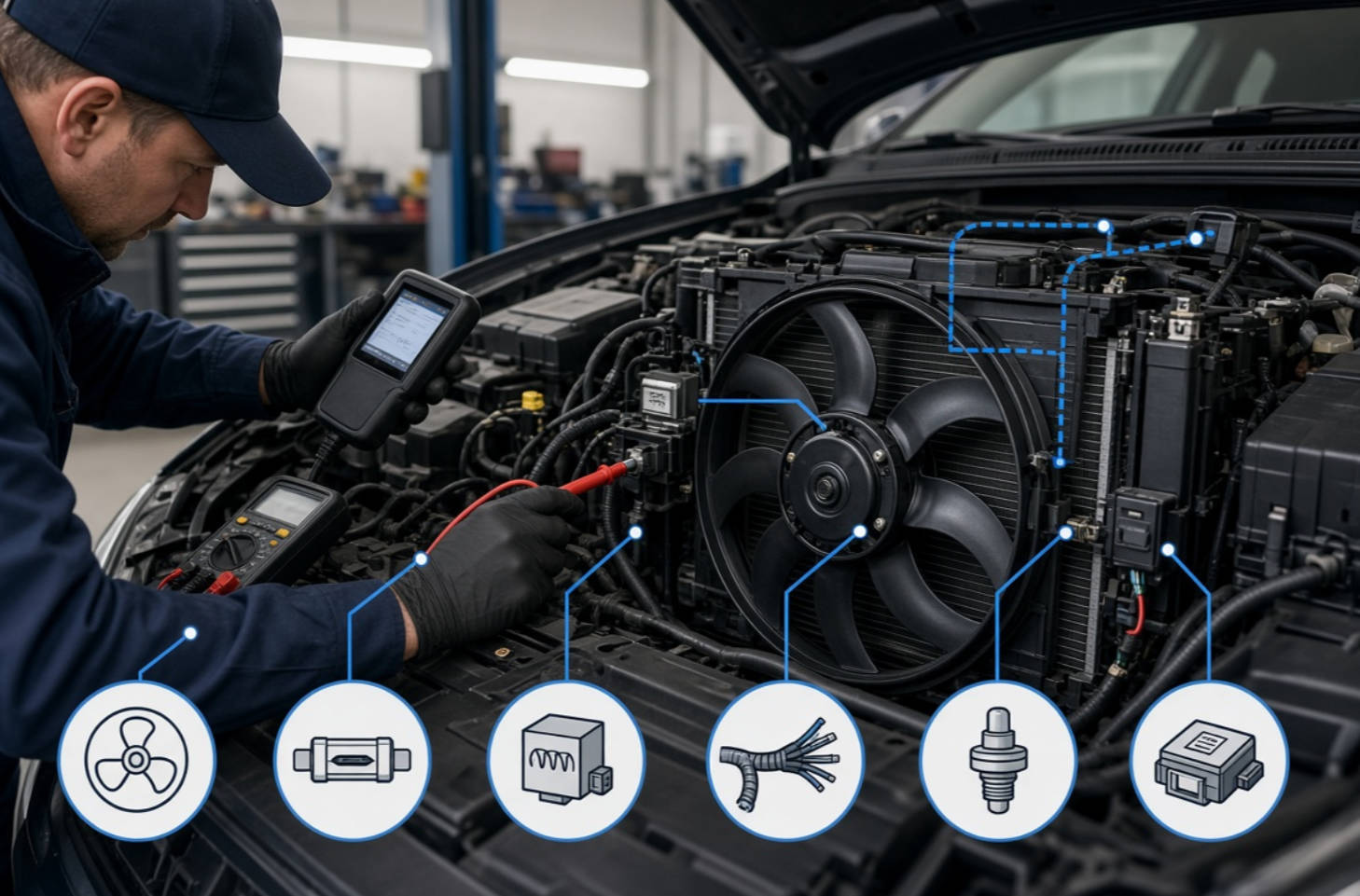
With the engine cool and ignition off, inspect the fan assembly carefully.
Look for:
- Cracked, chipped, bent, or missing blades
- Broken fan-shroud tabs or mounting points
- Leaves, plastic bags, stones, or road debris
- Loose hoses near the fan
- Wiring that may contact rotating blades
- Burnt connectors or melted plastic
- Corrosion at electrical terminals
- Coolant residue around the radiator, hoses, or reservoir
A damaged shroud matters because it helps direct airflow through the radiator core. Even a powerful fan can perform poorly when air bypasses the radiator due to a missing, damaged, or incorrectly fitted shroud.
Start the vehicle only after the inspection area is clear.
Allow the engine to reach normal operating temperature while monitoring the temperature gauge. On many vehicles, the fan cycles on once coolant temperature reaches a programmed threshold. The exact activation temperature varies by manufacturer, engine, sensor strategy, and fan-control design.
Observe from a safe distance:
- Does the fan begin to spin as the engine warms?
- Does it cycle on and off normally?
- Does it operate at only one speed when multiple speeds are expected?
- Does the temperature rise before the fan engages?
- Does the fan start but spin slowly or irregularly?
- Is there vibration, noise, or a burning electrical smell?
Do not reach through the grille or into the engine bay to test airflow. A fan may start unexpectedly and can cause injury.
On many vehicles, switching on the A/C requests additional airflow through the condenser. This often causes one or more cooling fans to run.
With the engine operating and the A/C turned on:
- Listen for fan engagement.
- Watch whether the fan starts.
- Check whether the A/C becomes cool at idle.
- Monitor whether the engine temperature remains stable.
If the fan does not run with the A/C activated, do not immediately condemn the fan motor. Some systems use temperature, pressure, ambient-condition, or ECU logic before commanding fan operation. Always consult the specific vehicle service procedure.
If the fan does not operate, inspect the electrical supply path.
A basic electrical inspection may include:
- Cooling-fan fuse condition
- Relay condition and relay-command signal
- Connector fit and terminal corrosion
- Harness damage near hot exhaust components
- Ground connection integrity
- Voltage supply at the fan connector
- Fault codes stored in the engine-control system
A fuse that has blown once may blow again if there is a short circuit, seized fan motor, damaged harness, or incorrect replacement part. Replacing a fuse without finding the cause can lead to repeat failure.
For electronically controlled fans, a scan tool can be more informative than a basic voltage check. It may reveal commanded fan speed, actual fan speed, coolant-temperature readings, A/C pressure data, and diagnostic trouble codes.
Directly applying battery voltage to a radiator fan may help determine whether the motor can run. However, this procedure carries risk.
A high-current fan circuit can create sparks, damaged terminals, blown fuses, personal injury, or unintended fan movement if handled incorrectly. It is not an appropriate test for every vehicle, particularly those with integrated controllers, smart fan modules, brushless motors, variable-speed electronics, or complex CAN-controlled systems.
A professional technician can use:
- Manufacturer wiring diagrams
- A digital multimeter
- Current clamp testing
- Scan-tool bidirectional controls
- Voltage-drop testing
- Circuit-load testing
- Oscilloscope analysis for PWM fan control
This approach separates a failed motor from a failed command, relay, connector, sensor, control module, or wiring circuit.
| Symptom | Likely causes | Best next step |
|---|---|---|
| Overheats at idle but not at highway speed | Fan not operating, weak fan motor, airflow restriction, shroud damage | Inspect fan operation, shroud, and electrical circuit |
| A/C warm at idle but cold while moving | Insufficient condenser airflow, fan-control fault | Verify fan operation with A/C on |
| Fan is noisy or vibrating | Worn bearings, blade damage, debris, loose mounting | Stop and inspect the assembly once cool |
| Fan runs only sometimes | Intermittent relay, loose connector, failing motor, wiring issue | Check codes, relay, harness, and motor current draw |
| Fan runs at high speed all the time | Failsafe command, stuck relay, sensor/module fault | Scan for diagnostic codes and inspect controls |
| Fuse repeatedly blows | Short circuit, seized motor, harness damage | Do not keep replacing fuses; diagnose the circuit |
| Engine overheats and coolant leaks appear | Fan failure plus pressure-related coolant loss, or another cooling fault | Stop driving and arrange professional inspection |
You should stop driving as soon as it is safe if you notice any of the following:
- Steam from the hood
- Temperature gauge in the red or hot zone
- Engine-temperature warning light
- Strong coolant smell
- Sudden loss of A/C combined with rising temperature
- Coolant leaking onto the ground
- Severe fan noise or fan blades contacting another component
- Reduced power or engine-protection warning
Continuing to drive an overheating vehicle can cause severe engine damage. AAA specifically recommends pulling over safely, turning off the engine, and arranging assistance rather than attempting to continue driving with an overheating condition. [aaa]
From a thermal-management perspective, the correct repair is the one that restores dependable airflow and control—not simply the quickest part replacement.
Before replacing a radiator fan, confirm:
- The fan receives correct voltage and ground.
- The fan receives the correct command signal.
- The fuse and relay are working under load.
- The connector is not heat-damaged.
- The wiring does not have excessive voltage drop.
- The fan blades and shroud are structurally sound.
- The radiator and condenser are not blocked externally.
- The cooling system has adequate coolant and no major leaks.
- The thermostat, water pump, and radiator are not creating a separate overheating condition.
For OEMs, vehicle service organizations, and industrial-equipment manufacturers, fan reliability depends on much more than nominal voltage. The right fan selection should consider airflow, static pressure, noise, bearing life, operating temperature, ingress protection, vibration exposure, speed-control method, current draw, mounting geometry, and long-term supply consistency.
At Capital Technology Co., Limited, cooling solutions are evaluated as system-level components rather than isolated parts. A dependable DC fan solution must work reliably with the application's heat load, airflow path, power supply, electronic controls, acoustic requirements, and real operating environment.
Whether you are sourcing fans for automotive electronics, telecom cabinets, industrial control systems, power equipment, medical devices, battery systems, or custom thermal assemblies, choosing the right manufacturer or authorized supplier is critical.
A strong cooling-fan partner should provide:
- Stable product quality and traceability
- Clear airflow and static-pressure performance data
- Appropriate voltage, speed, and control options
- Long-life bearing solutions
- Noise and vibration considerations
- Custom cable, connector, and mounting support
- Responsive engineering communication
- Reliable inventory and delivery capability
- Genuine-brand supply channels where required
- Application-specific thermal-management guidance
Capital Technology Co., Limited is a source manufacturer focused on DC fan and thermal-management solutions. In addition to its independent CAPITAL brand, the company serves as a leading SANYO DENKI authorized agent and supplies recognized enterprise customers including ZTE, HUAWEI, and HYTERA.
For engineers and procurement teams, this combination supports both flexible cooling-solution development and access to established high-performance fan technologies for demanding applications.

A radiator-fan failure shows why cooling performance cannot be left to chance. Whether you need a replacement fan, a high-reliability DC cooling fan, an industrial airflow solution, or support for a custom thermal-management project, selecting the correct fan specification is essential.
Contact Capital Technology Co., Limited to discuss your voltage, airflow, static-pressure, noise, reliability, connector, and application requirements. Our team can help you identify a practical cooling solution using CAPITAL products or suitable SANYO DENKI fan options for demanding equipment environments.
It is not recommended. A vehicle may appear normal at highway speed because moving air passes through the radiator, but it can overheat quickly in traffic, at idle, or while using the A/C. If the temperature gauge rises or a warning light appears, pull over safely and stop the engine.
This pattern often points to inadequate airflow through the radiator at low speed. A failed or weak radiator fan, damaged fan shroud, blocked radiator fins, faulty relay, or fan-control issue may be responsible. A professional diagnosis should also rule out coolant, thermostat, water-pump, and radiator faults.
Yes. The radiator fan helps move air through the A/C condenser, particularly when the vehicle is stopped. If the fan fails, the A/C may blow warm air at idle but become colder once the vehicle is moving.
Yes. A cooling-fan relay can fail internally, develop poor electrical contacts, or receive an incorrect control signal. The fan may then run intermittently, remain off, or operate continuously. Test the relay and its circuit rather than replacing parts based on symptoms alone.
Grinding can indicate worn motor bearings. Rattling may mean a loose shroud, broken blade, or debris. A loud, continuous roar may indicate that the fan is operating at high speed because of a temperature, sensor, relay, or control-system fault.
A short post-shutdown run can be normal on some vehicles because the system is removing residual heat. However, if the fan runs for an unusually long time, starts when the engine is cold, or drains the battery, inspect the relay, temperature sensor, wiring, and fan-control module.
Not always. The motor is the electrical component that turns the blades, while a complete fan assembly may include the motor, blades, shroud, connectors, control electronics, and mounting hardware. Replacing the full assembly can be more practical when multiple mechanical parts are damaged.
You can replace a blown fuse only with the correct specified rating, but you must find out why it failed. A repeatedly blown fuse may indicate a seized fan motor, damaged wiring, a short circuit, or an incorrect component. Never install a higher-rated fuse to "solve" the problem.
1. Capital Technology Co., Limited. "How Do I Tell If My Radiator Fan Is Bad?" Available at: [https://www.yccfan.com/articledetail/how-do-i-tell-if-my-radiator-fan-is-bad.html]. Original article reviewed and expanded for this revised content strategy. [yccfan]
2. AAA Automotive. "Car Overheating: 8 Causes and Solutions." Available at: [https://www.aaa.com/autorepair/articles/car-overheating-8-causes-and-solutions]. Used for emergency overheating guidance, including safely pulling over, switching off the engine, and seeking roadside assistance. [aaa]
3. AAA Oregon/Idaho. "What to Do If Your Car Is Overheating and How to Prevent It." Available at: [https://info.oregon.aaa.com/what-to-do-if-your-car-is-overheating-and-how-to-prevent-it/]. Used for warning signs and safety precautions related to steam, heat, coolant inspection, and cooling-fan operation. [info.oregon.aaa]
4. AAA Club Alliance. "Why Is My Car Overheating?" Available at: [https://acg.aaa.com/connect/blogs/5c/auto/why-is-my-car-overheating]. Used for current consumer guidance on overheating response and the risks of continued driving. [acg.aaa]
5. SAE International. "A Case Study of Engine Cooling System Simulation and Modelling of Air-Conditioning Application in a Medium-Duty Truck." Available at: [https://saemobilus.sae.org/papers/a-case-study-engine-cooling-system-simulation-modelling-air-conditioning-application-a-medium-duty-truck-2024-28-0106]. Used to support discussion of condenser, radiator, and fan-system airflow relationships. [saemobilus.sae]
6. SAE International. "Variable and Fixed Airflow for Vehicle Cooling." Available at: [https://www.sae.org/articles/variable-fixed-airflow-vehicle-cooling-2011-01-1340]. Used to support system-level airflow discussion across condenser, radiator, and fan modules. [sae]
7. National Highway Traffic Safety Administration. "Customer Satisfaction Program 21N01." Available at: [https://static.nhtsa.gov/odi/tsbs/2021/MC-10201085-0001.pdf]. Used as an example of how a non-functional cooling-fan relay can contribute to engine overheating at idle. [static.nhtsa]


