From idea to market-ready product, our NPI solutions make every stage easier, faster. Discover How We Help
Help Center

Views: 216 Author: Capital Technology Publish Time: 2026-10-19 Origin: Site
Content Menu
● What Makes High-Density Electronic Equipment Difficult to Cool?
● San Ace Fan Selection: Airflow Versus Static Pressure
>> What Maximum Airflow Actually Means
>> Why Static Pressure Matters
● DC Fan Versus AC Fan: Which Should You Evaluate?
>> When to Shortlist a San Ace DC Fan
● Conventional Axial Fans Versus Counter-Rotating Fans
>> A Documented High-Pressure Example
● A Practical San Ace Fan Selection Workflow
>> Step 1: Establish Heat Load and Temperature Limits
>> Step 2: Measure or Estimate System Impedance
>> Step 3: Compare Curves at the Required Operating Point
>> Step 4: Verify Integration Details
● PWM Control and Monitoring: Cooling Beyond Full Speed
>> Match Speed to Thermal Demand
>> Verify Feedback and Low-Speed Behavior
● Reliability: Interpreting San Ace Fan Life Expectancy
>> Compare Conditions, Not Just Hours
● Three Practical Insights That Improve Selection Quality
>> 1. Compare Equal Cooling Output, Not Equal Speed
>> 2. Treat Enclosure Changes as Selection Changes
>> 3. Build a Reproducible Validation Record
● Working With Capital Technology Co., Limited
>> 1. What is the most important factor when selecting a San Ace fan?
>> 2. Is a higher-CFM fan always better for dense electronics?
>> 3. When should I consider a counter-rotating San Ace fan?
>> 4. Can PWM control reduce fan noise and energy use?
>> 5. Does a 180,000-hour rating guarantee that service life?
>> 6. Can I approve a fan using calculations alone?
Selecting a San Ace fan for high-density electronic equipment starts with a practical question: how much air will the fan actually move through your enclosure? A high airflow rating alone does not establish cooling performance. Closely packed circuit boards, restrictive heatsinks, filters, and narrow ventilation paths all influence the result.
For engineers and procurement teams, the real comparison is not simply DC fans versus AC fans. It is also airflow versus static pressure, conventional axial fans versus counter-rotating designs, and purchase price versus validated operating performance.
This guide explains how to compare these factors, interpret manufacturer specifications, and build a shortlist that can withstand real equipment testing.
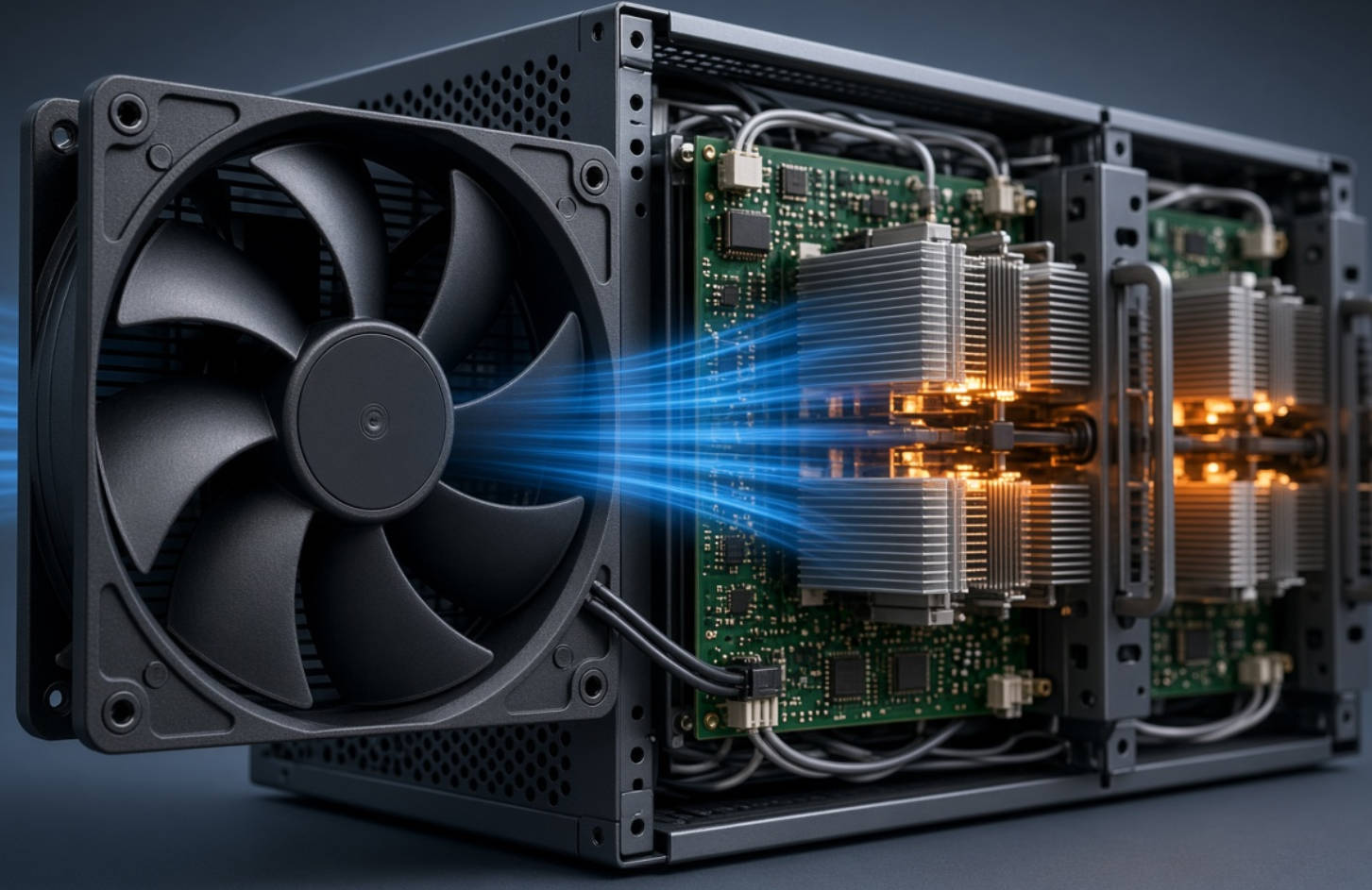
High-density equipment combines substantial heat generation with limited space for air movement. Servers, telecommunications systems, power supplies, and industrial electronics may have very different layouts, yet their cooling challenges often overlap.
Typical restrictions include:
- Closely spaced components and heatsink fins.
- Cable bundles crossing the airflow path.
- Filters, protective grilles, and ventilation openings.
- Small clearances between circuit boards.
- Uneven heat distribution around critical components.
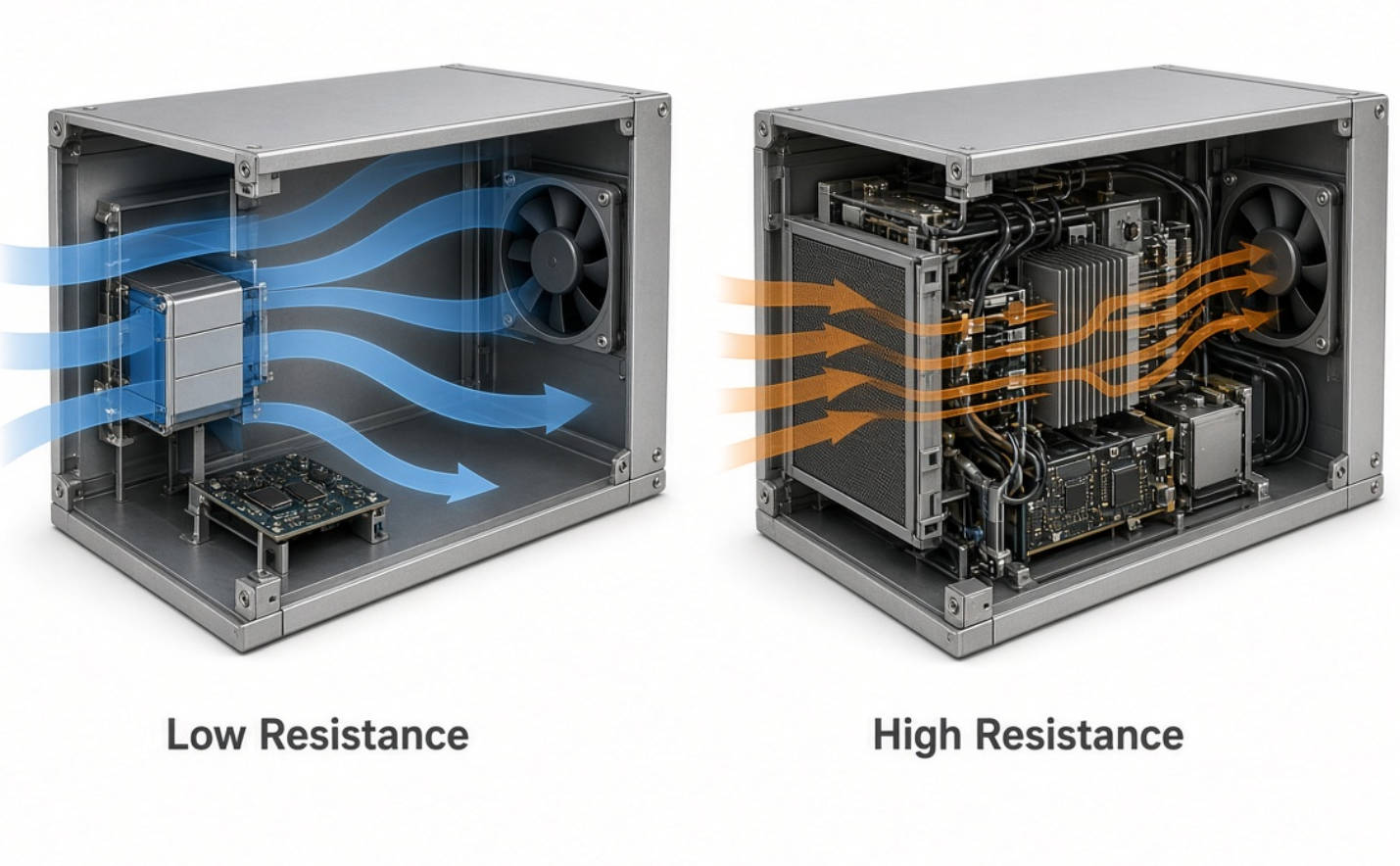
These restrictions create system impedance: resistance to airflow through the equipment.
SANYO DENKI's selection guidance explains that installed airflow depends on the relationship between the fan's airflow–static pressure curve and system impedance. Consequently, a fan that performs well in free air may deliver substantially less airflow inside an enclosure.
Understanding these two specifications prevents one of the most common selection mistakes.
Maximum airflow describes the high-flow end of a fan's performance curve, where external static pressure is approximately zero.
It is useful for initial comparisons, but it does not represent the airflow available through a densely populated chassis.
For a high-density electronics cooling fan, the more useful question is:
How much airflow remains available at the pressure resistance of our equipment?
Static pressure indicates a fan's ability to overcome airflow resistance. However, maximum static pressure occurs at the opposite end of the curve, where airflow is approximately zero.
Maximum airflow and maximum static pressure therefore are not simultaneous operating conditions.
The actual operating point lies where the fan curve intersects the system impedance curve. SANYO DENKI's technical guidance recommends identifying that operating point before comparing candidate fans for noise and power consumption.
| Selection factor | What it tells you | What it cannot establish alone |
|---|---|---|
| Maximum airflow | Free-air delivery potential | Installed cooling performance |
| Maximum static pressure | Pressure capability at near-zero flow | Air delivered through your chassis |
| Full performance curve | Available airflow across pressure conditions | Component temperatures without testing |
| Installed operating point | Fan performance within a specific airflow system | Performance after every future configuration change |
The practical priority is straightforward: compare complete curves, not isolated headline numbers.
Capital Technology Co., Limited supplies both DC and AC fan solutions. The starting point should be the equipment's available electrical supply and control requirements, rather than an assumption that one category is universally better.
A San Ace DC fan deserves evaluation when the equipment provides a compatible DC supply and requires adjustable cooling.
Many San Ace models offer pulse-width modulation, or PWM, for external speed control. Compatible models can adjust speed according to cooling demand, helping reduce unnecessary noise and power consumption. Sensor availability varies by model.
Check:
- Rated voltage and permitted operating voltage range.
- Rated input and power-distribution capacity.
- PWM compatibility.
- Speed-feedback or fault-detection requirements.
- Connector, pin assignment, and cable configuration.
Include AC fans in the comparison when the equipment architecture calls for an AC-powered cooling solution.
Do not assume that an AC candidate offers the same control functions, feedback signals, or performance as a similarly sized DC model. Request the exact datasheet and assess both options against the same installed cooling requirement.
For purchasing teams, the useful comparison is not "AC or DC?" in isolation. It is "Which electrically compatible solution meets our thermal, mechanical, and control requirements?"
After defining the supply architecture, compare fan configurations.

SANYO DENKI positions its counter-rotating San Ace fans for equipment with high mounting density, where limited installation space coincides with demanding airflow and static-pressure requirements.
| Comparison | Conventional axial candidate | Counter-rotating candidate |
|---|---|---|
| Evaluation priority | Determine whether its curve meets the required operating point | Assess suitability for restrictive airflow paths |
| Installation check | Verify frame dimensions and clearance | Pay particular attention to assembly depth |
| Electrical check | Compare model-specific input requirements | Check whether additional power demand is acceptable |
| Acoustic check | Validate noise at required cooling output | Avoid accepting pressure capability without evaluating noise |
| Final decision | Suitable if installed testing confirms performance | Suitable if its pressure capability produces a system-level benefit |
SANYO DENKI's San Ace 80 9CRHA announcement lists the 12 V model 9CRHA0812P8J001 with:
- Dimensions: 80 × 80 × 80 mm.
- Maximum airflow: 199 CFM.
- Maximum static pressure: 2,700 Pa.
- Rated input: 144 W.
- Sound pressure level: 85 dB(A).
These figures illustrate why pressure capability must be considered alongside electrical and acoustic constraints. They do not mean the fan delivers 199 CFM against 2,700 Pa; the maximum values describe different endpoints of its performance curve.
This model is an example of available capability, not a universal recommendation for compact electronics.
Begin with the heat that must leave the enclosure.
Document the maximum expected operating load, inlet-air conditions, and temperature limits for critical components. Distinguish between the allowable bulk-air temperature rise and component-specific limits.
SANYO DENKI's selection procedure begins by establishing heat generation and the permitted internal temperature rise. It also emphasizes that calculations provide an initial target, while final selection requires actual installation testing.
Use enclosure measurements where possible.
The San Ace Airflow Tester technical report describes measuring system impedance and operating airflow, then using this information to identify an appropriate fan operating point.
This is more informative than selecting a fan solely from its maximum airflow rating.
Overlay candidate fan curves with the system impedance curve.
Reject candidates that cannot supply the necessary airflow at the corresponding pressure. Then compare the remaining options for noise and power at comparable cooling output.
SANYO DENKI specifically recommends considering sound pressure level and power consumption at the operating point, rather than relying only on free-air comparisons.
Before ordering production quantities, confirm:
1. Frame size, thickness, and mounting arrangement.
2. Airflow direction and installation clearance.
3. Supply-voltage compatibility.
4. Connector and pin assignment.
5. PWM and sensor requirements.
6. Environmental and lifetime specifications.
A thermally promising fan still needs to fit the complete equipment design.
A fan should be evaluated as part of a control system, not only as a fixed-speed component.
PWM-compatible San Ace fans allow external speed adjustment. SANYO DENKI explains that running at the minimum necessary speed can reduce power consumption and noise.
For the equipment designer, this creates a useful distinction:
- Maximum capability determines whether peak cooling demand can be met.
- Controlled operation determines how the equipment behaves during ordinary use.
A sensible validation plan tests both conditions.
San Ace product families include models with pulse sensors for speed detection and locked-rotor sensors for detecting stopped rotation. These functions are model-specific.
Low-duty-cycle behavior also needs verification. For example, SANYO DENKI explicitly states that certain listed wide-temperature models do not rotate at 0% PWM duty cycle. Do not apply that behavior to every San Ace fan.
Record the required startup behavior, minimum operating speed, and response to a missing control signal in the component specification.
A lifetime figure is meaningful only when its test conditions are understood.
SANYO DENKI lists selected long-life San Ace fans with an expected life of up to 180,000 hours. The stated basis is L10 life: 90% survival during continuous operation in free air at 60°C and rated voltage.
When reviewing fan life expectancy, check:
- The exact model number.
- Ambient temperature.
- Supply voltage.
- Operating conditions.
- The stated life definition.
Do not interpret an L10 figure as a guarantee that every fan will operate for that duration. Nor should the longest published figure in a product family be assigned to every model.
For procurement, retaining the exact datasheet alongside the approved part number is more useful than recording a generic "long-life fan" description.
Two fans running at the same speed may deliver different installed airflow.
SANYO DENKI's technical work compares power consumption at an equivalent operating point, illustrating a better evaluation method: compare candidates delivering the same required cooling performance.
This avoids rewarding a quieter or lower-power candidate that simply moves less useful air.
The operating point depends on both the fan and the enclosure.
Changing a filter, grille, board arrangement, or airflow passage can change system impedance. The original curve intersection should therefore be treated as configuration-dependent, not permanently fixed. This follows directly from the manufacturer's operating-point methodology.
Include the tested enclosure configuration in the approval record.
A useful qualification report should record:
- Fan model and revision.
- Enclosure configuration.
- Ambient and inlet temperatures.
- Equipment workload.
- Control settings.
- Measured component temperatures.
- Acoustic acceptance criteria.
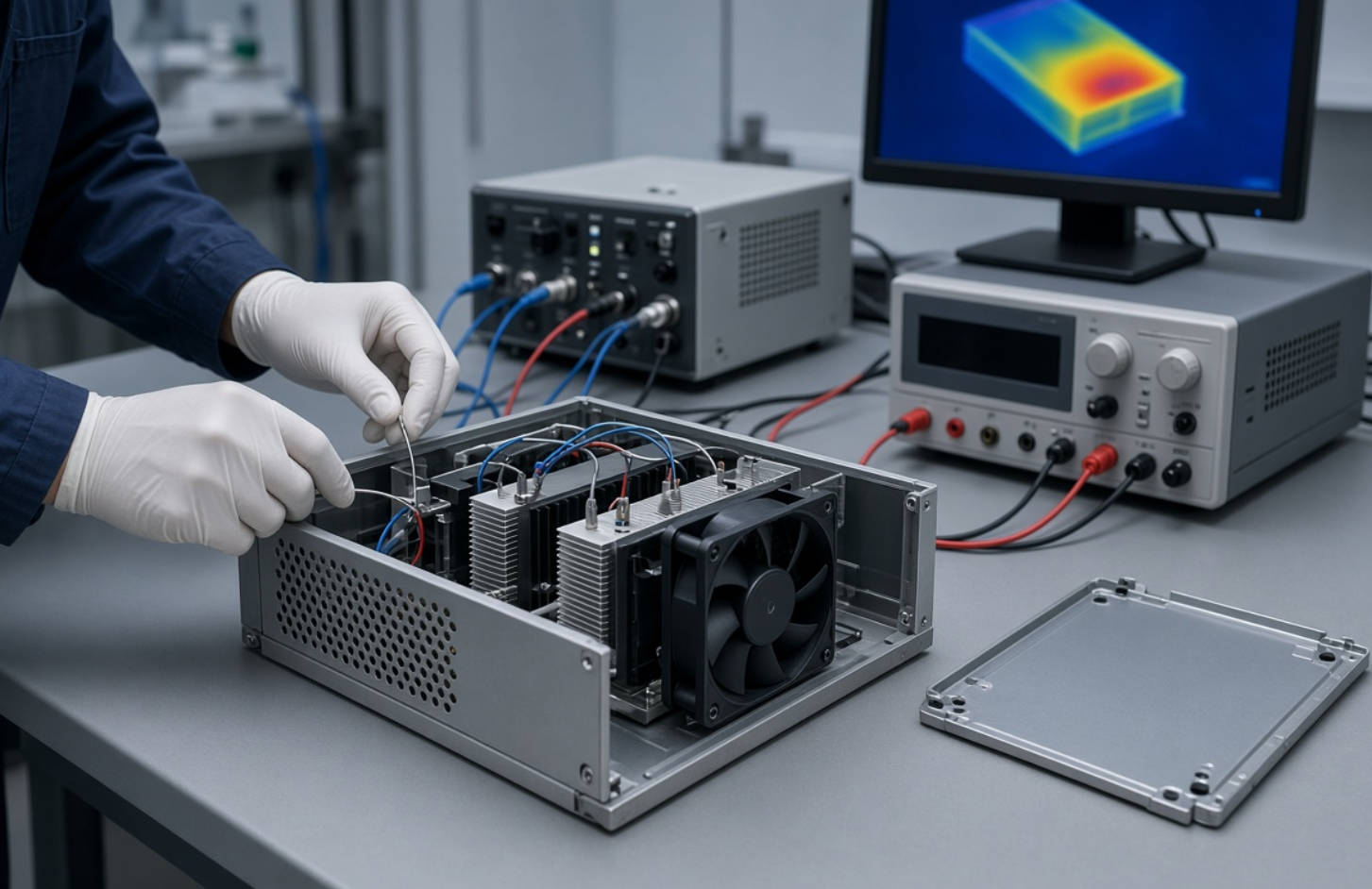
This is a proposed engineering workflow, not a claim that a particular test has already been performed. Its purpose is to make later comparisons repeatable.
According to the company information provided for this article, Capital Technology Co., Limited manufactures cooling solutions, including DC and AC fans, operates the CAPITAL brand, and serves as a principal agent for SANYO DENKI. The company also identifies ZTE, HUAWEI, and HYTERA among its customers.
These company statements are separate from the manufacturer specifications discussed above. Buyer qualification should still confirm authorization, product traceability, and application-specific requirements.
For a focused San Ace fan inquiry, send Capital Technology:
- Your enclosure dimensions and available fan space.
- Required supply voltage.
- Estimated heat load and temperature limits.
- Existing fan model, if available.
- Pressure–airflow measurements or enclosure details.
- Noise, control, and service-life requirements.
Request a model-specific shortlist supported by datasheets, performance curves, and a sample-validation plan—not simply a replacement based on frame size.
The installed operating point is a central factor. It connects the fan's performance curve with the resistance of the equipment and indicates achievable airflow.
No. Maximum CFM describes free-air capability. A restrictive enclosure requires comparison at the relevant pressure and airflow, not maximum airflow alone.
Consider this configuration when high mounting density and restricted installation space create demanding airflow and static-pressure requirements. Confirm suitability using the specific model curve.
Yes, compatible models allow speed adjustment to match cooling demand. The resulting benefit depends on the application and operating settings.
No. The cited rating is an L10 expectation under specified conditions, including temperature and voltage. It is not an individual-unit guarantee.
Calculations help establish an initial selection. SANYO DENKI recommends final selection based on actual installation testing.
1. [SANYO DENKI — Guideline in Selecting a Fan]. Manufacturer guidance on thermal requirements, installed airflow, and final testing.
2. [SANYO DENKI — Development of the "San Ace Airflow Tester"]. Technical report on system impedance, operating points, and fan comparison.
3. [SANYO DENKI — Counter Rotating Fan]. Product-family applications and PWM control.
4. [SANYO DENKI — San Ace 80 9CRHA Counter Rotating Fan, May 2025]. Published dimensions and performance specifications.
5. [SANYO DENKI — Long Life Fan]. Expected-life conditions and sensor options.
6. [SANYO DENKI — San Ace 40 Wide Temperature Range Fan]. Model-specific PWM and lifetime information.
7. [SANYO DENKI — Low Power Consumption Fan San Ace 92 GA Type]. Equivalent-operating-point power comparisons.


