From idea to market-ready product, our NPI solutions make every stage easier, faster. Discover How We Help
Help Center

Views: 286 Author: Capital Technology Publish Time: 2026-07-09 Origin: Site
Content Menu
● Understanding Why Centrifugal Fan Balancing Matters
● Static vs Dynamic Balancing: What Engineers Need to Know
>> Static balancing: simple, single‑plane correction
>> Dynamic balancing: two planes for high‑performance fans
● Types of Rotor Imbalance and How They Are Corrected
● How Professional Balancing Is Performed in Modern Fan Manufacturing
● Long‑Term Maintenance: How to Keep Your Centrifugal Fan Balanced
● Practical Field Tips for Engineers and Technicians
● Design‑Side Considerations: OEM and System Engineer View
● Call to Action: Build a Proactive Fan Balancing Strategy
>> 1. How often should a centrifugal fan be re‑balanced?
>> 2. What is the difference between static and dynamic balancing in practice?
>> 3. Can I balance a small exhaust fan myself without specialized equipment?
>> 4. What are the most common signs that my fan is out of balance?
>> 5. Which standards should I look for when selecting balanced fans?
Balancing a centrifugal fan is not just a maintenance task; it is a core reliability strategy that protects your bearings, reduces vibration, and keeps your entire cooling system stable over the long term. Drawing on both hands‑on engineering experience in DC/AC fan applications and current industry standards, this guide explains static and dynamic balancing, how to maintain balance in real‑world conditions, and what manufacturers and OEMs can do to design more reliable systems. [youtube]
When I audit cooling systems in telecom, industrial and IT applications, unbalanced centrifugal fans are one of the most common root causes of chronic vibration and premature bearing failure. Uneven mass distribution on the impeller, dust build‑up on blades, and minor manufacturing tolerances all contribute to imbalance, even when the fan is new and meets its datasheet values. [quimipol]
An unbalanced impeller causes:
- Higher vibration levels at 1× rotational speed, which accelerates bearing and shaft wear. [vibromera]
- Increased noise, sometimes mistaken as "normal" mechanical hum in older installations. [blog-aarcoair]
- Reduced service life of the fan, the motor and surrounding structures such as ducts or brackets. [youtube]
- Risk of resonant vibration if the fan speed coincides with structural natural frequencies. [vibromera]
From an OEM and thermal‑solution perspective, keeping fans properly balanced is also a brand and warranty issue: balanced fans lower failure rates, reduce RMA costs and improve user perception of quality. [youtube]
In practice, static balancing means correcting mass in one plane of the rotor so that the center of mass lies on the shaft axis. The impeller is mounted horizontally on a shaft or balancing mandrel, and the heaviest point naturally rotates downward under gravity. [youtube]
Key points for static balancing:
- Single correction plane – all correction weights or material removal happen in one plane. [youtube]
- Can be performed with relatively simple fixtures, sometimes without rotation if the rotor is free to move under gravity. [reddit]
- Works well when the rotor's height is small relative to its diameter, and when speed is moderate. [youtube]
For fan manufacturers and integrators, static balancing is often sufficient for small impellers, compact DC blowers, and lower‑speed applications where the rotor behaves as a rigid disk. However, once height or speed increase, static balancing alone may no longer control moment and dynamic imbalance. [youtube]

Dynamic balancing recognizes that real impellers behave like three‑dimensional rotors whose mass distribution varies along their width. Instead of one correction plane, dynamic balancing uses two correction planes and a balancing system to compute the required correction masses and angles. [vibromera]
What makes dynamic balancing more advanced:
- Two planes of correction mean adding or removing mass in one plane influences the other, so you need calculation support. [vibromera]
- Balancing is done with the rotor running at or near operating speed, using sensors and a tachometer to measure vibration amplitude and phase. [youtube]
- It is essential for tall impellers (high height‑to‑diameter ratio), high‑speed blowers and industrial fans in demanding environments. [vibromera]
Modern balancing systems capture vibration spectra, phase angle and correction influence coefficients, then recommend specific correction weights and positions, such as "install 65 g at 195°." For industrial centrifugal fans, dynamic two‑plane balancing is the standard route to achieving ISO‑compliant vibration limits. [vibromera]
From a rotor‑dynamics point of view, engineers typically deal with three main types of imbalance on centrifugal fan impellers: [youtube]
- Static imbalance – the rotation axis and the central inertia axis are parallel but offset; corrected by static balancing.
- Moment (couple) imbalance – the axes intersect at the rotor's center of mass and create opposing moments; requires dynamic balancing. [vibromera]
- Dynamic (mixed) imbalance – the axes intersect outside the center of mass or cross in space, combining static and moment components; the only effective correction is dynamic balancing. [vibromera]
In field diagnostics, if vibration is dominated by a steady 1× RPM component and phase angle is stable from run to run, imbalance is likely the primary issue. If higher‑order harmonics or rapidly changing phase angles appear, looseness, misalignment or resonance must be addressed before attempting balancing. [blog-aarcoair]
From the manufacturer's perspective, achieving consistent balancing quality requires high‑precision equipment and repeatable procedures. Leading industrial fan producers now customize their balancing setups for typical rotor sizes, weights and speeds used in their product range. [youtube]
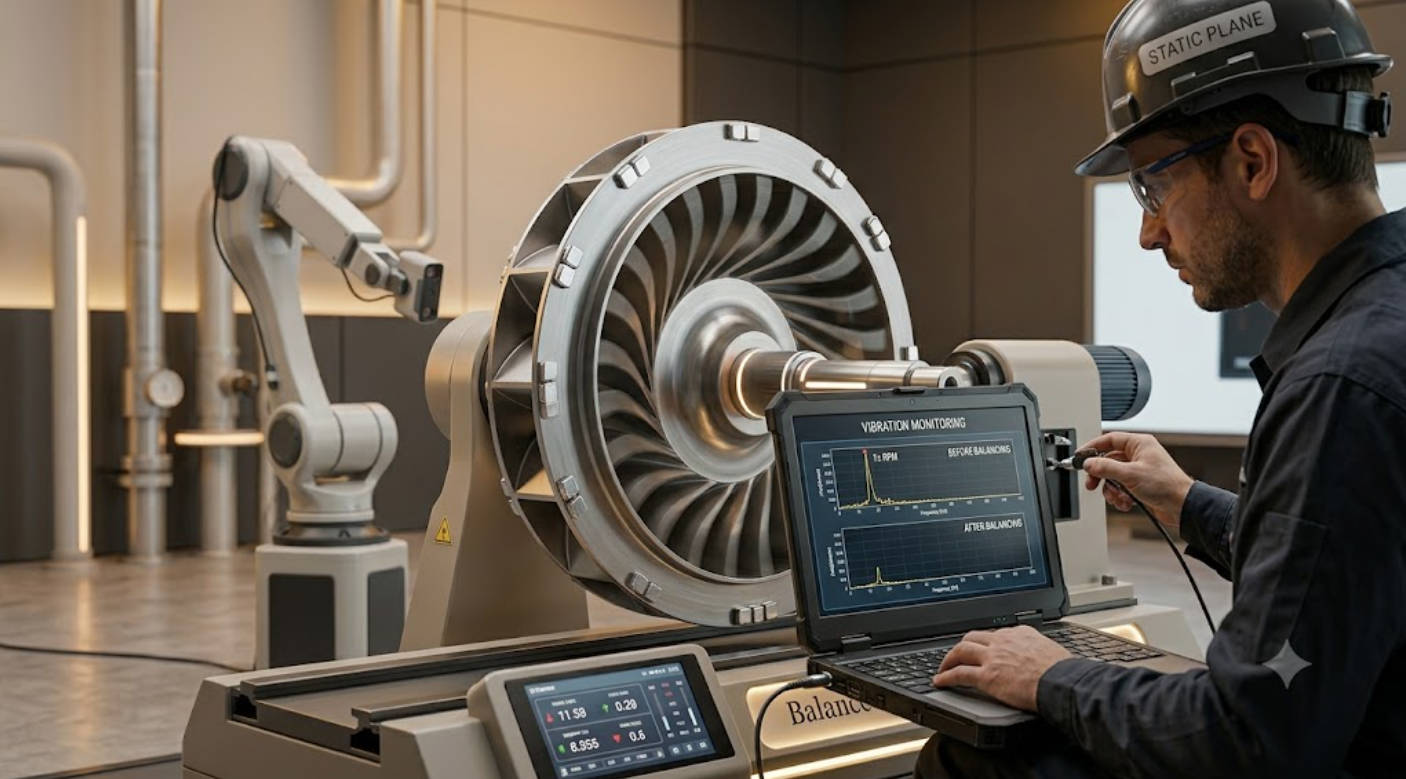
Professional balancing usually follows steps like:
1. Pre‑inspection and cleaning
- Clean the impeller thoroughly before any measurement; dust and debris can dramatically change mass distribution. [quimipol]
- Inspect blades, backplate and hub for cracks, bent parts or missing fasteners. [blog-aarcoair]
2. Initial vibration measurement
- Mount accelerometers on the bearing housings closest to the impeller. [vibromera]
- Attach reflective tape to the shaft and set up a laser tachometer for RPM and phase readings. [vibromera]
- Run the fan at operating speed and capture an FFT spectrum to verify that imbalance (1×) is the dominant vibration. [vibromera]
3. Trial weight method and influence coefficients
- Attach a trial weight at a known angle and radius on the impeller hub or backplate. [vibromera]
- Run the fan again; the balancing system calculates how the rotor responds to added mass and recommends permanent correction weights. [vibromera]
4. Correction and verification
- Weld or clamp the calculated correction weights securely, using suitable materials for the operating temperature. [vibromera]
- Perform a second run to confirm that vibration is below ISO‑recommended commissioning limits (for example 4.5 mm/s for certain fan classes). [vibromera]
- Document before/after data for maintenance records and future diagnostics. [blog-aarcoair]
By aligning balancing practices with standards such as ISO 21940 and ISO 14694, manufacturers can consistently achieve balancing classes like G6.3 or G2.5 where required, improving reliability and customer confidence. [youtube]
Balancing is not a one‑time event; it is part of an ongoing preventive maintenance strategy. Even a perfectly balanced impeller will drift over time due to contamination, wear and small structural changes. [quimipol]
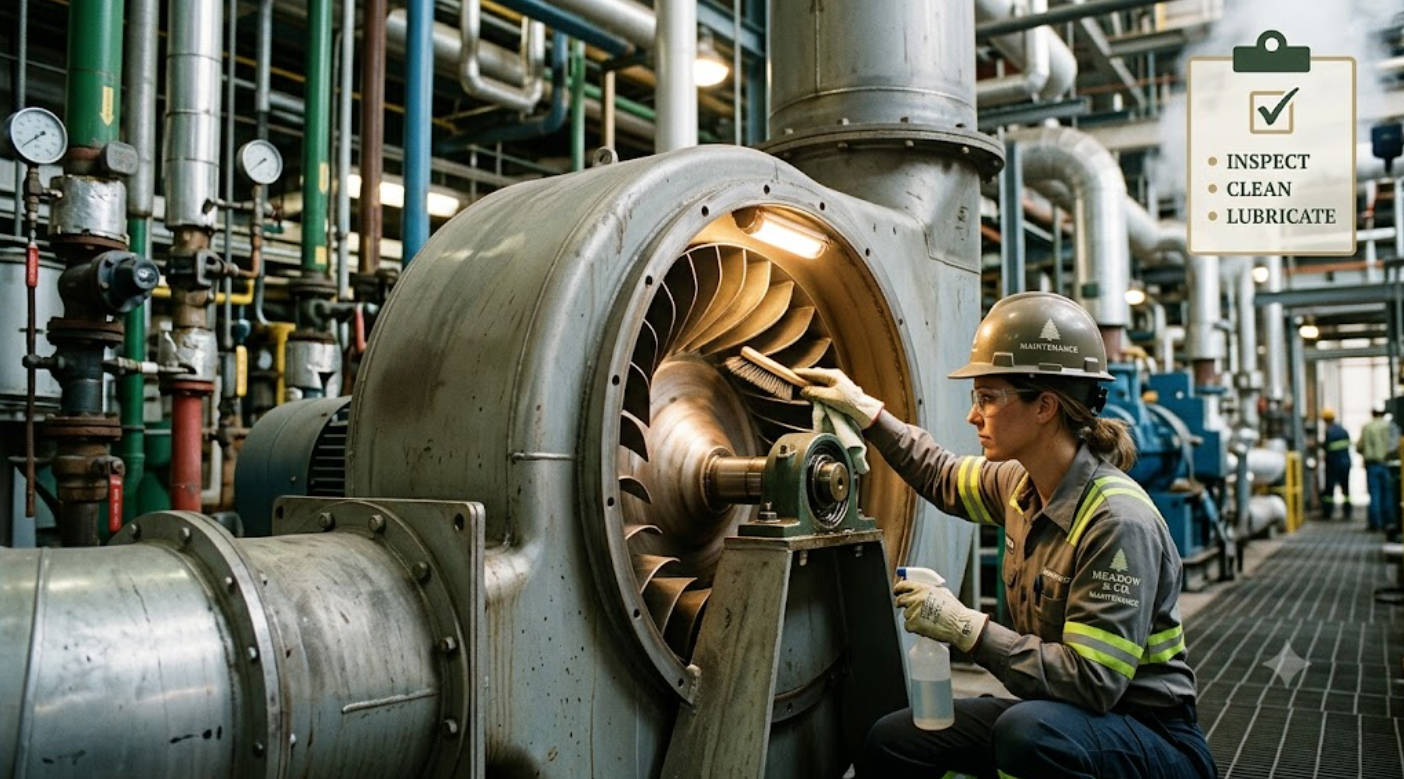
Best‑practice maintenance recommendations include:
- Monthly
- Visual inspection for dirt, corrosion or loose components.
- Impeller cleaning where dust or fibers accumulate on blades. [coolingfanmanufacturers]
- Basic noise and vibration check to detect changes early. [coolingfanmanufacturers]
- Quarterly
- Bearing lubrication according to manufacturer specifications. [quimipol]
- Fastener torque checks on bearing housings, motor mounts and frames. [blog-aarcoair]
- Verification of belt tension or coupling alignment in belt‑driven systems. [quimipol]
- Annually
- Detailed vibration analysis using portable or installed monitoring tools. [coolingfanmanufacturers]
- Insulation resistance tests on motors and electrical components, particularly in harsh environments. [coolingfanmanufacturers]
- Review of system alignment and structural integrity of supporting frames or ducts. [blog-aarcoair]
In high‑dust, high‑temperature or high‑speed environments, technicians should be prepared to perform dynamic re‑balancing whenever vibration exceeds acceptable limits, especially after major cleaning or component replacement. [longwellfans]
From an engineer's standpoint, several practical habits dramatically improve balancing outcomes and reduce rework:
- Clean before you measure: Avoid balancing a dirty fan; contamination patterns can cause misleading correction recommendations. [quimipol]
- Check basic mechanics first: Loose foundations, soft‑foot conditions or misaligned drives can mimic imbalance symptoms. [blog-aarcoair]
- Use conservative trial weights: Start with moderate weights (for example tens of grams on a heavy industrial impeller) to avoid overstressing the structure. [vibromera]
- Prefer material removal for DIY corrections: On small non‑critical fans, carefully drilling material from heavy spots can be safer than adding unsecured weights. [reddit]
- Track data across runs: Each balancing run should show lower vibration than the previous; if not, reassess assumptions and mechanical integrity. [youtube]
For OEMs integrating DC and AC centrifugal fans into telecom or industrial equipment, working closely with fan suppliers and agents ensures that balancing classes, test procedures and documentation align with system reliability targets and certification requirements. [youtube]
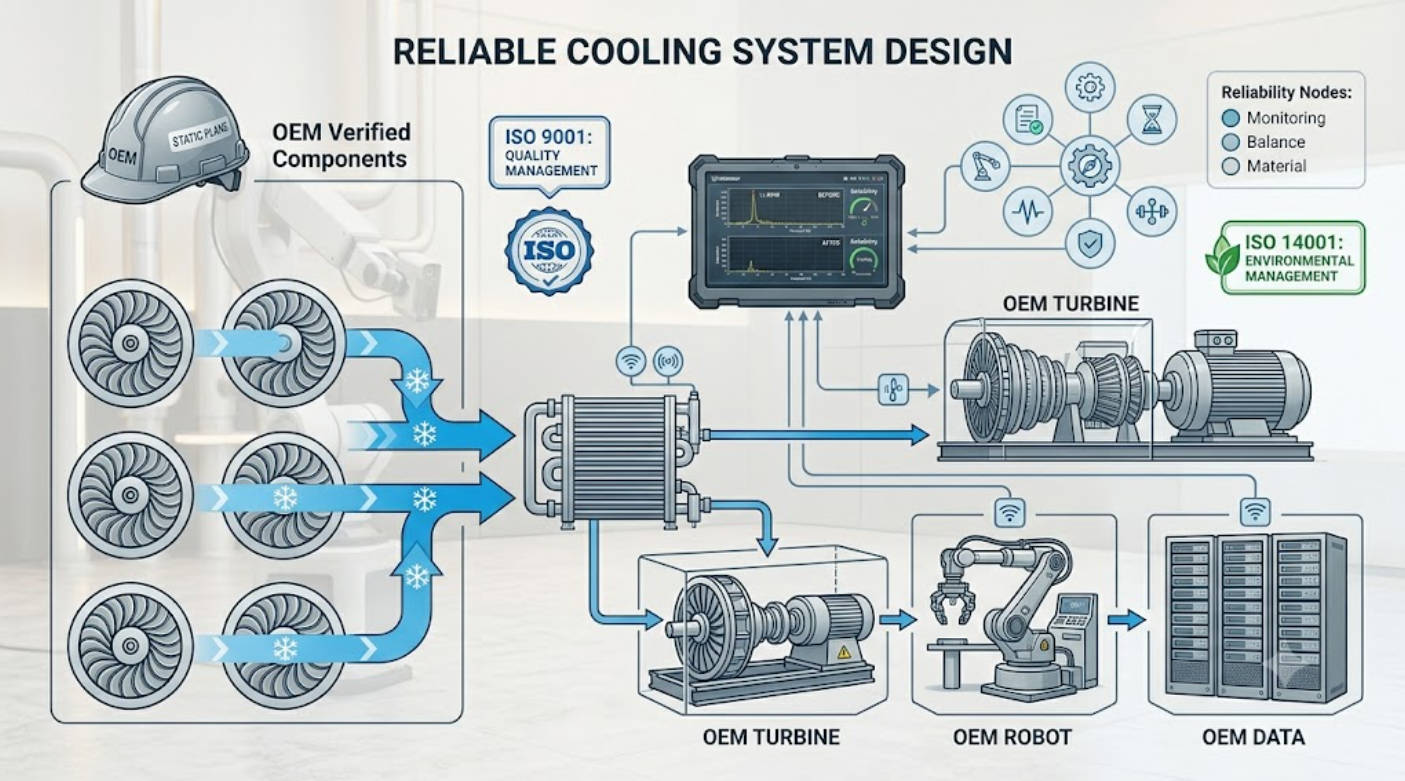
Reliability in the field starts with design decisions. System engineers can make balancing and vibration management easier by:
- Specifying fans from manufacturers who document balancing class, test methods and compliance with ISO 21940/14694. [youtube]
- Designing rigid mounting structures with adequate stiffness and clear access for inspection doors, sensors and cleaning tools. [blog-aarcoair]
- Avoiding speed ranges that coincide with structural resonances; variable speed drives should be configured to avoid critical speeds. [quimipol]
- Planning cable routing and component layout so that vibration sensors can be installed and serviced without major disassembly. [vibromera]
In multi‑fan systems, such as telecom base stations or industrial cabinets, engineers should also consider airflow interaction; turbulence, recirculation and uneven loading can increase vibration and masking noise even when individual impellers are correctly balanced. [quimipol]
If your organization relies on centrifugal fans for cooling critical equipment, it is time to treat impeller balancing as a strategic reliability tool instead of a reactive repair. Work with your fan suppliers, agents and internal maintenance teams to establish clear balancing standards, documented procedures and preventive schedules. [blog-aarcoair]
By combining proper static or dynamic balancing, ISO‑aligned quality control and disciplined maintenance, you can achieve:
- Lower vibration and noise
- Longer bearing and fan life
- Reduced unplanned downtime
- Better overall system stability and energy efficiency [quimipol]
Engineers typically recommend checking and balancing fans at least once a year, or sooner if vibration, noise or bearing temperature increase noticeably. High‑dust or high‑speed applications may require more frequent assessments, especially after major cleaning or part replacement. [longwellfans]
Static balancing corrects mass in a single plane and is suitable for low‑height, moderate‑speed rotors, while dynamic balancing uses two planes and running measurements to remove both static and moment imbalance. For tall or high‑speed impellers, dynamic balancing is essential to keep vibration within ISO limits. [youtube]
For non‑critical, small fans, some technicians use simple methods such as low‑friction supports and incremental material removal from heavy spots, following careful marking and weighing. However, adding unsecured weights can create safety risks, and professional dynamic balancing is recommended for industrial or safety‑critical systems. [reddit]
Typical symptoms include increased vibration at 1× RPM, unusual or growing noise, faster bearing wear, loosened fasteners and, in some cases, visible wobble of the impeller. Regular inspection and vibration analysis help distinguish imbalance from other issues such as misalignment or structural resonance. [blog-aarcoair]
Look for references to ISO 21940 and ISO 14694 in product documentation, along with declared balancing classes such as G6.3 or G2.5 where relevant to your application. Manufacturers that state their balancing standards and provide test reports typically offer more predictable reliability across different installations. [blog-aarcoair]
1. Blauberg Motoren. "How to Keep Balancing of Centrifugal Fan?" [youtube]
<https://www.blaubergmotors.com/news/how-to-keep-balancing-of-centrifugal-fan/>
2. Quimipol. "Preventive Maintenance of Centrifugal Fans: Tips and Best Practice." [quimipol]
<https://quimipol.com/en/preventive-maintenance-of-centrifugal-fans-tips-and-best-practice/>
3. Vibromera. "Industrial Fan Balancing: In-Situ Procedure by Fan Type." [vibromera]
<https://vibromera.eu/example/impellers/industrial-fan-balancing/>
4. Aarco Air Blog. "15 Best Practices for Centrifugal Fan Maintenance." [blog-aarcoair]
<https://blog-aarcoair.com/15-best-practices-for-centrifugal-fan-maintenance/>
5. Cooling Fan Manufacturers. "How Do I Maintain AC Centrifugal Fans for Long Service Life?" [coolingfanmanufacturers]
<https://www.coolingfanmanufacturers.com/FAQ/Detail/63>
6. Longwell Fans. "How to Balance a Centrifugal Fan: Step-by-Step Guide." [longwellfans]
<https://www.longwellfans.com/how-to-balance-a-centrifugal-fan-step-by-step/>
7. Reddit r/AskEngineers. "Economical or DIY Method to Balance an Exhaust Fan." [reddit]
<https://www.reddit.com/r/AskEngineers/comments/4liosb/economical_or_diy_method_to_balance_an_exhaust/>
8. YouTube. "How to Perform Dynamic Balancing of a Fan – Step-by-Step." [youtube]
<https://www.youtube.com/watch?v=RYhk9TAv0a0>


