From idea to market-ready product, our NPI solutions make every stage easier, faster. Discover How We Help
Help Center

Views: 222 Author: Astin Publish Time: 2026-05-08 Origin: Site
As a thermal design engineer who has spent years matching DC fans, AC fans, and motorized impellers to demanding telecom and industrial applications, I can tell you that "the best fan" is never a generic model—it is the one that fits your exact airflow, pressure, reliability, and control requirements with the lowest lifetime cost. This guide walks you through a practical, expert‑level process to choose between DC fans, AC fans, motorized impellers, and blowers for mission‑critical cooling, drawing on real project experience and current industry best practices. [orionfans]

Before you look at fan part numbers, you need a clear picture of the system you are actually trying to cool. In my consulting work with telecom, 5G, and industrial OEMs, projects fail most often not because the fan is "bad," but because the requirements were vague or incomplete. [iecmotores]
Key questions to define up front:
- What is the required airflow in CFM (or m³/h) at operating conditions
- What static pressure (Pa or inch H₂O) does the fan need to overcome from filters, ducts, grills, and obstructions
- What is the maximum allowable noise level (dB(A)) at a defined distance
- What is the available input voltage and power budget
- What temperature, humidity, vibration, and contamination (dust, salt, chemicals) levels will the fan see
- What service life (hours), MTBF, or warranty period do you need
In practice, you should also clarify how the airflow requirement changes over time: is it a constant load, or does your system have variable thermal peaks that require dynamic speed control. I often see excellent fan models misapplied because the designer sized for "worst case" without considering control strategies, leading to unnecessary noise and energy waste. [spanr]
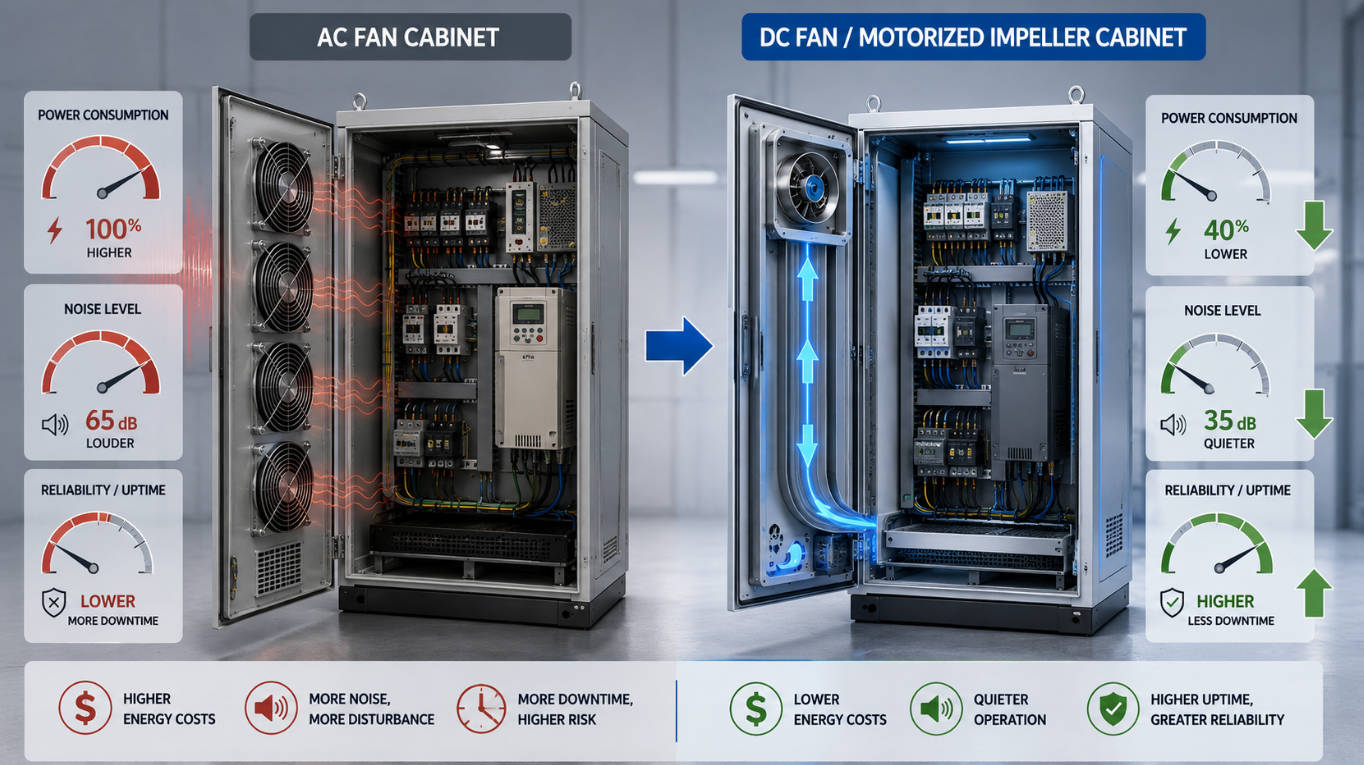
Choosing between DC and AC fans is one of the most strategic decisions you make early in a project, and it directly affects efficiency, acoustics, and control options. From experience with equipment for ZTE, Huawei, and other Tier‑1 manufacturers, the trend in new designs is clear: DC fans are increasingly preferred where energy efficiency and controllability matter, while AC fans remain strong in simpler or infrastructure‑level systems. [universalfans.com]
- Energy efficiency
- DC fans typically use about 50–70% less energy than equivalent AC fans at comparable speeds. [spanr]
- For always‑on equipment (base stations, servers, industrial cabinets), this translates into substantial OPEX savings and lower thermal stress on components. [cfmair]
- Noise and vibration
- AC motors can generate a distinct 50/60 Hz hum and harmonics, especially when using phase‑cut control. [pelonistechnologies]
- DC fans, driven by electronic commutation, usually deliver smoother, quieter operation—critical in office, medical, or indoor telecom environments. [universalfans.com]
- Control and monitoring
- DC fans support PWM or voltage control, tachometer feedback, and alarm outputs, enabling sophisticated thermal management and predictive maintenance. [eu.aspina-group]
- AC fans are typically fixed‑speed unless you add external controllers, which increases cost and complexity. [pelonistechnologies]
- System integration
- AC fans integrate easily in legacy or building‑level systems where AC mains are the default and speed control is not critical. [cfmair]
- DC fans integrate better in modern electronics, telecom, and 5G equipment powered by DC buses, especially where digital control is already present. [sunon]
From an expert perspective, DC fans are usually the right choice when:
- You need tight temperature control and variable fan speeds
- Energy efficiency and green compliance are high priorities
- Noise must be minimized in occupied spaces
- Remote monitoring, alarms, and smart diagnostics are required
AC fans remain compelling when:
- You have a simple system with constant load and minimal control needs
- AC mains are readily available and adding DC rails would be impractical
- Cost sensitivity is high and efficiency is a lower priority
- The equipment is installed in mechanical or outdoor rooms where noise is less critical
Once you know whether you lean toward DC or AC, the next big decision is whether to use a motorized impeller or a centrifugal blower for your cooling task. Both are widely used in telecom cabinets, base stations, power supplies, and industrial electronics, but their strengths differ. [sonicairsystems]
- Motorized impellers
- Typically backward‑curved or radial blades mounted directly on the motor; air moves radially and is discharged into a scroll or plenum. [orionfans]
- They provide high airflow and pressure in a compact footprint, which is ideal for dense electronic enclosures and rack systems. [pdhonline]
- Centrifugal blowers
- Use an impeller inside a scroll housing with defined inlet and outlet; better suited for ducted systems or where you must direct air through a specific path. [sonicairsystems]
- They excel when you need focused airflow through channels, filters, or heat exchangers, especially over longer paths. [theasengineers]
In my own projects, I often specify backward‑curved motorized impellers when space is tight but pressure requirements are relatively high, and choose blowers when ducting is more complex or serviceability (easy replacement) is a priority. [theasengineers]
When I sit with a customer's design team, we typically evaluate DC/AC fans, motorized impellers, and blowers against a short but rigorous checklist. [iecmotores]
- Determine system resistance (backpressure) across filters, grills, ducts, and internal obstructions. [pdhonline]
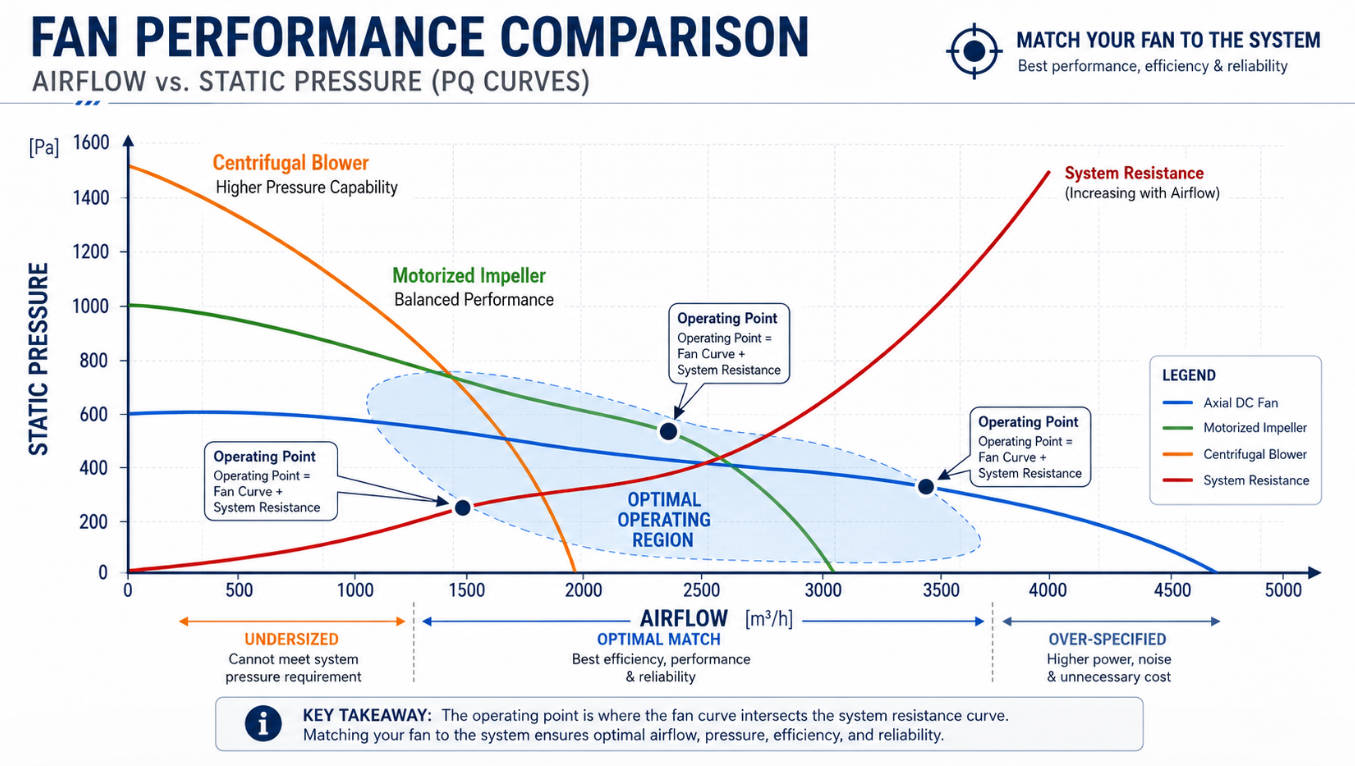
- Use the manufacturer's PQ (pressure–flow) curves to verify that the operating point (your required CFM at given static pressure) falls comfortably in the efficient region of the curve. [eu.aspina-group]
- Avoid running at the extreme right end (near free flow) or extreme left (near stall), as this can hurt stability and noise. [orionfans]
- Check dimensional constraints early; switching from an axial DC fan to a motorized impeller or blower may change depth, mounting patterns, and airflow direction. [theasengineers]
- Verify mounting hole patterns, flange types, and service access so replacement can be done without redesigning your chassis. [iecmotores]
- Set a maximum target for sound pressure level in dB(A) at a defined distance (e.g., 1 m) based on the usage environment. [spanr]
- Consider blade shape (backward‑curved vs forward‑curved) and fan speed; small high‑speed units may meet airflow but fail acoustically. [sonicairsystems]
- Use DC fans with PWM control to dynamically reduce speed and noise in off‑peak conditions. [universalfans.com]
- Match fan voltage (e.g., 5/12/24/48 V DC or 115/230 V AC) and allowable tolerances to your power architecture. [pelonistechnologies]
- Decide up front if you need:
- Tachometer (FG) signals for RPM feedback
- Alarm outputs (fail, locked rotor)
- PWM or analog (0–10 V) speed control
- For AC fans, evaluate any external speed controllers or inverters you might need and their impact on EMI and reliability. [cfmair]
- Specify target life in hours at a reference temperature (often 40 °C or 60 °C) and verify L10 or L50 values from the manufacturer. [sunon]
- Consider bearing type (sleeve, ball, advanced magnetic designs) based on operating position, vibration, and expected life. [sunon]
- Evaluate environmental risks: dust, corrosive gases, salt fog, or high humidity may require sealed or coated fans. [eu.aspina-group]
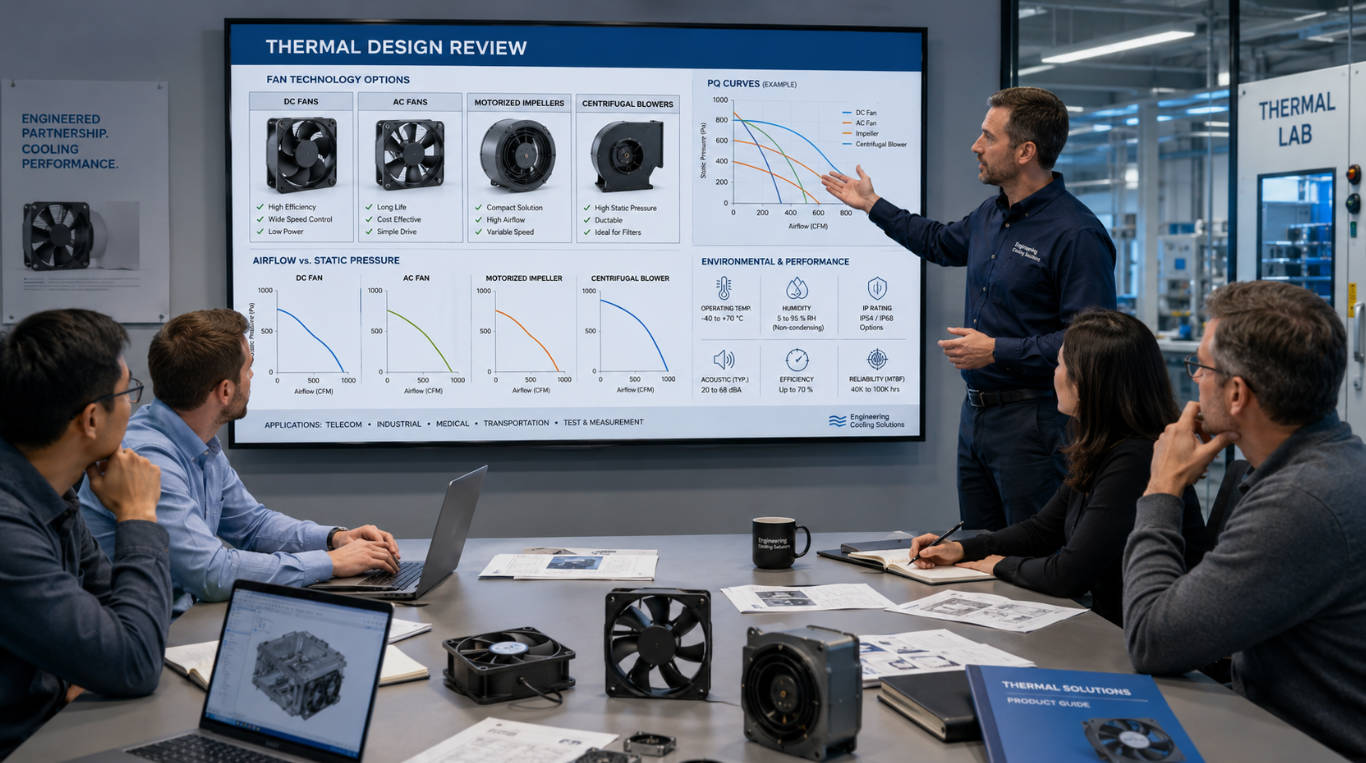
Below is a concise comparison I often use with engineering teams during design reviews. [pdhonline]
| Technology | Typical strengths | Common trade‑offs | Best‑fit applications |
|---|---|---|---|
| DC axial fan | High efficiency, excellent speed control, low noise with PWM, rich monitoring options. spanr | Requires DC supply and driver; more complex electronics. spanr | Telecom base stations, servers, networking gear, medical, precision instruments. spanr |
| AC axial fan | Simple wiring, robust for mains, cost‑effective for constant load. pelonistechnologies | Higher energy use, limited control, possible 50/60 Hz hum. spanr | HVAC, power cabinets, industrial enclosures with constant duty. pdhonline |
| Motorized impeller | High pressure in compact size, good for dense electronics, efficient backward‑curved designs. orionfans | Needs appropriate housing/plenum, higher cost than basic fans. orionfans | Telecom racks, inverters, power modules, compact industrial equipment. orionfans |
| Centrifugal blower | Directed airflow through ducts/filters, high static pressure handling. orionfans | Larger footprint, more complex mechanical integration. orionfans | Ducted cooling, heat exchangers, air filtration, process equipment. sonicairsystems |
To ensure repeatable, high‑confidence decisions, I recommend following a simple, five‑step workflow that we also use internally when supporting OEM customers.
1. Define airflow and pressure
- Use thermal simulations or measurements to define required CFM/m³/h and static pressure at all key operating conditions. [orionfans]
2. Choose DC vs AC platform
- Align with power architecture, efficiency targets, and your need for control and monitoring. [spanr]
3. Select fan type: axial, motorized impeller, or blower
- Axial for high flow, low pressure; motorized impeller or blower for higher pressure or ducted paths. [sonicairsystems]
4. Evaluate candidate models using PQ curves and specs
- Verify operating point, noise, efficiency, lifetime, and integration details. [iecmotores]
5. Prototype and test in real hardware
- Measure temperature, noise, and stability under worst‑case conditions, and adjust fan selection or control strategy as needed. [eu.aspina-group]
A real‑world example: in a compact base‑station radio unit, moving from a fixed‑speed AC blower to a controlled DC motorized impeller reduced fan power by more than half and substantially lowered acoustic noise, while keeping component temperatures well within spec. [universalfans.com]
Cooling technology is evolving quickly, driven by 5G, edge computing, and high‑density power electronics. Understanding these trends helps you avoid designing around soon‑to‑be‑obsolete concepts. [sunon]
- Higher‑efficiency DC motors and blade designs
- Modern DC fans often combine optimized blade geometry with advanced motor control, delivering more airflow at the same or lower input power. [spanr]
- Smart monitoring and predictive maintenance
- Fans increasingly support RPM feedback, alarm outputs, and even digital interfaces that feed into predictive maintenance algorithms. [eu.aspina-group]
- This is particularly valuable in distributed telecom infrastructure where unplanned downtime is costly. [cfmair]
- Advanced materials and bearings
- Suppliers are adopting improved bearing systems and corrosion‑resistant materials to meet the demands of outdoor, automotive, and industrial environments. [sunon]
For OEMs, partnering with a vendor that can supply both standard and customized thermal solutions across DC fans, AC fans, and impellers ensures you can follow these trends without redesigning your entire platform each time. [sunon]
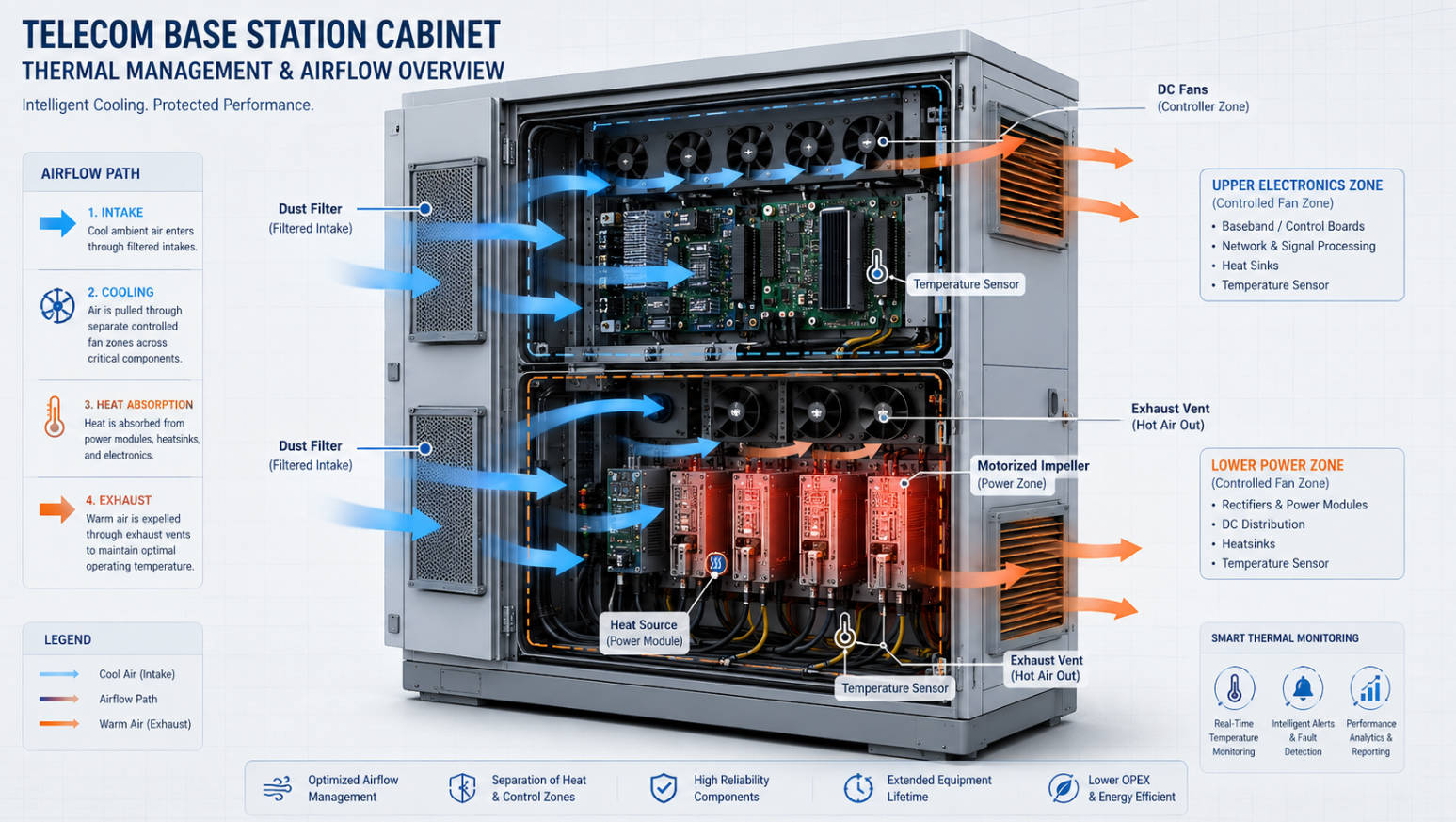
To give you a concrete sense of how these concepts come together, consider a typical telecom base station or outdoor wireless cabinet.
- Requirements: high uptime, wide ambient temperature range, limited service access, and strict noise limits near residential areas. [spanr]
- Approach:
- Use high‑efficiency DC fans or motorized impellers with PWM control to track thermal load. [universalfans.com]
- Design airflow paths carefully through filters and heat exchangers, then select fans based on measured system resistance. [pdhonline]
- Implement tachometer and alarm monitoring so any degradation or blockage triggers an early alert. [cfmair]
In such projects, choosing the right combination of DC fans or impellers can be the difference between a system that quietly runs for years and one that faces recurring alarms, overheating, or emergency field service. [orionfans]
Working directly with a specialized thermal solution manufacturer that offers both proprietary DC/AC fan lines and leading brands of motorized impellers gives designers a real advantage. Instead of selecting parts in isolation, you can collaborate on airflow modeling, PQ curve interpretation, and long‑term reliability planning. [sunon]
An experienced team can help you:
- Translate system‑level requirements into precise fan specifications and test plans. [iecmotores]
- Compare DC vs AC strategies for both first cost and lifetime cost in your target markets. [universalfans.com]
- Optimize not only fan choice but also filters, vents, and mechanical geometry to reduce pressure losses. [pdhonline]
This kind of partnership is especially useful for projects serving global OEMs in telecom, networking, industrial automation, and power conversion, where qualification cycles are long and field reliability is non‑negotiable. [eu.aspina-group]
Selecting the right DC fan, AC fan, motorized impeller, or blower is not a one‑size‑fits‑all task; it is a structured engineering decision that must balance airflow, pressure, efficiency, noise, reliability, and control. By applying the frameworks and checklists above—and by working with a specialist supplier who understands mission‑critical cooling—you can significantly reduce design risk and total cost of ownership over the product lifecycle. [pdhonline]
If you are working on a new design or facing thermal issues in an existing system, gather your key specifications (airflow, static pressure, environment, and lifetime targets) and reach out to a thermal engineering partner who can propose tailored DC and AC fan, motorized impeller, and blower solutions based on real‑world application experience. [iecmotores]
Choose a DC fan when efficiency, noise, and speed control are important, and your system already has a suitable DC bus. Choose an AC fan for simpler, constant‑load systems where you have AC mains and minimal need for dynamic control. [pelonistechnologies]
Use a motorized impeller when you need higher static pressure in a compact space, such as dense telecom or industrial electronics enclosures. Axial fans are better suited to high‑flow, low‑pressure applications with less restrictive airflow paths. [sonicairsystems]
The most common mistake is ignoring system resistance and choosing a fan based only on free‑air CFM ratings, leading to insufficient airflow in real conditions. Always design around the full PQ curve and measured or estimated static pressure. [orionfans]
In telecom, power, and industrial automation, fan lifetime directly affects system availability and maintenance cost. Selecting fans with appropriate MTBF and proper environmental ratings reduces field failures and unplanned site visits. [eu.aspina-group]
Retrofitting is possible, but you must consider available DC power, control electronics, mechanical fit, and any certification implications. A structured evaluation with your thermal solution provider helps ensure the retrofit delivers the expected efficiency and noise benefits without compromising safety or reliability. [pelonistechnologies]
1. Orion Fans – "How to Choose the Best Motorized Impeller or Blower." [orionfans]
2. Spanr – "DC vs AC Motor Fans: Efficiency, Noise, and Controls." [spanr]
3. Universal Fans – "DC Ceiling Fans vs AC – Which Ceiling Fan Is Best?" [universalfans.com]
4. Pelonis Technologies – "The Difference Between AC Fans & DC Fans." [pelonistechnologies]
5. PDH Online – "Characteristics and Selection Parameters of Fans and Blowers." [pdhonline]
6. IEC Motors – "How to Select Motor for Blower?" [iecmotores]
7. ASPINA – "How to Select Automotive Blower Motor." [eu.aspina-group]
8. Sonic Air Systems – "Common Types of Centrifugal Blowers and Applications." [sonicairsystems]
9. CFM Air – "Choosing the Right Blower Size for Your Industrial Application." [cfmair]
10. SUNON – Corporate site on thermal solutions and DC fan technology. [sunon]


