From idea to market-ready product, our NPI solutions make every stage easier, faster. Discover How We Help
Help Center

Views: 264 Author: Capital Technology Publish Time: 2026-08-24 Origin: Site
Content Menu
● Why 80mm Fans Remain Important in Compact Equipment
● Start With the Real Cooling Requirement
>> Ask These Seven Questions First
● Airflow vs. Static Pressure: The Most Important Selection Decision
>> Airflow: Best for Open Ventilation Paths
>> Static Pressure: Essential for Restricted Systems
>> Select From the Fan Curve, Not the Headline Number
● Choose the Right 80mm Fan Type: DC Fan or AC Fan?
>> When a DC 80mm Fan Is the Better Choice
>> When an AC 80mm Fan Is the Better Choice
● Bearing Type Determines Reliability and Maintenance Risk
>> Use Ball Bearings for Demanding Continuous Operation
>> Do Not Compare Lifetime Figures Without Conditions
● Noise Is More Than a dB(A) Rating
>> How to Reduce Noise Without Sacrificing Cooling
● Installation Details That Change Real-World Performance
>> Follow This Practical Installation Process
● A Practical Example: Selecting an 80mm Fan for a Telecom Power Enclosure
● Work With an Experienced Cooling Fan Partner
>> 1. What is an 80mm fan used for?
>> 2. Should I choose an 80mm DC fan or an AC fan?
>> 3. How much airflow does an 80mm fan need?
>> 4. What is better: high airflow or high static pressure?
>> 5. Are ball-bearing 80mm fans better than sleeve-bearing fans?
>> 6. How can I make an 80mm fan quieter?
>> 7. Can an 80mm fan be customized for OEM equipment?
Choosing the right 80mm cooling fan is not simply a matter of matching the frame size. The best 80mm DC fan or AC fan must deliver sufficient airflow and static pressure at the actual operating point of your equipment—while meeting its voltage, noise, lifetime, installation, and reliability requirements.
For compact power supplies, telecom cabinets, industrial controllers, network switches, medical equipment, and embedded systems, an incorrectly selected 80mm fan can lead to high component temperatures, unstable performance, premature failure, and unnecessary acoustic noise. This guide explains how engineers and buyers can select an 80mm fan with greater confidence.
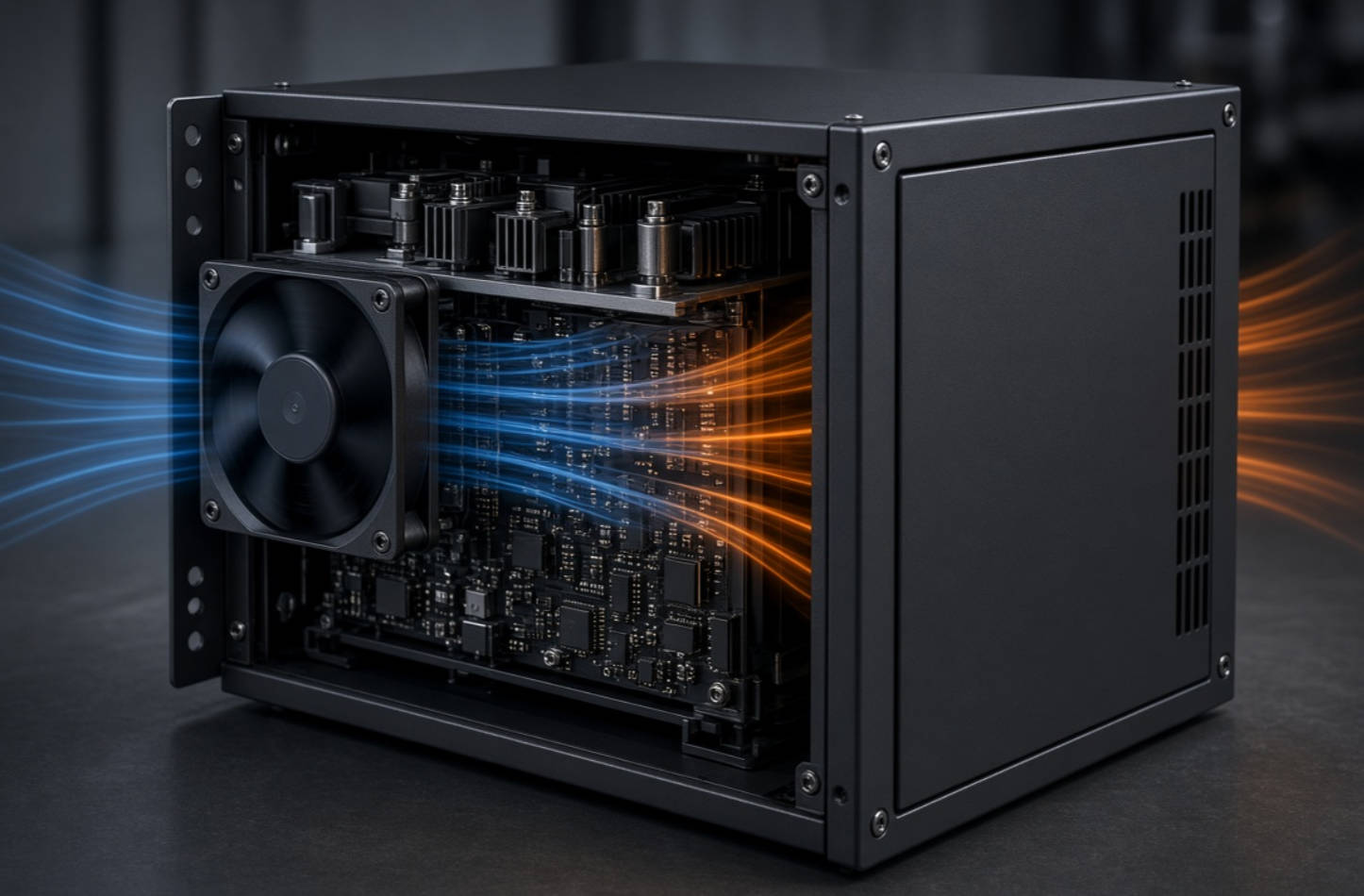
An 80mm axial cooling fan is widely used where equipment designers need practical thermal performance but have limited installation space. Compared with larger fans, an 80mm fan can fit compact chassis and targeted cooling locations. Compared with smaller fans, it can often provide more useful airflow at a lower speed and potentially lower tonal noise.
Typical applications include:
- Telecom base-station equipment and communication power systems
- Network switches, routers, and optical transmission devices
- Industrial control cabinets, PLC enclosures, and servo drives
- UPS systems, power supplies, chargers, and inverter units
- LED lighting systems and laser equipment
- Medical and laboratory instruments
- 3D printers, automation equipment, and embedded electronics
- Computer cases, CPU cooling assemblies, and compact servers
For these applications, the fan is part of the total thermal design—not an interchangeable accessory. Airflow performance changes significantly when the fan is installed behind a grille, dust filter, heatsink, narrow vent, or dense PCB assembly.
Before comparing 80mm fan models, define the thermal challenge inside the equipment. A fan should be selected according to the heat load, airflow path, resistance level, ambient temperature, duty cycle, and reliability target.
1. How much heat must the enclosure remove?
Identify the total heat generated by power devices, processors, transformers, regulators, and other high-temperature components.
2. What temperature limit applies to critical components?
Semiconductor, capacitor, battery, and power-module life can be affected by sustained high operating temperature.
3. Is the airflow path open or restricted?
Open chassis require a different fan profile than systems with filters, heatsinks, cables, grilles, and narrow exhaust openings.
4. Will the equipment run continuously?
A fan in a 24/7 telecom or industrial system needs a different bearing and lifetime strategy than a fan used intermittently.
5. What is the expected ambient temperature?
Higher ambient temperatures increase the cooling burden and can accelerate bearing-lubricant degradation.
6. What voltage and control method are available?
Common options include 12V DC, 24V DC, 48V DC, 110V AC, and 220–240V AC. Control may be fixed-speed, PWM, voltage-controlled, or signal-monitored.
7. What acoustic limit is acceptable?
A fan for a factory cabinet may prioritize cooling capacity, while a fan for a medical device, office product, or home system may need lower noise.
One of the most common fan-selection mistakes is choosing a product solely by its maximum airflow rating. Maximum airflow, often measured in CFM or m³/h, is normally measured in a relatively open-air condition. Real equipment rarely operates in open air.
Airflow is the volume of air a fan moves over time. A high-airflow 80mm fan is often appropriate when air can move freely through the enclosure.
Choose airflow-focused models for:
- Open-frame electronics
- Large, low-resistance ventilation openings
- Chassis with minimal internal obstruction
- General exhaust cooling
- Applications without dense heatsinks or filters
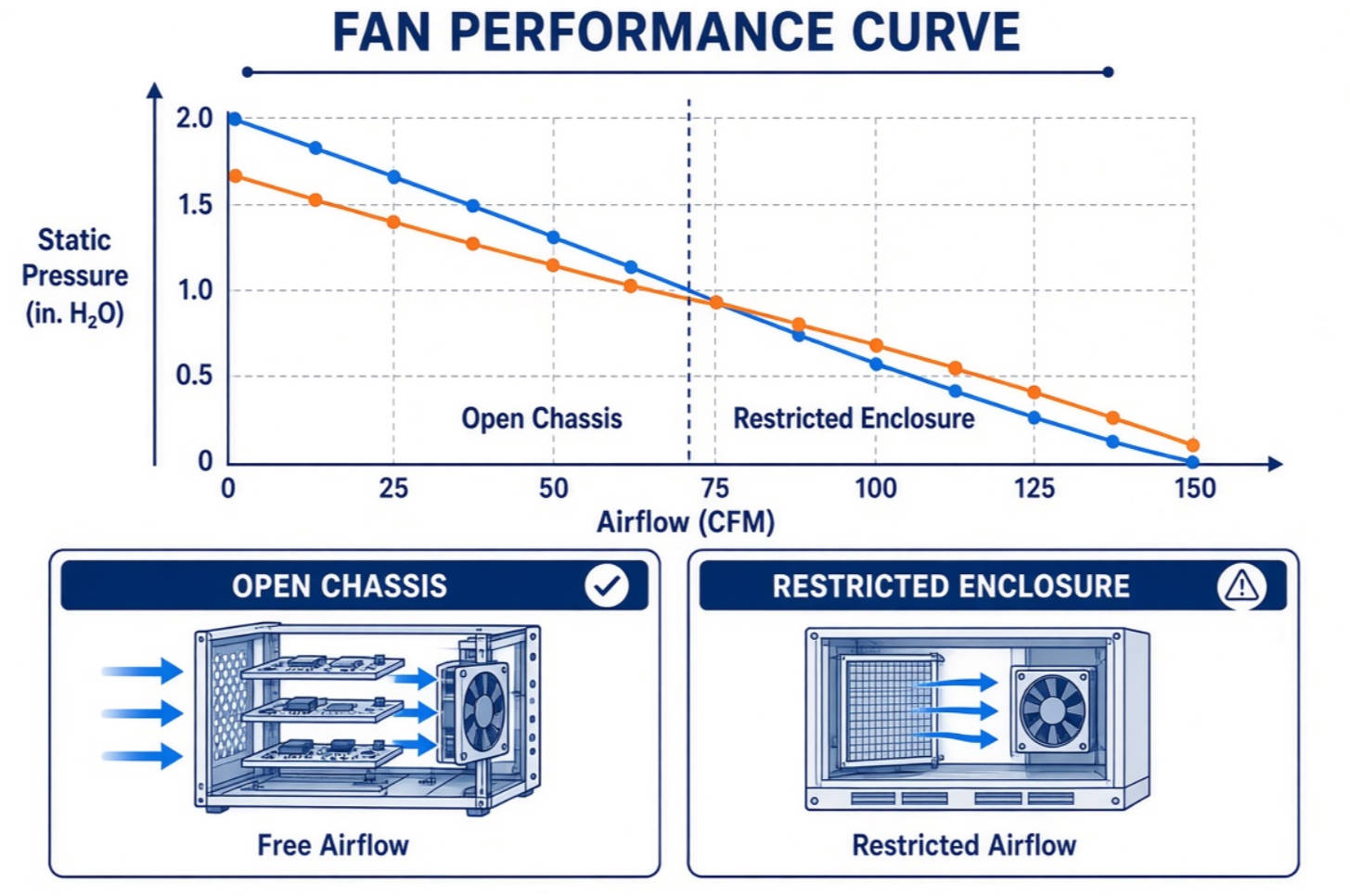
Static pressure describes the fan's ability to push air through resistance. It is commonly stated in Pa or mmH₂O. A high-static-pressure fan is often the better choice when air must pass through obstacles.
Choose pressure-focused models for:
- Dust filters and protective meshes
- Dense heatsinks
- Narrow or long air channels
- High-density PCBs and cable routing
- Compact power supplies
- Rack-mounted telecom equipment
- Enclosures with restrictive inlet or outlet grilles
A practical rule is simple: the more restricted the airflow path, the more important static pressure becomes.
A fan's performance curve shows the relationship between airflow and static pressure. At zero resistance, the fan may achieve its maximum airflow. As system resistance rises, delivered airflow decreases.
The correct fan is the one whose performance curve intersects the system resistance curve at a usable operating point. This is where the fan will actually operate after installation.
For professional engineering projects, ask the supplier for:
- Airflow–static-pressure performance curve
- Rated voltage and operating-voltage range
- Current and power consumption
- Rated speed and speed tolerance
- Noise measurement conditions
- Bearing configuration
- Expected lifetime or L10 life information
- Operating-temperature range
- Signal options, such as FG, RD, PWM, or speed control
Standardized fan-performance testing methods exist to determine airflow, pressure, power, rotational speed, and efficiency, so buyers should confirm how product data was measured before comparing different suppliers' specifications.
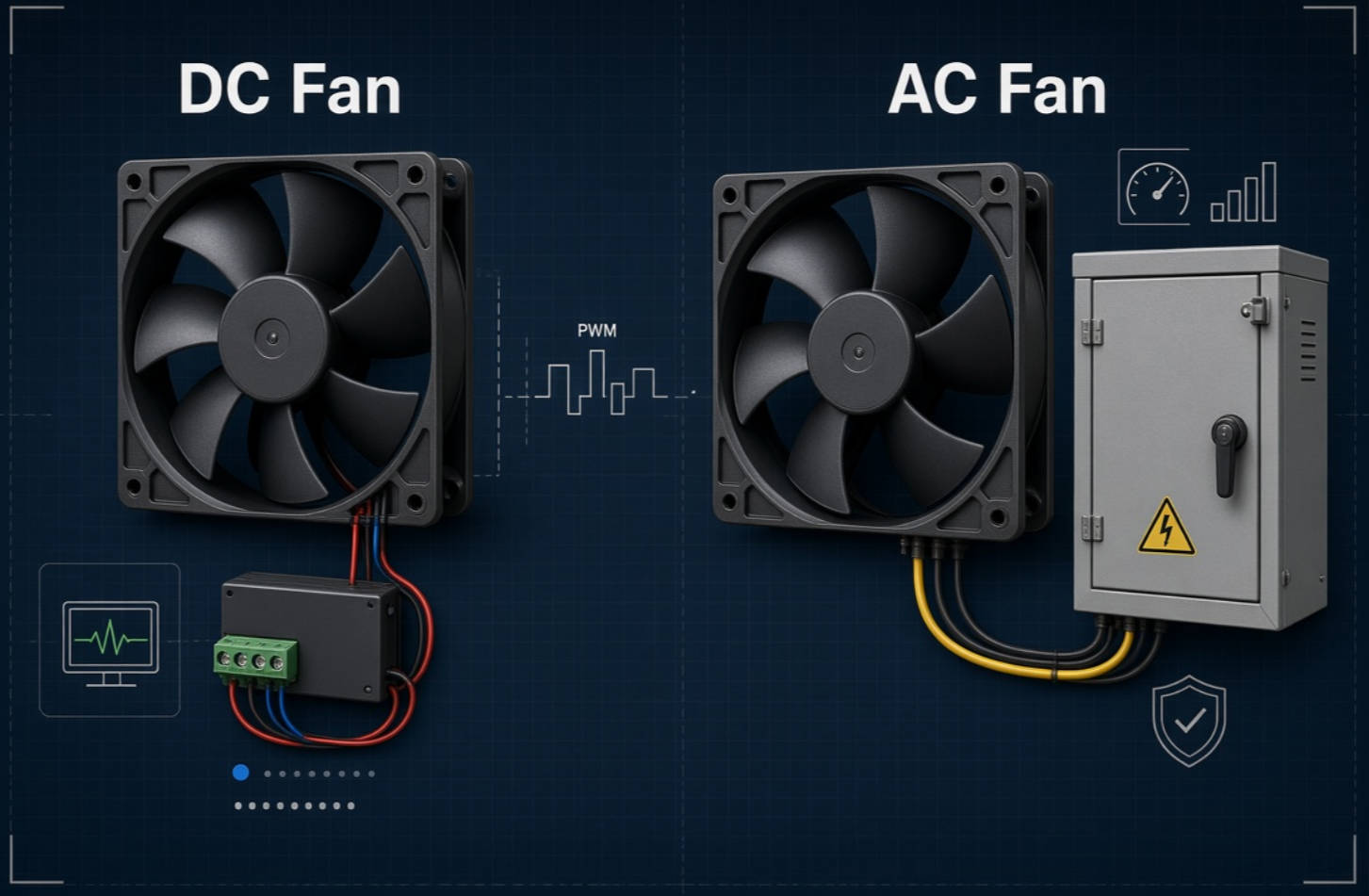
Both 80mm DC fans and 80mm AC fans can be effective, but they serve different system architectures.
| Feature | 80mm DC Fan | 80mm AC Fan |
|---|---|---|
| Typical voltage options | 5V, 12V, 24V, 48V DC | 110V, 115V, 220V, 230V, 240V AC |
| Speed control | Excellent; PWM and voltage control available | More limited, depending on the design |
| Monitoring signals | FG, RD, alarm, tachometer options possible | Less common |
| Use cases | Telecom, servers, automation, power electronics, smart equipment | Cabinets, AC-powered equipment, industrial ventilation |
| Integration | Requires DC power supply or controller | Can connect directly to compatible AC supply |
| Precision cooling | Strong option for intelligent thermal control | Suitable for fixed-speed ventilation needs |
A DC cooling fan is usually preferred when the system needs intelligent control, lower-voltage power, speed feedback, alarm signals, or dynamically adjusted thermal management.
For example, a 24V DC 80mm fan with PWM speed control can run at a lower speed during light load, then increase speed as cabinet temperature rises. This can reduce unnecessary noise, energy use, and bearing wear.
An AC axial fan can be a practical solution for industrial equipment with readily available mains power and relatively stable cooling demand. It is commonly used in electrical cabinets, machinery, power distribution systems, and general ventilation applications.
However, the application must still be evaluated for voltage compatibility, protective grounding requirements, guarding, ingress protection, maintenance access, and environmental conditions.
The bearing system has a major effect on fan noise, mounting flexibility, operating life, and long-term reliability. For an 80mm fan that runs continuously in industrial or communication equipment, bearing selection should never be treated as a minor specification.
| Bearing Type | Main Strength | Main Limitation | Best-Fit Applications |
|---|---|---|---|
| Sleeve bearing | Lower initial cost and relatively quiet initial operation | More sensitive to heat, orientation, and long duty cycles | Light-duty consumer or occasional-use products |
| Ball bearing | Durable, suitable for multiple mounting orientations | May produce more mechanical noise | Industrial, telecom, UPS, and 24/7 equipment |
| Fluid dynamic or hydraulic bearing | Smooth, low-vibration operation and low noise potential | Design quality varies between suppliers | Premium electronics and acoustically sensitive applications |
For applications with high ambient temperature, vertical installation, continuous operation, or difficult service access, dual ball bearing fans are often the safer reliability choice. They are widely specified in industrial controls, telecom equipment, network systems, power electronics, and transportation applications.
A lifetime claim is meaningful only when it includes the test conditions. Ask whether the stated lifetime applies at a specific temperature, voltage, orientation, and speed.
For example, two fans may both claim "long life," but one may be rated under mild laboratory conditions while the other is designed for sustained operation at elevated temperature. The purchasing decision should consider the actual application environment, not only a headline lifetime figure.
A typical 80mm fan may be rated from approximately 18 dB(A) to above 35 dB(A), depending on speed, airflow, blade geometry, bearing design, installation, and measurement distance. However, the published dB(A) figure should not be the only acoustic criterion.
Fan noise can come from several sources:
- Aerodynamic turbulence caused by grilles, filters, sharp bends, and restrictive vents
- Mechanical bearing noise that may increase as the fan ages
- Blade-passing tones caused by fan speed and blade geometry
- Vibration transmission from the fan frame into the metal enclosure
- Electronic commutation noise in some DC fan designs
- Dust buildup that disrupts blade balance and airflow
- Select a larger airflow margin so the fan does not need to operate at maximum speed continuously
- Use PWM or temperature-based speed control where practical
- Avoid overly restrictive fan guards and poorly designed inlet holes
- Use vibration-isolation mounts when enclosure resonance is a concern
- Keep the intake path clean and serviceable
- Choose a fan whose pressure capability matches the restriction level
- Test the fan inside the final enclosure, not only on an open bench
A quiet fan installed behind a highly restrictive grille can become noisy. In contrast, a moderately high-speed fan with a clean airflow path may provide better cooling and more acceptable acoustic results.
Even the best 80mm fan can underperform when installed incorrectly. In many projects, mechanical integration creates more cooling problems than the fan model itself.
1. Define the airflow direction.
Determine whether the fan should intake cool air or exhaust hot air. Most fans show airflow direction and blade rotation with arrows on the frame.
2. Place the fan near the heat path.
Exhaust fans should remove accumulated hot air near the highest-temperature zone. Intake fans should supply cooler air to components that need it most.
3. Avoid airflow short-circuiting.
Do not position intake and exhaust openings so close together that hot exhaust air returns immediately to the intake.
4. Keep clearance around the inlet and outlet.
Tight obstructions near the fan can reduce effective airflow and create turbulence.
5. Evaluate protective guards and filters.
Guards and filters improve safety or dust protection, but they also increase system resistance. Select the fan accordingly.
6. Confirm electrical and signal compatibility.
Verify connector type, wire length, polarity, rated current, PWM logic, tachometer output, and alarm-signal requirements.
7. Validate in the final product.
Measure temperature and noise after the fan is installed in the finished enclosure. Bench-test results alone are not enough.
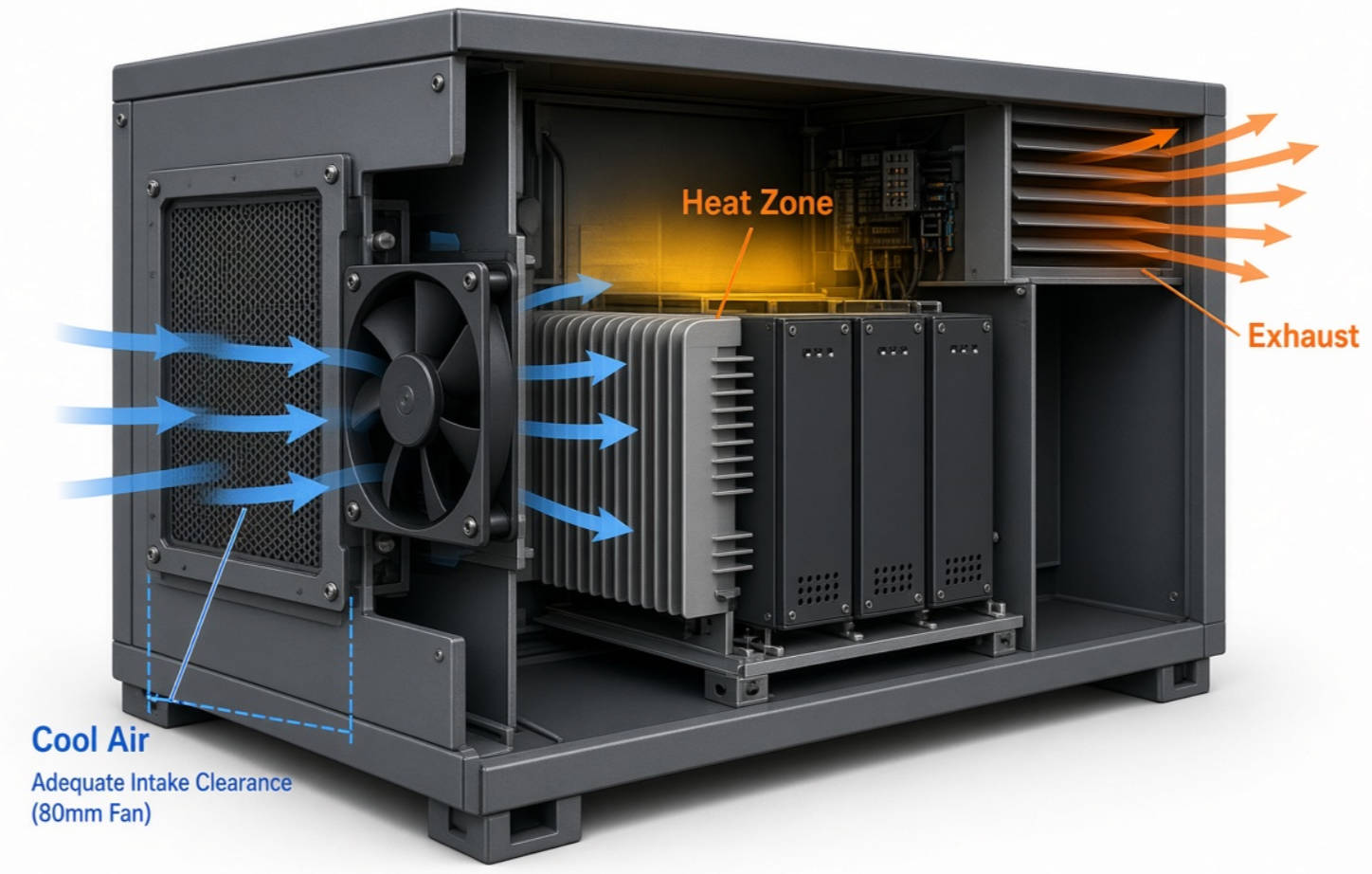
Consider a compact telecom power enclosure with a dense PCB layout, a front dust filter, limited ventilation openings, and continuous operation.
A low-cost sleeve-bearing fan with high free-air CFM may appear adequate on paper. In actual operation, the filter and dense components create resistance. Delivered airflow drops, internal temperature rises, and the fan may operate at maximum speed for long periods.
A better engineering approach would be:
- Choose a 24V DC 80mm fan compatible with the system power architecture
- Prioritize a model with sufficient static pressure
- Use dual ball bearings for continuous-duty reliability
- Add PWM speed control if thermal load changes significantly
- Specify tachometer or alarm output for remote monitoring
- Validate temperature rise at the highest expected ambient temperature
- Design a filter-maintenance schedule to prevent airflow degradation
This approach addresses cooling, reliability, maintainability, and total lifecycle cost together.
For OEM and industrial buyers, the ideal fan supplier should do more than provide a catalog model. The supplier should be able to discuss your heat load, enclosure restrictions, power conditions, noise limit, mounting structure, control needs, and expected operating environment.
Capital Technology Co., Limited focuses on cooling solutions including DC fans, AC fans, compact axial fans, and customized thermal-management products. With the independent CAPITAL brand and experience supporting major communication and industrial customers, our team can help assess the practical requirements behind your 80mm fan specification.
As a leading authorized distributor for SANYO DENKI, Capital Technology can also support customers seeking high-reliability cooling products for demanding electronics, telecom, automation, and industrial applications.
Need help choosing the right 80mm DC fan or AC fan? Contact Capital Technology with your voltage, installation size, airflow target, static-pressure requirement, ambient temperature, noise target, and application details. Our engineering team can recommend a suitable cooling solution and support OEM or project-specific requirements.
An 80mm fan is used to cool compact electronic equipment, including power supplies, telecom devices, network switches, industrial controllers, UPS systems, LED equipment, and computer enclosures. It is valued for fitting limited spaces while providing targeted airflow.
Choose a DC fan when your equipment uses low-voltage DC power or requires PWM control, speed feedback, alarm signals, or intelligent thermal management. Choose an AC fan when compatible AC mains power is available and the application requires stable, fixed-speed ventilation.
The required airflow depends on the enclosure heat load, allowable temperature rise, ambient temperature, and airflow restriction. Do not select solely by maximum CFM; review the fan curve and expected system resistance.
High airflow is better for open chassis with little resistance. High static pressure is better for systems with heatsinks, dust filters, protective grilles, narrow vents, or dense internal components. Many industrial applications need a balanced airflow-pressure design.
For continuous-duty, high-temperature, multi-orientation, or industrial applications, ball-bearing fans are generally the more reliable option. Sleeve-bearing fans can be economical for light-duty applications but may have limitations in demanding environments.
Use PWM or temperature-based speed control, reduce airflow obstruction, avoid restrictive grilles, add vibration isolation where needed, maintain clean filters, and select a fan with suitable pressure capability so it does not need to run at excessive speed.
Yes. Depending on the supplier, customization may include voltage, speed, bearing type, connector, cable length, PWM control, tachometer output, alarm function, frame design, label, packaging, and other project-specific requirements.
1. ISO. [ISO 5801:2017 — Fans: Performance Testing Using Standardized Airways]. Accessed August 2026.
2. Air Movement and Control Association International. [ANSI/AMCA Standard 210-25 / ASHRAE 51-25: Laboratory Methods of Testing Fans for Certified Aerodynamic Performance Rating]. Accessed August 2026.
3. Air Movement and Control Association International. [ANSI/AMCA 210-16 / ASHRAE 51-16 Standard PDF]. Accessed August 2026.
4. Capital Technology Co., Limited. [How to Choose the Right 80mm Fan: A Complete Buying Guide]. Accessed August 2026.
5. Air Movement and Control Association International. [AMCA 211-22: Certified Ratings Program Product Rating Manual].pdf). Accessed August 2026.


