From idea to market-ready product, our NPI solutions make every stage easier, faster. Discover How We Help
Help Center

Views: 278 Author: Capital Technology Publish Time: 2026-07-21 Origin: Site
Content Menu
● What "Quiet" Really Means in Decibels
>> dB vs dBA
>> Test Distance and Environment
● Why Small Decibel Changes Matter
● Noise Targets for Different Scenarios
>> Electronics and Equipment Cooling
>> Why DC Fans Are Often Quieter
>> When AC Fans Still Make Sense
● Design Factors That Make a Fan Quiet
>> Blade Geometry and Aerodynamics
>> Installation and Environment
● Practical Checklist for Choosing a Quiet Fan
● Industry Perspective on "Quiet Fan" Selection
>> 1. How many dB is a quiet fan?
>> 2. Is 30 dB loud for a fan?
>> 3. Are DC fans always quieter than AC fans?
>> 4. Why does the same fan sound louder in real use than in the datasheet?
>> 5. What should I focus on when choosing a quiet fan?
When people ask "how many dB is a quiet fan?", the honest answer is that it depends strongly on the application, the testing method, and the acoustic environment. In everyday situations, a quiet fan for room use is often in the 20–30 dBA range, while ultra-quiet cooling fans for electronics are typically in the 10–20 dBA range. The same decibel rating can feel very different in a silent bedroom compared with a busy office or inside a metal enclosure.
A fan's noise number is only useful when you also understand how it was obtained. Test distance, chamber conditions, fan speed, and installation all influence the sound that users actually hear. To make a confident purchasing decision, you need more than a single figure on a specification sheet; you need a clear explanation of what that figure represents in real-world use.
Most buyers do not expect a fan to be perfectly silent. Instead, they want the sound to blend into the background so it does not disturb sleep, concentration, or conversation. That perception of "quiet" varies with the space and the listener's sensitivity.
Below is a simple reference table that translates typical decibel ranges into everyday experience:
| Noise level (dBA) | Real-world perception | Typical use case |
|---|---|---|
| 10–20 | Very close to near-silent | Small electronics, precision cooling |
| 20–30 | Soft background sound | Bedrooms, study rooms, quiet home fans |
| 30–40 | Noticeable but still comfortable | Offices, living rooms, higher airflow needs |
| 40+ | Clearly audible | General ventilation, high-speed industrial |
What users call "quiet" in a living room might be unacceptable in a recording studio or a medical environment. For this reason, noise discussions are always more meaningful when they are tied to actual use cases rather than abstract numbers alone.
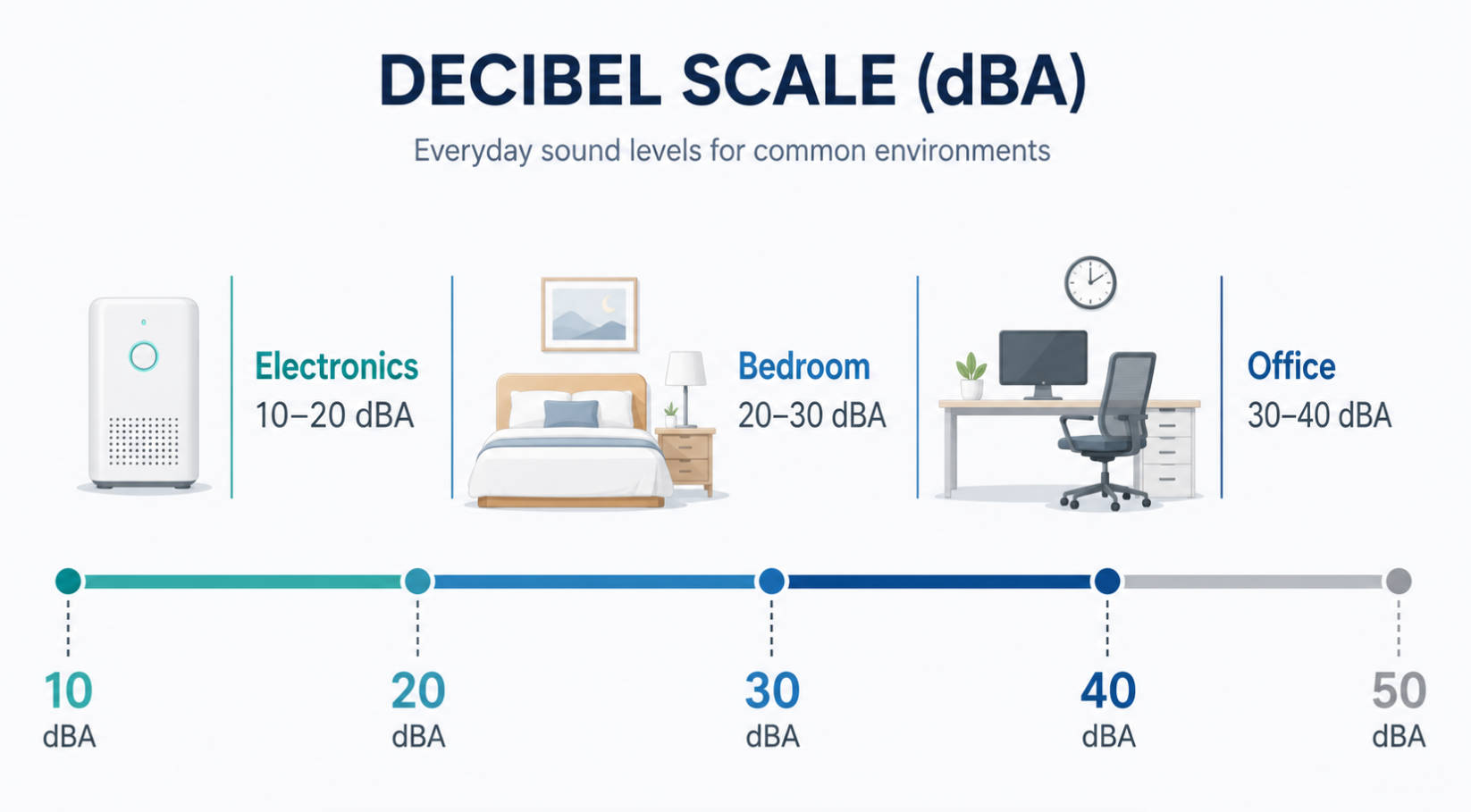
Fan noise is usually described in decibels, written as dB. However, many product sheets and test reports also use dBA. The letter "A" indicates that the measurement has been adjusted to reflect the way human hearing responds to different frequencies. A-weighted decibels emphasize the mid-frequency range and de-emphasize very low and very high frequencies, giving a better idea of how loud a fan will feel to the human ear.
Because of this, a dBA value is generally more useful for comparing fans than a raw dB figure. When evaluating specifications, it is important to check which unit is used and whether it is clearly stated.
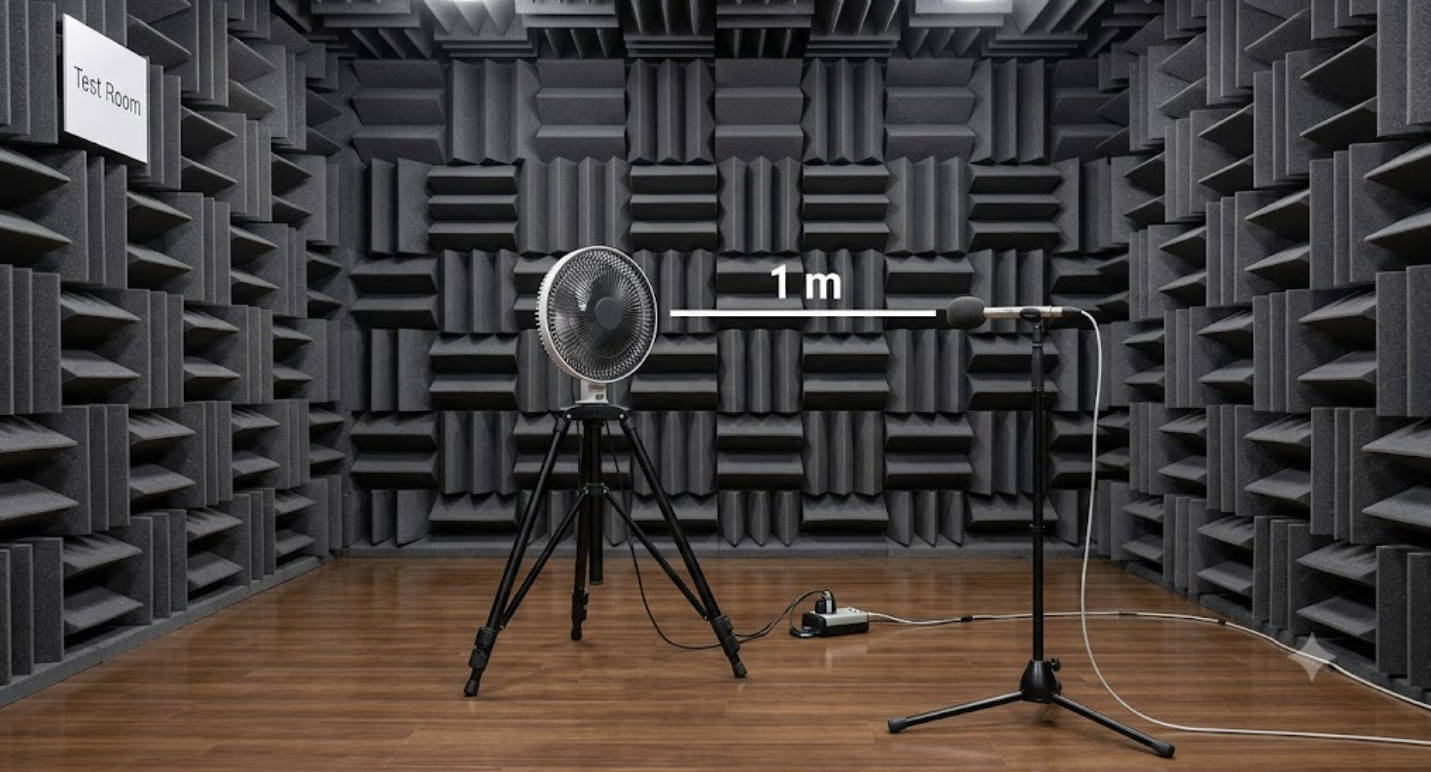
A fan that measures 30 dBA at one distance may measure significantly higher or lower at another. Many manufacturers use a distance of one meter as a reference point, as this provides a reasonable balance between proximity and practical installation. In addition, the test environment matters:
- Anechoic or semi-anechoic rooms reduce reflections and produce cleaner data.
- Standard rooms or office environments introduce reflections and background noise.
- Enclosures and cabinets can amplify or dampen certain frequencies.
Without information about distance and environment, fan noise ratings are much harder to interpret.
Noise levels also depend on how the fan is operated during testing. Key questions include:
- Was the fan running at low, medium, or maximum speed?
- Was it moving air freely, or was there resistance such as filters or grilles?
- Was the fan mounted in a way that could cause vibration or resonance?
A fan that is quiet at low speed may become noticeably louder at maximum output, and some designs prioritize airflow over acoustic comfort.
Decibels use a logarithmic scale rather than a linear one. This means that apparently small numerical changes can represent clear differences in perceived loudness. As a rule of thumb, increases of 3–5 dB can make a fan feel distinctly louder, especially in a quiet environment such as a bedroom late at night.
From a user's perspective, this can determine whether a fan becomes a background sound or a distraction. For buyers comparing products, understanding that a 3–5 dB difference is significant helps avoid the mistake of treating noise numbers as minor variations.
For bedrooms and sleep, most people prefer roughly 20–30 dBA. In this range, the fan provides gentle airflow and may even aid sleep as a form of soft ambient noise. Fans used for sleep should avoid sharp tonal components and sudden speed changes, because these tend to draw attention even when the overall decibel level is modest.
For offices and study areas, the ideal fan keeps noise below about 30 dBA at lower settings, staying stable across long sessions. In these environments, speech intelligibility and concentration matter. A fan that produces a smooth airflow sound is often more comfortable than one that adds noticeable mechanical or tonal noise, even at similar dBA levels.
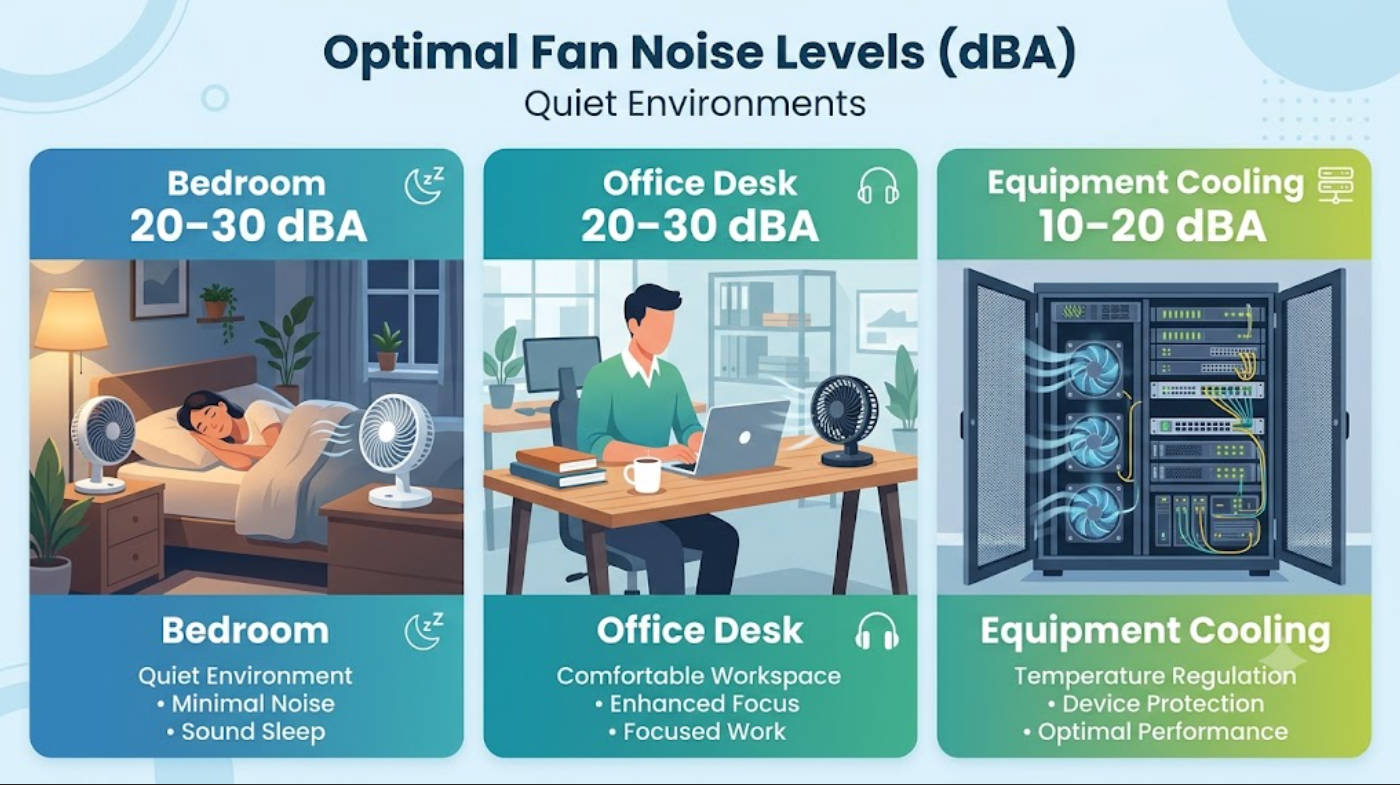
For electronics and equipment cooling, such as communication devices or server cabinets, quietness is important but cannot come at the cost of thermal performance. Smaller fans used in precision electronics may target 10–20 dBA, while larger fans in racks or cabinets may operate at higher levels as they move more air against higher resistance. In these cases, the appropriate noise range is decided by both cooling requirements and the sensitivity of the surrounding environment.
Many DC fans, especially brushless designs, are known for quieter operation compared with traditional AC fans in similar applications. There are several reasons for this:
- Finer speed control, allowing the fan to run at exactly the required level rather than fixed steps.
- Smoother motor operation, resulting in less mechanical noise and vibration.
- Optimized control electronics, which can reduce electrical noise and help stabilize performance.
As a result, DC fans are commonly used in devices and systems where low noise, energy efficiency, and precise control are essential.
AC fans remain widely used and can still be the right choice in many scenarios. They may be preferred when:
- The power system or infrastructure is based on AC supply.
- The application emphasizes durability and robustness.
- Cost considerations or existing design standards favor AC.
In such cases, the focus is on selecting AC fans with well-designed blades, stable bearings, and suitable speed profiles. The goal is to achieve acceptable noise levels while meeting airflow and reliability requirements.
A brushless motor reduces friction and wear compared with brushed designs. Combined with quality bearings, this leads to smoother rotation and lower mechanical noise. Over time, better bearings also help maintain noise performance, whereas poor-quality bearings can gradually become louder due to wear and vibration.
The shape, angle, and size of fan blades dramatically influence noise. Well-designed blades manage airflow more efficiently and reduce turbulence. This not only improves performance but also cuts down on tonal noise—the distinct hum or whine that sensitive users often find more annoying than general airflow sound.
Speed control affects how the fan behaves in daily use. A fan that can ramp slowly and maintain steady speeds tends to sound more pleasant than one that repeatedly jumps between low and high settings. Advanced control profiles may include:
- Gradual start and stop curves.
- Multiple speed steps or continuous adjustment.
- Specialized modes for night or low-noise operation.
Even the best fan can become noisy if mounted poorly. Common installation factors include:
- Rigid mounting to thin panels, which can create resonance.
- Obstructed intake or exhaust, leading to turbulent airflow.
- Proximity to grilles or filters, which can generate additional sound.
Proper mounting, vibration damping, and thoughtful enclosure design all contribute to lower perceived noise.
To turn technical specifications into concrete decisions, use the following checklist when selecting a quiet fan:
1. Confirm whether the rating is in dB or dBA.
2. Check the measurement distance and environment.
3. Compare noise levels at different speeds, not just one value.
4. Look for information on motor type and bearing quality.
5. Consider blade design and intended airflow performance.
6. Evaluate how and where the fan will be installed.
7. Match the target noise range to the actual application (bedroom, office, electronics, industrial equipment).
This structured approach helps buyers avoid purely price-based decisions and instead focus on the long-term comfort and performance that a quiet fan can provide.
In practical engineering work, the quietest fan is not simply the one with the lowest measured number. It is the fan that provides the required airflow and reliable long-term operation while producing the lowest acceptable noise for its environment.
Different industries need different balances:
- Telecom and communication equipment may accept moderate noise in exchange for high thermal safety.
- Office and home products prioritize comfort and acoustic discretion.
- Industrial cabinets and enclosures often need robust, long‑life fans that can operate continuously under demanding conditions.
A strong supplier relationship and careful analysis of operating conditions often matter more than chasing the absolute lowest number on a specification sheet.
Buyers who search "how many dB is a quiet fan" are usually trying to solve one of three problems: disturbed sleep, uncomfortable working conditions, or distracting equipment noise. The most useful guidance therefore connects decibel numbers to realistic expectations:
- A bedroom fan around 20–30 dBA is typically perceived as quiet.
- Office fans should stay low enough to avoid competing with conversation or concentration.
- Equipment cooling fans must balance noise with thermal margins and reliability.
By understanding how fan noise is measured and what factors affect real-world perception, buyers can make choices that improve comfort, protect equipment, and avoid disappointing results.
A quiet fan is defined not only by its decibel rating but also by how, where, and at what speed it operates. Numbers such as 20–30 dBA for bedrooms or 10–20 dBA for sensitive electronics serve as useful benchmarks, yet the full picture includes motor design, blade geometry, speed control, and installation details.
The most effective way to choose a quiet fan is to start from the application, identify an appropriate noise range, and then select DC or AC fan models that meet airflow and durability needs within that range. This approach turns technical specifications into practical comfort and reliable operation.
A quiet fan for typical room use is commonly around 20–30 dBA, while highly optimized electronic cooling fans may reach 10–20 dBA. The right range depends on how sensitive the environment and the users are.
For many people, 30 dB is reasonably quiet, especially in an office or living room. In a very quiet bedroom, some users may still notice it, but it is generally considered a comfortable level.
DC fans are often quieter because of smoother motor control and better speed management, but not all DC fans are automatically quiet. Design quality, blade geometry, and bearings are just as important as motor type.
Real installations can introduce vibration, resonance, airflow restrictions, and background noise. All of these can make a fan sound louder than it did in a controlled test environment.
Focus on dBA values, test conditions, motor and bearing quality, speed control, and how the fan will be installed in your specific environment. Matching these elements to your application is more effective than comparing a single number in isolation.
1. YCCFAN – "How Many dB is a Quiet Fan?"
[https://www.yccfan.com/articledetail/how-many-db-is-a-quiet-fan.html]
2. ISO – "ISO 3745:2003 – Acoustics — Determination of sound power levels of noise sources using sound pressure"
[https://www.iso.org/standard/21750.html]
3. ISO – "ISO 3745:2012(en) – Acoustics — Determination of sound power levels of noise sources using sound pressure"
[https://www.iso.org/obp/ui/es/]
4. Lamp and Light – "All about the noise level of a ceiling fan"
[https://www.lampandlight.co.uk/c/advice/all-about-ceiling-fans/sound]
5. Joybuy – "Quiet Fan 2026: The Ultimate Guide to a Silent Sleep"
[https://www.joybuy.nl/blog/quiet-fan-guide-2026/bXdXAcFy]
6. EBM-Papst – Fan Noise Measurement Standards (technical document)
[https://www.scribd.com/document/747181487/Ebm-papst-Noise-level-test-standard]


