From idea to market-ready product, our NPI solutions make every stage easier, faster. Discover How We Help
Help Center

Views: 215 Author: Capital Technology Publish Time: 2026-10-24 Origin: Site
Content Menu
● Introduction: Why Source Cooling Solutions Through China?
>> How to Recognize a Qualified Supplier
● Why High Static Pressure Matters in Modern Electronics
● How Does a San Ace Counter Rotating Fan Improve Static Pressure?
>> 1. The Front Impeller Accelerates and Swirls the Air
>> 2. The Rear Impeller Counteracts Swirl
>> 3. Two Stages Increase Pressure Capability, Not Simply Free-Air Flow
>> 4. The Useful Result Appears at the System Operating Point
● Verified San Ace Performance Examples
>> Understand the Electrical and Acoustic Trade-Off
● Materials, Manufacturing Quality, and Compliance
>> Specify Materials by Evidence, Not Appearance
>> Separate Company Certification from Product Compliance
● Selection Criteria: How These Five Supply Partners Were Chosen
● Five Cooling Supply Partners to Evaluate
>> 1. Capital Technology Co., Limited — Local Coordination and Customized Cooling Support
>> 2. SANYO DENKI — The Original San Ace Manufacturer
>> 3. Delta Electronics — Broad Thermal-Management Integration
>> 4. SUNON — Fans, Motors, and Cooling Modules
>> 5. Nidec — Customized High-Pressure Server Cooling
● Capacity, MOQ, and Certification Comparison
● Buyer's Guide: Qualifying a San Ace Counter Rotating Fan
>> Step 1: Write a Duty-Point Specification
>> Step 2: Verify the Supply Chain
>> Step 3: Test Samples in the Real Assembly
>> Step 4: Freeze the Approved Configuration
>> Step 5: Align Packaging and Logistics
● Common Sourcing Traps and How to Avoid Them
>> An Underappreciated Trap: A Running Fan Is Not a Fully Healthy Fan
● Conclusion: Buy Verified Cooling Performance, Not a Pressure Number
● FAQ
>> 1. How can I verify whether a supplier's ISO certificate is expired or outside the correct scope?
>> 2. Can two ordinary axial fans replace one San Ace Counter Rotating Fan?
>> 3. Does a published 40,000-hour life mean every fan will operate for 40,000 hours in my equipment?
>> 4. Can I change the connector without repeating the approval process?
>> 5. What evidence should support a "drop-in equivalent" claim?
A San Ace Counter Rotating Fan improves static pressure by using two aerodynamically matched impellers that rotate in opposite directions. The rear impeller counteracts the swirling airflow produced by the front impeller while adding energy to the air. This coordinated arrangement produces a more axial discharge and higher pressure capability than simply placing two identical, same-direction axial fans in series. The practical benefit is stronger airflow through restrictive heat sinks, filters, densely populated circuit boards, and compact equipment enclosures.
For procurement managers, however, pressure performance is only part of the purchasing decision. A reliable cooling partner must also demonstrate traceable products, engineering competence, controlled manufacturing, credible compliance documentation, and dependable delivery.
This guide explains the engineering behind counter-rotating fans, examines five relevant supply partners, and provides a qualification framework for long-term sourcing.
China is an important sourcing and integration location for electronic cooling products, but buyers must distinguish manufacturing origin from the location of their commercial partner. San Ace is SANYO DENKI's cooling-products brand; a Chinese supplier selling San Ace fans is not automatically the manufacturer of those fans.
For buyers working with Shenzhen-based equipment manufacturers, a local thermal-management partner can be useful for coordinating fans, connectors, filters, and application requirements. Capital Technology Co., Limited illustrates this model: its published profile identifies a Shenzhen address, a proprietary CAPITAL product range, and a business supplying SANYO DENKI products alongside its own cooling solutions.
The sensible sourcing strategy is therefore not "buy locally at any cost." It is to combine responsive local engineering and commercial coordination with documented product provenance.
Before comparing quotations, assess four dimensions:
- Factory and product verification: Confirm the legal manufacturer, manufacturing site, exact part number, and applicable approvals.
- Engineering capability: Ask for airflow–pressure curves, control-interface details, and recommendations based on enclosure resistance.
- Quality control: Review incoming-material checks, production testing, traceability, and corrective-action procedures.
- Delivery stability: Establish sample availability, production lead times, allocation rules, and change-notification obligations.
These are qualification requirements, not assumptions that every supplier already meets. A low quotation without supporting evidence is not a meaningful commercial advantage.
Maximum airflow describes how much air a fan can move when external resistance is very low. Static pressure describes its ability to overcome resistance. Equipment cooling requires both, because heat sinks, filters, grilles, and internal components obstruct airflow. SANYO DENKI specifically positions counter-rotating fans for high-density equipment with substantial ventilation resistance.
The wider market context reinforces the importance of careful cooling design. The IEA's 2025 Energy and AI report estimated global data-center electricity consumption at approximately 415 TWh in 2024 and projected approximately 945 TWh by 2030 in its Base Case. Those are data-center electricity figures—not fan-market revenue or a forecast of counter-rotating fan sales. The IEA's data-center tracking page also identifies a newer 2026 research update, Key Questions on Energy and AI.
For buyers, the connection is straightforward: growing computing demand increases the commercial importance of cooling efficiency, but no market-growth statistic can substitute for testing a fan in the actual equipment.
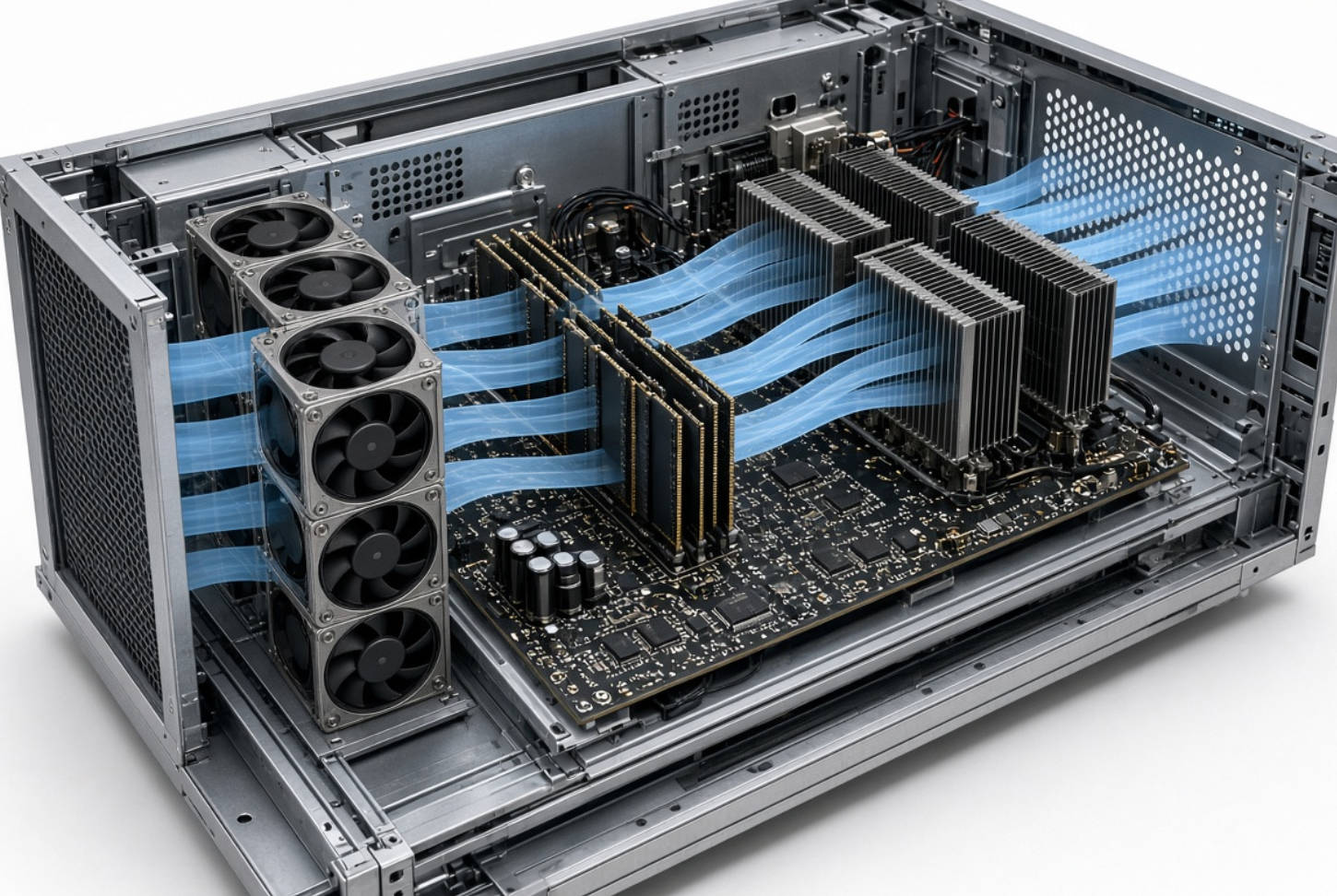
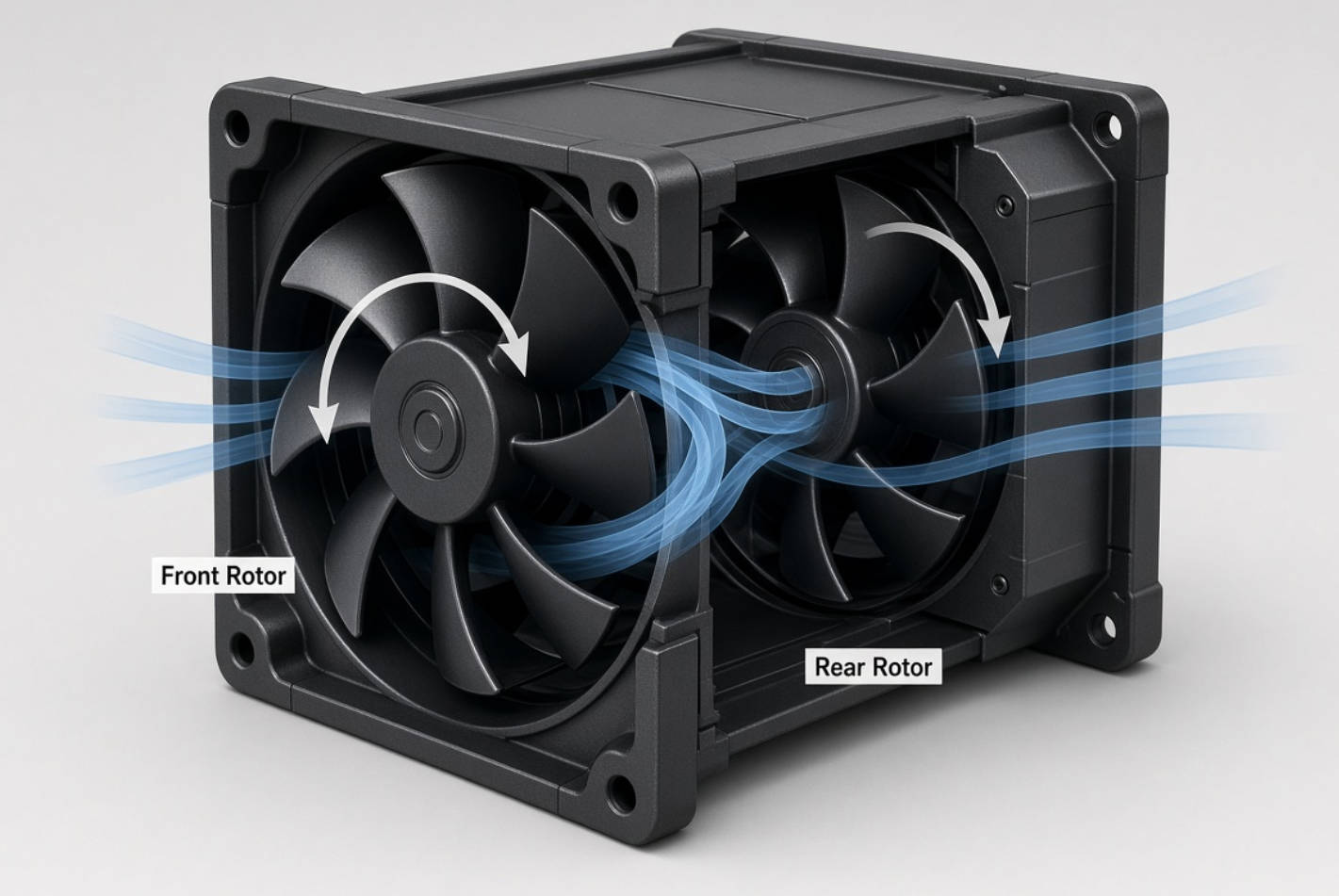
An axial fan does not produce perfectly straight airflow. Its rotating blades also impart a circumferential component to the moving air.
When two identical fans rotate in the same direction in series, the second stage can intensify that swirl. SANYO DENKI explains that this arrangement does not reproduce the performance of a purpose-designed counter-rotating fan.
In a counter-rotating design, the rear impeller rotates opposite to the front impeller. Its blade geometry is matched to the incoming airflow.
The rear stage weakens the front stage's swirling flow and helps produce a straighter discharge. Together, the two stages provide greater static-pressure capability for forcing air through restrictive equipment.
The important word is matched. Counter-rotation alone is not a guarantee of good performance. Blade geometry, motor characteristics, drive electronics, and the relationship between stages all matter. SANYO DENKI describes developing these elements together to improve airflow, pressure, and efficiency.
A counter-rotating fan should not be described as automatically doubling airflow or delivering exactly twice the pressure of a single fan.
The result depends on the complete aerodynamic design. SANYO DENKI notes that changing the combination of front and rear blades can significantly change performance.
This distinction matters when evaluating substitutes. Two products with the same external dimensions can have different pressure curves, electrical demand, noise, and operating behavior.
The relevant purchasing question is:
> How much airflow will this fan deliver against our equipment's resistance?
The operating point lies where the fan's airflow–pressure curve intersects the equipment's resistance curve. SANYO DENKI's technical explanation uses this relationship to show why counter-rotating designs suit high-resistance equipment.
A fan's maximum airflow and maximum static pressure are different endpoints on that curve. They are not simultaneous operating conditions.
Consequently, selecting a fan using only a headline CFM value—or only its maximum pressure—can produce a poor thermal result.
Published specifications illustrate the pressure capability available in compact formats.
| San Ace model | Dimensions | Rated voltage | Maximum airflow | Maximum static pressure | Published sound pressure |
|---|---|---|---|---|---|
| 9CRJ0412P5J001 | 40 × 40 × 56 mm | 12 VDC | 37.4 CFM | 2,400 Pa | 72 dB(A) |
| 9CRH0612P6G001 | 60 × 60 × 56 mm | 12 VDC | 90.8 CFM | 3,350 Pa | 78 dB(A) |
| 9CRHA0812P8J001 | 80 × 80 × 80 mm | 12 VDC | 199 CFM | 2,700 Pa | 85 dB(A) |
Specifications come from SANYO DENKI's respective product announcements. These are different sizes and designs, not a controlled efficiency ranking. Maximum airflow and maximum static pressure must not be interpreted as a single duty point.
The 80 mm 9CRHA announcement, published in May 2025, reports approximately 38% higher maximum static pressure than SANYO DENKI's previous 80 × 80 × 80 mm 9CRH product. That comparison applies to the stated predecessor, not to all competing fans.
The 12 V 9CRHA0812P8J001 has a published rated input of 144 W and sound pressure level of 85 dB(A). It is a demanding cooling component, not a quiet general-purpose cabinet fan. Its potential pressure advantage must be assessed alongside the power budget, acoustic target, and control strategy.
For noise-sensitive equipment, request performance at the intended control setting and validate the assembled enclosure rather than relying on a catalog maximum-speed figure.
A professional purchasing specification should request documentation covering:
- Frame and impeller material identification.
- Applicable flammability classifications.
- Bearing construction and lubricant suitability.
- Wire insulation and connector specifications.
- Environmental operating limits.
- Lot identification and material-change controls.
Do not assume every San Ace model uses identical materials or approvals.
For example, SANYO DENKI specifically states that the 80 mm 9CRHA product uses lead-free brass and complies with the RoHS Directive. The same announcement describes its Eco Product designation as a manufacturer-defined environmental assessment—not an independent substitute for regulatory compliance.
A company-level quality-management certificate and a model-specific compliance document answer different questions.
A supplier assessment should therefore maintain separate records for:
1. The manufacturing site's management-system certification.
2. The exact fan model's safety and environmental documentation.
3. Any modifications made to wires, connectors, mounting arrangements, or control interfaces.
4. The finished equipment's compliance obligations.
For ISO certification, IAF CertSearch provides tools to check company identity, certificate status, scope, issuing certification body, and accreditation information. A certificate image alone is weaker evidence than an independently verified record.
For CE or other market-access requirements, request the applicable declaration and supporting model identification instead of accepting an unexplained logo in a sales presentation.
The following shortlist is a procurement comparison, not an audited ranking of the world's five largest factories.
It includes:
- A China-based cooling manufacturer and San Ace supply partner.
- The original San Ace manufacturer.
- Three established thermal-management manufacturers relevant to alternative-source evaluation.
The criteria are:
| Evaluation area | Evidence buyers should request |
|---|---|
| Technical suitability | Complete curves, control specifications, environmental limits |
| Product authenticity | Manufacturer identity, part-number traceability, channel evidence |
| Engineering support | Application review and clearly defined customization scope |
| Quality management | Current certificates, site scope, inspection records |
| Supply resilience | Available capacity, confirmed lead times, change controls |
| Commercial suitability | MOQ, sample terms, tooling charges, warranty responsibilities |
Capital appears first because it is the featured company in this article. Its inclusion does not imply independent verification of all commercial claims.
Capital Technology Co., Limited describes itself as both a cooling-product factory with the CAPITAL brand and the chief agent of SANYO DENKI. Its published range includes DC and AC fans from 20 to 280 mm, along with other cooling-related products. The company also names ZTE, HUAWEI, HYTERA, and GOLD POWER as customers. These are company-published statements and should be verified where they influence supplier approval.
- Established: The reviewed profile does not disclose an incorporation year; it states more than 20 years of cooling-solution experience.
- Location: Shenzhen, China.
- Market focus: Its disclosed customer examples point toward communications and electronics applications; regional revenue distribution is not published.
- OEM/ODM scope: Its profile states that it designs products according to customer requirements, but detailed engineering boundaries require project confirmation.
Capital's potential value for small and midsize equipment brands is the combination of access to branded San Ace products and discussion of CAPITAL-branded alternatives or customized solutions.
Rather than assuming flexibility, buyers should test it: send a defined specification and assess response speed, drawing accuracy, sample coordination, and willingness to document engineering changes.
An important boundary is that OEM customization of a CAPITAL product must not be confused with permission to modify or relabel an original San Ace product. Request separate quotations and documentation for the two supply routes.
SANYO DENKI was founded in August 1927 and incorporated in December 1936. San Ace is its cooling-products brand, making it the primary technical source for San Ace counter-rotating fan specifications.
- Established: 1927; incorporated 1936.
- Market focus: International electronics and industrial applications, including GPU servers, network devices, and power supplies for the cited 9CRHA product.
- Core strength: Original product design, published technical data, and coordinated development of impellers, frames, motors, and drive circuits.
- OEM/ODM scope: Application-specific arrangements should be confirmed with the manufacturer or its relevant regional organization; do not assume private-label availability.
This is the logical technical reference when a project specifies an exact San Ace model. Procurement should preserve the complete part number and obtain written approval before accepting deviations.
Delta was founded in 1971. Its thermal-management portfolio includes axial fans, blowers, and cooling solutions, and its official fan website describes worldwide availability and customization for application requirements.
- Established: 1971.
- Main markets: Worldwide, across multiple equipment industries.
- Core strength: A broad thermal-management offering rather than a fan-only sourcing conversation.
- OEM/ODM scope: Customized cooling solutions are offered; project acceptance, tooling, quantities, and ownership terms require quotation.
Delta is relevant when buyers are considering a redesigned cooling subsystem or qualifying an alternative manufacturer.
However, a Delta product is not a San Ace product. Any substitution needs mechanical, electrical, thermal, and acoustic validation.
SUNON was established in 1980. Its official profile identifies production facilities in Kaohsiung, Kunshan, Beihai, and Bataan, and describes a portfolio spanning fans, motors, and thermal modules marketed worldwide.
- Established: 1980.
- Main markets: Worldwide.
- Core strength: A broad range of fan and thermal-module products supported by multiple production locations.
- OEM/ODM scope: Buyers should discuss application-specific fan or module development; exact customization and private-label terms are not established by the reviewed overview.
SUNON is relevant when the equipment design remains open to different cooling architectures. Buyers should evaluate the proposed product against the required resistance curve, rather than assuming that a matching frame size establishes equivalence.
Nidec was founded on July 23, 1973. Its official server-cooling material describes customized development beginning at the design stage and explains the use of contra-rotating propeller fans for high static pressure.
- Established: 1973.
- Market focus: Server and data-center cooling are explicit applications in the reviewed material; a regional sales breakdown is not provided.
- Core strength: Motor engineering, airflow simulation, and application-specific development.
- OEM/ODM scope: Customized server fans developed around customer specifications are explicitly described; commercial thresholds require confirmation.
Nidec is particularly relevant for projects that can support a deeper engineering engagement instead of requiring an immediate catalog drop-in replacement.
Public company information rarely establishes the capacity available for one exact model. Group scale, total fan output, and order-specific production allocation are different measurements.
| Company | Published capacity evidence relevant to this review | MOQ | Certification/compliance position |
|---|---|---|---|
| Capital Technology | Its page cites 3.9 million fans per month, but the same section references Japan and Philippine factories; ownership and allocation are unclear | Not publicly established; request separate standard and custom terms | Request current site certificates and exact-model documents |
| SANYO DENKI | Order-specific San Ace capacity not established by reviewed sources | Confirm by model and sales channel | Cited 9CRHA announcement explicitly states RoHS compliance |
| Delta | Reviewed pages do not establish model-specific available output | Quote-specific; confirm separately for custom products | Obtain documents for the supplying site and exact fan |
| SUNON | Multiple production facilities disclosed; available monthly output not established | Confirm catalog versus development quantities | Verify certificates against the proposed production location |
| Nidec | Reviewed sources do not establish available model-specific output | Confirm standard versus co-developed project requirements | Request exact product and manufacturing-site evidence |
The table deliberately avoids invented production volumes, standard MOQs, and blanket certification claims. Capital's capacity wording should be clarified before it is represented as owned manufacturing output.
Ask suppliers to distinguish annual theoretical output, demonstrated recent output, and capacity actually reserved for your orders.
Include:
- Target airflow at required pressure.
- Supply voltage and allowable voltage range.
- Maximum power budget.
- Mechanical envelope and mounting details.
- Ambient temperature and environmental conditions.
- Control and speed-monitoring requirements.
- Acoustic acceptance conditions.
- Destination-market documentation requirements.
Send the same specification to each candidate. Otherwise, quotation comparisons will mix different performance levels.
For branded San Ace products, request:
- Full manufacturer part number.
- Label and packaging photographs.
- Lot or production-date identification.
- Written supply-channel information.
- Confirmation of new, unused condition.
- Warranty and failure-analysis responsibilities.
Where agency status matters, ask for current manufacturer-issued evidence covering the relevant entity, territory, and product scope. A supplier's own statement is a starting point, not the entire verification process.
A useful sequence is:
1. Confirm dimensions, mounting, wiring, and connector orientation.
2. Check operation across the specified supply range.
3. Verify startup and control behavior.
4. Measure temperatures in the assembled equipment.
5. Evaluate noise and vibration under defined conditions.
6. Test foreseeable restricted-flow and failure conditions.
7. Approve a controlled sample and inspection specification.
Catalog performance should inform the test plan, not replace it.
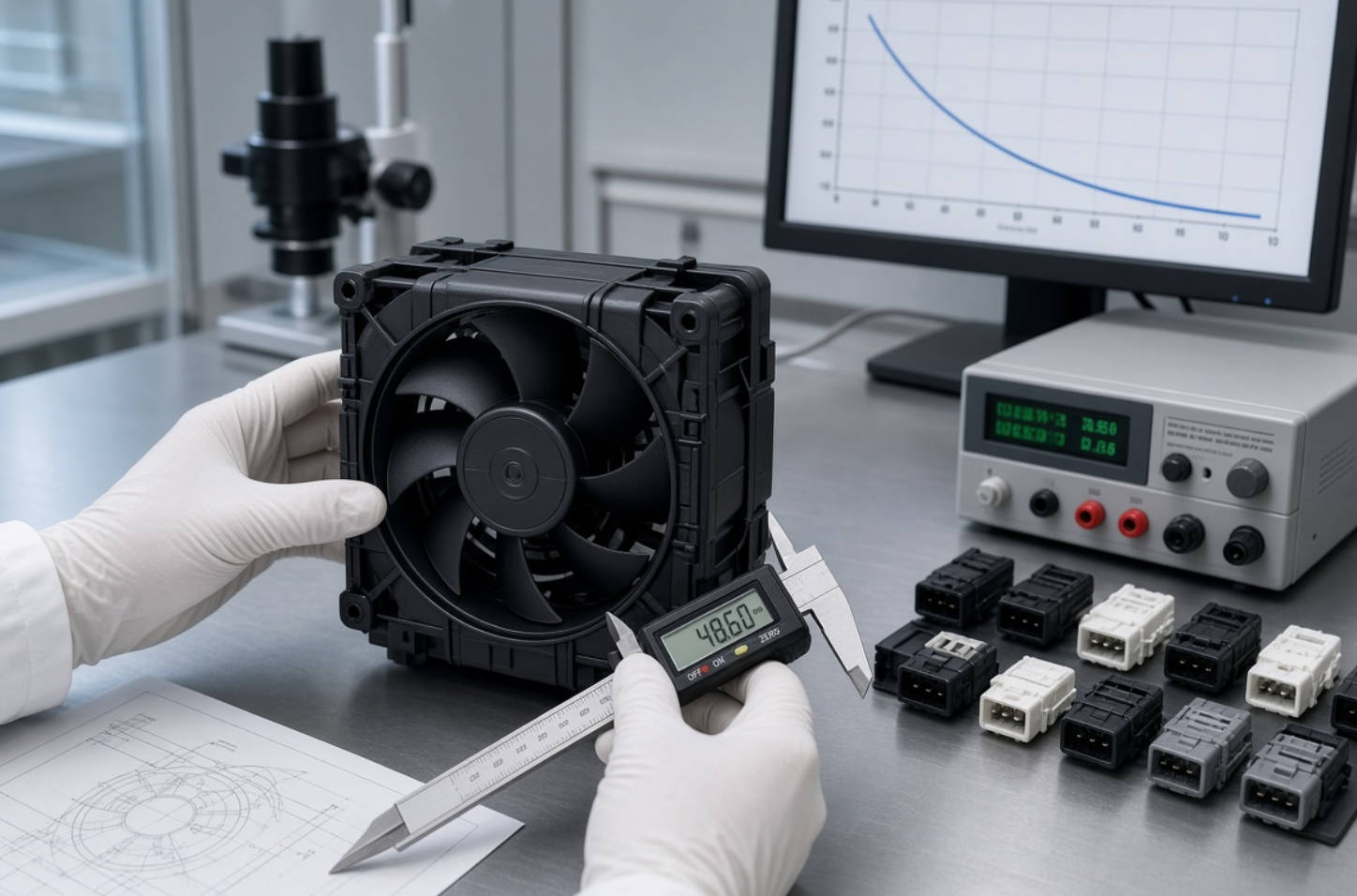
Document the exact part number, drawing revision, connector, wire arrangement, inspection criteria, and accepted deviations.
For customized products, agree which changes require prior approval. Relevant categories include bearings, impellers, electronics, materials, connectors, and manufacturing location.
Require packaging that protects the frame, impellers, and wiring. Agree on label visibility, carton quantities, moisture precautions where applicable, and the handling of damaged shipments.
Also clarify shipping terms, freight responsibility, customs documentation, and country-of-origin information before issuing the purchase order.
| Sourcing problem | Why it creates risk | Buyer response |
|---|---|---|
| Selecting only by free-air CFM | Ignores enclosure resistance | Compare curves at the required duty point |
| Comparing different size classes by maximum pressure | Does not establish efficiency or suitability | Compare mechanical, electrical, and acoustic constraints together |
| Accepting an unspecified "equivalent" | Conceals differences beyond dimensions | Require an engineering deviation and validation report |
| Accepting a generic RoHS statement | May not identify the purchased configuration | Obtain model- or family-linked documentation |
| Treating group capacity as reserved output | Overstates delivery security | Obtain order-specific allocation and lead-time commitments |
| Approving appearance alone | Does not establish internal material consistency | Use controlled specifications, traceability, and inspection |
The core technical reason for these precautions is that counter-rotating performance depends on the complete design and its interaction with equipment resistance.
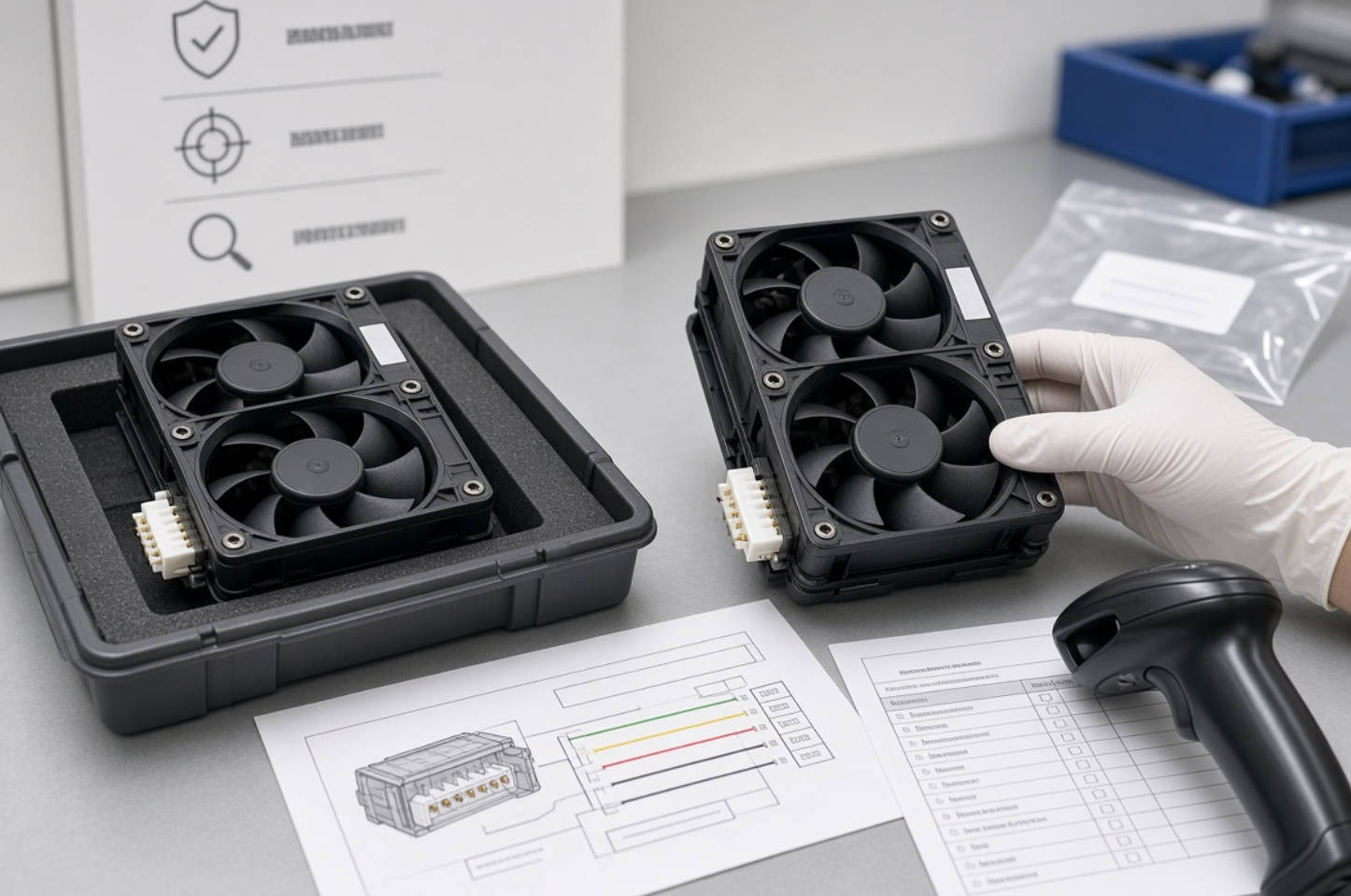
A two-stage fan should be treated as a cooling assembly, not merely as "a fan that spins."
During qualification, require the supplier to explain what the available speed or alarm signals actually monitor. Do not assume one signal proves that both stages are healthy.
A useful engineering test is to evaluate how the assembly behaves when one stage is impaired and determine whether the equipment detects the resulting loss of cooling.
This recommendation follows directly from the architecture: SANYO DENKI explains that performance changes significantly with the front/rear blade combination. Normal-looking motion therefore does not establish normal pressure performance.
The procurement lesson is to specify fault detection and degraded-mode cooling requirements before approving the product—not after a field failure.
A San Ace Counter Rotating Fan improves static pressure through coordinated, opposite-direction impellers that reduce swirl and support airflow through restrictive equipment. Its value depends on matching that capability to the actual operating point.
For long-term sourcing, combine thermal validation with product traceability, verified documentation, controlled customization, and realistic delivery commitments.
Capital Technology Co., Limited is a relevant first discussion partner for buyers seeking a Shenzhen-based interface for original San Ace products and CAPITAL-branded cooling solutions. Its stated manufacturing and application-support capabilities provide a basis for qualification—not a reason to skip it.
For a useful RFQ, send Capital your enclosure drawing, airflow–pressure target, voltage, noise limit, annual demand, destination markets, and customization requirements. Request clearly separated proposals for original San Ace supply and any CAPITAL alternative, each with its own documentation, samples, and validation plan.
Search the legal company name or certificate number in IAF CertSearch. Check active status, standard, scope, covered locations, issuing certification body, and accreditation information.
Match the certificate to the actual manufacturing entity and address—not just a similarly named trading company. If the record is unclear, seek confirmation from the issuing certification body rather than accepting the PDF alone.
Not without engineering validation. SANYO DENKI explicitly states that placing two identical axial fans in series does not reproduce a purpose-designed counter-rotating fan's performance.
The paired blade designs and opposite rotation are central to the airflow behavior. Any proposed replacement needs its own pressure curve and equipment-level testing.
No. For the cited 80 mm 9CRHA product, SANYO DENKI specifies 40,000 hours as L10 life: a 90% survival rate under continuous free-air operation at 60°C and rated voltage.
That is a defined statistical rating under stated conditions, not a universal warranty or an unconditional prediction for every enclosure. Request the exact model's life definition and assess your operating conditions separately.
Treat a connector change as a controlled configuration change. At minimum, confirm pinout, current suitability, contact construction, wire specification, and compatibility with the equipment.
Ask the original manufacturer or responsible engineering authority to determine whether existing safety or conformity documentation still covers the modified assembly. Do not assume that an electrically working sample is automatically an approved configuration.
Request a side-by-side comparison covering dimensions, mounting, full airflow–pressure curves, electrical limits, control behavior, monitoring signals, noise conditions, environmental limits, and life-rating definitions.
Then test the alternative in the equipment. Equal size and similar free-air CFM are insufficient because counter-rotating fan performance depends on stage matching and the system resistance relationship.
1. - Capital Technology Co., Limited: company overview, product range, customization statements, disclosed customers, and capacity wording. [sanyodenki-cn]
2. - SANYO DENKI Tech Compass: counter-rotating architecture, swirl reduction, and ventilation-resistance behavior. [techcompass.sanyodenki]
3. - SANYO DENKI: official counter-rotating product portfolio and design explanation. [products.sanyodenki]
4. - SANYO DENKI: 2025 San Ace 80 9CRHA announcement, specifications, RoHS statement, and life-rating conditions. [sanyodenki]
5. - SANYO DENKI: San Ace 60 9CRH and San Ace 40 9CRJ product announcements. [sanyodenki]
6. - Corporate profiles and official product information for SANYO DENKI, Delta, SUNON, and Nidec. [sanyodenki]
7. - International Energy Agency: Energy and AI and the data-center electricity tracking page identifying the 2026 research update. [iea]
8. - IAF CertSearch: accredited certification verification and certificate-scope checks. [iafcertsearch]


