From idea to market-ready product, our NPI solutions make every stage easier, faster. Discover How We Help
Help Center

Views: 259 Author: Capital Technology Publish Time: 2026-07-20 Origin: Site
Content Menu
● Understanding Forward and Backward Curved Centrifugal Fans
● How Forward Curved Fans Work in Real Projects
>> Blade Geometry and Performance Characteristics
>> Practical Advantages of Forward Curved Fans
>> Limitations to Consider Before Selection
● Why Backward Curved Fans Are Workhorses in Demanding Systems
>> Blade Design and Non‑Overloading Behavior
>> Advantages That Show Up in Lifecycle Cost
>> Trade‑Offs and Design Constraints
● Forward Curved vs Backward Curved Fans at a Glance
>> When Engineers Choose Forward Curved Fans
>> When Backward Curved Fans Are the Better Long‑Term Option
● Case Study – Upgrading from Forward Curved to Backward Curved Fans
● Expert Guidelines for Selecting the Right Fan
>> Step 1 – Define Operating Conditions
>> Step 2 – Match Fan Type to Project Priorities
>> Step 3 – Consider Motor Technology (DC vs AC)
● Maintenance and Lifespan Considerations
>> Lifetime Planning and Replacement Strategy
● The Value of Working With a Cooling Solutions Expert
● FAQs
>> 1. Can a forward curved fan be upgraded by changing only the blades?
>> 2. Which fan type handles dusty air better?
>> 3. Is a backward curved fan always more efficient than a forward curved fan?
>> 4. What extra maintenance do forward curved fans require?
>> 5. Over many years, which fan type tends to be more cost‑effective?
In HVAC and electronics cooling, selecting the right centrifugal fan is about efficiency, lifecycle cost, and long‑term reliability. As a manufacturer and engineering partner working with DC and AC fans daily, the choice between forward curved and backward curved impellers often determines whether a system meets its performance and energy goals.
Forward curved (FC) and backward curved (BC) fans are both centrifugal designs: they draw air in axially and discharge it radially. The key difference lies in blade geometry and how each impeller converts rotational energy into static pressure and airflow.
- Forward curved fan: blades curve in the same direction as rotation.
- Backward curved fan: blades curve opposite to rotation, with fewer, thicker blades.
From an engineering standpoint, FC fans are often chosen for high airflow at low pressure, while BC fans are preferred where higher static pressure and efficiency are critical.
Forward curved fans typically use many narrow blades that form a familiar "squirrel‑cage" impeller. At lower static pressures, this geometry produces high volumetric flow with relatively compact housing dimensions. However, their fan curve drops sharply as pressure increases, so they are seldom the first choice where duct resistance or filtration is substantial.
In practice, FC fans deliver large air volume at low static pressure, making them well‑suited to comfort ventilation and compact enclosures. Their efficiency generally peaks below backward curved designs, often in the 50–65% range in typical applications.
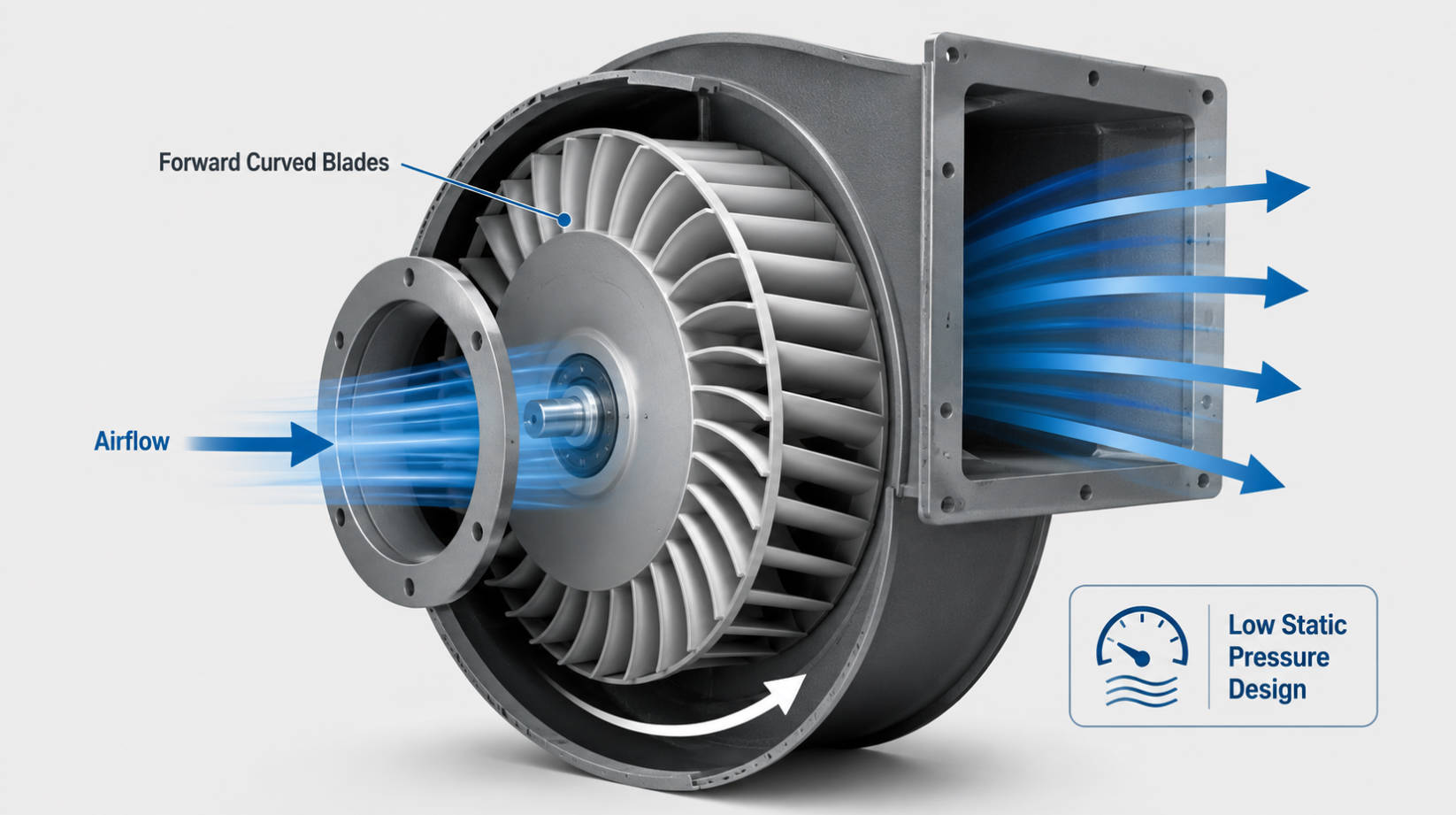
Engineers and equipment buyers choose forward curved fans when:
- Space is limited and the fan must fit into tight housings or legacy equipment.
- System pressure is modest, with short duct runs and minimal filtration.
- Lower initial hardware cost is a priority over long‑term efficiency.
Main benefits include:
- Compact footprint for small air handling units, fan‑coil units, and rooftop equipment.
- High airflow at low pressure for comfort ventilation and light commercial systems.
- Lower upfront cost compared with many backward curved alternatives.
- Quiet operation at low pressure and low speed.
Operational experience shows that the limitations of forward curved fans become clear after several years in service:
- Efficiency falls quickly as static pressure rises, increasing energy consumption.
- Blade geometry tends to trap dust and fibers, especially in dirty environments.
- Performance is more sensitive to improper inlet conditions and clogged filters.
These factors mean forward curved fans are best used where ducts are short, filters are clean, and maintenance access is straightforward.
Backward curved fans use fewer, thicker blades curved opposite to rotation. This geometry supports higher static pressure and a distinctive "non‑overloading" power curve, where power consumption peaks before maximum airflow on the fan curve. For system designers, this provides a safety margin against unexpected resistance in ductwork or filters.
Typical characteristics include:
- Static efficiency in the 70–85% range, significantly higher than most forward curved designs.
- Stable operation across a wider pressure range, well suited to modern filtration and long duct runs.
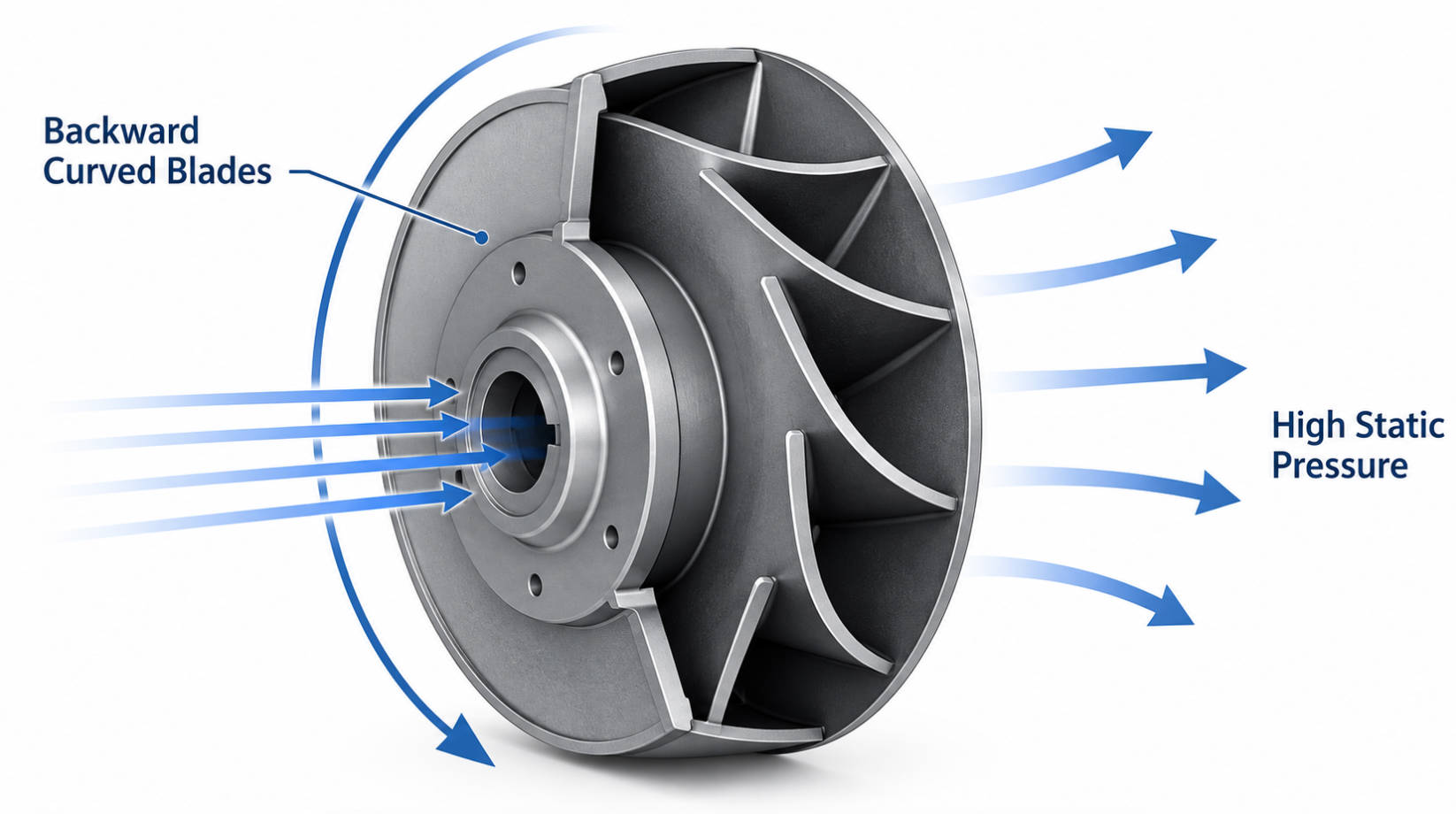
In plants, base stations, and dense electronics cooling, the benefits of backward curved fans go beyond peak performance:
- Higher efficiency, reducing operating power for the same duty point.
- Better handling of dust and debris due to reduced turbulence at the blade leading edge.
- Lower noise compared with many other high‑pressure fan types at equivalent duty points.
When energy cost is modeled over a decade, backward curved fans often deliver lower total cost of ownership despite their higher initial price.
Backward curved fans are not automatically ideal for every project:
- Higher initial hardware cost due to more complex impeller and housing.
- Typically larger overall size, which can challenge retrofits in extremely constrained cabinets.
- Commissioning may require more careful selection to hit a favorable efficiency point.
These trade‑offs matter most in projects where budget and space are tight but pressure requirements remain modest.
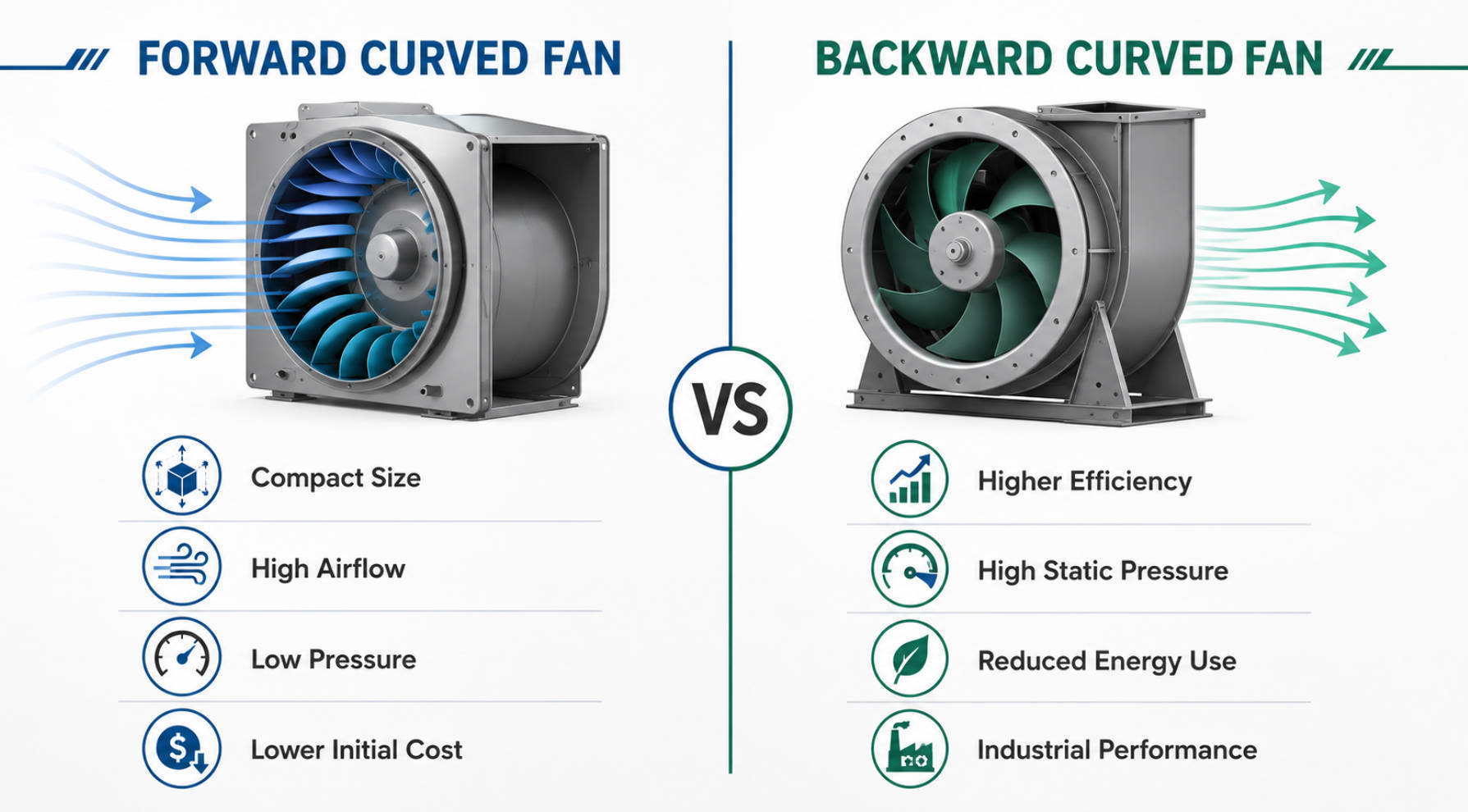
The following table summarizes key differences for quick engineering decisions.
| Feature | Forward Curved Fan | Backward Curved Fan |
|---|---|---|
| Blade curvature | Curved in direction of rotation | Curved opposite to rotation |
| Typical efficiency | Around 50–65% in common applications | Around 70–85% static efficiency |
| Best pressure range | Low static pressure systems | Medium to high static pressure systems |
| Airflow capability | High flow at low pressure | High flow maintained at higher pressure |
| Dust handling | More prone to dust build‑up | Better at managing dusty air |
| Noise profile | Quiet at low speed and low pressure | Quiet compared with many high‑pressure fans |
| Initial cost | Lower hardware cost | Higher hardware cost |
| Typical applications | Comfort HVAC, small AHU, light ventilation | Industrial HVAC, cleanrooms, telecom and IT |
Forward curved fans are a logical choice where volume flow matters more than pressure and the system design is relatively simple.
Representative scenarios:
- Residential and light commercial air handling units with short duct runs.
- Fan‑coil units and package equipment with minimal filtration.
- Compact electronics cooling in enclosures where static pressure is low and footprint is critical.
In these situations, forward curved fans deliver adequate performance at a lower initial cost and fit easily into space‑constrained housings.
Industries and networks increasingly operate under strict energy and uptime targets, pushing backward curved fans to the forefront in many professional systems.
Typical applications include:
- Telecom base stations and networking cabinets with long air paths and restrictive grilles or filters.
- Industrial process ventilation with high resistance ductwork, multiple bends, or dense filtration.
- Cleanrooms and laboratories where stable pressure and air quality are critical.
Here, backward curved fans maintain airflow under higher static pressure, support better energy performance, and reduce the risk of pressure‑related failures.
In a manufacturing facility, the main ventilation system originally used forward curved fans. These units delivered sufficient airflow but produced noticeable noise and increased energy consumption as filters loaded up over time. Engineers later replaced them with backward curved fans while maintaining the same design airflow.
A simplified view of the results:
| Metric | Before (Forward Curved) | After (Backward Curved) |
|---|---|---|
| Airflow (CFM) | 10,000 | 10,000 |
| Static pressure (in. wg) | 1.0 | 3.0 |
| Noise level (dB) | 80 | 75 |
| Energy use (kW) | 10.0 | 8.5 |
Even at the same airflow, the backward curved fans delivered higher static pressure, slightly reduced noise, and cut energy use by about 15%. Over several years, that reduction translated directly into lower operating expenses and more stable system performance.

As a cooling solution manufacturer with an independent brand and as a chief agent for a leading global fan producer, daily collaboration with designers and project owners has led to a structured way of choosing between forward curved and backward curved fans.
Begin by quantifying:
- Required airflow and expected operating range.
- System static pressure including ductwork, filters, and grilles.
- Air quality (clean, dusty, corrosive, high humidity).
- Acceptable noise level, especially in occupied spaces.
These parameters determine whether an FC or BC impeller can operate near its best efficiency point.
Use straightforward rules of thumb:
- Select forward curved fans when low pressure, high airflow, compact size, and low initial cost are primary goals.
- Select backward curved fans when static pressure, efficiency, dust handling, and lifecycle energy cost carry more weight than upfront price.
In high‑density electronics cooling and telecom cabinets, backward curved fans combined with high‑efficiency DC or EC motors often deliver the most robust outcome.
Fan impeller choice is closely tied to motor technology:
- DC and EC motors provide higher efficiency and better speed control, ideal for variable load applications and intelligent cooling strategies.
- AC motors remain common in traditional systems with stable loads and simple control requirements.
Having access to both DC and AC centrifugal fans allows designers to balance performance, cost, and control strategy within a single integrated solution.
Regardless of impeller type, maintenance strongly influences how long a centrifugal fan operates close to its original performance.
Routine tasks for both FC and BC fans typically include:
- Inspecting blades for dust, damage, and corrosion.
- Cleaning build‑up on blades and housings.
- Lubricating bearings according to manufacturer guidelines.
- Checking belt tension and alignment where applicable.
Forward curved fans often require more frequent cleaning because their narrow blades and scroll housings can trap contaminants. Backward curved fans handle dusty air better but still demand periodic inspection, particularly in harsh industrial environments.
Fan lifespan depends on load profile, environment, and build quality. In typical installations, well‑maintained centrifugal fans can operate reliably for many years, but high‑temperature, high‑dust, or corrosive conditions shorten service life.
Working with an experienced cooling systems supplier helps ensure:
- Proper derating for demanding environments.
- Matching impeller type and motor class to duty cycle and load profile.
- Clear maintenance plans aligned with manufacturer recommendations.
The decision between forward curved and backward curved fans is a system‑level design choice that influences energy cost, uptime, and user comfort over the entire life of the equipment. A manufacturer that combines its own product range with the portfolio of an established global brand can offer both components and engineering support, from early sizing discussions to long‑term optimization.
Such partnerships provide:
- Access to DC and AC cooling fans, radiators, filters, and related components as a complete solution set.
- Support from specialists who work daily on telecom, industrial, and electronics cooling projects.
- Experience supplying large technology companies and industrial clients where performance and reliability are non‑negotiable.
When fan selection is treated as part of a broader system design, projects are more likely to meet airflow and pressure targets, stay within energy budgets, and avoid costly redesigns.
Forward curved and backward curved fans each have a clear role in modern cooling and ventilation systems. Forward curved fans offer compact size, high airflow at low pressure, and lower initial cost, making them suitable for comfort ventilation and simple systems. Backward curved fans deliver higher efficiency, better performance at medium to high static pressure, and more stable long‑term operation, especially in industrial, telecom, and high‑density electronics environments.
By analyzing operating conditions, prioritizing lifecycle cost alongside initial budget, and considering both impeller geometry and motor technology, designers can select centrifugal fans that support long‑term performance and reliability. Collaborating with an experienced cooling solutions manufacturer further reduces uncertainty and helps ensure that the chosen configuration will perform as expected throughout the life of the equipment.
No. Forward and backward curved fans use different impeller and hub designs, so changing blades alone is not sufficient. In most cases, the complete fan assembly—impeller, housing, and often motor—needs to be replaced to achieve safe and reliable performance.
Backward curved fans generally handle dusty air better because their blade geometry creates less turbulence that traps dust on the impeller. Forward curved fans have many narrow blades that tend to collect dust, requiring more frequent cleaning and increasing maintenance demands.
Backward curved fans typically achieve higher efficiency, especially at medium to high static pressure. However, overall efficiency depends on the operating point, the motor type, and how well the fan curve matches the system curve. In low‑pressure systems, properly sized forward curved fans can still operate efficiently.
Forward curved fans often need more regular cleaning because their narrow blades and scroll housings accumulate dust and fibers. Without periodic cleaning, performance can drop, and vibration or noise may increase, particularly in applications with dirty or contaminated air.
In applications with significant static pressure or long operating hours, backward curved fans are usually more cost‑effective over the long term because their higher efficiency reduces energy consumption and their geometry copes better with dust. In simpler, low‑pressure systems with limited operating hours and tight budgets, forward curved fans can remain a suitable and economical choice when applied correctly.
1. Longwell Fans – "Forward vs Backward Curved Fans – Performance Comparison." [https://www.longwellfans.com/difference-between-forward-curved-and-backward-curved-fans/]
2. ProVent Fan – "Backward Curved vs Forward Curved Centrifugal Fans." [https://www.proventofan.com/backward-curved-vs-forward-curved-centrifugal-fans/]
3. Blauberg Motors – "Forward vs Backward Centrifugal Fans – How to Make the Right Choice." [https://www.blaubergmotors.com/news/forward-vs-backward-centrifugal-fans-how-to-make-the-right-choice/]
4. Fan‑Perfect – "Understanding Forward Curved and Backward Curved Fans – Key Differences Explained." [https://www.fan-perfect.com/understanding-forward-curved-and-backward-curved-fans-key-differences-explained/]
5. AC DC EC Fan – "Centrifugal Fan Types Explained: Forward Curved, Backward, Radial, Airfoil." [https://www.acdcecfan.com/centrifugal-fan-type/]
6. Aerovent – "Fan Performance Characteristics of Centrifugal Fans – FE‑2400." [https://www.aerovent.com/wp-content/uploads/sites/2/2021/12/Fan-Performance-Characteristics-of-Centrifugal-Fans-FE-2400.pdf]


