From idea to market-ready product, our NPI solutions make every stage easier, faster. Discover How We Help
Help Center

Views: 286 Author: Capital Technology Publish Time: 2026-09-05 Origin: Site
Content Menu
● Forward Curved Centrifugal Fans Explained
>> How Forward Curved Fans Create Airflow
>> Advantages of Forward Curved Centrifugal Fans
>> Limitations of Forward Curved Fans
● Backward Curved Centrifugal Fans Explained
>> How Backward Curved Fans Perform
>> Advantages of Backward Curved Centrifugal Fans
>> Limitations of Backward Curved Fans
● Forward Curved vs. Backward Curved Centrifugal Fans: Key Differences
● The Most Important Difference: Fan Curves and Motor Overload Risk
>> Why System Resistance Changes Everything
● How to Choose the Right Centrifugal Fan
>> Choose a Forward Curved Fan When
>> Choose a Backward Curved Fan When
● Application Examples for OEM and Industrial Equipment
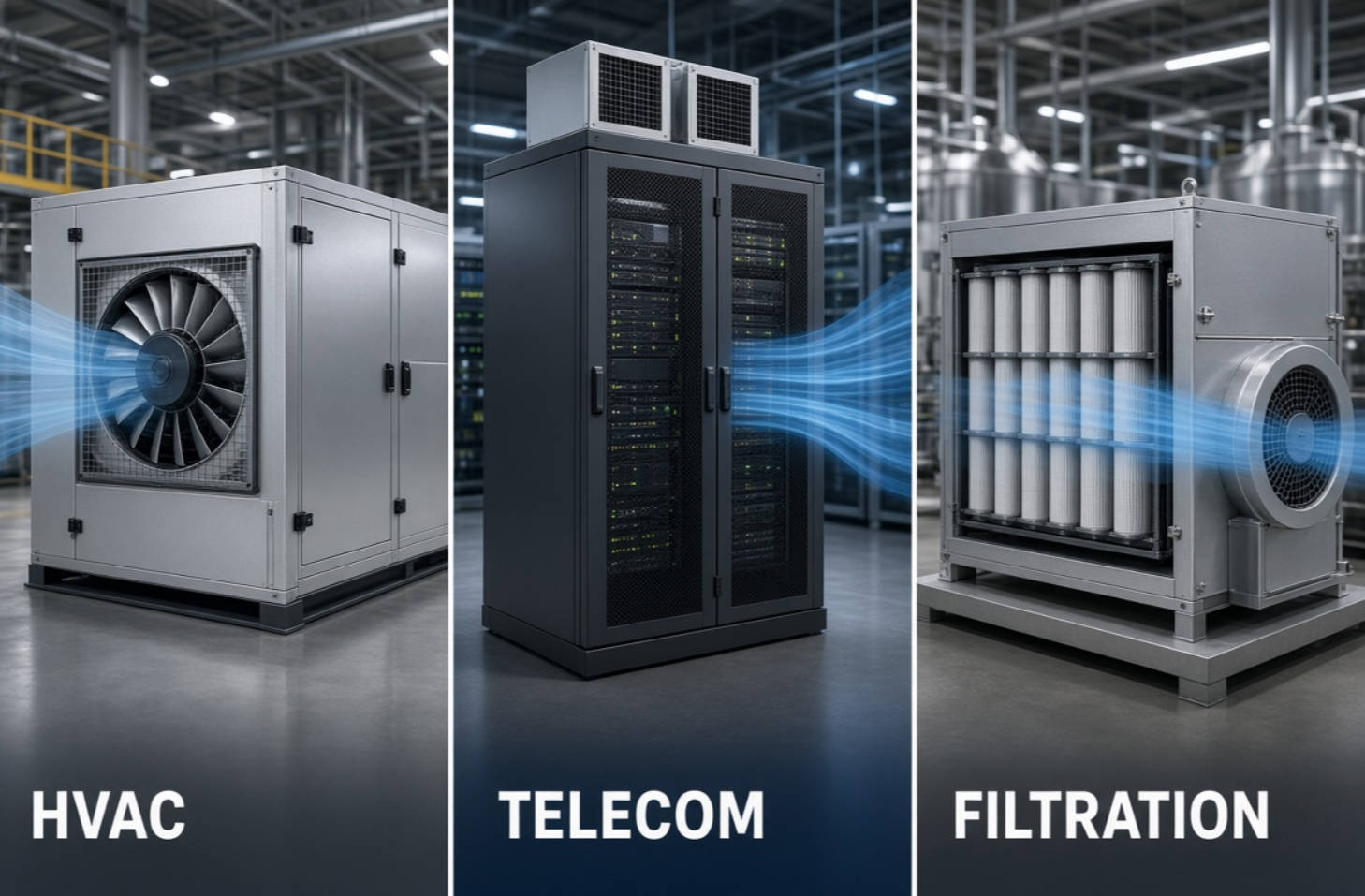
>> Example 1: Compact HVAC Fan Coil Unit
>> Example 2: Telecommunications Cabinet Cooling
>> Example 3: Industrial Air Filtration Unit
● Expert Checklist Before Requesting a Fan Quotation
● Why Total Cost of Ownership Matters
● Work With a Fan Supplier That Understands the System
● FAQ
>> 1. Are backward curved fans always more efficient than forward curved fans?
>> 2. Can a forward curved fan be used with a variable-frequency drive?
>> 3. Which centrifugal fan is quieter?
>> 4. Why does a centrifugal fan fail to achieve the rated airflow after installation?
>> 5. What information is needed to select a backward curved centrifugal fan?
>> 6. Can centrifugal fans be used for electronics and telecom cooling?
>> 7. What is the difference between backward curved and backward inclined fans?
Choosing between a forward curved centrifugal fan and a backward curved centrifugal fan is not simply a matter of comparing airflow. The correct choice depends on the required airflow, external static pressure, energy target, operating point, air cleanliness, sound limits, installation space, control strategy, and expected service life.
At Capital Technology Co., Limited, we work with cooling and airflow applications involving DC fans, AC fans, and centrifugal fan solutions. As the owner of the CAPITAL brand and a leading SANYO DENKI distributor, our engineering perspective is shaped by real equipment-selection requirements in telecommunications, industrial electronics, power systems, ventilation equipment, and OEM projects. For customers serving demanding sectors—including suppliers to ZTE, HUAWEI, and HYTERA—fan selection must be based on measured operating conditions rather than a simplified "high airflow versus high pressure" statement.
This guide explains the technical differences between forward curved and backward curved centrifugal fans, identifies the risks behind poor fan selection, and provides a practical decision process for OEM engineers, HVAC designers, system integrators, and procurement teams.
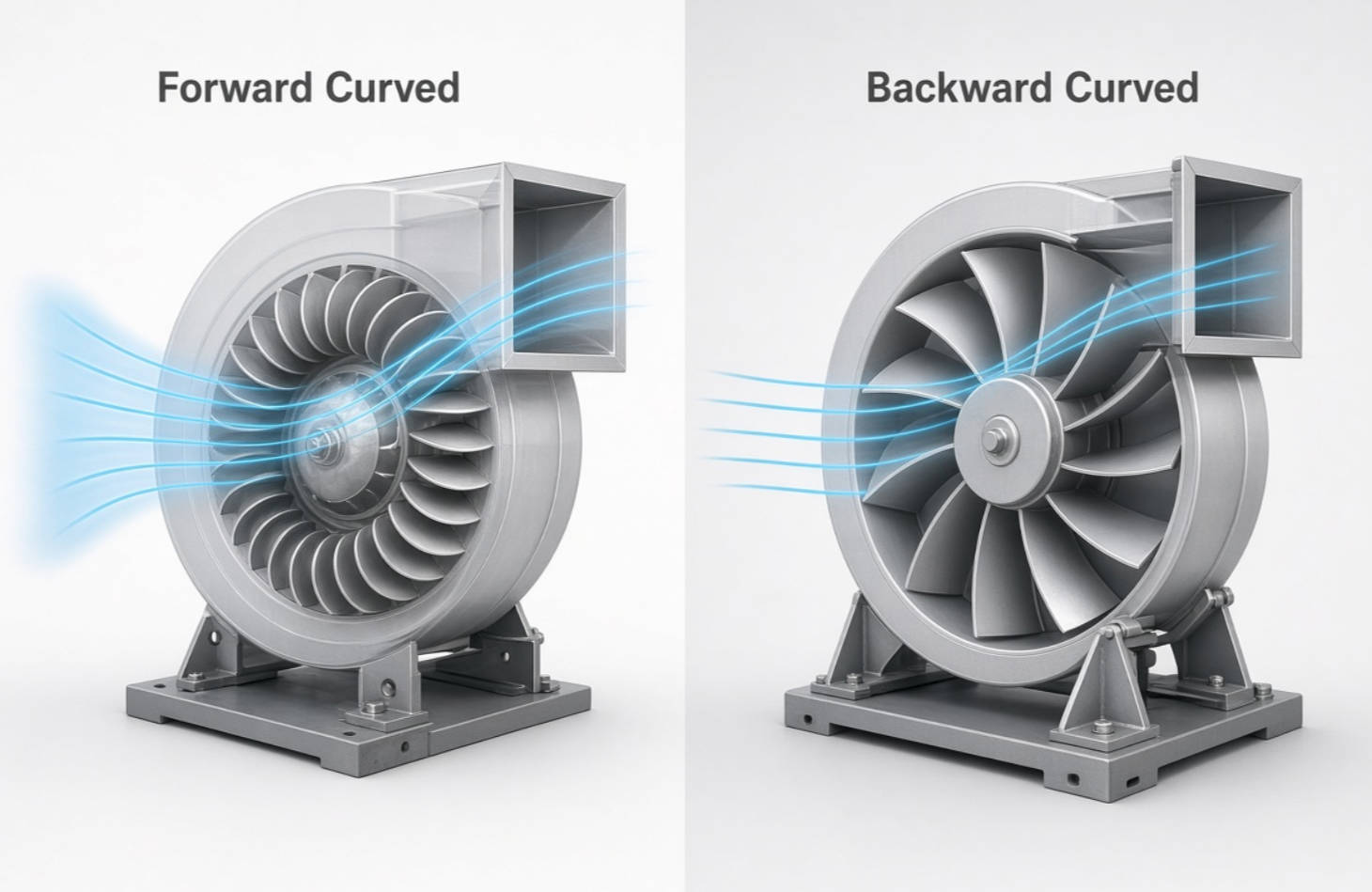
A centrifugal fan moves air by drawing it into the center of a rotating impeller and accelerating it outward through the fan outlet. Unlike an axial fan, which generally moves air parallel to the shaft, a centrifugal fan changes airflow direction—typically by about 90 degrees.
This configuration makes centrifugal fans especially useful when a system has ductwork, filters, heat exchangers, grilles, bends, silencers, narrow passages, or other restrictions that create resistance.
The two most commonly compared centrifugal fan impeller designs are:
- Forward curved centrifugal fans, often called squirrel-cage blowers
- Backward curved centrifugal fans, including backward-inclined, backward-curved, and airfoil-blade designs
Although both fan types can be used in air-handling and cooling systems, they behave very differently on a fan curve. That difference directly affects power consumption, motor sizing, noise, system stability, and long-term reliability.

A forward curved centrifugal fan has many short blades that curve in the same direction as impeller rotation. Its impeller often resembles a cylindrical cage, which is why this design is commonly known as a squirrel-cage blower.
Forward curved blowers are widely used in compact HVAC equipment, fan coil units, residential ventilation systems, packaged air-conditioning equipment, and certain electronics cooling assemblies.
The large number of shallow blades allows a forward curved impeller to pick up and move a substantial volume of air at relatively low rotational speed. This can provide a compact way to achieve useful airflow in low- to medium-resistance systems.
However, the design also produces a key selection issue: its absorbed power may continue rising as airflow rises. If system resistance is lower than expected, the fan can move more air than intended and demand more motor power.
This is why a forward curved fan must be selected carefully, especially when the final duct layout, filter condition, or outlet restriction may vary.
Forward curved fans can be an effective and economical choice when their operating range matches the application.
- High airflow in a compact footprint. The impeller can deliver substantial airflow for its physical size.
- Lower initial equipment cost. Many forward curved blower assemblies are cost-effective for high-volume HVAC and air-handling products.
- Useful at lower speed. Lower impeller speed can support acceptable acoustic performance in the right enclosure.
- Good fit for low-pressure airflow. They work well in applications with relatively low external static pressure.
- Suitable for compact equipment. Their geometry supports space-constrained units such as fan coil systems and compact air handlers.
The advantages of a forward curved blower should not be interpreted as universal benefits. In demanding systems, its limitations can become important.
- Lower peak efficiency than many backward curved designs
- Greater overload risk if airflow resistance falls
- Less suitable for high static-pressure systems
- More sensitive to dirty airflow and debris accumulation
- Potentially higher maintenance burden in contaminated environments
- Less attractive for high-efficiency, variable-speed equipment
Forward curved fans are generally a better choice for clean-air, moderate-duty systems where cost, compactness, and airflow volume matter more than peak efficiency at higher pressure.
A backward curved centrifugal fan has blades that curve away from the direction of impeller rotation. This category may include backward-inclined flat blades, backward-curved blades, and airfoil blades.
Backward curved fans are commonly selected for industrial ventilation, data-center cooling, telecommunications equipment, clean-air filtration, air-handling units, heat-recovery systems, precision cooling, and high-performance HVAC equipment.
Their design is particularly valued where static pressure, energy efficiency, speed control, and predictable power behavior are critical.
Backward curved impellers typically use fewer blades than forward curved impellers. The blade shape is designed to transfer energy to the air more efficiently, especially near the fan's preferred operating range.
One of the most important engineering characteristics is the non-overloading power curve found in many backward-curved fan designs. As airflow increases, absorbed power rises to a maximum and may then level off or decline, depending on the impeller and operating condition.
This behavior can reduce the chance of unexpected motor overload when system resistance changes. It does not eliminate the need for proper motor selection, but it gives designers a more manageable performance profile.
Backward curved fans are often preferred for energy-conscious, pressure-demanding, and speed-controlled systems.
- Higher static-pressure capability. They are more suitable for systems with filters, heat exchangers, ductwork, silencers, or dense electronic equipment.
- Higher energy efficiency. Many backward-curved fan designs achieve stronger aerodynamic efficiency at their design point than forward curved alternatives.
- Non-overloading power characteristics. This can support safer motor sizing and more stable operation across a changing system curve.
- Excellent variable-speed compatibility. They are widely used with EC motors, VFDs, and intelligent speed-control strategies.
- Long-term operating-cost potential. Higher initial cost can be offset by lower electricity use in long-running equipment.
- Strong fit for mission-critical cooling. They are often used in telecommunications, power electronics, industrial automation, and precision environmental-control equipment.
Backward curved centrifugal fans also involve trade-offs.
- Higher initial purchase cost
- Potentially larger installation space for equivalent duty
- Higher speed and tonal noise in some operating conditions
- More careful aerodynamic integration may be required
- Not always the best-value solution for simple low-pressure applications
A backward curved fan is not automatically the right option just because it is more efficient. For a low-pressure, cost-sensitive air-moving application, an appropriately selected forward curved blower can remain the more practical solution.
The most useful way to compare fan types is to look at the full application requirement, not just a single airflow figure.
| Selection Factor | Forward Curved Centrifugal Fan | Backward Curved Centrifugal Fan |
|---|---|---|
| Blade direction | Curves with the direction of rotation | Curves against the direction of rotation |
| Typical impeller design | Many short, closely spaced blades | Fewer, longer backward-inclined or airfoil blades |
| Airflow strength | High airflow at lower pressure | Strong airflow with better pressure-handling capability |
| Static-pressure suitability | Low to moderate | Medium to high |
| Peak efficiency | Usually lower | Usually higher at the design operating point |
| Power curve | Can overload when airflow increases | Often non-overloading or self-limiting |
| Motor-selection risk | Higher if system resistance changes | Generally easier to manage |
| Initial cost | Usually lower | Usually higher |
| Best air quality | Clean air with limited particulate contamination | Clean air; blade style should still match dust conditions |
| Typical applications | Fan coils, small AHUs, compact HVAC units | Industrial AHUs, telecom cooling, filtration, data centers |
| Variable-speed operation | Possible, but requires careful review | Often highly suitable for EC or VFD control |
| Lifecycle-cost potential | Better for simple, low-duty installations | Better for long operating hours and energy-sensitive systems |
The fan curve and system curve intersection determines the actual operating point. A fan does not produce one fixed airflow value in every installation. It produces the airflow and pressure dictated by the resistance of the installed system. The required pressure rises significantly as airflow increases through ducts, filters, coils, and restrictions.
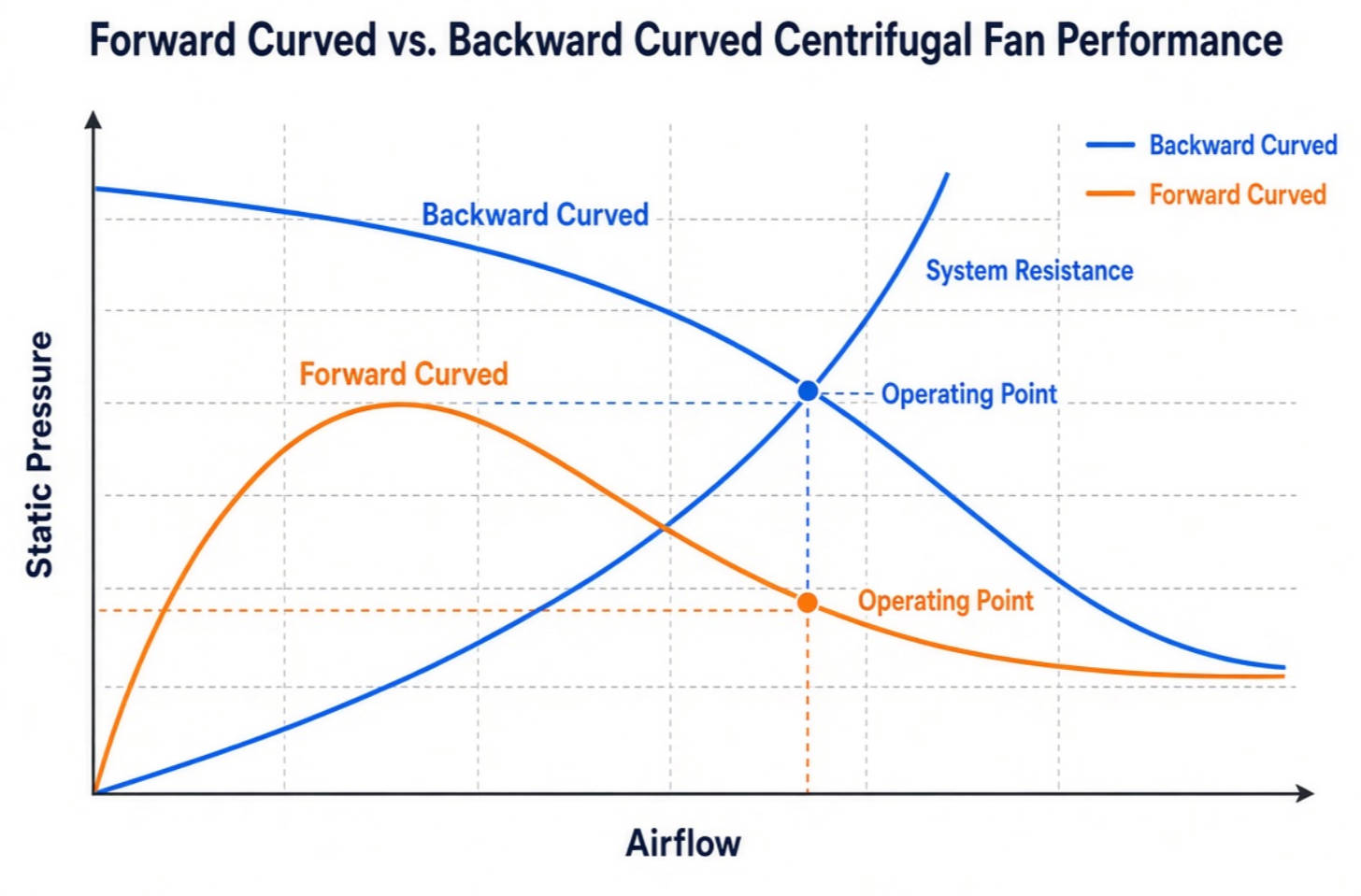
A common selection mistake is choosing a centrifugal fan based only on the target airflow, such as 1,000 m³/h or 2,000 CFM. That approach ignores the external static pressure required to move the air through the actual system.
A complete selection should consider:
1. Required airflow at the final operating condition
2. Static pressure from ducts, filters, coils, grilles, dampers, and equipment
3. Air density at the real temperature and altitude
4. Expected filter loading over time
5. Fan speed and motor performance
6. Sound limits at the equipment and occupied-space level
7. Available installation volume and discharge geometry
System resistance is not constant. A new filter has lower resistance than a loaded filter. A damper may be adjusted. A field-installed duct may have more elbows than the design drawing. A cabinet opening can be partially blocked by a cable bundle, rack, grille, or protective screen.
In general, fan affinity laws show that:
Where Q is airflow, P is pressure, and N is fan speed.
This means a modest speed increase can have a much larger effect on power. As an example, a 10% fan-speed increase can raise airflow by approximately 10%, pressure by approximately 21%, and power demand by approximately 33%.
For this reason, a fan that looks acceptable in a catalog can become inefficient, noisy, or overloaded after installation if its operating point is not verified.
For a practical selection, start with the application rather than the fan type.
A forward curved centrifugal fan may be appropriate when your project has the following characteristics:
- The system operates at low external static pressure
- The required airflow is relatively high for the available installation space
- Upfront cost is a major decision factor
- The air stream is clean and free of significant dust or sticky particles
- The equipment is a fan coil unit, compact HVAC system, small air handler, or enclosed blower assembly
- The motor and control system have been checked for potential overload conditions
A backward curved centrifugal fan is often the better choice when:
- The application requires medium or high static pressure
- The system includes filters, dense heat exchangers, long duct runs, or restrictive airflow paths
- Energy efficiency is important over many operating hours
- The fan will use EC motor control or a variable-frequency drive
- Motor-overload protection is a priority
- The equipment supports telecommunications, power electronics, data infrastructure, industrial automation, or process ventilation
- Stable performance is needed despite changing filter condition or system resistance
A compact fan coil unit needs high airflow in a limited enclosure. The duct path is short, the coil resistance is moderate, and the equipment runs in a clean indoor environment.
A forward curved blower may be the right solution because it can provide useful airflow from a compact assembly at a competitive cost. The engineering team should still confirm the motor's safe operating range at minimum system resistance.
A telecommunications cabinet may include power modules, filters, cable pathways, heat sinks, and limited inlet or outlet openings. These restrictions raise static pressure and may change as filters load with dust.
A backward curved centrifugal fan, particularly one combined with an EC motor or intelligent controller, can be more suitable. It can provide pressure capability, speed adjustability, and improved energy performance over variable thermal loads.
An air filtration system often experiences increasing pressure drop as filters accumulate particles. If the fan cannot maintain airflow, capture performance and cooling performance may decline.
A backward curved fan is commonly preferred for clean-air filtration and controlled ventilation systems because it can operate efficiently against higher resistance. However, the impeller construction and material must match the actual contaminant, temperature, humidity, and corrosion conditions.
To receive an accurate centrifugal fan recommendation, provide your fan supplier with complete operating data. This avoids selecting a fan based on free-air airflow, which is rarely representative of the installed system.
Prepare the following information:
- Required airflow in CFM, m³/h, L/s, or m³/min
- Required static pressure in Pa, mmH₂O, or in. w.g.
- Operating voltage, frequency, phase, and motor type
- Ambient temperature and altitude
- Air temperature, humidity, and cleanliness
- Dust, oil mist, corrosive gas, moisture, or particulate exposure
- Available mounting space and airflow direction
- Inlet and outlet dimensions
- Required IP rating and safety approvals
- Maximum allowable sound level
- Expected daily running hours and annual operating hours
- Control method, including fixed speed, voltage control, PWM, EC control, or VFD
- Required product life, maintenance plan, and target cost
For high-reliability systems, also request a fan curve, power curve, sound data, dimensional drawing, materials specification, motor insulation class, bearing information, and testing conditions.
The lowest-priced fan is not always the lowest-cost fan over the equipment lifecycle.
A fan that operates continuously in a telecom shelter, data room, electronics enclosure, or industrial ventilation unit can consume significant electricity over several years. In these applications, efficiency, controllability, and maintenance requirements can matter more than the initial component price.
When comparing a forward curved and backward curved centrifugal fan, evaluate:
- Initial fan and motor cost
- Electricity use at the real duty point
- Expected annual running hours
- Control-system compatibility
- Noise-treatment cost
- Maintenance and cleaning requirements
- Downtime risk
- Replacement availability
- Long-term reliability in the operating environment
A backward curved solution may justify its higher purchase price when the equipment operates for long periods, faces higher static pressure, or requires speed modulation. A forward curved fan may remain the best commercial choice when pressure is low, the duty cycle is limited, and compact low-cost airflow is the main objective.
The best centrifugal fan is selected as part of a complete thermal and airflow system. It must match the enclosure, ductwork, heat source, filter condition, motor, control method, acoustic requirement, and lifecycle target.
Capital Technology Co., Limited provides cooling solutions based on DC fans, AC fans, and centrifugal fan technologies for OEM and industrial projects. With our CAPITAL brand products and SANYO DENKI distribution capability, we can help customers assess airflow requirements, static pressure, installation constraints, reliability expectations, and control options before finalizing a fan model.
Contact Capital Technology today to share your airflow, pressure, voltage, temperature, installation drawing, and application environment. Our team can help you compare forward curved and backward curved centrifugal fan options and identify a cooling solution that balances performance, energy efficiency, reliability, and cost.
Not in every condition, but backward curved fans generally offer higher aerodynamic efficiency at their intended design point, especially in medium- and higher-static-pressure systems. Forward curved fans can still be economical and effective in compact, low-pressure air-moving applications.
Yes. However, the fan curve, motor capacity, sound level, and operating range should be reviewed carefully. Because forward curved fans can have an increasing power demand as airflow rises, control settings and minimum-resistance conditions require particular attention.
Noise depends on fan speed, impeller diameter, housing design, airflow turbulence, duct design, operating point, and nearby restrictions. Forward curved fans can be quiet in properly designed low-pressure systems, while backward curved fans can also achieve low sound levels when sized correctly and operated near their efficient range.
The installed system may have more resistance than expected. Common causes include undersized ducts, dirty filters, restrictive grilles, blocked inlets, sharp bends near the fan, dense heat exchangers, insufficient make-up air, or an incorrect fan rotation direction.
At minimum, provide required airflow, external static pressure, voltage, frequency, temperature, altitude, air cleanliness, available installation dimensions, required sound level, and speed-control method. A fan supplier may also need details about filters, coils, ducts, inlet conditions, and expected operating hours.
Yes. Centrifugal fans are often used when electronics equipment requires airflow through restrictive paths such as filters, heat sinks, cable channels, baffles, and compact enclosures. Backward curved designs are frequently considered when the system requires stronger pressure capability and variable-speed control.
Both blade types curve or lean away from the direction of rotation. "Backward inclined" often refers to flat blades angled backward, while "backward curved" can describe curved blades. Airfoil blades are another backward-oriented design intended to improve aerodynamic efficiency in clean-air applications.
1. Longwell Fans. "Forward Curved vs. Backward Curved Centrifugal Fans: Key Differences." Available at: [https://www.longwellfans.com/forward-curved-vs-backward-curved-centrifugal-fans/]
2. Air Movement and Control Association International. "Straightening Out Fan Curves."
[amca]
4. U.S. Department of Energy. "Improving Fan System Performance: A Sourcebook for Industry." [www1.eere.energy]
5. CIBSE Journal. "Matching the Fan to the Ventilation System." [cibsejournal]
6. AMCA International. "Centrifugal Fans." [amcaconnectstorage.blob.core.windows]1page_compressed.pdf)


