From idea to market-ready product, our NPI solutions make every stage easier, faster. Discover How We Help
Help Center

Views: 288 Author: Capital Technology Publish Time: 2026-07-02 Origin: Site
Content Menu
● Fans vs Blowers: The Core Technical Difference
● Structural Differences: Blades vs Impellers
● AC vs DC Axial Fans: Where Each Excels
● AC and DC Blower Fans: When You Need Pressure
● Industry Case Insight: Telecom and Industrial OEMs
● The Often‑Ignored Element: Filters in Cooling Systems
● Practical Selection Guide: Fan or Blower?
● Key Design Considerations for Modern Thermal Solutions
● FAQs
>> 1. How do I decide between a fan and a blower for my enclosure?
>> 2. Are DC fans more reliable than AC fans?
>> 3. When should I use filters in my cooling design?
>> 4. Why do some systems use both fans and blowers?
>> 5. How can I improve the UX of technical cooling content on my website?
When you design a critical cooling system today—whether for telecom base stations, industrial controllers, or high‑density servers—understanding the real difference between fans and blowers is not optional, it is strategic. As an engineer who has spent years helping OEMs and system integrators solve thermal challenges with DC fans, AC fans, and filtration modules, I can tell you that choosing the wrong device often shows up later as hot‑spots, premature failures, and unnecessary energy costs. [quickcreator]
In this guide, I'll walk you through the technical and practical differences between fans and blowers, how they perform in real‑world applications, and how to select the right solution for your project—including concrete examples from telecom and industrial electronics. I'll also share expert considerations on noise, efficiency, and filtration, plus a checklist you can use in design reviews with your team. [mtsoln]
From a mechanical engineering standpoint, fans and blowers are defined by their pressure ratio—the relationship between discharge pressure and suction pressure. The American Society of Mechanical Engineers (ASME) defines a fan as a device with a pressure ratio up to 1.11, a blower between 1.11 and 1.2, and a compressor above 1.2. [quickcreator]
In practice, this means:
- Fans provide relatively low pressure, higher volume airflow, ideal for general ventilation and electronics cooling. [quickcreator]
- Blowers deliver higher pressure, more focused airflow, suited to ducted systems or applications with significant flow resistance. [netalith]
If your design involves tight ducts, filters with high resistance, or narrow channels, a blower will usually maintain airflow where a fan quickly loses performance. [quickcreator]
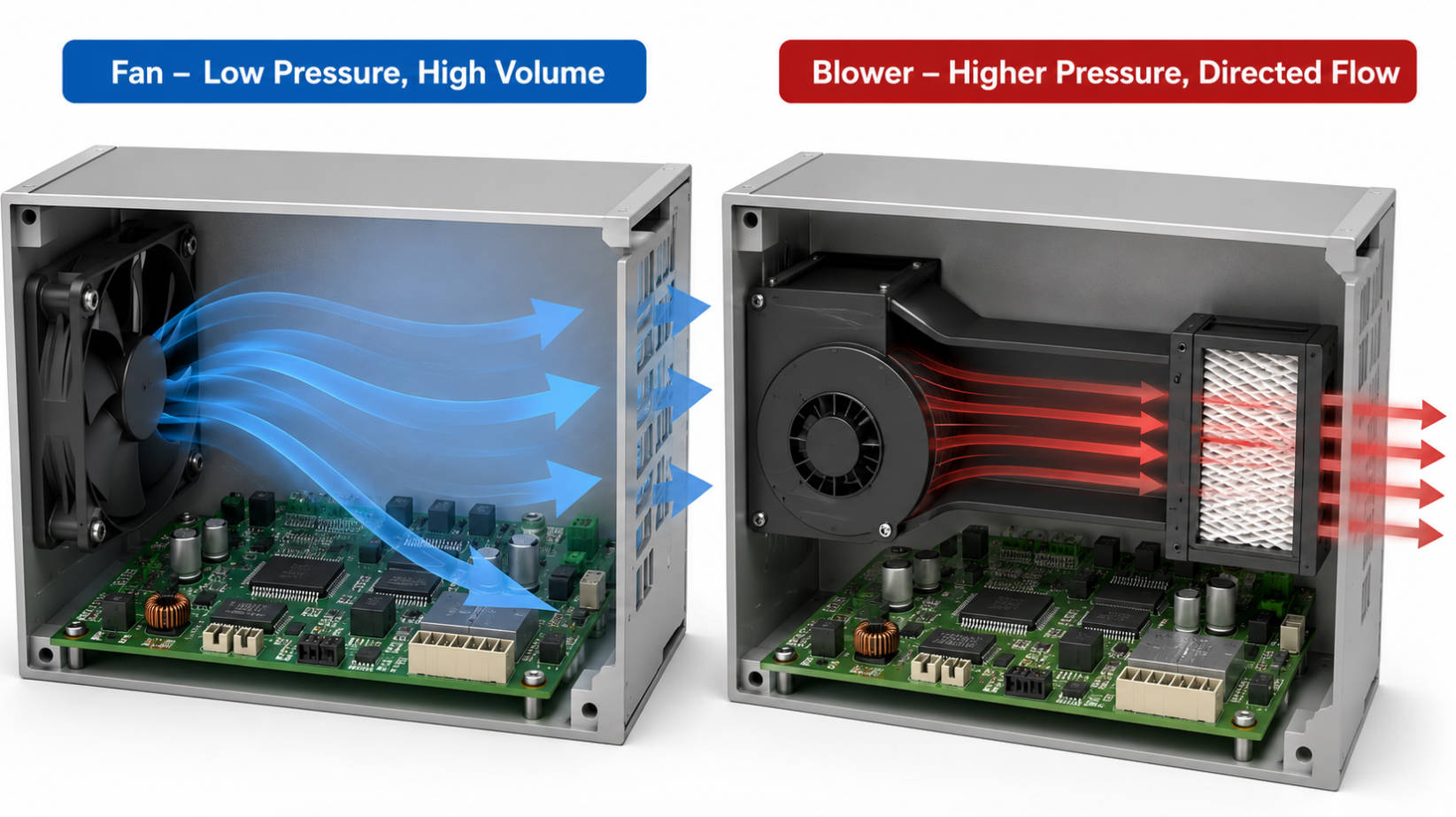
At a component level, the first thing you notice is how the devices move air. [quickcreator]
- A fan uses rotating blades mounted on a hub, usually in axial or radial configurations. [quickcreator]
- A blower uses impellers, often in a centrifugal housing, to accelerate air and then redirect it through an outlet. [quickcreator]
Here is a concise comparison you can use in design documentation:
| Parameter | Fan (DC / AC) | Blower |
|---|---|---|
| Rotating element | Blades quickcreator | Impeller quickcreator |
| Typical device type | Electrical device quickcreator | Mechanical device quickcreator |
| Power consumption | Lower, energy‑efficient quickcreator | Higher, for added pressure quickcreator |
| Airflow behavior | Medium airflow, wide coverage quickcreator | Higher airflow under resistance quickcreator |
| Main categories | Radial, axial, propeller fans quickcreator | Centrifugal, positive displacement blowers quickcreator |
In my own work with high‑density embedded systems, these structural differences translate directly into layout decisions: fans work better when you can give them open intake and exhaust; blowers shine when you must push air through restrictive paths. [netalith]
In many projects, you don't just choose between a fan and a blower—you choose between AC axial fans and DC axial fans. [quickcreator]
AC axial fans are commonly used to cool large machines and industrial systems where an AC mains supply is readily available. They appear in: [quickcreator]
- Generators and motor control cabinets
- Refrigeration systems
- Diesel engines and power systems [quickcreator]
Their strengths include robust construction, simple wiring, and suitability for environments where the device must run continuously at a fixed speed. [semrush]

DC axial fans are more prevalent in electronics and precision equipment where control and efficiency matter. They're widely used in: [quickcreator]
- Computers and servers
- Medical devices
- Automotive electronics and control modules
- Telecom and RF equipment [quickcreator]
DC fans can be designed to be waterproof and dustproof, and are easier to integrate with PWM or voltage control, making them ideal for smart thermal management strategies. In long‑life telecom applications, I've seen DC fans paired with temperature sensors to ramp speed only when required, significantly reducing acoustic noise and extending bearing life. [aiseoshift]
When airflow faces serious resistance—narrow ducts, dense filters, or long channel paths—designers turn to blower fans. [quickcreator]
AC blower fans increase the velocity of air passing through the impeller, making them suitable for high‑pressure industrial applications. They typically operate up to around 230 V AC and are common in: [quickcreator]
- Industrial ovens and combustion air supply
- HVAC units with ducting and long runs
- Equipment requiring strong, constant airflow over distance [medium]
DC blower fans are usually centrifugal blowers that increase airflow volume via their impeller geometry. They offer air displacement at a constant speed while producing less heat, which is critical in compact electronic enclosures. Typical use cases include: [quickcreator]
- Network switches and base stations with confined airflow channels
- Compact industrial controllers requiring directed cooling
- Embedded systems where space constraints demand side‑flow cooling [netalith]
In my experience with telecom gear, DC blowers are often the answer when a standard axial fan cannot overcome the static pressure of dense RF shielding and multi‑layer PCBs. [netalith]
As a thermal solutions partner and supplier to large telecom and industrial brands, I've repeatedly seen how the fan vs blower decision impacts field reliability. [medium]
In telecom base stations for brands like leading global OEMs, designers often start with axial fans because they are compact and efficient. However, once the full enclosure is assembled, static pressure increases due to filters, grills, and structural elements; this is where switching to a properly sized DC blower delivers stable airflow and reduces hot‑spot incidents. [netalith]
In industrial radio and communication systems, end users frequently report issues like dust ingress and clogged vents. Adding a filter module and upgrading from a low‑pressure fan to a blower improves both cooling performance and system resilience, provided the filter's pressure drop has been accounted for in selection. [developers.google]
Designers sometimes focus solely on fans and blowers, forgetting that filters are part of the airflow system and introduce resistance. Yet in industrial environments—where dust, oil mist, and fibers are common—filters are not optional; they are a reliability requirement. [developers.google]
When you design a thermal solution with filters, consider:
- Filter type and media: coarse mesh vs fine particulate capture. [medium]
- Pressure drop: the higher the filtration level, the more static pressure the fan or blower must overcome. [netalith]
- Maintenance interval: clogged filters dramatically reduce airflow long before devices fail electrically. [developers.google]
My recommendation is straightforward: treat filters and airflow devices as a single system, and always validate performance with pressure‑drop data from the filter manufacturer. [netalith]
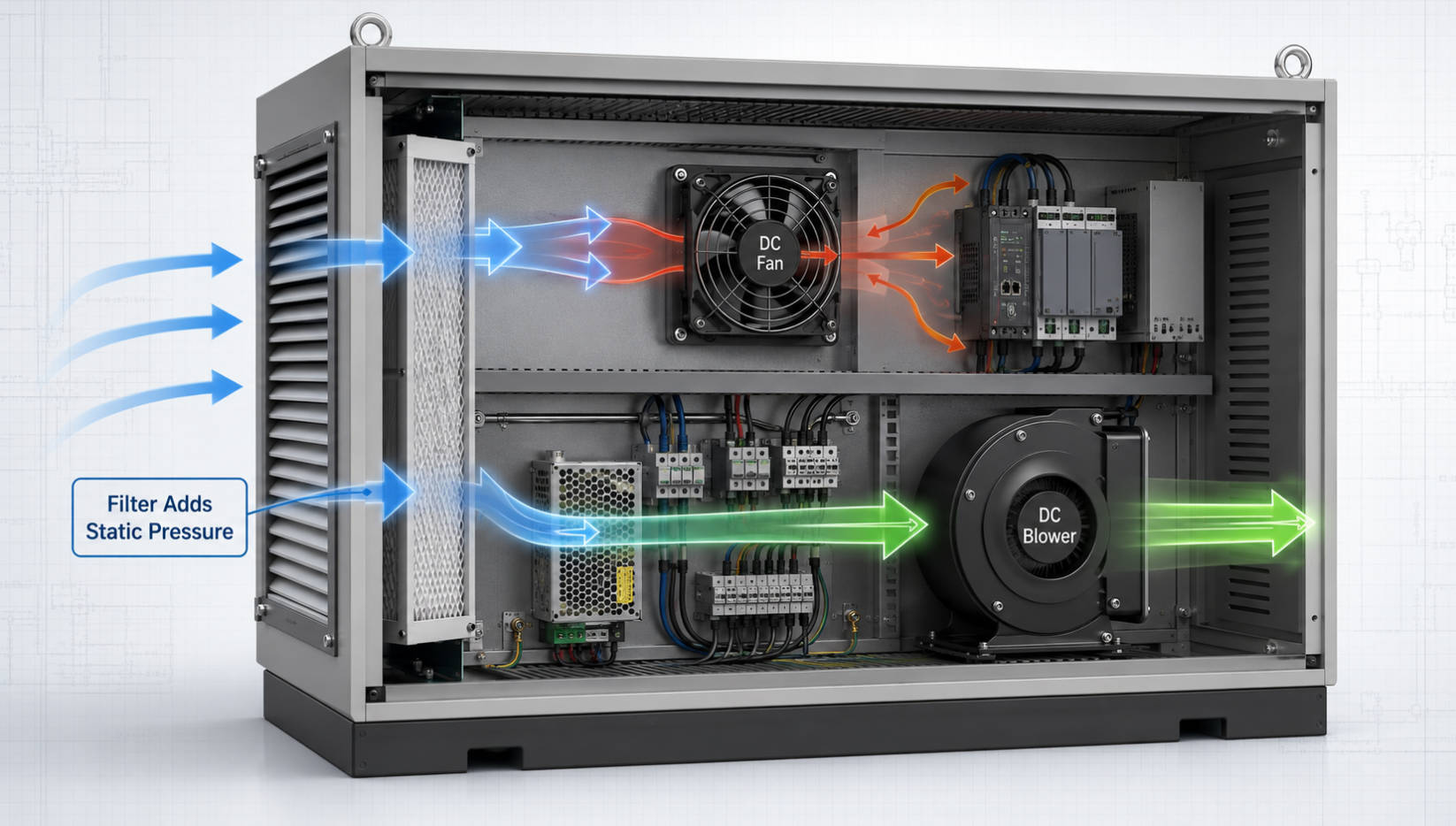
To make this actionable, here is a simplified decision approach you can use in design meetings.
Choose a fan when:
- You need broad, low‑pressure airflow over boards or components. [quickcreator]
- The airflow path is short and relatively open. [quickcreator]
- Efficiency and noise are priorities over maximum pressure. [semrush]
Choose a blower when:
- You must push air through ducts, tight channels, or dense filters. [quickcreator]
- Static pressure is high due to mechanical design constraints. [quickcreator]
- Air must travel further or be directed with precision to specific zones. [netalith]
During design reviews, I encourage teams to map the entire airflow path and calculate expected resistance before locking the device type. This simple step avoids costly redesigns later in the project. [seositecheckup]
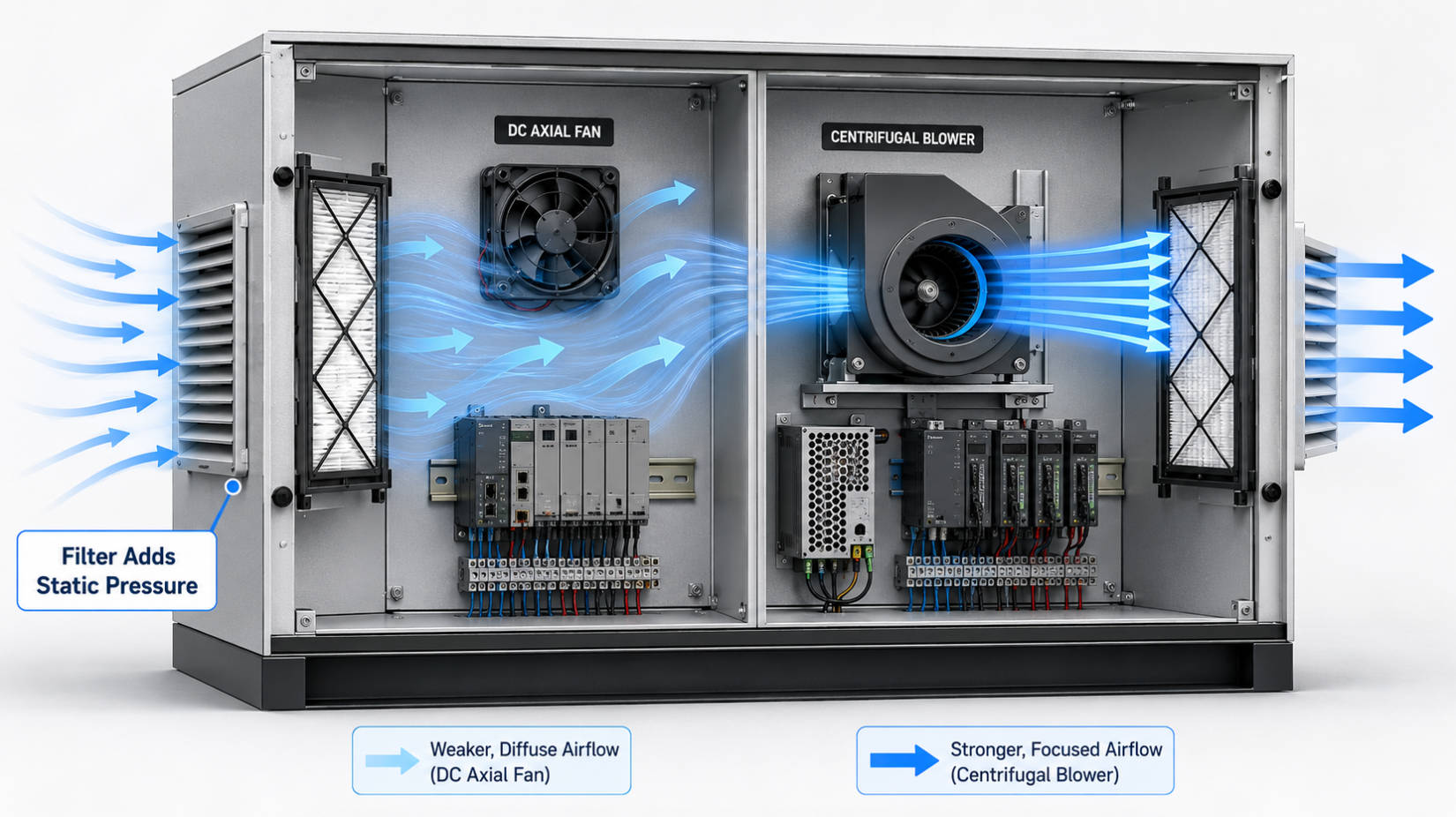
When specifying DC fans, AC fans, blowers, and filters, pay close attention to these factors:
- Static pressure vs airflow (CFM): Match the fan's performance curve to system resistance. [netalith]
- Operating environment: Temperature, humidity, dust, oil, and corrosive gases all matter. [developers.google]
- Noise and vibration: For office or medical environments, acoustic performance can be as important as cooling capacity. [semrush]
- Control strategy: DC devices allow finer control via PWM and sensors, supporting adaptive cooling. [quickcreator]
As an industry practitioner, I've seen the best results when engineering teams align their thermal design decisions with real field conditions instead of ideal lab configurations. [medium]
If you are planning or revising a cooling system and need to choose between fan, blower, and filtration options, share your system specs and constraints with our engineering team. We can help you select DC fans, AC fans, and filters that match your exact thermal and environmental requirements, and provide tailored recommendations for telecom, industrial, or OEM applications. [journaleus]
Start by estimating your enclosure's static pressure, including grills and filters, and then compare it against the performance curves of candidate devices. If the required airflow at that pressure exceeds what an axial fan can provide, a blower is usually the more reliable choice. [netalith]
DC fans are not automatically more reliable, but they often support smarter control and protection features that extend life, such as speed control and thermal feedback. AC fans are simple and robust, making them excellent for continuous, fixed‑speed operation in industrial environments. [netalith]
Use filters whenever your equipment operates in dusty, oily, or fiber‑rich environments, or when contamination could impact safety or product lifetime. Remember that filters add resistance, so you may need a higher‑pressure fan or blower to maintain adequate airflow. [developers.google]
Complex systems may use axial fans for general enclosure ventilation and blowers for high‑pressure zones or ducted sections. This hybrid approach balances efficiency and performance while targeting air exactly where it is needed. [netalith]
Use clear headings, concise paragraphs, comparison tables, and well‑placed visuals that show airflow paths, device types, and real application scenarios. Combine these with practical examples and a clear call to action to help visitors move from reading to contacting your team. [aiseoshift]
1. Sofasco, "Know the Difference Between Fans and Blowers." [quickcreator]
2. Google Search Central, "Creating Helpful, Reliable, People‑First Content." [Google documentation on helpful content] [developers.google]
3. Semrush, "Google E‑E‑A‑T: What it is & how it affects SEO." [Semrush E‑E‑A‑T guide] [semrush]
4. QuickCreator, "E‑E‑A‑T for Technical Content: 2025 Best Practice Guide." [QuickCreator EEAT guide] [quickcreator]
5. Medium, "Techniques to Follow EEAT in Blogs and Rank Better." [Medium EEAT techniques] [medium]


