From idea to market-ready product, our NPI solutions make every stage easier, faster. Discover How We Help
Help Center

Views: 222 Author: Astin Publish Time: 2026-04-29 Origin: Site
As an engineer working with DC fans and AC fans for telecom, networking, and industrial electronics, I've learned that using "fan" and "blower" interchangeably can quietly introduce serious risks: overheating, noise complaints, and even premature device failure. This guide explains, in practical terms, how fans and blowers really differ, how they impact system reliability, and how manufacturers like Capital Technology and SANYO DENKI approach cooling design in demanding applications. [thebetterappliances]
In air‑moving theory, the core difference is not marketing but pressure and airflow behavior. [sofasco]
- A fan moves a large volume of air with little change in pressure, usually to circulate or refresh air in a space or around components. [sofasco]
- A blower delivers more focused, higher‑pressure airflow to a defined direction through ducts, channels, or confined paths. [thebetterappliances]

Engineers often use these working rules: [thebetterappliances]
- Fans:
- Air pressure ratio close to 1:1 (almost no pressurization)
- Ideal for general cooling and ventilation of boards, enclosures, rooms
- Blowers:
- Typical pressure ratio around 1:1.1–1:1.2
- Best when air must be forced through filters, heat sinks with dense fins, small vents, or ducts
From a system design perspective, I advise teams to start with the air path: if the air is mostly free to move, use a fan; if the air must fight against resistance, start evaluating a blower. [acdcecfan]
Although their purpose overlaps, their internal mechanics are different. [sofasco]
- Fan
- Consists of blades mounted around a hub, driven by a motor (DC or AC).
- Often axial (air in front, air out back), but can also be centrifugal or cross‑flow. [sofasco]
- Commonly powered by electric motors; in niche applications, internal combustion or hydraulic drives appear.
- Blower
- An assembly with an impeller, housing, and inlet/outlet channels.
- The impeller draws air in and uses centrifugal force to accelerate it outward through a specific outlet. [thebetterappliances]
- Provides both directionality and a measurable increase in static pressure.
In practical design reviews, I often sketch this simple mental picture for non‑thermal experts: a fan "stirs" air in and around the system, while a blower "pushes" air down a defined path to a target. [acdcecfan]
Fans are the default choice whenever the priority is area cooling and ventilation rather than high pressure. [thebetterappliances]
Common use cases include:
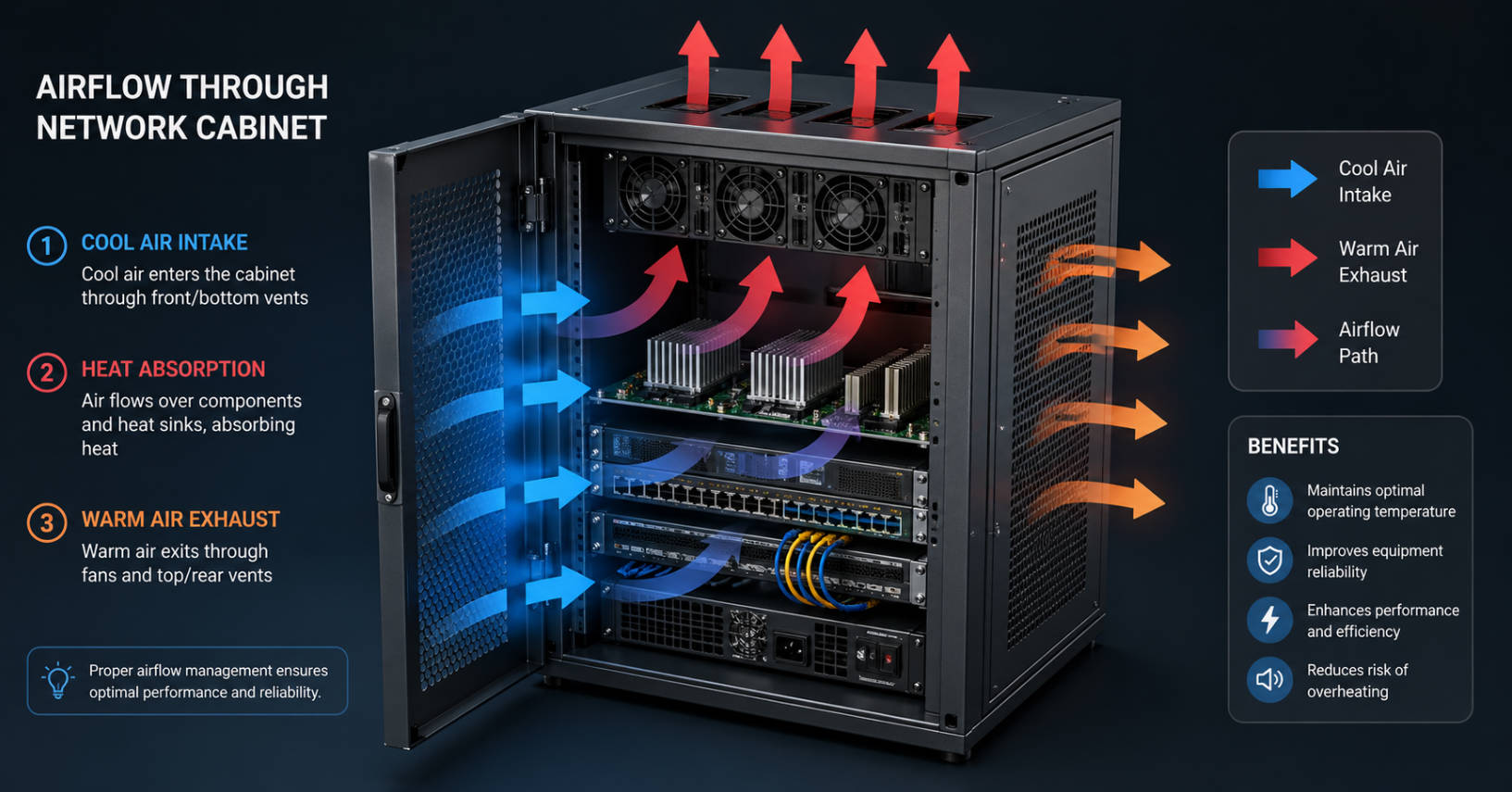
- Telecom and networking cabinets with relatively open airflow paths
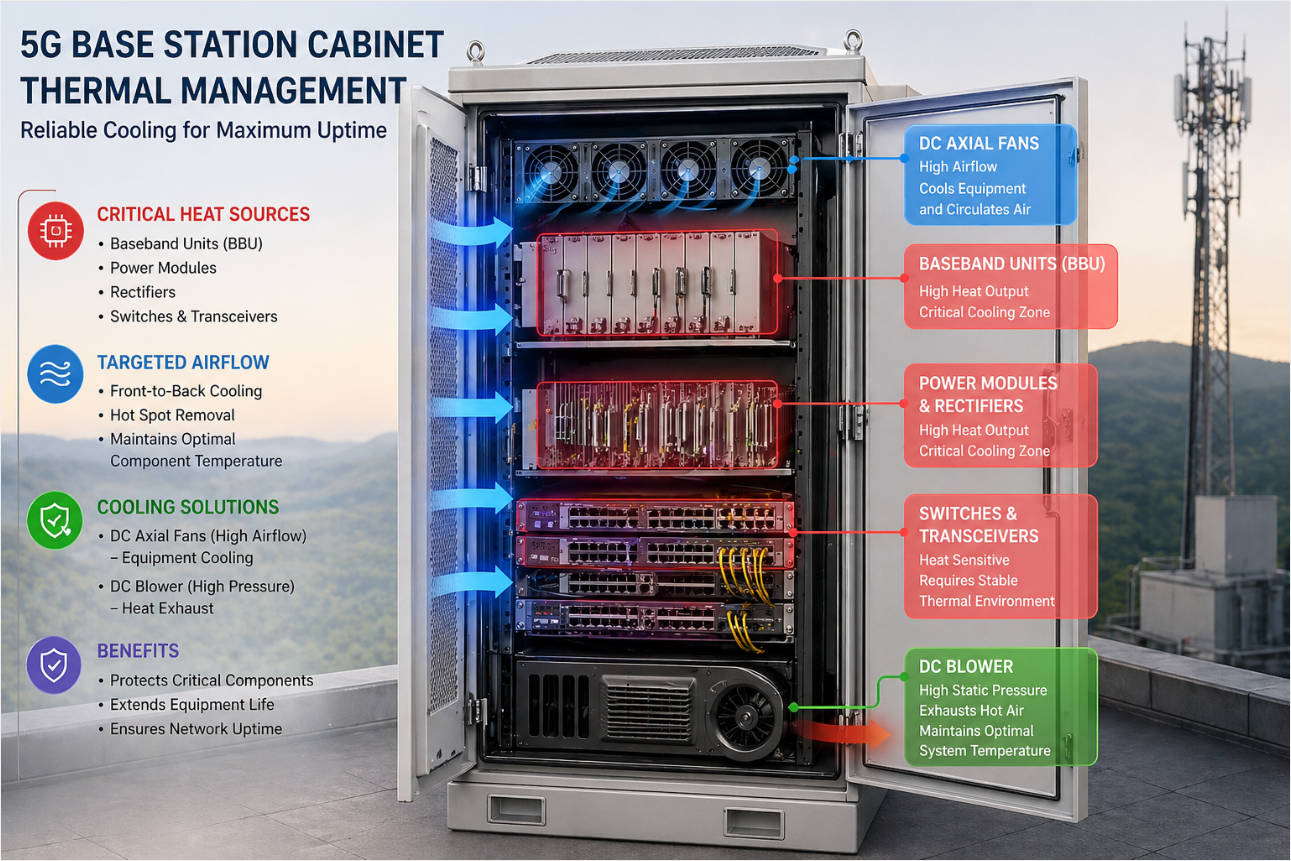
- Base stations and radio units with vented enclosures
- Consumer and office equipment (PCs, monitors, projectors)
- HVAC and room air circulation
In these scenarios, DC fans are popular for precise speed control, low noise, and direct integration with system monitoring, while AC fans are still favored in some industrial and infrastructure environments for their simplicity and mains compatibility. [legrand]
Blowers appear when the design calls for directed, higher‑pressure airflow. [acdcecfan]
Typical applications:
- Pushing air through dense heat sinks in high‑power electronics
- Cooling boards inside narrow, shielded metal enclosures
- Forcing air through dust filters or small openings
- Targeted drying, cleaning, or combustion air supply in industrial systems
For example, in compact radio units deployed in dusty outdoor environments, a blower with proper filtration can maintain airflow across the critical components even as filter resistance rises over time. [flexential]
From a purchasing perspective, it is tempting to ask, "Which is better?" As an engineer, I always frame it as "Which is better for this airflow path, power budget, and noise target?" [sofasco]
| Aspect | Fan | Blower |
|---|---|---|
| Airflow pattern | Broad, less directional thebetterappliances | Focused, directional jet acdcecfan |
| Pressure capability | Low pressure rise Up to 1.11 pressure ratio thebetterappliances | Moderate pressure (1.11–1.2 pressure ratio) |
| Energy use | Typically more efficient for same airflow thebetterappliances | Higher power for the same volume sofasco |
| Noise | Axial fans generate 65–85 dB at full load, mostly from airflow turbulence | Can spike to 90+ dB when pushing high pressure; generally louder at comparable load |
| Cost | High-performance units may have comparable or slightly higher price | Often lower initial price per unit thebetterappliances |
| Best use case | General circulation, open paths | Overcoming resistance, channels, filters |
When we support customers at Capital Technology, we discourage purely cost‑driven decisions: in high‑density electronics, a poorly chosen low‑cost blower or fan can generate significantly higher lifetime cost through failures, warranty claims, and unplanned downtime. [coresite]
Because we specialize in DC Fan and AC Fan solutions, many of our customers ask which motor type they should standardize on for new platforms. [amca]
DC fans are now dominant in telecom, IT, and embedded electronics because they allow fine‑grained control and higher overall system efficiency. [legrand]
Key advantages:
- Speed control via PWM or voltage adjustment for adaptive cooling
- Easier integration with system health monitoring (tachometer signals, alarms)
- Often better efficiency at partial load
- Suitable for battery‑powered or DC bus architectures
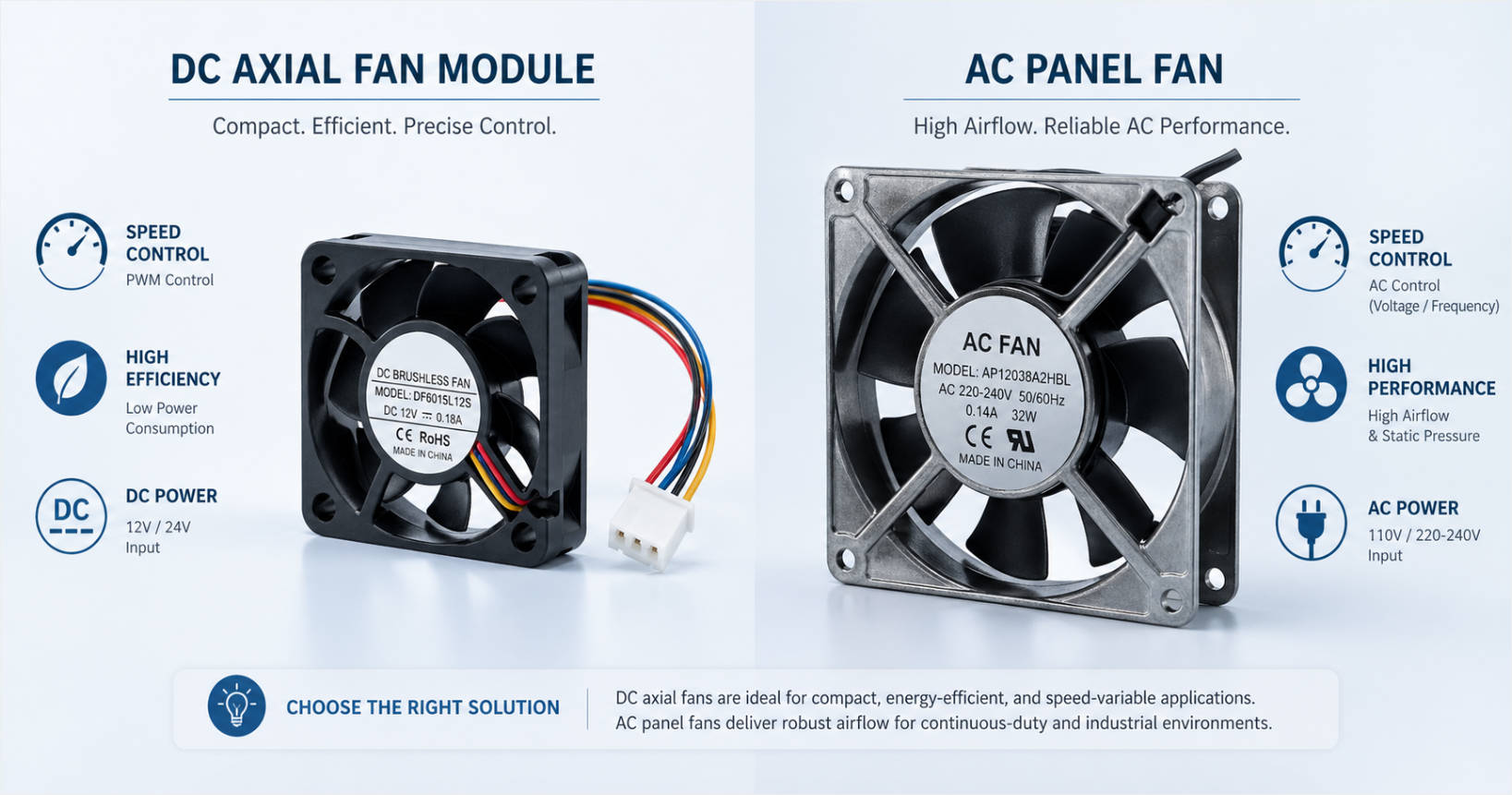
AC fans still have a strong role in infrastructure and industrial environments where AC mains is the primary supply. [acdcecfan]
Typical reasons to choose AC fans:
- Simple wiring and drive electronics
- Proven robustness in harsh or high‑voltage environments
- Legacy compatibility in existing cabinets and systems
In practice, many global OEMs standardize on DC fans for new, high‑efficiency platforms and continue to deploy AC fans in retrofit or industrial use cases where control is less critical and the environment is more demanding. [coresite]
Capital Technology, carrying its own brand CAPITAL and serving as a chief agent for SANYO DENKI (山洋电气), operates in sectors where a fan failure can mean service outages for major telecom and networking players. Companies like ZTE, HUAWEI, and HYTERA demand not just airflow ratings on paper, but validated thermal performance under real‑world conditions. [sanyodenki]
From that perspective, expert cooling design typically follows these principles:
1. System‑level airflow modeling
- Use CFD or at least structured airflow simulation for high‑density designs. [flexential]
- Evaluate the interaction between fans, blowers, heat sinks, and enclosure geometry.
2. Regulatory and efficiency compliance
- Consider evolving regulations and efficiency standards for commercial and industrial fans and blowers, such as DOE and CEC rules and AMCA standards. [amca]
- Specify products with suitable efficiency indices and compliance labeling.
3. Reliability margins and derating
- Operate fans and blowers below their maximum speed and temperature rating when possible to extend lifetime.
- Validate long‑term behavior under vibration, dust, and humidity relevant to telecom and industrial deployments. [legrand]
This holistic approach explains why many leading OEMs partner with specialized suppliers instead of treating fans as a trivial commodity purchase. [amca]
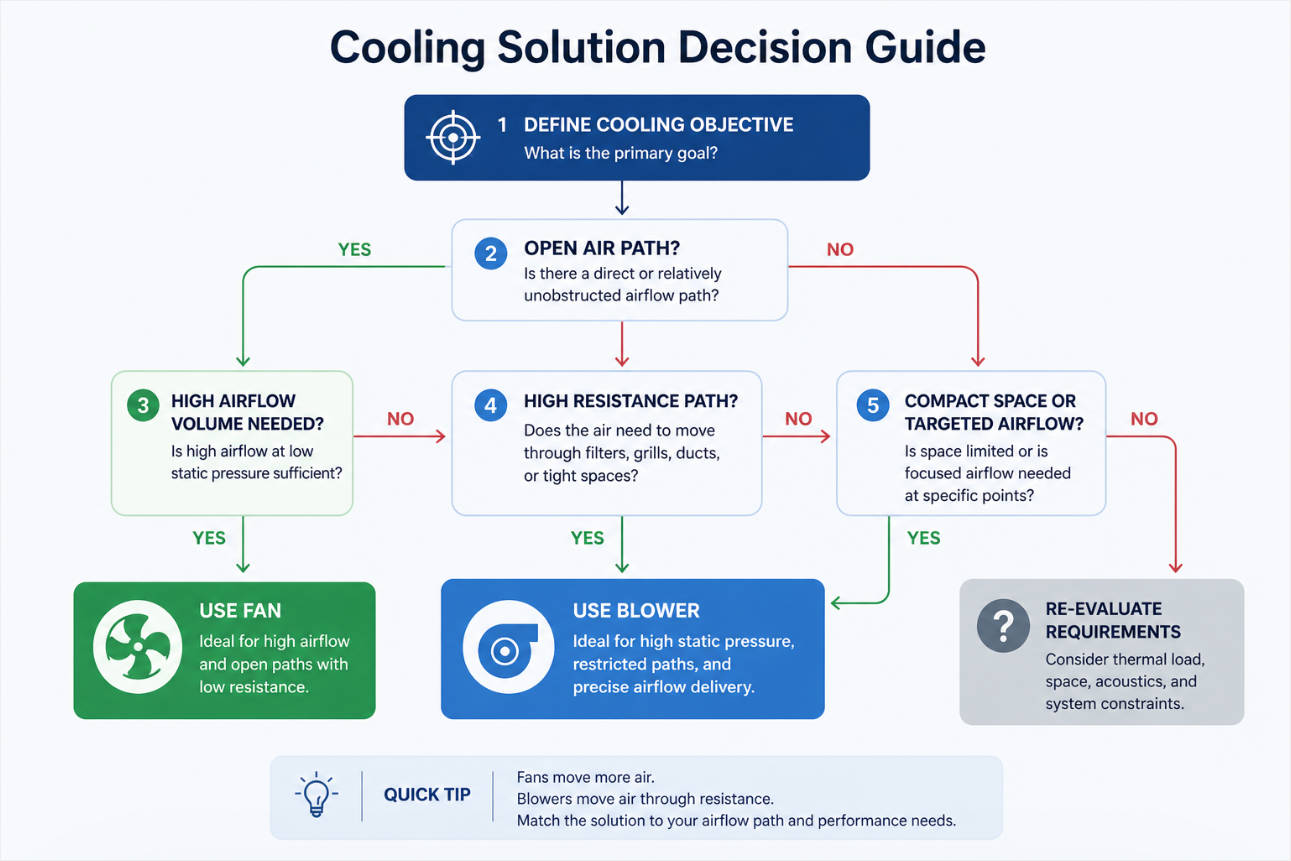
When I walk customers through cooling choices, I use a simple, repeatable process. You can apply this even if you are not a thermal expert. [coresite]
1. Define the cooling objective
- Do you need to cool an entire enclosure or target a specific hotspot?
- Are you trying to protect human comfort, sensitive electronics, or both?
2. Map the airflow path
- Sketch the exact path from air inlet to components to outlet.
- Identify restrictions: filters, grills, narrow ducts, dense heat sinks.
3. Estimate flow and pressure
- Determine required airflow (CFM) and back pressure based on component power and geometry.
- Use vendor tools or CFD support from your supplier if internal expertise is limited. [flexential]
4. Select fan vs. blower
- If airflow path is relatively open and you mainly need circulation, choose a fan.
- If airflow must be pushed through resistance or tightly guided, choose a blower.
5. Choose AC vs. DC and form factor
- Match supply (AC or DC), control Needs (PWM, alarms), noise, and space.
- Pick axial, centrifugal, or cross‑flow configurations as needed. [sofasco]
6. Prototype and test
- Measure component temperatures, noise, and power in realistic conditions.
- Iterate fan speed, duct design, and venting before freezing the design. [legrand]
I recommend documenting this decision process as part of your design history; it streamlines future platform updates and regulatory reviews. [developers.google]
Thermal design no longer happens in isolation; it is intertwined with energy efficiency, regulations, and new cooling technologies. [amca]
Key trends that affect how we specify fans and blowers today:
- Rising power density in data centers, AI, and 5G infrastructure is pushing traditional air cooling toward its limits. [flexential]
- Hybrid cooling architectures now combine precision fans/blowers with liquid cooling (direct‑to‑chip or immersion), using air movers for auxiliary or fallback cooling. [legrand]
- Regulatory frameworks such as DOE and California CEC are driving higher minimum efficiency for commercial and industrial fans and blowers through standards like ANSI/AMCA 205 and 214. [amca]
- End users increasingly evaluate total energy cost, not just component price, making high‑efficiency fans and optimized airflow paths more attractive. [coresite]
For OEMs in telecom and industrial markets, aligning your cooling approach with these trends improves not only reliability but also marketability in sustainability‑driven tenders. [legrand]
Based on real projects with large telecom and networking clients, here are practical guidelines that consistently improve outcomes:
- Use multiple smaller DC fans with intelligent control instead of a single, oversized unit where redundancy and gradual failure modes are important.
- Treat filters as dynamic components: design airflow and blower selection assuming increased resistance as filters accumulate dust. [flexential]
- Consider hot‑aisle / cold‑aisle concepts even in small cabinets, so fans and blowers reinforce, rather than fight, your intended airflow direction. [coresite]
- In outdoor or industrial environments, prioritize IP‑rated fans/blowers, corrosion‑resistant materials, and well‑designed seals.
- Always validate performance at the worst‑case combined condition: maximum ambient temperature, maximum power load, and realistic dust or obstruction levels. [flexential]
This is where working with a specialized partner like Capital Technology, backed by SANYO DENKI's product portfolio and experience, can dramatically shorten your trial‑and‑error cycle. [sanyodenki]
If you are designing or upgrading equipment for telecom, networking, industrial control, or high‑reliability systems, choosing between DC fans, AC fans, and blowers is no longer a trivial detail. It defines your product's thermal headroom, noise profile, and long‑term reliability.
As a source manufacturer and solution partner, Capital Technology can help you:
- Evaluate whether a fan or blower is a better fit for your airflow path.
- Select optimized DC and AC fan solutions from our CAPITAL brand and SANYO DENKI portfolio.
- Align your cooling design with current efficiency regulations and industry best practices. [sanyodenki]
You can reach out to our engineering team to review your thermal requirements, share mechanical drawings, and receive a tailored cooling proposal for your next platform.
If your airflow path is mostly open and you just need to circulate air, a fan usually suffices; if you must push air through resistance such as filters, ducts, or narrow vents, a blower is typically more appropriate. [thebetterappliances]
Blowers are not always higher in total airflow, but they generally provide higher static pressure, which makes them more effective when air must move through restrictions or over long channels. [acdcecfan]
Use DC fans when you need speed control, monitoring, and higher efficiency, especially in telecom, IT, and embedded systems; use AC fans when you rely on AC mains and want simpler, rugged installations in industrial environments. [acdcecfan]
In markets like the United States and California, commercial and industrial fans and blowers are increasingly regulated for efficiency, with standards and labels based on AMCA methods and DOE/CEC requirements, so you should choose products that meet relevant indices and documentation. [amca]
Direct replacement is risky because blowers and fans differ in form factor, airflow pattern, and pressure characteristics; any change should be analyzed with respect to airflow path, component temperatures, and mechanical integration before being approved. [thebetterappliances]
1. Pelonis Technologies, "The Difference Between Fans and Blowers."
<https://www.pelonistechnologies.com/blog/the-difference-between-fans-and-blowers>
2. Sofasco, "Know the Difference Between Fans and Blowers."
<https://sofasco.com/blogs/article/know-the-difference-between-fans-and-blowers> [sofasco]
3. Better Appliances, "Difference Between Fan and Blower."
<https://www.thebetterappliances.com/blog/difference-between-fan-and-blower> [thebetterappliances]
4. AMCA / HPAC, "Dawn of a New Era: The Regulation of Commercial and Industrial Fans and Blowers."
<https://www.amca.org/educate/articles-and-technical-papers/amca-inmotion-articles/dawn-of-a-new-era-the-regulation-of-commercial> [amca]
5. Google Search Central Blog, "Our latest update to the quality rater guidelines: E‑A‑T gets an extra E for Experience."
<https://developers.google.com/search/blog/2022/12/google-raters-guidelines-e-e-a-t> [developers.google]
6. Legrand, "Data Center Cooling: Types, Benefits and Best Practices."
<https://www.legrand.com/datacenter/gb-en/news/data-center-cooling-types-benefits-and-best-practices> [legrand]
7. CoreSite, "6 Best Practices for Optimizing Data Center Cooling."
<https://www.coresite.com/blog/6-best-practices-for-optimizing-data-center-cooling> [coresite]
8. Flexential, "Beating the heat: Cooling strategies for high-density colocation."
<https://www.flexential.com/resources/blog/beating-heat-cooling-strategies-high-density-colocation> [flexential]
9. ACDCFAN, "Blowers and Fans: Key Differences and Applications."
<https://www.acdcecfan.com/blowers-and-fans/> [acdcecfan]
10. SANYO DENKI company profile (Chinese).
<https://www.sanyodenki.com/archive/document/corporatedata/profile/companypro2017_zhch.pdf> [sanyodenki]


