From idea to market-ready product, our NPI solutions make every stage easier, faster. Discover How We Help
Help Center

Views: 264 Author: Capital Technology Publish Time: 2026-09-01 Origin: Site
Content Menu
● Fan vs. Blower: The Core Difference
>> Common Types of Cooling Fans
>> How a Centrifugal Blower Works
● Fan vs. Blower: Detailed Comparison
>> Airflow Volume vs. Static Pressure
>> Size and Installation Requirements
>> Noise and Acoustic Performance
● How to Select the Right Fan or Blower
>> Step 1: Define the Thermal Load
>> Step 2: Map the Airflow Path
>> Step 3: Estimate System Resistance
>> Step 4: Read the Fan Curve Correctly
>> Step 5: Confirm Electrical and Reliability Requirements
>> Server and Network Equipment
>> Battery and Power Electronics
● Energy Efficiency: Why Speed Control Matters
● Expert Checklist Before You Buy
>> 1. Is a blower stronger than a fan?
>> 2. Can a DC fan replace a centrifugal blower?
>> 3. What is the difference between an axial fan and a centrifugal blower?
>> 4. How do I calculate the airflow needed for electronics cooling?
>> 5. Why does my cooling fan become noisy after installation?
>> 6. Should I choose an AC fan or a DC fan?
>> 7. What data should I request from a fan or blower supplier?
Choosing between a fan and a blower is not simply a matter of terminology. The right choice directly affects cooling performance, static-pressure capability, acoustic noise, system reliability, power consumption, and the usable life of the electronics or equipment being protected.
In practical thermal-management engineering, a DC fan, AC fan, or blower must be selected against the system's real airflow resistance—not just a catalog airflow number. At Capital Technology Co., Limited, we support engineers and sourcing teams with thermal-management solutions built around CAPITAL-branded cooling fans and professional distribution support for SANYO DENKI products. Based on real-world needs in communications, industrial electronics, power equipment, and embedded systems, this guide explains the difference between a fan and a blower from an application-first perspective.

The simplest difference between a fan and a blower is how each device moves air and how much resistance it can overcome.
A fan is usually designed to move a relatively large volume of air at low-to-moderate pressure. It is widely used for ventilation, heat dissipation, air circulation, and general equipment cooling.
A blower is designed to produce a more focused airflow stream and typically deliver higher static pressure. It is better suited to applications involving ducts, dense filters, narrow air passages, heat sinks, restricted enclosures, or other airflow obstacles.
In many electronics projects, the distinction matters because a fan that looks powerful on paper can lose much of its effective airflow after it is installed behind a grill, air filter, heat sink, or tightly packed PCB assembly.
A practical rule is simple:
- Choose a fan when your system needs broad airflow with relatively low resistance.
- Choose a blower when your system needs directional airflow and stronger pressure to push through restrictions.
- Select based on the full system operating point, not free-air airflow alone.
The American Society of Heating, Refrigerating and Air-Conditioning Engineers and fan-industry engineering practices generally treat airflow, static pressure, speed, power, and efficiency as connected variables. A change in system resistance can move the operating point significantly along a fan curve, changing the actual delivered airflow.
A fan is an air-moving device that uses rotating blades or an impeller to create airflow. In most cooling applications, air enters on one side of the unit and exits in a direction that supports cooling, ventilation, or exhaust.
For electronics cooling, the most familiar example is the axial fan. Its airflow travels generally parallel to the motor shaft. This is why axial DC fans are common in telecom cabinets, servers, power supplies, network switches, charging equipment, and industrial control systems.
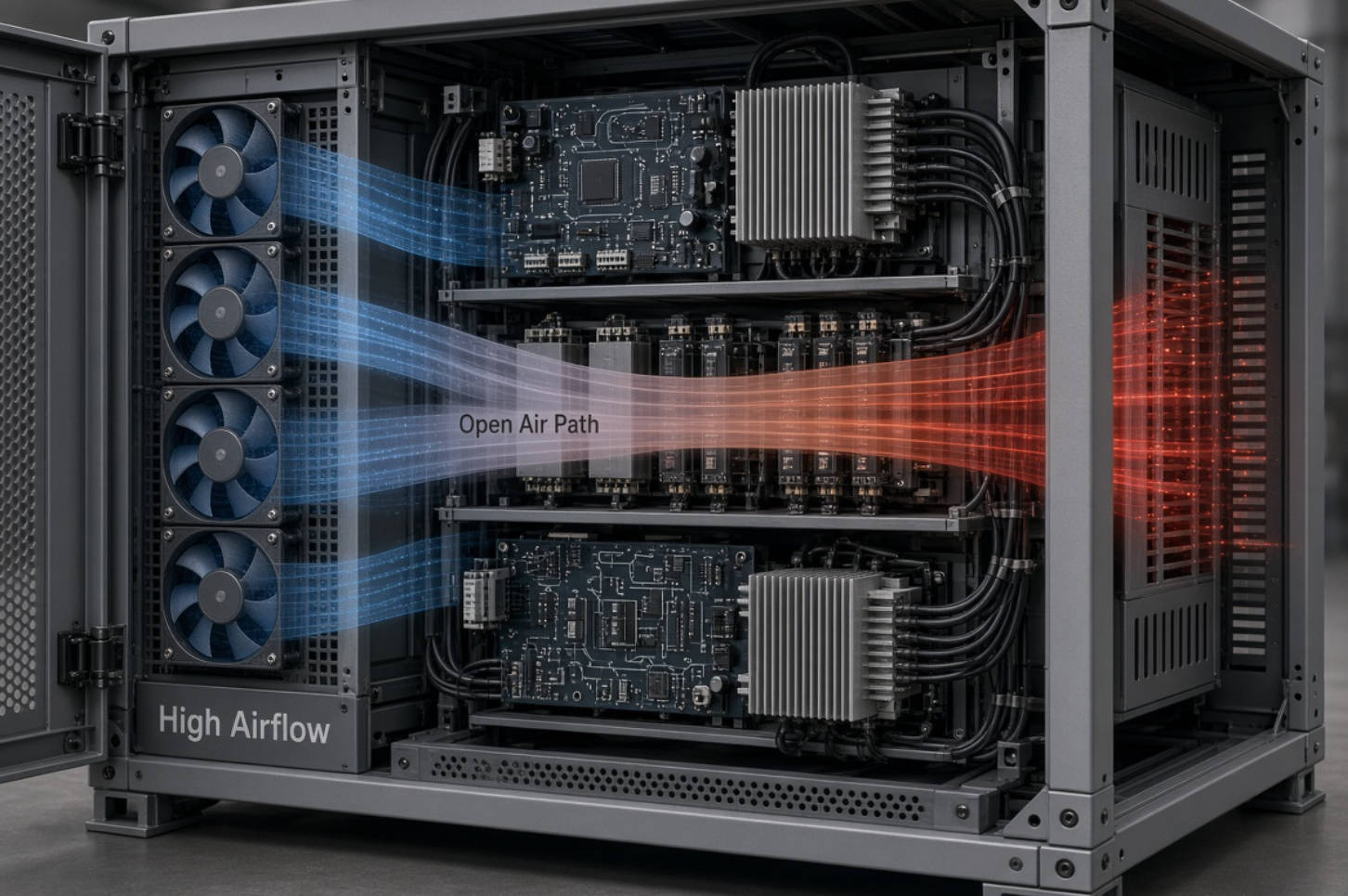
An axial fan uses propeller-like blades to accelerate air in the same general direction as the axis of rotation. It is highly effective when the equipment enclosure has a relatively open air path.
For example, a DC axial fan can draw cool ambient air through an intake opening, direct it across circuit boards and heat-generating components, and discharge warm air through an exhaust opening.
Typical axial fan strengths include:
- High airflow in open or low-restriction systems
- Compact installation depth
- Wide selection of frame sizes and voltages
- Strong suitability for DC-powered electronics
- Good performance for cabinet ventilation and general cooling
- Straightforward replacement and maintenance
Typical axial fan limitations include:
- Reduced airflow when static pressure rises sharply
- Less suitable for restrictive ducting or tightly packed equipment
- Greater risk of recirculation if inlet and outlet airflow paths are poorly designed
- Potential tonal noise when blades interact with grills, guards, or obstructions
A well-selected axial fan is often the most cost-effective choice when airflow has a clear, open route through the enclosure.
The word "fan" covers several aerodynamic designs. The right product category depends on the system's pressure requirement, airflow direction, space constraints, and noise target.
| Fan Type | Airflow Direction | Pressure Capability | Typical Applications |
|---|---|---|---|
| Axial fan | Parallel to shaft | Low to medium | Telecom cabinets, servers, power supplies, ventilation |
| DC axial fan | Parallel to shaft | Low to medium | PCB cooling, battery systems, network equipment, electronics |
| AC axial fan | Parallel to shaft | Low to medium | Industrial cabinets, HVAC auxiliaries, machinery panels |
| Centrifugal fan | Air exits radially | Medium to high | Ducted cooling, filtration, equipment with resistance |
| Cross-flow fan | Wide, transverse air curtain | Low to medium | Display equipment, appliances, compact thermal channels |
For most electronic thermal designs, the initial comparison is usually between a DC axial fan and a DC blower rather than between a generic fan and a generic blower.
A blower is an air-moving device built to create a concentrated airflow stream and higher static pressure than many conventional axial fans. In electronics, the term often refers to a centrifugal blower.
Rather than moving air straight through the unit, a centrifugal blower draws air into the inlet—often through the center of the impeller—and then accelerates it outward through a volute housing. The housing redirects the flow toward an outlet.
This design makes blowers especially useful when air must pass through a restrictive path.
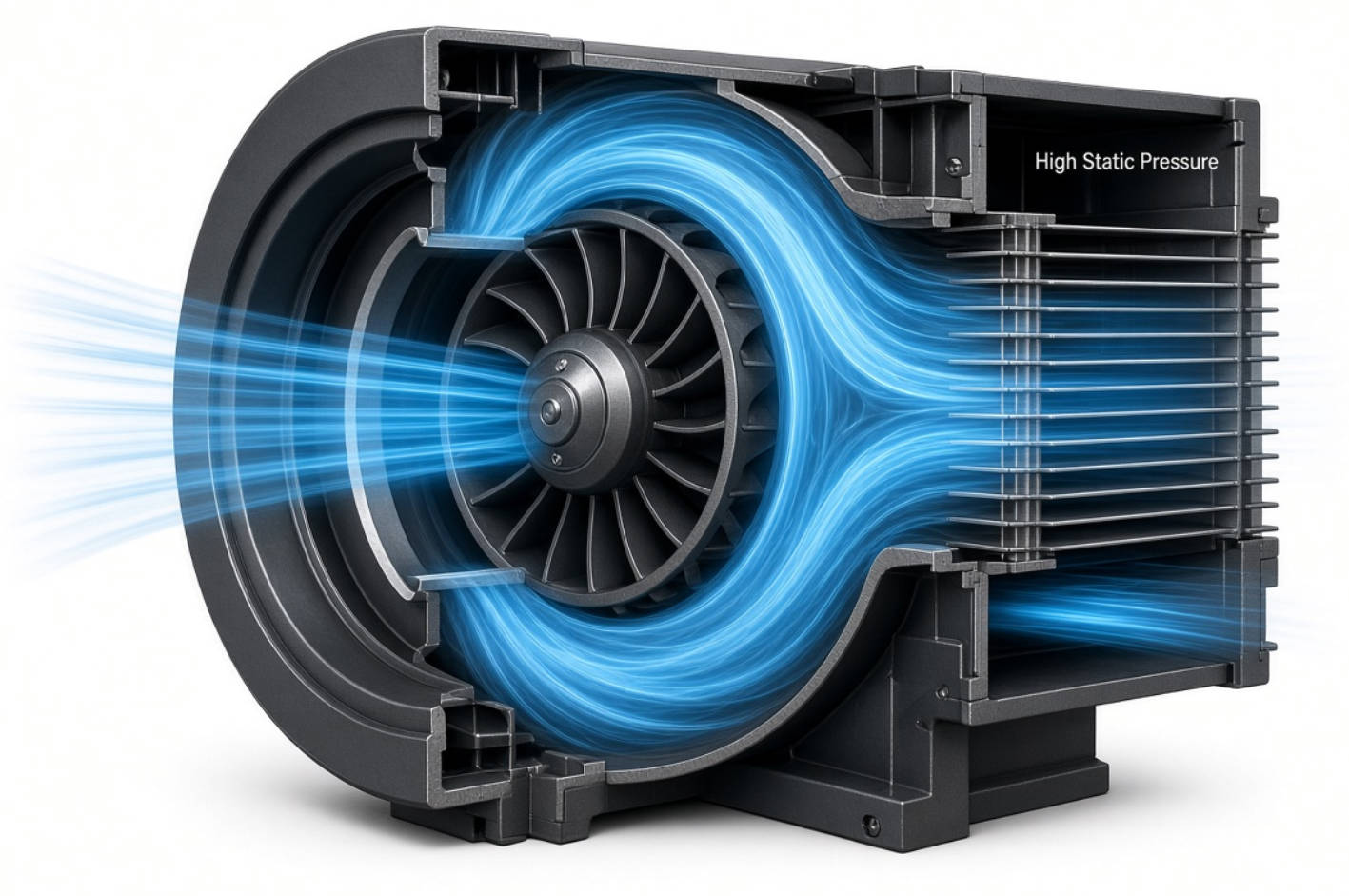
Inside a centrifugal blower, the rotating impeller adds energy to the air. The volute-shaped housing helps convert part of that velocity into pressure. The resulting airflow can be directed through a side outlet, making the blower practical for targeted cooling.
A blower is commonly selected when the airflow must pass through:
- Dense fin heat sinks
- Long or narrow ventilation channels
- Dust filters
- Ducts and manifolds
- Battery-module cooling paths
- Compact server or telecom equipment
- High-resistance electronic enclosures
- Optical, medical, or analytical equipment
A blower does not automatically replace a fan. Its higher-pressure capability can be valuable, but it may involve trade-offs in form factor, localized noise, cost, and airflow coverage.
The two broad blower families are centrifugal blowers and positive-displacement blowers. For compact electronic cooling, centrifugal blowers are generally the more relevant category.
| Blower Type | Operating Principle | Best-Fit Use |
|---|---|---|
| Centrifugal blower | Impeller accelerates air outward into a housing | Electronics cooling, filtered air paths, ducts, compact systems |
| Radial blower | Radial impeller generates pressure-focused flow | Industrial equipment, material handling, demanding airflow paths |
| Positive-displacement blower | Traps and transfers a defined volume of gas | Pneumatic conveying, aeration, process air, industrial systems |
| Regenerative blower | Re-energizes air through repeated impeller passes | Vacuum, aeration, low-to-medium pressure process applications |
For a supplier sourcing compact cooling components, it is important not to confuse a miniature centrifugal blower with a large industrial process blower. The design principles overlap, but their size, duty cycle, motor design, control features, and performance requirements can differ significantly.
The best way to understand the fan vs. blower difference is to compare the factors that engineers and buyers actually evaluate during product selection.
| Selection Factor | Fan | Blower |
|---|---|---|
| Main purpose | Broad air circulation and cooling | Focused airflow through resistance |
| Typical airflow pattern | Straight-through or axial | Directional side discharge or ducted flow |
| Static pressure | Usually lower | Usually higher |
| Free-air airflow | Often high | Can be lower than an axial fan of similar size |
| Performance in restrictive systems | May decline sharply | Usually more stable |
| Cooling coverage | Broad area coverage | Concentrated cooling zone |
| Typical form factor | Square or round frame | Scroll, snail-shell, or rectangular housing |
| Installation | Simple panel, chassis, or cabinet mounting | Requires careful inlet/outlet and duct-path planning |
| Noise profile | Often broad-band airflow noise | Can have higher-pitch or directional noise |
| Common applications | Cabinets, chassis, ventilation, open airflow paths | Heat sinks, filters, narrow channels, ducted electronics |
The most important technical distinction is not simply "fans move air and blowers create pressure." Both move air and both generate pressure. The real difference is how their performance curves suit a given system.
An axial fan can deliver strong airflow in free air. However, when it faces resistance from a filter, heatsink, grill, bend, duct, or dense component layout, airflow may fall significantly.
A centrifugal blower usually has a curve better suited to high-resistance systems. It can maintain useful airflow where an axial fan may operate far from its intended performance point.
This is why free-air CFM should never be the only specification used for selection.
A cooling device should be evaluated against:
1. Required airflow at the component or enclosure level.
2. Required static pressure at the expected operating condition.
3. Available installation space.
4. Inlet and outlet restrictions.
5. Noise target at real operating speed.
6. Input voltage and control method.
7. Ambient temperature and reliability requirement.
8. Expected contamination, dust, humidity, vibration, and service conditions.
An axial fan is often easier to integrate. It can be mounted directly on a panel, heat exchanger, rack door, or equipment chassis. Common DC fan formats include square frames with standardized mounting holes.
A blower can offer more installation flexibility when the air must be redirected. Its outlet can be aimed at a specific heat source or connected to a duct. This is valuable in compact designs where a component sits far from the air intake.
However, blower integration requires more care. The inlet must remain sufficiently open, the outlet should not be blocked, and the duct geometry should avoid unnecessary bends or leakage.
Neither fan nor blower is inherently "quiet." Acoustic performance depends on blade or impeller geometry, speed, bearing type, PWM control, housing design, turbulence, system impedance, mounting method, and nearby obstructions.
In our experience supporting electronic cooling projects, a technically correct fan can still become noisy after installation if a stamped-metal grill, cable bundle, or narrow chassis opening creates turbulence.
To reduce noise in real equipment:
- Avoid operating at the highest possible speed continuously.
- Use PWM or voltage-based speed control when appropriate.
- Keep inlet and outlet openings clear.
- Choose a fan curve with margin rather than overspeeding a small unit.
- Use well-designed guards instead of highly restrictive grills.
- Isolate vibration with suitable mounting hardware where needed.
- Review acoustic data at the intended operating point, not only at maximum speed.
A reliable selection process begins with the cooling problem, not the product category. Start by understanding where heat is generated, how air can enter and exit, and how much airflow resistance the system creates.
Identify total heat dissipation in watts and locate the critical components. A power module, CPU, RF amplifier, battery pack, or switching device may need more cooling than the enclosure average suggests.
Do not assume that cooling the enclosure air is enough. The key question is whether air reaches the actual heat source.
Sketch the air route from intake to exhaust. Mark filters, fins, cable bundles, baffles, ducts, bends, perforated panels, and components.
If the airflow path is relatively short and open, an axial fan may be appropriate. If the path is narrow, long, filtered, or highly obstructed, a blower should be evaluated.
System resistance rises as airflow increases. The relationship is often nonlinear, which means small geometry changes can have a meaningful performance impact.
A dense heat sink or clogged filter can move the required operating point into a range where an axial fan no longer supplies enough effective airflow. This is where a higher-static-pressure blower may provide a more dependable solution.
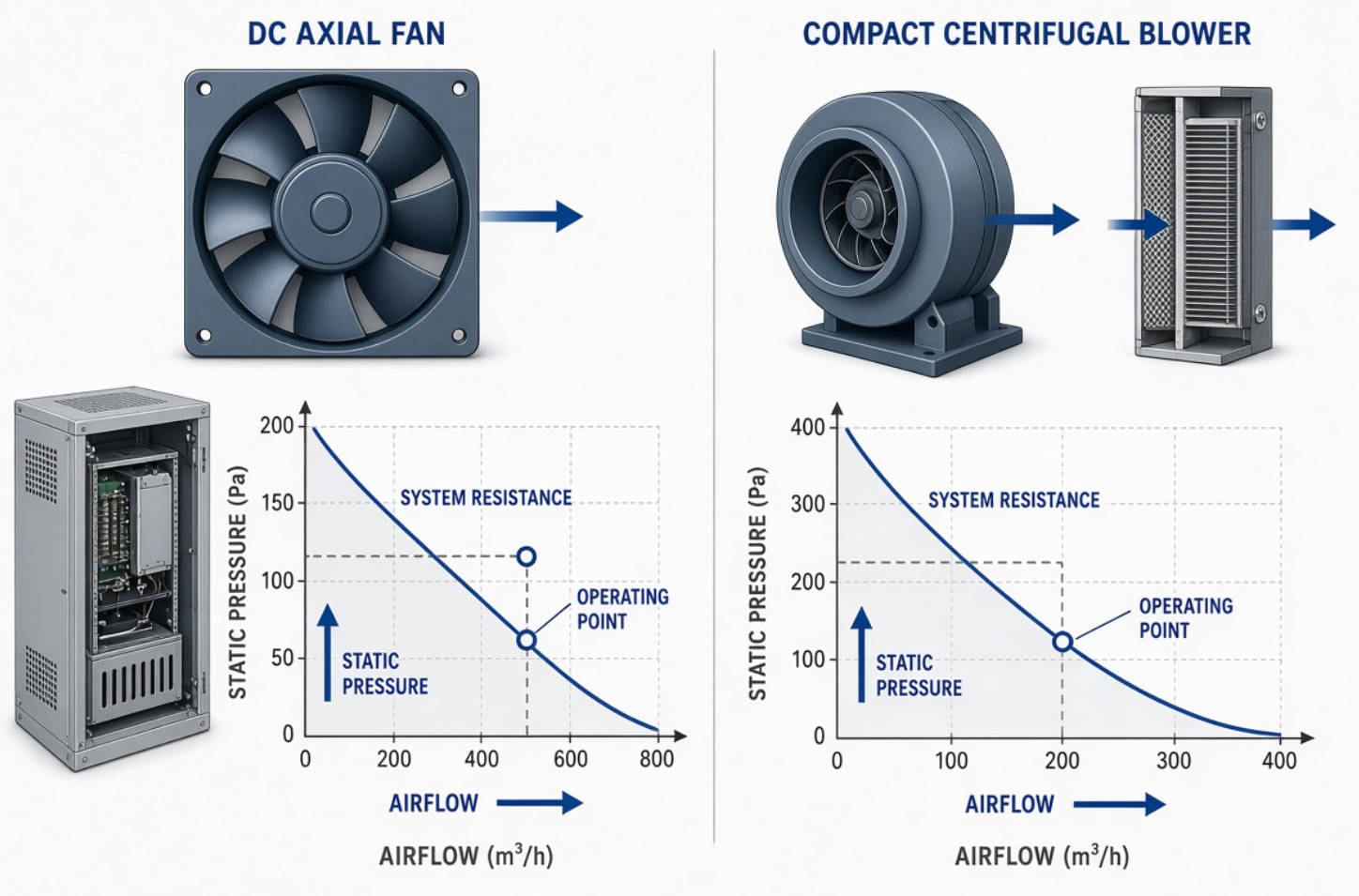
A fan curve shows the relationship between airflow and static pressure. The actual operating point occurs where the device curve intersects the system-resistance curve.
Important interpretation:
- At zero static pressure, the product may show its maximum free-air airflow.
- At zero airflow, the product reaches maximum static pressure.
- Your real system will operate somewhere between these two points.
- The best product is the one that meets the required airflow and pressure at the actual intersection point.
This approach is more accurate than selecting the product with the largest airflow number.
For DC fan and blower applications, verify:
- Rated voltage, such as 5 V, 12 V, 24 V, or 48 V DC
- Current draw and startup current
- PWM speed-control compatibility
- Tachometer or alarm output requirements
- Bearing system and expected service life
- Operating temperature range
- IP rating or environmental protection needs
- EMC and safety requirements
- Connector, lead-wire, and mounting specifications
For industrial or communication equipment, a thermal component should support the system's expected duty cycle and operating environment—not merely operate successfully during a short prototype test.
A telecom cabinet with broad front-to-rear airflow and moderate obstruction may benefit from multiple DC axial fans. The fans can create high-volume airflow across power boards, communication modules, and cable-management areas.
However, if the cabinet uses dense air filters, narrow channels, or high-power modules concentrated in one area, a higher-static-pressure fan or blower arrangement may be needed.
For suppliers serving communications infrastructure, the selection priority is often a balance of thermal stability, continuous-duty reliability, alarm monitoring, low maintenance, and acoustics.
Servers and switches are usually space-constrained and highly restrictive. Air must pass through tightly packed boards, finned heat sinks, processors, memory modules, and power supplies.
This environment often favors high-static-pressure axial fans or centrifugal blowers, depending on the chassis architecture. A low-pressure fan may have an attractive free-air rating but fail to maintain adequate airflow through the full equipment path.
Battery packs, UPS systems, chargers, inverters, and energy-storage equipment can develop localized heat. In these cases, directed airflow may be more important than general enclosure ventilation.
A blower can channel air toward battery cells, bus bars, power semiconductors, or heat sinks. Still, the final solution must account for dust, moisture, vibration, battery safety requirements, and the consequences of cooling failure.
Air-moving systems consume energy continuously, so fan selection has an operating-cost impact as well as a thermal impact.
The fan affinity laws are especially useful for understanding why speed control can be valuable. In general, airflow changes roughly in proportion to fan speed, pressure changes approximately with the square of speed, and power changes approximately with the cube of speed. Therefore, reducing speed modestly can reduce power demand substantially when system conditions permit.
For illustration, a 10% increase in rotational speed can increase airflow by about 10%, while the pressure requirement rises by about 21% and the power requirement can rise by approximately 33%. This is why running every cooling fan at maximum speed is not always the best engineering strategy.
A better approach is to combine:
- Correct fan or blower sizing
- Efficient motor design
- PWM or intelligent speed control
- Temperature sensing
- Proper inlet and outlet design
- Filter-maintenance planning
- Regular performance verification
The U.S. Department of Energy provides fan-system tools and guidance aimed at helping industrial users assess energy consumption and identify potential savings opportunities.
Before finalizing a fan or blower specification, ask your supplier or engineering team the following questions:
1. What airflow is required at the actual system static pressure?
2. Is the air path open, filtered, ducted, or restricted?
3. Is cooling needed across the enclosure or at one critical component?
4. What is the maximum allowable noise level?
5. What voltage, connector, control signal, and monitoring functions are required?
6. What ambient temperature and reliability target apply?
7. Will dust accumulation increase pressure resistance over time?
8. Is a single high-pressure blower better than several lower-pressure fans?
9. Can airflow recirculate from the exhaust back to the intake?
10. Is the selected product backed by complete performance, acoustic, and reliability data?
A professional supplier should help translate these questions into a real product-selection recommendation, including fan curves, electrical data, mechanical drawings, life expectancy, and sample testing.
The difference between a fan and a blower comes down to airflow direction, static-pressure capability, and system resistance.
Choose a fan when you need broad, high-volume air movement through an open or moderately restrictive path. Choose a blower when you need concentrated airflow that can overcome filters, ducts, dense heat sinks, or narrow internal channels.
For high-reliability electronics, selecting the right thermal-management product requires more than comparing CFM values. Engineers should evaluate the complete operating point, including airflow, pressure, noise, electrical requirements, environmental conditions, and long-term reliability.
Capital Technology Co., Limited can support your project with CAPITAL DC fans, AC fans, and tailored cooling solutions, along with professional sourcing and product-selection support for SANYO DENKI air-moving products. Contact our technical sales team with your voltage, dimensions, airflow target, static-pressure requirement, and application environment to receive a more accurate cooling recommendation.
A blower is not always "stronger" in every condition, but it typically provides higher static pressure than a conventional axial fan. That makes it more effective when airflow must pass through restrictive components such as filters, dense heat sinks, ducts, or narrow equipment channels.
Sometimes, yes—but only if the system resistance is low enough. A DC axial fan may replace a blower in an open enclosure with a short, unobstructed airflow path. If the design has high resistance, replacing a blower with an axial fan can reduce real airflow and cause overheating.
An axial fan moves air generally parallel to its rotating shaft, producing broad airflow suitable for ventilation and open cooling paths. A centrifugal blower draws air into the impeller and redirects it outward through a housing, typically producing higher pressure for restrictive or directional cooling applications.
Start with the equipment's heat load, allowable temperature rise, component locations, and enclosure airflow path. Then estimate system resistance and select a fan or blower using the manufacturer's performance curve. For complex or high-power systems, thermal testing and CFD analysis can help validate the final design.
Noise often increases because of turbulence caused by restrictive grills, narrow openings, nearby cables, blocked inlets, high operating speed, poor mounting, or airflow recirculation. Improving chassis airflow and selecting a fan with suitable static-pressure capability can often reduce noise.
Choose an AC fan when your system is powered directly by AC mains and simple fixed-speed operation is acceptable. Choose a DC fan when you need lower-voltage operation, PWM speed control, tachometer feedback, intelligent thermal control, or integration into electronic equipment.
Request a performance curve, airflow and static-pressure data, acoustic data, rated voltage and current, startup current, dimensions, wiring information, bearing type, expected life, operating-temperature range, control options, certifications, and environmental-protection information where applicable.
1. Air Movement and Control Association International (AMCA), “Centrifugal Fan Manufacturers and AMCA Certified Ratings Program.” [https://www.amca.org/certify/amca-certified/product-type/centrifugal-fan.html]
2. U.S. Department of Energy, “Fan Systems.” [https://www.energy.gov/cmei/ito/fan-systems]
3. U.S. Department of Energy, “Improving Fan System Performance: A Sourcebook for Industry.” [https://www.osti.gov/biblio/15003715]
4. National Renewable Energy Laboratory, “Improve the Energy Efficiency of Fan Systems.” [https://www.nlr.gov/docs/fy09osti/44654.pdf]
5. New York Blower, “Fan Basics and Beginner Resources.” [https://www.nyb.com/resources/fan-basics/]
6. QATS, “Fan Curves and Laws.” [https://www.qats.com/Download/Qpedia_Feb08_Fan_curves_and_laws.ashx]
7. Longwell, “Fan vs Blower: Key Differences Explained.” [https://www.longwellfans.com/difference-between-fan-and-blower/]


