From idea to market-ready product, our NPI solutions make every stage easier, faster. Discover How We Help
Help Center

Views: 222 Author: Astin Publish Time: 2026-04-30 Origin: Site
As a thermal design engineer who has helped telecom and industrial OEMs transition from traditional AC fans to EC fans, I've seen how the right fan choice can make or break a project's energy budget, reliability, and compliance roadmap. In this guide, I'll walk through the real‑world benefits of electronically commutated (EC) fans, how they compare to AC and DC fans, and where they fit best in today's high‑density, high‑efficiency systems. [ystechusa]
An electronically commutated (EC) fan combines a brushless DC motor with integrated electronics that allow it to run from an AC supply while delivering DC‑motor‑level efficiency and control. In practice, you feed the fan with AC power, the internal PCB rectifies it to DC, and a controller drives a permanent‑magnet rotor at variable speed to match the cooling demand.
Compared with a traditional AC induction fan, the EC motor does not waste energy generating a secondary magnetic field through copper windings, because that field comes from permanent magnets in the rotor. This difference, combined with intelligent onboard control, is what allows EC fans to reach significantly higher efficiency across a wide speed range. [blog.ebmfan]
Where EC fans are commonly used today: data centers, telecom base stations (ZTE, HUAWEI, HYTERA and similar), 5G infrastructure, industrial cabinets, EV charging, and smart building ventilation. [linkedin]

From both field projects and lab testing, the four core benefits of EC fans over traditional AC fans are:
1. Higher energy efficiency across the full operating curve
2. Smarter speed and torque control
3. Longer service life and higher reliability
4. More compact, flexible form factors
Each of these plays directly into real business metrics: operating cost, uptime, and design flexibility. [ystechusa]
The main reason engineers and buyers switch from AC to EC fans is the energy savings, especially at partial load. [ystechusa]
- EC fans can achieve up to 30% higher efficiency than comparable AC induction fans in many applications. [blog.ebmfan]
- Efficiency stays high even when the fan is running well below maximum speed, which is common in real installations. [blog.ebmfan]
- Permanent‑magnet rotors remove the need to energize a secondary magnetic field via copper windings, reducing losses.
In a typical telecom rack or industrial enclosure, fans rarely run at 100% PWM all the time. Instead, they modulate with temperature, load, or time of day. That's where EC technology pays for itself: every hour at partial speed still delivers high efficiency, unlike many legacy AC fans that waste power when throttled. [ystechusa]
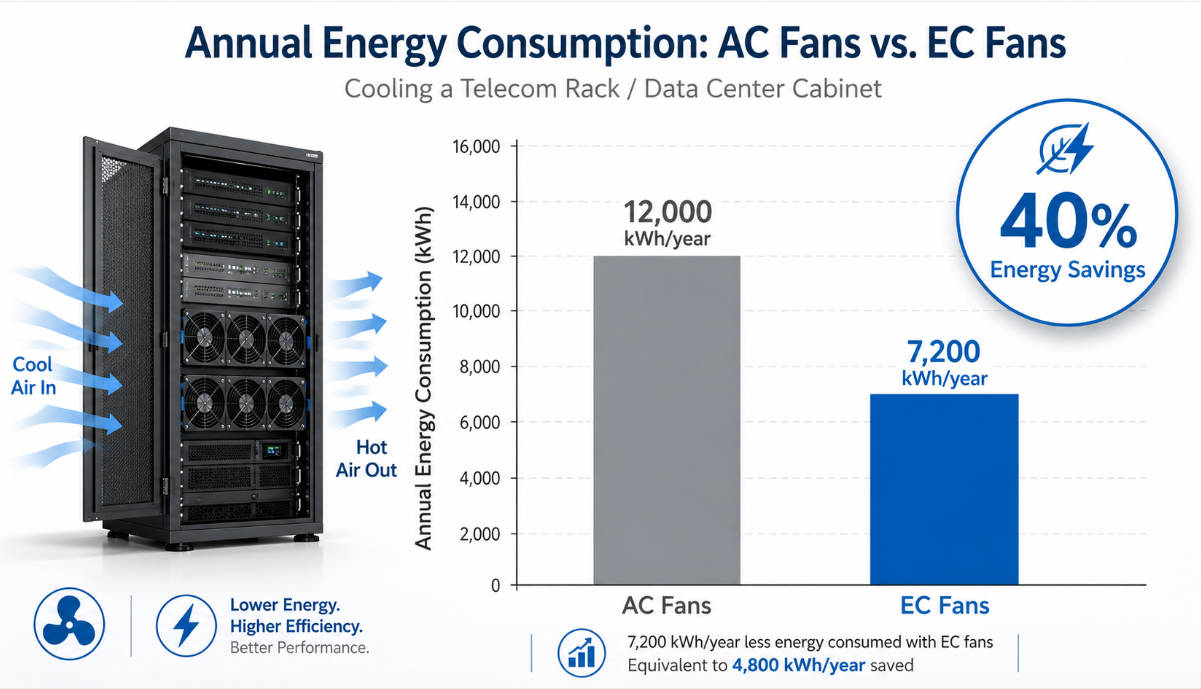
Illustrative example (simplified):
- 6 AC fans, 80 W each, running at an average of 70% duty → ~336 W
- 6 EC fans, 30% more efficient at that duty → ~235 W
Over thousands of operating hours per year, that difference can translate into meaningful OPEX savings and easier compliance with tightening energy regulations. [linkedin]
One of the most underrated advantages of EC fans is their integrated control electronics. [ystechusa]
- EC fans typically support 0–10 V, PWM, or digital bus control (such as MODBUS), making it easy to match airflow exactly to real‑time thermal loads. [ystechusa]
- From a central controller, engineers can adjust speed, torque, and ramp‑up profiles, reducing inrush current, mechanical stress, and acoustic noise. [ystechusa]
- EC fan telemetry (tachometer signals, alarms, sometimes advanced diagnostics) allows predictive maintenance and better system‑level visibility. [linkedin]
In large deployments—such as telecom base stations or industrial control rooms—this central, software‑defined control model turns fans from "dumb components" into part of a smart thermal subsystem. You can implement profiles like: [linkedin]
- Higher airflow during peak compute periods, quieter at night
- Temperature‑based curves to keep components within tight tolerances
- Soft‑start sequences to prevent sudden pressure spikes in ducted systems
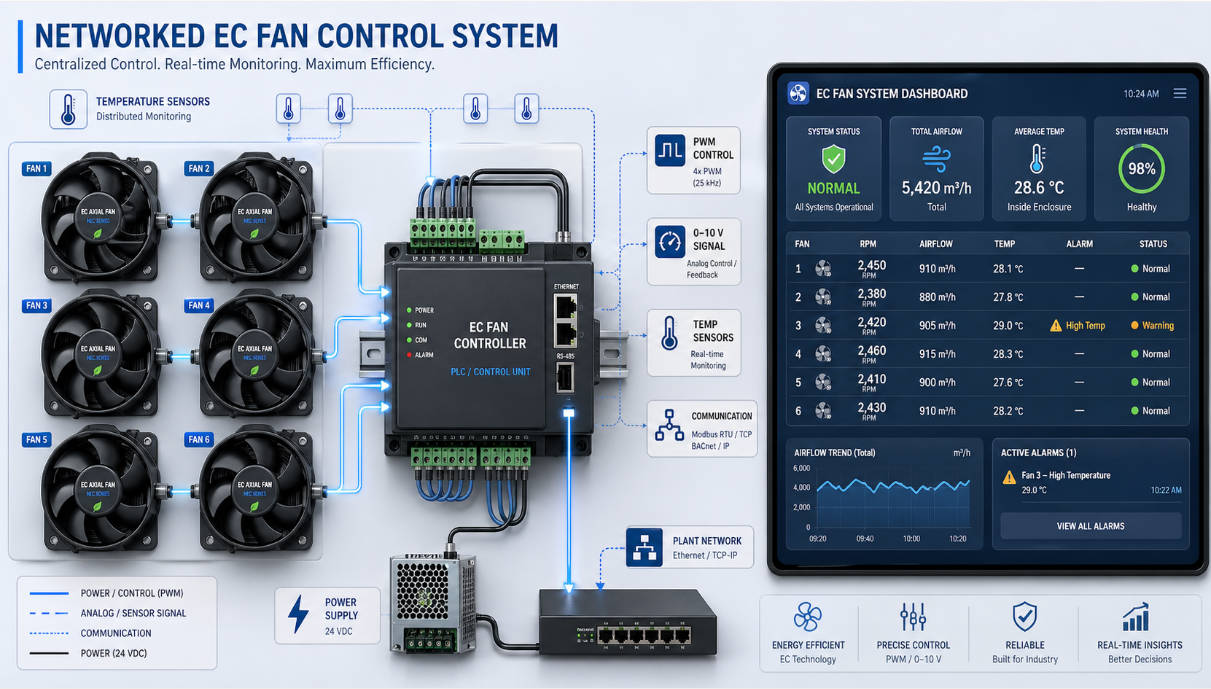
Compared with retrofitting external VFDs or fan controllers onto AC fans, EC fans provide a more integrated, compact, and often lower‑cost control solution at the system level. [ystechusa]
When I speak with OEMs and contract manufacturers, service life is often just as important as efficiency. EC fans are designed to run cooler and cleaner, and those two factors dominate reliability. [blog.ebmfan]
Key design aspects:
- Brushless motor design: There are no carbon brushes to wear out, which eliminates one of the common mechanical failure points found in many legacy motors.
- Lower operating temperature: EC motors typically run at lower temperatures than comparable AC motors, reducing thermal stress on bearings, insulation, and electronics. [blog.ebmfan]
- More stable operating profiles: Soft‑start and controlled acceleration reduce shock loads on mechanical components, extending bearing and impeller life. [ystechusa]
Although EC fans often have a higher upfront unit cost than simple AC fans, the total cost of ownership (TCO) is usually lower once you factor in:
- Fewer unplanned failures and replacements
- Reduced maintenance visits
- Lower downtime risk in critical systems
For Tier‑1 customers such as ZTE, HUAWEI, and HYTERA, whose equipment may run in harsh environments 24/7, this reliability advantage is a decisive factor when standardizing on EC cooling solutions. [linkedin]
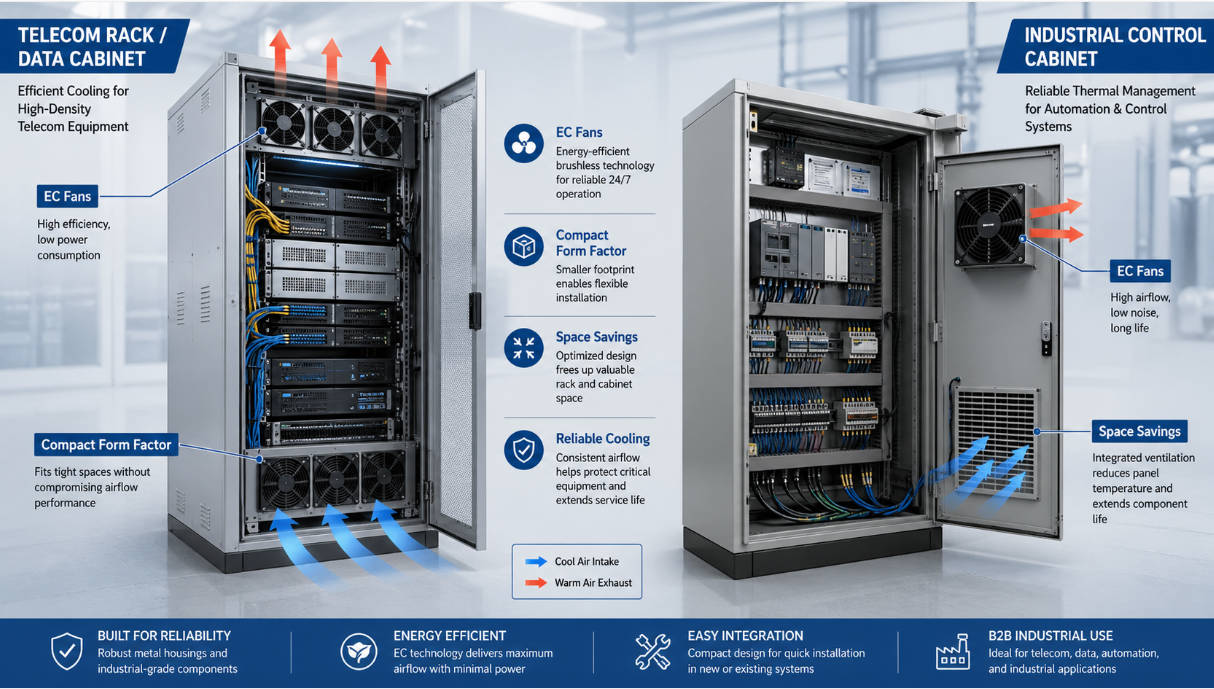
As power density continues to rise in data centers, base stations, and industrial controllers, space is at a premium. EC fan design directly addresses this constraint. [linkedin]
- Many EC motors use an external rotor architecture, allowing the fan to deliver high airflow in a smaller overall footprint.
- The weight of an EC motor can be significantly lower than a comparable AC motor, easing mechanical design and mounting constraints.
- Integrated electronics reduce the need for separate external control hardware, freeing up additional board or rack space. [ystechusa]
For enclosure designers, this means more flexible layouts, more PCB area for revenue‑generating components, and better airflow routing when every millimeter counts. [ystechusa]
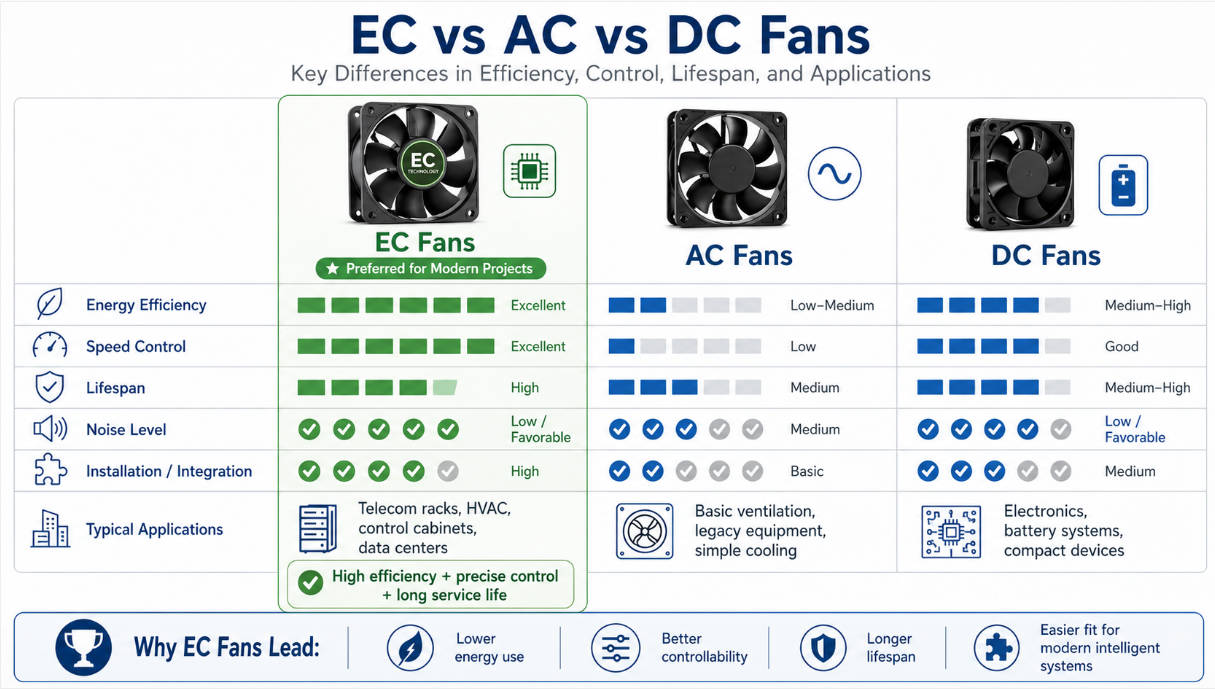
The table below summarizes the practical differences that come up most often in design reviews.
| Aspect | EC Fans | AC Fans | DC Fans |
|---|---|---|---|
| Input power | AC input, internal AC‑DC conversion for DC motor drive | Direct AC, induction motor | Direct DC input, usually external supply |
| Efficiency | High, often ~30% better than AC at comparable points blog.ebmfan | Moderate, drops at partial load blog.ebmfan | High at design speed, less flexible control |
| Speed control | Integrated PCB, 0–10 V, PWM, or bus; wide control range ystechusa | Typically needs external VFD or simple multi‑tap control | PWM or voltage control, but usually basic electronics |
| Lifespan | Long, brushless design, lower thermal stress blog.ebmfan | Shorter if brush wear or high temperature occur | Good, but depends heavily on external driver quality |
| Size and weight | Compact, external‑rotor options, integrated control | Bulkier motor for equivalent output | Compact motors but external electronics add bulk |
| Best use cases | High‑efficiency, networked, or space‑constrained systems linkedin | Simple, cost‑sensitive applications with fixed speed | DC‑only systems, smaller devices, or cost‑optimized designs |
The shift toward EC motors and EC fans is no longer theoretical—it is visible across multiple verticals in 2026. [linkedin]
- Data center and edge computing: Rising rack power density and strict PUE targets push operators toward high‑efficiency, controllable cooling solutions. [linkedin]
- Telecom and 5G: Outdoor and remote base stations need reliable, low‑maintenance cooling; EC fans help meet energy and uptime SLAs. [linkedin]
- Industrial and EV charging: Electrification trends and regulatory pressure on energy efficiency favor EC technology in cabinets and power electronics cooling. [linkedin]
Market analyses in 2026 indicate that EC motors are becoming the default choice in many mid‑ to high‑performance thermal applications, especially where dynamic control and telemetry offer system‑level benefits. This aligns with what we see from global OEMs who now specify EC solutions as standard for new platforms rather than as premium options. [blog.ebmfan]
From real project migrations—from legacy AC fans to EC fan platforms—these are the most important steps to get right.
1. Clarify the power and control architecture
- Confirm AC input voltage and frequency, and align with the EC fan's integrated driver specification.
- Decide early whether you will use 0–10 V, PWM, or digital bus control, and design your controller or PLC interface accordingly. [ystechusa]
2. Re‑evaluate airflow and pressure requirements
- Use updated PQ curves for EC fans; they may deliver more airflow at lower power compared with your existing AC models. [blog.ebmfan]
- In ducted or filtered systems, consider how variable‑speed operation will interact with system impedance over time.
3. Plan for monitoring and alarms
- Integrate tachometer outputs or alarm signals into your system controller to enable early fault detection. [ystechusa]
- If your EC fans support networked protocols, consider centralizing logging and analytics for predictive maintenance.
4. Consider acoustic performance
- Take advantage of variable‑speed control to implement noise‑aware profiles (e.g., quieter operation at night in indoor or office deployments). [ystechusa]
- Use soft‑start and ramp‑down to avoid audible "step" changes in fan speed.
5. Validate thermal performance under real conditions
- Run tests at typical and worst‑case power loads, ambient temperatures, and altitudes to confirm that airflow margins remain sufficient.
- Compare not just maximum temperature, but also temperature stability under dynamic workloads.
For OEMs and system integrators, the difference between a generic fan supplier and a thermal solutions partner is the ability to co‑design around your application. Manufacturers that specialize in DC fans, AC fans, and EC cooling solutions and act as strategic partners to major telecom and industrial brands are well positioned to:
- Provide application‑specific fan selection, matching PQ curves, form factors, and control interfaces to your exact thermal profile. [ystechusa]
- Support design validation with custom testing, documentation, and compliance guidance for global standards (CE, UL, and others). [developers.google]
- Offer long‑term supply stability and roadmap visibility so that your product lines are not disrupted by unexpected component changes. [developers.google]
For companies like ZTE, HUAWEI, and HYTERA, these factors are critical: their systems have long lifecycles, global deployment, and demanding environmental and regulatory requirements, so the cooling solution must be robust, traceable, and fully documented. [developers.google]
If you are designing a new platform or planning a mid‑life refresh of existing equipment, now is the right time to evaluate EC fans as your default cooling solution. Start by mapping your current airflow and energy profile, then explore EC options that deliver higher efficiency, smarter control, and longer service life. [blog.ebmfan]
For OEMs needing a complete thermal solution—from DC and AC fans to advanced EC platforms—partnering with a dedicated cooling manufacturer that already supports leading telecom and industrial brands can significantly reduce project risk and time‑to‑market. [linkedin]
In most mid‑ to high‑performance applications, EC fans are significantly more efficient than traditional AC induction fans, especially at partial load. The combination of permanent‑magnet motors and integrated control electronics allows them to maintain high efficiency across a wider speed range. [blog.ebmfan]
In many cases, yes—EC fans are designed to accept standard AC input voltages, and the AC‑to‑DC conversion happens on the fan's internal PCB. However, you should verify voltage, frequency, and inrush characteristics, and ensure that your system's protection devices and wiring are correctly rated.
EC fans don't require special controllers in the sense of external VFDs, but they do benefit from appropriate control signals such as 0–10 V, PWM, or digital bus interfaces. For simple use cases, you can run them at a fixed speed; for advanced applications, connecting them to a PLC or thermal controller unlocks the full benefits of EC technology. [ystechusa]
Although EC fans may have a higher unit price than basic AC fans, they typically reduce total cost of ownership through lower energy consumption, fewer failures, and less maintenance. Over the life of a telecom or industrial system, these savings can far exceed the initial price difference. [blog.ebmfan]
Yes, many EC fans are designed for demanding environments, including outdoor telecom, industrial, and transportation applications. When specifying fans for harsh conditions, review the IP rating, temperature range, and any available conformal coating or ruggedization options. [linkedin]
1. Pelonis Technologies. "Top 4 Benefits of EC Fans." [Link].
2. YS Tech. "2026 market trends reveal future of fans, blowers, and EC motors in thermal cooling." [Link]. [ystechusa]
3. LinkedIn. "2026 market trends reveal future of fans, blowers, and EC motors in thermal cooling." [Link]. [linkedin]
4. ebm‑papst fan blog. "What are the Benefits of Ebmpapst Axial Fan Ec Fan in 2026?" [Link]. [blog.ebmfan]
5. Google Search Central. "Creating helpful, reliable, people‑first content." [Link]. [developers.google]


