From idea to market-ready product, our NPI solutions make every stage easier, faster. Discover How We Help
Help Center

Views: 278 Author: Capital Technology Publish Time: 2026-07-05 Origin: Site
Content Menu
● EC, AC, and DC Fans: Key Technical Differences
● Why EC Fans Are More Energy Efficient
>> Efficiency in Real‑World Operation
>> Practical Impact on Energy Bills
● Longer Lifespan and Lower Maintenance
● Precise Speed Control and Airflow Management
● Reduced Noise Levels and Better Working Environments
● Environmental Impact and Regulatory Alignment
● Application Scenarios: Where EC Fans Deliver the Most Value
>> HVAC Systems and Air‑Handling Units
>> Industrial Cooling and Ventilation
>> Server and Communication Equipment Cooling
● How Capital Technology and SANYO DENKI Support Your Projects
● Practical Steps for Choosing Between AC, DC, and EC Fans
● Call to Action: Design Your Next Cooling System Around EC Fans
● Frequently Asked Questions (FAQ)
>> 1. Are EC fans always better than AC fans?
>> 2. How much energy can I realistically save by switching to EC fans?
>> 3. Do EC fans require special control systems?
>> 4. What certifications should I look for when selecting EC fans?
>> 5. How can Capital Technology support OEMs and integrators?
When I first started optimizing cooling systems for telecom cabinets and industrial HVAC projects in Shenzhen and later in global B2B markets, switching from traditional AC fans to electronically commutated (EC) fans consistently delivered the fastest efficiency wins and the most stable long‑term performance. In this guide, I'll explain—in plain, practical terms—why EC fans outperform conventional AC fans and how DC/EC solutions from Capital Technology (CAPITAL) and our partner SANYO DENKI help OEMs like ZTE, HUAWEI, and HYTERA build quieter, more reliable, and more energy‑efficient equipment. [quickcreator]
An EC fan is a cooling fan driven by a brushless DC motor combined with onboard electronics that allow it to run from an AC supply while internally converting power to DC for high efficiency and precise control. Unlike a classic AC induction fan, the rotor in an EC motor uses permanent magnets, and a control PCB manages commutation and speed. [coolingfans]
In practice, this means an EC fan gives you DC‑level efficiency and control, but with plug‑and‑play compatibility for many AC power environments common in data centers, telecom, and industrial cabinets. [aflmotor]
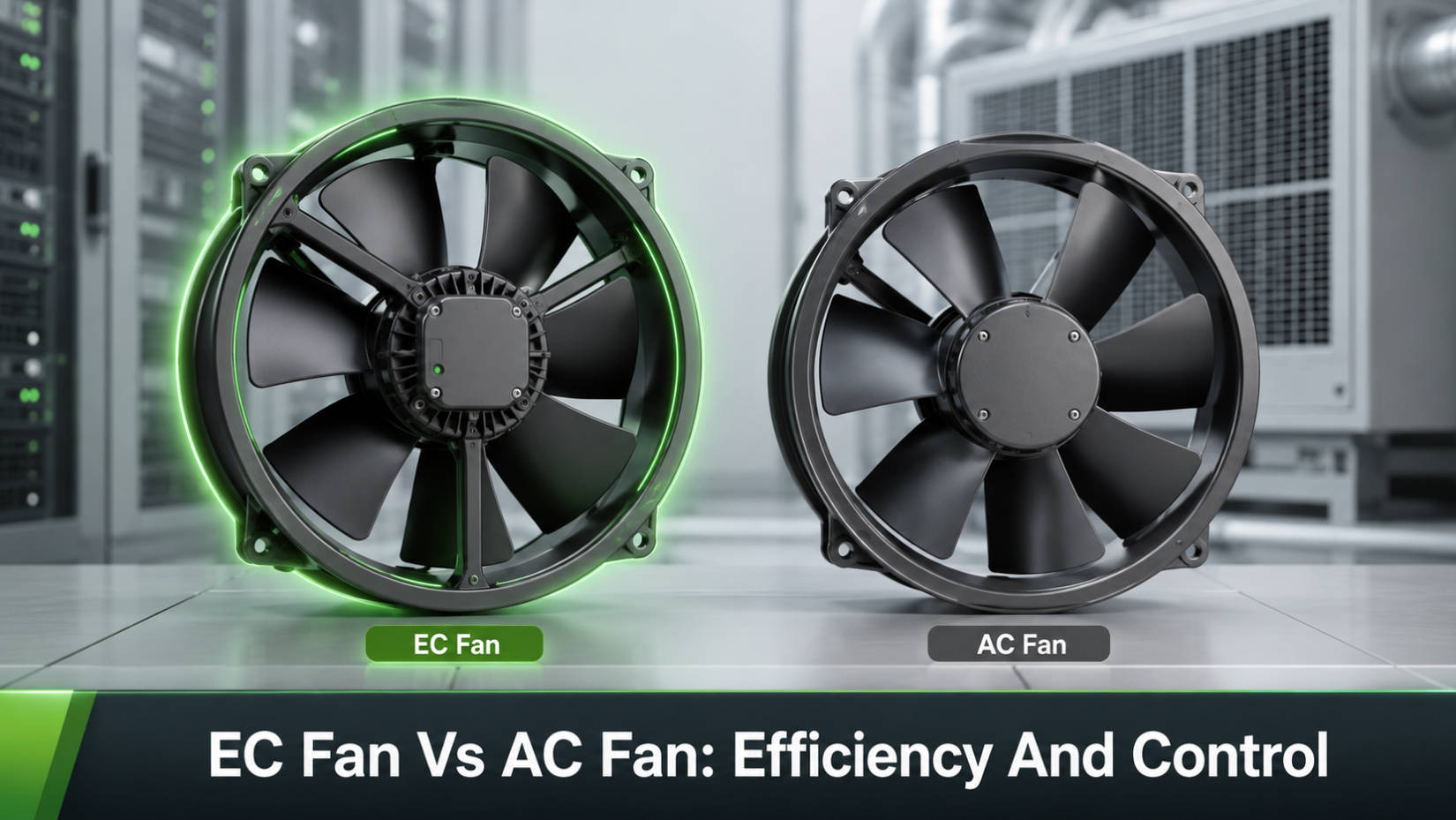
From a technical buyer's perspective, the most useful way to understand EC fans is to compare them directly with AC and DC fans.
| Feature | AC Fan | DC Fan | EC Fan |
|---|---|---|---|
| Motor type | Induction motor coolingfans | Brushless DC motor (BLDC) coolingfans | Brushless DC motor with integrated control PCB coolingfans |
| Power source | Runs directly on AC mains coolingfans | Requires DC supply coolingfans | Accepts AC, internally converted to DC coolingfans |
| Efficiency | Moderate; typically 30% less efficient than DC coolingfans | Very high efficiency coolingfans | Very high; often 80–90% overall coolingfans |
| Speed control | Usually fixed; needs external VFD for variable speed coolingfans | Precise, variable speed control coolingfans | Integrated variable speed control coolingfans |
| Noise level | Higher due to motor design and power draw coolingfans | Low noise coolingfans | Low noise, similar to DC fans coolingfans |
| Maintenance | Regular maintenance in many designs coolingfans | Low maintenance (brushless) coolingfans | Low maintenance, long service life coolingfans |
| Initial cost | Lowest coolingfans | Moderate coolingfans | Highest upfront coolingfans |
| Lifecycle cost | Higher due to energy use and maintenance coolingfans | Lower than AC coolingfans | Lowest for variable‑speed, high‑duty systems coolingfans |
For OEMs and system integrators, EC fans are usually the best choice when you need high efficiency, quiet operation, and flexible speed control in a single, compact component. [coolingfans]
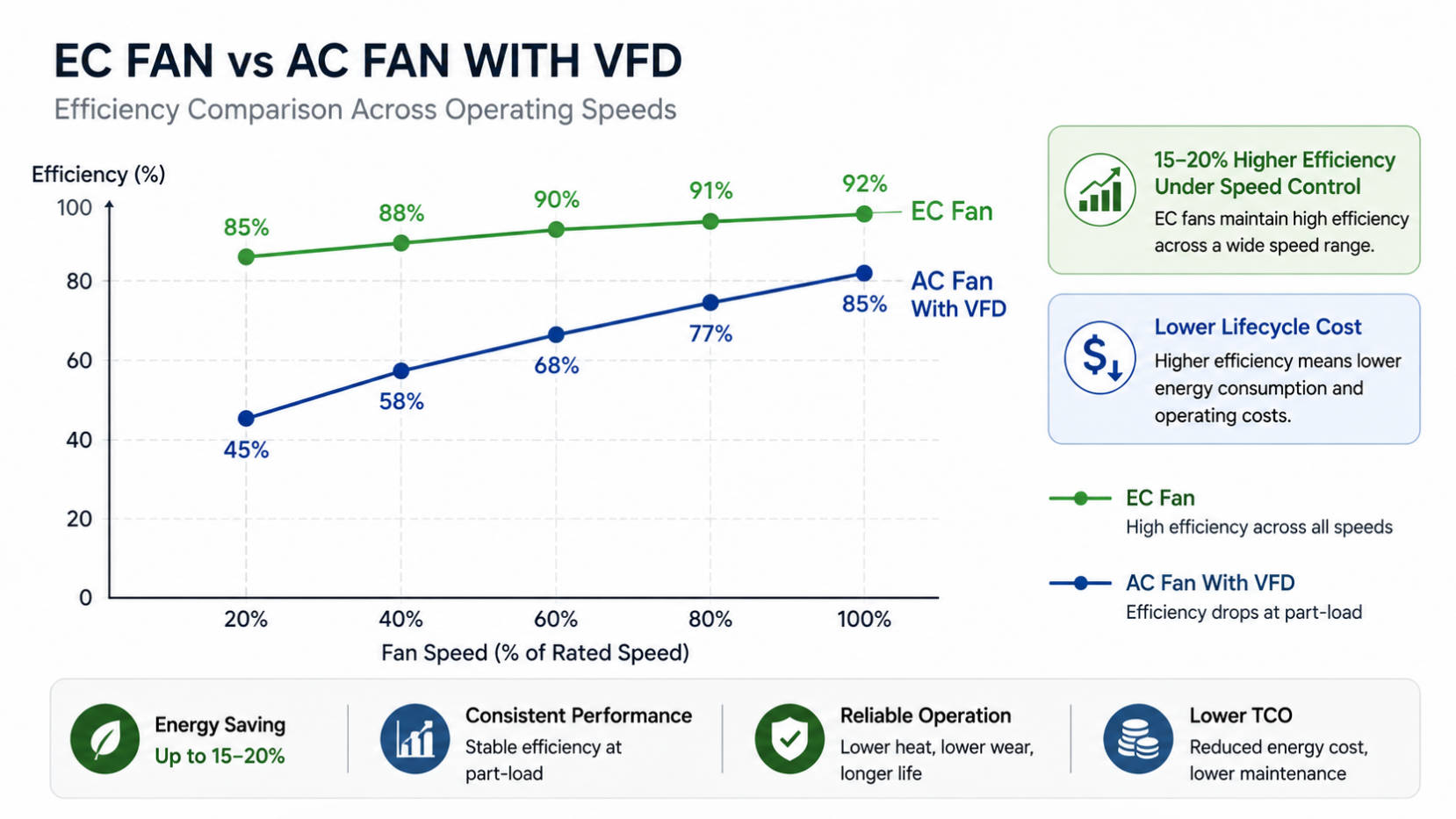
EC motors are designed to keep efficiency high across a wide speed range, which is exactly how most HVAC and electronics cooling systems operate in practice—rarely at 100% speed all the time. According to comparative tests aligned with minimum energy performance standards, EC motors can be 15–20% more efficient than comparable AC motors driven by variable speed drives (VSDs), especially under speed control. [youtube]
In my own projects, the biggest energy gains came from two factors:
- Built‑in variable speed control: By reducing fan speed by about 20%, you can achieve roughly 50% power savings, while still maintaining safe operating temperatures in many cabinets. [youtube]
- Consistently high efficiency at part load: Traditional AC+VFD combinations often suffer efficiency drop‑off at 50% speed, whereas EC fans stay at high efficiency across the whole speed range. [aflmotor]
Manufacturers and facility owners typically see:
- Up to 70% lower energy consumption compared with traditional AC fans in comparable duty cycles, based on industry guidance and typical fan efficiency ranges. [quickcreator]
- Noticeable reductions in overall HVAC power draw, since fans can account for 40–50% of energy consumption in air‑handling units and some building systems. [youtube]
For B2B buyers focused on ESG targets and operating cost reduction, these gains make EC fans a straightforward upgrade path. [nexoradesign]
Because EC fans use brushless DC motors, there are no brushes to wear out, and the integrated electronics handle commutation cleanly and predictably. This design significantly reduces mechanical wear and common failure modes associated with traditional AC motors under variable loads. [coolingfans]
From a maintenance perspective, EC fans typically offer:
- Longer service life, especially in continuous‑operation environments like base stations, servers, and industrial controllers. [quickcreator]
- Lower maintenance frequency, reducing the need for regular mechanical inspections, replacements, and recalibration. [aflmotor]
For Capital Technology's OEM customers, this often translates directly into lower lifetime cost of ownership and fewer unplanned outages in critical communication and networking equipment.
One of the most valuable advantages of EC fans is precise, software‑friendly speed control. The integrated electronics allow the fan to respond to control signals and feedback from temperature sensors or building management systems without needing a separate VFD. [coolingfans]
This offers several practical benefits:
- Fine‑grained airflow tuning to match real‑time thermal loads, rather than oversizing for worst‑case scenarios. [quickcreator]
- Smooth ramp‑up and ramp‑down, which reduces mechanical stress and acoustic spikes compared with abrupt AC fan starts. [aflmotor]
- Easier integration into smart cooling strategies, including zone‑based control and demand‑response scenarios in modern HVAC and telecom infrastructure. [nexoradesign]
In server or communication equipment cooling, precise EC control helps maintain tight temperature envelopes around CPUs, radios, and power supplies, improving overall system reliability. [quickcreator]
The brushless design of EC fans and their ability to run efficiently at lower speeds means they can deliver required airflow with significantly less noise than many traditional AC fans. In practice, this matters in several ways: [coolingfans]
- Quieter base stations and communication shelters, improving conditions for maintenance teams who work around active equipment. [aflmotor]
- Lower noise in data centers and industrial control rooms, where acoustic comfort is increasingly part of facility design standards. [youtube]
By designing systems to use EC fans with integrated speed control, you can often meet both thermal and acoustic requirements without resorting to complex mechanical damping or enclosure redesigns.
Modern cooling strategies are not just about keeping devices within temperature limits—they're increasingly tied to carbon reduction goals, RoHS compliance, and global safety standards. [nexoradesign]
EC fans help on several fronts:
- Lower energy consumption directly reduces CO₂ emissions associated with electricity use, whether in telecom networks or industrial plants. [nexoradesign]
- Many high‑quality EC fans are RoHS compliant and designed to meet UL, CE, and TUV requirements, easing global deployment and certification workflows. [quickcreator]
- Higher efficiency supports ESG frameworks and building certifications that prioritize energy‑efficient components within HVAC and electronic systems. [nexoradesign]
For global brands like ZTE, HUAWEI, and HYTERA, aligning component choices—like EC fans—with international standards simplifies export, site acceptance testing, and long‑term sustainability reporting.
In HVAC and ventilation, EC plug fans and EC fan arrays are now widely used to replace or augment traditional AC fans. They are particularly effective in: [youtube]
- Variable‑air‑volume (VAV) systems, where demand fluctuates throughout the day and across zones. [nexoradesign]
- Retrofits aimed at reducing fan energy consumption, often achieving double‑digit percentage savings with relatively simple mechanical changes. [youtube]
By pairing EC fans with intelligent control, facility owners can cut operating costs while improving comfort and reducing noise.
In industrial environments, EC fans support precise cooling of process equipment, electrical cabinets, and power electronics. Here, benefits include: [aflmotor]
- Stable airflow even under harsh conditions such as varying ambient temperatures and dust. [aflmotor]
- Easier integration with industrial control systems via standard control signals and protocols. [nexoradesign]
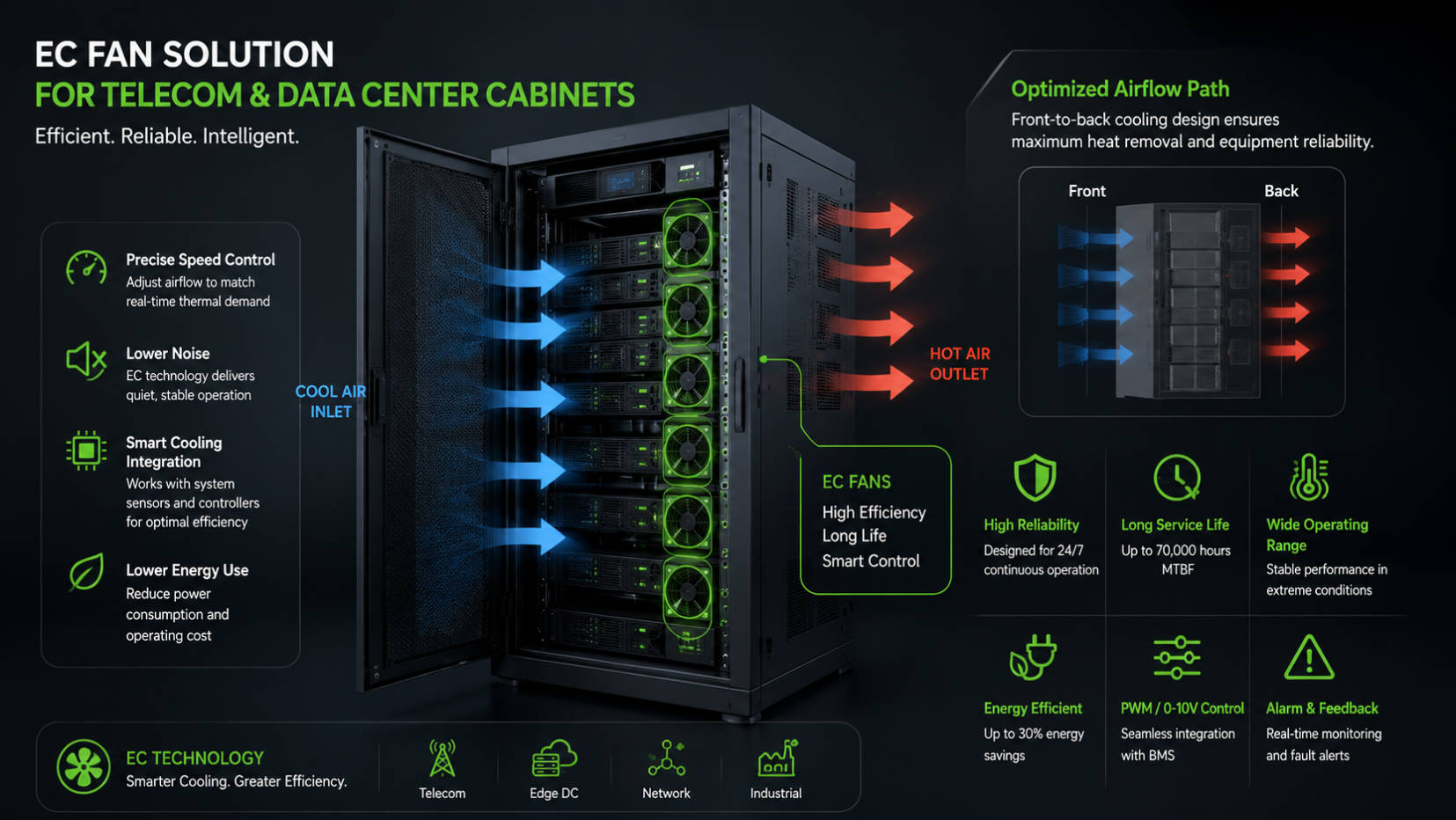
For telecom and IT equipment, EC fans are increasingly the default choice in high‑density racks and radio cabinets. They offer:
- Targeted cooling for hot spots with dynamic speed control. [quickcreator]
- Lower noise and power draw, helping operators meet network energy efficiency targets. [nexoradesign]
Capital Technology's DC and EC fan solutions, combined with SANYO DENKI's engineering heritage, are deployed across OEM platforms for ZTE, HUAWEI, HYTERA, and other global brands, underscoring their reliability in demanding real‑world environments. [quickcreator]
As an original manufacturer and solution provider focusing on DC and AC/EC fans, Capital Technology (CAPITAL) offers:
- Customizable EC fan designs tailored to your airflow, pressure, and form‑factor requirements. [quickcreator]
- Products that are RoHS compliant and designed to meet UL, CE, and TUV standards, simplifying global certification. [quickcreator]
- A portfolio that includes our own CAPITAL brand as well as our role as chief agent for SANYO DENKI (山洋电气), giving buyers access to proven Japanese engineering and global support networks. [aflmotor]
By combining local manufacturing agility with internationally recognized fan technologies, we help OEMs design cooling solutions that are both technically robust and commercially competitive.

If you are evaluating fan options for a new system or retrofit, a simple decision process can help:
1. Define your primary constraint: energy efficiency, noise, cost, or control flexibility. [coolingfans]
2. Map operating profiles: continuous duty, variable load, peak vs off‑peak usage. [nexoradesign]
3. Check standards and compliance needs: regional safety marks, RoHS, and internal ESG targets. [aflmotor]
4. Assess integration complexity: available power supplies, control interfaces, and BMS connectivity. [nexoradesign]
5. Compare lifecycle cost, not just initial purchase price, including energy and maintenance over the expected service life. [coolingfans]
In my experience, when you run this exercise objectively, EC fans win most scenarios that involve variable speed, long operating hours, and any form of energy‑efficiency or ESG requirement. AC fans still make sense in low‑duty, cost‑sensitive applications, while pure DC fans remain important in tightly controlled DC environments such as some telecom and renewable energy systems. [coolingfans]
If you are planning a new cabinet, base station, HVAC upgrade, or industrial controller, now is the right time to factor EC fans into your design baseline. By partnering with an experienced manufacturer and SANYO DENKI's chief agent, you can align cooling performance, energy efficiency, and regulatory compliance from day one. [quickcreator]
To explore DC and EC fan options for your project—or to benchmark an existing AC‑based design—reach out to Capital Technology Co., Limited (CAPITAL) for customized fan selection, technical support, and OEM/ODM collaboration. Our engineering team can help you model airflow, noise, and energy consumption so you can make a confident, data‑driven choice.
EC fans are not always the automatic choice, but they are usually superior in applications that need variable speed, long operating hours, and strong energy‑efficiency performance. For simple, low‑duty systems with a fixed airflow requirement and tight upfront budget constraints, traditional AC fans can still be a reasonable option. [youtube]
Real‑world savings depend on your operating profile, but many projects see double‑digit percentage reductions in fan energy use, with EC motors often delivering 15–20% higher efficiency versus AC motors with VFDs and even larger gains at part load. When combined with smart speed control strategies, EC‑based systems can significantly cut HVAC and equipment cooling bills. [youtube]
EC fans include integrated electronics for commutation and speed control, so they do not require external VFDs or complex motor controllers. However, to fully leverage their capabilities, they should be connected to appropriate control signals or BMS interfaces, allowing dynamic speed adjustment based on temperature or system demand. [coolingfans]
For global deployments, look for EC fans that are RoHS compliant and designed to meet UL, CE, and TUV standards, as these cover key safety and environmental requirements in major markets. Working with manufacturers and agents who understand these frameworks—such as Capital Technology and SANYO DENKI—helps ensure smoother site approvals and long‑term regulatory compliance. [aflmotor]
Capital Technology (CAPITAL) provides end‑to‑end support, from helping you choose the right DC or EC fan for your thermal profile to customizing mechanical and electrical specifications for OEM integration. As the chief agent of SANYO DENKI, we combine local manufacturing capabilities with globally proven fan technologies and can support projects for telecom, data center, industrial, and HVAC customers worldwide. [quickcreator]
1. ACDCFAN. "EC Fan Advantages in Air Cooling Systems." [https://www.acdcecfan.com/ec-fan-advantages/] [quickcreator]
2. CoolingFans.net. "Difference Between AC, DC, and EC Fans." [https://coolingfans.net/dc-ac-ec-fan-comparison/] [coolingfans]
3. AFL Motor. "What Are EC Fans? High‑Efficiency Electronically Commutated Fans." [https://www.aflmotor.com/article/ec-fan-efficiency-vs-ac-fan-complete-guide] [aflmotor]
4. Nexora Design. "EC Fans vs AC Fans in HVAC: Energy Savings, ROI & Real Project Data." [https://www.nexoradesign.net/post/ec-fans-vs-ac-fans-in-hvac-energy-savings-roi-real-project-data] [nexoradesign]
5. ebm‑papst A&NZ. "Fan Efficiency: EC vs AC fans with a VSD." [https://www.youtube.com/watch?v=XSFXA42O2D4] [youtube]
6. Google Search Central. "Creating Helpful, Reliable, People‑First Content." [https://developers.google.com/search/docs/fundamentals/creating-helpful-content] [developers.google]
7. CoolingFans.net and AFL Motor technical guides for comparative data on fan types and efficiencies. [coolingfans]


