From idea to market-ready product, our NPI solutions make every stage easier, faster. Discover How We Help
Help Center

Views: 276 Author: Capital Technology Publish Time: 2026-08-31 Origin: Site
Content Menu
● Why DC Fans Matter in Modern Equipment
● How Brushless DC Fan Technology Works
>> Free-Air Airflow Is Not the Whole Story
>> PWM Control Enables Demand-Based Cooling
>> Energy Efficiency Through Better Control
>> More Options for Compact Designs
● DC Fan Applications Across Industries
>> Telecom and Network Equipment
>> Industrial Automation and Control Cabinets
>> Power Electronics and Renewable Energy
>> Medical and Laboratory Equipment
● A Practical DC Fan Selection Process
>> 3. Determine Airflow and Static Pressure
>> 4. Choose the Right Control Method
>> 5. Confirm Reliability Requirements
● Common DC Fan Selection Mistakes
● Expert Perspective: Cooling Is a System, Not a Component
● FAQ
>> 1. What is the main benefit of a DC fan?
>> 2. Are all DC fans PWM controllable?
>> 3. How do I choose between high airflow and high static pressure?
>> 4. What is a tachometer signal on a DC fan?
>> 5. Can DC fans reduce equipment noise?
>> 6. Why is fan monitoring important in telecom equipment?
>> 7. Should I select a larger fan whenever possible?
Modern electronic equipment needs more than "enough airflow." It needs controlled, measurable, and application-specific cooling. For telecom cabinets, power supplies, industrial control panels, medical devices, servers, and energy systems, a properly selected DC fan can improve thermal stability, reduce unnecessary power consumption, simplify global product design, and support condition monitoring.
At Capital Technology Co., Limited, we work with engineers and equipment manufacturers that cannot treat cooling as an afterthought. As a thermal-management source manufacturer with the independent CAPITAL brand—and as a leading SANYO DENKI distributor—we support projects that require dependable DC fan solutions, including applications for established organizations such as ZTE, HUAWEI, and HYTERA. Our practical view is simple: a fan should be selected around the system's real heat load, airflow path, pressure requirement, control method, and reliability target—not only by its frame size or free-air CFM rating.
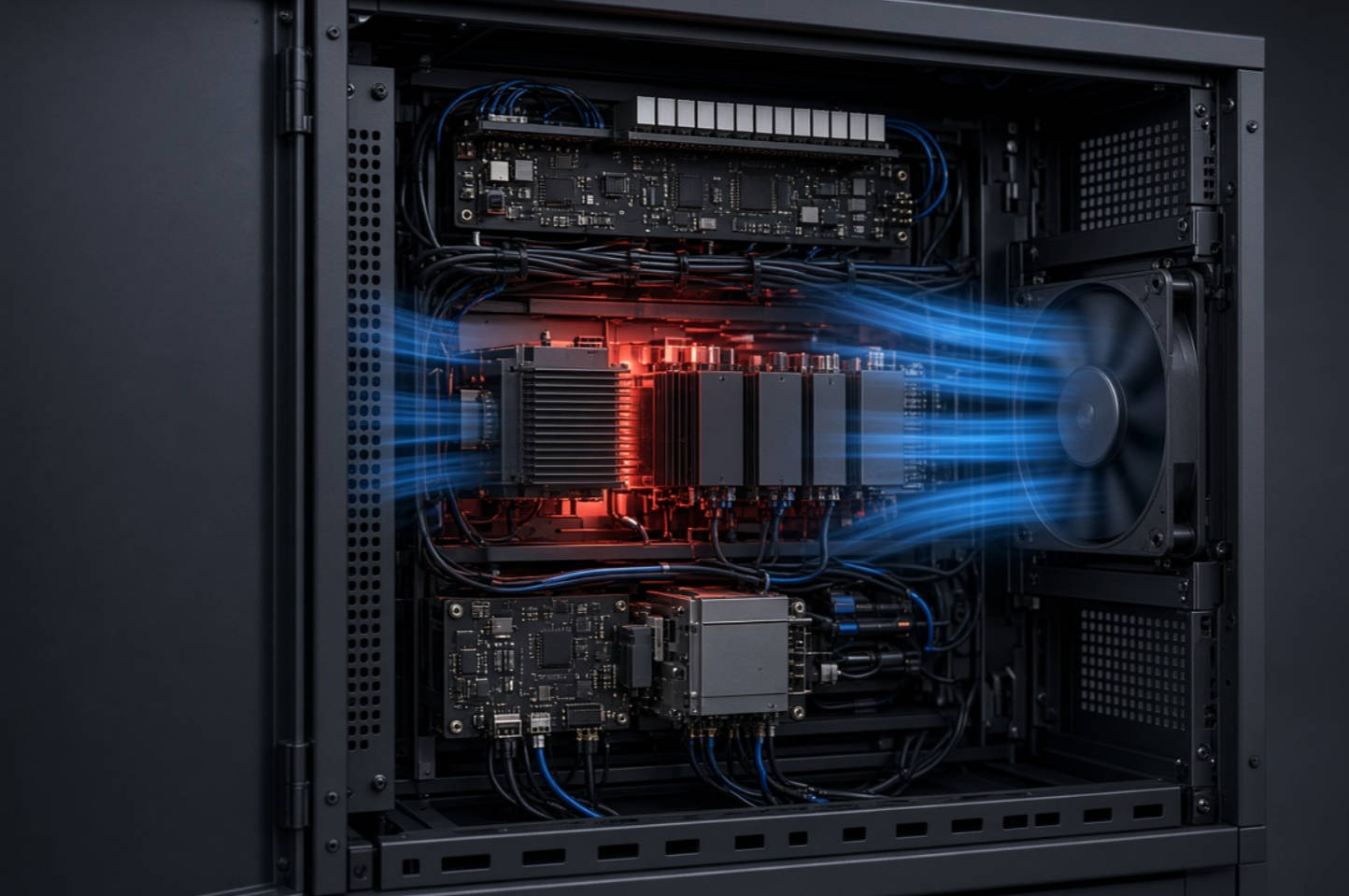
A DC fan is a compact air-moving device powered by direct current, commonly available in low-voltage formats such as 5 V, 12 V, 24 V, and 48 V. Most high-quality DC axial fans use electronically commutated, brushless motor technology. Instead of mechanical brushes, internal electronics switch the motor phases and maintain rotation.
This construction makes DC fans especially suitable for compact and intelligent equipment. They can be integrated into products where designers need stable cooling, flexible speed control, diagnostic signals, and compatibility with a regulated DC power rail.
The key advantage is not simply that a DC fan "uses less energy" than every possible alternative. Actual performance depends on the fan curve, operating point, control strategy, system impedance, and duty cycle. The more meaningful advantage is that a brushless DC fan can be precisely matched to changing thermal demand.
For example, a telecom power cabinet may operate at a light load overnight but reach much higher internal temperatures during peak network usage. A fixed-speed fan may run at maximum speed throughout both conditions. A DC fan with PWM speed control can instead respond to temperature signals and deliver only the airflow required at that moment.
That approach can help reduce:
- Fan energy consumption during low-load periods
- Acoustic noise in occupied or noise-sensitive environments
- Dust intake caused by excessive continuous airflow
- Wear associated with unnecessary high-speed operation
- Thermal stress caused by poor temperature control
For manufacturers selling equipment globally, DC fans can also simplify design. Products with internal AC-to-DC power supplies can use the same low-voltage fan architecture across regions, rather than relying on separate AC fan versions for different mains voltages and frequencies.
A brushless DC fan combines several elements into one compact cooling component:
- A fan frame and impeller that guide air through the equipment
- A brushless motor that converts electrical energy into rotation
- A driver circuit that electronically commutates the motor
- Bearings that support the rotor
- Optional signal and control functions for monitoring or speed adjustment
The electronic circuit detects the rotor position and energizes the motor coils in sequence. This eliminates the brush-and-commutator contact used in conventional brushed motors. Fewer wear-prone electrical contacts can contribute to stable operation and lower mechanical friction.
However, a reliable DC fan is not defined by motor architecture alone. Long-term performance is affected by bearing type, operating temperature, mounting orientation, airborne contamination, voltage quality, airflow obstruction, vibration, and the operating speed profile.
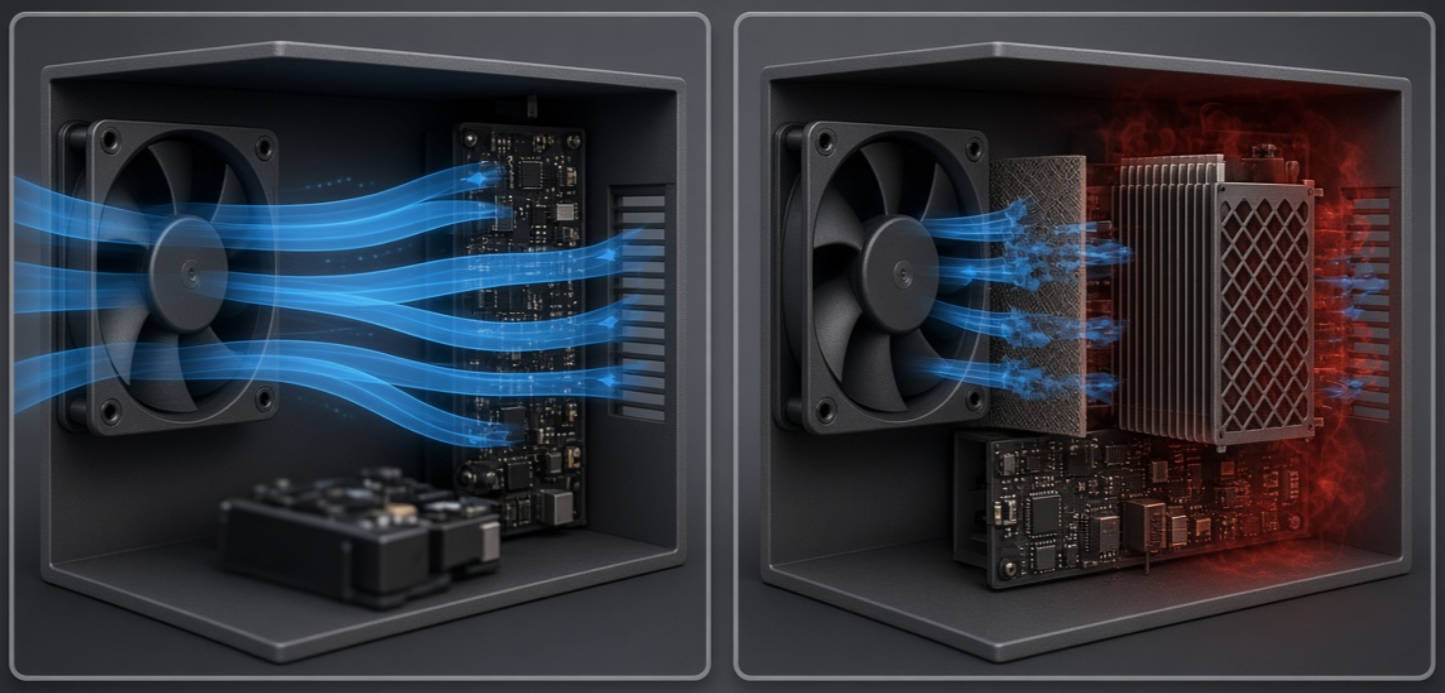
One of the most common fan-selection mistakes is choosing a fan only by its listed airflow value. A fan may deliver impressive airflow in free air, but real equipment contains resistance from grills, filters, heat sinks, circuit boards, cable bundles, louvers, ducts, and narrow passages.
The system operating point occurs where the fan performance curve intersects the system resistance curve. As airflow rises, pressure losses through the enclosure typically rise as well. Therefore, an application with dense components or a restrictive air path may need a fan with stronger static-pressure capability—not merely higher free-air CFM.
A practical rule is:
Select the fan based on required airflow at the expected system resistance, not on free-air airflow alone.
This distinction is especially important for:
- Telecom base-station cabinets
- Network switches and rack-mounted equipment
- Power converters and energy-storage systems
- Industrial enclosures with filters
- Compact medical and laboratory instruments
- Dense server, storage, and AI-computing hardware
PWM, or pulse-width modulation, is a common speed-control method for compatible DC fans. It allows the system controller to adjust fan speed according to temperature, workload, ambient conditions, or other parameters.
A typical strategy may look like this:
1. Run the fan at a low or moderate baseline speed when equipment temperature is normal.
2. Increase fan speed gradually when a monitored hot spot approaches a threshold.
3. Command full speed if temperature rises rapidly or redundancy is needed.
4. Trigger an alarm or controlled shutdown if cooling performance remains inadequate.
The result is a more intelligent thermal-management system. Instead of treating cooling as a fixed mechanical function, the equipment can use it as an active part of its protection and energy-management strategy.
Not every DC fan includes PWM as a standard function. Engineers should confirm the control interface, logic level, PWM frequency requirements, minimum duty-cycle behavior, startup characteristics, and fail-safe behavior before finalizing the design.

DC fans offer several benefits when they are properly matched to the application.
| Benefit | What It Means for Equipment Designers | Typical Application Value |
|---|---|---|
| Variable-speed control | Airflow can respond to real thermal demand | Lower noise and reduced energy use |
| Compact construction | High cooling capacity can fit into restricted spaces | Telecom, power electronics, compact enclosures |
| Low-voltage compatibility | Works directly with common internal DC power rails | Global equipment platforms |
| Diagnostic signals | Speed and fault information can be monitored | Predictive maintenance and remote alarms |
| Flexible airflow performance | Models can be optimized for airflow, pressure, noise, or size | Application-specific thermal design |
| Brushless motor design | Eliminates brushes that can wear in conventional motor systems | Stable long-term operation |
| Integration potential | Supports sensors, alarms, PWM, and smart control | Connected and mission-critical equipment |
Energy efficiency should be evaluated at the system level. The right question is not only, "How many watts does this fan consume?" It is also, "How much cooling does the application need over its real operating cycle?"
A fan that is oversized and continuously operated at full speed can waste energy, generate excess noise, and pull unnecessary contaminants into an enclosure. By contrast, a PWM-capable DC fan can be managed according to measured temperature and load.
For data-center and electronics cooling systems, industry guidance emphasizes matching airflow to actual IT demand rather than oversupplying airflow. Right-sizing airflow and controlling fan speed can support both energy performance and stable operating temperatures.
Equipment is becoming denser. Board-level components, processors, power semiconductors, batteries, and communication modules generate heat in increasingly confined volumes. This creates a difficult design balance: engineers need adequate airflow, but may have limited space for a larger fan or a more open internal channel.
DC fans are available in a wide range of frame sizes, thicknesses, voltage options, and airflow-pressure characteristics. That makes them useful for applications where a designer must choose between:
- A thin fan in a shallow enclosure
- A high-static-pressure fan for a restrictive airflow path
- A high-airflow fan for a more open chassis
- A reversible-flow fan for maintenance-oriented designs
- A low-noise fan for office, laboratory, or medical environments
The best option depends on the complete thermal design. Fan size alone does not determine performance.
For equipment that operates remotely or continuously, a fan failure may be more than a maintenance inconvenience. It can lead to temperature alarms, performance throttling, accelerated component aging, unexpected downtime, or protective shutdown.
Many DC fans can provide monitoring functions, including:
- Tachometer or pulse output for rotational-speed monitoring
- Locked-rotor alarm for detecting abnormal rotation conditions
- PWM input for external speed control
- Temperature-based control in selected designs
- Dual-fan redundancy for systems requiring continued operation after one fan fails
SANYO DENKI explains that its DC-fan pulse sensors output two pulse waves per revolution, enabling the system to detect fan speed. This type of feedback gives equipment designers a clear way to identify reduced fan speed, stalled rotation, wiring issues, or abnormal operating conditions.
DC fans are widely used because their electrical interface and control capabilities fit many modern systems.
Telecom cabinets, radio equipment, switches, routers, and power systems often operate continuously in changing ambient conditions. These systems may include dense circuit boards, power modules, battery backup components, or restricted ventilation paths.
A DC fan solution for telecom equipment should consider:
- Required airflow at real system resistance
- Ambient temperature range
- Dust exposure and filter condition
- Redundancy requirements
- Noise limits
- Remote monitoring requirements
- Voltage stability and surge environment
- Fan replacement accessibility
For suppliers working with telecom manufacturers, reliability documentation and traceability can be just as important as airflow performance.
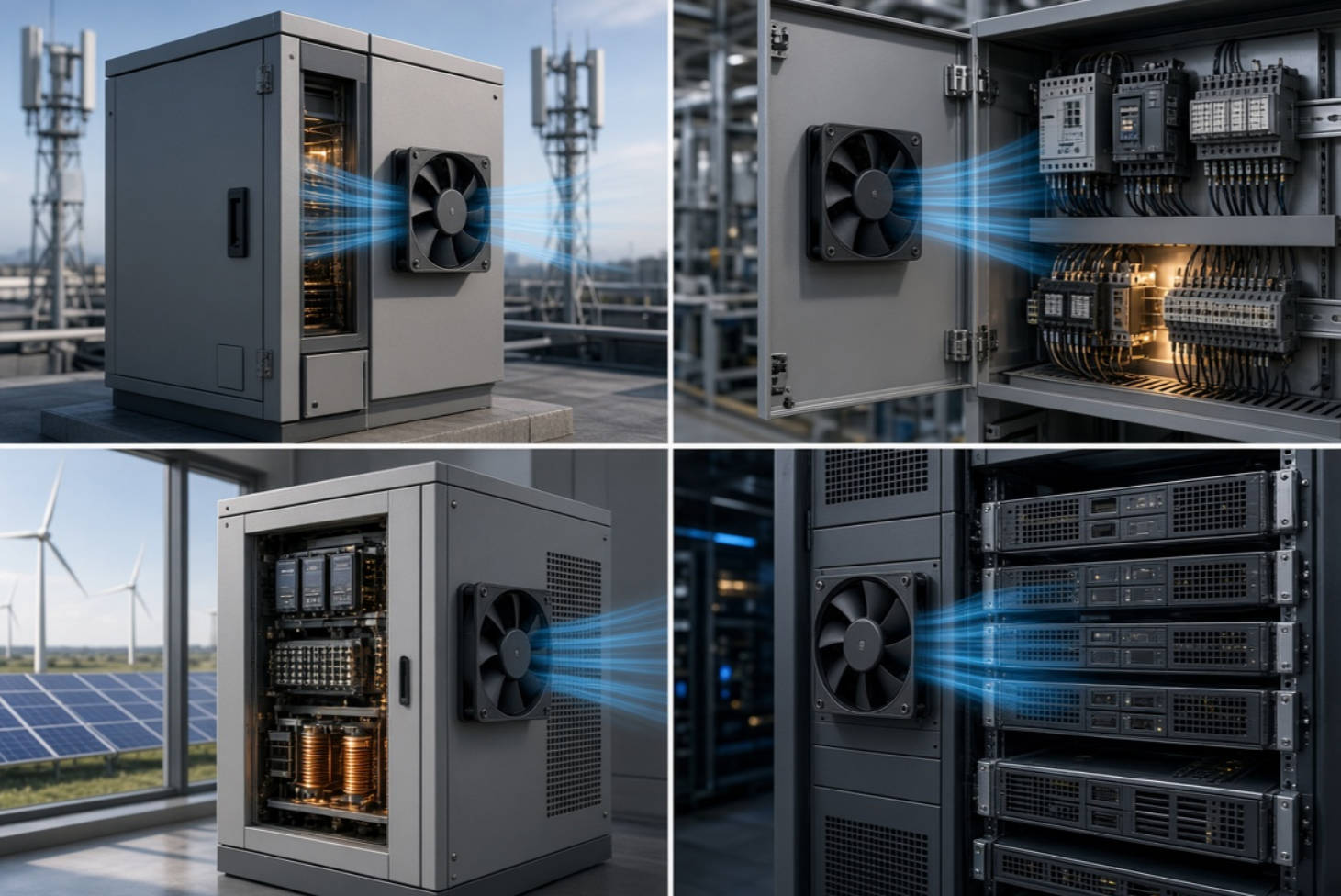
Industrial cabinets may house PLCs, variable-frequency drives, power supplies, motion controllers, sensors, and communication hardware. Heat build-up can reduce component reliability, especially when panels are installed in factories with high ambient temperatures, airborne particles, oil mist, or vibration.
A high-static-pressure DC fan may be more suitable than a high-free-airflow model if air must pass through filters, louvers, or closely arranged electrical components. Designers should also make sure that inlet and exhaust locations create a complete airflow path across heat-generating components rather than allowing air to short-circuit from inlet to outlet.
Inverters, converters, charging equipment, energy-storage systems, and power-distribution products can generate substantial heat in compact spaces. Cooling requirements may change with output load, solar production, charging cycles, or ambient temperature.
A controlled DC fan can help these systems maintain component temperatures without running at maximum speed under every operating condition. The fan should be selected with careful attention to static pressure, bearing life, high-temperature operation, and control-system compatibility.
Medical equipment can require stable airflow, controlled acoustic performance, compact dimensions, and dependable monitoring. Examples include diagnostic instruments, analyzers, imaging subsystems, laboratory power supplies, and patient-support equipment.
In these applications, designers should evaluate not only airflow and pressure, but also vibration, electromagnetic compatibility, cleaning requirements, noise, safety requirements, and product-specific regulatory obligations.
A disciplined selection process reduces redesign risk. Before requesting a fan recommendation or quotation, prepare the following application information.
Estimate the heat that must be removed from the enclosure. This includes heat generated by processors, power components, memory, batteries, displays, converters, and other internal devices.
When detailed thermal simulation is unavailable, engineers should still identify:
- Maximum and typical equipment power
- Expected ambient temperature range
- Target internal air temperature or component temperature
- Peak-load duration
- Safety margin for abnormal conditions
Review where air enters, where it exits, and what obstructs it. A fan cannot compensate indefinitely for a poorly designed airflow path.
Check for:
- Restrictive fan guards or louvers
- Dirty or undersized filters
- Dense heat-sink fins
- Cable bundles blocking flow
- Gaps that allow bypass airflow
- Components positioned outside the main airflow stream
- Recirculation of hot exhaust air back into the inlet
Do not specify only a CFM target. Define the expected system pressure resistance and select a fan whose curve meets the required operating point with appropriate margin.
For example, an 80 mm fan with high free-air airflow may underperform in a filtered cabinet if its pressure capability is insufficient. A different 80 mm fan with stronger static pressure may produce better real-world cooling even if its headline CFM specification is lower.
Select the control approach based on the product's actual operating needs.
| Control Option | Best Fit | Key Consideration |
|---|---|---|
| Fixed-speed DC fan | Stable thermal load and simple systems | Confirm worst-case cooling and acceptable noise |
| Voltage control | Basic speed adjustment | Verify starting voltage and operating range |
| PWM control | Dynamic thermal loads and intelligent equipment | Confirm signal specifications and fail-safe settings |
| Thermally controlled fan | Standalone temperature-responsive systems | Confirm sensor location and response behavior |
| Networked controller plus fan feedback | Remote or mission-critical systems | Plan alarm logic and maintenance workflow |
Ask how the fan will operate in the real environment. Fan life is not a single universal number. Temperature, bearing type, dust, humidity, vibration, speed, and mounting orientation can all influence service life.
For critical systems, include:
- Fan-speed monitoring
- Locked-rotor alarm capability
- Preventive-maintenance intervals
- Redundancy or N+1 fan architecture
- Spare-part planning
- Validation testing at maximum ambient temperature
Avoiding a few recurring mistakes can improve both product reliability and project efficiency.
- Selecting by free-air airflow only
- Ignoring pressure losses from filters, grills, and heat sinks
- Treating all 12 V or 24 V fans as interchangeable
- Using PWM control without confirming the fan's interface requirements
- Operating a fan constantly at maximum speed when variable control is available
- Placing temperature sensors away from the actual hot spot
- Allowing inlet-to-outlet airflow bypass inside the enclosure
- Overlooking acoustic requirements until late in development
- Choosing a fan without monitoring for equipment that must run unattended
- Failing to validate cooling performance after filters become partially loaded
From our experience supporting DC fan and thermal-management applications, the strongest designs begin with a system-level discussion. The fan must work with the enclosure, airflow path, heat sources, control logic, power supply, environmental conditions, and maintenance plan.
A high-performance fan cannot fully solve an enclosure with blocked exhausts, poor cable routing, recirculated hot air, or insufficient inlet area. Conversely, a carefully designed airflow path may allow an OEM to use lower fan speeds, reduce noise, and improve component temperature consistency.
For demanding projects, work with a supplier that can help evaluate more than a catalog number. Capital Technology can support thermal-management requirements with CAPITAL-branded DC fan solutions as well as SANYO DENKI fan products, helping customers evaluate airflow, static pressure, voltage, dimensions, signal options, and application-specific operating conditions.
Selecting the right DC fan can protect product reliability, improve user experience, and reduce costly redesigns. Whether you are developing telecom equipment, industrial controls, power electronics, medical equipment, or network hardware, start with the real thermal challenge—not only the fan size.
Contact Capital Technology Co., Limited to discuss your airflow requirement, operating voltage, installation space, static-pressure condition, temperature range, control method, and reliability target. Our team can help you identify an appropriate CAPITAL or SANYO DENKI DC fan solution for your application.
The main benefit is controllable, low-voltage cooling. DC fans can support compact product designs and, when compatible with PWM or other speed-control methods, can adjust airflow according to changing thermal demand.
No. Some DC fans are fixed-speed models, while others support PWM input, voltage control, temperature-based control, or monitoring signals. Always confirm the electrical interface and specifications for the exact model.
Choose based on your system resistance. Open enclosures usually benefit from airflow-focused fans, while restrictive paths containing filters, dense heat sinks, grills, or narrow channels often require a fan with higher static-pressure capability.
A tachometer, pulse, or speed signal provides feedback about fan rotation. The host system can use it to estimate RPM and identify abnormal conditions, such as reduced speed or a stopped fan.
Yes. A DC fan with proper speed control can operate at a lower speed when thermal demand is low. Lower fan speed often reduces acoustic noise, although final noise performance also depends on blade design, mounting, grills, enclosure resonance, and airflow turbulence.
Telecom equipment may operate continuously and in remote locations. Fan monitoring enables the system to detect reduced airflow or fan failure early, allowing maintenance teams to respond before overheating causes alarms, service degradation, or equipment shutdown.
Not always. A larger fan may provide useful airflow at lower speed, but space, pressure requirement, acoustic targets, voltage, mounting design, and system airflow path must all be considered. The correct selection is the fan that meets the required operating point efficiently and reliably.
1. Orion Fans. "Benefits of DC Fans." [Read the original article]
2. ASHRAE. "Energy and Thermal Efficiency: AI Data Center Energy Performance." [Read ASHRAE guidance]
3. SANYO DENKI. "Specifications for DC Fan Sensors." [Read the technical material]
4. SANYO DENKI. "San Ace 60HVA DC Fan Released." [Read the product announcement]
5. AMCA International. "Fan Efficiency Grade Application Guide and Testing Standards." [Explore AMCA certified product and standards resources]
6. Uptime Institute. "Implementing Data Center Cooling Best Practices." [Read the airflow-management guidance]
7. Strobic Air. "AMCA Compliance Guidelines and AMCA Standard 210 Overview." [Read the overview]


