From idea to market-ready product, our NPI solutions make every stage easier, faster. Discover How We Help
Help Center

Views: 222 Author: Astin Publish Time: 2026-04-26 Origin: Site
DC fans are the quiet backbone of modern electronics and communication systems, and after more than a decade in thermal management I have seen how choosing the right DC fan manufacturer directly decides whether a project is stable, scalable, and profitable. In this guide, I will walk you through how we design, test, and deliver DC cooling solutions at Capital Technology Co., Limited (CAPITAL) while also benchmarking against other leading DC fan manufacturers worldwide. [windmillstrategy]
From telecom base stations in the mountains to compact medical devices in crowded hospitals, DC fans are the "hidden" components that keep systems alive 24/7. As an engineer-turned-supplier working with brands like ZTE, HUAWEI, and HYTERA, I've learned that selecting a DC fan is not just about airflow—it is about lifecycle risk, certification, and long‑term service support.
In this article, you will learn:
- How leading DC fan manufacturers differ in technology, reliability, and markets.
- What evaluation checklist professional buyers use before approving a fan vendor. [windmillstrategy]
- How CAPITAL and SANYO DENKI support mission‑critical OEM projects with customized thermal solutions. [monsterinsights]

DC fans are now standard in almost every critical system that generates heat, from 5G base stations to data centers and medical imaging devices. They maintain safe operating temperatures, extend component lifetime, and reduce unexpected downtime that can cost enterprises thousands of dollars per hour. [windmillstrategy]
Key roles of DC fans in real projects:
- Electronics and servers – Cooling CPUs, GPUs, power modules, and densely packed boards in routers, switches, and base stations.
- Automotive and EV – Managing battery temperature, in‑vehicle infotainment cooling, and HVAC systems in harsh vibration and dust environments.
- Medical devices – Stabilizing temperature in ventilators, MRI equipment, and diagnostic devices where failure is unacceptable.
- Telecom and industrial equipment – Preventing overheating in outdoor cabinets, power inverters, and industrial controllers operating in wide temperature ranges.
| Industry | Typical DC Fan Applications |
|---|---|
| Electronics | Computers, servers, telecom base stations, network switches |
| Automotive/EV | Engine compartment cooling, battery packs, HVAC modules |
| Medical | MRI, ventilators, diagnostic analyzers |
| Data centers | Rack servers, storage arrays, power distribution units |
| Industrial/Telecom | Outdoor cabinets, inverters, base station RRUs |
Not all DC fans solve the same problem. As a thermal engineer, I typically start by matching the fan type to the heat profile and mechanical constraints of the equipment.
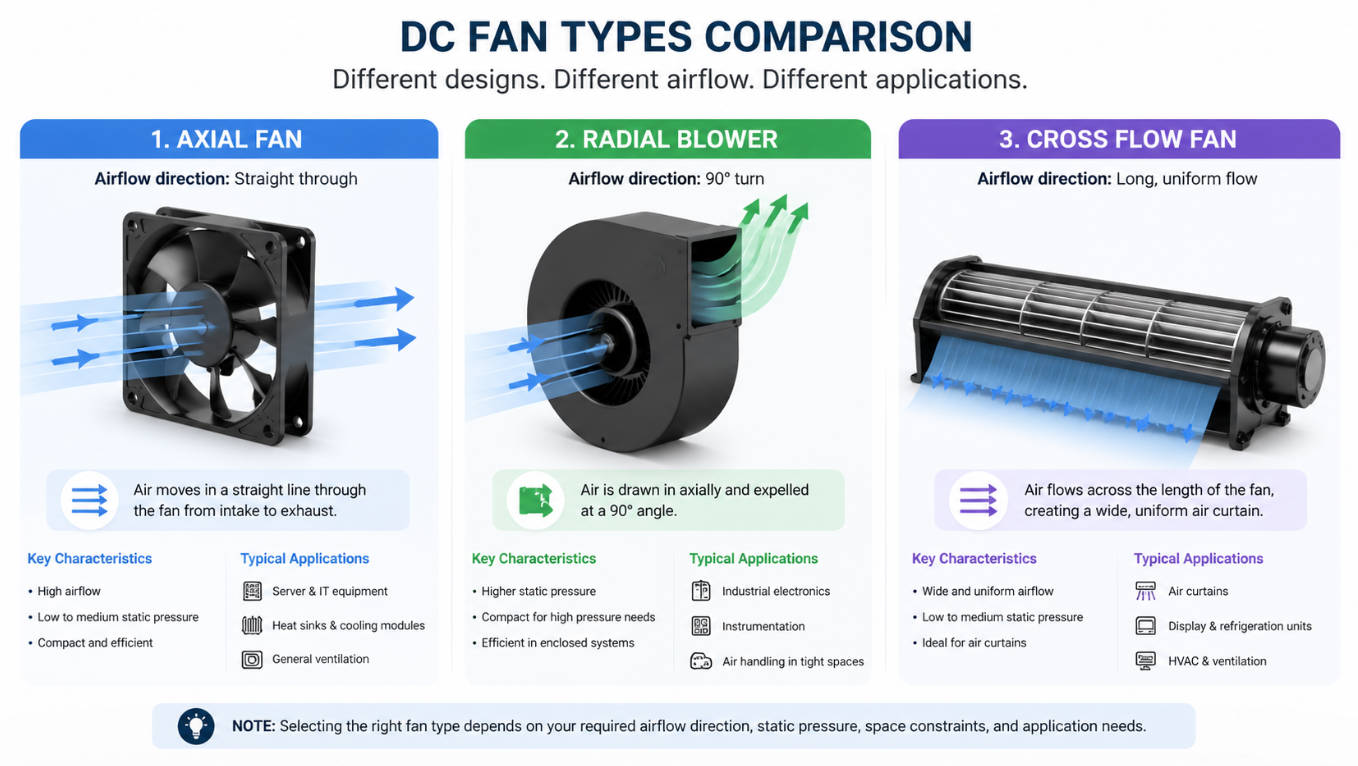
DC axial fans move air parallel to the shaft and are the most common choice when you need maximum airflow with moderate pressure in limited space. They are widely used in electronics, telecom, and general ventilation of enclosures.
Use DC axial fans when:
- You have a straight airflow path through a cabinet or chassis.
- Noise needs to be controlled but not ultra‑critical.
- You want a wide range of standard sizes (25 mm to 254 mm) for easy integration.
DC blowers generate higher static pressure and are ideal when the airflow meets obstacles such as dense heatsinks, filters, or long ducts. They are common in compact equipment such as projectors, small telecom boxes, or sealed enclosures.
Choose DC blowers if:
- Air must pass through restrictive heatsinks or filters.
- You need directional airflow with a 90‑degree outlet.
- Space is tight but cooling demand is high.
Cross‑flow fans (tangential fans) provide a long, uniform airflow ideal for cooling wide PCBs, displays, or air curtains. Centrifugal fans are a category of radial fans designed for high static pressure in HVAC and industrial ducts.
Select these fan types when:
- You must distribute air evenly over a wide surface.
- You design HVAC, industrial ventilation, or special air curtains.
Many buyers search for "top DC fan manufacturers" as a shortcut to reliability—but the reality is more nuanced. Below is an expert overview of global manufacturers frequently selected for high‑performance cooling projects, based on their product portfolios, certifications, and market focus. [windmillstrategy]
| Manufacturer | Key Strengths | Main Markets |
|---|---|---|
| ACDCFAN | Wide AC/DC fan range, industrial and telecom focus | Asia, Europe, America |
| Delta Group | Miniature high‑performance fans, consumer electronics | Europe, America |
| Nidec Corporation | Energy‑efficient designs, broad industrial portfolio | Europe, America |
| AVC (Asia Vital Components) | High‑performance fans, R&D heavy, ISO17025 lab | Asia, America, Europe |
| SANYO DENKI | Quiet, reliable San Ace fans, telecom and servers | Asia, America, Europe |
| Orion Fans | Customizable DC fans and blowers for industry | America, Europe |
| EVERCOOL | Advanced cooling systems, dust‑proof options | America, Europe |
| CUI Devices | Wide CFM range, waterproof IP68 models | America, Europe |
| Oriental Motor | High‑grade cooling fans with variable speed | America, Europe |
From the perspective of an OEM buyer, having a single thermal partner that can both design custom fans and provide access to global brands is extremely valuable. CAPITAL fills exactly this role in the DC fan supply chain. [made-in-china]
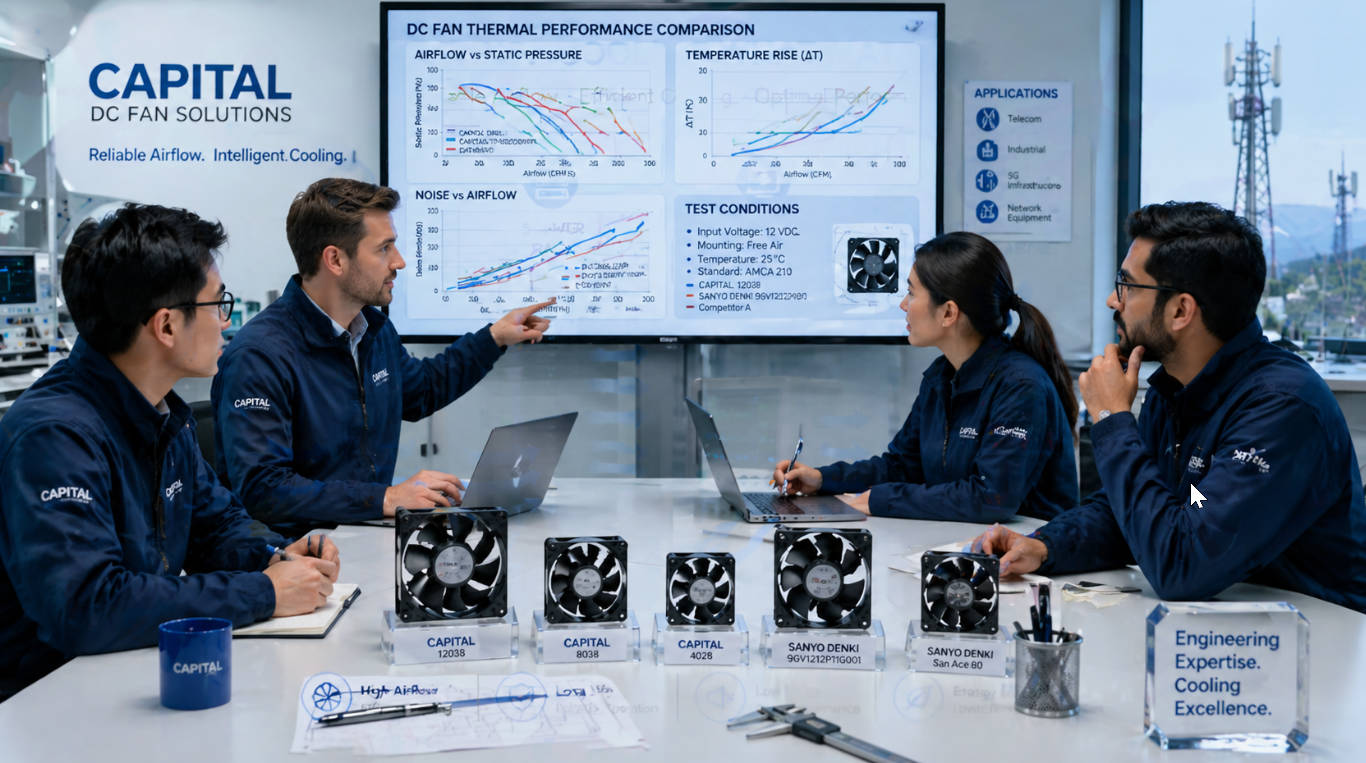
Capital Technology Co., Limited (CAPITAL) is a specialized DC fan and thermal solutions manufacturer with its own brand CAPITAL, and we also serve as a leading distributor and key partner of SANYO DENKI (San Ace) in China. Over the years, we have become an approved supplier for ZTE, HUAWEI, HYTERA and other well‑known communication and electronics companies, which has shaped our design standards and quality control culture. [made-in-china]
From my experience supporting telecom and industrial projects, three aspects of CAPITAL are especially important for buyers:
- Dual capability – in‑house DC fan design and manufacturing plus access to SANYO DENKI's San Ace product lines. [monsterinsights]
- Project‑driven engineering – we start from the customer's thermal problem, not from existing catalog items.
- Long‑term lifecycle support – stable supply and consistent models critical for long‑lived telecom and industrial equipment.
SANYO DENKI is known globally for quiet, reliable DC fans that combine high airflow, high static pressure, and low vibration. The San Ace series is widely used in telecom, servers, and other mission‑critical systems where downtime has a direct financial impact. [monsterinsights]
As a key distributor, CAPITAL helps OEMs:
- Select the right San Ace model based on airflow, pressure, and noise targets.
- Integrate fans mechanically and electrically into existing designs.
- Localize stocking, logistics, and after‑sales support in Asia and global markets. [made-in-china]
When we evaluate a DC fan for a customer, we never look at airflow alone. Below is the checklist our engineers use, which you can apply to any manufacturer. [wpduo]
- Airflow and static pressure – Must match heat load and system resistance under worst‑case conditions.
- Operating temperature range – For industrial and telecom products, we often target from around −30 °C to +70 °C or higher, depending on project needs.
- Expected lifetime (L10) – Many quality DC fans provide 30,000–70,000 hours or more, depending on bearing type and operating conditions. [monsterinsights]
For international deployment, compliance is non‑negotiable:
- Safety & environmental – RoHS, UL, CE, TUV compliance signals that the fan meets global safety and material standards. [monsterinsights]
- EMI/EMC performance – Brushless DC fans must minimize electromagnetic interference, especially in telecom and medical equipment.
- ISO systems – ISO 9001 and ISO 14001 certification show that the manufacturer has robust quality and environmental management systems.
Choosing the right bearing and motor design is critical for both lifetime and usability. [wpduo]
Common options include:
- Ball bearings – Longer life, better for high‑temperature or vertical mounting.
- Sleeve bearings – Quieter and lower cost for less demanding environments.
- Advanced systems – Some brands offer proprietary bearing systems (for example, omniCOOL‑type solutions) to balance noise and lifetime.
Professional buyers should also compare:
- Noise level (dBA) under typical operating points.
- Power consumption to reduce the load on power supplies, especially in large arrays or data centers. [monsterinsights]
In many customer projects, the question is not "Which fan?" but "Which manufacturer can I trust for the next 10–15 years of production?" Below is a practical process we use when auditing vendors for strategic partnerships. [wpduo]
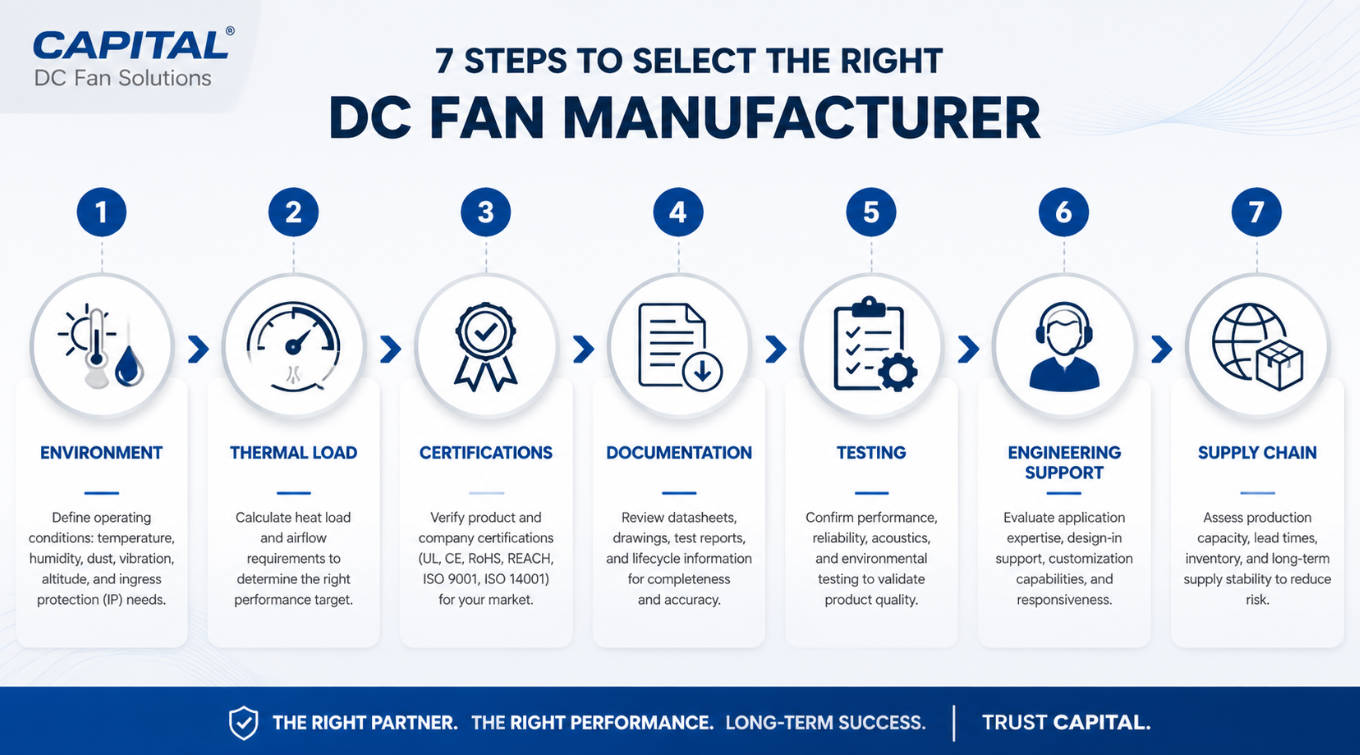
1. Define your operating environment
- Temperature range, humidity, dust, vibration, and altitude.
- Determine if you need waterproof or dust‑proof fans with IP67/IP68 ratings.
2. Quantify your thermal load
- Calculate heat dissipation (W) and allowable temperature rise.
- Use simulation or prototypes to estimate required airflow and pressure.
3. Shortlist manufacturers with relevant certifications
- Filter suppliers that can show RoHS, UL, CE, TUV, ISO 9001, ISO 14001, and relevant test reports. [monsterinsights]
4. Request detailed technical documentation
- Curves for airflow vs pressure, noise vs speed, lifetime vs temperature.
- Mechanical drawings, connector options, wiring diagrams.
5. Run in‑house tests on samples
- Test multiple units per model under realistic load conditions. [wpduo]
- Monitor temperature, noise, vibration, and failure modes over extended time.
6. Assess engineering and customization support
- Can the vendor support custom voltages, speeds, housings, or control signals (PWM, tach)?
- Is there an application engineer who can co‑design with your team?
7. Review supply chain stability and after‑sales service
- Check lead times, minimum order quantity (MOQ), and buffer stock options.
- Evaluate responsiveness to RMA, field failures, and design changes.
This process may take longer upfront but usually saves substantial cost and risk over the lifecycle of a product line. [windmillstrategy]
In outdoor telecom, EV charging, and industrial automation, conventional fans can fail quickly due to dust and moisture. That is why we increasingly design and supply waterproof and dust‑proof DC fans with enhanced protection.
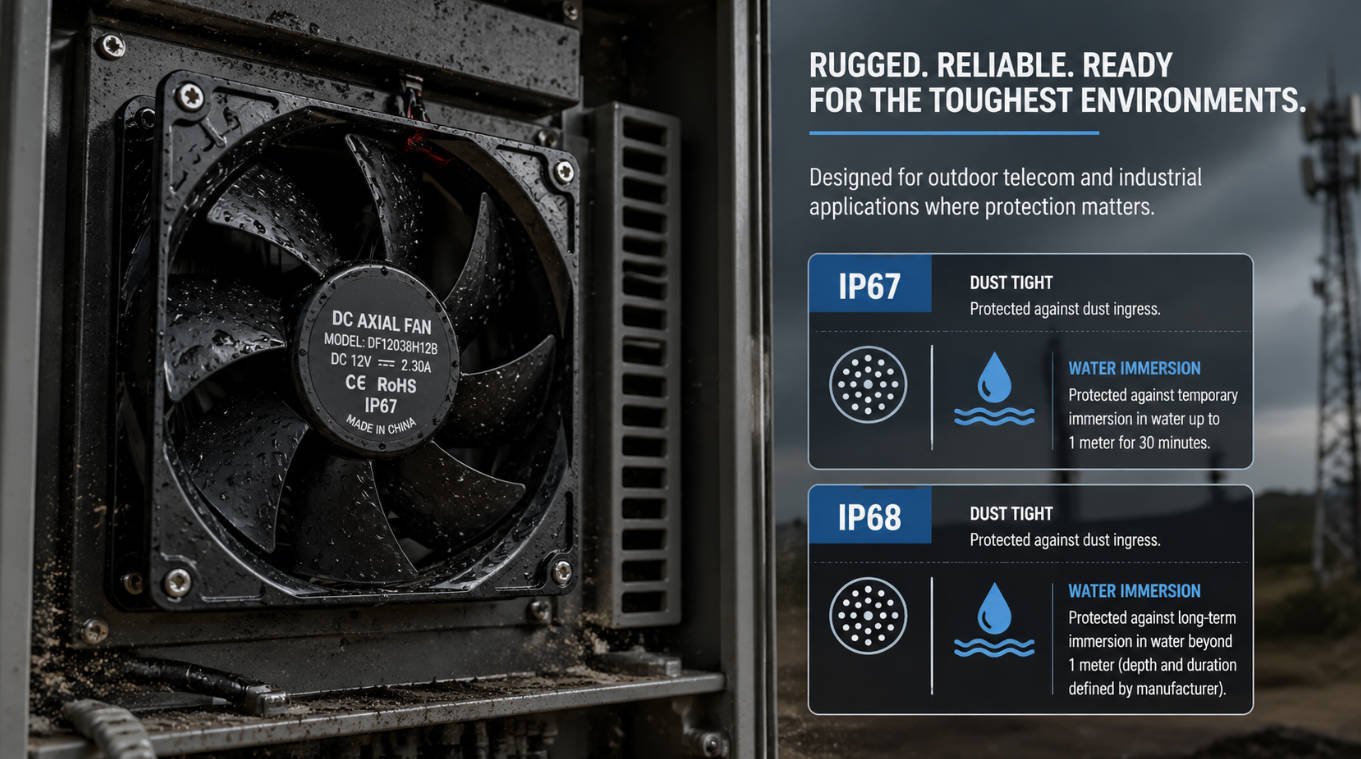
Key aspects to consider:
- IP Ratings – IP67 and IP68 indicate strong protection against dust and water ingress.
- Salt fog testing – Essential for coastal or marine applications to verify corrosion resistance.
- Protective coatings and materials – Specialized coatings on PCBs and housings extend life in corrosive or polluted environments.
Typical use cases include outdoor base stations, industrial control panels, LED street lighting power supplies, and marine electronics. In these scenarios, choosing the right protection level can double or triple the effective service life of the fan.
Technical audiences are busy; they reward clarity and penalize vague marketing language. Based on both UX best practices and feedback from our OEM customers, an effective DC fan product or category page should: [wpduo]
- Use short paragraphs and clear headings to make scanning easy.
- Highlight critical specs (size, voltage, airflow, noise, IP rating) near the top of the page. [monsterinsights]
- Provide downloadable datasheets, 3D models, and test reports in one visible area. [windmillstrategy]
- Include comparison tables so engineers can quickly identify the correct model. [wpduo]
Example of a user‑friendly spec snapshot:
| Parameter | Typical Range/Option |
|---|---|
| Frame sizes | 25–254 mm for DC axial fans |
| Voltage options | 5 V, 12 V, 24 V, 48 V |
| Lifetime (L10) | 30,000–70,000 hours depending on bearing |
| Operating temp | Around −30 °C to +70 °C or higher |
| Certifications | RoHS, UL, CE, TUV, ISO 9001, ISO 14001 |
From my experience working on projects for telecom, power, and industrial customers, CAPITAL is a strong fit when:
- You need customized DC fan solutions rather than only catalog parts. [made-in-china]
- Your equipment targets telecom, data communication, industrial control, or security applications with demanding reliability requirements. [made-in-china]
- You want to combine CAPITAL‑brand fans with SANYO DENKI San Ace products under one coordinated supply and engineering support team. [monsterinsights]
We support you through the entire lifecycle:
1. Early thermal feasibility and model selection.
2. Prototype fans and iterations based on test data.
3. Pre‑production verification and reliability testing.
4. Mass production, logistics, and long‑term after‑sales service.
If you are planning a new product or reviewing your current thermal design, this is the best time to involve a DC fan manufacturer early in the process. Early collaboration reduces redesign risk, improves thermal safety margins, and often lowers total cost of ownership. [venveo]
Get in touch with CAPITAL today to:
- Share your thermal requirements and constraints.
- Request tailored DC fan proposals from CAPITAL and SANYO DENKI.
- Arrange engineering support, samples, and a quick feasibility review.
Our engineering and sales teams are ready to work with you on building quieter, cooler, and more reliable systems.
A reliable DC fan manufacturer should typically provide RoHS, UL, CE, and TUV certifications, along with ISO 9001 and ISO 14001 for quality and environmental management. These certifications show that the products meet international safety, material, and process standards and are suitable for global deployment. [wpduo]
The lifetime of a high‑quality DC fan depends on bearing type, temperature, and operating speed, but many industrial‑grade fans specify lifetimes in the range of roughly 30,000–70,000 hours or more under rated conditions. Ball‑bearing designs and advanced bearing systems usually provide longer life, especially in higher temperature or continuous operation environments. [wpduo]
You should consider waterproof or dust‑proof DC fans when your equipment operates outdoors, in dusty factories, or near marine/coastal environments. Fans with IP67 or IP68 ratings, combined with corrosion‑resistant materials and coatings, are designed to maintain cooling performance and reliability in these harsh conditions.
DC axial fans move air parallel to the shaft and are ideal when you need high airflow with relatively low static pressure, such as ventilating enclosures. DC blowers (radial fans) generate higher static pressure and are better for pushing air through restrictive paths like dense heatsinks, filters, or ducts.
Engaging a DC fan manufacturer early allows you to correctly size the fan, select the right type, and validate the thermal design before finalizing mechanical and electronic layouts. This reduces redesign cycles, helps avoid late‑stage overheating problems, and often leads to a more energy‑efficient and cost‑effective solution. [venveo]
1. ACDCFAN – "Top 10 DC Fan Manufacturers for Efficient Cooling Solutions."
<https://www.acdcecfan.com/dc-fan-manufacturer/>
2. MonsterInsights – "How to Optimize for E‑E‑A‑T (Proven Strategies That Work)."
<https://www.monsterinsights.com/how-to-optimize-for-e-e-a-t/>
3. Windmill Strategy – "SEO for Industrial Companies: An SEO/Content Creation Guide."
<https://www.windmillstrategy.com/seo-for-industrial-companies-comprehensive-guide/>
4. HubSpot – "Is Your Website EEAT‑compliant? What Developers Should Keep In Mind."
<https://blog.hubspot.com/website/eeat-compliance>
5. Innovation Visual – "Google's EEAT Guidelines – How To Remain Compliant."
<https://www.innovationvisual.com/knowledge-hub/resources/google-eeat-guidelines-how-to-remain-compliant>
6. wpDuo – "6 SEO Tips for Manufacturers | Industrial SEO."
<https://wpduo.com/blog/seo-for-industrial-manufacturers/>
7. Sixth City Marketing – "Manufacturing SEO Strategies That Work (Plus What to Avoid)."
<https://www.sixthcitymarketing.com/2026/02/24/manufacturing-seo-strategies/>
8. Capital Technology Co., Ltd profile – Made‑in‑China.
<https://www.made-in-china.com/showroom/szcptqin/>
9. Marketing Essentials – "SEO for Industrial Manufacturing – 10 Tips to Outrank the Competition."
<https://mktgessentials.com/blog/seo-for-industrial-manufacturing-10-tips-to-outrank-the-competition>


