From idea to market-ready product, our NPI solutions make every stage easier, faster. Discover How We Help
Help Center

Views: 265 Author: Capital Technology Publish Time: 2026-10-05 Origin: Site
Content Menu
● What Does DC Fan Lifespan Mean?
● L10 Life vs. MTBF: Do Not Treat Them as the Same
● Why Ball Bearings Matter in Long-Life DC Fans
>> Ball Bearing Fans for Demanding Applications
>> Grease Life Often Determines Fan Life
● Ambient Temperature Is a Major DC Fan Life Driver
>> How to Reduce the Fan's Local Temperature
● Airflow and Static Pressure Affect Fan Reliability Indirectly
>> A Practical DC Fan Selection Method
● Common DC Fan Selection Mistakes
>> Ignoring Temperature Conditions Behind the Life Rating
>> Treating MTBF as a Guaranteed Individual Fan Lifetime
>> Neglecting Dust and Filter Maintenance
>> Overlooking Fan Orientation and Vibration
>> Using an Undersized Fan at Maximum Stress
● Expert Checklist for Long-Life DC Fan Projects
● When to Choose a Long-Life SANYO DENKI or CAPITAL DC Fan
● Build Cooling Reliability Into the Design
● FAQ
>> 1. What is L10 life for a DC fan?
>> 2. Is MTBF the same as the lifespan of a DC cooling fan?
>> 3. Why does high temperature shorten DC fan life?
>> 4. Are ball-bearing DC fans better than sleeve-bearing fans?
>> 5. How do I choose the right DC fan airflow?
>> 6. Can a dust filter reduce DC fan lifespan?
>> 7. What information should I provide when requesting a DC fan recommendation?
For engineers designing telecom, networking, industrial, medical, and power equipment, DC fan lifespan is not a secondary specification. It directly affects system uptime, maintenance cost, thermal safety, warranty risk, and the real service life of the finished product.
A DC cooling fan may deliver the required airflow on day one, yet still become the weakest link in the equipment if its bearings, lubrication, operating temperature, or installation conditions are not properly considered. In our work supporting cooling-system projects, the most effective fan-selection process looks beyond maximum airflow and static pressure. It evaluates how long the fan can sustain its required rotational speed and cooling performance in the actual operating environment.
Capital Technology Co., Limited is a source manufacturer of DC fans and cooling solutions under the CAPITAL brand, and a leading authorized distributor of SANYO DENKI products. With experience serving demanding applications for customers such as ZTE, HUAWEI, and HYTERA, we see a consistent engineering reality: a long-life DC fan should be chosen according to its real thermal, mechanical, electrical, and maintenance conditions—not only a headline life rating.
This guide explains how DC fan life expectancy, L10 life, bearing design, ambient temperature, airflow resistance, and preventive maintenance work together. It also provides a practical selection framework for equipment designers and procurement teams.

DC fan lifespan refers to the expected period during which a fan can continue operating without an unacceptable reduction in cooling performance or increase in abnormal noise.
For a cooling fan, "still spinning" is not always the same as "still performing." A fan may remain electrically energized while its speed, airflow, acoustic behavior, or vibration condition has deteriorated enough to compromise the cooling system.
A practical fan-lifespan evaluation should consider:
- Rotational speed retention
- Airflow retention
- Bearing condition
- Lubricant condition
- Noise and vibration growth
- Operating temperature
- Voltage quality
- Dust, moisture, and corrosive contaminants
- System airflow resistance
- Continuous or intermittent duty cycle
SANYO DENKI defines fan life in relation to rotational-speed degradation. In its published guidance, the fan life endpoint is reached when rotational speed declines to 70% of the initial speed. This definition is important because a major reduction in rotational speed can substantially reduce airflow and weaken the cooling margin designed into the equipment.
For system designers, the key question is therefore not simply, "How many hours can this fan run?" It is:
"How many hours can this fan provide sufficient cooling performance under the real operating conditions of my equipment?"
Two reliability terms often appear in DC fan and electronics specifications: L10 life and MTBF. They are both useful, but they answer different questions.
| Reliability term | What it means | How it should be used |
|---|---|---|
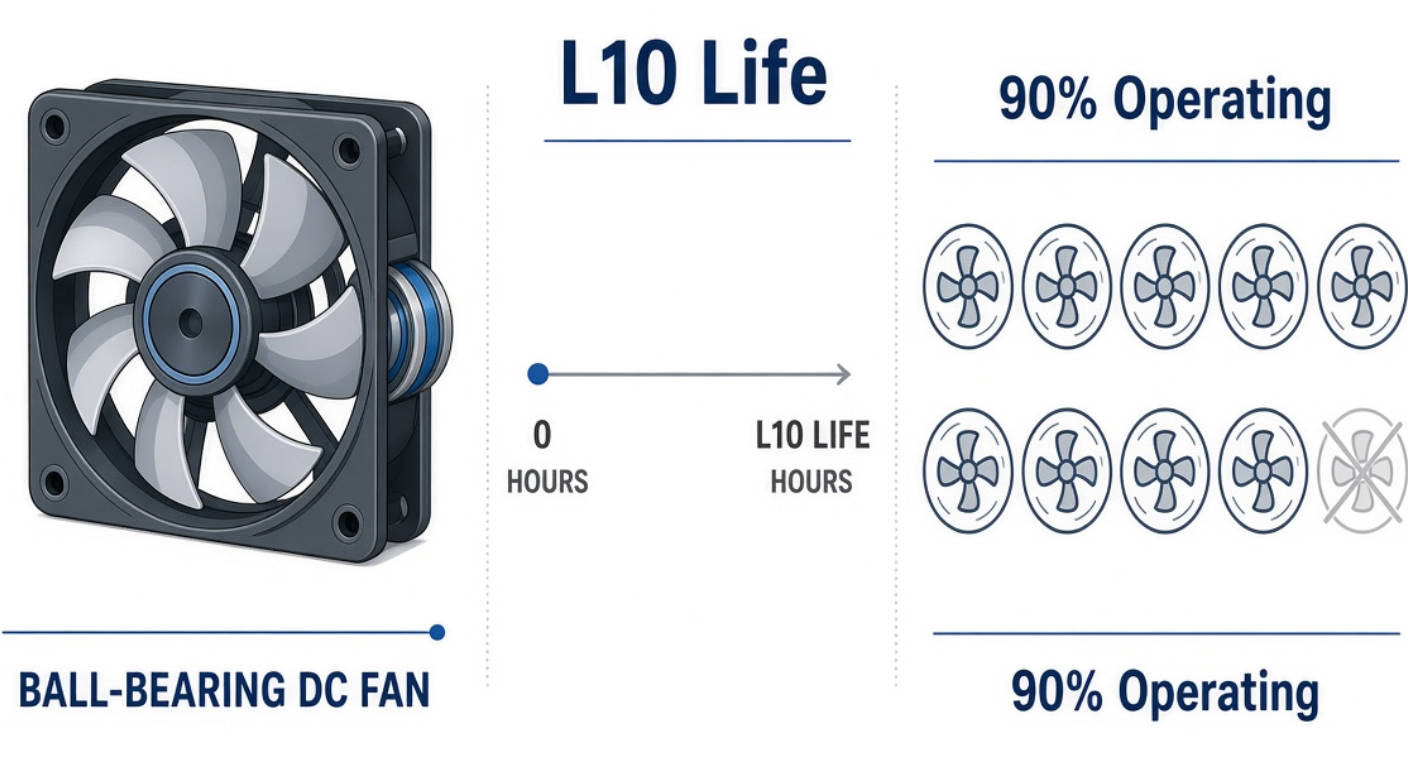
| L10 life | The operating duration at which 90% of a tested or modeled fan population is expected to remain functional under defined conditions | Primary comparison metric for fan mechanical service life |
| 90% survival rate | Another expression of L10 life | Confirms the statistical reliability level behind the life rating |
| MTBF | Mean Time Between Failures; a statistical measure often used for repairable systems or electronic reliability calculations | Useful for system-level reliability analysis, but not a direct prediction of the life of one fan |
| Fan life endpoint | The manufacturer-defined point at which performance degradation becomes unacceptable | Check the exact test definition before comparing products |
For DC cooling fans, L10 life is usually the more decision-relevant number because it is tied to bearing and lubrication durability under defined operating conditions. An L10 rating of 60,000 hours at 60°C does not mean every fan will run exactly 60,000 hours. It means that, under the stated test conditions, 90% of the fan population is expected to remain operational to that point.
This distinction matters in long-service equipment such as:
- Telecom base-station cabinets
- Data-center and edge-computing equipment
- Network switches and routers
- EV charging infrastructure
- Industrial automation panels
- Energy-storage systems
- Medical diagnostic equipment
- Security and communications systems
A long-life SANYO DENKI fan series, for example, can offer life ratings up to 180,000 hours under specified conditions. The stated L10 condition is continuous operation in free air at rated voltage and 60°C ambient temperature.
However, engineers should never copy a catalog life number directly into a product-life promise. The actual fan life depends on the system environment.
The bearing system is one of the most influential mechanical elements in a DC fan's service life. Although fan electronics, rotor magnets, winding design, and driver circuits all matter, the bearing assembly often determines whether a fan continues to operate smoothly after years of continuous duty.
In a DC axial fan, the bearing supports the rotating shaft and fan rotor. It must maintain stable motion while handling rotational load, vibration, heat, and lubricant aging.
High-reliability DC fans commonly use ball bearings because they are suitable for continuous operation, elevated temperatures, and a broad range of mounting orientations.
Compared with many lower-cost sleeve-bearing designs, ball-bearing fans are often preferred when equipment must run for long periods or operate in hotter environments. Typical applications include telecom equipment, industrial electronics, server hardware, UPS systems, power supplies, and communication cabinets.
SANYO DENKI states that it uses high-reliability ball bearings in its fans, with the bearing system playing a central role in long-term durability.
The advantages of a carefully designed ball-bearing system may include:
- Better suitability for continuous operation
- Improved resistance to elevated ambient temperature
- More stable operation across different mounting orientations
- Lower risk of lubricant migration compared with some sleeve-bearing designs
- Better long-term mechanical consistency in demanding equipment
That said, "ball bearing" alone is not a complete quality guarantee. Fan life also depends on bearing size, load capacity, grease selection, motor design, frame material, thermal path, manufacturing consistency, and actual application stress.
For many cooling fans, bearing fatigue is not the first limiting mechanism because the mechanical load can be relatively low. Instead, lubricant or grease life can become the critical factor.
As grease degrades, it may lose its ability to create a stable lubricating film. Friction can increase. The bearing temperature may rise. Noise and vibration may grow. Eventually, rotational speed and cooling performance can decline.
The main design paths for extending bearing grease life include:
1. Reducing bearing temperature
2. Reducing bearing load
3. Improving grease properties
4. Increasing bearing load capacity
For equipment users, the first item—reducing actual bearing temperature—is often the most actionable. The fan manufacturer controls much of the internal design, but the system designer controls airflow path, cabinet temperature, heat-source placement, fan location, dust filtration, and recirculation risk.
A fan is installed to cool the system, but the fan itself is also exposed to heat. This creates a common selection mistake: engineers calculate component temperature but overlook the air temperature surrounding the fan motor and bearings.
High ambient temperature accelerates lubricant degradation and can shorten fan life. This is why a life rating must always be read together with the specified test temperature.
SANYO DENKI provides a practical example: a San Ace fan rated for an expected life of 40,000 hours at 60°C may reach approximately 70,000 hours when operated at 40°C.
This does not mean every fan follows the same exact conversion factor. Different bearing systems, lubricant formulations, motor constructions, and test methods can produce different behavior. The broader lesson is clear:
Lowering the fan's operating temperature can significantly extend usable fan life.
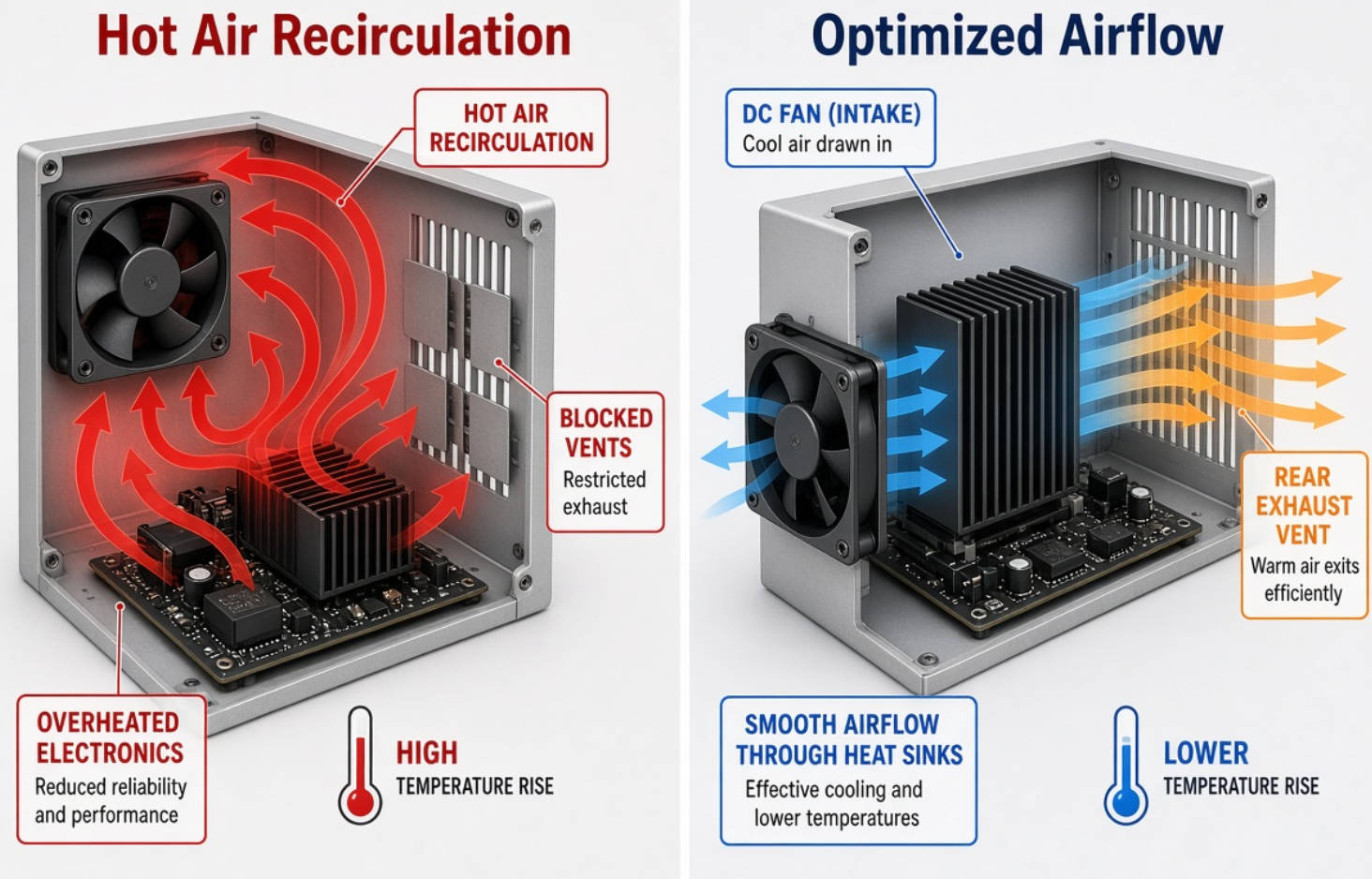
Use these engineering measures to lower the thermal stress experienced by a DC cooling fan:
- Place the fan away from high-loss power semiconductors, transformers, resistors, and heat sinks where practical.
- Prevent hot exhaust air from recirculating back to the fan inlet.
- Separate inlet and exhaust paths inside the enclosure.
- Use properly sized vents, grilles, and filters to reduce unnecessary airflow restriction.
- Verify airflow direction before finalizing the chassis layout.
- Avoid placing the fan directly behind a localized heat source without a controlled air path.
- Use temperature monitoring near the fan inlet, not only at the hottest electronic component.
- Select a higher-temperature-rated fan when the installation environment cannot be improved.
A useful design review asks two separate questions:
1. What is the maximum temperature of the electronic component?
2. What is the maximum temperature at the fan inlet and bearing region?
These temperatures can differ substantially.
Maximum airflow and maximum static pressure are essential DC fan specifications, but neither value alone describes real installed performance.
A fan reaches its maximum airflow near free-air conditions, where airflow resistance is minimal. It reaches maximum static pressure when airflow is near zero because the outlet is blocked or highly restricted. In an actual device, the fan operates somewhere between these two points on its P-Q curve, also called the airflow-static-pressure curve.
System resistance can come from:
- Dust filters
- Fan guards
- Perforated panels
- Narrow ducts
- Dense heat sinks
- Cable congestion
- PCB assemblies
- Battery packs
- Internal baffles
- Long or sharply bent air channels
A fan selected only for free-air CFM may fail to provide enough airflow once installed behind a restrictive filter or dense heat sink. The resulting equipment temperature increase can also raise the fan's own bearing temperature, indirectly reducing fan life.
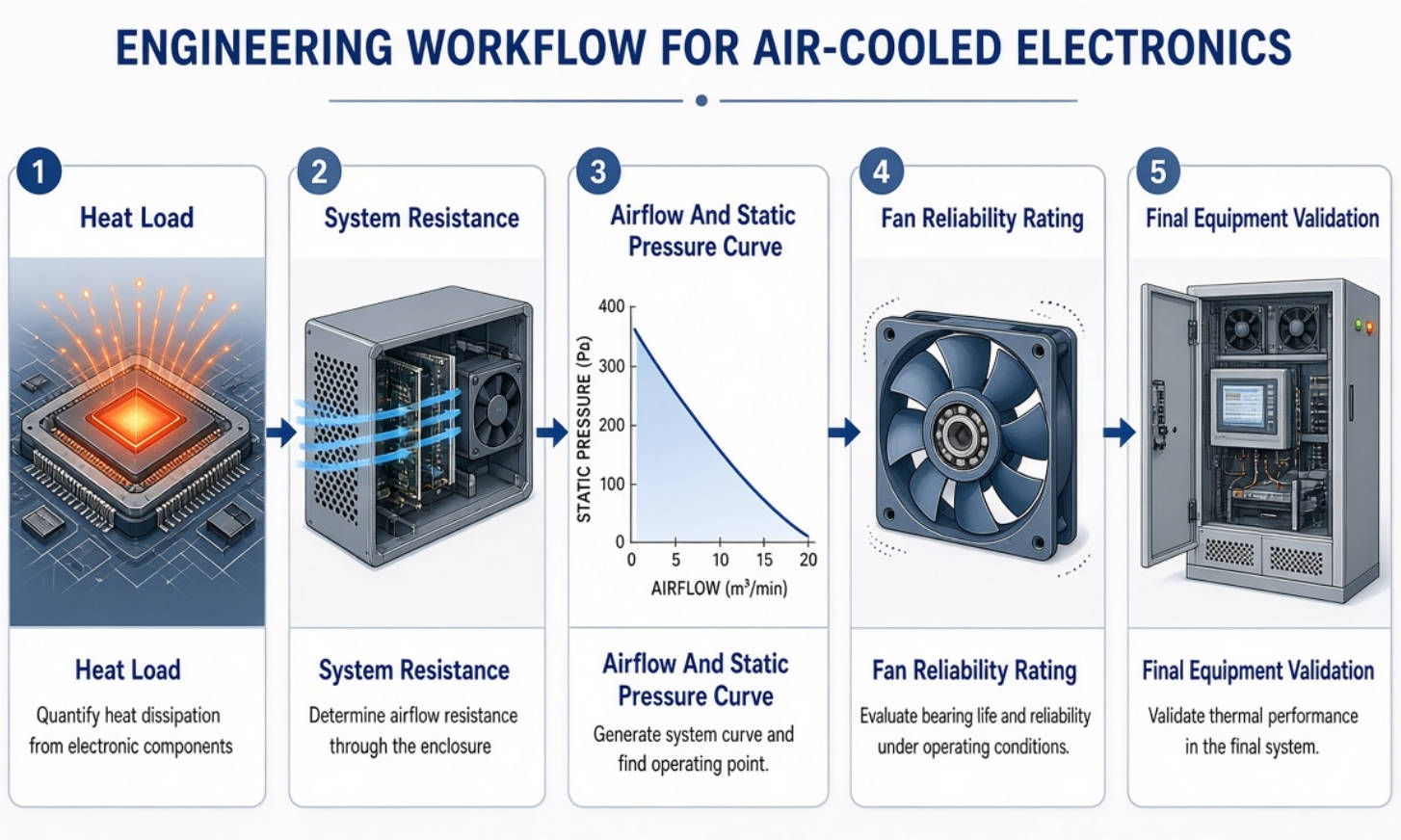
Use this sequence when selecting a cooling fan:
1. Define the required cooling load and allowable component temperatures.
2. Estimate or measure the enclosure's system resistance curve.
3. Select a fan whose P-Q curve intersects the system curve at the required airflow.
4. Check the fan's L10 life at the real ambient temperature and voltage condition.
5. Confirm acoustic limits, power consumption, dimensions, and mounting requirements.
6. Evaluate dust, humidity, vibration, shock, and corrosive-gas exposure.
7. Validate the design with prototype thermal testing and worst-case operating conditions.
8. Add fan-failure monitoring if loss of airflow could create a safety, uptime, or warranty risk.
This method avoids the common error of selecting a fan based only on size, voltage, and maximum CFM.
Even experienced teams can underestimate the gap between a datasheet condition and a real installation. The following mistakes frequently reduce cooling reliability.
A higher free-air airflow rating does not automatically produce better cooling inside a restrictive enclosure. Match the fan to the system impedance, not just the free-air number.
A 60,000-hour rating at 60°C is different from a 60,000-hour rating at 40°C. Always record the rated voltage, test temperature, airflow condition, and reliability definition.
MTBF is not the same as a guaranteed service life for a particular unit. For mechanical fan-life comparisons, L10 life and its test conditions are usually more informative.
Dust accumulation increases airflow resistance. The fan works against a higher system impedance, while electronic components may receive less cooling. A maintenance plan is essential in dusty industrial, telecom, warehouse, and outdoor environments.
For applications with strong shock, vibration, frequent transport, or unusual mounting constraints, verify suitability with the fan supplier. Mechanical environment can change bearing loading and system reliability.
A small fan running continuously at high speed in a hot enclosure may meet initial thermal requirements but leave little reliability margin. In many designs, a correctly sized fan operating with thermal margin produces a more durable and quieter solution.
Before approving a DC fan for production, ask the supplier or engineering team for the following information:
- Rated voltage and allowable voltage range
- Rated current and power consumption
- Fan dimensions and mounting pattern
- Airflow-static-pressure curve
- L10 life rating and test temperature
- Definition of fan end-of-life
- Bearing type and intended application environment
- Operating temperature range
- Acoustic noise level and measurement method
- Tachometer, alarm, PWM, or speed-control options
- IP rating or protection approach, if required
- Vibration and shock specifications
- Material and flammability information
- Compliance documentation and traceability requirements
- Availability, lead time, and long-term supply capability
For mission-critical equipment, go further. Request application-level validation support, including thermal modeling, prototype testing, airflow measurement, and fan-failure alarm strategy.
At Capital Technology, our approach is to evaluate the full cooling path: heat source, enclosure, restrictions, required airflow, ambient condition, reliability target, and lifecycle expectations. This helps customers select not only a DC fan that fits mechanically, but a cooling solution that supports stable equipment operation over its intended service period.
A long-life DC fan is especially appropriate when fan replacement is expensive, inconvenient, unsafe, or operationally disruptive.
Consider a higher-reliability fan solution when your equipment is used in:
- Telecom and wireless communication infrastructure
- Servers, storage systems, and network equipment
- Industrial automation and machine-control cabinets
- Power supplies, inverters, and energy-storage systems
- EV charging equipment
- Medical and laboratory instruments
- Security, surveillance, and emergency communication systems
- Outdoor cabinets or remote installations
- Equipment with a planned service life of five years or more
SANYO DENKI long-life fan products are positioned for equipment such as telecom systems, servers, and industrial equipment that require extended maintenance-free operation. Certain long-life products are specified with L10 life ratings up to 180,000 hours at 60°C, under stated test conditions. [products.sanyodenki]
The right choice, however, depends on the full project requirement. A compact CAPITAL DC fan may be appropriate where customization, cost efficiency, and fast engineering support are priorities. A SANYO DENKI San Ace solution may be particularly valuable where recognized high-reliability specifications, advanced performance, long-life capability, or demanding thermal requirements are central to the project.
A DC fan is a mechanical component, an electrical component, and a thermal-management component at the same time. Its lifespan cannot be evaluated from one catalog number alone.
For dependable equipment cooling, prioritize these principles:
- Use L10 life rather than MTBF alone when comparing fan mechanical durability.
- Read every life rating together with its temperature, voltage, and test conditions.
- Control ambient temperature around the fan bearing and motor.
- Match the fan's P-Q curve to the actual system resistance.
- Prevent hot-air recirculation and excessive inlet restriction.
- Plan for dust, vibration, electrical quality, and preventive maintenance.
- Validate cooling performance in the finished equipment, not only on the bench.
A properly selected long-life DC fan can protect much more than itself. It can improve component reliability, reduce field-service events, preserve system performance, and strengthen the long-term value of the equipment you deliver.
Need a DC fan matched to your airflow, static pressure, temperature, noise, and lifetime target? Contact Capital Technology Co., Limited for CAPITAL DC fan selection support or SANYO DENKI San Ace product consultation.
L10 life is the time at which 90% of a fan population is expected to remain operational under specified conditions. It is commonly used to describe the expected mechanical service life of a cooling fan.
No. MTBF is a statistical reliability metric and should not be interpreted as the guaranteed operating life of one fan. For fan mechanical durability, L10 life and its test conditions are generally more useful.
High temperature can accelerate bearing-lubricant degradation and increase stress on the fan's internal components. Lowering the fan's ambient temperature can help extend its expected service life.
Ball-bearing fans are commonly preferred for continuous-duty, higher-temperature, and industrial applications because they generally offer stronger long-term mechanical performance. However, the correct choice still depends on the specific temperature, mounting, cost, noise, and reliability requirements.
Do not select only by maximum CFM. Determine the system resistance caused by filters, grilles, ducts, heat sinks, and internal components, then select a fan whose airflow-static-pressure curve delivers the required airflow at that resistance.
Yes. As a filter becomes clogged, airflow resistance rises. Reduced airflow can increase equipment temperature and may raise the thermal stress on the fan. Filter inspection and maintenance should be included in the system maintenance plan.
Provide fan size, voltage, required airflow, static pressure, operating temperature, noise limit, duty cycle, installation environment, control-signal requirements, expected product life, and any dust, vibration, or IP-protection requirements.
1. SANYO DENKI, "Fan lifespan | Basic knowledge of fans – Tech Compass." Explains the definition of fan life, the relationship between L10 life and 90% survival rate, bearing grease life, and the influence of ambient temperature. [SANYO DENKI Tech Compass]
2. SANYO DENKI, "Long Life Fan | San Ace." Product information describing long-life DC fan applications and L10-life conditions, including models with life expectancy up to 180,000 hours. [SANYO DENKI Long Life Fan]
3. SANYO DENKI, "San Ace 80LG Long-Life Fan." Product announcement describing an 80 × 80 × 38 mm long-life fan and its stated L10-life measurement conditions. [SANYO DENKI San Ace 80LG]
4. National Institute of Standards and Technology, "Accelerated Life Tests." Overview of why accelerated testing is used to obtain failure information under elevated stress and project performance at normal use conditions. [NIST Accelerated Life Tests]
5. International Electrotechnical Commission, "IEC 61709:2017." Standard guidance concerning the use of failure-rate data and reference conditions for reliability prediction of electric components. [IEC 61709:2017 Overview]
6. RS Components DesignSpark, "Why L10 Life Expectancy Is Key for Fan Durability Over MTBF Ratings." Industry discussion of the distinction between L10 service life, bearing/grease durability, and MTBF. [DesignSpark Article]


