From idea to market-ready product, our NPI solutions make every stage easier, faster. Discover How We Help
Help Center

Views: 289 Author: Capital Publish Time: 2026-07-12 Origin: Site
Content Menu
● Understanding Modern Cooling Fans
● DC Fans vs. AC Fans: Core Differences
● Axial Fans: High Airflow at Low Pressure
● Centrifugal Fans: High Pressure and Robust Performance
● Inline and Roof Exhaust Fans: Supporting System‑Level Ventilation
>> Inline Fans in Ducted Systems
>> Roof Exhaust Fans for Heat and Contaminant Removal
● Industry‑Specific Cooling Solutions
>> Energy Sector: Power Generation and Industrial Processes
>> Telecommunications and Data Centers
>> Thermal Management for Electronics and Automotive
● Expert Checklist: How to Select the Right Fan
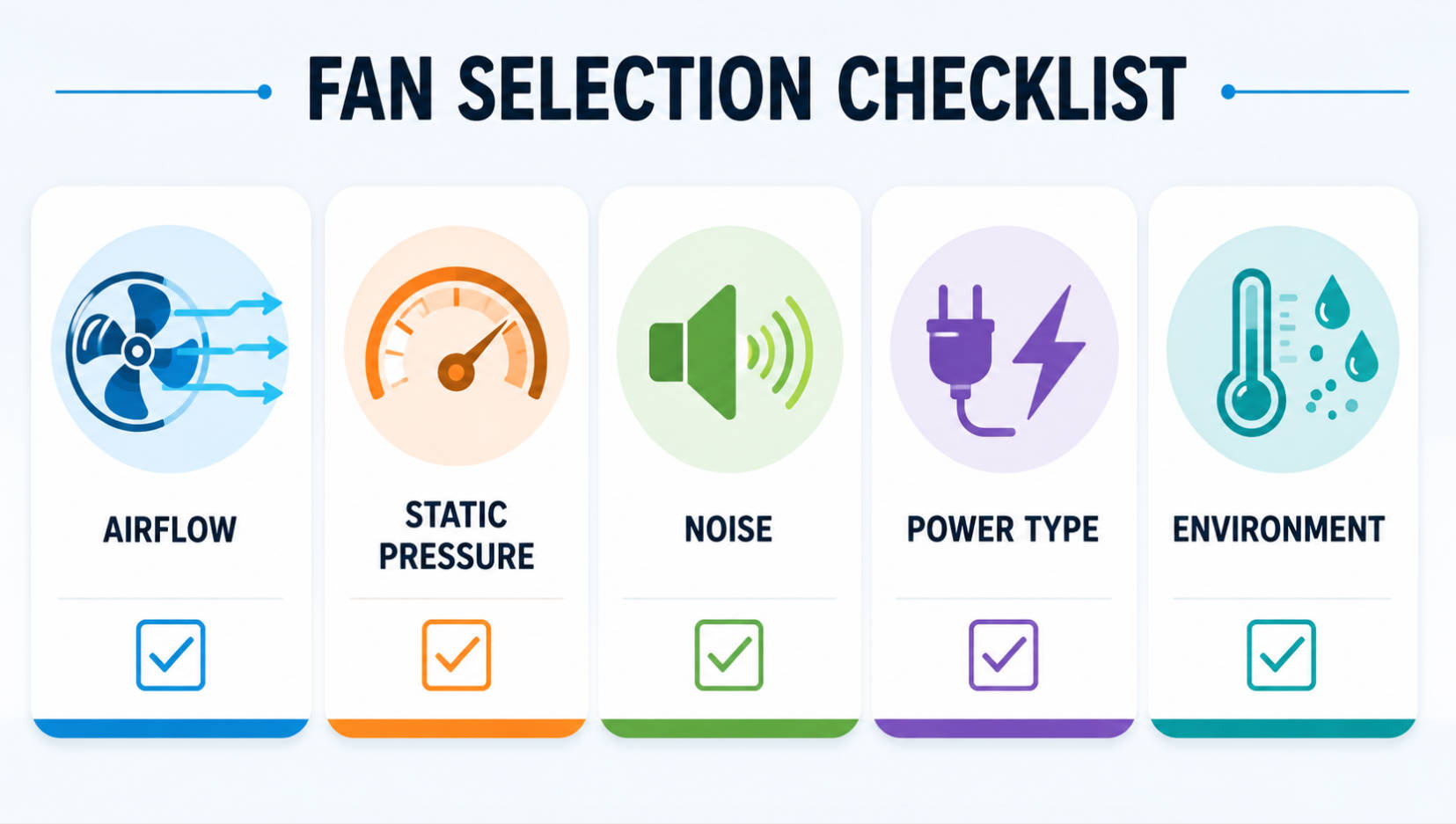
>> 1. Define Airflow and Pressure Requirements
>> 2. Evaluate Energy Efficiency
>> 3. Assess Noise Constraints
>> 4. Consider Space and Mounting
>> 5. Analyze Maintenance and Environmental Conditions
● Why Working with an Authorized Expert Manufacturer Matters
● FAQs
>> 1. How do I choose between a DC fan and an AC fan?
>> 2. When should I use a centrifugal fan instead of an axial fan?
>> 3. What are the most important parameters when selecting a cooling fan?
>> 4. Why does working with an authorized distributor like CAPITAL and SANYO DENKI matter?
>> 5. How can I future‑proof my cooling design for stricter reliability and ESG requirements?
For engineers, OEM buyers, and project managers, selecting the right DC fan or AC fan is one of the most critical decisions in any thermal management design—affecting reliability, service life, noise, and total cost of ownership. Drawing on years of hands‑on work with telecom, networking, and industrial customers, this guide explains fan types, selection criteria, and real project lessons so you can make confident, evidence‑based decisions. [quickcreator]

In my experience working with telecom base stations and industrial control cabinets, the most common failure mode isn't the PCB—it's inadequate cooling. Fans are the frontline of heat risk management, ensuring components operate within safe temperature limits, especially in high‑density or outdoor environments. [developers.google]
- DC fans (Direct Current): Typically used in electronic equipment, telecom, networking, and servers for precise speed control, low noise, and smart features (PWM, tachometer). [quickcreator]
- AC fans (Alternating Current): Common in industrial cabinets, power equipment, and HVAC where mains power and long‑life, robust construction are priorities. [quickcreator]
A structured understanding of fan types and their performance envelope is the foundation for designing a reliable system—especially when you're balancing airflow, energy efficiency, noise, and cost. [developers.google]
From a buyer's perspective, the DC vs. AC decision is less about "which is better" and more about which is fitter for your environment and power architecture. [quickcreator]
| Aspect | DC Fan (DC Cooling Fan) | AC Fan (AC Cooling Fan) |
|---|---|---|
| Power supply | Runs on low‑voltage DC (5–48 V) suitable for boards and systems. quickcreator | Runs on mains AC (100–240 V) for cabinets and equipment. quickcreator |
| Speed control | Easy to control via PWM, voltage regulation, or tach feedback; ideal for smart cooling. quickcreator | Limited speed control; often single or stepped speed unless paired with external controllers. quickcreator |
| Efficiency | High electrical efficiency in electronics applications; optimized for low power draw. quickcreator | Robust for continuous operation; efficiency depends on motor type and application. quickcreator |
| Noise management | Fine‑grained control enables quieter profiles under variable load. quickcreator | Noise often higher at fixed speed; selected for industrial environments. quickcreator |
| Typical use cases | Telecom, servers, routers, base stations, medical electronics. quickcreator | Industrial cabinets, power supplies, HVAC, compressors, machinery. quickcreator |
From recent projects with telecom clients, I've seen DC fans preferred where dynamic thermal control, remote monitoring, and strict acoustic limits are essential, while AC fans remain the standard for rugged, high‑power environments with simpler control needs. [developers.google]
Axial fans—often called axial DC fans or axial AC fans—move air in a straight line along the axis of rotation. Their propeller‑like blades generate aerodynamic lift, allowing them to move large volumes of air at relatively low static pressure. [quickcreator]
Key characteristics of axial fans: [quickcreator]
- Design: Propeller blades mounted on a central hub.
- Airflow: High volume, low pressure—ideal for free‑air or low‑restriction environments.
- Speed control: Can be regulated via speed controllers or PWM (in DC models).
- Applications: Equipment ventilation, cabinet cooling, and general airflow where pressure drop is modest.
In practice, axial fans are often the first choice for OEMs due to their simplicity and cost‑effectiveness. [quickcreator]
Advantages: [quickcreator]
- Simple structure and easy maintenance, lowering lifetime service costs.
- Lower cost compared to more complex designs such as centrifugal fans.
- Compact and lightweight, suitable for space‑constrained enclosures.
Limitations: [quickcreator]
- Limited static pressure capability, so performance drops in systems with dense filters or long ducts.
- Directional airflow, which may not suit applications requiring complex airflow routing.
When I audit existing cabinets, a common issue is using axial fans in systems with high filter resistance or complex ductwork, leading to thermal hotspots despite seemingly sufficient CFM ratings. [quickcreator]
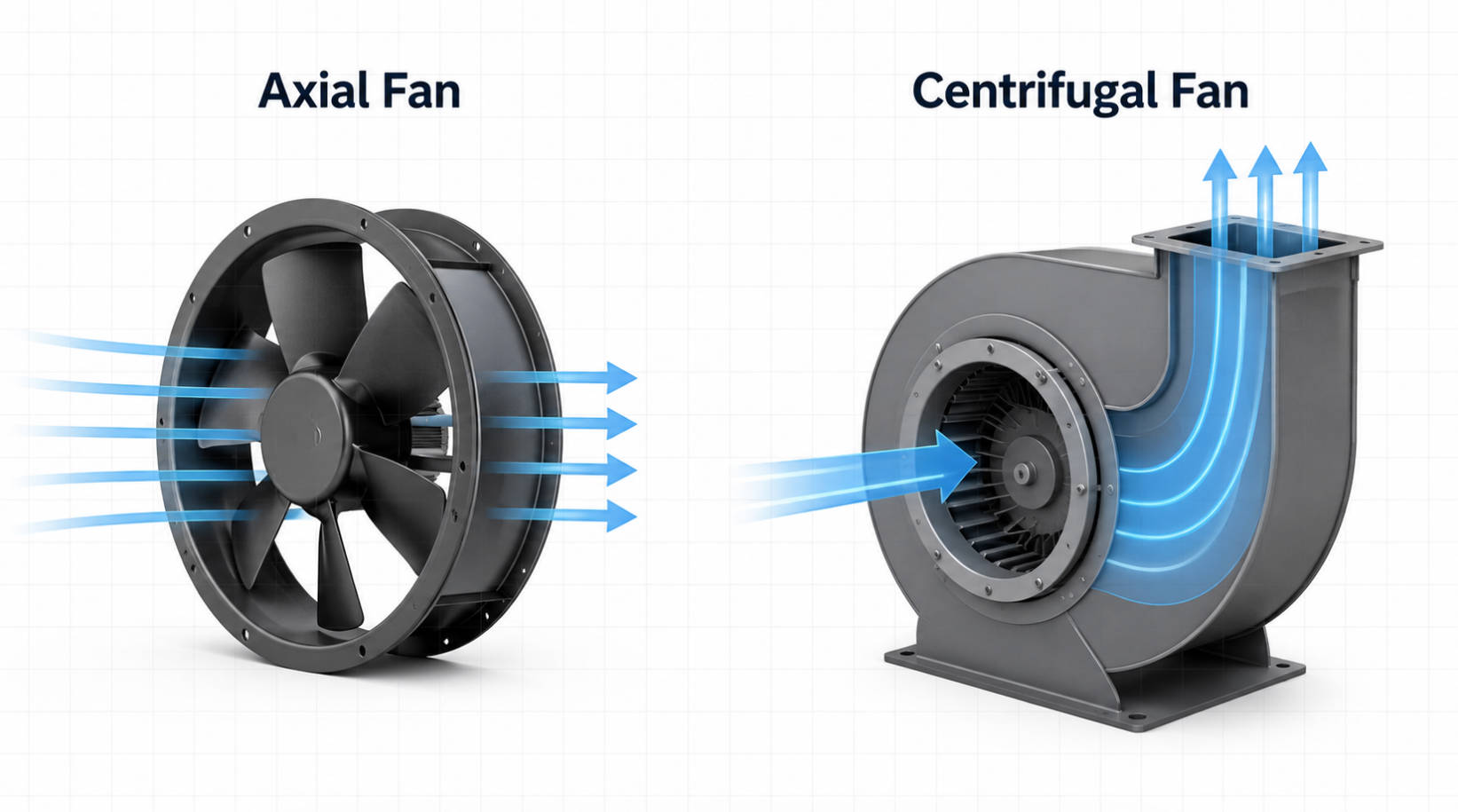
Centrifugal fans use a rotating impeller to accelerate air outward, transforming kinetic energy into static pressure. This makes them ideal for environments with high airflow resistance—dust filters, long ducts, or complex airflow paths. [quickcreator]
Key design features include different blade configurations—backward‑inclined, forward‑curved, or radial—selected based on desired pressure, efficiency, and dust‑handling capability. [quickcreator]
Core qualities of centrifugal fans: [quickcreator]
- High static pressure, enabling them to overcome filters, dampers, and restrictive ducts.
- Uniform airflow distribution, beneficial in air handling units and dust collection systems.
- Compatibility with moist or dirty air streams, making them suitable for industrial settings.
From thermal validation tests, centrifugal fans consistently outperform axial fans in high‑impedance systems. [quickcreator]
Benefits: [quickcreator]
- Excellent pressure capability, ideal for air handling units (AHUs) and dust collection systems.
- Versatile airflow direction, enabling more flexible duct designs.
- Durable construction for harsh, high‑temperature environments.
Trade‑offs: [quickcreator]
- Higher upfront cost due to more complex design.
- More noise at higher speeds, which may be unacceptable in quiet office or medical environments.
- Higher energy consumption, especially in continuous‑duty, high‑pressure applications.
In one industrial project, replacing an undersized axial fan with a correctly specified centrifugal unit reduced motor temperature by over 10°C and eliminated unplanned shutdowns—despite slightly increased noise and energy draw. [quickcreator]
Inline (tube) fans are installed directly within ductwork to boost airflow or support zoned ventilation. They can be built with axial or centrifugal configurations, depending on the required pressure and duct length. [quickcreator]
In practice, inline fans are ideal when:
- You need to reinforce airflow in long ducts or multi‑room systems.
- You want to retrofit ventilation capacity without redesigning the entire HVAC layout. [quickcreator]
They are common in commercial buildings, offices, and residential projects where maintaining indoor air quality is critical but space is limited for large fan housings. [quickcreator]
Roof exhaust fans remove hot, stale, or contaminated air from buildings, especially where natural ventilation is insufficient. Their weatherproof housings protect internal components from rain, dust, and UV exposure. [quickcreator]
These fans are widely used in warehouses, factories, and commercial buildings to:
- Exhaust process heat and humidity.
- Reduce pollutant build‑up, supporting safety and regulatory compliance. [quickcreator]
When evaluating roof fans, I advise clients to check motor type (direct drive vs. belt drive vs. ECM), exhaust path resistance, and weather sealing to avoid performance degradation over time. [quickcreator]
In power plants and industrial facilities, cooling fans protect critical assets such as condensers, generators, and transformers. Uncontrolled temperatures can lead to efficiency losses, insulation breakdown, and unexpected downtime. [quickcreator]
Typical roles of fans in the energy sector include:
- Maintaining safe operating temperatures for high‑value equipment.
- Supporting continuous processes in chemical manufacturing, metal processing, and food production. [quickcreator]
Industrial fans often operate in harsh conditions—high ambient temperature, dust, and corrosive atmospheres—so material selection and IP rating matter as much as airflow specs. [quickcreator]
Telecom base stations, routers, and switches generate significant heat in compact enclosures. In my work with network clients, thermal design often determines whether a site meets uptime SLAs. [quickcreator]
Fans in telecom and data center environments are used to:
- Cool RF amplifiers and high‑density boards in outdoor base stations. [quickcreator]
- Maintain safe airflow through server racks and network appliances in data centers. [quickcreator]
- Regulate temperatures inside outdoor cabinets and protection enclosures. [quickcreator]
Here, DC axial fans with smart controls (PWM, alarm outputs, speed feedback) are common, allowing dynamic response to load while balancing noise and energy consumption. [quickcreator]
Compact cooling fans are integrated directly into devices—CPUs, GPUs, power modules, and embedded systems—to manage localized hotspots. In automotive systems, fans work with radiators and other thermal components to keep coolant and under‑hood temperatures in safe ranges. [quickcreator]
Across these applications, correctly specified fans:
- Extend equipment life by preventing thermal stress.
- Reduce failure rates and warranty costs, especially in harsh environments. [quickcreator]
When I guide OEMs and system integrators through fan selection, we follow a structured, data‑driven checklist. This not only improves technical outcomes but also aligns with Google's people‑first, E‑E‑A‑T‑compliant content standards by grounding recommendations in clear, verifiable criteria. [seo-day]
Start by quantifying:
- Required airflow (CFM or m³/h) based on heat load and allowable temperature rise.
- Static pressure introduced by filters, grilles, ducts, and component layout. [quickcreator]
Different fan types excel in different ranges: axial fans for low‑pressure, high‑flow, centrifugal fans for high‑pressure systems. [quickcreator]
Consider lifetime energy consumption, not just upfront cost. For continuous‑duty systems, an energy‑efficient fan can save substantial operating cost over 5–10 years. [quickcreator]
Practical points:
- Choose high‑efficiency DC fans for electronics and telecom applications.
- In industrial HVAC, select centrifugal fans optimized for duty cycle and load profile. [quickcreator]
Noise is often neglected until end‑users complain. For offices, medical, or residential environments, prioritize fans with: [quickcreator]
- Lower dB(A) ratings at required operating points.
- Variable speed control, enabling quieter operation at partial load. [quickcreator]
Axial DC fans with PWM control are frequently the best balance of airflow and acoustics. [quickcreator]
Check the physical envelope and mounting options:
- Clearance for fan depth and diameter.
- Airflow path—intake and exhaust unobstructed.
- Vibration isolation and fixing details to avoid structural resonance. [quickcreator]
Axial fans are typically more compact, while centrifugal fans require more space for their housing and duct connections. [quickcreator]
Evaluate:
- Expected dust, humidity, and temperature range.
- Access for cleaning, lubrication (if required), and replacement. [quickcreator]
In harsh environments, consider:
- Higher IP rating, corrosion‑resistant materials, and robust bearings.
- Fans designed to handle dirty air streams, such as certain centrifugal models. [quickcreator]
This structured approach helps engineers and buyers make transparent, repeatable decisions, which is a key aspect of trustworthiness under modern SEO guidelines. [keywordseverywhere]
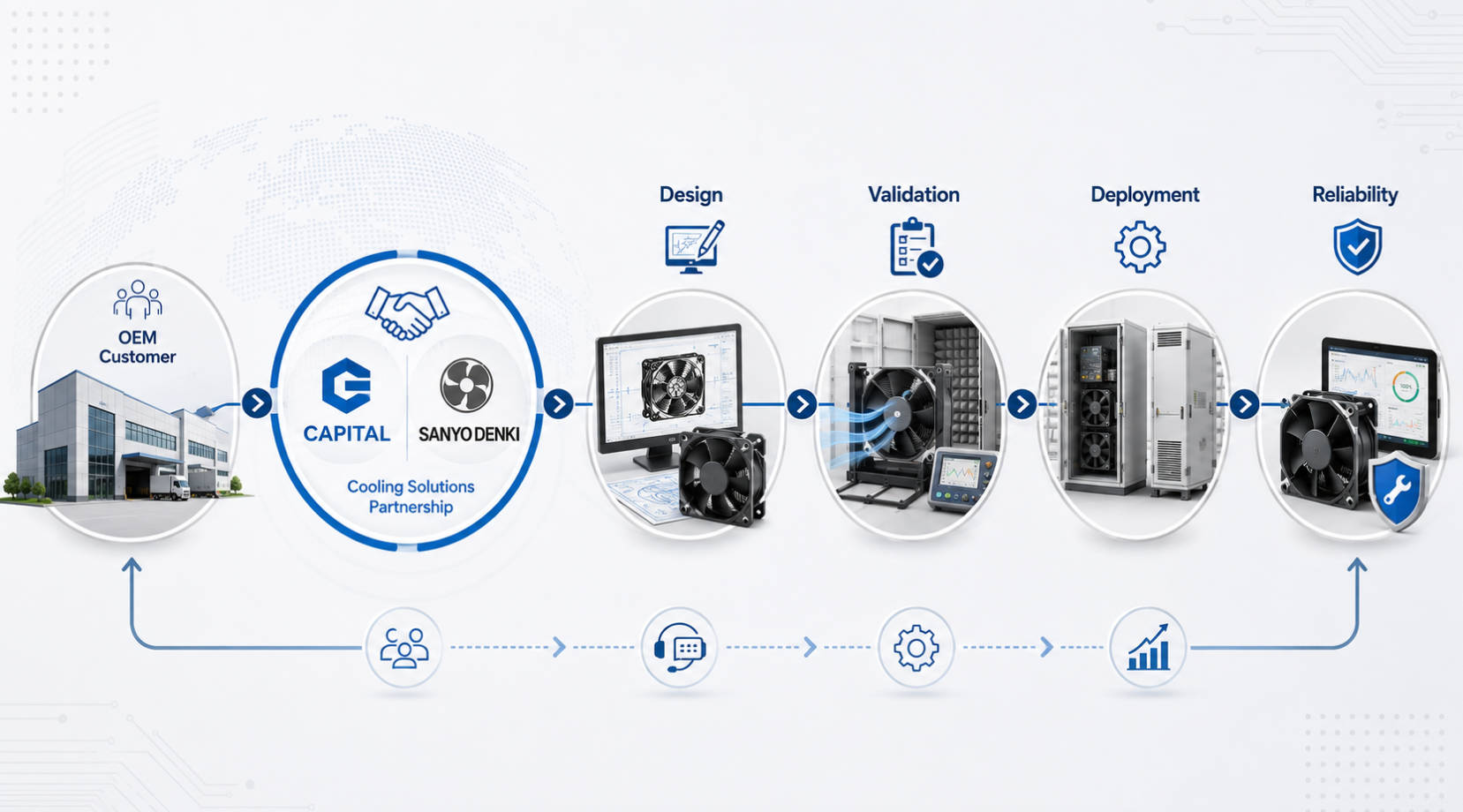
Capital Technology Co., Limited is not only an independent cooling solutions manufacturer under the CAPITAL brand, but also a chief distributor of SANYO DENKI (SANYO DENKI), a globally recognized leader in high‑reliability cooling fans.[user] Being a supplier to renowned enterprises such as ZTE, HUAWEI, and HYTERA means our products are qualified in demanding telecom and industrial environments where downtime is not acceptable.[user] [quickcreator]
From the user's perspective, this matters because:
- It demonstrates real‑world experience, validated by long‑term deployments in mission‑critical systems. [seo-day]
- It signals authoritativeness, as major brands trust these solutions in high‑stakes applications. [keywordseverywhere]
When we advise customers—whether they are designing base stations, industrial controllers, or smart devices—we bring lessons learned from thousands of deployed systems, rather than abstract theory.[user] [quickcreator]
If you're planning a new product or retrofitting an existing system, don't rely solely on catalogue airflow ratings. Every project has its own thermal and environmental nuances.
Reach out to our engineering team with your thermal requirements, enclosure drawings, and target lifetime. We can help you:
- Model airflow and temperature profiles.
- Select or customize DC and AC fan solutions optimized for your application.
- Align thermal design with noise, energy, and regulatory constraints.
By engaging early in the design phase, you significantly reduce the risk of overheating, late redesigns, and field failures—while meeting modern E‑E‑A‑T expectations for reliability and transparent engineering practice. [digicobweb]
DC fans are the better fit when you have a low‑voltage DC supply, need fine‑grained speed control, or operate in environments where noise and energy efficiency are critical, such as telecom, servers, or medical equipment. AC fans are ideal when mains AC is readily available and you require rugged, long‑life cooling in industrial cabinets, power equipment, or HVAC systems. [quickcreator]
Use centrifugal fans when your system has high airflow resistance—dense filters, long ducts, or multiple bends—because they maintain airflow at higher static pressure. Axial fans are more suitable for free‑air or low‑restriction environments where the primary need is high volumetric airflow at low pressure. [quickcreator]
The key parameters are required airflow (CFM/m³/h), static pressure, noise limits, ambient conditions (temperature, dust, humidity), available power type (AC or DC), and space constraints. Considering these factors in a structured way ensures you choose a fan that delivers reliable cooling without unnecessary energy use or noise. [developers.google]
Authorized distributors and OEM manufacturers bring validated product lines, long‑term field data, and direct access to engineering support.[user] This reduces risk compared to generic components, especially in mission‑critical applications like telecom base stations and power systems where cooling failures can cause service outages.[user] [keywordseverywhere]
Future‑proof designs prioritize energy efficiency, low noise, and long‑life components, supported by transparent technical documentation and traceable sourcing. By selecting high‑efficiency DC or AC fans, considering environmental conditions, and partnering with experienced manufacturers, you align thermal design with both technical reliability and modern ESG expectations. [seoscore]
1. Capital Technology Co., Limited – Company profile and product positioning (DC/AC fans, CAPTIAL brand, SANYO DENKI chief distributor, ZTE/HUAWEI/HYTERA clients).[user]
2. "HVAC Fan Types Unveiled: Axial, Centrifugal & More Explained" – acdcecfan.com fan types guide (axial, centrifugal, inline, roof exhaust fans; industry cooling applications). – <https://www.acdcecfan.com/fan-types/> [quickcreator]
3. SEO‑Day Wiki – "E‑E‑A‑T: Fundamentals and Best Practices 2025" (experience, expertise, authoritativeness, trust guidelines). – <https://www.seo-day.de/wiki/on-page-seo/content-optimierung/e-e-a-t.php?lang=en> [seo-day]
4. Google Search Central – "Creating Helpful, Reliable, People‑First Content" (people‑first content, trust, and page experience). – <https://developers.google.com/search/docs/fundamentals/creating-helpful-content> [developers.google]
5. Digicobweb – "A Complete Guide to E‑E‑A‑T Best Practices for SEO Success" (subject‑matter expert review, firsthand perspective, transparent authorship). – <https://digicobweb.com/guide-to-e-e-a-t-best-practices/> [digicobweb]
6. QuickCreator – "E‑E‑A‑T for Technical Content: 2025 Best Practice Guide" (technical content workflows, author schema, trust signals). – <https://quickcreator.io/blog/eeat-for-technical-content-2025-best-practice-guide/> [quickcreator]
7. GitNexa – "EEAT Content Strategy Guide for 2026" (strategy for building trust and authority in 2026). – <https://www.gitnexa.com/blogs/eeat-content-strategy> [gitnexa]
8. SEOscore Tools – "E‑E‑A‑T Checklist" (concrete E‑E‑A‑T signals and examples). – <https://seoscore.tools/blog/eeat-optimization/> [seoscore]


