From idea to market-ready product, our NPI solutions make every stage easier, faster. Discover How We Help
Help Center

Views: 222 Author: Astin Publish Time: 2026-04-16 Origin: Site
From my experience working with cooling solutions for telecom, data communication, and industrial customers, a centrifugal fan is best understood as a pressure-generating machine rather than just "a fan that blows air." [ystechusa]
A centrifugal fan uses a rotating impeller to draw air in axially (along the shaft) and discharge it radially (at 90 degrees), converting rotational energy into higher-pressure airflow. This higher pressure allows centrifugal fans to move air through filters, ducts, heat sinks, and complex systems where simple axial fans would struggle. [linkedin]
In cooling projects for OEM clients such as telecom base stations or industrial cabinets, we typically use centrifugal fans when:
- The system has long ducts or high resistance to airflow
- Precise, stable airflow is needed across filters or heat exchangers
- The environment is dusty, humid, or chemically aggressive
- Low noise and controlled pressure are more important than maximum free airflow [indexbox]
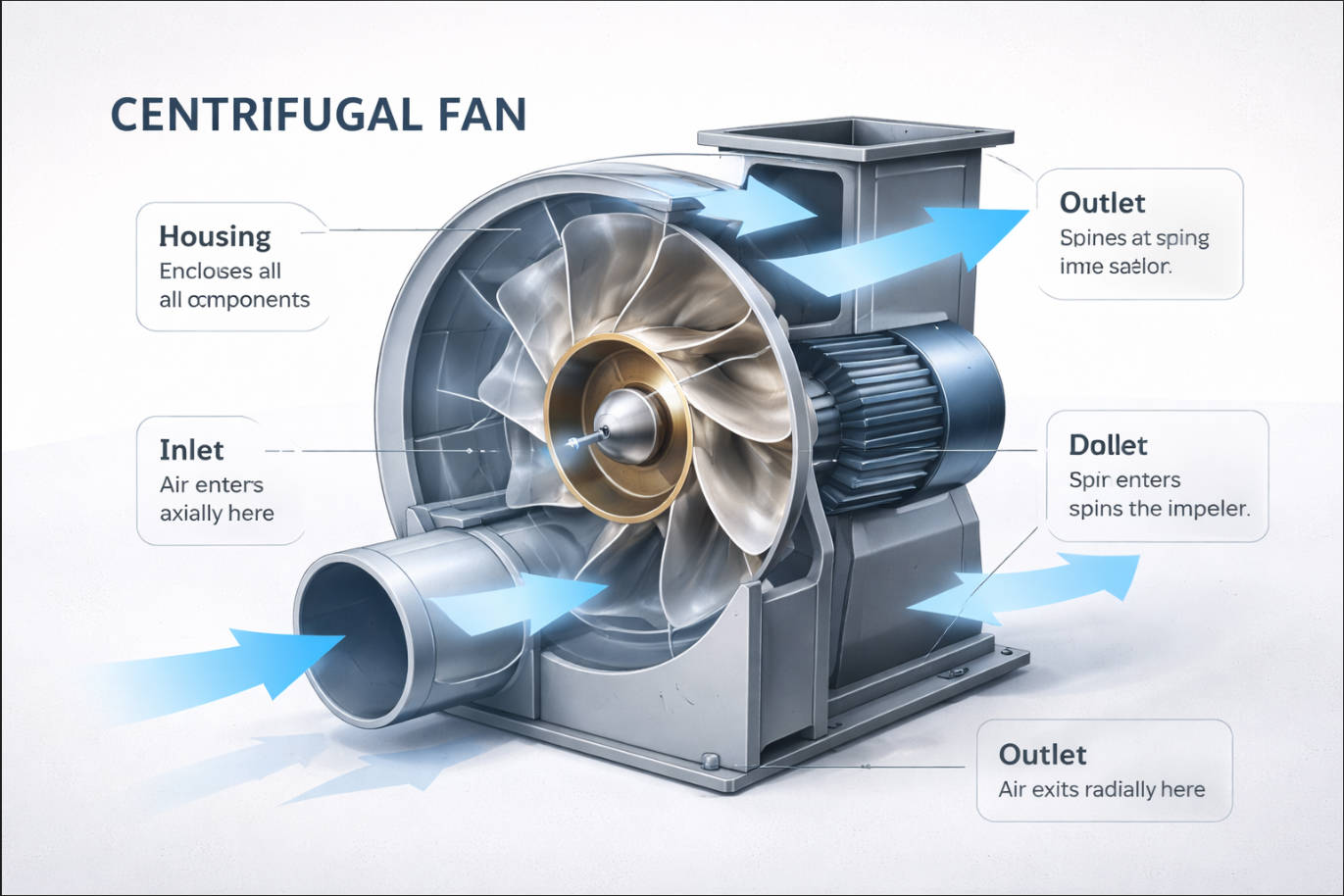
From an engineering and maintenance standpoint, understanding the core components is essential for reliability, noise, and efficiency. [quimipol]
- Impeller (Fan Wheel)
The impeller is the heart of the centrifugal fan and consists of a central hub with multiple blades. As it rotates, it pulls air in through the center and throws it outward by centrifugal force, increasing air velocity and pressure. [linkedin]
- Fan Housing
The housing (or scroll casing) surrounds the impeller and shapes the airflow, guiding it into a controlled discharge. A well-designed housing directly improves static pressure, efficiency, and noise performance. [linkedin]
- Inlet and Outlet
The inlet is usually a round opening aligned with the impeller eye; the outlet is typically rectangular or shaped to match ducting. Proper inlet design reduces turbulence and improves fan efficiency, which is a key optimization in high-end cooling solutions. [linkedin]
- Drive System
Centrifugal fans can be direct-drive (motor shaft connected directly to the impeller) or belt-drive. Direct-drive designs are compact, efficient, and require less maintenance, while belt-drive allows precise speed adjustment and flexibility in layout. [quimipol]
In our own projects, we favor high-efficiency impellers and quality motors from leading brands such as SANYO DENKI because long-term stability and low vibration are critical for telecom and data equipment. [sanyodenki-cn]
In real applications, centrifugal fans serve several core functions that go far beyond simple air movement. [indexbox]
- Generate high-pressure airflow
They can overcome filters, heat sinks, ducts, and bends while maintaining stable air volume and pressure, which is essential for reliable thermal design. [indexbox]
- Handle different air and gas mixtures
Properly engineered centrifugal fans can handle dusty air, moist air, corrosive gases, or hot exhaust streams when combined with suitable materials and coatings. [indexbox]
- Operate in harsh environments
Industrial and telecom environments often involve temperature swings, dust, or 24/7 operation; centrifugal fans are designed for these demanding duty cycles. [linkedin]
Because of these characteristics, we often use centrifugal fans in combination with DC fans, AC fans, and radiators to build integrated cooling solutions tailored to complex systems. [ystechusa]
Different impeller blade geometries lead to very different behavior. Choosing the right type is one of the most important design decisions. [indexbox]

- Backward-curved fans
- Higher efficiency, good for medium to high pressure
- More stable performance and better suited for variable-speed control
- Often used in HVAC air handlers, industrial cabinets, and energy-efficient systems [linkedin]
- Forward-curved fans
- Compact, high airflow at lower pressures
- Common in small HVAC units and appliances where size is critical
- Typically operate at lower efficiency but with a smaller footprint [indexbox]
Inline centrifugal fans are designed to fit into ducting, combining some advantages of axial fans with the pressure capability of centrifugal fans. They are widely used in ducted ventilation, telecom shelters, and compact air-handling modules where airflow must be routed through constrained spaces. [linkedin]
The original article lists major application categories; in daily engineering work, we see these play out in several practical ways. [indexbox]
Centrifugal fans are central to modern HVAC units, air handling units (AHUs), and rooftop systems. They: [linkedin]
- Circulate conditioned air in commercial and industrial buildings
- Overcome filter resistance and complex duct networks
- Support ventilation standards and energy codes that require efficient, controllable airflow [indexbox]
In factories, power electronics, and process plants, centrifugal fans are used to:
- Cool large enclosures and control cabinets
- Remove heat from power supplies, inverters, and rectifiers
- Extract fumes, dust, and process gases safely and efficiently [linkedin]
Centrifugal fans are essential in dust collectors, scrubbers, and filtration systems. They: [linkedin]
- Transport dust-laden air to filters
- Maintain the negative pressure required for safe capture
- Support emission control and workplace safety regulations [indexbox]
In small appliances and equipment, compact centrifugal fans help with:
- Drying (e.g., car wash systems, dryers)
- High-suction cleaning (e.g., vacuum cleaners)
- High-speed air streams (e.g., hair dryers, blowers) [linkedin]
From a market and technology perspective, centrifugal fans are undergoing a quiet but significant transformation. [blog.ebmfan]
- Shift to energy-efficient and low-noise designs
Stricter environmental and energy regulations are pushing manufacturers to adopt more efficient impellers, motors, and control strategies, including EC (electronically commutated) motors and optimized blade designs. [linkedin]
- Integration with smart controls
Fans increasingly integrate with variable speed drives, IoT monitoring, and closed-loop control systems to deliver the exact airflow needed while minimizing energy consumption. [ystechusa]
- Market growth in high-value segments
Demand from data centers, telecom, EV charging, and industrial automation is driving robust growth, with centrifugal fan and blower markets expected to grow steadily through 2030 and beyond. [mordorintelligence]
For a cooling solutions manufacturer, these trends translate into more projects that combine DC fans, AC fans, centrifugal blowers, and radiators into highly integrated, energy-aware systems rather than standalone components. [ystechusa]
Based on real project reviews and feedback from engineers we support, most cooling failures originate not from component quality, but from early-stage selection mistakes. Below is a practical approach you can apply on every project. [osapiens-cmms]
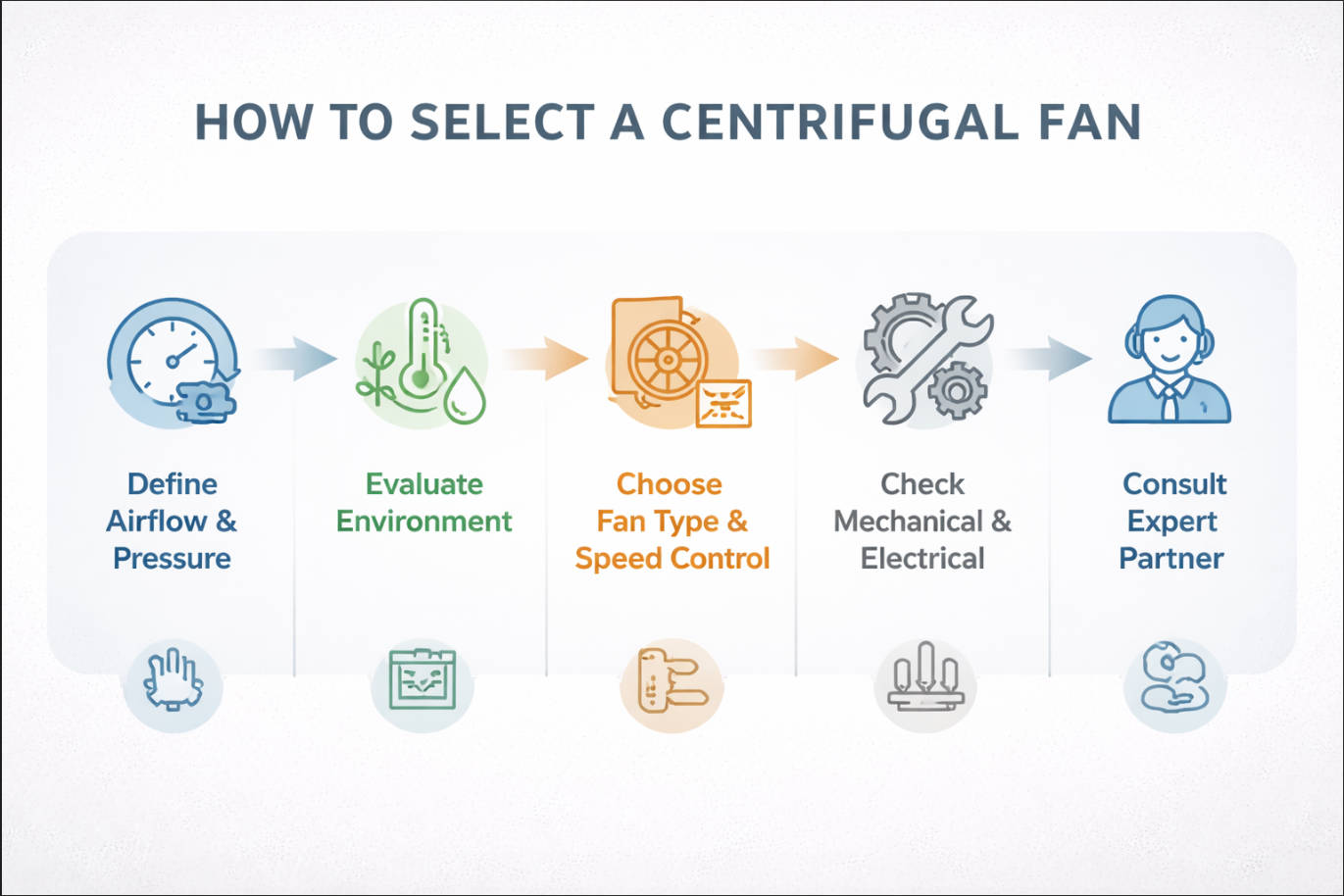
- Calculate or estimate the required airflow in m³/h or CFM under real operating conditions.
- Determine system pressure losses, including filters, ducts, bends, grills, and radiators or heat exchangers.
- Always size the fan for the worst credible condition (e.g., clogged filters, high ambient temperatures). [indexbox]
- Temperature range (continuous and peak)
- Dust, humidity, or corrosive gases
- Indoor vs outdoor mounting, exposure to water or oil mist
- Compliance needs (e.g., explosion-proof, IP rating, or specific safety standards) [indexbox]
- Decide whether variable-speed control is required to balance performance, noise, and energy. [quimipol]
- Evaluate sound power levels at expected operating points, not only at free air.
- Consider EC or high-efficiency motor options for long-life systems with high energy costs. [ystechusa]
- Check available space, mounting orientation, and ease of maintenance.
- Align voltage, current, and control requirements with your power architecture (AC, DC, or hybrid). [ystechusa]
- Verify compatibility with filters, radiators, and enclosures already in the design.
As a factory-level supplier and chief agent of SANYO DENKI, our engineering team regularly supports customers through this entire selection process, including simulation, sample testing, and customization for OEM projects. [scribd]
A well-selected fan can still fail prematurely if maintenance is neglected. In many post-failure analyses, we see the same preventable issues: contamination, misalignment, and poor lubrication. [blog-aarcoair]
- Regular inspection
Perform periodic visual checks for dirt buildup, corrosion, loose fasteners, and unusual noise or vibration. [blog-aarcoair]
- Component cleaning
Clean the impeller and housing to prevent dust buildup that can reduce efficiency and unbalance the fan, leading to vibration and bearing overload. [osapiens-cmms]
- Bearings and lubrication
Follow manufacturer recommendations for lubrication type and interval; overheating bearings are a leading cause of unexpected downtime. [osapiens-cmms]
- Belt and alignment checks (where applicable)
Check belt tension and pulleys, and verify motor–impeller alignment to avoid energy loss and premature wear. [blog-aarcoair]
- Operational testing and monitoring
Monitor speed, noise, vibration, and temperature, and consider integrating condition monitoring for critical systems. [quimipol]
Industry best practice is to shift from time-based to condition-based maintenance, using actual operating hours, environmental conditions, and vibration trends to set intervals. For high-availability systems such as telecom or data center cooling, we recommend documented checklists and digital records. [osapiens-cmms]
To illustrate how all of this comes together, consider a telecom outdoor cabinet used for base stations.

- Challenge: High power density electronics, limited enclosure space, and outdoor exposure to dust and temperature extremes.
- Solution: A combination of high-reliability DC fans, a centrifugal blower for filtered ventilation, and radiators or heat exchangers for targeted component cooling. [ystechusa]
- Implementation: Fans are selected for high MTBF, wide operating temperature, and stable performance with filters, then integrated with smart control algorithms that vary fan speed based on temperature and system load. [ystechusa]
This type of solution is where factory-level engineering support and access to premium brands such as SANYO DENKI make a measurable difference in uptime and lifecycle cost. [sanyodenki-cn]
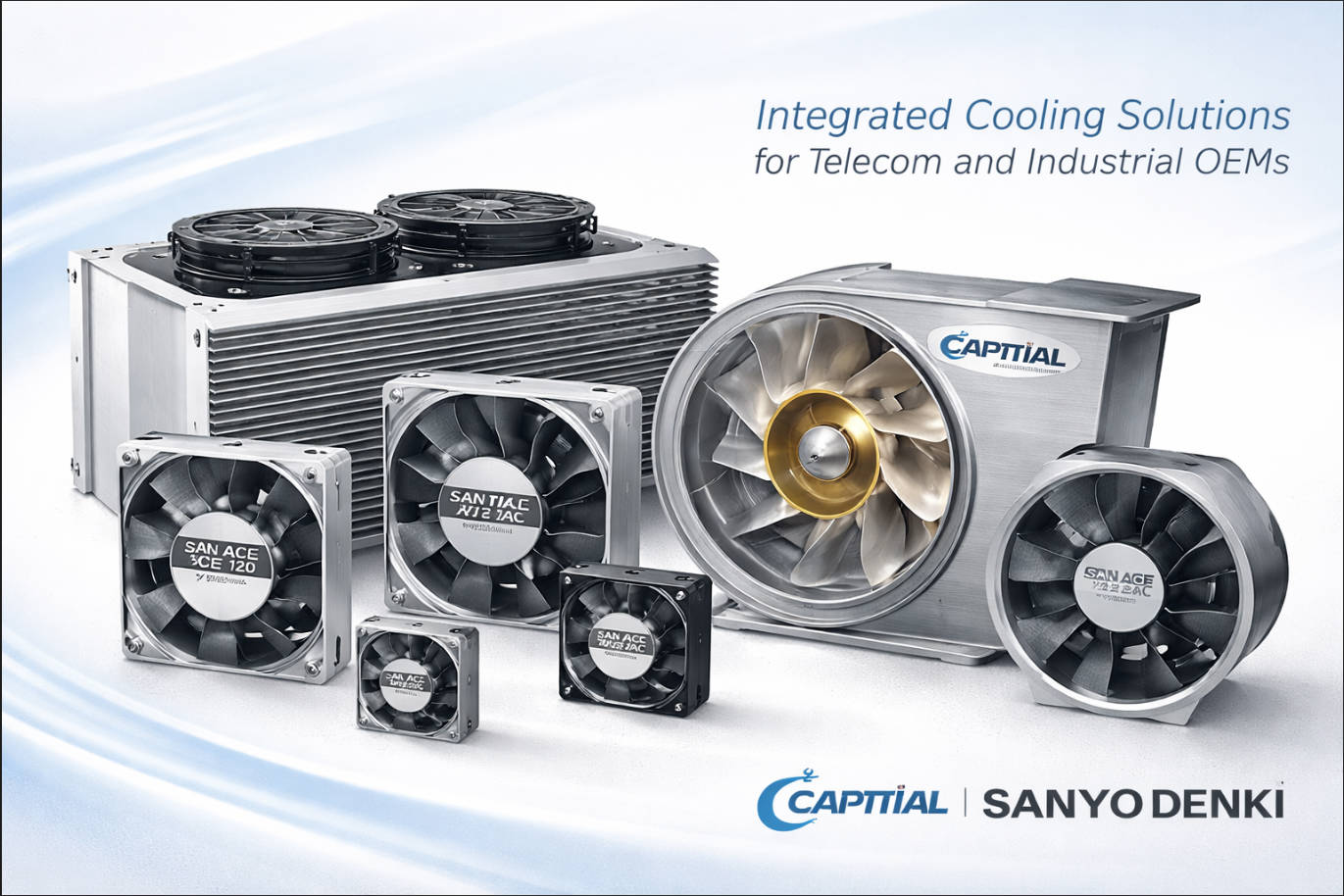
Capital Technology Co., Limited is both a cooling fan manufacturer with its own CAPITAL brand and the chief agent of SANYO DENKI, a long-established leader in the cooling fan industry. [scribd]
From an end-user's perspective, this brings several advantages:
- Direct factory support for DC fans, AC fans, centrifugal fans, radiators, and related components
- Access to high-quality Japanese engineering from SANYO DENKI, combined with local application support and customization
- Proven track record supplying major customers such as ZTE, HUAWEI, HYTERA, and GOLD POWER in demanding applications [sanyodenki-cn]
For engineering teams, this means you can treat cooling as a co-designed subsystem rather than an afterthought, reducing risk and improving product reliability.
| Application area | Typical role of centrifugal fan | Key benefits |
|---|---|---|
| HVAC systems | Move air through filters and ducts in AHUs and rooftop units | Stable pressure, good efficiency, supports energy codes linkedin |
| Industrial cooling & exhaust | Remove heat, fumes, and contaminants from equipment and processes | High reliability, precise airflow control, handles harsh environments linkedin |
| Air pollution control | Drive airflow in dust collectors, scrubbers, and filtration systems | Maintains negative pressure, supports regulatory compliance linkedin |
| Everyday appliances | Provide high-velocity, directed airflow | Compact design, efficient for targeted air movement linkedin |
| Telecom & electronics | Cool outdoor cabinets, servers, and power systems | High pressure in compact spaces, compatible with smart controls ystechusa |
If you are designing or upgrading systems that rely on reliable, efficient cooling, you don't need to solve the centrifugal fan selection problem alone. Our engineering team at Capital Technology Co., Limited can help you:
- Evaluate your airflow and pressure needs for DC, AC, and centrifugal fans
- Optimize fan–radiator–filter combinations for efficiency, noise, and lifetime
- Select or customize SANYO DENKI and CAPITAL products for your specific industry and standards
You can share your drawings, requirements, or even failure history, and we will propose a complete cooling solution rather than just a single part.
A centrifugal fan changes the direction of airflow by 90 degrees and generates higher pressure, making it suitable for ducts, filters, and high-resistance systems, while axial fans move air straight through and are best for free-air or low-resistance applications. [linkedin]
You should select a backward-curved centrifugal fan when you need higher efficiency, stable performance across varying flow conditions, and good compatibility with variable-speed control, such as in modern HVAC or industrial cabinet applications. [indexbox]
Maintenance intervals depend on environment and operating hours, but best practice includes regular visual inspections, periodic cleaning of impeller and housing, routine bearing checks and lubrication, and scheduled verification of vibration and noise. [blog-aarcoair]
Yes, with proper material selection, coatings, and sealing, centrifugal fans can handle corrosive, dusty, or humid air streams, and they are widely used in industrial, HVAC, and air pollution control systems under such conditions. [quimipol]
A factory-level partner provides integrated solutions—including DC and AC fans, centrifugal fans, and radiators—backed by engineering support, access to premium brands such as SANYO DENKI, and proven experience with demanding customers in telecom, industrial, and power electronics sectors. [scribd]
1. Capital Technology Co., Limited – Company Profile. https://www.en.szcpt.com/intro/1.html [ystechusa]
2. "What Is a Centrifugal Fan: Functions and Uses Explained – ACDCFAN." https://www.acdcecfan.com/what-is-a-centrifugal-fan/ [linkedin]
3. "2026 market trends reveal future of fans, blowers, and EC motors in thermal cooling." [YS Tech USA.]
4. "Centrifugal Cooling Fans Market: Next-Phase Digital Smart…" LinkedIn article, 2026-04-01. [LinkedIn]
5. "Centrifugal Fans Market Global Analysis and Growth Forecast to 2035." [IndexBox.]
6. "Preventive Maintenance of Centrifugal Fans: Tips and Best Practice." , 2024-07-29. [Quimipol]
7. "Centrifugal Fan Maintenance Checklist." osapiens HUB, 2025-12-31. [osapiens HUB]
8. "15 Best Practices for Centrifugal Fan Maintenance." Aarco Air, 2024-05-13. [Aarco Air]
9. "Top China Centrifugal Fans for Global Buyers in 2026?" Blog, 2026-04-01. [Blog]
10. "About Us – Capital Tech / SANYO DENKI agent." [agent]
11. "Sanyo Denki Company Profile." Scribd. [Scribd]