From idea to market-ready product, our NPI solutions make every stage easier, faster. Discover How We Help
Help Center

Views: 279 Author: Capital Technology Publish Time: 2026-07-31 Origin: Site
Content Menu
● What Durability Really Means in Fan Selection
● Centrifugal Fan vs Axial Fan Overview
>> Key Differences at a Glance
● Pressure Resistance and Service Life
● Dust, Heat, and Contamination
● Energy Efficiency and Operating Cost
● Expert View From Industrial Applications
● Real-World Selection Scenarios
● Practical Buyer Recommendation
● FAQs
>> 1. Is a centrifugal fan always more durable than an axial fan?
>> 2. Which fan is better for dusty environments?
>> 3. Which fan uses less energy?
>> 4. Should I choose DC or AC first?
>> 5. Can fan durability be improved by maintenance?
>> 6. Which is better for telecom cabinets?
Choosing between a centrifugal fan and an axial fan is not only a question of airflow. It is also a question of durability, system resistance, maintenance, operating environment, and long-term reliability. In industrial cooling, telecom cabinets, power electronics, and manufacturing equipment, the "more durable" fan is often the one that matches the application correctly rather than the one with the highest raw airflow.
As a cooling solution supplier working with DC fan, AC fan, and industrial thermal management products, we see this mistake often: buyers focus on airflow first and durability second. In reality, the fan that survives longer is usually the one that operates in its ideal pressure range, temperature range, and contamination level.
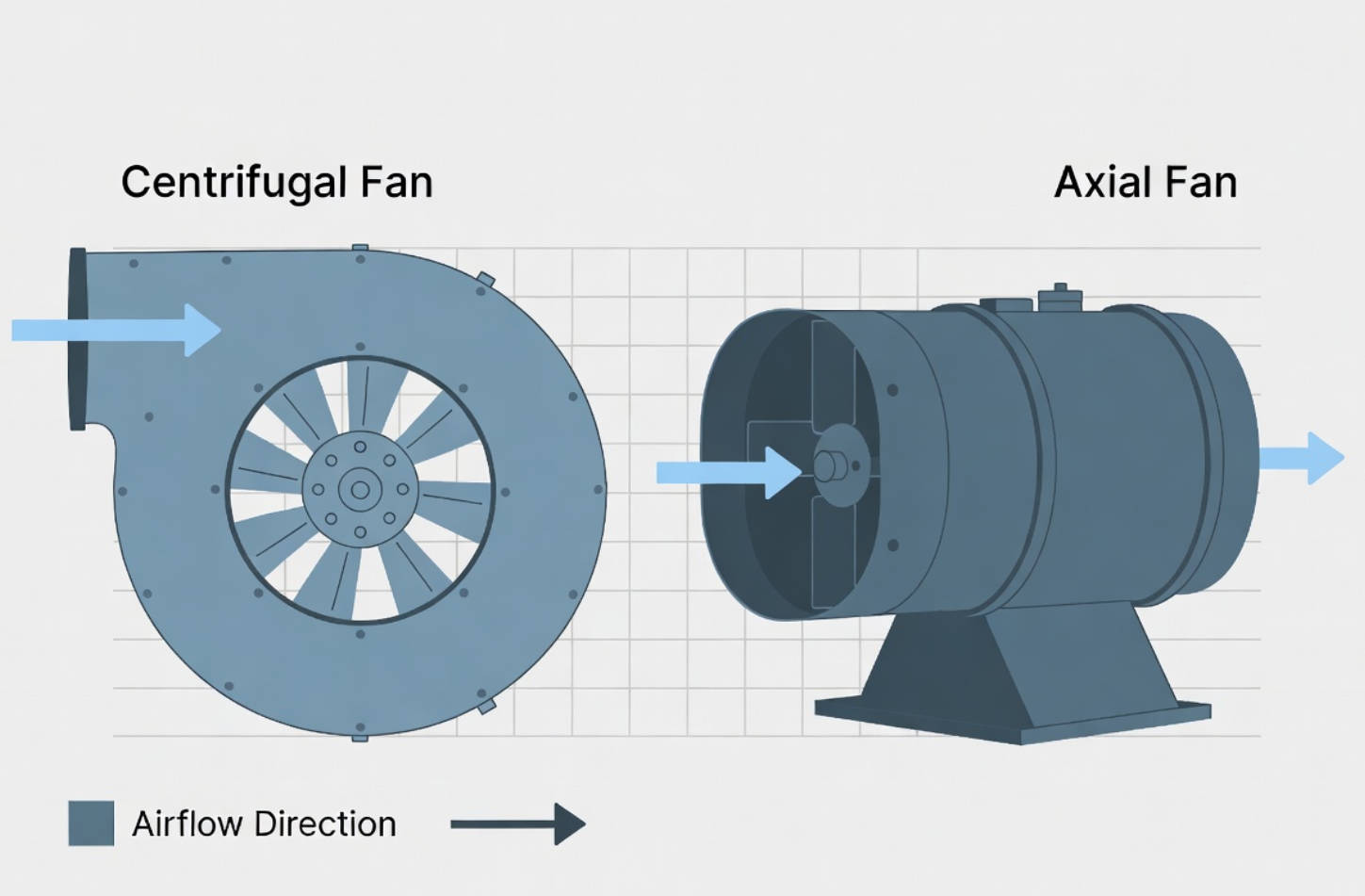
Durability is more than "how long the motor lasts." In practice, it includes bearing life, impeller stability, dust tolerance, vibration resistance, thermal stress, and maintenance frequency. A fan can have a strong motor but still fail early if the system creates excessive backpressure or recirculation.
For industrial buyers, durability usually depends on four factors:
- Mechanical load, including bearing stress and vibration.
- Air system resistance, including ducts, filters, heat sinks, and grille restrictions.
- Operating environment, including dust, humidity, heat, and corrosive air.
- Duty cycle, including whether the fan runs continuously or intermittently.
A centrifugal fan moves air inward and then discharges it at a 90-degree angle. This design makes it better at handling higher static pressure and more restrictive airflow paths.
An axial fan moves air straight through the fan in the same direction as the shaft. It is generally the better option for open systems with lower resistance where the airflow path is direct.
| Feature | Centrifugal Fan | Axial Fan |
|---|---|---|
| Airflow direction | Turns 90 degrees | Straight through |
| Static pressure | High | Low to moderate |
| Best environment | Restricted or ducted systems | Open-air systems |
| Durability in harsh conditions | Often stronger in dirty or resistant systems | Strong when resistance is low |
| Maintenance load | Lower risk of overload in restricted systems | May struggle if resistance rises |
| Typical use cases | Cabinets, ducts, blowers, filtration systems | General ventilation, electronics cooling, open enclosures |
In many industrial situations, centrifugal fans are more durable in real-world use because they tolerate pressure resistance better. When an axial fan is forced to work against a clogged filter, long duct, or dense heat sink, it can run inefficiently, draw more stress, and wear faster.
That said, an axial fan can be extremely durable when used in the right environment. In low-resistance, clean, and well-ventilated systems, axial fans often deliver long service life with lower energy use and simpler installation.
So the correct answer is not "centrifugal always wins." The better answer is: the more durable fan is the one matched to system resistance and environmental conditions.
Static pressure is one of the biggest reasons fans fail early. If the system has filters, ducts, narrow passages, or blocked exhaust paths, the fan must work harder to push air through the system. That extra effort can reduce efficiency and accelerate wear.
Centrifugal fans are built for this type of job. Their design makes them more stable under pressure, which is why they are often favored in ventilation equipment, cabinets, and industrial systems with obstacles in the airflow path.
Axial fans are excellent when resistance is low, but they are less forgiving when the system becomes restrictive. In practice, that means an axial fan may be the right choice for durability only when the airflow path remains open and predictable.

Durability also depends on the cleanliness of the air. In dusty, oily, or contaminated environments, fans face higher mechanical and aerodynamic stress. Over time, dust buildup can increase imbalance, vibration, and bearing wear.
Centrifugal fans often perform better in these conditions because they are commonly used in more demanding airflow paths and can be specified with stronger materials or more protective configurations.
Axial fans can also be reliable in industrial settings, but they usually need better environmental control. If a system is exposed to heavy dust or requires filtration, the fan selection should be paired with cleaning access, sealing strategy, and maintenance planning.
Durability is important, but so is total operating cost. Axial fans usually win on simplicity and efficiency in low-resistance systems because they move high airflow with less energy loss.
Centrifugal fans can be more energy-efficient in restricted systems because they are working in their intended pressure range. In other words, a fan that is "more powerful" is not always the fan that uses more energy. The most efficient fan is the one that avoids unnecessary strain.
For buyers managing long equipment lifecycles, the lowest-cost option is often the fan that balances service life, energy use, noise, and maintenance instead of optimizing only one variable.
From a field-selection perspective, we typically recommend thinking in terms of system design, not just fan shape. In telecom equipment, control cabinets, industrial modules, and power systems, airflow is rarely perfectly open. Resistance changes over time as filters age and dust accumulates.
That is why many engineers prefer centrifugal fans for more stable performance in restricted airflow paths, while axial fans remain a strong choice for direct ventilation and compact systems. In our experience supporting industrial cooling projects, durability improves most when the fan is selected with a realistic margin, not at the edge of its capability.
This is also where product sourcing matters. Working with reliable manufacturers and established brands, such as CAPITAL and SANYO DENKI channels, helps reduce risk because the fan specification, quality control, and application matching are more consistent.
Here are practical examples to help readers choose correctly:
1. Choose a centrifugal fan when the system has ducts, filters, long airflow channels, or high static pressure.
2. Choose an axial fan when the enclosure is open, airflow resistance is low, and compact cooling is the priority.
3. Choose a higher-reliability industrial model when uptime matters more than purchase price.
4. Choose a DC fan or AC fan based on the power source, then decide fan geometry after that.
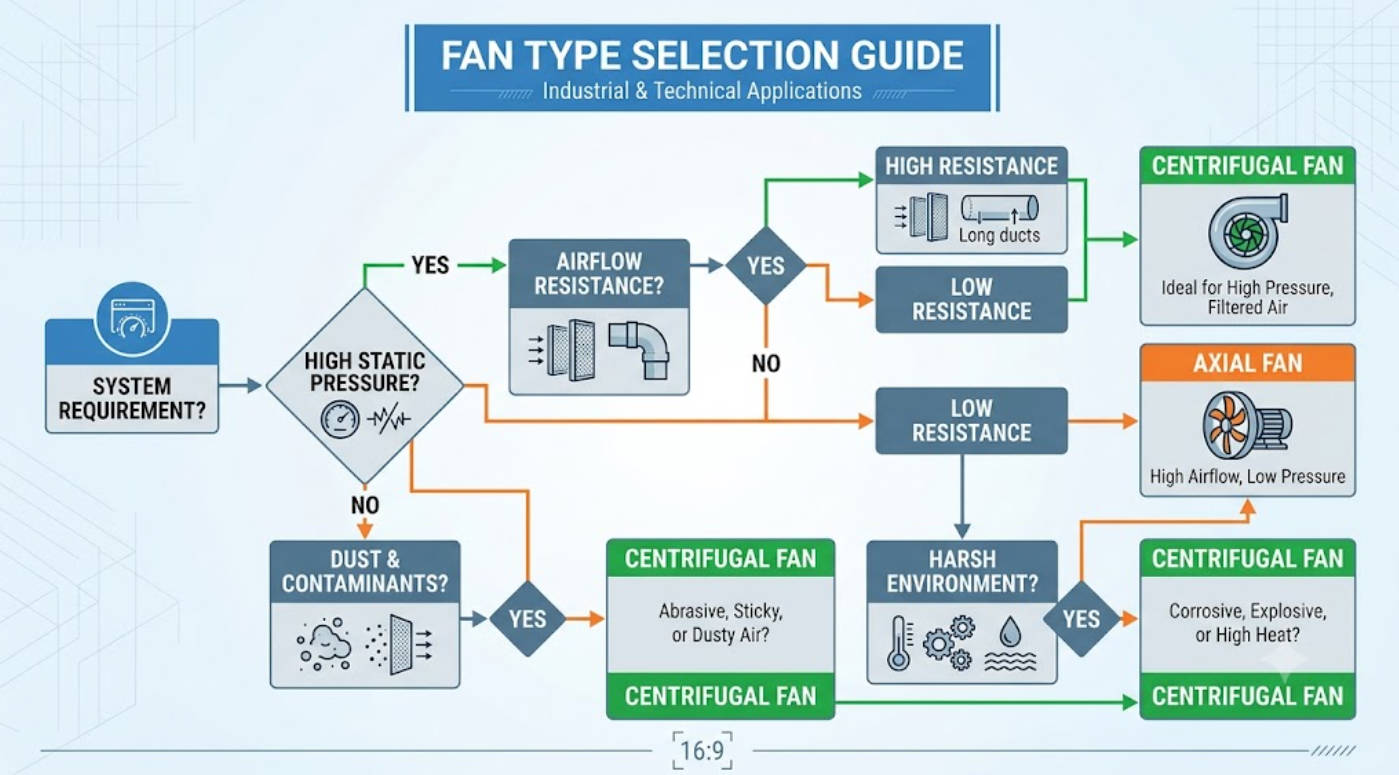
To improve durability in the real world, use this simple process:
1. Define the power source. Is the system DC-powered or AC-powered?
2. Measure airflow resistance. Check for filters, ducts, heat sinks, and cabinet obstructions.
3. Estimate duty cycle. Continuous operation demands more robust bearing and thermal performance.
4. Check the environment. Dust, heat, and moisture all shorten service life if ignored.
5. Review noise and maintenance goals. A quieter system is not always a longer-lasting one, but it often signals better overall integration.
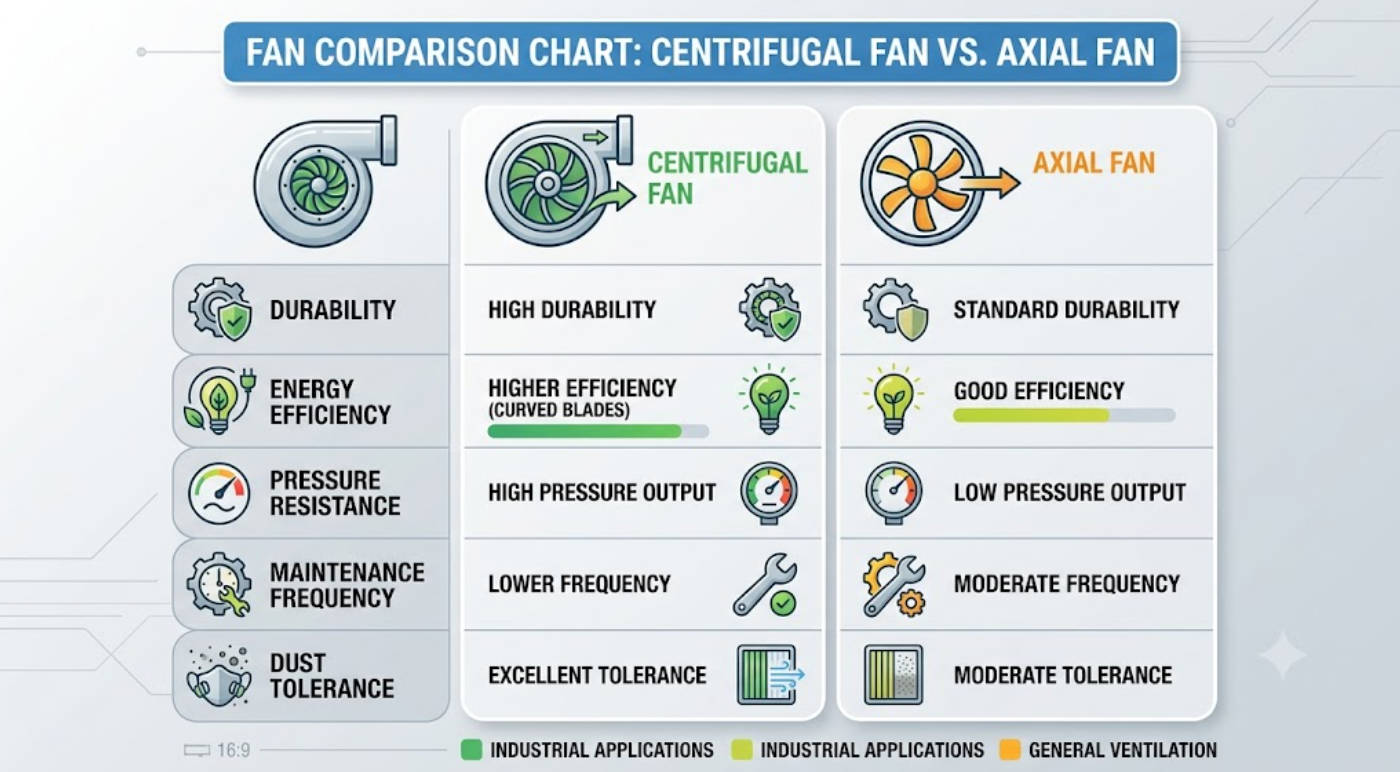
If your system has high resistance, dust, ducts, or unstable airflow, a centrifugal fan is usually the more durable choice. If your system is open, simple, and low resistance, an axial fan can deliver excellent long-term performance with less energy use.
For industrial buyers, the best outcome comes from matching the fan to the system instead of over-specifying the fan itself. That approach reduces failure risk, improves uptime, and makes maintenance more predictable.
If you are designing or sourcing a thermal solution for telecom, industrial control, power electronics, or cabinet cooling, request a fan selection review before final procurement. A properly matched centrifugal or axial fan can extend service life, reduce maintenance, and improve system stability.
No. A centrifugal fan is usually more durable in high-resistance systems, but an axial fan can be just as durable in open, low-resistance applications.
Centrifugal fans are often the safer choice because they handle pressure and restrictive conditions better, especially when filters or ducts are involved.
Axial fans usually use less energy in open systems, while centrifugal fans can be more efficient in restrictive systems because they are operating in their intended range.
Yes. Power source comes first. Then choose the fan geometry based on airflow resistance, noise, and reliability needs.
Yes. Regular cleaning, filter replacement, and airflow inspection can significantly improve service life for both fan types.
It depends on resistance and layout, but centrifugal fans are often preferred when ducts, filters, or concentrated airflow paths create higher static pressure.
1. [Axial Fan vs Centrifugal Fan: Performance Comparison]— source for general airflow and resistance behavior. [jmindustrial]
2. [SANYO DENKI] — company background and related cooling fan information. [en.szcpt]
3. [What's the Difference Between DC Fans & AC Fans?]— source for DC/AC fan selection guidance. [ystechusa]
4. [Centrifugal Fan vs Axial Fan: How to Choose]— source for pressure range guidance. [proventofan]
5. [Sanyo Denki, San Ace, Cooling Fan Supplier]— source for CAPITAL and SANYO DENKI positioning. [sanyodenki-cn]
6. [DC vs AC vs EC Cooling Fan Selection Guide]— source for selection workflow and RFQ inputs. [sxdool]
7. [Selection Guide for Electronic Cooling Fans]— source for airflow impedance and fan selection principles. [sofasco]
8. [Comparing Centrifugal vs. Axial Fans: Which Is Right for Your OEM ...]— source for comparison structure and industrial applications. [jepcoinc]
9. [SANYO DENKI AMERICA Company Profile]— source for brand credibility and industrial positioning. [automate]
10. [How to Choose the Right Fan for Your Industrial Application]— source for application-based selection factors. [forum.digikey]


