From idea to market-ready product, our NPI solutions make every stage easier, faster. Discover How We Help
Help Center

Views: 284 Author: Capital Technology Publish Time: 2026-07-24 Origin: Site
Content Menu
>> Main Features of Axial Fans
>> Typical Applications of Axial Fans
>> Main Features of Centrifugal Fans
>> Typical Applications of Centrifugal Fans
● Centrifugal Fan vs Axial Fan
● Installation Space and Design Fit
● Industrial and Electronics Use Cases
>> Telecom and Networking Equipment
>> Step 1: Define the Cooling Requirement
>> Step 2: Evaluate System Resistance
>> Step 3: Determine the Required Airflow
>> Step 4: Consider Noise Limits
>> Step 5: Review Space and Mounting Conditions
>> Step 6: Balance Performance and Reliability
● Common Mistakes in Fan Selection
>> Mistake 1: Comparing Airflow Only
>> Mistake 2: Ignoring Static Pressure
>> Mistake 3: Overlooking Noise
>> Mistake 4: Choosing Without System Testing
● Buyer Guidance for OEM Projects
● Application-Based Recommendation
● FAQ
>> 1. Which is better: centrifugal fan or axial fan?
>> 2. Are centrifugal fans louder than axial fans?
>> 3. Which fan uses less power?
>> 4. Where are axial fans commonly used?
>> 5. Where are centrifugal fans commonly used?
>> 6. Can both fan types be used in electronics cooling?
When engineers compare centrifugal fan vs axial fan, the decision is rarely about which one is absolutely better. The real question is which fan type can deliver the most reliable cooling performance under the actual conditions of the system.
In industrial manufacturing, telecom equipment, power electronics, and enclosure cooling, fan selection can directly affect temperature stability, product life, acoustic performance, and maintenance cost. A fan that looks strong on paper may perform poorly once it faces duct resistance, filters, bends, or tightly packed components.
As a manufacturer and supplier focused on cooling solutions, Capital Technology Co., Limited understands that thermal design is not only about moving air. It is about matching the right airflow pattern to the right operating environment, with enough margin for reliability, noise control, and long-term stability.

An axial fan moves air in a direction parallel to the fan shaft. In simple terms, air enters one side of the fan and exits the other side in a straight line.
This structure makes axial fans especially suitable for applications that require large airflow volume with relatively low resistance. They are widely used in ventilation systems, cabinet cooling, electronics cooling, and equipment that needs broad air movement rather than concentrated pressure.
- High airflow in open or low-resistance environments.
- Compact and simple construction.
- Lower power demand in suitable conditions.
- Generally quieter than many centrifugal fans.
- Easy to integrate into many types of enclosures.
- Telecom cabinets.
- Network equipment.
- General electronic cooling.
- HVAC intake and exhaust.
- Industrial control boxes.
- Ventilation systems with straight airflow paths.
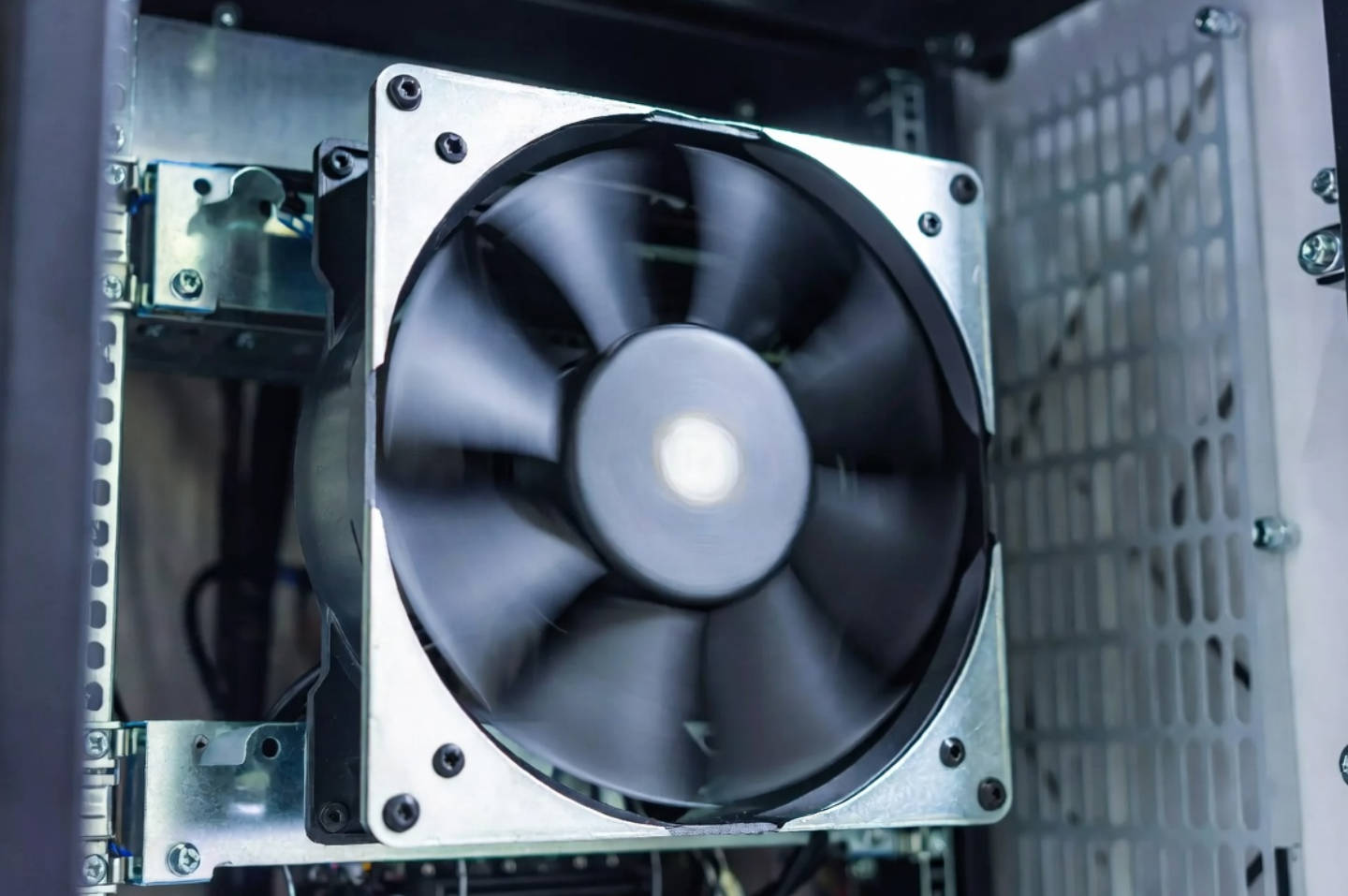
A centrifugal fan draws air in along the axis and discharges it at a right angle. This design creates stronger pressure and makes the airflow more suitable for systems with resistance.
Centrifugal fans are often called blowers or radial fans. They are commonly used where air must travel through ducts, filters, narrow channels, or restricted enclosures. When the system needs pressure rather than just volume, the centrifugal design becomes the stronger choice.
- Strong static pressure capability.
- Better performance in restricted airflow paths.
- Suitable for ducted or directed cooling.
- Often more effective in compact, enclosed systems.
- Can maintain airflow better against resistance.
- Ducted ventilation systems.
- Filtered air systems.
- Industrial machinery.
- Power electronics.
- Localized cooling for hot components.
- HVAC blowers and air-handling units.
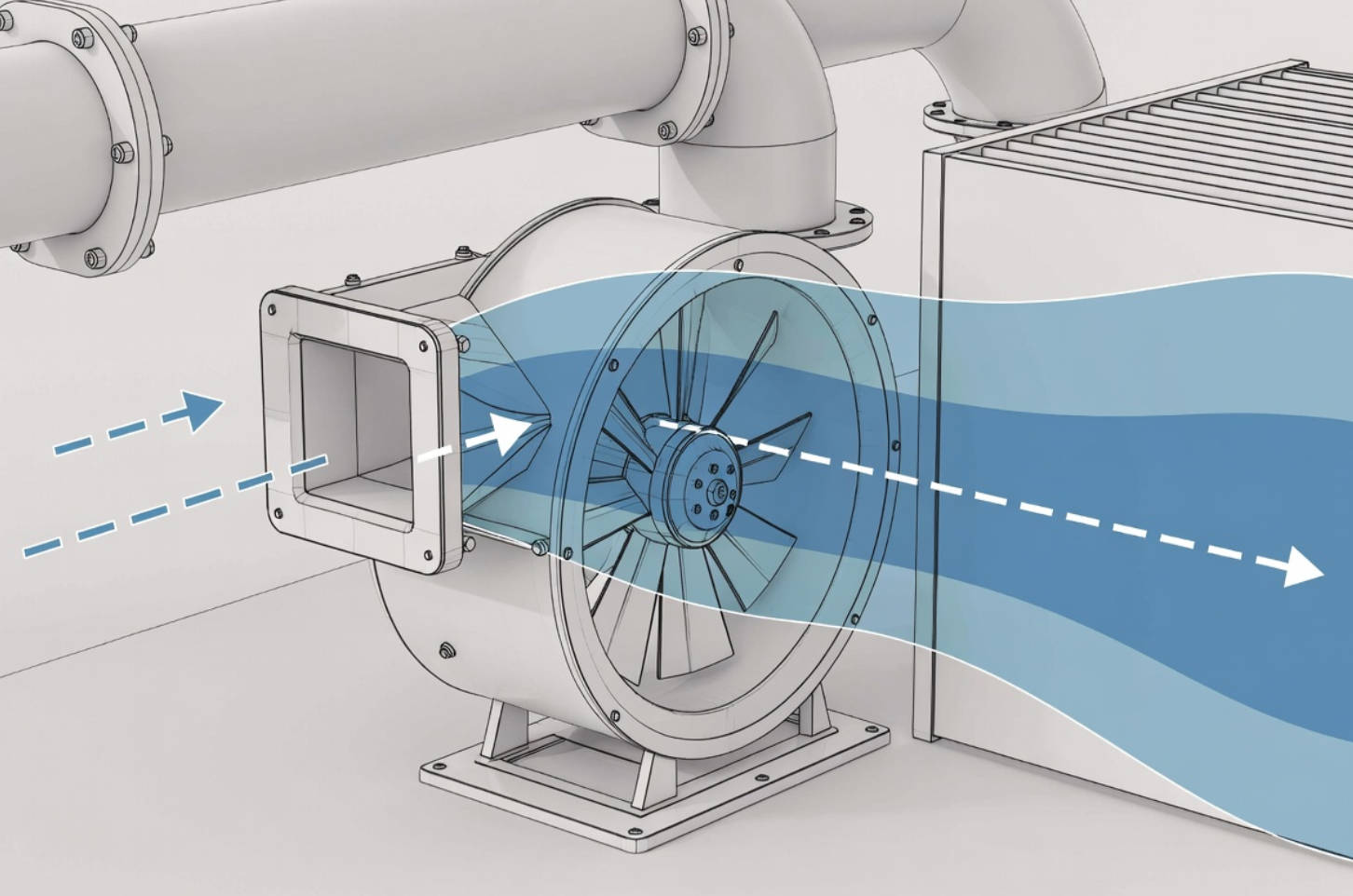
The difference between these two fan types becomes much clearer when they are compared by performance factors rather than by name alone.
| Factor | Axial Fan | Centrifugal Fan |
|---|---|---|
| Airflow direction | Parallel to shaft | Perpendicular to shaft |
| Best use | High airflow, low resistance | High pressure, restricted airflow |
| Noise | Usually lower | Often higher in demanding systems |
| Power use | Lower in open flow paths | Can be higher under resistance |
| Space fit | Compact depth | More housing space may be needed |
| Duct compatibility | Less suitable | More suitable |
| Cooling style | Broad airflow | Targeted airflow |
| Common use | General ventilation, electronics cooling | Ducted cooling, industrial blowers |
In practical terms, axial fans are usually the better fit when the airflow path is open and resistance is low. Centrifugal fans are usually better when the air must push through obstacles, bends, filters, or tight internal layouts.
The most important difference between the two fan types is the relationship between airflow and pressure.
Axial fans are designed to move a large volume of air efficiently when the resistance is limited. Their performance drops more noticeably when the system becomes restrictive. That is why they work best in open or lightly obstructed environments.
Centrifugal fans are designed to overcome resistance. They may not always deliver the same open-air airflow as an axial fan, but they can maintain stronger performance when static pressure increases. This makes them ideal for systems where airflow must travel through a complex path.
If the application is open and simple, airflow matters most. If the application is tight, layered, or ducted, pressure becomes the deciding factor.
Noise is a major consideration in many cooling projects. In offices, telecom systems, commercial equipment, and some industrial environments, fan noise can influence both product acceptance and user comfort.
Axial fans usually have an acoustic advantage when used in low-pressure applications. Their direct airflow path often results in smoother operation and lower perceived noise.
Centrifugal fans can be quieter in some high-pressure systems than expected, but they may become louder when forced to work against heavy resistance. The final noise level depends on fan size, speed, blade design, system resistance, and installation quality.
For noise-sensitive products, the best approach is to evaluate the full system instead of the fan alone.
Energy efficiency depends on how the fan is used. A fan that performs efficiently in one environment may waste energy in another.
Axial fans are usually more efficient in low-resistance applications because they can move air with less effort. This makes them a strong choice for ventilation and broad cooling tasks.
Centrifugal fans may consume more power in some cases, but they can still be the more efficient solution when the system has higher resistance. If a fan must constantly fight against filters, bends, or narrow air paths, the wrong design can waste more energy than it saves.
In other words, efficiency should be measured in the full operating environment, not by airflow alone.
Physical space is often overlooked during fan selection, yet it has a major impact on performance.
Axial fans are usually easier to install in shallow spaces and compact enclosures. Their simple geometry allows them to fit well in many standard product designs.
Centrifugal fans often need a different kind of housing because the air exits at an angle. This can require more careful mechanical planning, but it also gives the designer more flexibility in directing airflow where it is needed most.
If the product has limited depth but broad ventilation needs, an axial fan may be the better fit. If the product needs controlled airflow routing, a centrifugal fan often works better.
Fan selection varies greatly depending on the industry and operating environment. Below are some of the most common real-world use cases.
Telecom systems often run continuously and generate significant internal heat. Many cabinets need broad ventilation, which makes axial fans a practical choice. However, when airflow must pass through a dense internal layout or restricted exhaust path, centrifugal fans can provide better pressure support.
Industrial control boxes often operate in warm, dusty, or vibration-heavy environments. Centrifugal fans are frequently used when airflow must be pushed through filters, ducts, or narrow channels. Axial fans can still be useful for general cabinet ventilation where resistance is low.
Power electronics often create concentrated hot spots near components such as modules, drivers, or converters. In these cases, the airflow must be more targeted and stable. Centrifugal fans are often preferred when the design requires focused pressure delivery.
HVAC systems often rely on both fan types depending on the design stage. Axial fans are common where high airflow and open ventilation are needed. Centrifugal fans are widely used in blowers and air-handling units that must move air through ductwork and filters.
A proper fan selection process should start with the thermal requirements of the system, not with the fan catalog.
Identify the amount of heat that must be removed and the acceptable operating temperature range.
Check whether the air path is open, filtered, ducted, bent, or blocked by internal components.
Estimate how much air movement is needed to keep the system within safe temperature limits.
Decide whether the product must remain quiet for office, telecom, or customer-facing use.
Make sure the fan type fits the enclosure depth, orientation, and mechanical layout.
Choose the option that best supports long-term stability rather than just the lowest initial cost.
This process helps reduce redesign risk and improves cooling consistency across the product lifecycle.
Many cooling problems happen not because the fan is weak, but because it was chosen using incomplete information.
Airflow alone does not tell the full story. A fan with high free-air airflow may underperform badly once resistance is added.
If the system has filters, bends, or dense components, pressure matters as much as airflow.
A fan that cools well but creates too much noise can still be a poor choice in real use.
Prototype testing is essential. The best fan is the one that performs well inside the real product, not just on a datasheet.
For OEM and export-focused projects, fan selection should also consider supply stability, product consistency, and technical support.
- Performance curves.
- Noise data.
- Voltage and speed options.
- Environmental limits.
- Reliability or life-test information.
- Sample validation before mass production.
A low-cost fan that fails in testing can create delays, warranty risk, and extra engineering work. A more suitable fan may cost slightly more at the start but reduce total project risk and improve customer satisfaction over time.
If the system needs broad airflow, low resistance, and lower noise, an axial fan is usually the better fit. If the system needs higher pressure, directed airflow, and better performance in restricted paths, a centrifugal fan is usually the stronger choice.
This is why experienced engineers do not choose by fan type alone. They choose based on the actual thermal environment, airflow path, and product goals.
The difference between a centrifugal fan and an axial fan is not only mechanical. It is also functional, because each design serves a different kind of cooling challenge.
Axial fans are best when the design needs high airflow in a more open environment. Centrifugal fans are best when the design must overcome resistance and deliver stronger pressure. The right choice depends on the full system, not a single specification.
For industrial buyers, equipment designers, and OEM teams, the most reliable result comes from matching the fan to the real application conditions from the beginning.
For stable cooling performance, start with the airflow path, pressure requirement, and installation limits before selecting the fan. A well-matched solution protects product performance, reduces redesign risk, and supports long-term reliability.
Neither is always better. Axial fans are better for open airflow and lower resistance, while centrifugal fans are better for higher pressure and restricted airflow.
In many applications, yes. Centrifugal fans can be louder when they must work against higher resistance.
Axial fans usually use less power in low-resistance environments. Centrifugal fans may become more efficient in systems where resistance is high and pressure is needed.
Axial fans are often used in general ventilation, cabinet cooling, telecom equipment, and electronics with open airflow paths.
Centrifugal fans are often used in ducted systems, industrial equipment, filtered airflow systems, and applications that need strong static pressure.
Yes. The best choice depends on enclosure layout, heat concentration, airflow resistance, and noise requirements.
1. Same Sky, “Axial Fans vs. Centrifugal Fans – What’s the Difference?” https://www.sameskydevices.com/blog/axial-fans-vs-centrifugal-fans-what-is-the-difference
2. RS Online, “The Difference Between Centrifugal Fans and Axial Fans?” https://uk.rs-online.com/web/content/discovery/ideas-and-advice/difference-between-centrifugal-fans-axial-fans
3. ebm-papst, “Centrifugal fan” https://www.ebmpapst.com/de/en/newsroom/fanwiki/centrifugal-fan.html
4. ebm-papst, “Axial Fans - Basic principles” https://www.ebmpapst.dk/wp-content/uploads/2018/04/Technology-basics-Axial-Fans.pdf
5. Aerovent, “Fan Performance Characteristics of Centrifugal Fans” https://www.aerovent.com/wp-content/uploads/sites/2/2021/12/Fan-Performance-Characteristics-of-Centrifugal-Fans-FE-2400.pdf
6. Orion Fans, “Axial Fans vs Centrifugal Fans” https://orionfans.com/axial-fans-vs-centrifugal-fans/
7. Longwell, “Industrial Blower Fan - Latest Technology Trends” https://www.longwellfans.com/industrial-blower-fan-technology-trends-every-manufacturer-should-know/


