From idea to market-ready product, our NPI solutions make every stage easier, faster. Discover How We Help
Help Center

Views: 267 Author: Capital Technology Publish Time: 2026-06-27 Origin: Site
Content Menu
● Understanding Cabinet Cooling Challenges
● Why Fan‑Based Cabinet Cooling Still Dominates
● AC, DC, and EC Fans for Cabinet Cooling
>> AC Fans: Robust Workhorses for Harsh Environments
>> DC Fans: Precision Cooling for Electronics
>> EC Fans: Energy‑Efficient, Intelligent Airflow
● Environmental and Compliance Considerations
● Sizing Cabinet Cooling Systems by Cabinet Class
>> Small Cabinets: Network and Small PLC Control Cabinets
>> Medium Cabinets: Industrial Control and Communication Base Stations
>> Large Cabinets: High‑Power Inverter and Data Center Cabinets
● Practical Design Steps for Cabinet Cooling
● Case‑Style Insights: From Telecom Cabinets to Industrial Inverters
● Partnering With Capital Technology and ACDCFAN
● Call to Action: Design Your Next Cabinet Cooling System
● FAQs
>> 1. How do I choose between AC, DC, and EC fans for my cabinet?
>> 2. What is the first step when designing a cabinet cooling system?
>> 3. Why is IP68 sealing important for outdoor cabinet cooling?
>> 4. How can PWM speed control improve cabinet cooling?
>> 5. When should I involve a cooling solution supplier in my project?
As someone who has spent years working with telecom, industrial, and data center clients on cabinet cooling design, I've seen one pattern repeat: most cabinet failures start with heat, not hardware. When temperature control is treated as an afterthought, even premium PLCs, inverters, and servers will underperform or fail prematurely. This guide walks through cabinet cooling systems from a practitioner's perspective and introduces how CAPTIAL Technology and ACDCFAN solutions help engineers design robust, long‑life cooling architectures. [jasonpittock]
Cabinet cooling is not just about installing a fan—it is about maintaining a stable thermal environment in a constrained, often dusty and noisy enclosure. Across telecommunications and industrial machinery, research indicates that 60–80% of cabinets rely on fan‑based air circulation to stay within safe operating temperature. [jasonpittock]
In practice, engineers must handle several concurrent challenges:
- Overheating risk leading to equipment failure or shortened lifespan. [jasonpittock]
- Operation in dusty, humid, or corrosive environments that quickly degrade standard fans. [jasonpittock]
- Noise constraints in offices, base stations, and control rooms. [jasonpittock]
- Cabinets squeezed into confined spaces, where standard airflow patterns do not work. [jasonpittock]
From field experience, the most successful cooling strategies start with a simple rule: treat the cabinet as a system, not a box with a fan. You qualify the environment, define heat load, select AC/DC/EC fans, and design airflow paths before ordering hardware. [guides.libraries.psu]

Despite advances in liquid cooling and heat exchangers, air‑based cabinet cooling using AC, DC, or EC fans remains the default in industrial and telecom contexts. The reason is a balance of cost, reliability, and serviceability. [jasonpittock]
Key advantages of fan‑based cabinet cooling:
- High reliability over tens of thousands of hours of operation when properly specified. [jasonpittock]
- Flexible configurations for small network cabinets, medium control cabinets, and large inverter or data center enclosures. [jasonpittock]
- Ease of maintenance, as fans and filters can be replaced without redesigning the cabinet.
- Cost‑effective scalability, from a single AC fan to complex EC fan arrays.
In my work with industrial OEMs, we often start with AC axial fans for simple retrofit projects, then move to EC and DC fans with PWM control when energy efficiency and noise become strategic KPIs. [tiecas]
Selecting between AC, DC, and EC fans is one of the most important engineering decisions in any cabinet cooling project. [jasonpittock]
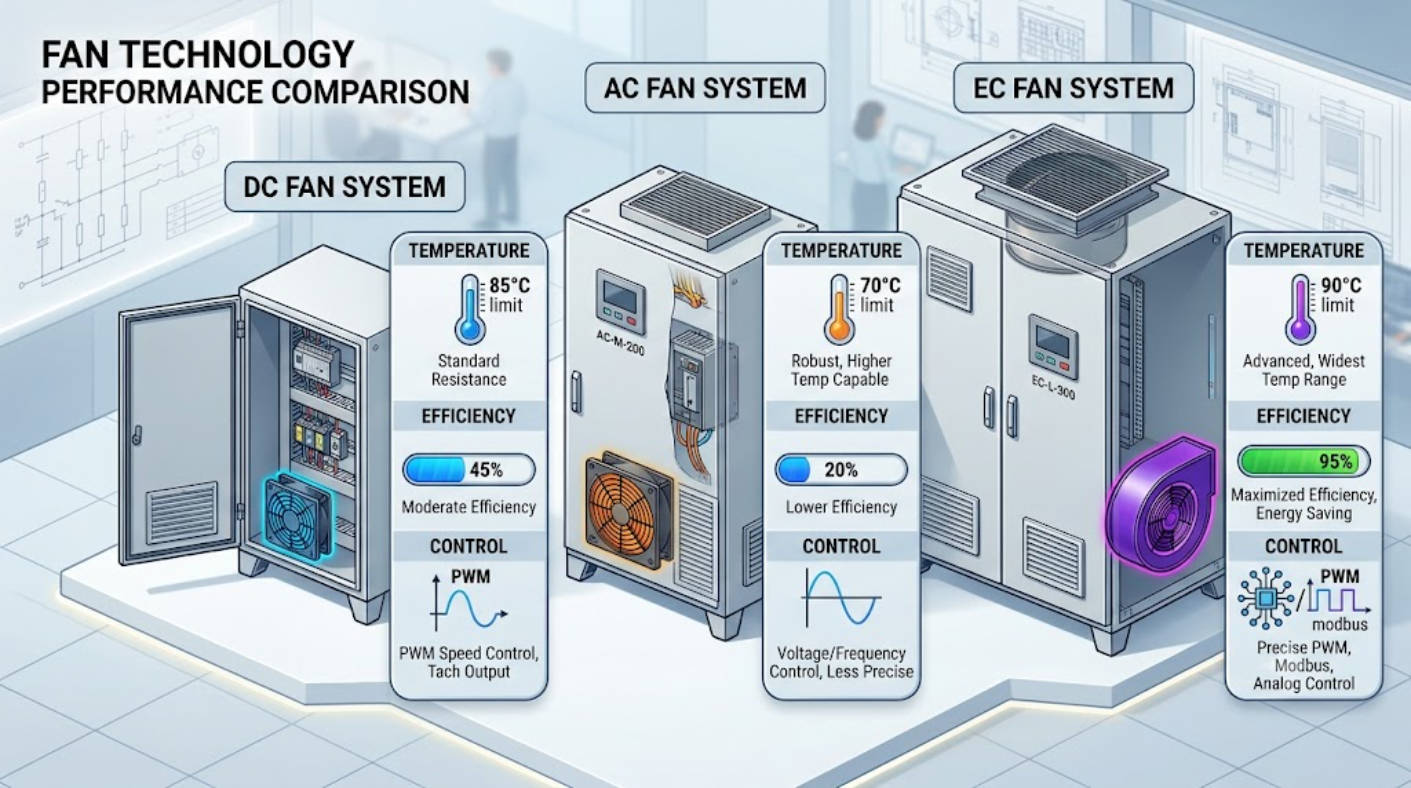
ACDCFAN fully‑metal AC fans are engineered to operate at temperatures up to 150°C, making them ideal for PLC control cabinets, inverter cabinets, and other extreme environments. Frames typically use ADC‑12 aluminum alloy with 3–5% copper reinforcement, while blades are BT plastic rated UL 94V‑0, providing around 30% higher mechanical stability than standard designs. [jasonpittock]
Practical use cases:
- High‑temperature control cabinets near furnaces or compressors.
- Retrofit projects where AC mains power and minimal control wiring are available.
DC fans are common in electronics‑heavy cabinets and offer tight control over speed and airflow. The ACDCFAN portfolio includes small form‑factor DC fans that cover 40 mm to 120 mm classes, with airflow from roughly 6 to 266 CFM depending on size and RPM. [jasonpittock]
Engineers choose DC fans when:
- They need low‑voltage operation (5, 12, 24, 48 V).
- Cabinets contain sensitive PCBs, RF modules, or logic controllers.
- Integration with monitoring systems is important.
EC (Electronically Commutated) fans combine AC input with DC motor efficiency and control. ACDCFAN EC fans feature IP68‑rated sealing, which blocks dust, moisture, and corrosive particles—a key requirement for outdoor cabinets and telecom base stations. [jasonpittock]
Advantages in practice:
- PWM speed control for energy‑optimized airflow and lower noise. [jasonpittock]
- Improved efficiency, especially in variable load environments where heat generation changes over time. [jasonpittock]
- Better integration with smart control systems and predictive maintenance logic. [mccordweb]
In real projects, cooling choices must align with regulatory and reliability requirements. ACDCFAN cabinet cooling fans integrate several critical compliance features:
- RoHS‑compliant materials, reducing hazardous substance risk in global deployments. [jasonpittock]
- EMC‑certified designs, minimizing electromagnetic interference with PLCs and variable frequency drives (VFDs) inside control cabinets. [jasonpittock]
- IP68 sealing in selected DC and EC fan models for superior resistance to dust and moisture. [jasonpittock]
These attributes matter when you are supplying to telecom operators, industrial OEMs, or public infrastructure projects, where long‑term reliability and regulatory audits are standard. [indusmart]
From a practical engineering perspective, it is easier to think in terms of cabinet classes rather than individual fan models. The original cabinet cooling portfolio from ACDCFAN defines small, medium, and large cabinet solutions. [jasonpittock]
Small network communication cabinets and compact PLC cabinets typically require economic airflow, moderate cooling efficiency, and low noise. [jasonpittock]
Representative configurations include: [jasonpittock]
- 80 × 80 × 38 mm AC fans (110/220 V) at ~28–33 CFM.
- 40 × 40 × 20 mm DC fans (5/12/24 V) at ~6–9 CFM.
- 60 × 60 × 25 or 60 × 60 × 38 mm DC fans at higher RPM ranges and airflow up to ~76 CFM.
Mid‑sized cabinet exhaust fans are optimized for larger control cabinets and communication base stations, maintaining stable temperatures in higher heat settings. [jasonpittock]
Typical options: [jasonpittock]
- 92 × 92 × 38 mm DC fans with airflow from ~82 to 164 CFM.
- 120 × 120 × 25 mm AC fans at ~59–67 CFM.
- 120 × 120 × 38 mm DC fans with airflow up to ~266 CFM.
- 80 × 80 mm AC fans for dense rack layouts.
For high‑power inverter cabinets, data center racks, or large control panels, high‑capacity fans are required. [jasonpittock]
ACDCFAN provides: [jasonpittock]
- 280 × 280 × 80 mm AC fans with airflow in the 1050–1100 CFM range.
- 180 × 180 × 60 mm DC fans with 315–525 CFM airflow.
- Ø220 × 60 mm AC and DC/EC fans with up to ~720 CFM airflow.
These large‑scale solutions are known for dependable long‑term cooling performance and strong airflow capacity, especially when combined with well‑designed intake and exhaust channels. [jasonpittock]
| Cabinet type | Typical fan size | Voltage range | Airflow range (approx.) | Best for |
|---|---|---|---|---|
| Small network / small PLC | 40–80 mm | 5–24 VDC, 110–240 VAC | 6–38 CFM jasonpittock | Network cabinets, small controllers jasonpittock |
| Medium industrial / base station | 80–120 mm | 12–48 VDC, 110–380 VAC | 59–266 CFM jasonpittock | Control cabinets, base stations jasonpittock |
| Large inverter / data center | 172–280 mm, Ø220 mm | 12–48 VDC, 110–380 VAC | 315–1100 CFM jasonpittock | Inverter, data center, large panels jasonpittock |
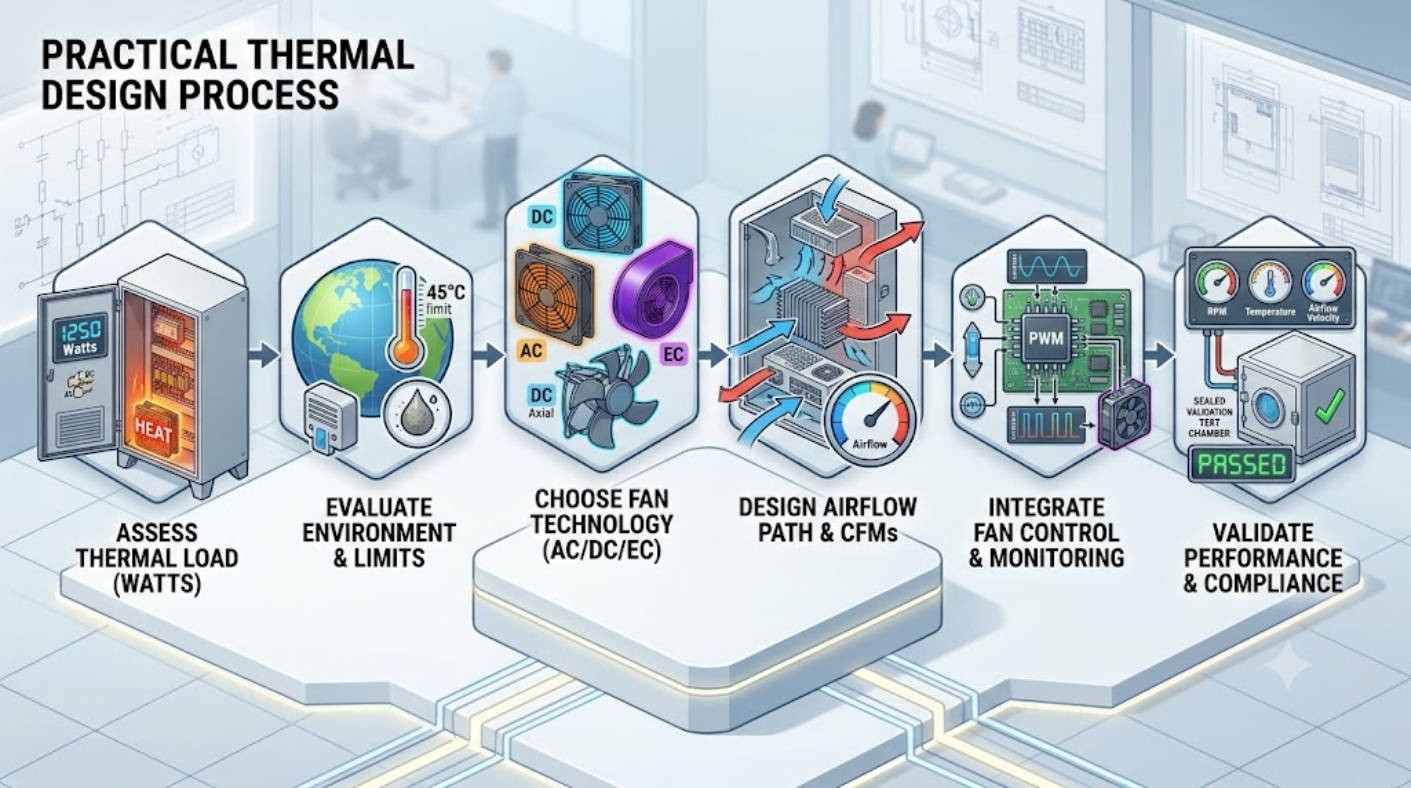
Over multiple B2B projects, a repeatable, user‑centric design process has emerged. Engineers who follow a structured approach reduce failure rates and optimize energy usage. [developers.google]
1. Define the thermal load.
Estimate or measure the total power consumption of equipment and convert it to expected heat output.
2. Assess the environment.
Check ambient temperature, dust exposure, humidity, corrosive gases, and noise constraints.
3. Choose fan technology (AC, DC, EC).
- Use AC fans for extreme heat and simple mains‑powered cabinets. [jasonpittock]
- Use DC fans for electronics‑dense, low‑voltage cabinets.
- Use EC fans where energy efficiency and advanced control are priorities. [jasonpittock]
4. Calculate required airflow.
Use cabinet volume and temperature rise targets to calculate minimum CFM; then choose fan models that exceed that baseline with safety margin. [guides.libraries.psu]
5. Plan airflow paths.
Design intake, exhaust, and internal flow to avoid hotspots. Use fan trays, baffles, and filters where necessary.
6. Integrate control and protection.
Add PWM control, temperature sensors, and alarm triggers for critical cabinets. [jasonpittock]
7. Validate and iterate.
Perform thermal testing under load, adjust fan speed and positions, and document the configuration.
In my experience, step 2 (environment assessment) is the most commonly skipped stage—and it is also where most field problems originate.
While confidentiality prevents naming all client scenarios, the patterns across cabinet cooling projects are consistent.
- Telecom network cabinets often start with small AC or DC fans and later upgrade to IP68‑sealed EC fans when outdoor deployment introduces dust, moisture, and corrosive particles. [jasonpittock]
- Industrial PLC and inverter cabinets favor fully metal AC fans rated up to 150°C, as ambient temperatures can spike near production lines and power electronics. [jasonpittock]
- Data center cabinets benefit from high‑CFM axial fans combined with well‑designed hot‑aisle/cold‑aisle strategies, turning individual cabinet cooling into part of a broader system. [tiecas]
In all three contexts, a partner manufacturer that can supply AC, DC, and EC fans from a single portfolio accelerates design and deployment, because engineers can mix and match models without changing vendor ecosystems. [jasonpittock]
CAPITAL Technology Co., Limited and ACDCFAN position themselves as source manufacturers and solution partners for DC fans, AC fans, and EC fans used in cabinet cooling systems. While ACDCFAN specializes in AC/DC/EC axial and radial fans, CAPTIAL brings additional value as the independent CAPTIAL brand owner and chief agent for SANYO DENKI (SANYO DENKI) fans, supplying to major enterprises such as ZTE, HUAWEI, and HYTERA. [tiecas]
For buyers and engineers, this combination provides:
- Access to multi‑brand fan portfolios, from ACDCFAN's metal AC fans to leading‑edge SANYO DENKI solutions. [jasonpittock]
- A single point of contact for cabinet cooling integration, including model selection and customization.
- Strong B2B credibility, backed by long‑term relationships with top telecom and industrial clients. [eeatchecker]
If you are currently evaluating server cabinet cooling systems, CAPTIAL can also guide you to dedicated server rack cooling solutions beyond standard control cabinets. [jasonpittock]
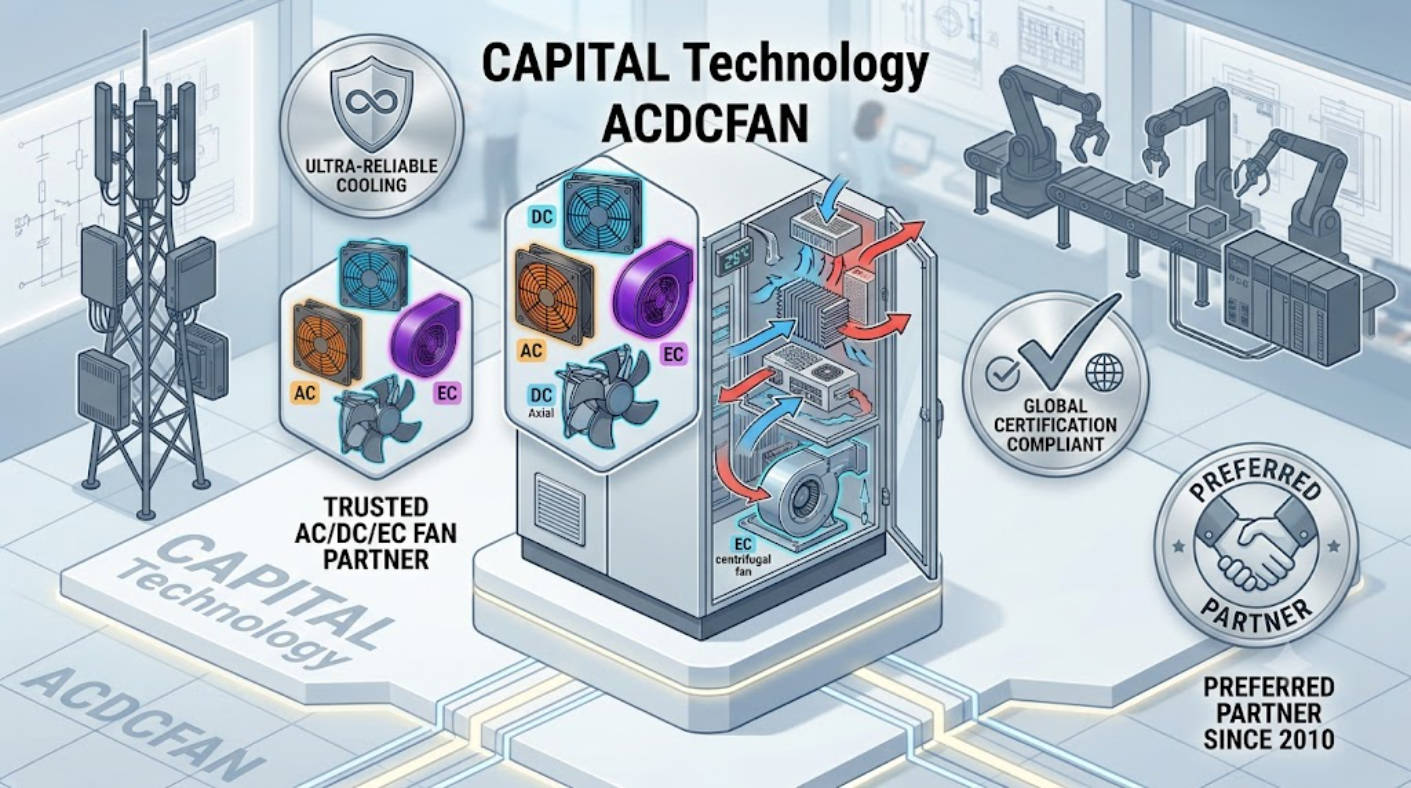
If your team is planning a new telecom, industrial, or data center cabinet deployment, now is the ideal time to audit your cooling strategy before hardware installation. By engaging with CAPTIAL Technology and ACDCFAN early, you can: [developers.google]
- Define a cabinet cooling architecture that matches real‑world thermal loads and environmental constraints.
- Select AC, DC, and EC fans that meet your reliability, efficiency, and compliance targets.
- Reduce long‑term maintenance costs and unplanned downtime.
Contact us to discuss your specific cabinet cooling challenges, share your operating environment, and request tailored AC/DC/EC fan recommendations for your next project. [jasonpittock]
AC fans are ideal for high‑temperature, mains‑powered environments where robustness is critical. DC fans suit low‑voltage, electronics‑dense cabinets, while EC fans offer energy‑efficient, controllable airflow with IP68 options for harsh outdoor deployments. [jasonpittock]
Start by quantifying your thermal load based on equipment power consumption, then assess ambient conditions such as temperature, dust, and humidity. This ensures that airflow calculations and fan selections are grounded in reality. [guides.libraries.psu]
IP68 sealing protects fans against dust ingress and prolonged moisture exposure, extending service life in outdoor telecom base stations and industrial enclosures. Without adequate sealing, fans can fail prematurely and jeopardize cabinet uptime. [jasonpittock]
PWM control allows you to modulate fan speed based on temperature or load, reducing energy consumption and noise while maintaining adequate airflow when needed. This is especially useful in dynamic environments such as data centers or variable‑load inverter cabinets. [jasonpittock]
Ideally, involve suppliers like CAPTIAL Technology and ACDCFAN during the early design stage, before cabinet layouts are finalized. Early collaboration enables optimal fan selection, airflow planning, and long‑term reliability optimization. [tiecas]
1. ACDCFAN – *Cabinet Cooling System* (AC, DC, EC fan portfolio, technical data, and application notes). [https://www.acdcecfan.com/cabinet-cooling/] [jasonpittock]
2. Google Search Central – *Creating Helpful, Reliable, People‑First Content*. [https://developers.google.com/search/docs/fundamentals/creating-helpful-content] [developers.google]
3. Penn State University Libraries – *Ten Tips for Technical Writing – Industrial and Manufacturing*. [https://guides.libraries.psu.edu/c.php?g=370389&p=8995924] [guides.libraries.psu]
4. MFG Tribe – *Using Industry Knowledge to Write Engaging Technical Content* (YouTube masterclass). [https://www.youtube.com/watch?v=eR6szNLY3Pc] [youtube]
5. Tiecas – *Creating Industrial Content that Resonates with Engineers and Industrial Professionals*. [https://www.tiecas.com/creating-industrial-content/] [tiecas]
6. Indusmart Digital – *E‑E‑A‑T for Technical Authors in the Industrial Sector*. [https://indusmart.digital/en/blog/eeat-technical-authors/] [indusmart]
7. EEATChecker – *How to Improve E‑E‑A‑T for SEO: A Practical Guide*. [https://eeatchecker.ai/how-to-improve-eeat/] [eeatchecker]


