From idea to market-ready product, our NPI solutions make every stage easier, faster. Discover How We Help
Help Center

Views: 283 Author: Capital Technology Publish Time: 2026-08-19 Origin: Site
Content Menu
● Why Cabinet Fan Selection Matters
● DC Fan vs. AC Fan for Cabinets
● How to Calculate Cabinet Fan Airflow
● Static Pressure: The Most Overlooked Fan Parameter
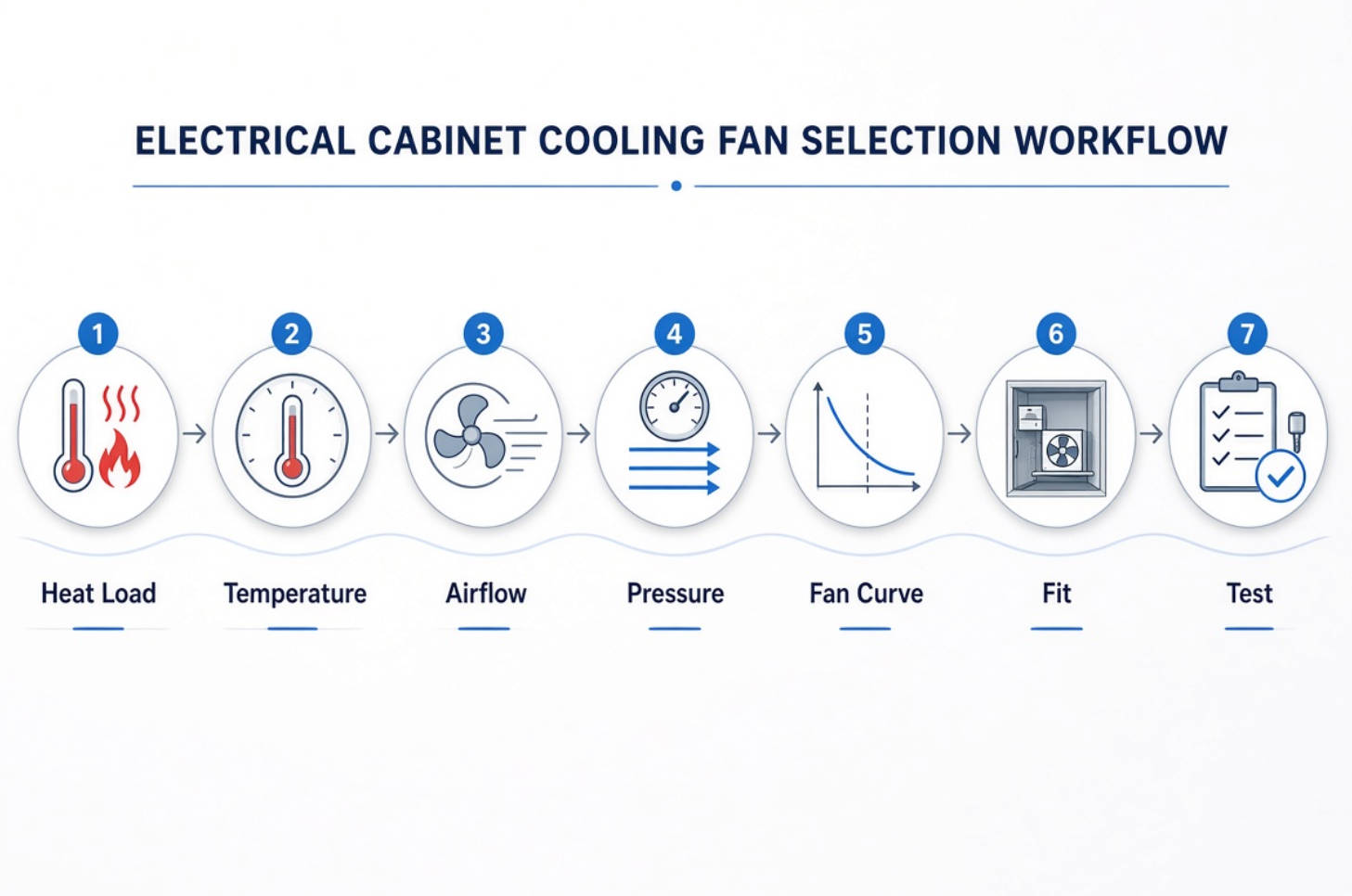
● A 7-Step Cabinet Fan Selection Process
>> 2. Define ambient and target temperatures
>> 3. Estimate required airflow
>> 4. Assess cabinet resistance
>> 6. Confirm electrical and mechanical fit
>> 7. Validate in the real cabinet
● Cabinet Airflow Layout Best Practices
● Reliability, Environment, and Maintenance
● Why Work With CAPITAL Technology
● FAQ
>> 1. What is the best cabinet fan for an electrical enclosure?
>> 2. How do I know whether I need an AC fan or DC fan?
>> 3. Why is my cabinet still overheating after installing a high-CFM fan?
>> 4. Should I use an intake fan, an exhaust fan, or both?
>> 5. How often should cabinet fan filters be replaced?
>> 6. Is a higher static-pressure fan always better?
>> 7. What information should I send to a cabinet fan supplier?
Choosing the best cabinet fan is not simply a matter of selecting the model with the highest airflow rating. For electrical enclosures, telecom cabinets, control panels, power systems, and industrial automation equipment, a cooling fan must deliver sufficient airflow at the actual resistance level of the cabinet. It must also match the available power supply, installation space, operating environment, acoustic requirements, and expected service life.
At CAPITAL Technology Co., Limited, we work with customers that need dependable thermal-management solutions for demanding electronic and industrial equipment. As a manufacturer of DC fans and AC fans under the CAPITAL brand, and as a principal distributor of SANYO DENKI products, we understand a critical fact that is often missed during fan selection: a fan's free-air CFM value is not its real operating airflow inside a cabinet.
The right cabinet cooling fan protects sensitive components, supports stable operation, reduces heat-related failure risk, and helps equipment maintain consistent performance over long operating cycles. This guide explains how engineers, panel builders, OEMs, and purchasing teams can select the right fan with greater confidence.
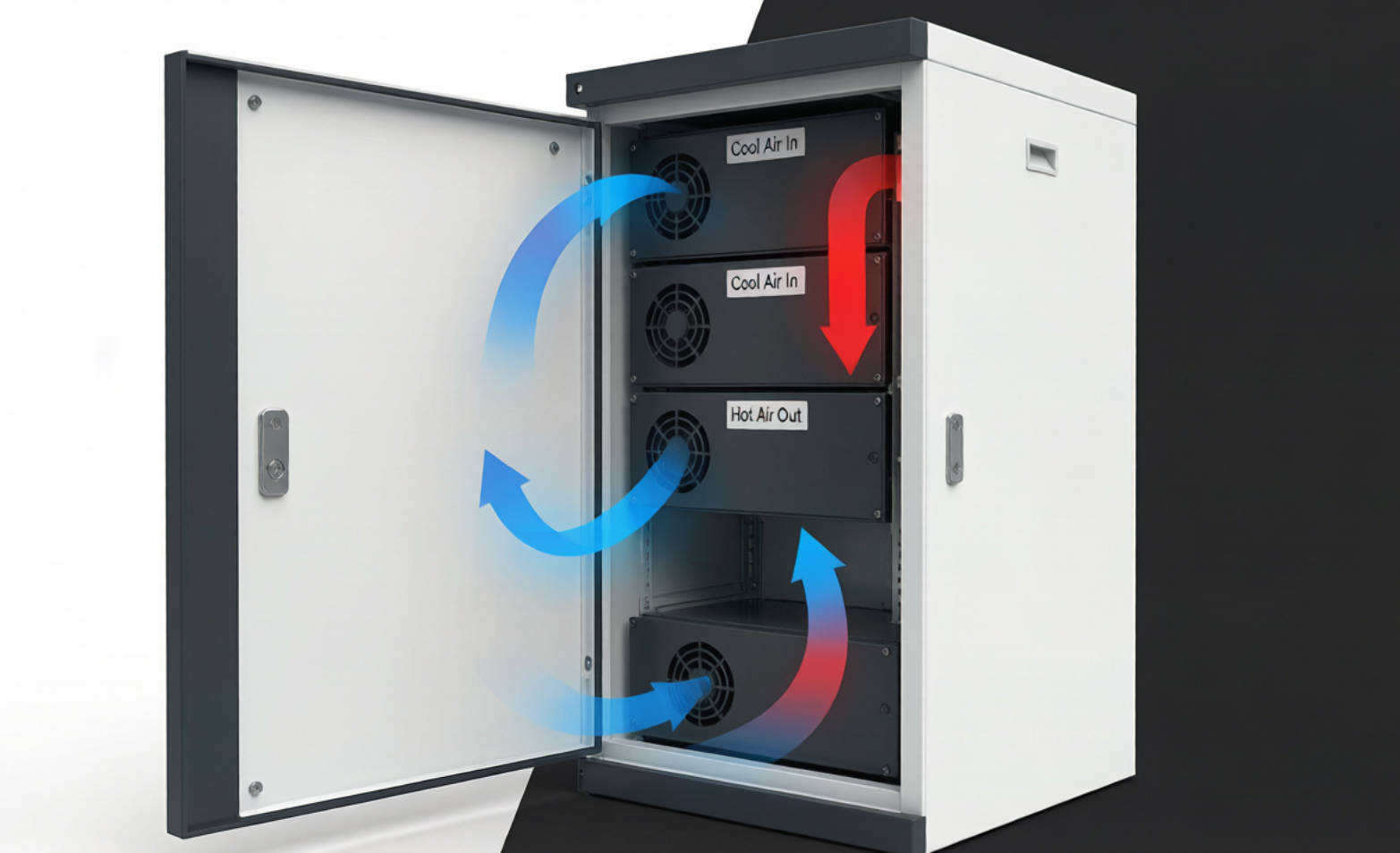
A cabinet fan, also called an enclosure cooling fan, panel cooling fan, or electrical cabinet fan, moves air through an enclosure to remove heat generated by internal components. Typical heat sources include power supplies, PLCs, drives, transformers, communication modules, inverters, switches, servers, and battery-management equipment.
Most cabinet cooling systems use axial fans because they are compact, economical, and easy to mount. Depending on the application, the fan may operate as:
- An intake fan that brings cooler ambient air into the cabinet
- An exhaust fan that removes hot air from the top of the enclosure
- A push-pull system using both intake and exhaust fans
- A redundant cooling system for critical equipment
- A filtered fan assembly for dusty industrial environments
The goal is not merely to move air. The goal is to create a controlled airflow path that carries heat away from high-temperature components before heat accumulates in the enclosure.
Heat is one of the most persistent threats to electronic equipment reliability. When a cabinet is poorly ventilated, internal temperatures can rise quickly, especially in compact enclosures with high component density, clogged filters, or high ambient temperatures.
A correctly selected cooling fan helps organizations:
- Maintain safer internal operating temperatures
- Improve equipment stability during continuous operation
- Reduce hot spots around power electronics and communication devices
- Support longer component service life
- Minimize downtime and maintenance disruption
- Improve thermal consistency across densely populated cabinets
However, choosing a fan based only on frame size or maximum airflow can produce disappointing results. A 120 mm fan with a high published CFM rating may deliver much less airflow after it is installed behind a filter, grille, heat sink, cable bundle, or restrictive cabinet vent.
The key is to evaluate airflow and static pressure together. Fan-selection guidance from Eaton and DigiKey emphasizes that airflow resistance, expressed as system impedance or static pressure, must be considered alongside the airflow target.
Both DC cooling fans and AC cooling fans can be effective. The better option depends on the power architecture, runtime, control requirements, environmental conditions, and total cost of ownership.
| Selection factor | DC cabinet fan | AC cabinet fan |
|---|---|---|
| Typical power input | 5 V, 12 V, 24 V, 48 V DC | 110 V, 115 V, 220 V, 230 V AC |
| Speed control | Usually supports PWM, voltage, tachometer, or alarm options | Often fixed-speed, though variable-speed solutions exist |
| System integration | Suitable for telecom, networking, battery, and electronic equipment | Suitable where mains AC power is readily available |
| Monitoring capability | Easier to integrate with alarms and control systems | Depends on fan model and external monitoring design |
| Efficiency potential | Often preferred for intelligent, adjustable fan systems | Common in traditional control cabinets and industrial systems |
| Selection priority | Control, monitoring, low-voltage compatibility | Simplicity, direct AC connection, legacy installations |
A DC fan is often the better choice when a system needs speed control, tachometer feedback, locked-rotor alarms, PWM control, or compatibility with 24 VDC and 48 VDC power systems. It is widely used in telecom equipment, network cabinets, communications infrastructure, battery systems, and compact electronic assemblies.
An AC fan remains a practical option for industrial control cabinets and equipment that already uses AC mains power. Its straightforward wiring and familiar installation method make it suitable for many automation, machinery, and electrical-distribution applications.
Do not select AC or DC solely by price. Start with the equipment's available power supply and the operational requirements of the complete cooling system.

The first step in selecting an electrical cabinet fan is estimating the heat load inside the enclosure. Heat load is normally measured in watts and represents the electrical energy converted into heat by internal devices.
For a practical early-stage estimate, required airflow can be approximated as:
Where:
- Heat Load is the total heat dissipated inside the cabinet
- ΔT is the allowable temperature rise above ambient temperature
For example, assume an industrial enclosure produces 300 W of heat and the permitted internal temperature rise is 10°C:
Airflow≈(3.1×300)/10=93 m³/h
This calculation is a starting point, not a final specification. It assumes that air can move through the enclosure effectively. Real cabinets contain filters, grilles, wiring, heat sinks, partitions, and other restrictions that reduce delivered airflow.
Therefore, engineers should add a reasonable design margin and then verify the selected fan against its airflow-versus-static-pressure curve. Published fan curves show what airflow a fan can actually deliver as system resistance rises.
Static pressure describes a fan's ability to overcome airflow resistance. It becomes especially important when the cabinet contains:
- Fan filters or filter mats
- Narrow intake and exhaust openings
- Protective finger guards or dense grilles
- Long or indirect airflow paths
- High-density PCBs and heat sinks
- Cable congestion
- Dust accumulation over time
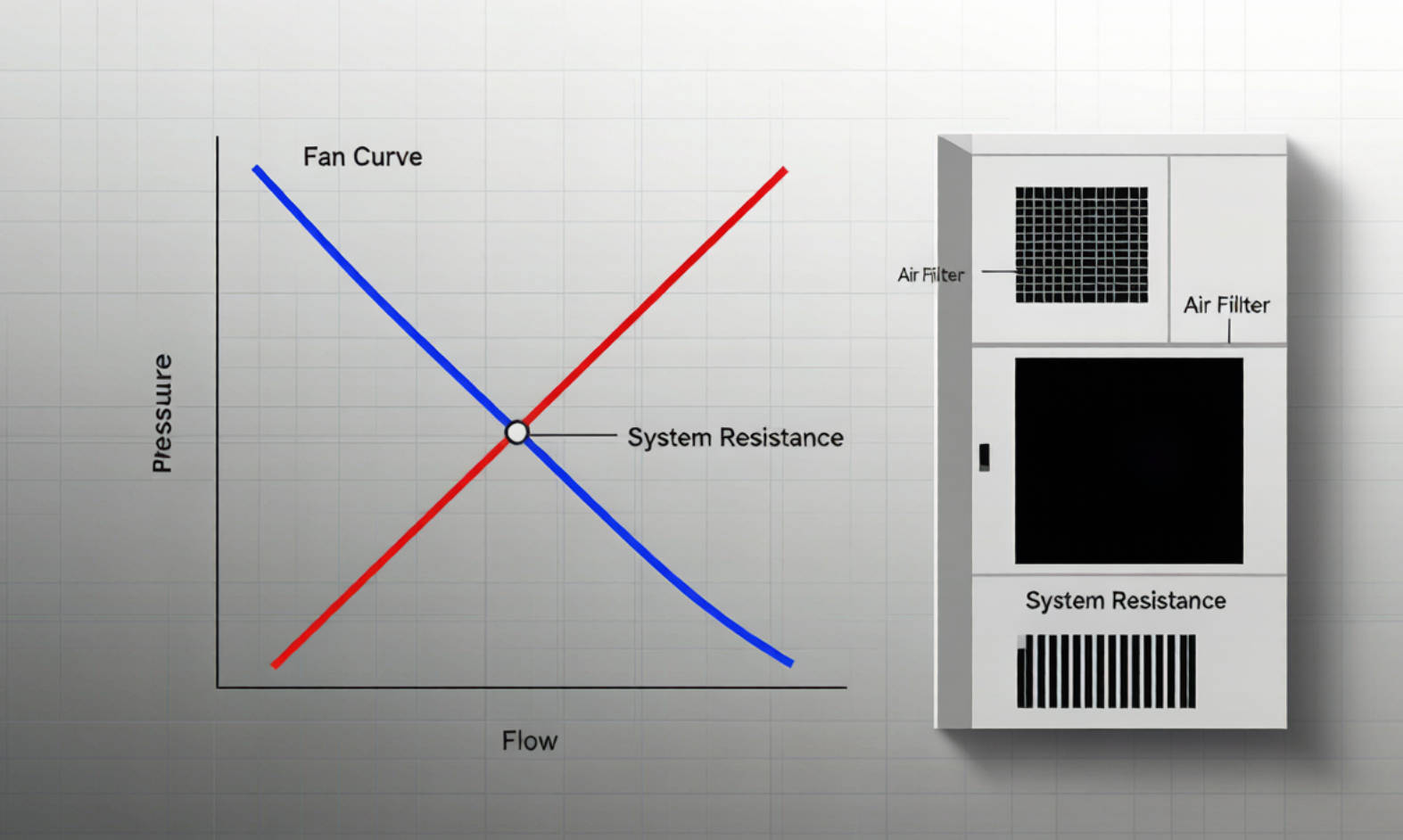
A high-airflow fan may perform well in open air but lose much of its capacity in a restricted enclosure. In contrast, a high-static-pressure fan can maintain useful airflow through filters and dense internal layouts.
The correct method is to compare the cabinet's system-resistance curve with the fan's P-Q curve. The point where those curves intersect is the expected operating point. This is the airflow the fan will deliver in the real system—not the maximum airflow printed in a catalogue.
For low-resistance cabinets, airflow may be the dominant requirement. For filtered, compact, or high-density cabinets, static pressure can be equally important or more important than maximum CFM.
List all major heat-generating components, including drives, power supplies, transformers, processors, communication modules, and converters. Use manufacturer loss data where possible instead of assuming that every device dissipates its full rated input power.
Identify the highest expected ambient temperature around the cabinet. Then define the maximum acceptable internal temperature based on the most temperature-sensitive component, not the average temperature of the enclosure.
Use the heat-load calculation to establish an initial airflow target. Add an engineering margin where environmental conditions, airflow resistance, or future loading are uncertain.
Check every feature that can restrict air movement: intake filters, grilles, louvers, cable routing, internal partitions, dense assemblies, and exhaust vents. A cabinet with a filter is not an open-air application.
Review the fan's P-Q curve at the expected static pressure. Confirm that the fan provides the required airflow at the actual operating point, rather than relying on its free-air airflow rating.
Verify voltage, current, power consumption, fan size, mounting-hole pattern, wire length, connector type, rotation direction, and airflow direction. Confirm whether the application requires 2-wire, 3-wire, or 4-wire fan connections.
Prototype testing is essential for important applications. Measure internal temperatures, inspect for hot spots, evaluate noise, and confirm that filters remain maintainable. If possible, test at high ambient temperature and under full equipment load.
Fan selection and cabinet layout must work together. Even a high-quality fan cannot compensate for a poor airflow path.
Use these practical layout principles:
- Install intake openings near the bottom or lower side of the cabinet where incoming air is cooler.
- Position exhaust fans near the top, because hot air naturally rises.
- Keep intake and exhaust paths separated to reduce air recirculation.
- Direct airflow across high-heat components instead of allowing it to bypass them.
- Avoid blocking vents with cable bundles, documents, or components.
- Use filtered intake air when dust or industrial contamination is a concern.
- Plan filter replacement access before finalizing the enclosure design.
- Consider redundant fans and alarm signals for mission-critical systems.
A common failure mode is short-circuit airflow: cool air enters and exits near the same location without travelling through the hot areas of the cabinet. Thermal imaging or multi-point temperature measurement can reveal this problem during prototype validation.
The best cabinet fan is not necessarily the fan with the highest specification on paper. It is the fan that performs reliably in the customer's actual conditions.
Before approving a fan, evaluate:
- Continuous operating hours per year
- Ambient temperature range
- Humidity and condensation exposure
- Dust, oil mist, corrosive gases, and particulate contamination
- Vibration and shock
- Noise limits for the installation environment
- Required IP protection level
- Bearing construction and expected service life
- Alarm, tachometer, PWM, or speed-control requirements
- Availability of replacement parts and technical support
For demanding applications, ask suppliers for the complete datasheet, P-Q curve, operating-temperature range, acoustic data, life-expectancy conditions, wiring diagram, dimensional drawing, and quality documentation. A quoted lifetime should always be interpreted together with the test conditions, including temperature, voltage, humidity, and survival-rate criteria.
SANYO DENKI documentation, for example, provides application-specific performance and long-life information for selected San Ace fan series. One published long-life DC fan document states a maximum static pressure of 1,260 Pa and maximum airflow of 3.42 m³/min for the referenced model family; these values should never be generalized to all fan models.
CAPITAL Technology Co., Limited provides thermal-management solutions for customers seeking DC fans, AC fans, and application-oriented cooling support. Our own CAPITAL brand gives customers access to source-manufacturer capabilities, while our role as a principal SANYO DENKI distributor helps us support projects requiring recognized high-performance cooling products.
We understand that every cabinet is different. A telecom cabinet may need controlled DC airflow and alarm feedback. An industrial control panel may need a robust AC fan with filter protection. A high-density power or communication system may require careful airflow-path design, high static pressure, redundancy, and thermal validation.
Our team can help you evaluate:
- AC fan and DC fan options
- Required airflow and pressure conditions
- Fan dimensions and installation compatibility
- Voltage and connector requirements
- Noise, reliability, and maintenance priorities
- CAPITAL and SANYO DENKI product matching
- Prototype testing and long-term supply considerations
Need help selecting the right cabinet cooling fan? Send us your cabinet dimensions, internal heat load, ambient temperature, allowable temperature rise, supply voltage, airflow restrictions, and target quantity. CAPITAL Technology can recommend a practical cooling solution tailored to your equipment.
The best cabinet fan is the one that supplies enough airflow at the cabinet's real static pressure, fits the available voltage and mounting space, and can withstand the operating environment. There is no single best model for every enclosure.
Choose a DC fan when your equipment uses low-voltage DC power or requires speed control, tachometer feedback, alarms, or PWM control. Choose an AC fan when the cabinet has a direct AC power source and needs a simple, dependable cooling solution.
The fan may be operating against more resistance than expected. Dirty filters, small vents, dense grilles, cable congestion, and poor airflow paths can sharply reduce delivered airflow. Review static pressure and verify the fan's operating point on its P-Q curve.
For many cabinets, filtered intake at the lower area and exhaust at the upper area creates an effective airflow path. Higher heat loads, large enclosures, or critical equipment may benefit from both intake and exhaust fans, provided their airflow is balanced and recirculation is avoided.
Filter maintenance depends on dust levels, operating hours, and pressure loss. Inspect filters regularly and replace them when visibly contaminated or when cabinet temperature rises beyond normal operating levels. A clogged filter can significantly reduce airflow.
Not always. High-static-pressure fans are valuable in restrictive systems, but they may create more noise, consume more power, or be unnecessary in an open, low-resistance cabinet. Select according to the actual system resistance and airflow requirement.
Provide the cabinet size, heat load in watts, maximum ambient temperature, permitted temperature rise, available voltage, required fan dimensions, installation orientation, dust or moisture conditions, filter/grille details, noise limits, annual operating hours, and estimated order quantity.
1. Eaton. "[Heat Exchanger Fan Selection]."
Explains how cooling-airflow requirements and system impedance should be evaluated during fan selection.
2. DigiKey. "[Establishing Cooling Requirements: Air Flow vs Pressure]."
Discusses system impedance, static pressure, and the real-world relationship between airflow and resistance.
3. Same Sky Devices. "[Thermal Management Techniques and Choosing a Fan]."
Covers thermal-management fundamentals, airflow estimation, and the importance of matching fan performance to system resistance.
4. LCSC. "[Cooling Fan Selection Guide: Airflow, Static Pressure & More]."
Reviews key cooling-fan selection factors, including airflow, static pressure, frame size, voltage, bearing type, and operating conditions.
5. SANYO DENKI. "[Long Life Fan: San Ace 80L DC Fans Datasheet]."
Provides technical specifications and performance information for a selected long-life San Ace DC fan series.
6. LINKWELL. "[Fan Selection, Layout & Maintenance for Stable Equipment Operation]."
Discusses practical electrical-cabinet cooling considerations, including fan layout, airflow, filtration, maintenance, and reliability.


